
State Back Taxes
Indiana Back Taxes Payment Plan: How to Set One Up With the DOR (2026)
The short answer: an Indiana back taxes payment plan is set up through INTIME, the Indiana Department of Revenue's online portal, and most individual income-tax balances qualify — plan terms scale with what you owe. Set one up before the DOR files a tax warrant, which turns your bill into a public county-court judgment with fees added.
The envelope didn't say IRS — it came from the Indiana Department of Revenue, and the number at the bottom is money you don't have sitting in checking. If you're on a fixed income, a state tax bill feels like it broke the budget for the year. It didn't: Indiana's payment plan system is one of the more straightforward ones in the country, and the whole path fits on this page.
Farther down, the image shows exactly what an Indiana DOR bill looks like and where the tax year, balance, and payment date sit — worth locating on the paper in front of you before you do anything else.
⏱ Your deadline: the payment date printed on your DOR bill or Demand Notice for Payment is the one that controls — Indiana doesn't publish a single statewide day count. What is certain: penalty and interest keep accruing until the balance is paid, and once a Demand Notice goes unanswered, the DOR's next step is a tax warrant that adds court costs and collection fees on top of everything you already owe.
Why You Got a Bill From the Indiana Department of Revenue
The Indiana DOR bills you when its records show unpaid state or county income tax — most often from a return you filed but couldn't pay in full. Indiana collects both the state income tax and your county's income tax on the same return, so the bill usually blends the two.
Four situations produce most Indiana back-tax bills:
- You filed but didn't pay in full. The return posted; the payment didn't cover it. The DOR adds its late-payment penalty — generally 10% of the unpaid tax — plus interest at the rate it sets each year.
- The DOR adjusted your return and issued a proposed assessment. You can still protest this — but only within the window printed on the notice itself.
- An IRS change flowed downhill. Indiana receives federal data. If the IRS added income to a past year (a CP2000, an audit), the DOR often assesses the state tax on that same income months or years later.
- Retirement income withholding never got set up. Indiana doesn't tax Social Security — but it does tax IRA and 401(k) withdrawals and most pension income. Retirees who assumed "retired means done with state taxes" are one of the most common groups holding these bills.
Whatever produced it, the bill is a debt, not an audit and not an accusation. The image below shows what the notice looks like and where to look, so you can match the tax year and amount against your own records before paying anything.
What Happens If You Ignore Indiana Back Taxes
Ignored Indiana back taxes end in a tax warrant — a public court judgment with collection fees stacked on top — not just a thicker pile of letters. The sequence is largely automated, and each stage costs more than the one before it:
- The first bill or proposed assessment. Tax, penalty, and interest. If it's a proposed assessment you disagree with, this is the only stage where a protest is simple — the window is printed on the notice.
- Demand Notice for Payment. The DOR's last letter before enforcement. Pay or start a plan by the date it shows and nothing that follows happens.
- Tax warrant filed with your county's circuit court clerk. This is the stage that changes everything: the warrant becomes a judgment lien against your property in that county, a public record anyone can find, and court costs are added to the balance.
- Sheriff or contracted collection agency. Collection on the warrant moves to your county sheriff or a DOR-contracted agency, with collection fees added on top. At this stage Indiana can garnish wages and levy bank accounts through the warrant.
- Refund offsets, every year. The DOR keeps your Indiana refunds automatically, and state income-tax debts can be submitted against your federal refund through the Treasury Offset Program — until the balance hits zero.
Two things worth saying plainly. A tax warrant is not an arrest warrant — nobody is coming to your door with handcuffs over an unpaid income-tax bill. And the lien on your home rarely means a forced sale; it means the debt gets paid out of the proceeds whenever you sell or refinance, with fees that didn't need to exist.
Holding an Indiana DOR bill or Demand Notice right now?
Get it reviewed free before a tax warrant is filed — penalty and interest are accruing either way, and the warrant is the stage that adds court costs, collection fees, and a public lien. An experienced tax professional will map your real options in one call.
Your Indiana Back Taxes Payment Plan Options in 2026
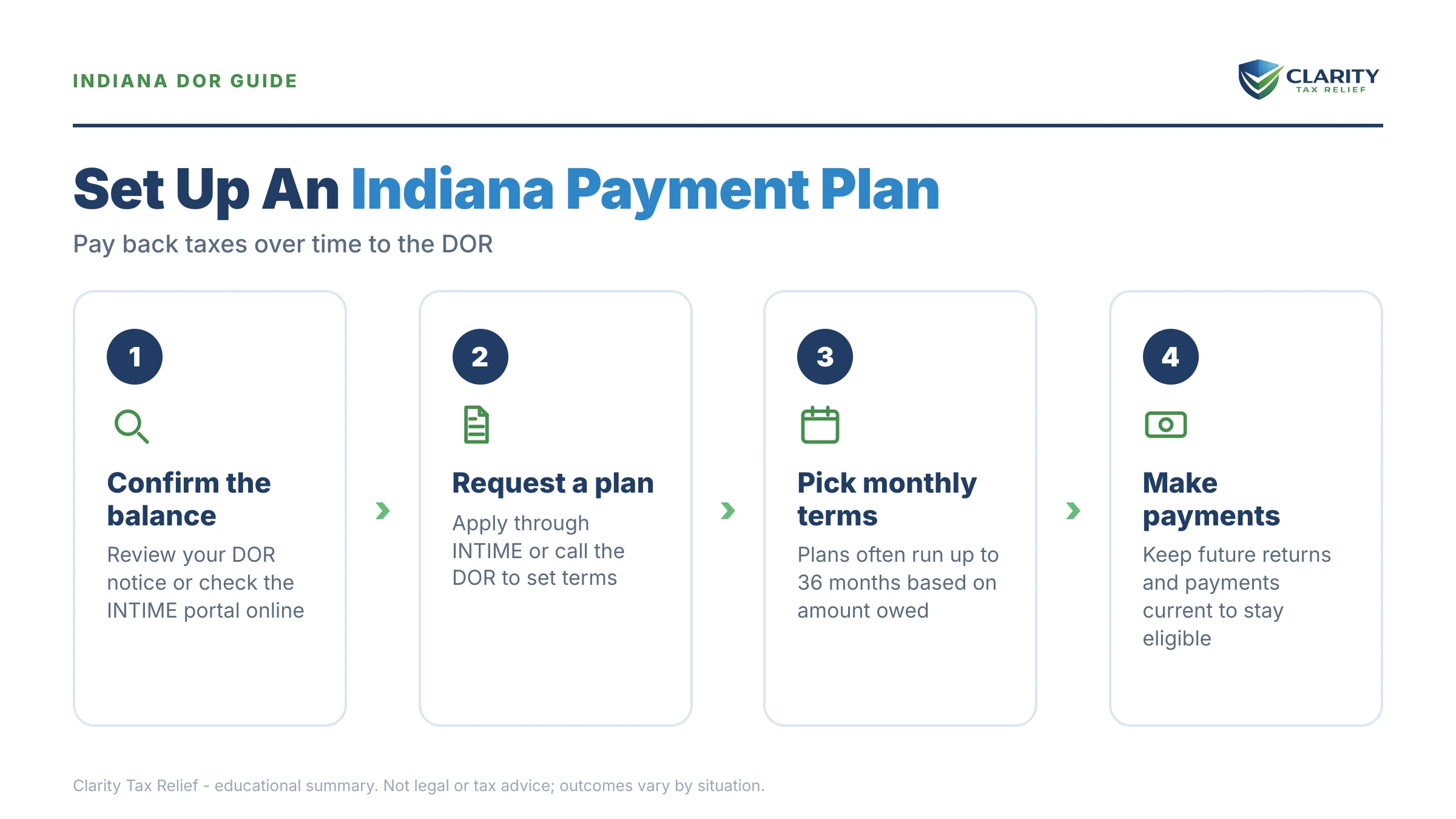
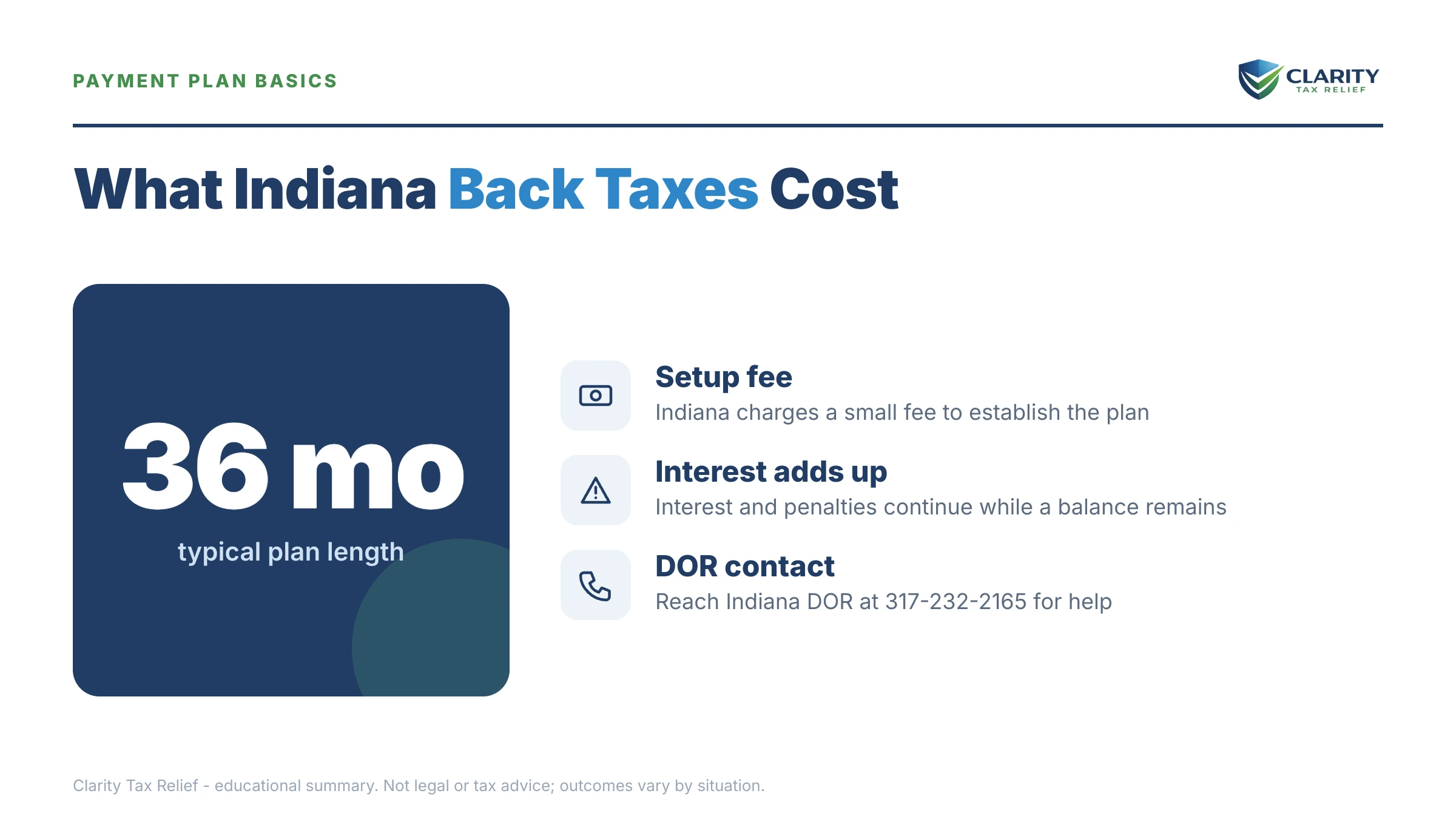
The Indiana DOR sets up payment plans through INTIME, and most individual income-tax balances qualify without a financial interrogation. The plan length you're offered scales with the size of your balance — INTIME quotes the available terms on screen before you commit, and some plans ask for a portion down, which the portal also shows up front. Interest continues while you pay, so shorter is cheaper if your budget allows it.
A payment plan isn't the only door, though. Here's the full menu:
| Option | Who it typically fits | How to request it |
|---|---|---|
| Pay in full | You can cover it within days or weeks | One-time payment in INTIME — stops penalty growth and prevents a warrant |
| INTIME payment plan | You can sustain a steady monthly amount | Set up online in INTIME; terms scale with balance, shown before you commit |
| Penalty waiver | Illness, disaster, or another genuine cause put you behind | Written reasonable-cause request to the DOR; tax and interest remain |
| Hardship / Offer in Compromise | Income and assets genuinely can't cover the debt | Documentation-heavy request through the DOR; narrow, not a default path |
| Protest a proposed assessment | You disagree with an amount the DOR added | Respond within the window printed on the notice — before it becomes final |
A note on Indiana's settlement path, because tax-relief ads oversell it everywhere: Indiana does consider offers in compromise and hardship arrangements, but only when documented finances show the debt truly can't be collected. The DOR runs that math on your actual income and assets — no one can promise you a reduced balance, and any pitch that does is a red flag. For most people reading this, the payment plan is the realistic tool; settlement is the exception to explore when the numbers genuinely don't work.
A worked example: owing Indiana $4,800 on a fixed income
Say you owe $4,800 on your Indiana return — a retiree whose IRA withdrawals had no state withholding is a classic version of this. Indiana's late-payment penalty is generally 10%, so figure roughly $480 added on top, plus interest at the DOR's annual rate. Call the balance $5,400 in round numbers by the time the bill lands.
Now the arithmetic at common plan lengths (INTIME will show you which terms your balance actually qualifies for):
- 12 months: about $450/month — steep on Social Security plus a modest pension.
- 24 months: about $225/month — often the workable middle for a fixed income.
- 36 months: about $150/month — the gentlest cash-flow hit, with more interest over the life of the plan.
Compare that to the do-nothing path: the same $5,400 grows with interest, then a warrant adds court costs and collection fees and parks a lien on your house. The plan at $150–$225 a month is almost always the cheaper road — and if even $150 would push you into skipping medication or utilities, that's precisely the situation Indiana's hardship review exists for. Don't sign up for a payment you can't actually sustain.
| Balance | Realistic path | Watch out for |
|---|---|---|
| Under $500 | Pay in full if at all possible — interest on a plan can rival the balance's urgency | Small balances still trigger warrants if ignored; they don't fall off |
| $500 – $5,000 | INTIME payment plan; add a penalty-waiver request if a genuine cause put you behind | Keep current-year Indiana taxes paid or the plan can default |
| $5,000 – $25,000 | Longer INTIME plan; penalty waiver worth pursuing; hardship review if the payment doesn't fit | Warrant risk grows with balance — start the plan before the Demand Notice date |
| Over $25,000 | Expect closer DOR attention; plan, hardship, or offer paths benefit from professional review | Business or withholding tax in the mix changes the liability picture entirely |
How to Respond, Step by Step
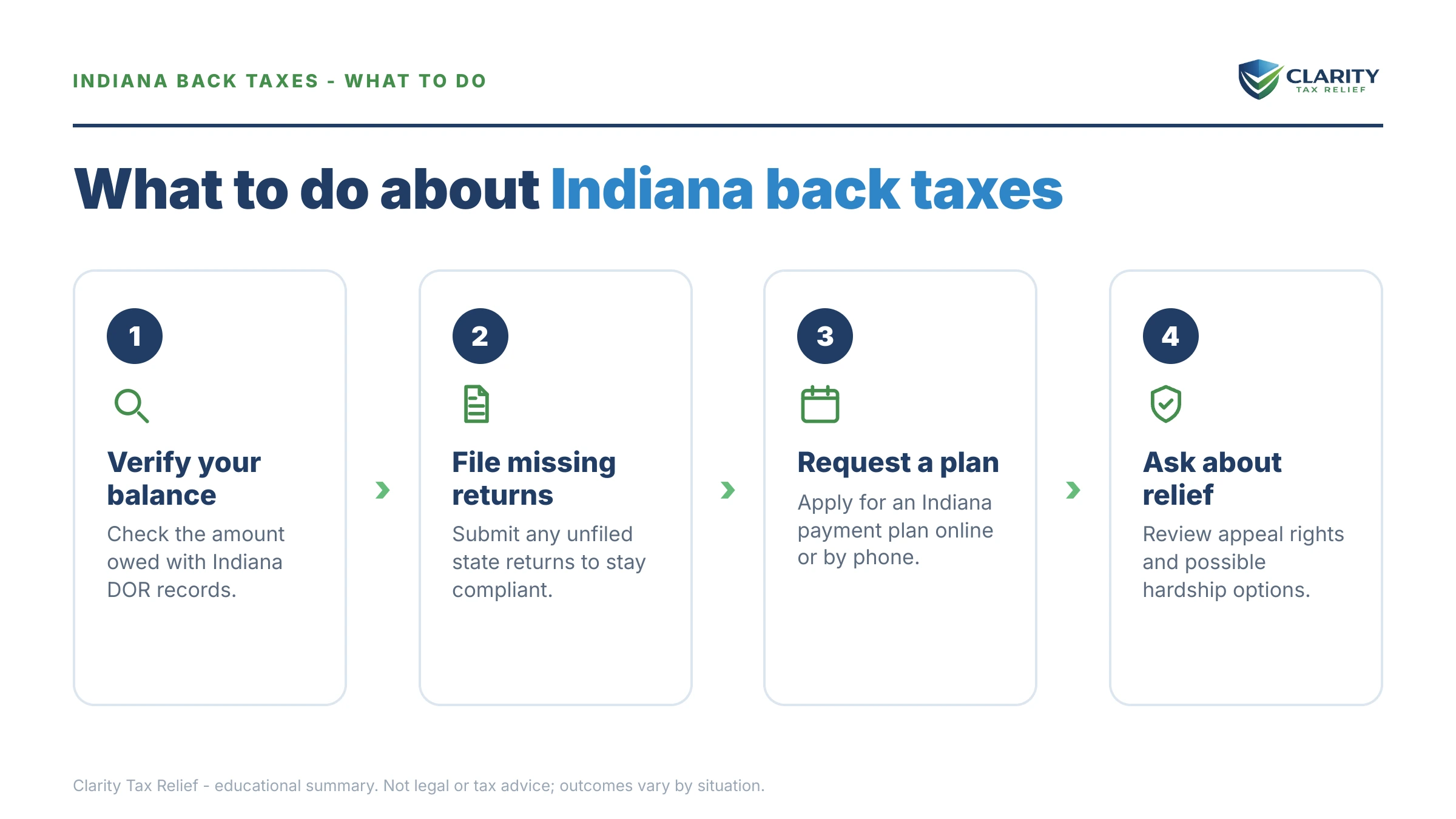
- Pull your exact balance in INTIME. Create or sign in to an account at intime.dor.in.gov and confirm the tax years, tax, penalty, and interest the DOR shows before trusting the paper bill.
- Check which notice you're holding. A proposed assessment can still be protested by the date printed on it; a Demand Notice for Payment means a tax warrant is the next step.
- Run the monthly math against your real budget. Choose a payment you can sustain every single month — a defaulted plan is worse than a slower one.
- Set up the payment plan in INTIME. The portal quotes the terms available for your balance; pick automatic payments so a forgotten month can't default the plan.
- Request penalty relief in writing. If illness, a death in the family, or another genuine cause put you behind, ask the DOR to waive the penalty — the tax and interest remain either way.
- Stay current on this year's Indiana taxes. A new balance is the fastest way to default an existing plan, so adjust pension withholding or make estimated payments now.
On Social Security? What Indiana Can — and Can't — Touch
The Indiana DOR cannot garnish your Social Security check — federal law puts Social Security benefits off-limits to state tax collectors. That single fact defuses the scariest version of this for retirees: your monthly benefit is not going to shrink because of a state tax warrant. (The IRS is different — as a federal agency it can take up to 15% of Social Security for federal tax debt, but Indiana has no such power.)
What Indiana can reach, once a warrant is filed:
- Bank accounts — with an important cushion: federal rules generally require banks to protect two months of directly deposited federal benefits from garnishment orders. Money above that, or money in accounts without direct-deposited benefits, is exposed.
- Wages — if you or a spouse still works, warrant-based wage garnishment is on the table.
- Your home and property in the county — as a judgment lien. Forced sales are rare; the practical effect is that the debt gets paid from proceeds when you sell or refinance.
- Refunds — Indiana refunds automatically, and potentially your federal refund through the offset program.
Indiana also doesn't tax Social Security benefits at all — so if your only income is Social Security, question whether the assessed year is even correct before you agree to it. And if a realistic plan payment genuinely isn't there after essentials, ask the DOR about hardship handling rather than defaulting silently. The federal version of that analysis is covered in IRS hardship on Social Security, and the broader retiree playbook lives in retired and owe back taxes.
If a Tax Warrant Has Already Been Filed
A filed Indiana tax warrant is a judgment lien in your county's court records, and it stays there until a warrant satisfaction is filed after payment. If you're past that stage, the situation is worse but far from unfixable:
- You can still pay or arrange payments — but you may be dealing with the county sheriff or a DOR-contracted collection agency rather than the DOR directly, and collection fees are now part of the balance. Confirm who currently holds the warrant before sending money anywhere.
- Verify before you pay a caller. Warrant collection involving third parties is exactly the environment scammers imitate. Confirm any balance yourself in INTIME or through the DOR before paying someone who phoned you.
- After payoff, confirm the satisfaction. Ask for written confirmation that a warrant satisfaction was filed with the circuit court clerk — you'll want it in hand at any future home sale or refinance.
- Wrongly billed? Indiana has a warrant expungement process for warrants that shouldn't have been issued. If the underlying assessment was wrong — a year you already paid, income that wasn't yours — expungement, not just satisfaction, is the outcome to pursue.
The fees only run one direction — every stage a warrant advances adds cost, so the best day to stop it is today, whichever stage you're at.
Owe Both Indiana and the IRS?
An Indiana payment plan and an IRS payment plan are two separate arrangements — neither one touches the other debt. This matters because the two systems also reach into each other's pockets: the IRS can take your Indiana refund through the State Income Tax Levy Program, Indiana can reach your federal refund through offset, and both can be true at once. The full picture of refunds taken across systems is its own topic.
| Indiana DOR | IRS | |
|---|---|---|
| Online portal | INTIME | IRS Online Account |
| Payment plan | Set up in INTIME; terms scale with balance | Short-term up to 180 days ($0 setup); up to 72 months online for balances of $50,000 or less |
| Main enforcement tool | Tax warrant — county judgment lien, sheriff/agency collection | Federal tax lien plus direct levy on wages, banks, and payments |
| Social Security | Cannot garnish your benefit | Can take up to 15% via the Federal Payment Levy Program |
| Your refunds | Keeps state refunds; can offset federal refunds through the Treasury Offset Program | Keeps federal refunds; can take state refunds through SITLP |
Which do you resolve first? The honest answer is usually "start both, weight them by threat level" — states often move to enforcement faster while the federal balance is usually larger. The full decision framework is in state tax debt vs. IRS: which to resolve first, and the federal side of the setup is walked through in how to set up an IRS payment plan online. Whatever you do, run both monthly payments against your budget together before committing to either — two plans you can't sustain is worse than one plan plus a hardship request.
When You Can Handle This Yourself
Most Indiana balances under a few thousand dollars can be resolved in INTIME without hiring anyone. Be honest with yourself about which side of this line you're on:
Handle it yourself when: you agree with the balance, it's one tax year, no warrant has been filed, and the plan payment INTIME quotes fits your budget. That's a 30-minute online task — do it this week and keep the confirmation.
Experienced help changes the outcome when:
- A warrant is already filed and a sheriff or collection agency is calling — sequencing the payoff, fee questions, and the satisfaction filing correctly matters.
- Multiple years are unfiled with Indiana, the IRS, or both — the order you file and resolve them in changes the total you pay.
- The assessment traces to an IRS change you dispute — fixing the federal side first can erase the Indiana bill instead of paying it.
- Business tax is involved. Indiana sales tax and payroll withholding are trust taxes that can attach to you personally even after a business closes — see state sales tax debt help before assuming the entity absorbed it.
- You owe both Indiana and the IRS on a fixed income and the combined payments don't fit — hardship analysis across two agencies is where a professional earns their fee.
If you're local and want a starting point, our tax relief in Indianapolis guide covers what to expect from a consultation. And if your Indiana balance sits on top of an IRS one, a free case review at (888) 825-7779 can map both plans against your actual monthly budget before you commit to either.
Terms on Your Indiana Notice, Decoded
- INTIME — the Indiana Taxpayer Information Management Engine, the DOR's online portal where you check balances, pay, and set up payment plans.
- Demand Notice for Payment — the DOR's final letter before enforcement; the last cheap moment to pay or start a plan.
- Tax warrant — Indiana's civil collection judgment, filed with your county's circuit court clerk; not an arrest warrant.
- Judgment lien — the claim a filed warrant creates against your property in that county, satisfied when you pay, sell, or refinance.
- Warrant satisfaction — the court filing that clears a paid warrant from the public record; always confirm it was filed.
- Expungement — the DOR process for removing a warrant that shouldn't have been issued, as opposed to one that was simply paid.
Official sources worth bookmarking: the Indiana Department of Revenue, the INTIME portal itself, and — for the federal side of a two-agency problem — the IRS payment plans page.
Indiana Back Taxes Questions, Answered
Does Indiana offer payment plans for back taxes?
Yes. The Indiana Department of Revenue sets up payment plans through INTIME, its online taxpayer portal, and most individual income tax balances qualify. The length of plan you're offered scales with how much you owe — INTIME shows you the available terms before you commit. If a tax warrant has already been filed, a plan is usually still possible, but you may be arranging it through the sheriff or collection agency handling the warrant.
Is an Indiana tax warrant an arrest warrant?
No. Despite the alarming name, an Indiana tax warrant is a civil collection document, not a criminal one — no one is coming to arrest you. It's filed with your county's circuit court clerk, where it becomes a judgment lien against your property and a public record. Its real teeth are financial: added fees, lien status, and collection by the county sheriff or a contracted agency.
Can Indiana garnish my Social Security for back taxes?
No — federal law protects Social Security benefits from state tax collectors, so the Indiana DOR cannot garnish your monthly check. Be aware of two wrinkles: the IRS (a federal agency) can take up to 15% of Social Security for federal tax debt, and money sitting in a bank account is a different question — though federal rules generally require banks to protect two months of directly deposited benefits from garnishment orders.
Will Indiana take my tax refund for back taxes?
Yes. The DOR automatically applies your Indiana state refund to any back-tax balance before sending you the difference, and it can do so every year until the debt is paid. State income tax debts can also be submitted for offset against your federal refund through the Treasury Offset Program. Being on a payment plan doesn't necessarily stop refund offsets — the refund just pays the balance down faster.
Does Indiana have a tax settlement or offer in compromise program?
Indiana does accept offers in compromise and hardship requests, but the door is narrow: you have to document that your income and assets genuinely cannot cover the debt. These requests run through the DOR and require detailed financial disclosure. Most Indiana back-tax cases resolve through a payment plan instead — treat settlement as the exception to explore when the math truly doesn't work, not the default.
What happens if I miss a payment on my Indiana payment plan?
A missed payment puts the plan at risk of default, and a defaulted plan puts you back on the path to a tax warrant — often faster than the first time, because the DOR has already billed you. If you see a tight month coming, contact the DOR before the payment date rather than after. Automatic payments through INTIME are the simplest protection against an accidental default.
How long can Indiana collect back taxes?
Longer than most people hope — and a filed tax warrant makes it longer still, because a warrant is a court judgment that can be renewed. Unlike the IRS, which generally has a 10-year collection statute, you should not assume Indiana's window will quietly expire. Waiting out the DOR is not a strategy; the balance grows with interest the entire time while a plan would be shrinking it.
Does an Indiana tax warrant show up on my credit report?
Not on your credit report itself — the major credit bureaus stopped including tax liens and civil judgments in consumer credit files in 2018. But the warrant is still a public record at your county's circuit court clerk, and lenders, landlords, and title companies routinely find it in public-records searches. It will surface during a mortgage, refinance, or home sale until a warrant satisfaction is filed.
Can I set up an Indiana payment plan if I also owe the IRS?
Yes — the two debts live in completely separate systems, and you'll need an arrangement with each. An INTIME plan does nothing for a federal balance, and an IRS installment agreement does nothing for Indiana. Budget for both payments together before you commit to either, and think through which debt to prioritize: state collectors often move to enforcement faster, while the IRS balance is usually larger.
Your Next 24 Hours
- Find two things on your notice: the payment date and which letter it is — a first bill, a proposed assessment, or a Demand Notice for Payment. The Demand Notice is the last stop before a warrant, so it moves to the top of the pile.
- Gather your numbers: the notice itself, your Indiana return for that year, and a one-line monthly budget — income in, essentials out — so you know what plan payment you can actually sustain.
- Get a free case review: call (888) 825-7779 or use the 2-minute form. An experienced tax professional will check whether the assessment is even right, whether a penalty waiver applies, and which plan or hardship path fits a fixed income — before a warrant adds fees that never needed to exist.
This guide is general information, not tax or legal advice for your specific situation. Eligibility for IRS programs depends on individual facts and circumstances; no outcome is guaranteed. Indiana Department of Revenue programs have their own eligibility rules; confirm current terms with the DOR.