
State Tax Debt
Kentucky Back Taxes: What the DOR Can Do and How to Resolve It in 2026
The short answer: Kentucky back taxes are collected by the Kentucky Department of Revenue, which can garnish wages, levy bank accounts, and file liens without suing you first — and add a collection fee of up to 25% once a debt is referred to its Division of Collections. A payment agreement, penalty waiver, or Offer in Settlement can resolve most balances.
Maybe it started with a Notice of Tax Due from Frankfort for a year you never filed, or maybe you've been delivering and driving on 1099s for three years knowing this letter was coming. Either way, you're now looking at a Kentucky number that grew while you weren't watching. That's uncomfortable — and entirely fixable, in a specific order that this guide walks through.
Here's what makes Kentucky back taxes different from a plain IRS balance: Kentucky adds a cost-of-collection fee of as much as 25% under KRS 131.440 once your account is referred for enforced collection. The IRS never does that. It means the cheapest moment to fix a Kentucky debt is before referral — and the timeline below shows exactly where that line sits.
⏱ Your real clock: there is no single statutory deadline on Kentucky back taxes, but two costs run anyway. Penalties and interest accrue monthly on both your Kentucky and IRS balances — and once the DOR refers your account to the Division of Collections, Kentucky law allows a collection fee of up to 25% to be stacked on top. If a specific notice sets a response date, that printed date controls.
Why you owe Kentucky back taxes
Kentucky taxes every dollar a resident earns — including gig, rideshare, freelance, and cash income that never had a penny withheld. The state's flat individual income tax is calculated on Form 740, which starts from your federal adjusted gross income. That linkage matters: whatever the IRS knows about you, Kentucky effectively knows too, because the DOR receives federal data through information-sharing agreements.
Most Kentucky back-tax cases trace to one of four causes:
- Unfiled years. You earned 1099 or platform income, no one withheld anything, and the returns never got filed. If you don't file, the DOR can estimate your liability from federal data and assess it — usually higher than a real return would show, because estimates ignore your expenses and mileage.
- Filed but couldn't pay. You filed Form 740 honestly, owed more than you had, and the balance has been compounding since.
- An adjustment. The DOR changed your return — often after the IRS adjusted the federal one — and billed the difference.
- A federal fix that never reached Frankfort. Because Kentucky piggybacks on federal AGI, an IRS audit or CP2000 change flows downhill. Resolving the IRS side without amending Kentucky leaves a state bill waiting.
Two Kentucky-specific wrinkles trip up gig workers in particular. First, the 1099-K threshold reverting to $20,000 means fewer forms get issued — but the income was always taxable, and years already reported to the IRS remain visible to Kentucky. Second, many Kentucky cities and counties — including Louisville Metro and Lexington-Fayette — impose their own occupational license taxes on net self-employment profits, billed separately from the DOR. Resolving the state balance doesn't automatically resolve a local one, so read the letterhead on every notice carefully.
If your situation is really "three years of DoorDash and Uber income, nothing filed anywhere," start with our guides on haven't filed in 3 years and Uber/Lyft driver back taxes for the federal mechanics — then come back here for the Kentucky sequence, because the two debts resolve on different tracks.
What happens if you ignore Kentucky back taxes
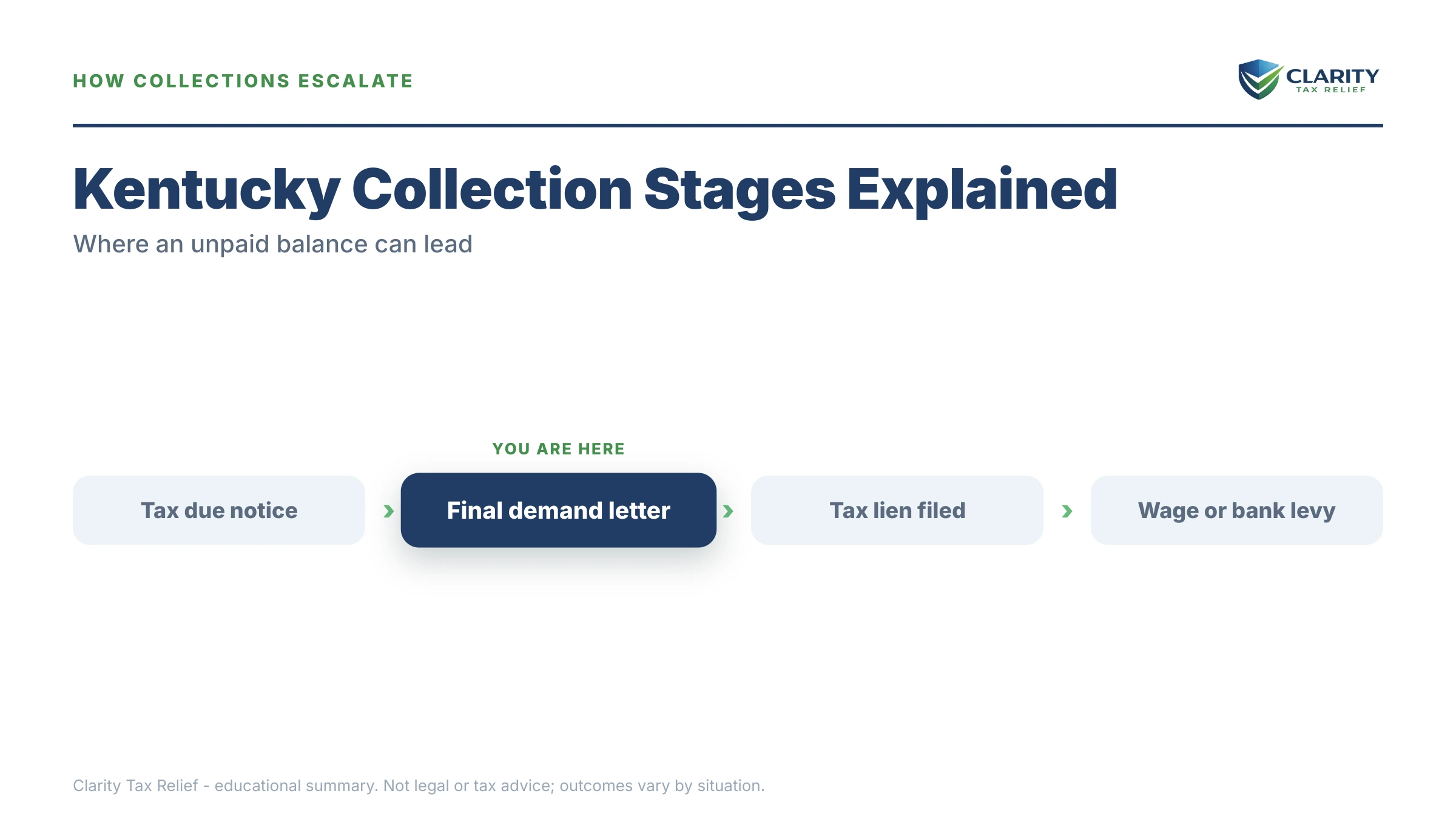
Unresolved Kentucky back taxes move through a fixed sequence: assessment, referral to the Division of Collections with a fee of up to 25%, then liens, wage garnishment, bank levies, and refund offsets. Kentucky's enforcement is administrative — the DOR does not need to sue you before it garnishes or levies. The image below shows what this escalation path looks like from first notice to enforced collection.
- Notice of Tax Due. The DOR's opening bill or proposed assessment. You have a protest window — typically 60 days, but use the date printed on your notice — to dispute it in writing.
- Final assessment. Pay, protest, or let the window close. Once it closes, the amount becomes a fixed, collectible debt; disputing it later is far harder.
- Referral to the Division of Collections. The DOR's enforcement arm takes over, and Kentucky law (KRS 131.440) permits a cost-of-collection fee of as much as 25% of the amount due to be added at this stage.
- Notice of State Tax Lien. Filed in county records, the lien attaches to your real estate and other property and becomes public record.
- Wage garnishment and bank levy. Administrative orders to your employer or bank — no court judgment required.
- Refund offsets, indefinitely. Kentucky keeps your state refunds, and state income tax debt can be submitted to the Treasury Offset Program to intercept your federal refund too. This runs in the background at every stage until the balance is gone.
| Stage | What happens | What you can still do |
|---|---|---|
| Notice of Tax Due | DOR bills or proposes an assessment | Protest in writing within the printed window, or arrange payment |
| Final assessment | The debt becomes fixed and collectible | Set up a payment agreement before referral; request penalty waiver |
| Division of Collections referral | Collection fee of up to 25% may be added | Negotiate an agreement or Offer in Settlement — enforcement is now imminent |
| Notice of State Tax Lien | Public lien attaches to your property | Resolve the balance to obtain a release; a lien is not yet a seizure |
| Garnishment / bank levy | Employer or bank must remit your money | Payment agreement or documented hardship to get it released |
| Refund offsets (ongoing) | State and federal refunds applied to the debt | Only full resolution stops the intercepts |
Don't count on 2026's shrunken IRS to slow the state side down. The DOR is a separate agency with its own systems, and both agencies' notice-and-offset machinery is automated. The letters keep coming whether or not a human ever reviews your file.
Behind with Kentucky — or with Kentucky and the IRS both?
Send us your DOR notices and we'll map exactly where you sit in the sequence, what the 25% collection fee would add, and the cheapest order to resolve everything — free, confidential, no pressure.
Your options for resolving Kentucky back taxes
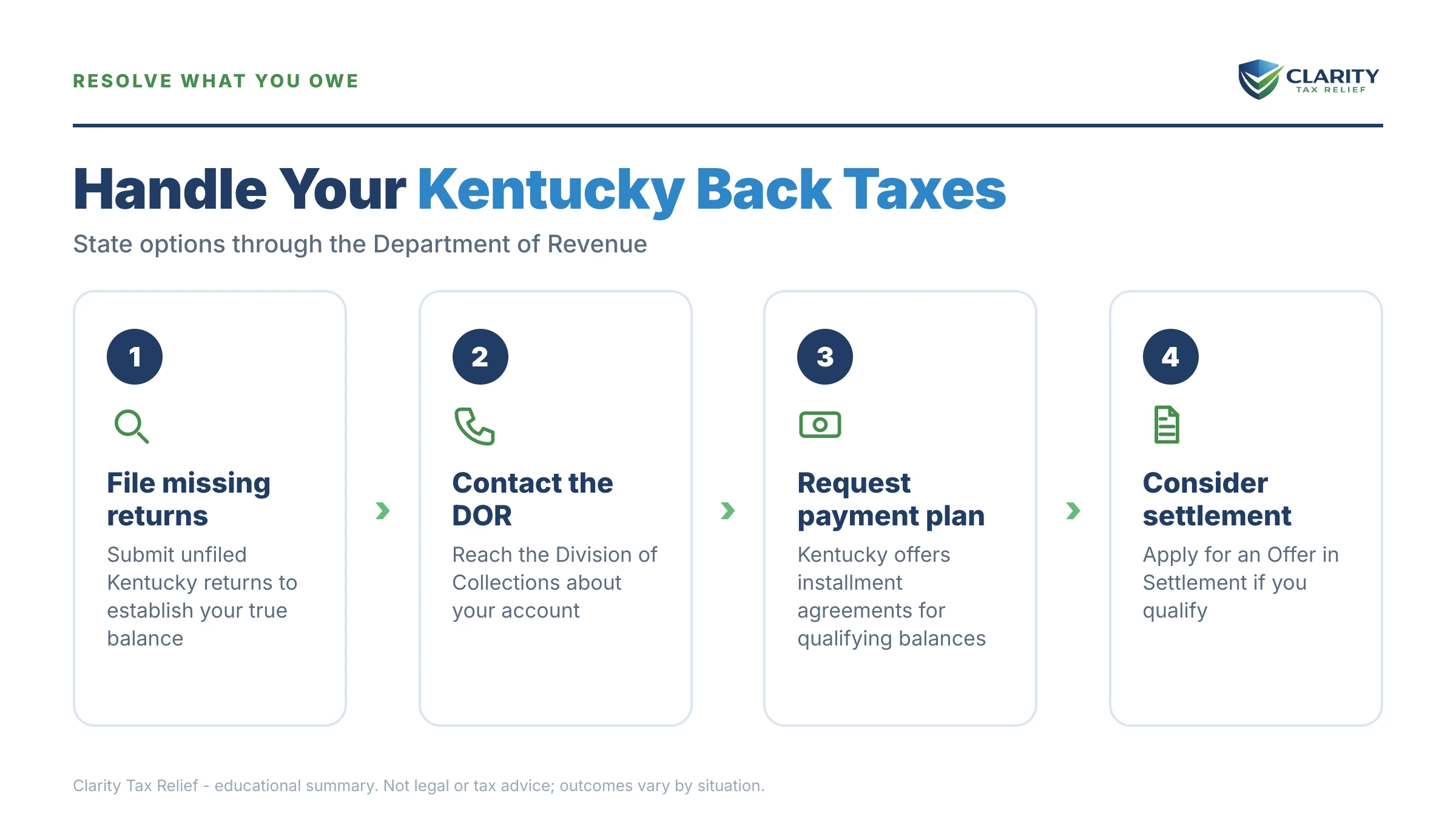
The Kentucky Department of Revenue resolves back taxes through payment agreements, reasonable-cause penalty waivers, and an Offer in Settlement program for debts it cannot realistically collect in full. Which door you use depends on how much you owe, what you can document, and whether you dispute the number at all.
| Option | Best for | What it requires | Watch out for |
|---|---|---|---|
| Pay in full | Balances you can clear within a month or two | Payment through the DOR before referral to collections | Draining an emergency fund to pay one agency while the other still escalates |
| DOR payment agreement | Steady income, can't pay all at once | All required returns filed; terms set case by case on your balance and finances | Interest keeps accruing; a missed payment can put enforcement back in motion |
| Offer in Settlement | Debts your assets and income genuinely can't cover | Full financial disclosure proving the DOR can't collect in full | Means-tested — not a discount for asking; weak offers waste months |
| Penalty waiver (reasonable cause) | Illness, disaster, or circumstances beyond your control | A written request with documentation of the cause | Removes penalties, not tax or interest |
| Hardship arrangement | No ability to pay anything right now | Detailed proof of income, expenses, and assets | Case-by-case pause, not forgiveness — interest continues |
| Written protest | You dispute the assessed amount | Filing within the window printed on the notice | Miss the window and the assessment becomes final |
A critical caution: none of the IRS's published thresholds apply in Kentucky. The federal rules — 180-day short-term plans, streamlined agreements under $50,000, 72-month terms — are IRS programs. Kentucky negotiates its own terms, and its Offer in Settlement runs on its own financial standards, not the federal offer formula. Treat the two debts as two separate negotiations. (The general logic of running dual-agency debt is covered in our hub on state tax debt vs IRS — which to resolve first; everything on this page is the Kentucky-specific layer.)
For the federal half of a combined debt, the standard toolkit applies: a payment plan (up to 72 months online for balances of $50,000 or less — see how to set up an IRS payment plan online), first-time penalty abatement if your prior compliance was clean, or — when the math truly supports it — an offer; how an offer in compromise works explains the federal version Kentucky's settlement program loosely mirrors.
Kentucky DOR vs. the IRS: two collectors, two rulebooks
Kentucky's Department of Revenue and the IRS collect separately, under different statutes, and neither waits for the other. If you owe both — the normal situation for an unfiled gig worker — you're running two cases in parallel, and the differences below decide your sequencing.
| Question | Kentucky DOR | IRS |
|---|---|---|
| Extra collection charges | Cost-of-collection fee of up to 25% when referred (KRS 131.440) | No referral fee; 0.5%/month failure-to-pay penalty instead |
| Payment plans | Negotiated case by case with the DOR | Published tiers: 180-day short-term, up to 72 months online under $50,000 |
| Settlement program | Offer in Settlement (state financial standards) | Offer in Compromise — $205 fee, waivable for low-income applicants |
| Collection time limit | State statutes; generally no limit on never-filed years | 10 years from assessment (the CSED), subject to tolling |
| Refund reach | Keeps state refunds; can intercept federal refunds via offset | Keeps federal refunds; can take your Kentucky refund through the State Income Tax Levy Program |
The sequencing rule of thumb: file everything for both agencies first, stop any live garnishment or levy second, then put the cheaper-to-delay debt on a plan. The IRS's federal clock — 10 years from assessment — at least has an end date; a never-filed Kentucky year has none until you file it. And Kentucky's 25% referral fee is a one-time cliff the IRS side simply doesn't have, which frequently makes the smaller state balance the one to clear fast.
A worked example: $23,800 behind after three unfiled years
Say you drove for delivery apps across Kentucky from 2022 through 2024, never filed, and the combined damage now stands at $23,800. This is a hypothetical, but the arithmetic is how these cases actually add up:
- Federal tax across the three years: $14,800 (income and self-employment tax after mileage and expenses).
- Federal failure-to-file penalty: accrues at 5% per month and caps at 25% of the unpaid tax — roughly $3,550 here, since all three years are past the cap.
- Federal failure-to-pay penalty and interest: about $950 more and still climbing at 0.5% per month plus interest. Federal total: ≈ $19,300.
- Kentucky: about $3,700 in tax on the same income, plus the state's own late-filing and late-payment penalties and interest — call it ≈ $4,500. Combined: $23,800.
Now the resolution math. The federal $19,300 is under $50,000, so an online long-term installment agreement over up to 72 months works out to roughly $268 a month minimum ($19,300 ÷ 72) — paying more shortens the interest runway. The Kentucky $4,500 is the urgent piece: if it gets referred to the Division of Collections, the 25% fee could add up to about $1,125 on top. Clearing or formally arranging the state balance quickly, then carrying the federal balance on a structured plan, is usually the cheapest combined path.
One more lever: if 2022 was your first-ever delinquent year and the three years before it were clean, first-time abatement may knock the penalties off that year on the federal side — and starting summer 2026, the IRS's new Automatic Exemption from Penalty (AEP) begins applying qualifying relief automatically, with no request needed. You can estimate your own federal penalty and interest exposure with our IRS penalty and interest calculator before you talk to anyone.
Missing records don't block any of this. Your IRS wage and income transcript shows every 1099 filed under your Social Security number, and app earnings summaries plus bank deposits fill the gaps — our guide to filing back taxes with no records walks through the reconstruction.
How to respond to Kentucky back taxes, step by step
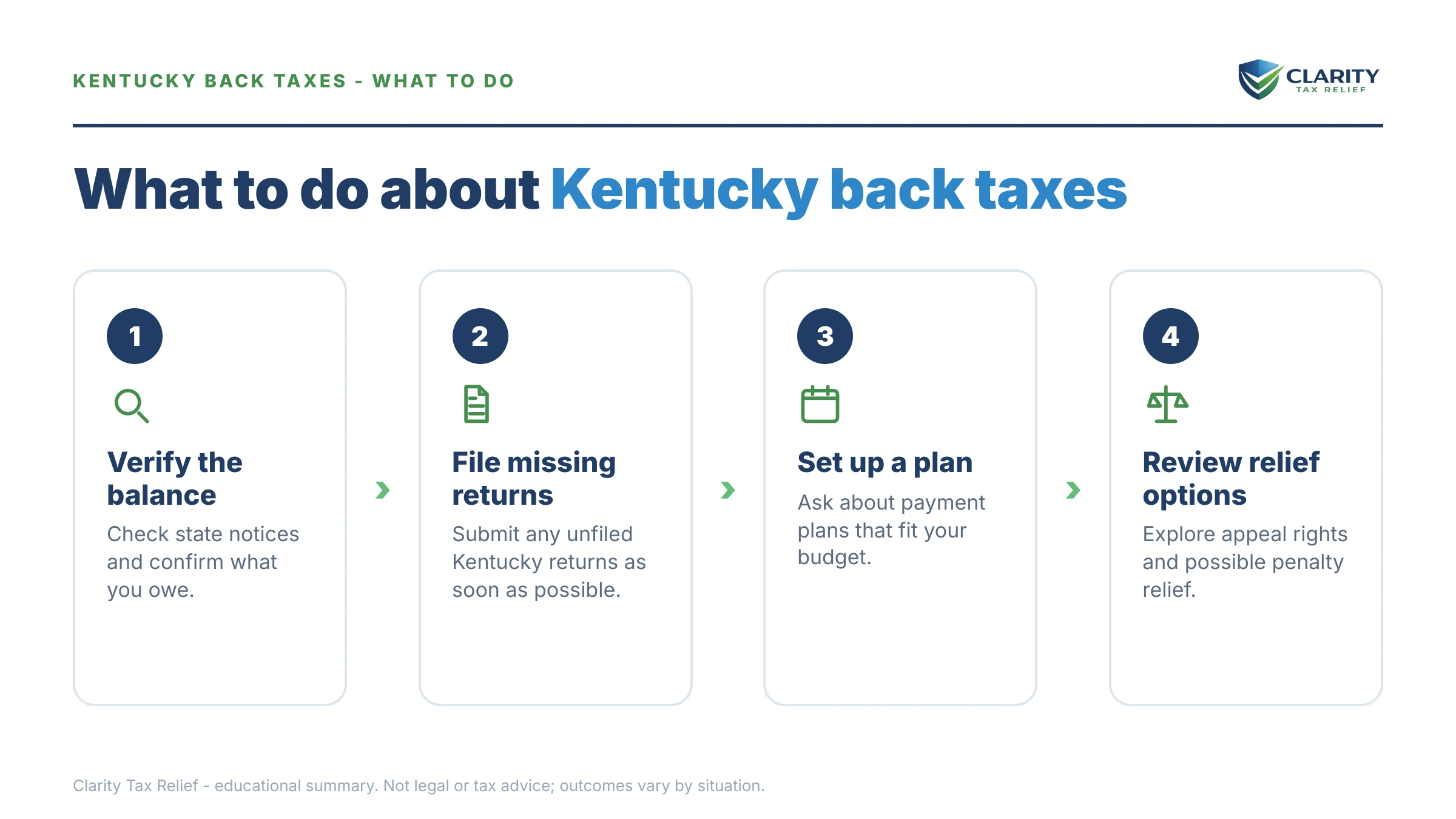
Resolving Kentucky back taxes follows one sequence: records, returns, balances, then a resolution for each agency. Skipping ahead — negotiating before filing, for example — just gets you sent back to the start.
- Pull your income records. Request your IRS wage and income transcripts and gather 1099s, bank deposits, and app earnings summaries for every unfiled year.
- File every missing return. Prepare the federal returns first, then Kentucky Form 740 for each year, because Kentucky starts from your federal adjusted gross income.
- Verify both balances. Check your IRS online account and every DOR notice so you know exactly what each agency says you owe, including penalties and fees.
- Protest anything you dispute. Respond in writing within the window printed on the DOR notice — once it closes, the assessment becomes final and collectible.
- Set up a resolution for each debt. Arrange a DOR payment agreement or Offer in Settlement for Kentucky and a payment plan or Offer in Compromise for the IRS.
- Request penalty relief. Ask the DOR for a reasonable-cause penalty waiver and check whether first-time abatement applies on the federal side.
Then stop the cycle from restarting: if you're still earning 1099 income, begin making quarterly payments to both the IRS and Kentucky going forward — how quarterly estimated taxes work covers the mechanics. A resolution on the old years collapses fast if a new unpaid year lands on top of it.
When you can handle Kentucky back taxes yourself
You do not need professional help for a single filed year with a balance you can pay within a few months. Honest triage:
- Handle it yourself when: you filed, you agree with the number, and you can pay in full or arrange a straightforward payment agreement directly with the DOR through revenue.ky.gov. Same on the federal side — a first notice you agree with may qualify for a guaranteed installment agreement, which is available to individuals who owe income tax of $10,000 or less (excluding penalties and interest), have filed all required returns, have filed and paid on time for the past 5 years without entering an installment agreement in that period, and can pay the balance in full within 3 years; you can set one up at the IRS payment plans page in twenty minutes.
- Experienced help changes outcomes when: you have multiple unfiled years across both agencies (return reconstruction and filing order affect what gets assessed); a garnishment or bank levy is already in motion; your account has been referred to the Division of Collections and the 25% fee is in play; you're weighing an Offer in Settlement or federal Offer in Compromise, where the financial disclosure is the whole case; or local occupational tax bills are stacked on top of the state and federal debt.
The dividing line is complexity, not fear. A simple balance is a phone call and a payment plan; three unfiled years with two collectors and a referral fee looming is a project with an order of operations — and the order is where money gets saved or lost. Readers in the state's two biggest metros can also see our local pages on tax relief in Louisville and tax relief in Lexington.
If your case sits on the "get help" side — multiple unfiled years, both agencies, or a Division of Collections referral looming — start with a free Kentucky back-tax review or call (888) 825-7779 before the next notice adds another layer.
Terms on your Kentucky notices, decoded
Kentucky's collection letters use their own vocabulary. The six terms you're most likely staring at:
- Notice of Tax Due — the DOR's bill or proposed assessment; the printed response window is your chance to dispute it.
- Protest — your written disagreement with an assessment, filed within the notice's window, before the amount becomes final.
- Final assessment — a debt that is fixed and collectible because it was upheld or the protest window passed.
- Division of Collections — the DOR's enforcement arm; referral here is when garnishments, levies, and the collection fee become live possibilities.
- Cost-of-collection fee — the charge of up to 25% of the amount due that Kentucky law allows once your account is referred for enforced collection.
- Notice of State Tax Lien — the public filing in county records that attaches Kentucky's claim to your property; a cloud on title, not a seizure.
Kentucky back taxes: your questions, answered
How far back can Kentucky collect back taxes?
Kentucky runs on its own statutes, not the IRS's 10-year collection rule. If you never filed a return for a year, there is generally no time limit — the Department of Revenue can assess that year whenever it discovers the income. Once a debt is assessed, the DOR can pursue it for many years and renew liens along the way, so waiting out a Kentucky balance is not a realistic strategy.
Does Kentucky have a tax settlement program like an IRS offer in compromise?
Yes — Kentucky's version is called an Offer in Settlement, run by the Department of Revenue. Like the federal program, it is means-tested: you must show that your assets and income genuinely cannot cover the full debt, documented with detailed financial disclosure. It is not a discount for asking; most applicants who could afford a payment agreement will be steered to one instead.
Can the Kentucky Department of Revenue garnish my wages?
Yes. The DOR has administrative collection powers, meaning it can garnish wages and levy bank accounts without first suing you in court. Garnishment typically follows earlier notices and referral to the Division of Collections, so you will have had chances to arrange payment first. If a garnishment is already running, a payment agreement or documented hardship is usually the fastest path to getting it released.
Can Kentucky take my federal tax refund for state back taxes?
It can. State income tax debts can be submitted to the Treasury Offset Program, which intercepts federal refunds and applies them to the state balance. Kentucky will also keep any state refund you are owed and apply it to your back taxes. If a refund disappears, the offset notice you receive names the agency that took it and the amount applied.
What is Kentucky's 25% collection fee?
Kentucky law (KRS 131.440) allows the Department of Revenue to add a cost-of-collection fee of as much as 25% of the amount due once your account is referred for enforced collection. On a $4,500 balance, that can mean more than $1,100 added on top of tax, penalties, and interest. It is one of the strongest reasons to arrange payment before your account reaches the Division of Collections.
Do I owe Kentucky taxes on gig income if I never got a 1099?
Yes. Kentucky taxes all of a resident's income whether or not a form was issued, and the 1099-K threshold reverting to $20,000 and 200 transactions only changes what platforms report — not what you owe. The DOR also receives federal data, so income the IRS knows about tends to surface in Frankfort eventually. Report gig income from your own records: app summaries, bank deposits, and mileage logs.
Should I pay Kentucky or the IRS first if I owe both?
Usually you file everything first, then prioritize based on cost and pressure. Kentucky's potential 25% collection fee and case-by-case payment terms often make the smaller state balance worth clearing quickly, while the larger federal balance goes on a structured IRS plan. But an active garnishment or levy from either agency jumps the queue — stop live enforcement first, then optimize the rest.
What happens if I can't afford to pay Kentucky anything?
Kentucky handles hardship case by case rather than through a formal published program like the IRS's Currently Not Collectible status. Expect to provide detailed financial information showing your income, expenses, and assets before the DOR pauses or reduces collection. Interest continues to build while collection is paused, so hardship treatment is a bridge, not a resolution — revisit a payment agreement or Offer in Settlement when your finances improve.
Will Kentucky file a lien against my house for back taxes?
It can. The DOR files a Notice of State Tax Lien in county records, which attaches to real estate and other property you own and becomes public record. A lien is not a seizure — you keep your home — but it clouds the title, complicates selling or refinancing, and can surface in background checks. Resolving the underlying balance is what gets the lien released.
Your next 24 hours
- Find where you sit in the sequence. Pull your most recent DOR letter and note the notice type, tax years, total, and any response date — and check whether it mentions the Division of Collections, because that tells you how close the 25% fee is.
- Gather your records. 1099s, app earnings summaries, bank statements for the unfiled years, any federal returns you did file, and every letter from the DOR, the IRS, or a local occupational tax office — all in one folder.
- Get a free case review. Call (888) 825-7779 or use the 2-minute form, and an experienced tax professional will walk both balances with you and map the cheapest resolution order — before penalties and interest add another month, and before a collections referral adds up to 25% more.
This guide is general information, not tax or legal advice for your specific situation. Eligibility for IRS programs depends on individual facts and circumstances; no outcome is guaranteed. Kentucky's programs, fees, and windows are governed by state law and DOR policy — confirm current specifics with the Kentucky Department of Revenue or a professional review of your notices.