
City Guides
Tax Relief Louisville: Every Real Option for IRS and Kentucky Tax Debt (2026)
The short answer: real tax relief for Louisville taxpayers comes from IRS programs — payment plans, penalty abatement, hardship status, and the Offer in Compromise — plus the Kentucky Department of Revenue's separate options for state debt. Owe under $10,000? A guaranteed installment agreement is usually your fastest, cheapest fix, and you can set it up yourself.
The divorce is final, you filed your first return on your own, and now there's an IRS balance with your name on it — some of it from a joint return you signed years ago. That's the moment most "tax relief Louisville" searches start. This debt is fixable, and it is cheaper to fix today than at any later stage of collection. Here's the complete map: every program, its cost, its eligibility line, and how a divorce changes the math.
⏱ The real clock: there's no application deadline for tax relief itself — but doing nothing is never neutral. The failure-to-pay penalty adds 0.5% of your balance every month, interest compounds daily on top, and each IRS notice in the sequence arrives with more enforcement power than the last. Any response date printed on a notice you're holding controls; the closer that notice is to a levy, the less that date can flex.
Tax relief Louisville: who is actually collecting from you
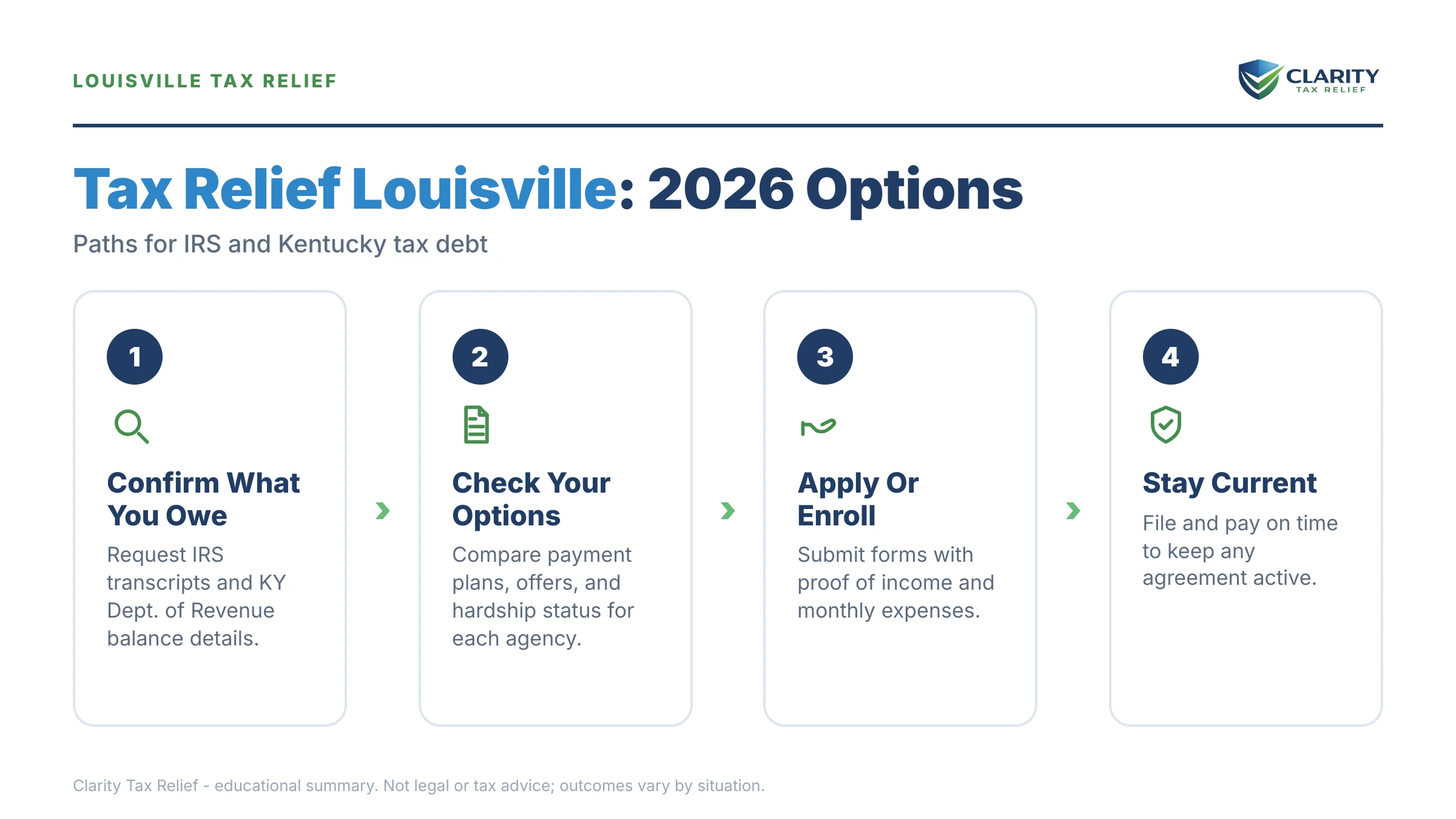
Louisville taxpayers can owe three separate tax agencies at once — the IRS, the Kentucky Department of Revenue, and the Louisville Metro Revenue Commission — and each collects independently. Fixing one balance does nothing about the other two, which is why the first step is always sorting out who sent what.
Most searches for tax relief in Louisville are about federal debt: a balance from a filed return, a CP2000-style adjustment, or years of unfiled returns catching up. The IRS is the biggest creditor and has the most formal relief programs — but it's also the most automated, which cuts both ways.
The Kentucky Department of Revenue collects state income tax under its own rules and its own timelines, which do not match the IRS's. And if you have self-employment or business income earned in Jefferson County, the Louisville Metro Revenue Commission administers the local occupational license tax — W-2 workers usually have it withheld, but 1099 earners must file and pay it themselves. More on both below; this guide covers the federal side first because that's where the strongest relief programs live.
What happens if you ignore tax debt in Louisville
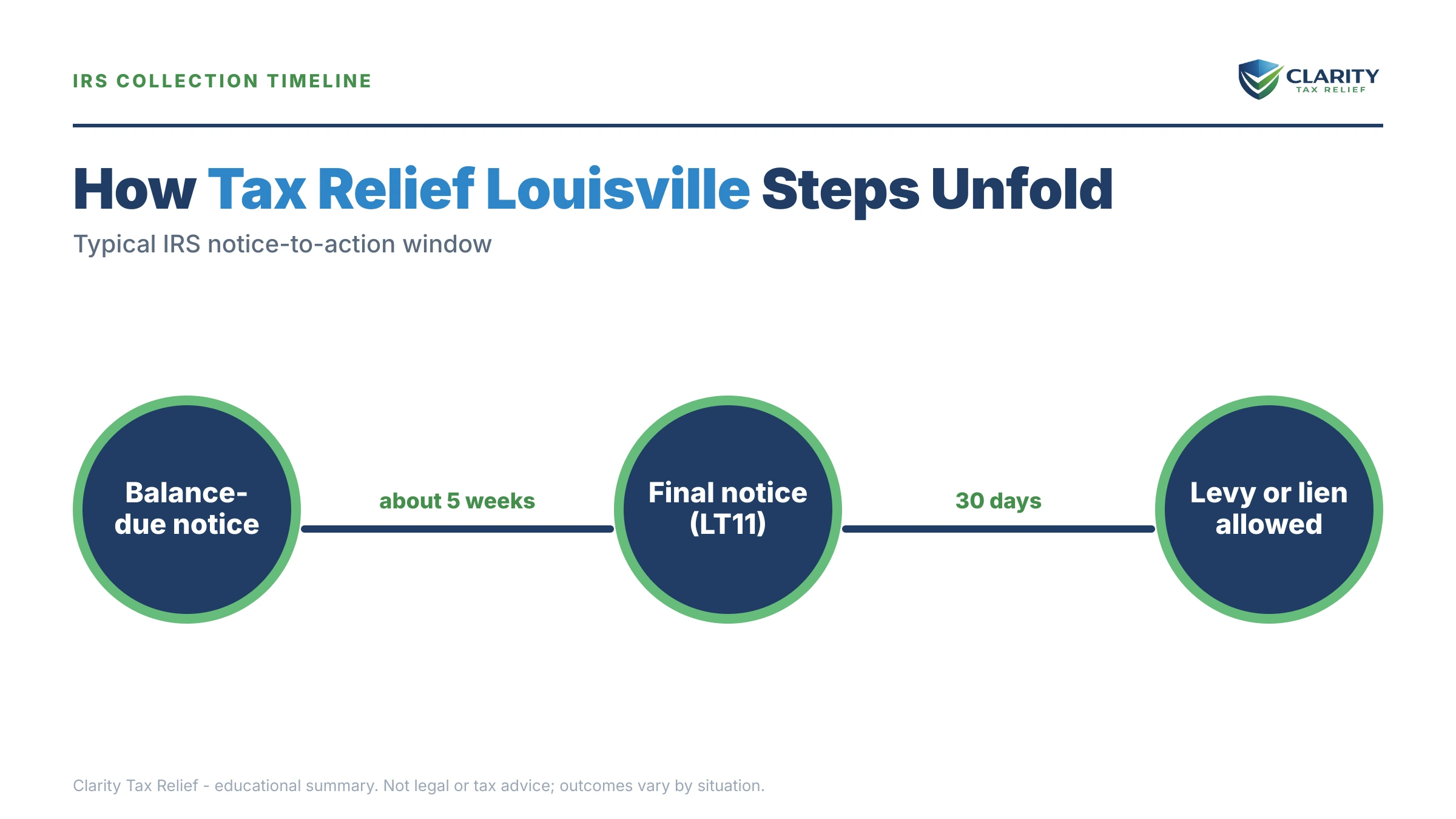
IRS collection escalates in a fixed, automated sequence — and in 2026, with the IRS workforce down roughly 27% from 2025 cuts, the notices and levies still fire on schedule even though reaching a human is harder than ever. The sequence for an unpaid individual balance runs like this:
- CP14 — the first bill. Typically about 21 days to pay before the reminders start. No enforcement yet; this is the cheapest moment to act.
- CP501 / CP503 — reminder notices. Still just bills, but the 0.5% monthly penalty and daily interest are compounding the whole time.
- CP504 — Notice of Intent to Levy under IRC §6331(d). After 30 days, the IRS can seize your Kentucky state tax refund, and a federal tax lien becomes a live possibility.
- LT11 / Letter 1058 — the Final Notice. A 30-day clock starts on your Collection Due Process rights (Form 12153). Miss it, and the IRS can levy your bank account and garnish your paycheck.
- Levy — a bank levy freezes funds for 21 days before they're sent to the Treasury; a wage levy is continuous until released. For a newly single filer, the levy-exempt amount is calculated on single filing status — meaning the IRS keeps more of each check than it would have when you filed jointly.
Separately, any federal refund you're owed gets offset against the balance every year until it's gone. If you were counting on a refund to catch up after the divorce, the IRS gets to it first.
Owe the IRS after a divorce in Louisville?
Send us your notices — an experienced tax professional will pull your IRS records, sort joint-year debt from your own, and map your options for free. Interest and the 0.5% monthly penalty accrue either way; knowing where you stand costs nothing.
Your tax relief options in Louisville, compared
Every legitimate resolution — whether you do it yourself or hire help — runs through one of seven IRS programs, each with a hard eligibility line. If you want the full do-it-yourself playbook for the mechanics of each, our guide on how to settle tax debt yourself walks through them; here's the decision table:
| Option | Who typically qualifies | Cost to set up | The catch |
|---|---|---|---|
| Short-term payment plan | Can pay in full within 180 days | $0 | Interest and the 0.5%/month penalty keep running until paid |
| Guaranteed installment agreement | Owe $10,000 or less; can full-pay within 3 years; returns filed | Setup fee (reduced online with direct debit) | You must file and pay on time every year going forward |
| Streamlined installment agreement | Owe $50,000 or less; up to 72 months online | Setup fee; low-income waiver available | Interest accrues across the whole term — longer means costlier |
| Currently Not Collectible | Paying anything would leave you unable to cover basic living costs (Form 433-F) | $0 | Debt remains, refunds are offset, and a lien may still be filed |
| Offer in Compromise | Assets plus future income genuinely can't cover the balance | $205 fee + 20% down on lump-sum offers (both waived if AGI ≤ 250% of the poverty level) | The IRS accepted roughly 1 in 5 offers in FY2024 — it's a math test, not a negotiation |
| First-time penalty abatement | Clean compliance record for the prior 3 years | $0 | Removes penalties only, not tax or most interest; AEP begins automating this in summer 2026 |
| Innocent spouse / separation of liability | Joint-return debt caused by a spouse's understatement (Form 8857) | $0 | §6015(c) covers deficiencies, not tax you reported but didn't pay — equitable relief may |
Two of these deserve a flag for divorced filers. Separation of liability under §6015(c) is available only to people who are divorced, legally separated, or living apart — it exists precisely for your situation. And penalty abatement matters more than most people expect: on older balances, penalties can be a meaningful slice of what the notice shows.
IRS deadlines and the rights each notice carries
Each IRS collection notice sets a specific response window, and each window protects a right you lose if it passes. If you're holding a letter right now, find it in this table before anything else:
| Notice | Your response window | What's at stake if it passes |
|---|---|---|
| CP14 (first bill) | Typically about 21 days from the notice date | The reminder sequence begins; penalties and interest keep compounding |
| CP504 (intent to levy) | 30 days | The IRS can seize your Kentucky state refund and move toward a lien |
| LT11 / Letter 1058 (final notice) | 30 days | Your Collection Due Process hearing right (Form 12153) — the last formal brake before wage and bank levies |
| CP523 (payment plan default) | The date printed on the notice | Your installment agreement terminates and full enforcement resumes |
Say you owe $8,900 after your divorce: the real math
A hypothetical, with the arithmetic shown. Say you're recently divorced in Louisville and owe the IRS $8,900 — $5,200 from your last joint return with your ex, and $3,700 from your first year filing single, when your withholding was still set for a two-income household. Here's what each path actually costs:
- Do nothing: the failure-to-pay penalty alone is 0.5% × $8,900 = $44.50 per month — over $530 a year — with daily-compounding interest stacked on top. You can estimate how fast your own balance grows with our IRS penalty and interest calculator.
- Guaranteed installment agreement: because $8,900 is under $10,000, the IRS must accept a plan that full-pays within 3 years. $8,900 ÷ 36 ≈ $248/month, plus a bit more to cover accruing interest. No financial disclosure required.
- 72-month streamlined plan: $8,900 ÷ 72 ≈ $124/month — easier on a single-income budget, but you'll pay noticeably more total interest over the longer term.
- First-time penalty abatement: if, say, $1,000 of the $8,900 is penalties and your prior three years were clean, an abatement request could strike that portion — and starting summer 2026, the new Automatic Exemption from Penalty (AEP) begins applying this kind of relief automatically, no request needed.
- Offer in Compromise: at $8,900 with a steady job, your future income alone will usually exceed the balance, so an offer rarely pencils out — you'd spend the $205 fee and months of review to be told to get a payment plan. It only makes sense if your finances genuinely can't cover the debt.
- Separation of liability: if the $5,200 joint-year portion came from income your ex understated (not just tax you both reported and didn't pay), Form 8857 could shift that slice off your account entirely — potentially cutting the problem nearly in half before you set up any plan.
Notice the pattern: at this balance level, the winning move is usually a combination — knock out what relief removes, then put a plan on the remainder.
Tax debt after divorce: the Louisville filer's specific problems
On a joint return, each spouse owes 100% of the balance — and the IRS is not bound by your divorce decree. Even if a Jefferson County family court ordered your ex to pay the tax debt, the IRS can still collect all of it from you; the decree only gives you a claim against your ex, not a defense against the government. Our guide on who pays IRS debt after divorce covers this trap in depth.
Three relief doors exist for joint-year debt, all requested on Form 8857. Innocent spouse relief applies when you didn't know about your ex's understated income and it would be unfair to hold you liable. Separation of liability lets divorced or separated filers split a deficiency between the two names on the return. Equitable relief is the catch-all — and importantly, it's the only one of the three that can cover tax that was reported correctly but never paid.
Two quieter post-divorce problems to fix at the same time. First, your withholding: a W-4 still set for married status is how the $3,700-type balance happens again next April — update it with your employer now. Second, your levy exposure: the amount of each paycheck exempt from an IRS wage levy is based on filing status and dependents, so as a single filer you keep less if collection ever reaches that stage.
Owing Kentucky or Louisville Metro is a different problem
Kentucky state tax debt is collected by the Kentucky Department of Revenue under Kentucky law — its payment programs, penalty rules, and collection windows are its own, and none of the IRS numbers in this article apply to a state balance. The DOR can file liens and garnish wages under state rules, and in practice states often move on smaller balances faster than the IRS does. For the state-side playbook, see our guide to Kentucky back taxes.
Louisville adds a third layer most cities don't have: the occupational license tax on wages and net profits earned in Louisville/Jefferson County, administered by the Louisville Metro Revenue Commission. If you're a W-2 employee, your employer withholds it and you likely owe nothing extra. But if you picked up 1099 or side-business income after the divorce, you're responsible for filing and paying it yourself — and it's a common surprise debt for newly self-employed Louisvillians.
One place the systems intersect: after a CP504, the IRS can intercept your Kentucky refund through its state-refund levy authority. If you owe both governments, assume neither refund is coming back to you until the balances are handled.
When you can handle this yourself
Most Louisville taxpayers who owe under $10,000, agree with the balance, and have steady income can resolve this alone in an afternoon. At $8,900 with all returns filed, you can set up a guaranteed installment agreement through your IRS online account without ever speaking to anyone, and request penalty abatement with a phone call or letter. Paying a firm to do that is paying for convenience, not results.
Experienced help changes the outcome in specific situations: a final levy notice already in hand (the 30-day CDP window is unforgiving), joint-return debt you're trying to shift to an ex (innocent spouse cases are evidence-driven and frequently denied on thin filings), multiple unfiled years, business or payroll tax debt, or a balance large enough that the IRS demands full financial disclosure. In those cases the order of operations — returns first, relief second, plan last — often changes what you ultimately pay.
How to choose tax debt help in Louisville (and avoid the mills)
Almost every "Louisville tax relief" ad you'll see is a national sales floor buying local search traffic — which is fine, as long as you vet it like one. The classic pitch to debunk: settling for "pennies on the dollar." That's a sales script, not tax law — Offer in Compromise acceptance is a financial formula, roughly 1 in 5 offers succeeded in FY2024, and no honest professional quotes a settlement before pulling your IRS transcripts.
Vet any firm the same way: confirm an enrolled agent, CPA, or tax attorney will actually work your case; demand a flat, written fee; and ask what happens if you don't qualify for the program they're pitching. Our checklist on how to choose a tax relief company covers the full vetting process, and if you're comparing the big national brands, start with our Optima Tax Relief alternative and Precision Tax Relief alternative breakdowns.
How to start resolving your tax debt in Louisville, step by step
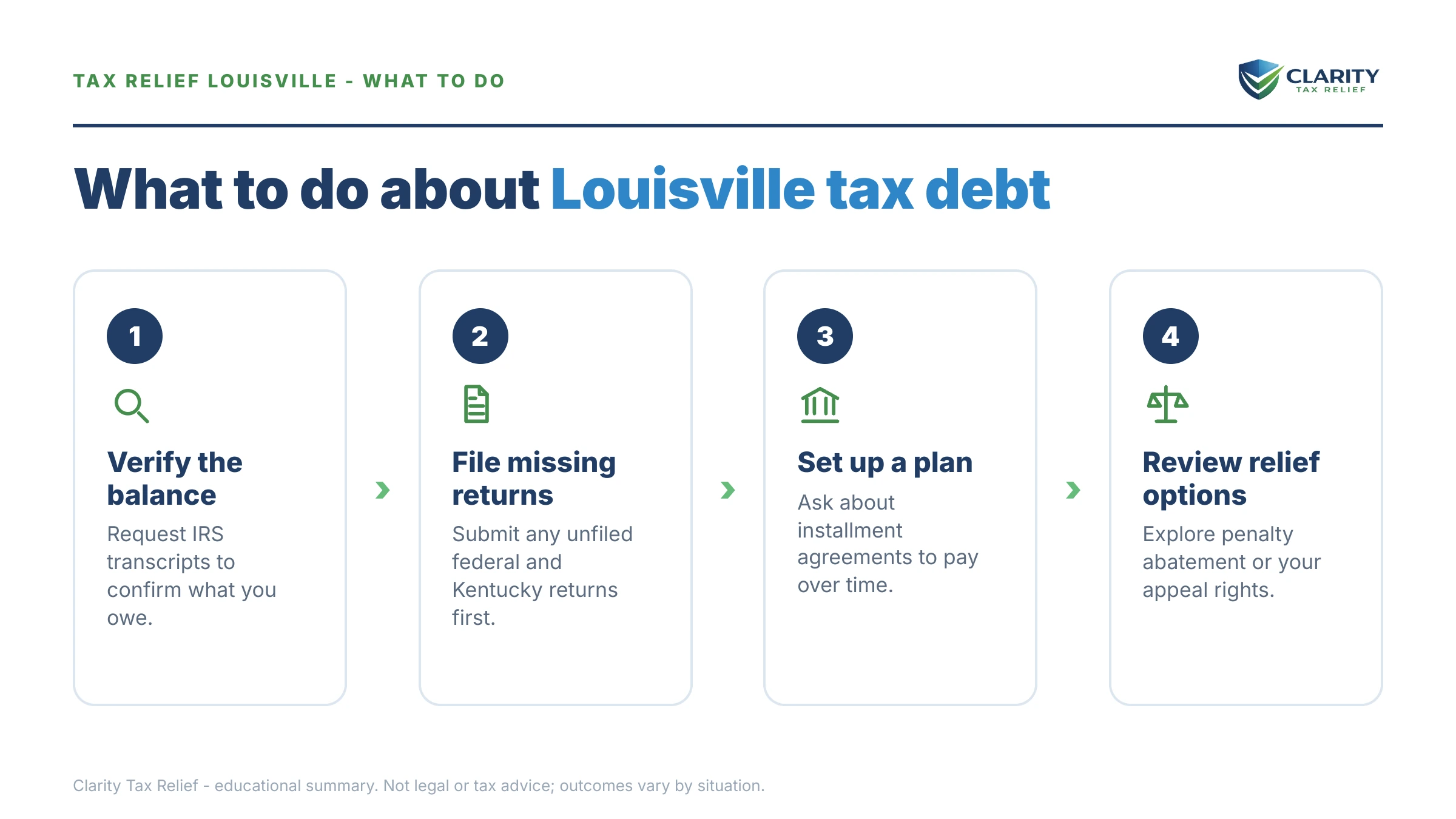
- Pull your IRS records. Create an online account at IRS.gov and download account transcripts for every year with a balance — they show exactly what you owe and which notices have already gone out.
- Confirm who you owe. The IRS, the Kentucky Department of Revenue, and the Louisville Metro Revenue Commission are three separate creditors — a plan with one does nothing about the others.
- File anything unfiled. No IRS resolution program will be approved while a required return is missing, and filing stops the 5%-per-month failure-to-file penalty.
- Match your numbers to a program. Compare your balance and monthly budget to the options table above — under $10,000, the guaranteed installment agreement is usually the fastest fit.
- Set it up before the next notice. Apply online through the IRS payment plans page, or by mail with Form 9465 — an active agreement stops the escalation sequence.
- Get a professional review if anything is tangled. Joint-return debt from a marriage, multiple unfiled years, or a final notice already in hand are the situations where experienced help changes the outcome.
Terms you'll hear, decoded
- Lien vs. levy: a lien is the government's legal claim against your property; a levy is the actual taking — the garnished paycheck or frozen bank account.
- CSED: Collection Statute Expiration Date — the IRS generally has 10 years from assessment to collect, though appeals, offers, and bankruptcy pause the clock.
- Joint and several liability: on a joint return, each spouse owes the full 100% — the IRS can collect all of it from either person, regardless of the divorce decree.
- Installment agreement: the IRS's formal monthly payment plan; interest and a reduced late-payment penalty continue while it runs.
- CDP hearing: Collection Due Process — the formal appeal (Form 12153) you can request within 30 days of a final levy notice; it pauses seizure while pending.
- Occupational license tax: Louisville Metro's local tax on wages and net profits earned in Jefferson County, administered by the Louisville Metro Revenue Commission.
Tax relief in Louisville: your questions answered
Are tax relief companies in Louisville legitimate?
Some are, but every legitimate one uses the same IRS programs you can read about for free — payment plans, penalty abatement, hardship status, and the Offer in Compromise. The test isn't a Louisville address; it's whether an experienced tax professional reviews your IRS transcripts before quoting a fee. Walk away from any firm that promises a specific settlement amount before seeing your records.
How much does tax relief cost in Louisville?
The IRS's own fees are modest: $0 for a short-term payment plan, a reduced setup fee for online direct-debit installment agreements, and $205 to apply for an Offer in Compromise (waived if your income is at or below 250% of the federal poverty level). Professional representation is separate and varies by firm and case complexity — get a flat-fee quote in writing before you sign anything.
Do I need a local Louisville firm, or can I use a national company?
For IRS debt, geography barely matters — collection cases are worked by phone, mail, and online with centralized IRS units, not at a local office. Credentials and a written fee agreement matter far more than a Louisville zip code. Local knowledge helps most when your problem involves the Kentucky Department of Revenue or the Louisville Metro Revenue Commission, or when a revenue officer has been assigned to your case.
Does Kentucky have a tax relief program like the IRS Fresh Start?
The Kentucky Department of Revenue runs its own payment agreements and settlement processes, but they follow Kentucky law — not IRS thresholds like the $50,000 streamlined limit or the 72-month term. Never assume an IRS number applies to a state balance. Start with our Kentucky back taxes guide, or contact the Department of Revenue directly to confirm what your state balance qualifies for.
My ex-spouse caused our tax debt — am I still responsible after the divorce?
If the debt comes from a joint return, yes — the IRS can collect the entire balance from either of you, no matter what your divorce decree says. Relief exists: separation of liability under IRC §6015(c) lets divorced filers split a deficiency, and equitable relief can cover tax that was reported but never paid. Both are requested on Form 8857, and being divorced is exactly the situation §6015(c) was built for.
Can the IRS garnish my wages at my Louisville job?
Yes, but only after it sends a final notice — an LT11 or Letter 1058 — and 30 days pass without a response. An IRS wage levy is continuous until released, and the amount you keep is based on your filing status and dependents, so a newly single filer keeps less of each paycheck than a married one. Requesting a Collection Due Process hearing within the 30 days pauses the levy.
Where can I get free help with tax debt in Louisville?
Start with your free IRS online account, which shows every balance, notice, and payment on file. If your income is modest, a Low Income Taxpayer Clinic can represent you in IRS disputes at no charge — Kentucky clinics are listed through the Taxpayer Advocate Service. The Taxpayer Advocate itself can also step in when IRS delays or errors are causing you financial harm.
What if I owe both the IRS and the Kentucky Department of Revenue?
Handle whichever agency is closest to enforcement first — an intent-to-levy notice outranks a first bill, whoever sent it. You can run an IRS installment agreement and a Kentucky payment agreement at the same time; just make sure the combined monthly payments actually fit your budget, because defaulting on either restarts collection. Also remember the IRS can seize your Kentucky refund after a CP504.
More on the free-help route, including what a Low Income Taxpayer Clinic can and can't do for a collection case, is in our dedicated guide.
Your next 24 hours
- Find every notice. Pull the most recent letter from each agency and note the notice number (top corner) and any response date printed on it — that date, not a generic timeline, controls your clock.
- Gather three things: your last filed return, your divorce decree if any of the debt is from a joint year, and a recent pay stub. That's everything needed to price every option in the table above.
- Get your free case review. Call (888) 825-7779 or use the 2-minute form — the 0.5% monthly penalty and daily interest accrue whether you act or not, so acting first is the only way to stop the meter.
Official resources: set up a federal plan at the IRS payments portal, handle state balances through the Kentucky Department of Revenue, and find free clinic help via the Taxpayer Advocate Service.
This guide is general information, not tax or legal advice for your specific situation. Eligibility for IRS programs depends on individual facts and circumstances; no outcome is guaranteed.