
City Guides
Tax Relief in Indianapolis: Resolving IRS and Indiana DOR Back Taxes in 2026
The short answer: tax relief in Indianapolis usually means resolving two separate debts — federal back taxes with the IRS and state or county income tax with the Indiana Department of Revenue. Both offer payment plans; the IRS also offers settlement and hardship programs. Move before a federal tax lien or Indiana tax warrant hits the public record.
Maybe you found this the hard way: you sat down with a mortgage lender about refinancing your Indianapolis home, the title search or credit pull surfaced a back-tax balance, and suddenly the closing is on hold. That knot in your stomach is normal — and the situation is more fixable than the lender made it sound. The order you fix things in is what decides whether your refinance survives, and this guide maps that order.
One thing that makes Indianapolis different from a purely federal problem: Indiana enforces its debts with a tax warrant — a court-filed instrument that behaves like a civil judgment against you, not just a letter. The image below shows you how the two collection tracks — IRS and Indiana DOR — run side by side and where each one can touch your home.
⏱ The real clock: there's no single deadline on Indianapolis tax debt — the cost just never stops climbing. The IRS adds a 0.5% monthly failure-to-pay penalty plus compounding interest, and every month unresolved raises the odds that the Indiana DOR files a tax warrant with the Marion County clerk — a public judgment lien that lenders will find.
Tax relief in Indianapolis means dealing with two collectors
Indianapolis taxpayers answer to two separate tax agencies: the IRS for federal income tax and the Indiana Department of Revenue (DOR) for state income tax. There is no third collector for the city — Marion County's local income tax is reported on your Indiana return and collected by the DOR, so a state balance already includes the county share.
That two-track reality is why so many Indianapolis taxpayers get blindsided. They set up an IRS payment plan, exhale, and then a DOR letter arrives — because resolving one agency does nothing for the other. Each has its own portal, its own plans, and its own enforcement tools.
The DOR's online system is called INTIME, and it's where Indiana payment plans get set up. The IRS equivalent is your IRS online account. If you owe both, you'll use both — our Indiana back taxes payment plan guide covers the state side in full detail.
| How it works | IRS (federal) | Indiana DOR (state + county) |
|---|---|---|
| What it collects | Federal income tax, penalties, interest | Indiana income tax plus Marion County local income tax |
| Lien instrument | Notice of Federal Tax Lien (attaches to all your property) | Tax warrant filed with the county clerk — functions like a civil judgment |
| Who enforces | Automated levy systems; revenue officers on larger cases | County sheriff or contracted collection agency, with fees added |
| Where to set up a plan | IRS online account / Form 9465 | INTIME portal or by contacting the DOR |
| Settlement programs | Offer in Compromise, Currently Not Collectible, penalty abatement | Narrower relief; confirm current options directly with the DOR |
| Collection window | 10 years from assessment (CSED), pausable by appeals, OIC, bankruptcy | Different rules — a filed warrant works like a judgment; confirm your dates with the DOR |
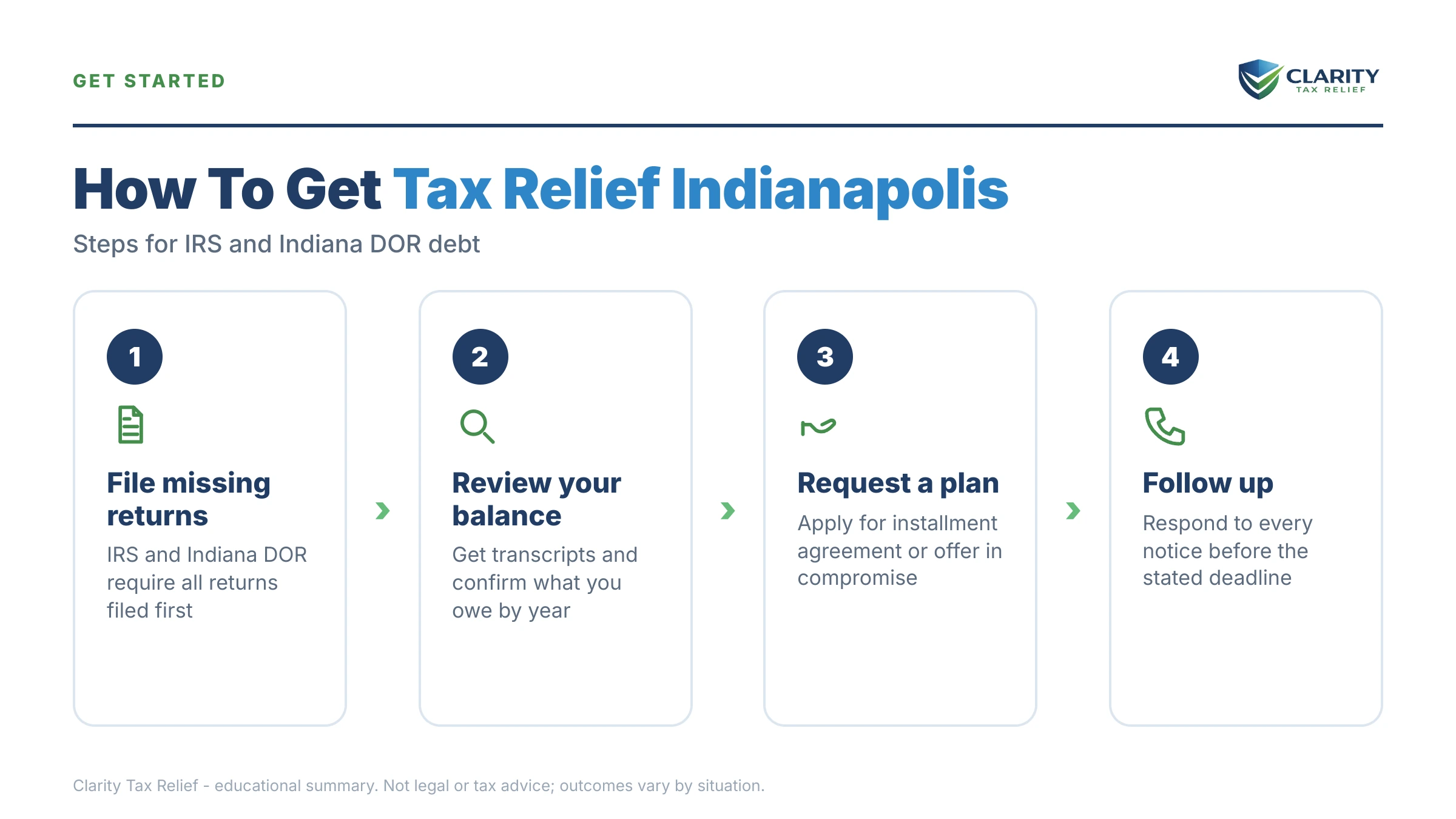
What happens if you ignore tax debt in Indianapolis
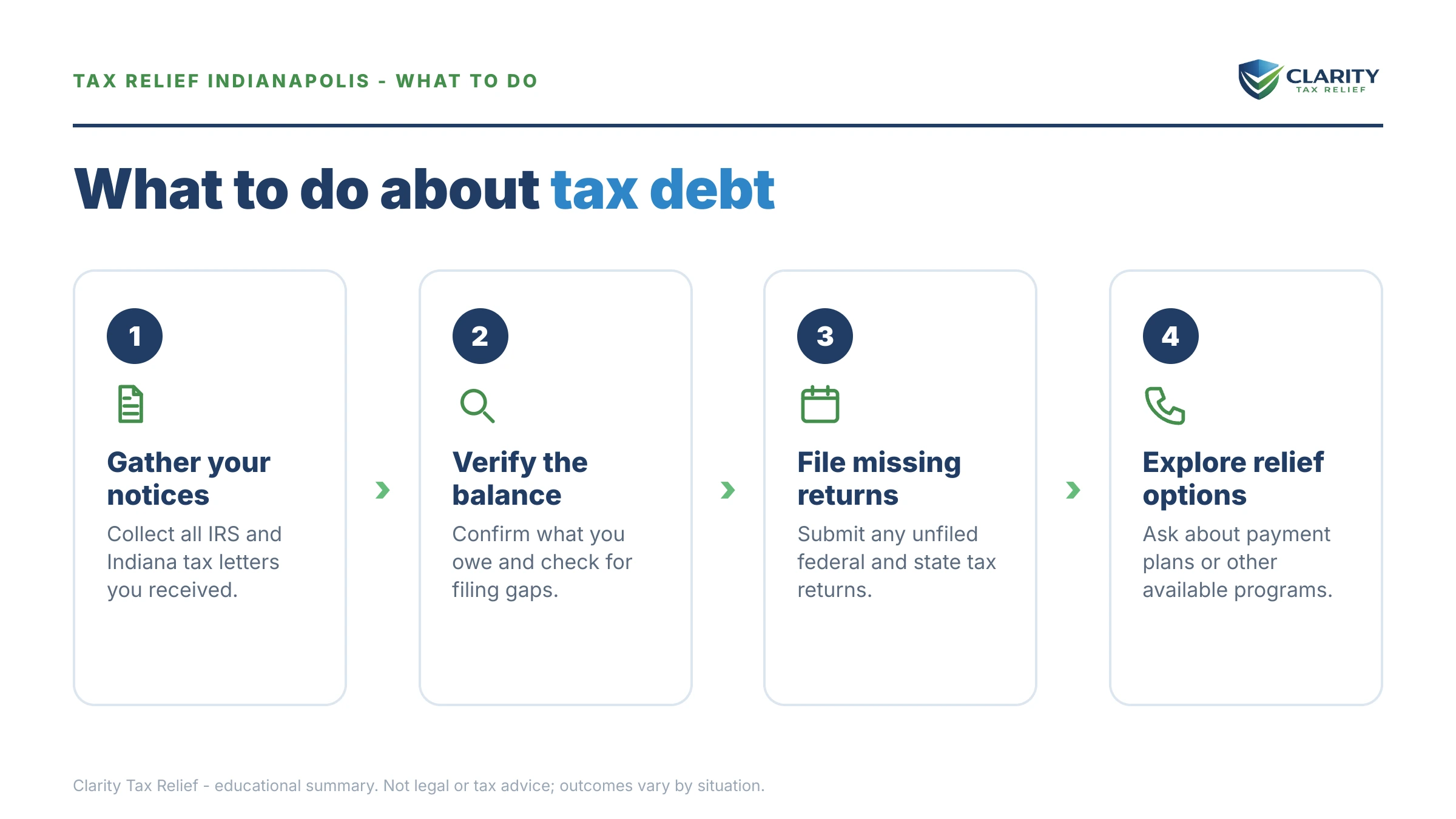
Both agencies escalate automatically, and neither needs a human to look at your file before enforcement starts. On the federal side, the sequence runs in a fixed order:
- First bill (CP14) — no enforcement yet, but penalties and interest are already compounding on the balance.
- Reminder notices (CP501 / CP503) — still just bills; each one means the automated system is moving your account forward.
- CP504 — Notice of Intent to Levy — the IRS can now seize your Indiana state tax refund, and a Notice of Federal Tax Lien against your home becomes a realistic next move.
- LT11 / Letter 1058 — Final Notice — this starts a 30-day clock and your Collection Due Process rights (requested on Form 12153). After it runs, the IRS can garnish wages and levy bank accounts, where a 21-day hold applies before funds leave.
The state track is shorter and blunter. If a DOR bill goes unresolved, Indiana files a tax warrant with the circuit court clerk — Marion County for most Indianapolis addresses. A filed tax warrant is a public judgment lien against your Marion County property, and it authorizes collection through the county sheriff or a contracted collection agency, with collection fees stacked on top of what you already owe.
For a homeowner, the warrant and the federal lien are the two events that turn a private debt into a public one. Title searches find both. Once either is filed, your refinance goes from routine underwriting to a lien-resolution project — which is why the entire strategy below is built around acting before the filing, not after.
And in 2026, don't mistake IRS silence for a pause. The agency's workforce shrank roughly 27% in 2025, so phones are harder to reach — but the notices, liens, and levies come from automated systems that never stopped running.
Tax debt threatening your Indianapolis refinance?
Before a federal lien or Marion County tax warrant reaches the public record, get your IRS and Indiana DOR balances reviewed free. An experienced tax professional will map the resolution order that keeps your closing alive — no pressure, no obligation.
Indianapolis tax relief options in 2026, compared
The IRS runs five real resolution programs, and eligibility for each is set by hard thresholds — not by sales pitches. The table below shows where the lines fall; the full do-it-yourself walkthrough of each program lives in our guide to how to settle tax debt yourself.
| Option | Typically fits when | Cost & key terms |
|---|---|---|
| IRS short-term plan | You can pay in full within 180 days | $0 setup; interest and penalties continue until paid |
| Streamlined installment agreement | Balance $50,000 or less — set up online, up to 72 months | Setup fee applies; no detailed financial disclosure required |
| Non-streamlined agreement | Balance over $50,000, or you need a lower payment | Requires financial disclosure (Form 433 series); terms negotiated |
| Offer in Compromise | Assets and income genuinely can't cover the debt before the CSED | $205 fee + 20% down on lump-sum offers (both waived with low-income certification); roughly 1 in 5 offers accepted in FY2024 |
| Currently Not Collectible | Paying anything would create genuine hardship | $0; collection pauses but the debt and interest remain |
| Penalty abatement | Clean compliance the prior 3 years, or reasonable cause | $0 to request; can remove failure-to-file/failure-to-pay penalties |
| Indiana DOR payment plan | Any Indiana/Marion County balance you can't pay at once | Set up through INTIME; separate from any IRS agreement |
Two notes on that table. First, an Offer in Compromise is judged on Reasonable Collection Potential — the IRS's math on what it could ever collect from you — and a homeowner's equity counts in that math, which is why homeowners with meaningful equity are rarely strong OIC candidates. Second, penalty relief is changing: first-time penalty abatement still requires a request, but starting summer 2026 the IRS's new Automatic Exemption from Penalty (AEP) begins applying similar relief automatically, with no request needed. You can estimate what penalties and interest have added to your own balance with our Penalty & Interest Calculator.
A worked example: $54,600 owed and a refinance on hold
Say you're an Indianapolis homeowner who owes the IRS $54,600 and wants to refinance this year. That number sits in an awkward spot: it's $4,600 over the $50,000 ceiling for the online streamlined plan, so you have two realistic paths. (This is a hypothetical illustration, not a client story.)
Path one — buy your way under the line. Pay roughly $4,700 toward the balance to bring it to about $49,900. That unlocks the online long-term agreement of up to 72 months: $49,900 ÷ 72 ≈ $693 per month as the floor payment. Interest and the 0.5% monthly failure-to-pay penalty keep accruing on the shrinking balance, so paying more than the minimum each month meaningfully cuts the total cost.
Path two — negotiate above the line. Keep the $54,600 balance and set up a non-streamlined agreement, which means disclosing your finances on a Form 433. That path can produce a lower payment if your budget is tight, but the financial review also gives the IRS a look at your home equity — relevant when a lien decision is pending.
For the refinance itself, the sequencing is everything. At $54,600 unresolved, a Notice of Federal Tax Lien is a realistic risk, and a filed lien clouds title. If you get an installment agreement in place first, many lenders can work with a documented plan in good standing — see can I refinance with an IRS lien for how underwriters treat each scenario. If a lien has already been filed, the usual fixes are a tax lien subordination (Form 14134), which lets the new mortgage take priority so the loan can close, or — in certain direct-debit situations — a lien withdrawal via Form 12277 that removes the lien from the public record entirely.
One more wrinkle: $54,600 is below the $66,000 passport-certification threshold for 2026, so your passport isn't at risk at this balance — but a growing balance plus accruing penalties can cross that line over time. Another reason the meter matters.
How to resolve tax debt in Indianapolis, step by step
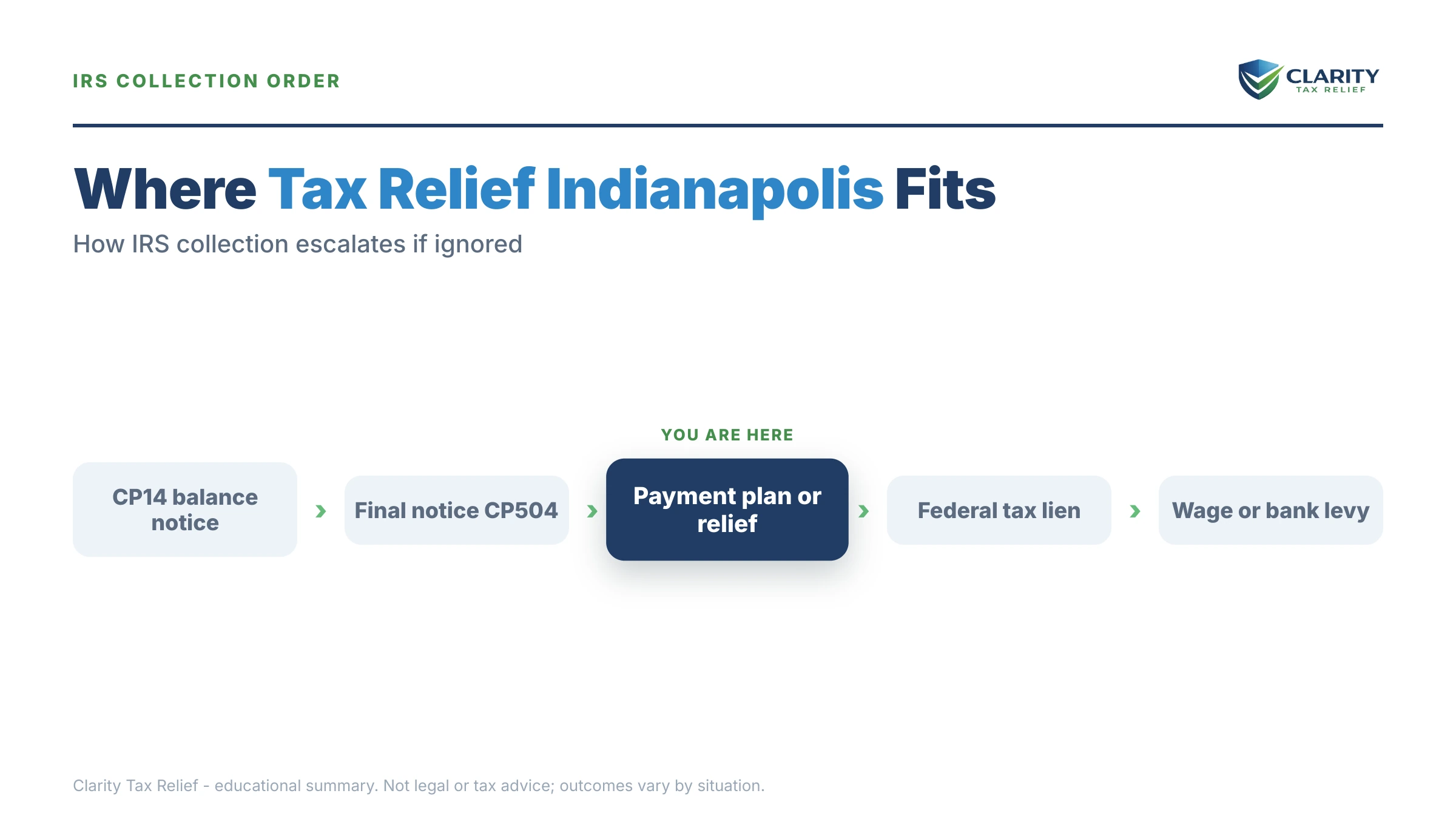
- Pull your exact balances. Log into your IRS online account for the federal number and check INTIME or your latest DOR notice for the Indiana number. You can't pick the right program without both figures.
- File any missing returns. The IRS and the DOR both require you to be current on filings before approving a payment plan, and unfiled years block every relief program.
- Set up your IRS resolution before a lien is filed. Choose the option from the table above that fits your balance and budget, and get it in place while your public record is still clean — an agreement in good standing is what refinance underwriters want to see.
- Set up your Indiana DOR plan separately. An IRS agreement does nothing for your state balance. Arrange the DOR plan through INTIME before a tax warrant reaches the Marion County clerk.
- Request penalty relief once the plans are in place. Ask about first-time abatement on the federal side — and watch for the automatic AEP rollout in summer 2026 — then ask the DOR what penalty waivers apply to your account.
Choosing a tax relief company in Indianapolis
Searching "tax relief Indianapolis" surfaces mostly national firms, and that's fine — this work is done by phone, mail, and online portals, so credentials matter far more than a downtown address. What you're checking for: an enrolled agent, CPA, or tax attorney will personally work your case; the firm quotes a flat fee after reviewing your transcripts, not before; and it has actually handled Indiana DOR warrants, not just IRS cases.
What you're screening out: any firm that promises to settle your debt for "pennies on the dollar" before seeing a single document. That phrase is a sales script, not a legal outcome — the IRS accepted roughly 1 in 5 offers in FY2024, and eligibility is pure math, not persuasion. Our how to choose a tax relief company checklist walks through every question to ask, and if you're comparing the big names, start with our Optima Tax Relief alternatives and Larson Tax Relief alternatives breakdowns.
When you can handle this yourself
Plenty of Indianapolis tax problems don't need professional help, and it would be dishonest to pretend otherwise. You can likely handle it yourself if: you can pay in full within 180 days; you owe $50,000 or less and just need the online streamlined agreement; or you agree with the balance and only need to set up matching DOR and IRS plans and let them run.
Experienced help changes outcomes in specific situations: a lien or tax warrant is already filed and a refinance or sale is pending (the subordination/withdrawal paperwork is unforgiving); you have multiple unfiled years to reconstruct; you owe business or payroll tax, where personal liability rules apply; a levy is already in motion; or your finances might genuinely support an Offer in Compromise, where the Reasonable Collection Potential math decides everything. In those cases, the cost of getting the sequence wrong usually exceeds the cost of the help.
Terms you'll see on your notices, decoded
- Tax warrant — Indiana's collection instrument, filed with the county clerk; it acts like a civil judgment and lien, not an arrest warrant.
- Notice of Federal Tax Lien — the IRS's public claim against everything you own, including your Indianapolis home; it's what title searches find.
- Subordination — the IRS agreeing (via Form 14134) to let a new mortgage jump ahead of its lien so a refinance can close.
- CSED — the Collection Statute Expiration Date; the IRS generally has 10 years from assessment to collect, though appeals, offers, and bankruptcy pause the clock.
- Streamlined installment agreement — an IRS payment plan (balances of $50,000 or less) approved without detailed financial disclosure.
- INTIME — the Indiana DOR's online portal, where you view state balances and set up Indiana payment plans.
Primary sources worth bookmarking: the Indiana Department of Revenue for state balances and INTIME access, the IRS payment plans page for federal agreements, and the Taxpayer Advocate Service if an IRS action is causing hardship the normal channels won't fix.
Indianapolis tax relief questions, answered
Do I need a local Indianapolis tax relief company, or can a national firm help?
Location matters far less than credentials — IRS and Indiana DOR cases are worked by phone, mail, and online portals, not across a desk downtown. What matters is that an enrolled agent, CPA, or tax attorney is authorized to represent you (Form 2848 for the IRS) and has actually handled Indiana tax warrants before. The one exception: if a revenue officer is making field visits, some taxpayers prefer representation that can appear in person.
Can the Indiana Department of Revenue garnish wages in Indianapolis?
Yes — once the DOR files a tax warrant, collection can proceed through the county sheriff or a contracted collection agency, and that can include wage garnishment and bank levies, with collection fees added on top. Because the warrant functions like a judgment, Indiana doesn't need to sue you first. Setting up a DOR payment plan through INTIME before the warrant stage avoids all of it.
Will tax debt stop me from refinancing my Indianapolis home?
Not automatically — filed liens and warrants are what block closings, not the balance itself. If no Notice of Federal Tax Lien or Indiana tax warrant has been filed yet, many lenders will proceed once you show an installment agreement in good standing. If a lien has already been filed, you'll typically need a lien subordination (IRS Form 14134) or a payoff at closing to clear title.
What is an Indiana tax warrant?
An Indiana tax warrant is the DOR's main collection instrument — it's filed with the circuit court clerk in your county (Marion County for most Indianapolis addresses) and functions like a civil judgment against you. It becomes a lien on your real property, appears in public records where lenders search, and authorizes the sheriff or a collection agency to collect. Despite the name, it is not an arrest warrant.
How much does tax relief cost in Indianapolis?
Cost depends on the work, not the city: setting up a straightforward payment plan costs far less than preparing an Offer in Compromise or releasing a levy. Reputable firms quote flat fees after reviewing your IRS transcripts and DOR account, not before. The government's own fees are modest — $0 for an IRS short-term plan and a $205 application fee for an OIC (waived for low-income applicants). Be wary of anyone quoting a large fee before seeing your file.
Can the IRS take my Indiana state tax refund?
Yes. Once you receive a CP504 notice, the IRS can levy your Indiana state refund through the State Income Tax Levy Program without further warning. Indiana can also intercept your state refund for its own unpaid balances. If you owe both agencies, expect refunds from either side to be applied to the debt until the balances are resolved — plan your withholding accordingly.
Does Indianapolis have its own city income tax debt?
There's no separate city tax collector — Marion County's local income tax is reported on your Indiana state return and collected by the Indiana Department of Revenue. If you fall behind, the county share is folded into your DOR balance and resolved through the same DOR payment plan. You will never deal with a third agency for Indianapolis income tax.
Your next 24 hours
- Find your two numbers. Log into your IRS online account and pull your federal balance by year; then check INTIME or your latest DOR letter for the Indiana figure. Write both down — every decision flows from them.
- Gather your file. Last year's tax return, every IRS and DOR notice you've received, a recent pay stub or income statement, and — if a refinance is pending — your lender's contact information.
- Get a free case review. Call (888) 825-7779 or use the 2-minute form. An experienced tax professional will map both balances against the options above and tell you which order protects your home — before penalties, interest, and a possible warrant or lien add to what this costs.
This guide is general information, not tax or legal advice for your specific situation. Eligibility for IRS programs depends on individual facts and circumstances; no outcome is guaranteed.