
State Tax Debt
Hawaii Back Taxes in 2026: GET, DOTAX Collections, and Every Way Out
The short answer: Hawaii back taxes are collected by the Hawaii Department of Taxation (DOTAX), and most balances involve the 4%–4.5% general excise tax (GET) alongside income tax. DOTAX can record a lien, garnish wages, and levy bank accounts — but a payment plan through Hawaii Tax Online generally stops enforcement once your returns are filed.
You're paying Honolulu rent, the freelance work finally steadied out — and now a letter from the Hawaii Department of Taxation says a levy is coming for taxes you didn't know you owed on income you already spent. That sinking feeling is real, and so is the fix: DOTAX resolves these cases every day, and the sequence below shows you exactly where you stand and which door to walk through first.
⏱ Your real clock: the response date printed on your most recent DOTAX letter controls everything. If you're holding a final demand or levy notice, contact collections before that date passes. There is no grace period beyond it — and penalties and interest on Hawaii back taxes keep accruing monthly until the balance is resolved.
Why you owe Hawaii back taxes — and why GET drives most of it
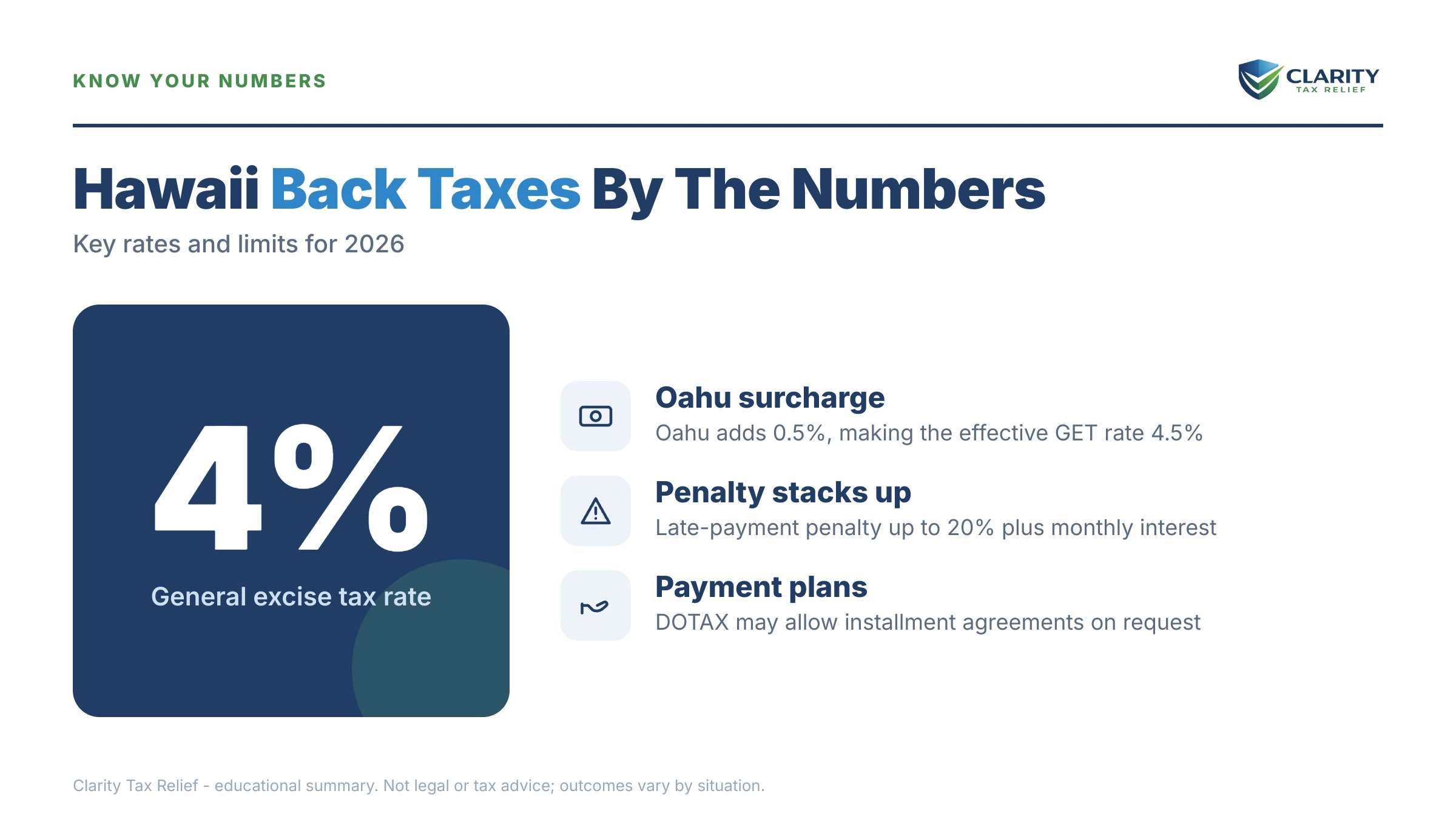
Most Hawaii back-tax balances include general excise tax (GET) — a tax on gross business receipts that has no real equivalent on the mainland. DOTAX administers three revenue streams that routinely turn into surprise debt: GET on nearly all business income, individual income tax with a top rate of 11% (among the highest in the country), and the transient accommodations tax (TAT) on short-term rentals.
The pattern we see over and over: someone freelances, drives, rents out a room, or sells online. They handle (or mostly handle) the IRS side. Nobody tells them Hawaii taxes the gross — before expenses — through GET. Years later, DOTAX matches 1099s and federal data against its records and mails an assessment covering every unfiled period at once.
| Hawaii tax | Rate | Who typically ends up owing it |
|---|---|---|
| General excise tax (GET) | 4% state + 0.5% county surcharge (0.5% on wholesale sales) | Freelancers, contractors, landlords, online sellers — anyone with business or rental income |
| Individual income tax | Graduated, up to 11% | Residents and part-year residents with under-withheld or unreported income |
| Transient accommodations tax (TAT) | 10.25% state, plus a separate county TAT | Airbnb, VRBO, and other short-term rental hosts (stays under 180 days) |
| Employer withholding | Amounts withheld from employee pay | Small businesses that fell behind on payroll remittances |
The GET trap: why so many Hawaii tax debt cases start here
Hawaii's general excise tax applies to nearly every dollar of business income — services, commissions, rents, and retail sales — at 4% plus a 0.5% county surcharge. Unlike a mainland sales tax, GET is legally imposed on your gross receipts, not your customer. You're allowed to pass it on (that's the familiar 4.712% you see on Oahu receipts), but whether you charged it or not, the tax is yours to pay.
Three features make GET a debt machine:
- It taxes the gross, not the profit. A photographer who grossed $50,000 and netted $18,000 after gear and travel still owes GET on the full $50,000. Deductions that shrink your income tax don't shrink GET.
- It has its own license and its own returns. Doing business in Hawaii requires a general excise (GE) license, periodic Form G-45 filings, and an annual Form G-49 reconciliation. Miss the registration and you've missed every filing since — and each unfiled period accrues its own penalties.
- DOTAX assesses non-filers on estimates. When you never filed, the Department can build an assessment from 1099s and industry assumptions. Those estimates routinely run high, because filing your actual returns is the only way to prove the real number.
Long-term residential landlords owe GET on rents. Short-term hosts owe GET and TAT on the same gross — see our guide to Airbnb host tax debt for how those balances stack. And if the income ran through a business you've since shut down, don't assume the debt died with it: Hawaii can pursue responsible individuals for certain unpaid business taxes, the same trap covered in closed business owe sales tax. For the broader playbook on state-level gross-receipts and sales-type taxes, see sales tax debt help.
What happens if you ignore Hawaii back taxes
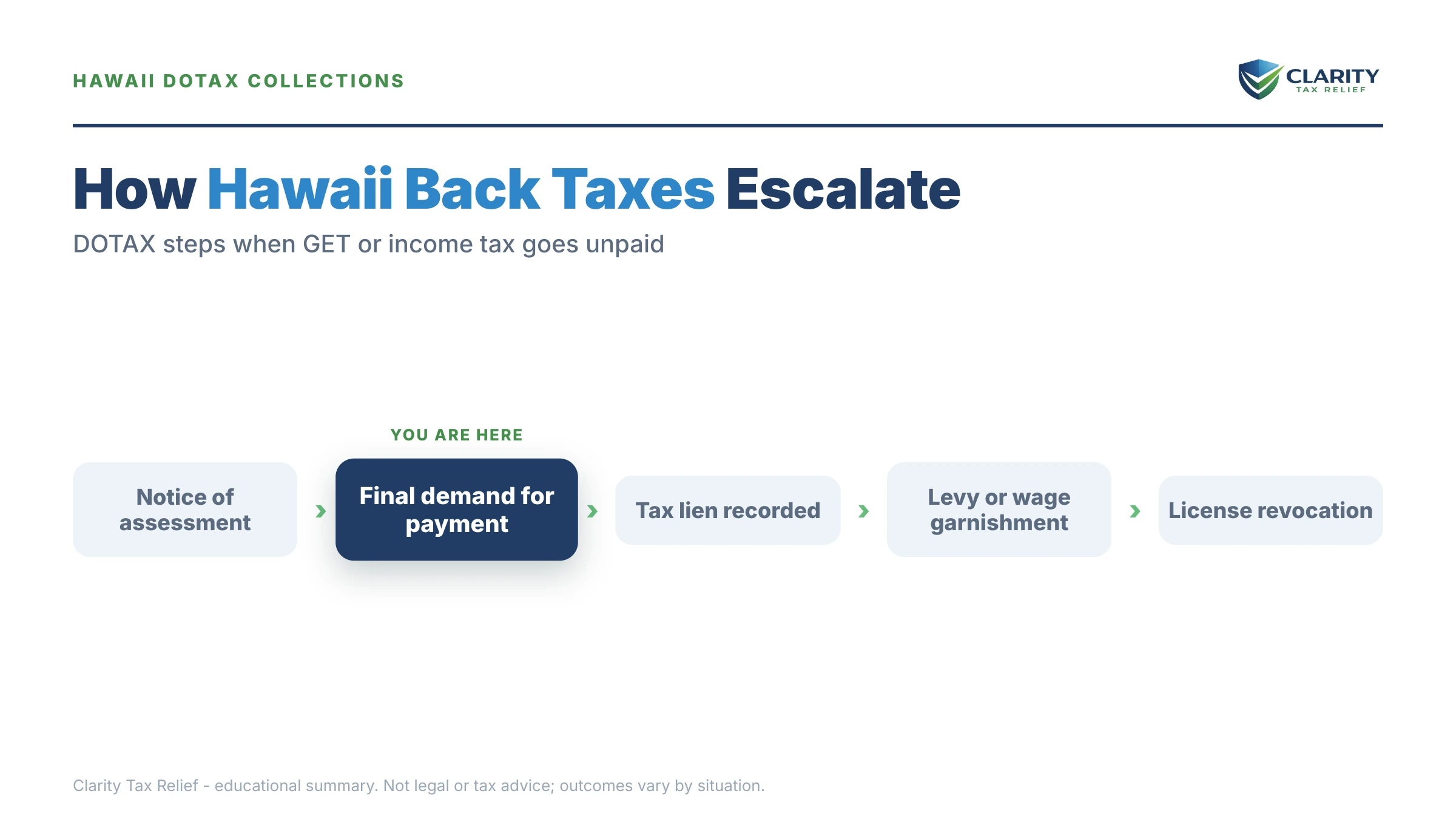
Ignore a DOTAX bill and collection runs from letters to a recorded lien to a bank levy or wage garnishment — no courtroom required. The sequence is orderly, which is good news if you act inside it and expensive news if you don't:
- Assessment and billing notice. DOTAX issues a statement of taxes due showing tax, penalties, and interest by period. This is the cheapest moment in the entire sequence.
- Final demand. A collections letter warns that enforcement is next and gives a response date. That date — not any statute you read online — is your deadline.
- Tax lien recorded. Hawaii records tax liens with the statewide Bureau of Conveyances. It's a public record that attaches to property you own now or acquire later — renters included.
- Levy and garnishment. DOTAX can levy bank accounts, garnish wages, and (for businesses) intercept payments from your customers.
- Refund interception. Your Hawaii refunds are applied to the balance automatically, and offsets can reach other payments owed to you.
- The meter never stops. Interest and penalties accrue through every stage. The balance on today's letter is the smallest it will ever be.
One point renters miss: having no house doesn't make you levy-proof. A paycheck and a checking account are the two easiest things for a state collector to reach — the lien is the slow tool; the levy is the fast one.
Facing a DOTAX levy or final demand right now?
Send us the letter. An experienced tax professional will review your Hawaii back taxes free — what DOTAX can actually take, which option fits your numbers, and what to do before the response date printed on your notice passes.
Your options for resolving Hawaii back taxes
Hawaii resolves most back-tax cases through a payment plan set up on Hawaii Tax Online after all missing returns are filed. The Department's menu is narrower than the IRS's, but every real option is on this table:
| Option | Best fit | What to know |
|---|---|---|
| Pay in full | Small balances you can cover within a billing cycle | Stops all accrual and enforcement immediately; payable through Hawaii Tax Online |
| Payment plan | Most cases — steady income, can't pay at once | Requested via Hawaii Tax Online or collections; all required returns must be filed first; interest continues during the plan |
| Correct an estimated assessment | Non-filers assessed from 1099s and estimates | Filing your actual G-45/G-49 and N-11 returns often shrinks the balance before you negotiate anything |
| Penalty relief | Late filings caused by illness, disaster, or events beyond your control | Hawaii considers reasonable-cause waiver requests; interest generally stays |
| Compromise | Genuine doubt you could ever pay, or doubt you owe it | Exists in Hawaii law but is used sparingly; expect full financial disclosure and strict review |
| Hardship review | Paying anything would leave you unable to cover basics | DOTAX may temporarily hold enforcement on documented hardship; the debt and interest remain |
Two practical notes. First, filing compliance comes before every option — DOTAX generally won't finalize a plan while GET or income returns are open, so if records are the obstacle, start with filing back taxes with no records. Second, get any agreement's terms in writing and calendar the payment dates: a defaulted state plan usually restarts enforcement faster than the first round did.
Here's how those options map to real balance sizes:
| Amount owed | Realistic path | Watch out for |
|---|---|---|
| Under $5,000 | Pay in full or a short plan through Hawaii Tax Online | Letting a small balance ride — the lien and accrual cost more than the tax |
| $5,000 – $25,000 | Monthly payment plan after filing all missing returns; request penalty relief where facts support it | Agreeing to an estimated assessment before filing actual returns that could lower it |
| $25,000 – $100,000 | Plan with financial disclosure likely; compromise only in genuine hardship | Lien recording and faster enforcement; get every term in writing |
| Over $100,000 | Assigned collector, near-certain lien, high levy exposure — representation usually changes the outcome | Business balances (GET, TAT, withholding) that may carry personal exposure for owners and officers |
Say you owe Hawaii $19,700: a worked example
This is a hypothetical, but it's the anatomy of a typical case. Say you're a freelance designer renting in Honolulu. Over three years you grossed about $180,000 on 1099s, filed your federal returns, but never registered for a GE license or filed Hawaii returns. DOTAX matched the 1099s, assessed every open period, and the total came to $19,700: roughly $8,100 in GET (4.5% of $180,000), grown to about $11,000 with penalties and interest, plus about $8,700 in unpaid income tax and additions. Now there's a levy notice aimed at your checking account.
Here's the math on your moves:
- Check the assessment first. If DOTAX estimated your receipts at, say, $240,000 instead of your actual $180,000, filing the real G-45/G-49 returns cuts the GET base by a quarter before you negotiate a dime.
- Call collections before the levy date. A levy on a renter's checking account can swallow rent money overnight. Getting a plan approved — or a hardship review opened — before the response date is what stops it.
- Run the plan numbers. If DOTAX agrees to 36 months, $19,700 ÷ 36 is roughly $547 a month; at 48 months it's about $410. Interest keeps running during the plan, so the true payoff lands somewhat higher — budget for it.
- Ask about penalties. If a documented event — illness, a disaster year, bad professional advice — explains the non-filing, a reasonable-cause waiver request can trim the penalty layer.
Notice what's not on the list: waiting. Every month of silence adds interest, and once the levy executes, you're negotiating to get money back instead of negotiating terms.
When you owe Hawaii and the IRS both
Owing Hawaii back taxes and IRS debt at the same time is common — the same unreported 1099 income triggers both. The agencies collect independently, but they intersect in ways that matter: the IRS can seize your Hawaii refund through the State Income Tax Levy Program, and refunds can be intercepted in both directions, as covered in state refund taken for IRS debt.
The federal side runs on its own rules — none of which apply to DOTAX. The IRS offers short-term plans up to 180 days with no setup fee and online installment agreements up to 72 months for balances of $50,000 or less; its debt generally expires under the 10-year collection statute (with pauses); and federal debt at or above $66,000 can trigger passport certification in 2026. Penalty relief also differs: the IRS offers first-time penalty abatement — being replaced by an automatic exemption starting summer 2026 — while Hawaii relief runs on reasonable cause. You can estimate what the federal side is adding each month with our IRS Penalty & Interest Calculator.
Which to tackle first? Whoever is enforcing. A levy in motion — either agency — jumps the line. If neither has escalated, the full decision framework lives in our guide to state tax debt vs IRS: which to resolve first. The one non-negotiable: both payment plans must fit inside one real monthly budget, because defaulting either restarts that agency's enforcement.
One 2026 wrinkle worth knowing: IRS staffing fell roughly 27% in 2025, which makes the federal side slower to reach — but its automated levies never paused, and DOTAX was never affected at all. Understaffing on the phones is not understaffing in the collection computers.
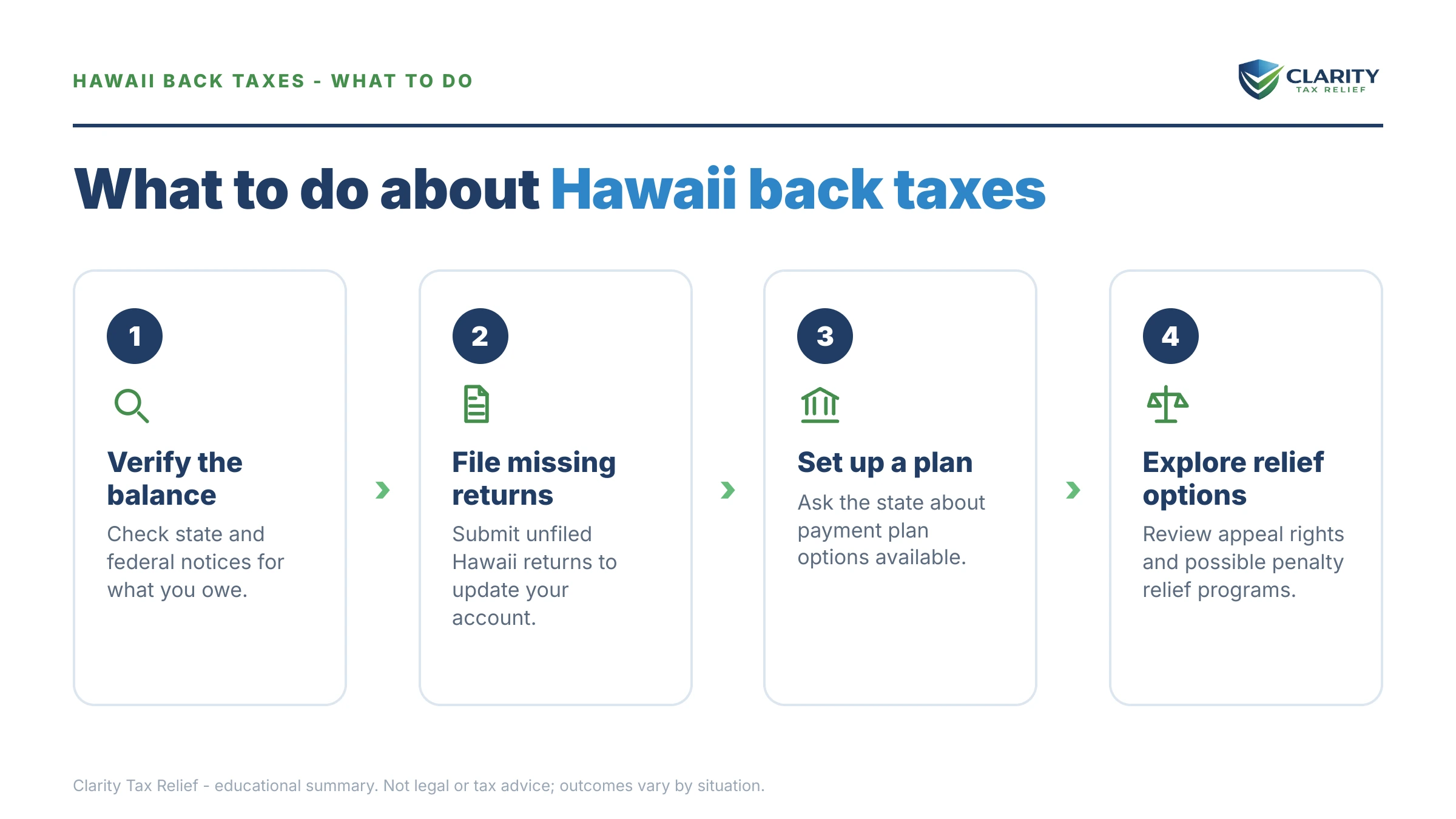
How to respond to Hawaii back taxes, step by step
- Pull your Hawaii records: Create or log into your Hawaii Tax Online account and pull your balance by tax type and period, then compare it against every DOTAX letter you've received.
- File every missing return: Submit any unfiled G-45 and G-49 GET returns and N-11 income returns — DOTAX generally won't finalize a payment plan while required filings are open, and actual returns often shrink estimated assessments.
- Verify the assessment: Check DOTAX's numbers against your real gross receipts and income; estimated assessments built from 1099s routinely overstate what you owe.
- Contact DOTAX collections before your notice date: Call the number on your letter or use Hawaii Tax Online to request a payment plan or hardship review, and get the terms in writing.
- Coordinate the federal side: Check your IRS balance too — unresolved federal debt can reach your Hawaii refund, and both plans have to fit one budget.
- Get a professional review if a levy is active: When a bank levy or garnishment is already in motion, an experienced tax professional can pursue release and negotiate terms while you stay out of the crossfire.
When you can handle this yourself
Plenty of Hawaii back-tax cases don't need professional help — and you should know which kind yours is before you pay anyone. Handle it yourself when:
- The balance is a few thousand dollars, all your returns are filed, and you agree with DOTAX's number — pay it or set a short plan on Hawaii Tax Online and move on.
- You're behind on one or two GET periods with clean records — file the G-45s, pay with them, done.
- You just need a straightforward monthly plan and can keep it current.
Experienced help genuinely changes outcomes when a levy or garnishment is already in motion, when DOTAX has assessed multiple unfiled years on estimates you believe are inflated, when you owe DOTAX and the IRS simultaneously and the budget won't cover both demands, when business taxes (GET, TAT, withholding) create possible personal exposure, or when you're weighing a compromise or hardship case that turns on how your finances are presented. Local context helps too — see tax relief in Honolulu for what resolution looks like on the ground.
If your account is already frozen or your paycheck is being garnished over Hawaii back taxes, a free case review — or a call to (888) 825-7779 — can map the fastest release path before the next pay cycle.
Terms on your Hawaii tax notice, decoded
- GET (general excise tax): Hawaii's tax on gross business receipts — owed by the business on nearly all income, whether or not it was passed on to customers.
- GE license: the general excise license every person or business doing business in Hawaii must hold before earning taxable receipts.
- TAT (transient accommodations tax): the separate state-plus-county tax on short-term rental income (stays under 180 consecutive days), charged on top of GET.
- Assessment: DOTAX's formal determination of what you owe for a period — the amount penalties and interest grow from, and the number you can correct by filing actual returns.
- Lien vs. levy: a lien is a recorded claim against your property (current and future); a levy is the actual seizure of money from a bank account or paycheck.
- Bureau of Conveyances: Hawaii's single statewide recording office — where a DOTAX tax lien becomes a public record visible in any title or background search.
Hawaii back taxes: your questions, answered
Can the Hawaii Department of Taxation levy my bank account?
Yes. Once a Hawaii tax debt is assessed and demand for payment goes unanswered, DOTAX can levy bank accounts, garnish wages, and intercept state tax refunds without going to court first. The most reliable way to stop a levy is to get into a payment arrangement before the response date on your notice passes — enforcement generally pauses once an approved agreement is in place and you stay current.
Does Hawaii offer payment plans for back taxes?
Yes. DOTAX accepts payment plan requests through Hawaii Tax Online or its collections offices, and a plan is how most Hawaii back-tax cases resolve. Expect to be current on all required filings first — open unfiled GET or income returns usually stall approval — and to keep up with new taxes as they come due, since falling behind again typically defaults the agreement.
Does Hawaii settle tax debt for less than the full amount?
Sometimes, but rarely and only on strict terms. Hawaii law lets the Department compromise a liability in limited circumstances — generally where there is real doubt you could ever pay it or genuine doubt you owe it. Most Hawaii cases resolve through a payment plan plus penalty relief instead. Be skeptical of anyone promising a Hawaii settlement before reviewing your finances.
Does Hawaii tax debt expire after 10 years like IRS debt?
No — the 10-year collection statute is a federal rule that applies only to the IRS. Hawaii's collection window is set by state law and runs on its own schedule, so never assume a DOTAX balance will simply age off. Ask DOTAX or an experienced tax professional to confirm the assessment dates and collection deadlines on your specific account rather than waiting it out.
I rent and own no property — can Hawaii still file a tax lien against me?
Yes. A Hawaii tax lien is recorded with the statewide Bureau of Conveyances and attaches to property you own now or acquire later, so it can sit and wait for a future home purchase or inheritance. More importantly for renters, DOTAX doesn't need real estate to collect — bank levies, wage garnishment, and refund interception all work regardless of what you own.
Why do I owe GET if I never charged my customers tax?
Because Hawaii's general excise tax is legally imposed on your business's gross receipts, not on your customer. Passing GET on to the customer — the 4.712% you see on Oahu receipts — is allowed, but it's optional; the tax is owed either way. If you did freelance or contract work without filing G-45 returns, the GET on that income is still due, plus penalties and interest.
Do I owe Hawaii GET on freelance or 1099 income?
Almost certainly yes. Unlike mainland sales taxes, Hawaii's GET applies to services, commissions, and rents — virtually all business income — at 4% plus the county surcharge. You need a general excise (GE) license, periodic Form G-45 filings, and an annual Form G-49 reconciliation. Unfiled years can be assessed by DOTAX based on 1099s and estimates, usually for more than you actually owe.
Should I pay Hawaii or the IRS first if I owe both?
Prioritize whichever agency is actively enforcing — a levy in motion outranks a bill in the mail. If neither has escalated yet, many people address the IRS balance first because federal penalties on larger debts compound alongside consequences like passport certification at $66,000, while keeping a Hawaii payment plan running in parallel. The right order depends on your notice stack, not a universal rule.
Do I owe Hawaii TAT on my Airbnb or short-term rental income?
Yes, if you rent to guests for fewer than 180 consecutive days. Hawaii's transient accommodations tax is 10.25% at the state level, each county layers its own additional TAT on top, and GET applies to the same gross rental income separately. Hosts who never registered often owe both taxes for every unfiled year, which is why vacation-rental balances grow so fast.
Your next 24 hours
- Find three things on your latest DOTAX letter: the total balance, the tax types and periods it covers, and the response date. That date is the only deadline that matters right now.
- Gather your paper: every DOTAX letter, your last filed Hawaii returns (N-11, G-45/G-49 if any), your 1099s and income records for the assessed years, and — if you got a levy notice — the bank account or employer it names.
- Get the free case review before that date passes: use the 2-minute form or call (888) 825-7779. An experienced tax professional will read the notice, check whether the assessment is even right, and lay out the plan that stops the levy — interest is accruing either way, so the review costs nothing and waiting doesn't.
Primary sources: the Hawaii Department of Taxation publishes GET, TAT, and collections guidance, and balances, filings, and payment plan requests run through Hawaii Tax Online. For the federal side of a dual debt, the IRS's official options are at IRS payment plans and installment agreements.
This guide is general information, not tax or legal advice for your specific situation. Eligibility for IRS programs depends on individual facts and circumstances; no outcome is guaranteed.