
City Guides
Tax Relief Honolulu: Your 2026 Options for IRS and Hawaii Tax Debt
The short answer: tax relief in Honolulu means matching your IRS or Hawaii Department of Taxation debt to a real program — a payment plan, hardship status, penalty abatement, or an Offer in Compromise. Most Honolulu taxpayers owing under $50,000 can set up an IRS plan online; state debt goes through DOTAX separately.
The divorce is final, the accounts are divided — and then an IRS envelope shows up at your Honolulu address for a year you filed jointly, with a balance your ex swore was handled. That knot in your stomach is real. So is this: the debt is fixable, and every option on this page gets cheaper the earlier you use it. Here's the complete map, federal and state.
⏱ The clock that matters: there's no single deadline on tax debt itself — but the failure-to-pay penalty adds 0.5% of the balance every month and interest compounds daily until you act. If an IRS notice is in your hand, the response date printed on it controls your rights. Find that date first.
Why Honolulu taxpayers end up needing tax relief
Tax debt in Honolulu usually starts with cash flow, not carelessness — the cost of housing here eats the margin that would otherwise absorb a surprise tax bill. A few patterns come up again and again on Oahu:
The post-divorce withholding shock. The year your filing status flips from married filing jointly to single or head of household, the same paycheck produces a higher tax bill — and if nobody updated the W-4, the shortfall lands in April. Divorces finalized after 2018 add another wrinkle: alimony is no longer deductible to the payer, which surprises a lot of first-year payers. And if the balance itself came from a joint return, the IRS can pursue either ex-spouse for all of it, whatever the decree says — more on that in the options section, because it changes which program you should use.
Untaxed income in a tourism and service economy. Tips, 1099 gig work, short-term rental income, and side businesses all arrive with zero withholding, and self-employment tax stacks on top. One busy season without quarterly payments can create a five-figure balance.
Two agencies collect here, not one. If you're self-employed, you may owe the IRS on your profit and owe Hawaii general excise tax (GET) on your gross receipts — two separate debts, two separate collectors, two separate fixes. The state side is covered below and in our full Hawaii back taxes guide.
Military families. With the large service population around Pearl Harbor–Hickam, multi-state filing tangles and deployment gaps cause real balances. If you or your spouse served in a combat zone, special rules pause deadlines and collection — see combat zone IRS collection relief before you agree to anything.
What happens if you ignore IRS tax debt in Honolulu
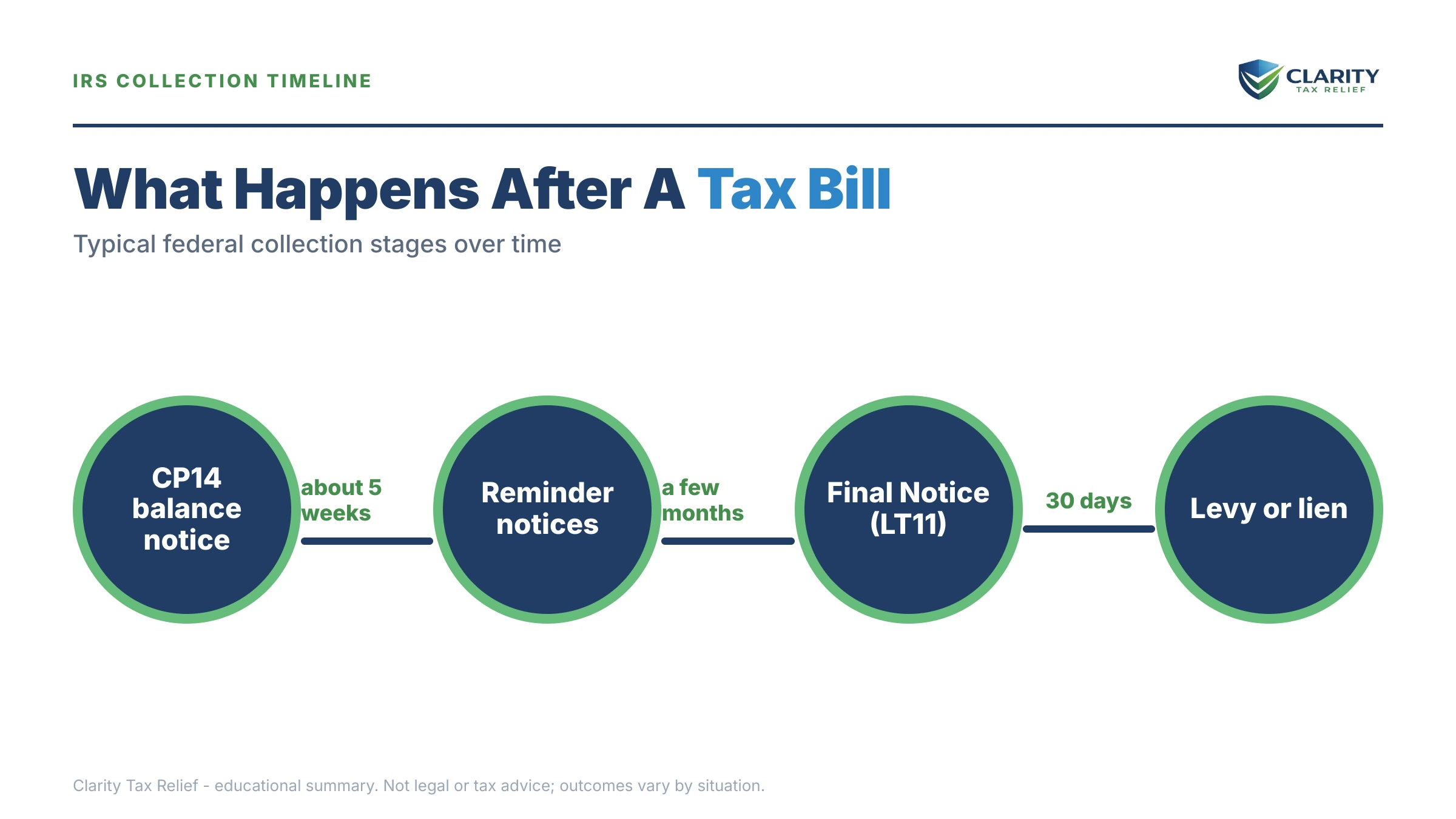
The IRS collection sequence is fully automated, and in 2026 it runs on a workforce roughly 27% smaller than the year before — the notices still go out on schedule even when no human answers the phone. Distance from the mainland buys you nothing; the machine escalates in the same order for a Kalihi address as for one in Kansas:
- CP14 — the first bill. Typically about 21 days to pay before the sequence advances. No enforcement yet; this is the cheapest moment to act.
- CP501 / CP503 — automated reminders. Still just bills, but the balance grows every month they sit.
- CP504 — Notice of Intent to Levy under IRC §6331(d). The IRS can now take your Hawaii state income tax refund, and a federal tax lien becomes a live risk.
- LT11 / Letter 1058 — the final notice. A 30-day clock starts on your right to a Collection Due Process hearing (Form 12153). After it runs, the IRS can levy bank accounts and garnish wages.
- Levy — a bank levy freezes funds for 21 days before they're sent to the IRS; a wage levy continues every payday until released.
Two other tripwires sit alongside that sequence. If your certified debt passes $66,000 (the 2026 threshold), the IRS can certify you to the State Department for passport denial or revocation — a serious problem when you live on an island and travel internationally. And every month of delay compounds: you can estimate what your balance grows into with our IRS Penalty & Interest Calculator.
| Notice | Your response window | What's at stake if it passes |
|---|---|---|
| CP14 (first bill) | Typically 21 days from the notice date | The automated reminder sequence starts; penalties and interest keep compounding |
| CP504 (intent to levy) | The pay-by date printed on the notice | The IRS can seize your Hawaii state tax refund under IRC §6331(d) |
| LT11 / Letter 1058 (final notice) | 30 days | You lose the right to a Collection Due Process hearing (Form 12153) before wage and bank levies begin |
| CP523 (payment plan default) | The date printed on the notice | Your installment agreement terminates and the full balance returns to active collection |
| CP508C (passport certification) | Ongoing while seriously delinquent | Passport denial or revocation once certified debt exceeds $66,000 (2026 threshold) |
Divorce — or a busy season — left you holding an IRS balance in Honolulu?
An experienced tax professional can review your notices free and map the exact program your numbers support — while the monthly 0.5% penalty and daily interest are still small. No pressure, no obligation.
How tax relief in Honolulu actually works: every IRS option compared
Every legitimate tax relief outcome comes from one of six IRS programs — there is no secret seventh program any company can unlock. What a good professional adds is choosing the right one, sequencing it correctly, and defending the numbers. Here's the full menu:
| Option | Typical eligibility (2026) | Cost & what it does |
|---|---|---|
| Short-term payment plan | Any balance you can pay in full within 180 days | $0 setup fee; stops the notice sequence while interest and the 0.5%/month penalty continue |
| Streamlined installment agreement | Balance ≤ $25,000 (or ≤ $50,000 with direct debit); up to 72 months, set up online | Setup fee applies (reduced or waived for low income); no detailed financial disclosure required |
| Guaranteed installment agreement | Balance ≤ $10,000 plus a compliant filing history | Approval is required by statute when the conditions are met |
| Currently Not Collectible | Paying anything would leave you unable to cover basic living costs (shown on Form 433-F) | $0; levies and garnishments stop, but the debt and interest remain |
| Offer in Compromise | Your assets plus future income genuinely can't cover the debt before collection expires | $205 fee + 20% down on lump-sum offers (both waived with low-income certification); the IRS accepted roughly 1 in 5 offers in FY2024 |
| Penalty abatement (FTA / AEP) | Clean compliance for the prior 3 years; AEP becomes automatic starting summer 2026 | Free; removes penalties (and their interest), not the underlying tax |
A few notes the table can't hold. The streamlined installment agreement is the workhorse for most Honolulu balances — fast, online, no financial statement. Currently Not Collectible matters here because the IRS's hardship math uses local living-cost standards, and Honolulu's housing costs are among the highest the IRS recognizes — a rent that would sink a hardship claim in Ohio can support one on Oahu. And first-time penalty abatement is the most under-used option on the list: if this is your first slip in three years, a single request can strip the penalties before you even talk about the tax.
The divorce-specific option most people miss: if the balance came from a joint return and traces to income your ex hid or deductions your ex invented, you may not need a payment program at all — innocent spouse relief (Form 8857) or separation-of-liability relief can remove the debt from you entirely. The IRS doesn't care what your decree says about who pays; only these relief provisions do. Our guide to who pays IRS debt after divorce walks through which relief fits which facts.
If you want to run the whole process without hiring anyone, the mechanics for every option live in our DIY pillar on how to settle tax debt yourself.
A worked example: owing $23,800 after a Honolulu divorce
Say you owe $23,800 — a joint-return balance from your last married year, now landing on you alone. Here's how the three most likely paths price out (hypothetical numbers, real mechanics):
Path 1 — streamlined installment agreement. At $23,800 you're under the $25,000 line, so no financial disclosure is needed. Spread over the maximum 72 months, the floor payment is about $23,800 ÷ 72 ≈ $331 a month — and because interest and the 0.5% monthly penalty keep accruing inside the plan, the real cost runs higher. Push the payment to $600 a month and you're done in roughly four years with far less interest paid.
Path 2 — Offer in Compromise. The IRS decides offers using Reasonable Collection Potential: your asset equity plus your monthly disposable income times 12 (for a lump-sum offer). If Honolulu rent and the IRS's local expense allowances leave you $75 a month of disposable income, you have no home equity, and your car is worth less than the exemption, your RCP is roughly $75 × 12 = $900 plus any remaining asset value — dramatically less than $23,800. That's the kind of gap that makes an offer worth pursuing, but remember only about 1 in 5 offers were accepted in FY2024, and the math has to survive IRS scrutiny. You can estimate your own numbers with our Offer in Compromise Calculator.
Path 3 — innocent spouse relief. If that $23,800 exists because your ex left self-employment income off the joint return without your knowledge, Form 8857 may take you off the hook for it entirely — no monthly payment, no offer. It's slower and fact-intensive, but it's the only path that can make the debt not yours.
Which path wins depends on your transcript, your budget, and how the debt arose — which is exactly what a competent case review sorts out before you pay anyone anything.
Hawaii state tax debt: DOTAX and the general excise tax
The Hawaii Department of Taxation collects state tax debt on its own track, with its own rules — nothing you arrange with the IRS touches your Hawaii balance. That surprise catches a lot of taxpayers who resolve the federal side and assume they're done.
The state debt Honolulu business owners hit most is GET — Hawaii's general excise tax, charged on gross receipts, not profit. The base rate is 4%, with a county surcharge on Oahu, and because it applies to gross income, a business that lost money can still owe it. Freelancers, rideshare drivers, and short-term rental hosts are all in scope, and many don't learn that until a DOTAX notice arrives. State collectors also tend to move faster on business-tax balances than the IRS does, so a GET debt often deserves attention first even when it's smaller.
Don't apply IRS figures to the state: Hawaii's payment-plan terms, appeal windows, and collection timelines are its own, and they change. Confirm current requirements directly with the department at tax.hawaii.gov, and see our Hawaii back taxes guide for the state-side playbook. If your debt is business-related on both fronts — GET plus federal payroll or self-employment balances — the buyer's guide to tax relief for small business covers how those cases differ.
How to get tax relief in Honolulu, step by step
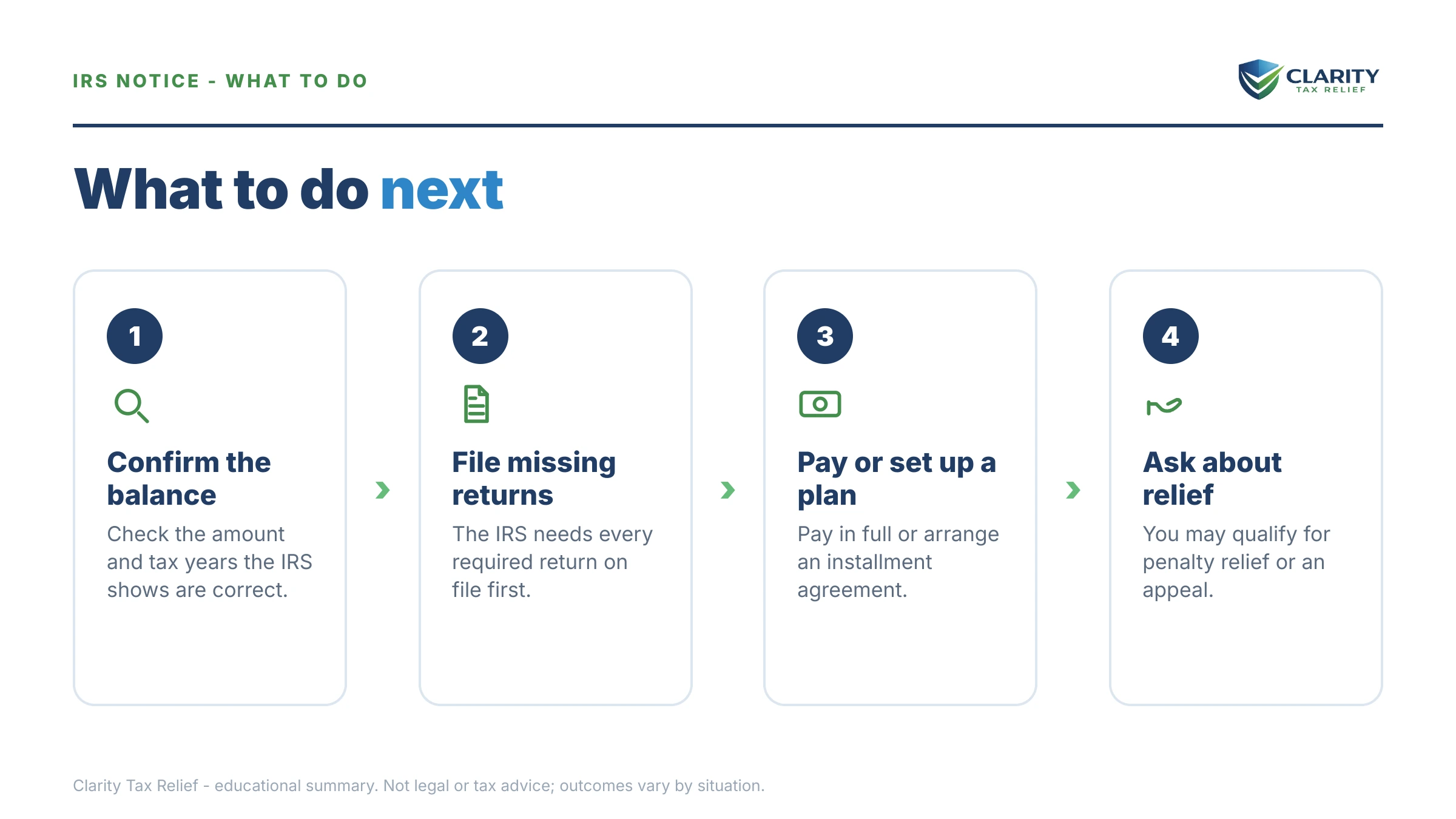
- Pull your IRS records. Create or log in to your IRS online account to see every year's balance, penalties, interest, and filing status before you commit to anything.
- Check your Hawaii DOTAX account separately. Your state balance is a different debt owed to a different agency — confirm what Hawaii shows at tax.hawaii.gov before you build a plan around the IRS number alone.
- File any missing returns. The IRS won't approve a payment plan or an offer while required returns are unfiled — and the failure-to-file penalty runs 10 times the failure-to-pay penalty (in months where both apply, the failure-to-file portion drops to 4.5 percent, for 5 percent combined), so filing always comes first.
- Match your finances to one program. Use the options table above — 180-day plan, installment agreement, hardship status, Offer in Compromise, or penalty abatement — and pick the one your actual numbers support.
- Set it up before the next notice lands. Every arrangement made at the CP14 or CP501 stage is cheaper and simpler than the same arrangement made after an LT11, when levy rights are already in motion.
When you can handle this yourself — and when help changes the outcome
Plenty of Honolulu tax debts don't need a professional, and it's worth saying so plainly. Handle it yourself when: you agree with the balance and can pay it within 180 days ($0 setup, five minutes online); you owe under $25,000 and just need a streamlined monthly plan; or you got a single first notice and the fix is obvious. Set-up instructions are on the IRS payment plans page, and if a levy or delay is causing genuine hardship and you can't get traction, the Taxpayer Advocate Service exists for exactly that.
Experienced help earns its fee in a different set of situations: a levy or garnishment already in motion, multiple unfiled years that have to be reconstructed and sequenced, joint-return debt where innocent spouse relief is in play (these cases are won or lost on how the facts are documented), business debt spanning the IRS and DOTAX at once, and Offer in Compromise math — where a badly built offer wastes months and money. The single best predictor of a good outcome is whether a credentialed professional reviews your IRS transcripts before anyone quotes a strategy.
If you do hire someone, hire carefully. Our how to choose a tax relief company checklist covers the questions that separate real firms from sales floors, our breakdown of how much tax relief costs — see how much does tax relief cost — shows what fair pricing looks like, and if you've been quoted big numbers by a national brand, compare the Optima Tax Relief alternatives before signing anything.
Terms you'll see on your notices, decoded
Levy: the IRS actually taking money or property — a bank account, a paycheck, a state refund.
Lien: a legal claim recorded against everything you own to secure the debt; it takes nothing by itself but clouds sales and refinances.
CSED: the Collection Statute Expiration Date — the IRS generally has 10 years from assessment to collect, though offers, appeals, and bankruptcy pause the clock.
CDP hearing: the Collection Due Process appeal (Form 12153) you can demand within 30 days of a final levy notice — your strongest procedural right.
RCP: Reasonable Collection Potential — the asset-plus-future-income formula the IRS uses to decide whether to accept an Offer in Compromise.
GET: Hawaii's general excise tax, charged by DOTAX on gross business receipts — a state debt entirely separate from anything federal.
Tax relief in Honolulu: your questions, answered
Do I need a Honolulu-based tax relief company, or can a national firm help?
IRS tax problems are federal, so location doesn't matter — a qualified representative anywhere in the country can be authorized on your account with Form 2848 and handle everything by phone, mail, and the IRS's online systems. Hawaii Department of Taxation matters are also handled remotely in most cases. What matters far more than the office address is whether the firm puts a credentialed professional — an enrolled agent, CPA, or attorney — on your case.
Does Hawaii have its own tax relief programs?
Yes — the Hawaii Department of Taxation runs its own collection process with its own payment-plan and settlement procedures, and they are completely separate from anything you arrange with the IRS. Resolving your federal debt does nothing for a state balance, and vice versa. Because state terms change and differ from federal rules, confirm current requirements directly with DOTAX at tax.hawaii.gov before assuming an IRS rule applies to Hawaii.
My ex-spouse caused the tax debt — am I still responsible after the divorce?
If the debt comes from a jointly filed return, the IRS can collect the full amount from either of you, no matter what your divorce decree says — the decree binds your ex, not the IRS. Your escape routes are innocent spouse relief (Form 8857) if your ex understated income or overstated deductions without your knowledge, or separation-of-liability relief, which can split a joint debt after a divorce. Both are fact-specific, and deadlines can apply, so raise them early.
Can the IRS garnish wages or bank accounts in Honolulu?
Yes — federal levy power applies fully in Hawaii. A bank levy freezes the funds for 21 days before the bank sends them to the IRS, which is your window to get it released, and a wage levy continues every payday until the debt is resolved or the levy is lifted. The IRS must first send a final notice (LT11 or Letter 1058) and give you 30 days to respond before those levies can begin.
How much does tax relief cost in Honolulu?
Simple cases can cost nothing: you can set up an IRS payment plan yourself online, and the IRS charges $0 for a short-term plan of up to 180 days. Professional representation typically runs from several hundred dollars for straightforward work to several thousand for complex cases like an Offer in Compromise or innocent spouse claim. Be wary of any firm quoting a large fee before anyone has actually reviewed your IRS records.
Will the IRS take my Hawaii state tax refund?
It can. Once the IRS issues a CP504 notice, it has authority under IRC §6331(d) to seize your state income tax refund and apply it to your federal balance. This is usually the first asset the IRS actually takes, because it doesn't require the final levy notice that wage and bank levies do. If you're expecting a Hawaii refund and owe the IRS, assume it's at risk until the debt is in a resolution.
Is there free help with tax debt in Honolulu?
Yes. If your income is modest, a Low Income Taxpayer Clinic can represent you in IRS disputes for free or a nominal fee, and the Taxpayer Advocate Service helps when the normal IRS process has failed you or a levy is causing hardship. You can also set up most IRS payment plans yourself at no professional cost at IRS.gov — the short-term 180-day plan has no setup fee at all.
I'm behind on Hawaii general excise tax — is that the same as owing the IRS?
No — GET is a Hawaii state tax on your gross business receipts, collected by the Department of Taxation, and it has nothing to do with your federal account. States tend to move faster than the IRS on business-tax balances, so a GET debt often needs attention first even when the IRS balance is bigger. You'll need separate arrangements with each agency, and paying one never reduces the other.
Your next 24 hours
- Find the newest notice in the pile and locate two things: the notice code in the corner (CP14, CP504, LT11) and the response date printed on it. That tells you exactly which stage you're at on the table above.
- Gather three items: your most recent tax return, every IRS and DOTAX notice you've received, and a rough picture of your monthly income and rent — that's everything needed to match you to a program.
- Get the free case review. Call (888) 825-7779 or use the 2-minute form and an experienced tax professional will decode your notices and map your Honolulu options — federal and state — while interest and the monthly penalty are still small.
This guide is general information, not tax or legal advice for your specific situation. Eligibility for IRS programs depends on individual facts and circumstances; no outcome is guaranteed.