
IRS Forms
Form 433-F: How to Fill Out the IRS Collection Information Statement (2026)
Form 433-F, how to fill out: work through the two-page form's lettered sections — assets in A–D, business and wage income in E–F, household income in G, and monthly living expenses in H — using three-month averages and the IRS's Collection Financial Standards for expenses. Sign it under penalties of perjury and send it by the date on the letter that requested it.
You asked the IRS for a payment plan or hardship status — or an LT27 landed demanding your finances — and now a blank two-page disclosure wants every bank account, asset, and monthly bill you have. It feels invasive. It's also your leverage: in 2026, the numbers you write on Form 433-F are what decide your monthly payment, not the IRS's opening demand.
This guide walks the form line by line, shows how the IRS reworks your Section H expenses, and runs the full math on a hypothetical $68,500 self-employed balance. The image below shows exactly what the two-page form looks like and where each lettered section sits — worth keeping in view as you work through it.
⏱ Your deadline: the response date printed on the letter that requested your Form 433-F — usually an LT24 notice or LT27 notice, or a date an ACS agent gave you by phone. Miss it and your request is closed without your numbers while penalties and interest keep accruing monthly on the full balance.

Why the IRS is asking you for Form 433-F
Form 433-F is the financial statement the IRS's Automated Collection System (ACS) uses to measure your ability to pay before granting anything beyond a standard payment plan. If you got a letter demanding it — that's the shortest version of why you got a letter from the IRS at all: the system wants proof before it says yes.
Three situations put this form on your desk:
- Your balance is too big for a streamlined plan. Online payment plans run up to $50,000 over as long as 72 months with no financial disclosure. Owe more — like the $68,500 in our example — and the IRS wants a 433-F before it agrees to terms. See IRS payment plan over $50,000.
- You're claiming you can't pay. Currently not collectible status, a lowered payment, or a partial-pay agreement all require the IRS to verify hardship with this exact form. It's the test at the center of how to qualify for CNC.
- The IRS demanded it directly. An LT24 or LT27 tells you ACS won't discuss your account further until the completed statement arrives.
One reframe before you start: this form is not a trap. It's the mechanism that converts "the IRS wants everything now" into "the IRS accepts what you can actually afford." Filled out carelessly, though, it can lock you into a payment that's too high for years.
Form 433-F vs. Form 433-A vs. 433-A(OIC): use the right one
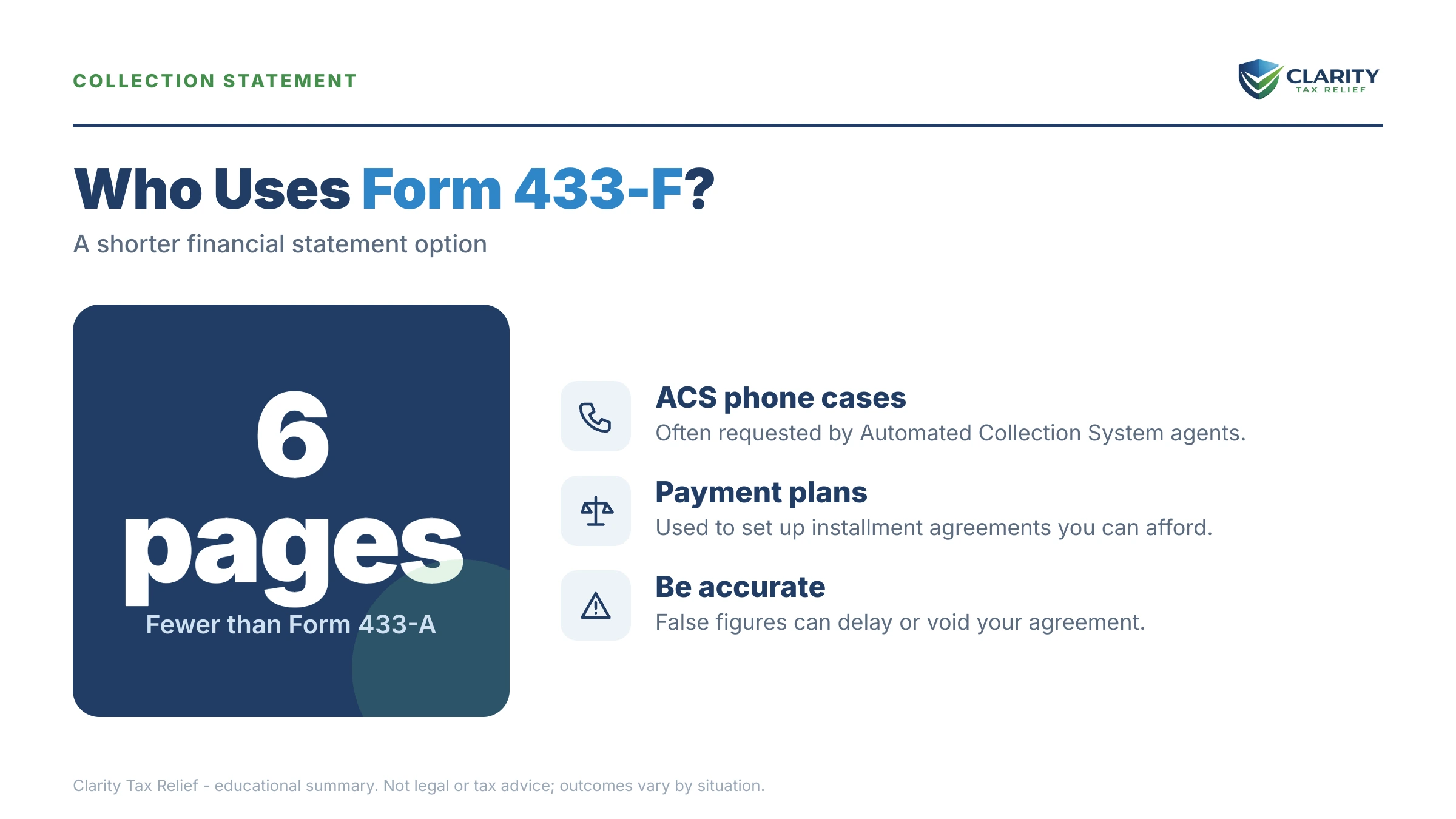
Form 433-F is the short form for cases handled by ACS — the automated phone-and-mail side that manages most tax debts. If a revenue officer has been personally assigned to your case, they'll require the longer Form 433-A instead; our Form 433-A walkthrough covers that version. If you're pursuing an Offer in Compromise, the offer package uses Form 433-A(OIC), not this form.
The practical rule: use whichever form the IRS letter or employee names. Sending a 433-F to a revenue officer who asked for a 433-A just restarts the clock.
How to fill out Form 433-F, section by section
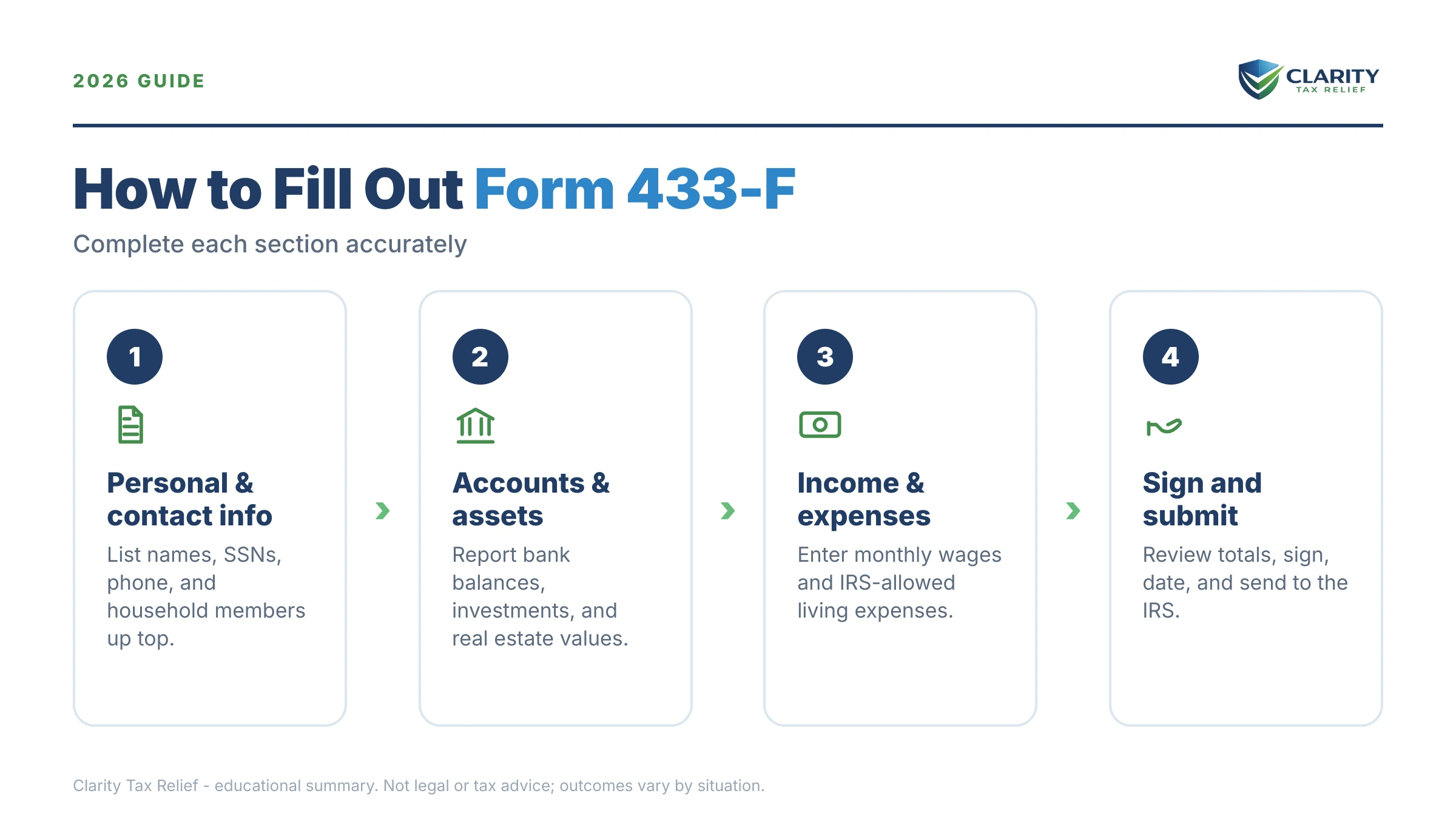
Form 433-F has a personal-information block at the top and eight lettered sections, A through H, across two pages. Here's the map, then the guidance that matters for each part.
| Section | What goes there | Most common mistake |
|---|---|---|
| Top block | Name, SSN, address, county, phone numbers, dependents claimed | Leaving the county blank — it sets your local housing standard |
| A — Accounts / lines of credit | Checking, savings, investment, and retirement accounts; online payment accounts | Omitting PayPal, Venmo, or other app balances the IRS can see |
| B — Real estate | Your home and any other property, with value and loan balance | Guessing a value with nothing to support it |
| C — Other assets | Vehicles, whole life insurance cash value, equipment, boats | Listing the loan but not the asset's current value |
| D — Credit cards | Card limits, balances, and minimum payments | Assuming card payments count as allowable expenses (they usually don't) |
| E — Business information | Accounts receivable and whether you accept credit cards | Sole proprietors skipping it because they "have no business assets" |
| F — Employment | W-2 wage income for you and your spouse | Self-employed filers forcing business income in here |
| G — Non-wage household income | Net self-employment income, rental income, Social Security, pensions, support | Reporting gross receipts instead of net — inflating what you can pay |
| H — Monthly living expenses | Food, housing, transportation, medical, taxes, court-ordered payments, child care | Forgetting current-year estimated tax payments as an expense |
The top block and Sections A–D: your assets
List every account and asset, even ones with small or zero balances. The IRS already receives interest, dividend, and 1099-K data tied to your SSN, so an "overlooked" account reads as concealment on a sworn statement. For each asset, show both the current value and any loan against it — the IRS cares about equity, not sticker price. A truck worth $18,000 with a $16,500 note is $1,500 of equity, not an $18,000 asset.
Retirement accounts belong in Section A too. Listing them doesn't mean the IRS will demand you drain them, but leaving them off is the kind of omission that sinks credibility for the whole form.
Sections E–G: income, and the self-employed trap
If you're a sole proprietor, three things change. First, complete Section E — accounts receivable are an asset the IRS can levy, and it will ask. Second, Section F likely stays blank unless you also hold a W-2 job. Third, your business income goes in Section G as net self-employment income: receipts minus ordinary business expenses, averaged over the last three months or longer if your income swings seasonally.
The gross-versus-net mistake is the single most expensive error on this form. Write $9,400 of monthly deposits in Section G when your true net is $5,100, and the IRS will build your payment plan on income you don't keep. Back your net figure with a simple profit-and-loss statement so ACS doesn't default to your bank deposits.
Section H: expenses — where the form is really decided
Section H is where the IRS calculates your "ability to pay": income minus allowable expenses equals the monthly payment it expects. Claim every category that applies — food, clothing and miscellaneous; rent or mortgage plus utilities; vehicle payments and operating costs; health insurance and out-of-pocket medical; child care; court-ordered payments; term life insurance; and current federal and state taxes, including your quarterly estimated payments.
That last line deserves emphasis for the self-employed: your current-year estimated tax payments are an allowable expense, and claiming them does double duty — it lowers your calculated ability to pay and keeps you compliant so the new arrangement doesn't default the moment next year's return lands.
The expense caps: how the IRS rewrites your Section H
The IRS does not simply accept your expense numbers — it compares them to its Collection Financial Standards and caps several categories. Food, clothing, and miscellaneous items are capped at a national standard by household size. Housing and utilities are capped at a local standard for your county (that's why the top-block county field matters). Vehicle ownership and operating costs get their own caps. Health costs, current taxes, child care, and court-ordered payments are generally allowed at your actual, documented amounts.
Two consequences follow. First, every dollar of expense the IRS disallows becomes a dollar added to your proposed monthly payment — so know the caps before you agree to anything on the phone. Second, if you can fully pay the balance within roughly six years, the IRS can often accept your actual expenses without applying the caps at all, a point most taxpayers never think to raise. Our guide to the IRS allowable living expenses standards breaks down each category; the current tables are published on the IRS's Collection Financial Standards page (linked at the bottom of this article).
What happens if you ignore a Form 433-F request
An unanswered Form 433-F request doesn't pause your case — it closes the door you were trying to open and puts the account back on the enforcement track. The sequence runs in this order:
- Your request dies. ACS closes the payment-plan or hardship review without your numbers. Nothing was decided in your favor because you gave the system nothing to decide with.
- The collection notice track resumes. Balance-due and intent-to-levy notices restart, each adding accrued penalties and interest to the total.
- The final notice arrives. An LT11 or Letter 1058 starts a 30-day clock, after which levies are authorized. Your Collection Due Process rights at that stage are requested with Form 12153 — but you'll be handing the appeals officer the same financial statement you're avoiding now, with a worse balance.
- Levies begin. Bank levies come with a 21-day hold before funds leave; for a sole proprietor, levies can also reach accounts receivable and customer payments, which cuts off business cash flow directly.
- Passport certification. At $66,000 or more in 2026, a seriously delinquent tax debt can be certified to the State Department — a threshold the $68,500 reader in our example has already crossed. See passport revoked for tax debt.
One 2026-specific note: with IRS staffing down roughly 27% since 2025, reaching a human at ACS can take multiple long calls — but the notice and levy systems are automated and never slowed down. Submitting a complete, accurate 433-F the first time matters more than ever, because getting a second chance to explain it takes weeks you may not have.
Staring at a blank Form 433-F right now?
The numbers you put on this form set your monthly payment — or your hardship status — for years. Before you send it by the date on your LT24 or LT27, let an experienced tax professional review your figures free. No pressure, no obligation.
What your Form 433-F numbers qualify you for
The same completed form can lead to four very different outcomes, and which one you land in depends entirely on the math it contains. Here's the map:
| Resolution | Typical eligibility | 433-F required? | What the IRS checks |
|---|---|---|---|
| Guaranteed installment agreement | Owe $10,000 or less; full pay within 3 years | No | Filing compliance only |
| Streamlined installment agreement | Owe $50,000 or less; up to 72 months (direct debit at the upper range) | No | Balance and term, not finances |
| Non-streamlined installment agreement | Owe over $50,000, or need a lower payment than the balance supports | Yes | Disposable income and asset equity |
| Partial payment installment agreement | Affordable payment won't full-pay before the CSED | Yes, with periodic re-reviews | Income, expenses, equity, and time left to collect |
| Currently not collectible status | Allowable expenses equal or exceed income | Yes | The hardship math in Sections G and H |
| Offer in Compromise | Assets plus future income can't cover the debt | No — uses Form 433-A(OIC) instead | Reasonable collection potential |
Notice what this table implies: interest and the failure-to-pay penalty keep accruing under every option, including CNC. The form doesn't erase debt — it determines how, and how fast, the IRS collects it.
A worked example: $68,500 owed, self-employed
Say you owe $68,500 in self-employment tax across two years as a sole proprietor. Every number below is hypothetical, but the mechanics are exactly what ACS runs on your form.
Income (Section G): your last three months of receipts average $9,400/month; ordinary business expenses average $4,300. Net self-employment income: $5,100/month — the figure that goes on the form, not the $9,400.
Expenses (Section H, after standards): you claim $2,050 in rent and utilities, but say your county's local standard allows $1,650. Add a hypothetical $780 national food/clothing standard, $480 vehicle ownership, $290 vehicle operating, $310 health insurance, $75 out-of-pocket medical, and $615 in quarterly estimated tax payments. Allowable total: $4,200.
The result: $5,100 − $4,200 = $900/month of disposable income. At $900/month, $68,500 full-pays in about 76 months — before counting accruing interest. Now the collection statute decides the outcome:
- If roughly 90 months remain before the 10-year collection statute expires, $900 × 90 = $81,000 — full payment is possible, so ACS proposes a non-streamlined installment agreement around $900/month.
- If only 60 months remain, $900 × 60 = $54,000 — less than $68,500. That's partial-pay territory: you pay $900/month until the statute runs, and the remainder legally expires (though the clock can be paused by appeals, offers, or bankruptcy). You can estimate how much time the IRS has left on your debt with our CSED Calculator.
And see what the disallowed $400 of housing did: it raised the IRS's payment demand by $400/month — $4,800 a year — which is exactly why Section H deserves more care than any other part of the form. Note also that at $68,500 this taxpayer sits above the $66,000 passport certification threshold; getting into an approved agreement is what prevents or reverses that certification.
How to fill out and submit Form 433-F, step by step
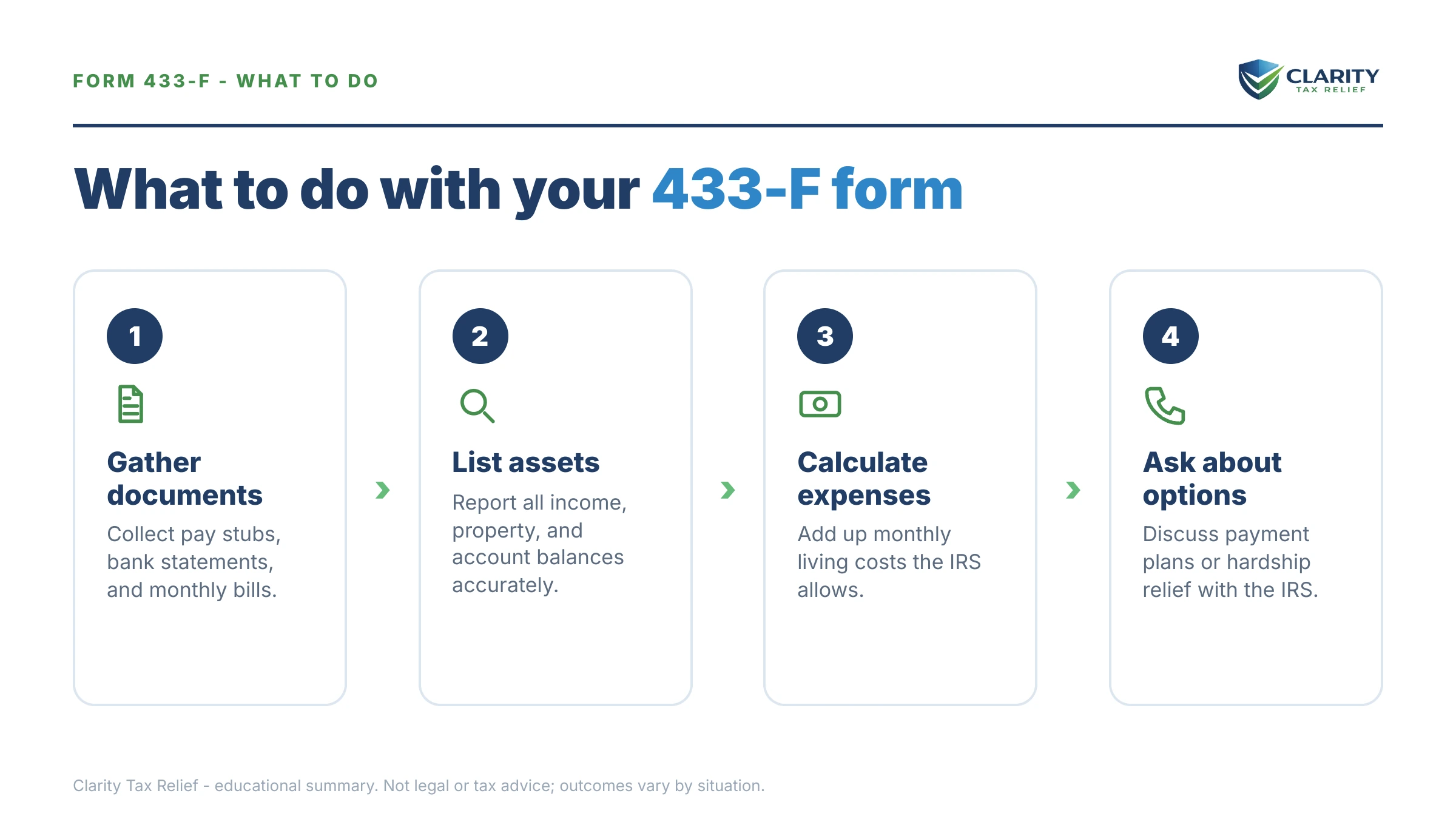
- Gather three months of records. Bank statements, pay stubs or a profit-and-loss statement, and bills for housing, utilities, insurance, child care, court-ordered payments, medical costs, and estimated tax payments.
- Complete the asset sections (A through D). List every bank, investment, retirement, and online payment account, plus real estate, vehicles, and credit cards, with honest current values and loan balances.
- Report income as a three-month average. Wages go in Section F; net self-employment income — receipts minus ordinary business expenses — goes in Section G, along with any other household income.
- List expenses against the IRS standards in Section H. Claim your actual costs, but know which categories the Collection Financial Standards cap before you agree to a monthly payment.
- Sign, date, and send it by your deadline. Fax or mail it to the number or address on the letter that requested it, and keep a complete copy with proof of the date you sent it.
- Confirm the outcome in writing. Call ACS to verify receipt, then get the result — installment agreement terms on Form 433-D or currently not collectible status — documented before you consider the matter closed.
Here's how the common triggers line up against your clock and what's at stake with each:
| How the request arrived | Your clock | What you risk by missing it |
|---|---|---|
| LT24 notice — IRS wants a completed Form 433 and proposed terms | The response date printed on the letter | Account returns to the enforcement track; levy notices resume |
| LT27 notice — IRS wants Form 433-F specifically | The response date printed on the letter | Your plan or hardship review is closed without your numbers |
| ACS phone request during a call | The fax-by date the agent gives you | The arrangement you discussed is never finalized |
| You're requesting an installment agreement over $50,000 | No fixed date — but penalties and interest accrue monthly | No agreement; collection notices continue escalating |
| You're requesting currently not collectible status | No fixed date — levy track continues until approved | Enforcement can proceed while the hardship claim sits unproven |
When you can fill out Form 433-F yourself — and when to get help first
Plenty of people can and should handle this form alone. If you're a W-2 employee with simple finances, one tax year owed, and expenses comfortably inside the standards, the form is genuinely a fill-in-the-boxes exercise — gather your documents, be accurate, and send it on time. The same goes if you agree with the balance and just need the IRS to approve a payment you can clearly afford.
Experienced help changes the outcome in specific situations: self-employment income the IRS may recompute from gross deposits, multiple unfiled years that must be resolved before any agreement sticks, a levy already in motion, meaningful equity in a home or business assets the IRS wants tapped, or a balance where partial-pay versus CNC versus full-pay turns on statute math. In those cases, how the form is prepared — which expenses are claimed, how income is averaged, whether the six-year rule applies — can swing the monthly payment by hundreds of dollars. A professional can also file Form 2848 and handle the ACS calls so you never sit on hold at all.
If your situation looks more like the second list than the first, a free case review before you submit costs nothing and can't hurt — request it here or call (888) 825-7779.
Terms on the form and your letter, decoded
- Collection Information Statement — the IRS's name for its financial disclosure forms; 433-F is the short version used in automated collections.
- ACS (Automated Collection System) — the IRS's centralized phone-and-notice operation that handles most tax debts without an assigned officer.
- Collection Financial Standards — the national and local expense caps the IRS applies to Section H when calculating what you can pay.
- CSED — Collection Statute Expiration Date; the IRS generally has 10 years from assessment to collect, though appeals, offers, and bankruptcy pause the clock.
- PPIA (partial payment installment agreement) — a monthly plan that won't pay the debt in full before the CSED; the rest expires when the statute runs.
- Currently not collectible — a status that pauses levies when your allowable expenses meet or exceed your income; the debt and interest remain.
Form 433-F questions, answered
What is Form 433-F used for?
Form 433-F is the short, two-page Collection Information Statement the IRS uses to decide what you can afford to pay on a tax debt. The IRS's Automated Collection System (ACS) reviews it when you request a payment plan on a balance over $50,000, ask for hardship (currently not collectible) status, or receive a notice like LT24 or LT27 demanding it. Your numbers on this form set your monthly payment — or prove you can't make one.
Do I need Form 433-F or Form 433-A?
You use Form 433-F when your case sits with the IRS's automated collection system — the phone-and-mail side that handles most balances. Form 433-A is the longer, more detailed statement a revenue officer requires once a human is assigned to your case, and Form 433-A(OIC) is the version attached to an Offer in Compromise. If an IRS letter or agent names a specific form, use that one.
Where do I send Form 433-F?
Send it wherever the letter that requested it says — typically the fax number or mailing address printed on your LT24 or LT27 notice. If an ACS agent requested it by phone, they will usually give you a fax number so they can review it during or shortly after the call. Always keep a complete copy, note the date you sent it, and call to confirm it was received.
Do I have to include my spouse's income on Form 433-F?
Generally yes — Section G asks for household income, and the IRS looks at the whole household's ability to pay shared expenses even when only one spouse owes. If your spouse has no liability, the IRS still uses their income to figure out what share of household expenses your income realistically covers. Community-property states add another layer, so get advice before leaving a non-liable spouse's income off entirely.
What documents should I have ready to back up Form 433-F?
Have three months of bank statements, pay stubs or a profit-and-loss statement if self-employed, and bills for rent or mortgage, utilities, insurance, child care, court-ordered payments, and out-of-pocket medical costs. The form itself doesn't always require attachments, but ACS routinely asks for proof of any number that matters — and expenses you can't document are the first ones disallowed.
What if my real expenses are higher than the IRS standards?
The IRS generally caps food, housing, and transportation at its Collection Financial Standards, even if your actual bills run higher. Health costs, current taxes, court-ordered payments, and child care are usually allowed at your actual, documented amount. If you can fully pay the debt within a set number of years, the IRS may accept your actual expenses without applying the caps — a point worth raising before you accept a payment you can't sustain.
Does Form 433-F have to be signed?
Yes. Form 433-F is signed under penalties of perjury, and an unsigned form is treated as incomplete — ACS will bounce it back and your request stalls while penalties and interest keep accruing. The signature also means accuracy matters: deliberately hiding an account or asset on a sworn financial statement creates far bigger problems than the tax debt itself.
Can Form 433-F get me currently not collectible status?
Yes — Form 433-F is exactly how the IRS tests for hardship. If your allowable expenses equal or exceed your income after the standards are applied, ACS can code your account currently not collectible, which pauses levies and garnishment. The debt doesn't go away: interest keeps accruing, refunds are kept, and the IRS re-checks your finances periodically, but collection stops while you can't pay.
Will filing Form 433-F trigger an audit?
No — Form 433-F goes to the IRS's collection side, not its examination side, and submitting one does not start an audit of your returns. What it does do is put your finances on record under penalty of perjury, so the numbers need to be honest and consistent with your bank records. Collection employees can flag obvious contradictions, which is a reason for accuracy, not avoidance.
Your next 24 hours
- Find your clock. Pull out the letter that requested the form — LT24, LT27, or your notes from the ACS call — and circle the response date and the fax number or address it gives.
- Gather the three-month file. Bank statements, a simple profit-and-loss or pay stubs, and your bills for housing, vehicles, insurance, medical costs, and estimated tax payments — everything Sections G and H will need.
- Get the numbers reviewed before they're sworn. A free case review can catch a gross-vs-net income error or a missed expense before it costs you hundreds a month for years — start with the 2-minute form or call (888) 825-7779.
Primary sources: the official form and instructions are at IRS.gov: About Form 433-F; the current expense caps are published in the IRS Collection Financial Standards; and payment plan terms are on the IRS payment plans page.
This guide is general information, not tax or legal advice for your specific situation. Eligibility for IRS programs depends on individual facts and circumstances; no outcome is guaranteed.