
Tax Debt by Profession
Physician Tax Debt: How Doctors Resolve IRS Back Taxes in 2026
The short answer: physician tax debt usually ends in an IRS payment plan, not a settlement — most doctors earn too much for an Offer in Compromise. Above $50,000, the IRS wants financial disclosure before agreeing to monthly payments; above $66,000 (the 2026 threshold), it can certify your passport for revocation. Both are fixable.
You collected well over six figures last year, and the IRS says you still owe — because nothing was withheld from your 1099 deposits, and every quarterly estimate lost the cash-flow fight with malpractice premiums, student loans, and overhead. That contradiction is embarrassing at your income, and it's common. It's also mechanically fixable, and the fix turns on one number: your total balance across all years.
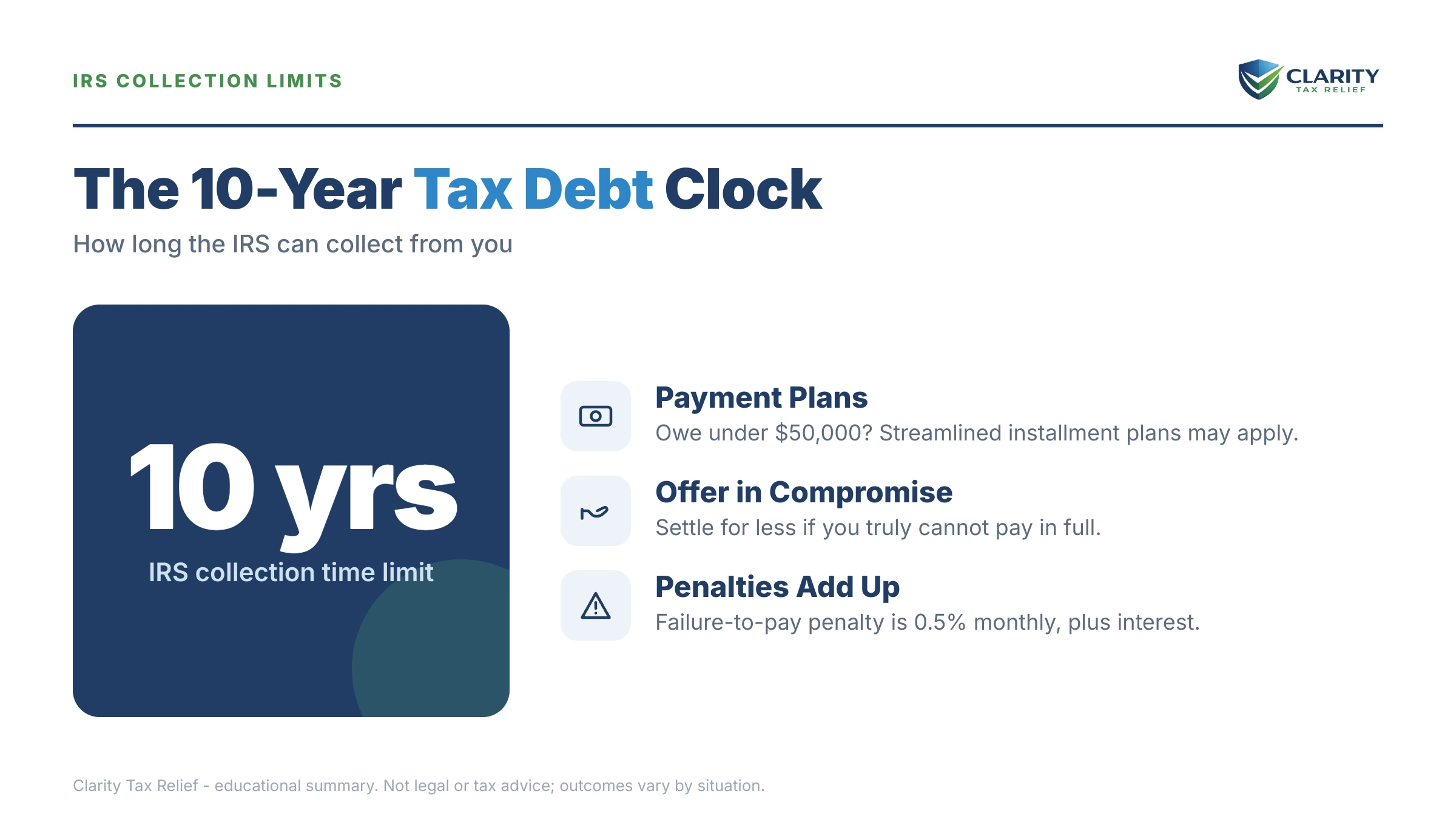
⏱ Your real clock: there's no single response deadline on physician tax debt — the clock is monthly. The failure-to-pay penalty adds 0.5% of the balance every month, and interest compounds daily on top of it. On an $83,100 balance, that penalty alone is roughly $415 a month before interest.
Why physician tax debt happens — even at a physician's income
Most physician tax debt is a withholding problem, not a spending problem: 1099 collections arrive with zero tax taken out, and the combined federal hit on self-employment income can exceed 40 cents of every marginal dollar. A locum tenens or independent-contractor physician owes ordinary income tax at the top brackets plus self-employment tax — 15.3% on earnings up to the Social Security wage base, with the Medicare portion continuing above it — and none of it is collected until you send it in yourself.
The residency-to-attending transition makes it worse. The prior-year safe harbor for quarterly estimates is calculated from your resident salary, so the year your income triples, "safe harbor" payments cover a fraction of the real liability — and the shortfall lands as a five-figure April balance plus a didn't pay estimated taxes penalty. Hospital-employed physicians hit a version of the same trap when moonlighting or medical-directorship 1099s stack on top of a W-4 that only covers the salary.
Practice owners add two more failure modes: personal estimates skipped to cover payroll and rent during a slow quarter, and S-corp owners whose low salary defers tax into a distribution-driven April bill — a structure the IRS scrutinizes separately as an S corp reasonable salary back taxes problem. The same no-withholding arithmetic drives chiropractor tax debt; what changes for physicians is the size of the numbers and what's attached to them.
| How you practice | Typical trigger | What you end up owing |
|---|---|---|
| Hospital-employed (W-2) + 1099 moonlighting | W-4 covers the salary; nothing covers the side income, which lands in your top bracket | Income tax + self-employment tax on the 1099 side |
| Locum tenens / 1099 contractor (sole proprietor) | No withholding at all; quarterlies missed or set from a lower-income prior year | Income tax + 15.3% SE tax + estimated-tax penalty |
| Sole-proprietor practice owner with staff | Personal estimates skipped to fund payroll, rent, and supplies | Personal 1040 debt — sometimes 941 payroll debt alongside it |
| S-corp practice owner | Salary set low; distributions create an April balance and reclassification risk | Income tax on K-1 income; payroll exposure if the salary is unreasonable |
| Group-practice partner | K-1 income with no withholding; buy-in loan payments crowd out estimates | Income tax + SE tax on partnership earnings |
What tax debt actually costs a doctor (beyond the balance)
Tax debt costs a physician more than money: above $66,000, the IRS can certify your passport for denial or revocation, and a filed Notice of Federal Tax Lien is a public record that surfaces in practice-loan underwriting and buy-in due diligence. Three consequences hit doctors harder than most taxpayers:
Passport certification. Once your debt is "seriously delinquent" — over $66,000 for 2026, with a lien filed or a levy issued — the IRS sends a CP508C and certifies the balance to the State Department. If you attend international conferences, hold a visa, or practice across borders, a passport revoked for tax debt is a career problem, not just a travel problem. Getting into an installment agreement takes you out of certifiable status.
The public lien record. Tax liens no longer appear on consumer credit reports, but they remain public filings — and lenders financing a practice purchase, equipment, or a partnership buy-in search public records as a matter of routine. A lien can stall a deal even when your income easily services the payments.
Levies on how you're actually paid. A 1099 physician's receivables — amounts a staffing agency, facility, or insurer owes you — can be levied. A W-2 salary can be levied continuously. A bank levy freezes funds for 21 days before they're sent to the Treasury. One thing the IRS cannot do: touch your medical license. That's a state matter, and federal tax debt alone doesn't reach it.
What happens if you ignore physician tax debt
IRS collection escalates in a fixed, automated sequence — and for balances over $66,000, passport certification can land in the middle of it. The 2025 workforce cuts (roughly 27%) made humans harder to reach, but the notice stream and levy issuance are automated and never paused. The sequence runs:
- CP14 — the first bill for the balance, typically giving about 21 days before the reminder cycle starts (10 business days when the balance is $100,000 or more). Penalties and interest are already accruing monthly.
- CP501 / CP503 — reminder notices. Still bills, but each one arrives with a larger number on it.
- CP504 — Notice of Intent to Levy under IRC §6331(d). The IRS can now seize your state tax refund, and a Notice of Federal Tax Lien becomes a real possibility.
- LT11 / Letter 1058 — the Final Notice of Intent to Levy. This starts a 30-day clock and your Collection Due Process rights (requested on Form 12153). After the 30 days, levies can issue.
- Enforcement — bank levies with a 21-day hold, a continuous levy on W-2 wages, levies on 1099 receivables owed to you by facilities or agencies — and, above $66,000, CP508C passport certification alongside it all.
Every stage is more expensive and offers fewer options than the one before it. A physician who acts at the CP14 stage picks the terms; a physician who acts after an LT11 is negotiating with a levy already authorized.
Owe the IRS on 1099 or practice income?
Every unresolved month adds another 0.5% penalty plus daily interest to the balance. Get your transcripts pulled and your options mapped by an experienced tax professional — free, confidential, before the next notice in the sequence goes out.
Your options: how doctors actually resolve IRS back taxes
Every realistic path out of physician tax debt runs through one of the IRS programs below, and eligibility is set by your balance and your financials — not your profession. For the step-by-step application mechanics behind each program, our guide to how to settle tax debt yourself covers them all; here's how they map to a physician's numbers:
| Option | Who qualifies (2026) | Cost & key terms |
|---|---|---|
| Pay in full | Anyone with the liquidity | No fee; all accrual stops when the balance posts to zero |
| Short-term payment plan | Balance you can clear within 180 days | $0 setup; penalties and interest continue until paid |
| Streamlined installment agreement | Total balance ≤ $50,000, spread up to 72 months | Online setup, no financial disclosure; lower setup fee with direct debit |
| Non-streamlined installment agreement | Over $50,000; Form 433-F financial disclosure required | Payment set from your disclosed income and IRS allowable expenses |
| Partial-payment installment agreement | Financials show you can't full-pay before the 10-year CSED | Pays less than the full balance over time; re-reviewed periodically |
| Currently Not Collectible | Genuine hardship — rare at physician income levels | Collection pauses; the debt, accrual, and lien risk all remain |
| Offer in Compromise | Reasonable Collection Potential below the balance — uncommon for practicing physicians | $205 fee + 20% down on lump-sum offers; roughly 1 in 5 accepted in FY2024 |
| Penalty abatement (FTA / AEP / reasonable cause) | Clean prior 3 years, or qualifying circumstances | Removes penalties, not tax; AEP becomes automatic starting summer 2026 |
Two honest notes on this table. First, the Offer in Compromise: the IRS computes what it could collect from your assets and future income, and a physician's earning power usually makes that number bigger than the debt. If your income has genuinely collapsed — disability, retirement, a practice failure — the math changes, and the OIC self employed rules govern how business income counts. Anyone promising a doctor a settlement without seeing the financials is selling, not advising.
Second, penalty relief is the most underused lever. First-time penalty abatement requires only a clean compliance history for the prior three years — which many first-time-debtor physicians have — and starting summer 2026, the Automatic Exemption from Penalty (AEP) applies without a request for those who qualify. On a large balance, removed penalties can shrink the debt by thousands before you make a single plan payment. At the extreme end, when enforcement is moving and the balance is unmanageable alongside other debts, chapter 13 irs back taxes treatment can force a structured repayment — a narrow fit, but a real one.
How much do you owe? Realistic options by balance
The IRS treats a $9,000 balance and a $90,000 balance as different cases, with different disclosure requirements and different enforcement priority. Find your band:
| Total balance | Realistic options | What changes at this level |
|---|---|---|
| Under $10,000 | Guaranteed installment agreement; short-term plan | The IRS must accept a qualifying plan — minimal friction, quick online setup |
| $10,000 – $25,000 | Streamlined online plan, up to 72 months | No financial disclosure; direct debit lowers the setup fee and default risk |
| $25,000 – $50,000 | Streamlined plan with direct debit | Direct debit is expected at the top of this band; still no financial statement |
| $50,000 – $100,000 | Pay down below $50,001, or non-streamlined plan with Form 433-F | Passport certification territory above $66,000; revenue officer assignment becomes possible |
| Over $100,000 | Full financial review; PPIA; OIC only in rare fact patterns | Human attention: lien filing is likely, asset review is standard, and the 10-business-day CP14 window applies |
Worked example: a physician who owes $83,100
Say you owe $83,100 — a hypothetical self-employed sole-proprietor physician, two years of under-paid quarterlies on locum income. Here's the actual arithmetic:
The monthly bleed. The failure-to-pay penalty is 0.5% per month: $83,100 × 0.005 = $415.50 a month in penalty alone, with daily-compounding interest on top. Doing nothing for a year costs roughly $5,000 in penalties before a dollar of interest — estimate your own accrual with our Penalty & Interest Calculator.
Path A — buy your way under the streamlined line. $83,100 is $33,101 above the $50,000 streamlined ceiling. If savings or a practice line of credit can cover that pay-down, the remaining $49,999 qualifies for an online 72-month agreement with no financial disclosure: $49,999 ÷ 72 ≈ $695 a month as the floor, with the real payment somewhat higher because interest and the (reduced) penalty keep accruing inside the plan. This path also pulls you back under the $66,000 passport threshold immediately.
Path B — keep the full balance and disclose. Above $50,000 you file Form 433-F, and the IRS sets the payment from your income minus its allowable-expense standards — which don't include student loan payments at private-refinance levels or a luxury vehicle. Spread evenly, $83,100 over 72 months is about $1,155 a month before accruals; expect the IRS's number to land higher. The trade-off versus Path A is cash today against a bigger monthly commitment and a likelier lien filing — our guide to an irs payment plan over 50000 covers what disclosure actually involves.
The OIC reality check. Could this physician settle instead? Only if Reasonable Collection Potential — asset equity plus roughly what the IRS projects from future income — falls below $83,100. A doctor grossing $280,000 with normal expenses will project far more collectible income than that, so an offer would be rejected and the fee spent for nothing. That's not pessimism; it's the formula.
The condition everyone forgets. Whichever path you take, this year's quarterlies must be paid in full and on time. Owe again next April, and the agreement defaults — and collection restarts on everything.
If your practice owes payroll taxes too
Withheld payroll taxes are the one category of physician tax debt the IRS treats as personal no matter what entity you practice under. The income tax and FICA withheld from your staff's paychecks are trust funds — the government's money passing through your hands — and if they weren't deposited, the IRS can assess the Trust Fund Recovery Penalty against you individually as the owner who controlled the checkbook. An LLC or corporation doesn't shield you; the entity rules are mapped in our guide to llc back taxes personal liability.
If your practice is behind on Form 941 deposits, that debt outranks your personal 1040 balance in urgency: the IRS pursues trust-fund debt harder, revenue officers get assigned faster, and the exposure follows you even if the practice closes. Get the deposits current first, then resolve the arrears — the full sequence is in our 941 back taxes guide. Never use withheld payroll taxes to float the practice for a quarter — repeat non-deposit is the pattern the IRS treats most severely.
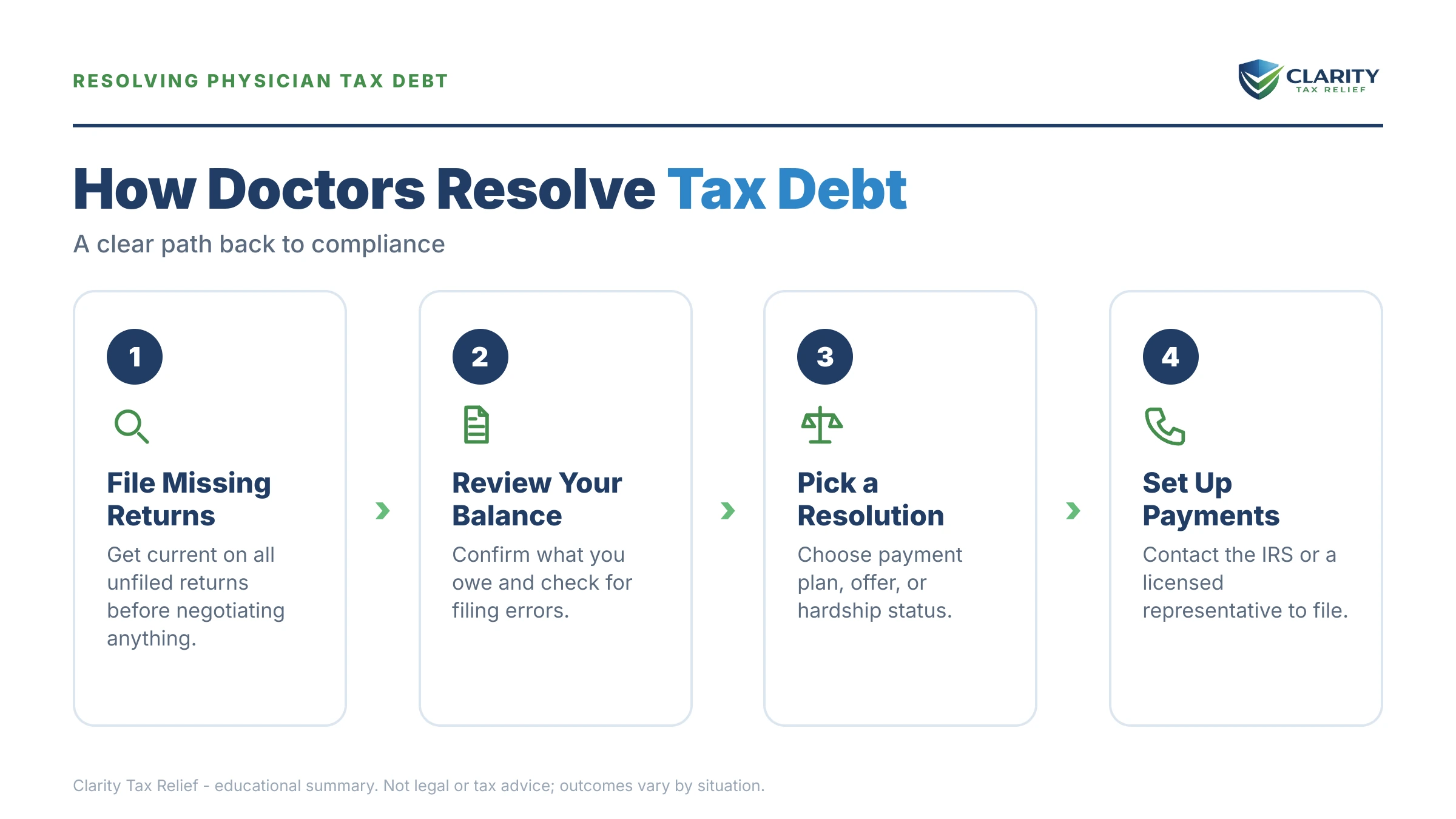
How to resolve physician tax debt, step by step
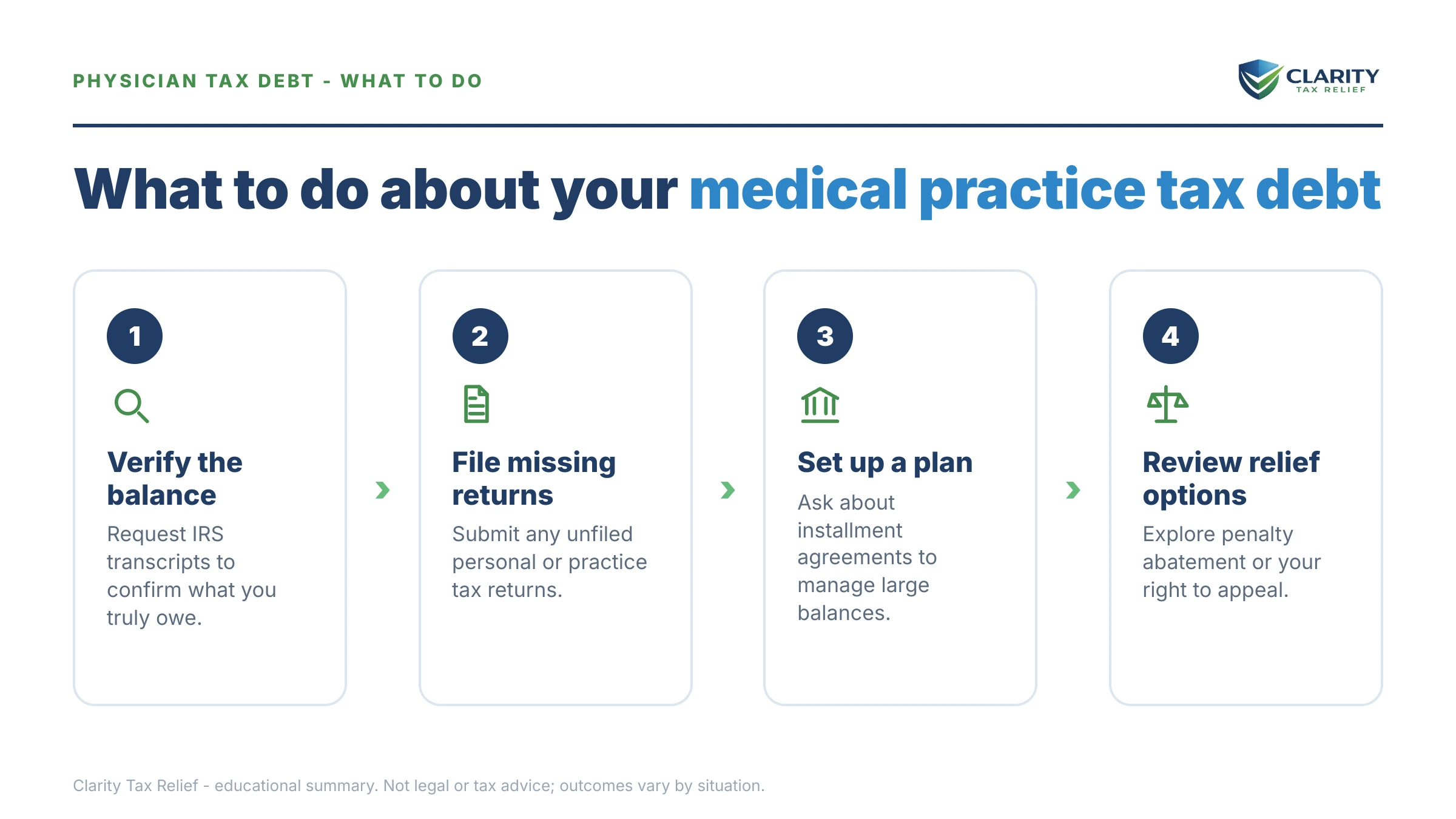
- Pull your IRS transcripts. Log into your IRS online account and confirm the total balance, which tax years it covers, and that every required return is actually filed — the IRS will not finalize any agreement while a year is missing.
- Stop the debt from growing. Recalculate your current-year estimated taxes (Form 1040-ES) or your W-4 withholding so this year's liability is covered; every resolution defaults if you owe again next April.
- Choose your resolution track. Match your balance to the options table above — online payment plan under $50,000, Form 433-F financial disclosure above it, and an Offer in Compromise only if your collection potential genuinely falls below the debt.
- Set up the agreement before enforcement starts. Apply through the IRS online payment agreement tool or file Form 9465; an accepted agreement stops levies from issuing and keeps your account out of passport certification.
- Request penalty relief once the plan is in place. Ask for first-time abatement if your prior three years are clean, or reasonable cause if illness or other events beyond your control caused the lapse; removed penalties shrink the balance the plan has to retire.
- Calendar every quarterly deadline going forward. Automate estimated payments from a separate tax account so the agreement never defaults; a defaulted plan reinstates collection on the entire remaining balance.
The mechanics live on the IRS's own payment plans and installment agreements page, and payments themselves go through IRS.gov/payments — never to anyone who called you.
When you can handle this yourself — and when help changes the outcome
A physician with a single filed year and a balance under $50,000 can usually resolve it online in under an hour without paying anyone. If you agree with the number, the streamlined agreement application asks for a payment amount and a bank account — that's the whole process. A balance you can clear inside 180 days is even simpler: the short-term plan costs nothing to set up. And if the IRS's own processing is the obstacle rather than the debt, the Taxpayer Advocate Service exists for exactly that.
Experienced help earns its fee in specific situations: an LT11 already received (the 30-day CDP window is a one-shot right, and how it's used shapes everything after), multiple unfiled years that must be reconstructed and sequenced before any agreement is possible, a balance above $50,000 where the Form 433-F presentation determines your monthly payment for the next six years, practice payroll debt with Trust Fund Recovery Penalty exposure, or an OIC where the collection-potential math needs to be run honestly before you spend $205 and 20% down finding out. In those cases, the difference between a good and bad filing is measured in tens of thousands of dollars — not in reassurance.
If your case has any of those complications, a free physician-specific case review — the 2-minute form or (888) 825-7779 — will tell you which track fits your numbers before you commit to anything.
Terms on your IRS paperwork, decoded
- CSED — the Collection Statute Expiration Date: the IRS generally has 10 years from assessment to collect, though appeals, an OIC, or bankruptcy pause the clock.
- Streamlined installment agreement — a payment plan on balances up to $50,000 that requires no financial disclosure and spreads payments over up to 72 months.
- Form 433-F — the collection information statement listing your income, assets, and expenses, used to set payments on balances above the streamlined ceiling.
- Reasonable Collection Potential (RCP) — the IRS's calculation of your asset equity plus future collectible income; an Offer in Compromise is only viable when RCP is below the debt.
- Seriously delinquent tax debt — a balance over $66,000 (2026) with a lien filed or levy issued, which triggers passport certification via CP508C.
- Trust Fund Recovery Penalty (TFRP) — personal liability for withheld payroll taxes a practice failed to deposit, assessed against whoever controlled the money.
Physician tax debt questions, answered
Can the IRS take my medical license for tax debt?
No. The IRS has no authority over state medical licenses, and federal tax debt alone will not suspend one. A few states can act against professional licenses over delinquent state taxes — a separate system with its own rules — so if you owe your state as well as the IRS, check your state agency's license-compliance program before assuming you're clear.
Does IRS tax debt show up in hospital credentialing?
The debt itself is private, but a Notice of Federal Tax Lien is a public record that background checks and loan underwriters can surface. Credentialing and privileging applications vary by facility, and some ask broad financial-disclosure questions. Resolving the balance before a lien is filed keeps the issue out of the public record entirely, and a direct-debit agreement on smaller balances may support a lien withdrawal request.
Do physicians ever qualify for an Offer in Compromise?
Rarely, because the IRS bases acceptance on Reasonable Collection Potential — your asset equity plus what it can collect from future income — and physician earning power usually exceeds the balance owed. The IRS accepted roughly 1 in 5 offers in FY2024, and high, stable income is the most common disqualifier. Doctors with a genuine collapse in earning capacity, such as disability or retirement, are the realistic exceptions.
Can the IRS garnish a doctor's income?
Yes, and how depends on how you're paid. W-2 wages can be levied continuously until the debt is resolved; 1099 payments from a hospital, staffing agency, or insurer can be taken with a levy on each amount owed to you; and a bank levy freezes funds for 21 days before they're sent to the IRS. All of these require the IRS to send a final notice — LT11 or Letter 1058 — and wait 30 days first.
Will the IRS really take my passport over tax debt?
It can if your debt is 'seriously delinquent' — over $66,000 in 2026 with a lien filed or levy issued — because the IRS certifies the debt to the State Department, which can deny or revoke your passport. Entering an installment agreement or a pending Offer in Compromise removes you from certifiable status. For physicians who travel for conferences or hold visas, this is worth fixing before certification, not after.
Should I cash out retirement funds to pay the IRS?
Usually not without running the math first. An early withdrawal before age 59½ typically triggers income tax plus a 10% penalty, which can cost more than the IRS's own interest and penalty accrual on a payment plan. Compare the true cost of a 72-month installment agreement against the tax hit on the withdrawal — for many physicians the plan is cheaper.
Do I have to keep paying quarterly estimates while on an IRS payment plan?
Yes — staying current on this year's taxes is a condition of every installment agreement. If you skip estimated payments and owe again next April, the IRS can default the plan and restart collection on the whole balance. Recalculate your Form 1040-ES vouchers when you set up the plan so the agreement and your current-year obligations both get funded.
What happens if my practice owes payroll taxes on top of my personal balance?
Payroll debt jumps the line — withheld employee taxes are trust funds, and the IRS can assess the Trust Fund Recovery Penalty against you personally, an obligation that survives even if the practice closes. Resolve the 941 side first or in parallel with your personal balance, and never use withheld payroll taxes to float other practice bills.
How does the IRS know about my 1099 income?
Every 1099-NEC a hospital, staffing agency, or facility issues to you is also filed with the IRS, and its automated underreporter system matches those forms against your return. If reported income doesn't appear, a CP2000 proposing additional tax follows — often 18 months or more after filing, with penalties and interest backdated. Reporting accurately and resolving the balance is almost always cheaper than the matching program catching it.
Your next 24 hours
- Pull your two numbers. Log into your IRS online account and write down the total balance and the tax years it covers — everything above depends on those two facts.
- Gather the file. Your last filed return, any IRS notices you've received, and a rough picture of monthly practice and personal cash flow. That's all a resolution plan needs to start.
- Get the free case review. An experienced tax professional will map your balance to the right track — the 2-minute form or (888) 825-7779 — before another month's 0.5% penalty and daily interest post to the account.
This guide is general information, not tax or legal advice for your specific situation. Eligibility for IRS programs depends on individual facts and circumstances; no outcome is guaranteed.