
IRS Notices
IRS CP80 Notice: The IRS Has Your Money but No Tax Return (2026)
The short answer: a CP80 notice means the IRS is holding a credit — withholding, estimated payments, or other money — on your account, but has no tax return on file for that year. It is not a bill. To claim the money, file (or re-send) that year's return, generally within three years of its original due date.
You've been bracing for collection letters — maybe there's already a levy in motion on another year — and now the IRS writes to say it's holding money with your name on it and nowhere to put it. A CP80 isn't a demand. It's a mismatch: payments on file, no return to apply them to.
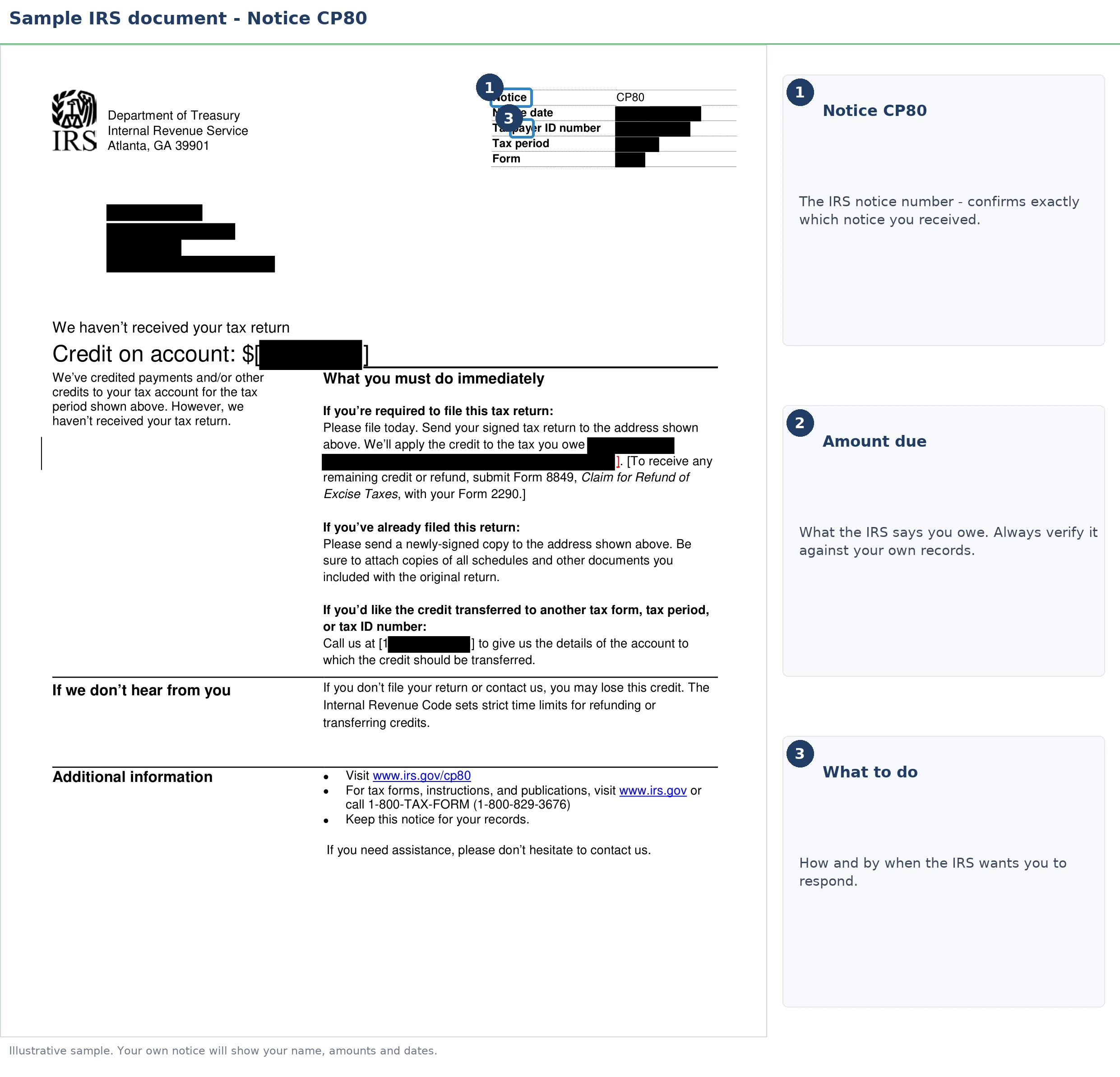
Depending on your numbers, this letter can actually work in your favor — but only if you act before a hard legal deadline erases the credit. The image below shows exactly what a CP80 looks like and where the tax year and credit amount appear, so you can match it to your own letter.
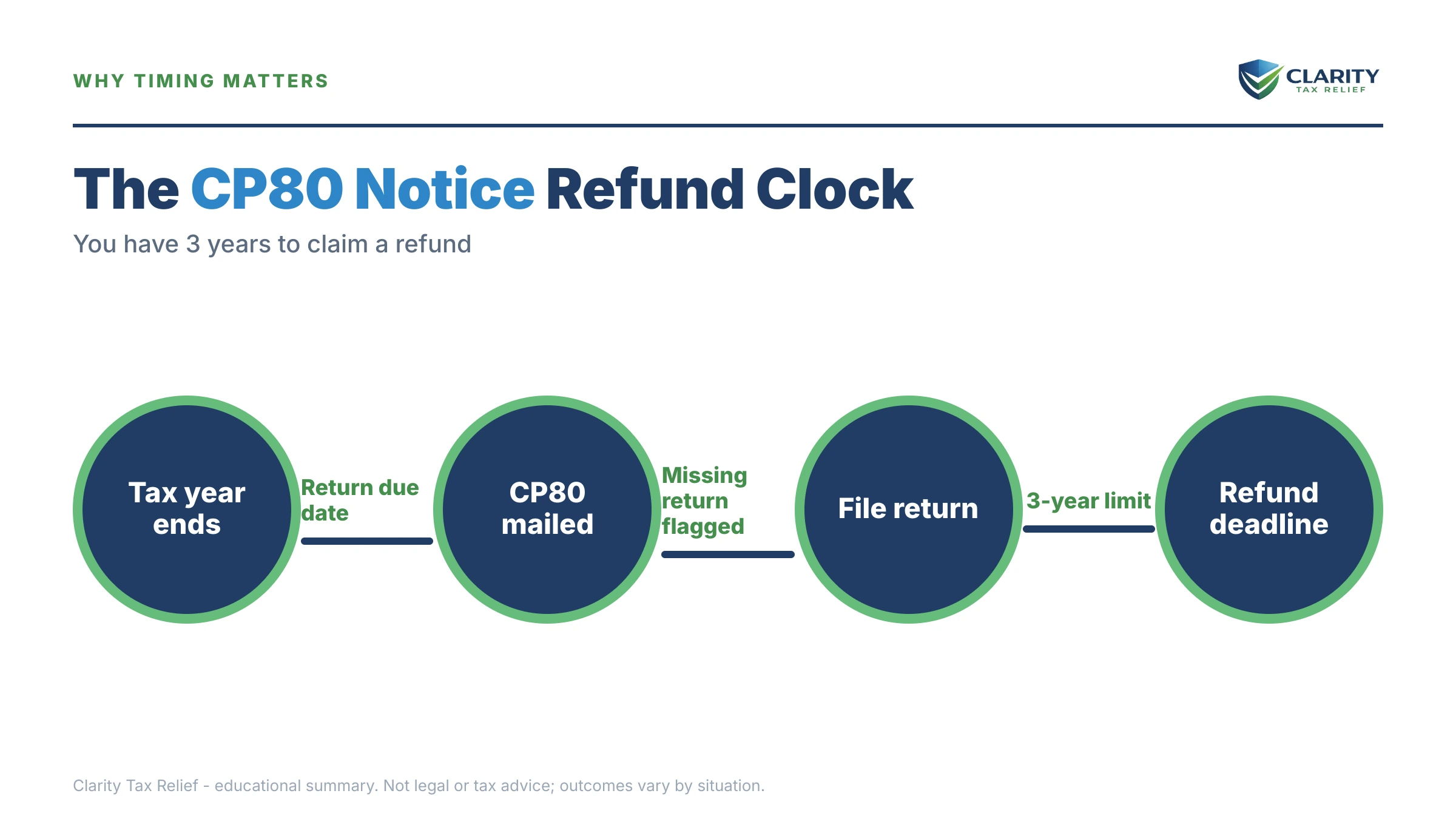
⏱ Your real deadline: you generally have 3 years from the return's original due date to file and claim the credit shown on a CP80 as a refund. If you had an extension that year, the window is measured differently — but once it closes, the money is permanently forfeited to the Treasury, and the IRS has no legal authority to pay it out afterward.
Why you got a CP80 notice
A CP80 notice goes out when the IRS has posted credits to your account for a specific tax year — usually W-2 withholding, 1099 withholding, or estimated payments — but shows no processed return for that year. The notice lists the tax year and the exact credit amount the IRS is holding, and asks you to file or re-send the return.
Four situations trigger it most often:
- You never filed that year. Your employer sent withholding to the Treasury all year, so the IRS has money — just no return telling it what you actually owe.
- You filed, but the return was never processed. Paper returns especially can sit unopened for months. The computer that generates CP80s doesn't check the mail room.
- Your return was rejected or misrouted — an e-file rejection you didn't catch, or a name/SSN mismatch that kept the return from posting to your account.
- A payment posted to the wrong year, creating a credit on a year you never intended to have activity on.
The processing-delay cause is more common in 2026 than it used to be: the IRS workforce shrank roughly 27% in 2025, and paper-return processing slowed with it — our guide to IRS layoffs 2026 processing delays covers what that means in practice. Note the key contrast with its sibling notice: a CP59 notice says "you haven't filed" with no money attached, while a CP80 says "you haven't filed and we're holding your money." For the general anatomy of IRS mail, see why did I get a letter from the IRS.
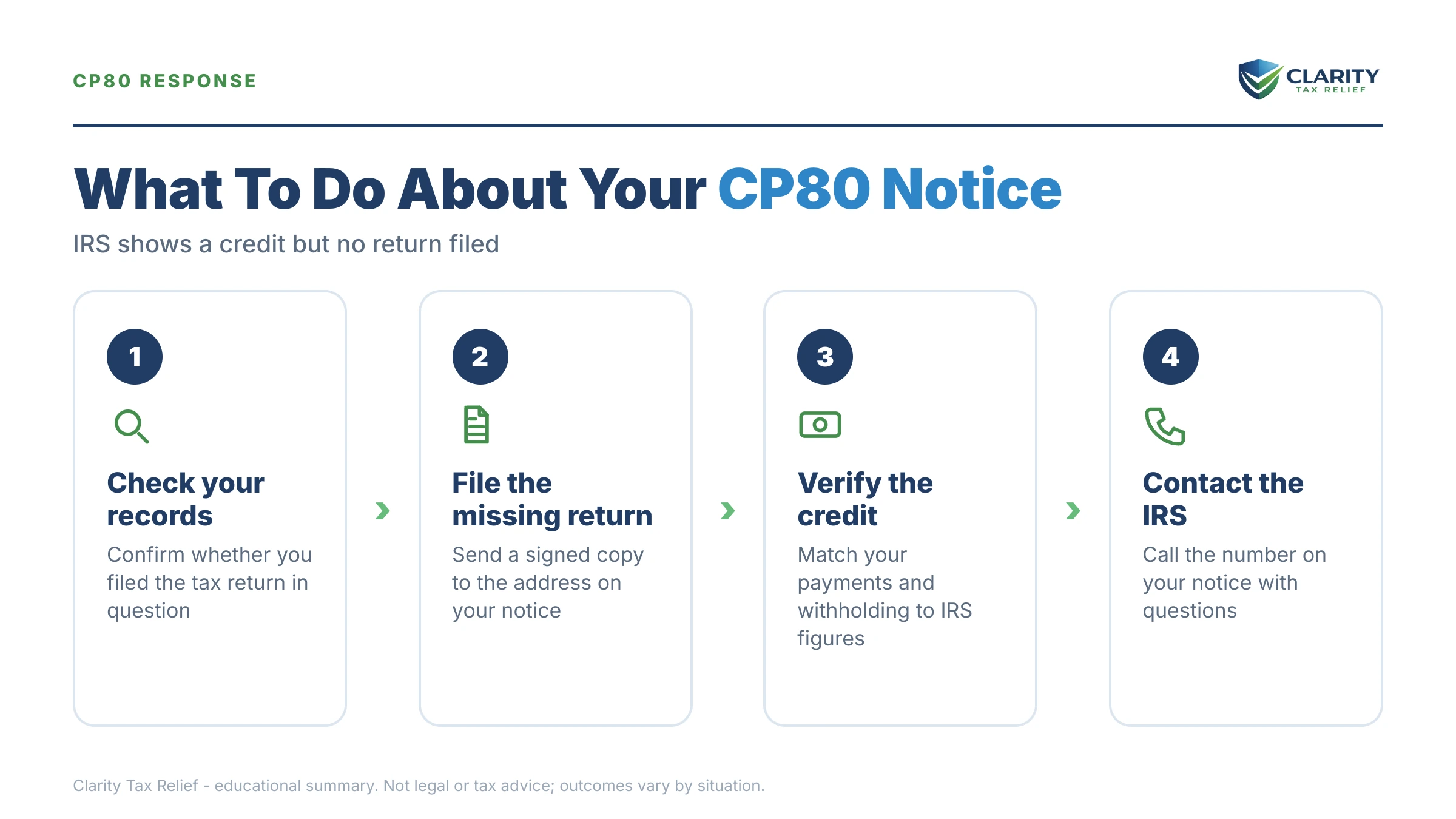
First: check whether the IRS really has no return
Before you prepare anything, your IRS account transcript will tell you in five minutes whether your return actually posted. Log in to your IRS online account and pull the account transcript for the year on the notice. Look for Transaction Code 150 — that code means a return posted.
- Code 150 is there: your return and the CP80 likely crossed in processing. Watch the account for a few weeks; the credit should resolve against the return on its own.
- No Code 150: the IRS genuinely has no return from you for that year — whether or not you mailed one. You'll need to send it (or send it again).
- Missing income records: pull an IRS wage and income transcript for the same year. It lists every W-2 and 1099 reported under your SSN — enough to rebuild the return even if you've lost the paperwork.
One thing not to do: don't e-file a brand-new duplicate if you already filed. The IRS asks for a newly signed copy of the original return, mailed to the address on the notice. A second original can trigger duplicate-return screening and slow everything down further.
What happens if you ignore a CP80
Ignoring a CP80 starts two separate countdowns: the IRS's non-filer enforcement sequence, and the refund statute quietly running out on your credit. They move independently, and only one of them ever sends you another warning.
- CP80 — credit on file, no return. You are here. No enforcement, but both clocks are running.
- CP59 — the formal "you didn't file" notice, if the IRS believes a return was required.
- CP516 / CP518 — escalating requests ending in a final notice that the IRS will act on the missing return itself.
- Substitute for Return (SFR) — the IRS files a substitute return for you using only the income reported under your SSN: no itemized deductions, no dependents, no credits you'd have claimed. The bill it produces is almost always the worst version of your year.
- CP3219N — Notice of Deficiency. You get 90 days to petition Tax Court; after that, the SFR amount is assessed and regular collection notices (bills, then intent-to-levy letters) begin.
Meanwhile, the second clock never sends mail at all. The IRS may issue a CP81 notice as the refund statute nears expiration, but it isn't required to — and when the three-year window closes, the credit is legally forfeited even if the IRS later assesses tax against you via SFR. Your withholding still offsets whatever the SFR assesses, but any excess above that assessment is simply gone.
| Stage | What it means | Enforcement power |
|---|---|---|
| CP80 | Credit on account, no return on file | None — informational, but the refund statute is running |
| CP59 | Formal notice that a required return wasn't filed | None yet — a demand to file |
| CP516 / CP518 | Escalating requests; CP518 is the final unfiled-return notice | Sets up the IRS to file for you |
| Substitute for Return | IRS builds your return from reported income — no deductions or credits | Produces an inflated proposed tax |
| CP3219N | Notice of Deficiency on the SFR figures | 90 days to petition Tax Court, then assessment and collection |
| Refund statute expires | Three years from the return's original due date pass | Credit above any assessed tax is permanently forfeited |
Holding a CP80 with money you can't afford to lose?
Send us a photo of your notice. An experienced tax professional will confirm whether your return posted, how much of the credit is still claimable, and how long your three-year window has left — free, confidential, no pressure.
Your options: what to send and what happens to the credit
Every CP80 response runs through one of four doors, and which door you're behind determines both what you mail and whether the credit comes back to you.
| Your situation | What to send | What happens to the credit |
|---|---|---|
| Already filed, return never posted | Newly signed copy of the original return, mailed to the address on the notice | Applied when the return processes; overpayment refunded if the 3-year window is open |
| Never filed, expecting a refund | Prepare and file the missing return before the 3-year deadline | Refunded — unless first offset to other federal tax or certain other debts |
| Never filed, return will show a balance | File anyway, then arrange payment for the difference | Applied against the tax; penalties are computed only on the unpaid remainder |
| Not required to file that year | A written response stating you had no filing requirement | Stays frozen — the credit can only be paid out through a filed return |
Three wrinkles change the math for a lot of readers:
- If you owe on another year, the credit goes there first. Any overpayment from the CP80 year is applied to other federal tax debt before a dime is refunded — you'd see it on a CP49 refund applied notice. If a levy is already in motion on an old balance, filing this return is one of the few moves that shrinks that debt without costing you new money.
- The penalty math rewards filing even late. The failure-to-file penalty runs 5% per month (capped at 25%) — but it's calculated on the unpaid tax after credits. If the CP80 credit covers your full tax, a late return generally carries no failure-to-file penalty at all. If it doesn't, you can estimate the exposure with our Penalty & Interest Calculator.
- Filing can unlock more than the credit. If your income that year was modest, the return may qualify you for the Earned Income Tax Credit or Additional Child Tax Credit on top of the withholding — the same money the IRS flags on a CP09 notice. Those refundable credits die with the same three-year statute.
One caution on timing expectations: once you do file, a refund from a previously unfiled year sometimes gets a second look before it's released. If that happens you'd receive a CP05 notice — a review, not an audit, and usually resolvable with documents you already have.
A worked example: a $13,600 credit and a levy on another year
Say your CP80 shows $13,600 in credits for tax year 2023 — withholding from the W-2 job you had before you went 1099. The 2023 return was due April 15, 2024, so your refund window typically runs to April 15, 2027. This is hypothetical, but the arithmetic is exactly how the IRS runs it:
- Scenario A — the return shows $12,150 in tax. You overpaid by $1,450 ($13,600 − $12,150). No failure-to-file penalty applies, because the penalty is a percentage of unpaid tax — and yours is zero. If you also owe $3,900 on 2021 and the IRS is levying your wages for it, the $1,450 doesn't come to you as a check; it's applied to 2021, cutting that levied balance to $2,450. You just paid down the debt behind the levy without writing a check.
- Scenario B — the return shows $15,400 in tax. You owe $1,800 ($15,400 − $13,600). The failure-to-file penalty accrues at 5% per month on that $1,800, capping at $450. Without the credit on file, the same penalty would have capped near $3,850 (25% of $15,400) — the withholding already sitting on your account is what keeps a late filing survivable.
- Scenario C — you never file. After April 2027, the $13,600 stops being your money. If the IRS then files a substitute return assessing, say, $15,400, your credit offsets that assessment — but if the SFR had assessed less than $13,600, the excess would be forfeited, not refunded. You'd get the worst return possible and lose the overpayment.
The pattern across all three: filing is either free money, cheap damage control, or both. Not filing is the only losing move.
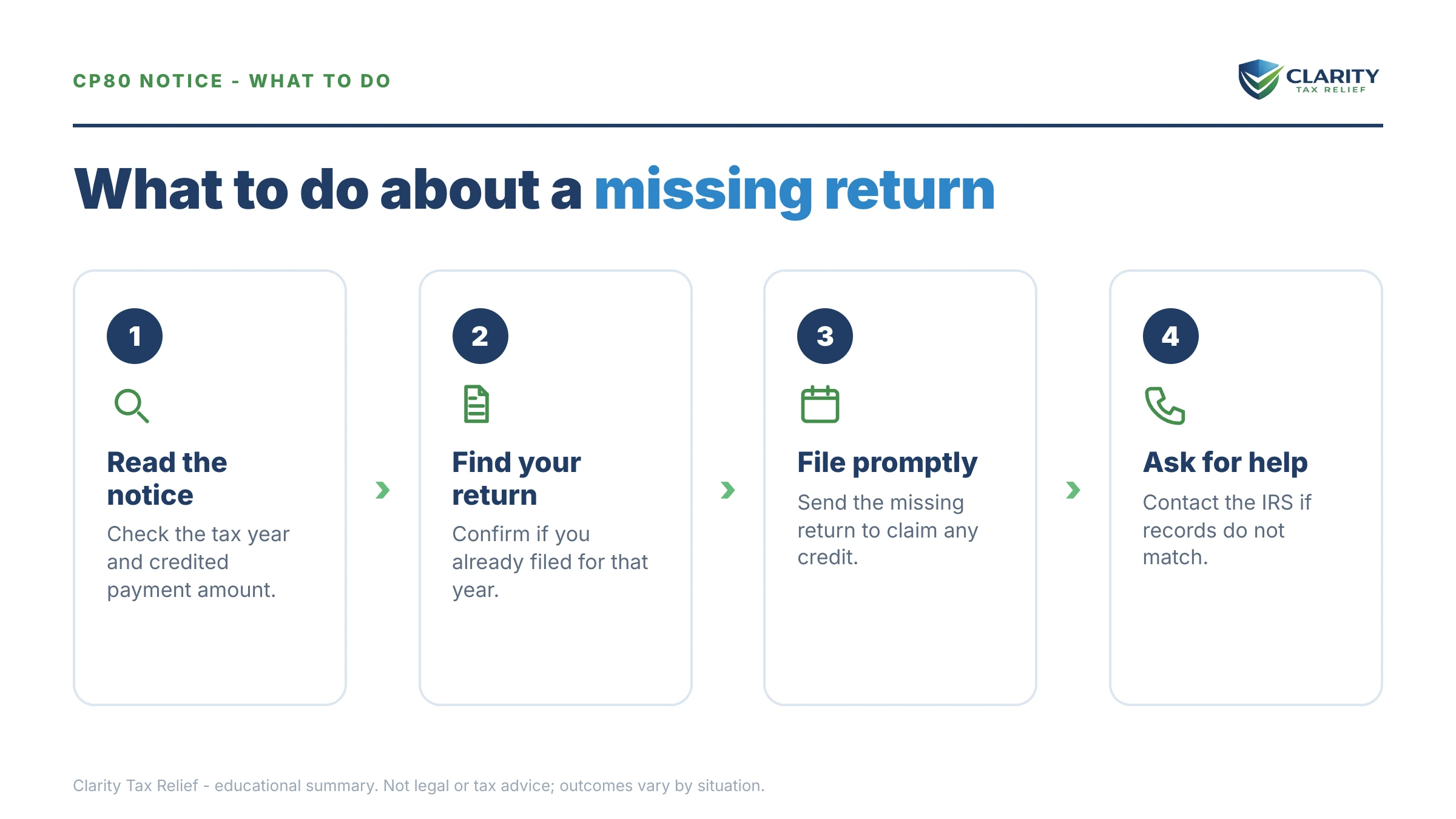
How to respond to a CP80 notice, step by step
- Check your account transcript. Log in at IRS.gov and confirm whether a return actually posted for the year on your notice — a Code 150 means the IRS has it and the CP80 crossed in processing.
- Match the notice to your records. Confirm the tax year and the credit amount against your W-2s, 1099s, and any estimated payments you made that year.
- Send a newly signed copy if you already filed. Mail a fresh, signed copy of the return to the address on the CP80 — don't file a second original, which can create duplicate-return delays.
- Prepare and file the return if you never filed. Use a wage and income transcript to rebuild missing records, and file before the three-year refund deadline.
- Respond even if you weren't required to file. Tell the IRS you had no filing requirement — but remember the credit can only be paid out through a filed return.
- Send everything by certified mail. Keep proof of mailing and copies of the full package; processing delays are common and your postmark is your evidence.
The IRS's own page — Understanding your CP80 notice — confirms the mailing address and the signed-copy instruction. Transcripts are free at the IRS's Get Transcript tool.
When you can handle a CP80 yourself
Most CP80s are a do-it-yourself fix, and it would be dishonest to tell you otherwise. You likely don't need help if:
- It's one missing year, you have (or can pull) the income records, and the credit likely covers the tax — mail the return, keep the certified receipt, done.
- You already filed and just need to send a signed copy while the backlog clears.
- You weren't required to file and simply need to say so in writing.
Experienced help changes the outcome when the CP80 is a symptom of something bigger: multiple unfiled years (order of filing affects penalties and what the credits offset — see haven't filed taxes in 3 years), self-employment income with no records to reconstruct, a substitute return already assessed that needs to be replaced with a correct one, or an active levy where the sequencing of returns, credits, and a collection arrangement determines how fast the levy comes off. If a return you filed months ago still hasn't posted and the delay is causing genuine financial harm, the Taxpayer Advocate Service can also intervene at no cost.
If your CP80 sits on top of unfiled years or an active collection problem, a free review with an experienced tax professional will map the filing order before you mail anything — start with the 2-minute form or call (888) 825-7779.
Terms on your CP80, decoded
- Credit: money already on your account for that year — withholding, estimated payments, or transferred overpayments — waiting for a return to apply it to.
- RSED (Refund Statute Expiration Date): the legal last day to claim an overpayment as a refund — generally three years from the return's original due date.
- Code 150: the transcript code showing a return posted to your account; its absence is why the CP80 exists.
- Substitute for Return (SFR): a return the IRS constructs for you from reported income only, with no deductions or credits you'd have claimed.
- Refund offset: the IRS's application of your overpayment to other federal tax you owe (and certain other debts) before refunding anything.
CP80 notice FAQs
Is a CP80 notice a bill or a refund?
Neither — a CP80 is a status alert that the IRS is holding a credit on your account with no return to apply it to. You aren't being billed, and no refund is on the way yet. The money only turns into a refund (or gets applied to tax you owe) when the IRS processes a return for that year, so filing is what unlocks it.
I already filed my return — why did I get a CP80?
Usually because your return was never processed — paper returns in particular can sit for months, and CP80s go out automatically when the computer sees credits with no posted return. Check your account transcript for a Code 150 before doing anything. If there's no 150, mail a newly signed copy of the return to the address on the notice rather than e-filing a duplicate.
How long do I have to claim the credit on my CP80?
Generally three years from the return's original due date. For a 2023 return due April 15, 2024, that window typically closes April 15, 2027. If you filed an extension that year, the window is measured differently, so check your specific dates. After the deadline passes, the credit is forfeited permanently — the IRS has no authority to refund it late.
What happens if I ignore a CP80 notice?
Two bad things run on separate clocks. If a return was required, the IRS moves through its non-filer sequence — CP59 reminders, a CP518 final notice, and eventually a substitute return that assesses tax with no deductions and full appeal deadlines attached. And whether or not you owed, the refund statute keeps running: once the three-year window closes, the credit is gone.
Will the IRS send me the CP80 credit automatically?
No. The IRS cannot issue a refund without a processed return, even when its own records show you overpaid. And when the return is processed, any overpayment is first applied to other federal tax you owe before anything is mailed to you. If you're behind on another year, expect the credit to shrink that balance rather than arrive as a check.
Can I e-file the missing return?
Sometimes. E-filing typically supports the current tax year and the two years before it through tax software or a preparer; older returns generally must be mailed on paper. If you're mailing, use the address on your CP80 and send it certified so you can prove the filing date — the postmark matters if the three-year deadline is close.
What if I wasn't required to file that year?
Respond anyway — the CP80 will keep generating follow-ups until the IRS knows why there's no return. If your income was below the filing threshold, you can say so in writing. But note the catch: even with no filing requirement, the only way to get the withheld money back is to file a return claiming it, and the same three-year clock applies.
Your next 24 hours
- Find the tax year and credit amount on your CP80 — they're printed near the top of the notice, along with the mailing address the IRS wants your response sent to.
- Gather what you'll need to file: that year's W-2s and 1099s (or a wage and income transcript if they're gone), your most recent filed return, and proof of any payments you made toward that year.
- Get a free case review — the 2-minute form or (888) 825-7779. We'll confirm whether your return posted and how much of your three-year window remains, so the credit gets claimed instead of forfeited.
This guide is general information, not tax or legal advice for your specific situation. Eligibility for IRS programs depends on individual facts and circumstances; no outcome is guaranteed.