
Gig Economy Taxes
Amazon Flex Owe Taxes? Why Your 1099 Bill Is So Big and How to Fix It (2026)
The short answer: Amazon Flex drivers owe taxes because Amazon pays you as a 1099 contractor with zero withholding — so 15.3% self-employment tax plus income tax on every dollar of profit lands at filing time. You can shrink the bill with the mileage deduction most drivers skip, then pay the rest through an IRS payment plan.
You worked blocks on nights and weekends around your regular job, filed your W-2 and your Flex 1099-NEC together expecting a refund like every other year — and the software spat out a balance due instead. If you typed "Amazon Flex owe taxes" into a search bar with that number still on your screen, you're in the most common gig-tax situation there is, and it has a clear fix. The map is below: why the bill happened, the deduction that shrinks it, and every realistic way to pay it off.
⏱ The clock that's actually running: there's no letter with a printed deadline yet, but your balance is not standing still. The failure-to-pay penalty adds 0.5% of the balance every month, and interest compounds daily on top, until you pay or set up a payment arrangement. Every month you wait makes the same debt more expensive.
Why you owe taxes from Amazon Flex
Amazon Flex pays drivers as independent contractors on Form 1099-NEC, which means Amazon withholds $0 in tax from every block you drive. Your day-job employer takes taxes out of each paycheck before you ever see it. Flex hands you the gross amount and hands the tax problem to you — and Amazon issues a 1099-NEC once you earn $600 or more in a year, sending an identical copy to the IRS. The image below shows exactly what that 1099-NEC looks like and where to find the income figure the IRS is matching against your return.
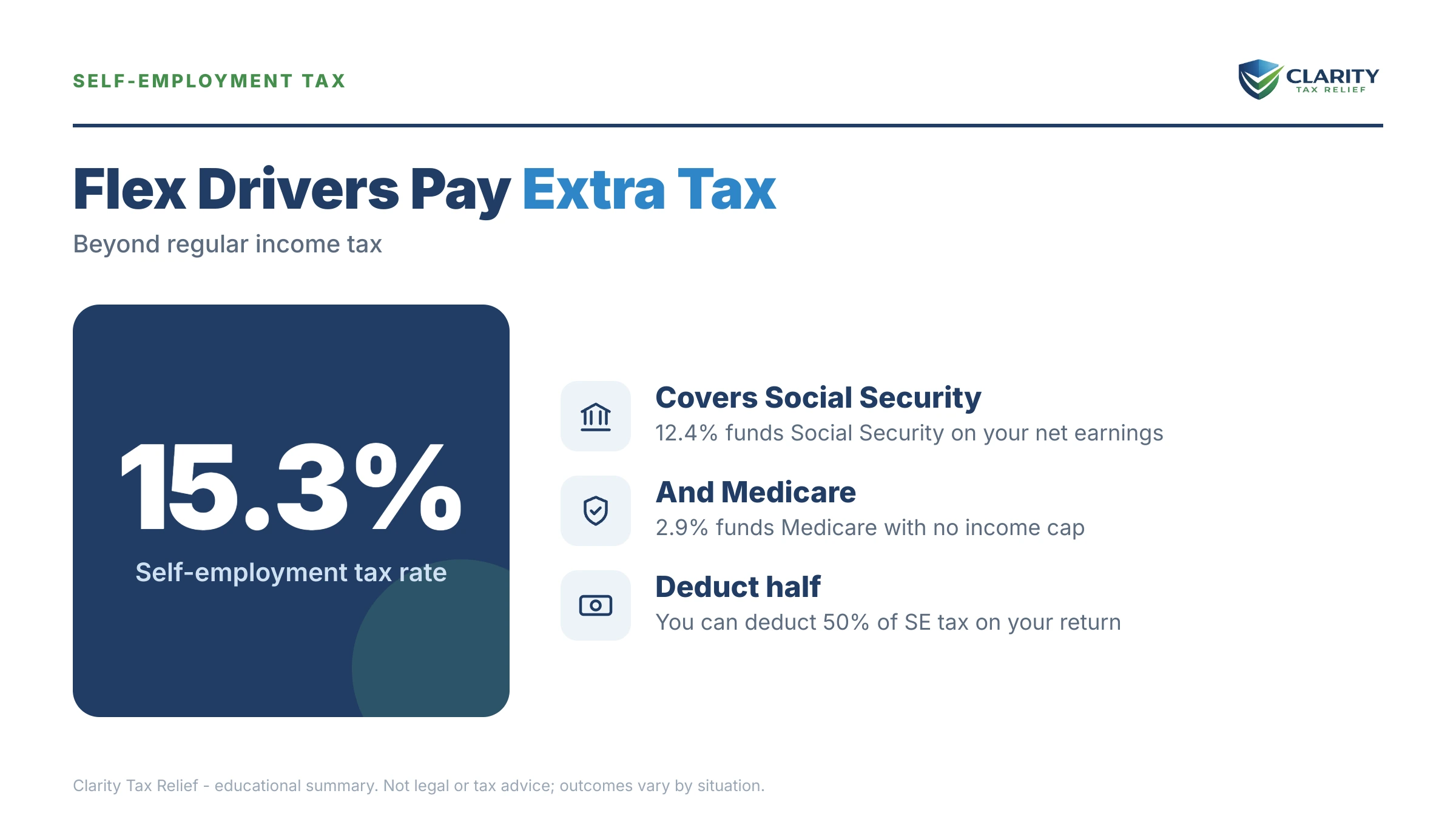
Two taxes hit that income at once. First, self-employment tax — 15.3% on your net profit from the very first dollar, covering both halves of Social Security and Medicare (your day-job employer pays half of that for your W-2 wages; on Flex income, you pay both halves). If the mechanics of that surprise you, our guide to self employment tax owe irs breaks down where the 15.3% goes.
Second, ordinary income tax — and here's the part that makes side-hustle bills feel disproportionate: Flex income stacks on top of your W-2 wages, so it's all taxed at your highest marginal bracket. Your standard deduction and lower brackets were already used up by your day job. If you filed and got a number far bigger than expected, you're living the exact scenario in filed taxes owe more than expected — with a Flex-specific twist: most of the fix lives in your car's odometer.
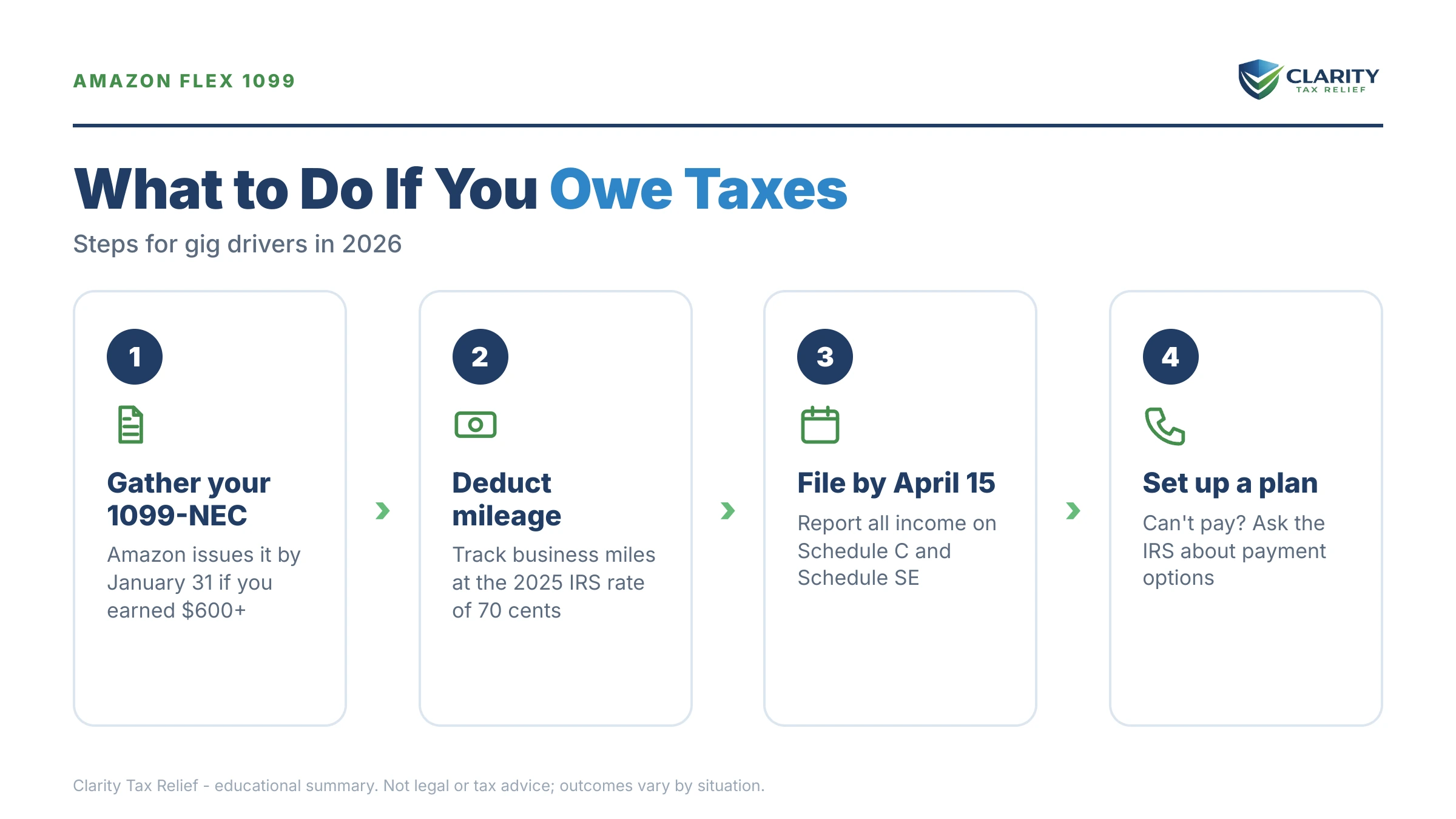
How a $7,400 Amazon Flex tax bill happens — the math
A single W-2 filer in the 22% bracket can owe roughly $7,400 on about $24,000 of Amazon Flex income claimed with no deductions. Here's a clearly hypothetical example so you can see where every dollar comes from.
Say you're single, you earn $55,000 at your day job with normal withholding, and you grossed $24,000 driving Flex — and you filed the whole $24,000 as profit because you never tracked expenses:
- Self-employment tax: $24,000 × 92.35% = $22,164 subject to SE tax. At 15.3%, that's about $3,390.
- Income tax: after deducting half the SE tax (about $1,695) and the 20% qualified business income deduction (about $4,460), roughly $17,845 of Flex profit is taxed at your 22% marginal rate — about $3,925.
- Total: roughly $7,300–$7,400 once a small underpayment penalty is tacked on for not paying during the year.
That's about 31 cents of federal tax per Flex dollar — with nothing withheld to cover it. Now the part that should make you pause before paying: if that same driver had logged (or reconstructed) 9,000 delivery-block miles, the standard mileage deduction — 70 cents per mile at the 2025 rate — would have cut net profit by $6,300 and the total bill by roughly $2,000. Current-year figures are in our 2026 mileage rate self employed owe less guide. If you already filed without mileage, don't assume it's lost — an amended return can claw it back, covered below.
Want to see what the penalties and interest add as months pass? Our Penalty & Interest Calculator estimates how a balance like this grows if you wait versus setting up a plan now.
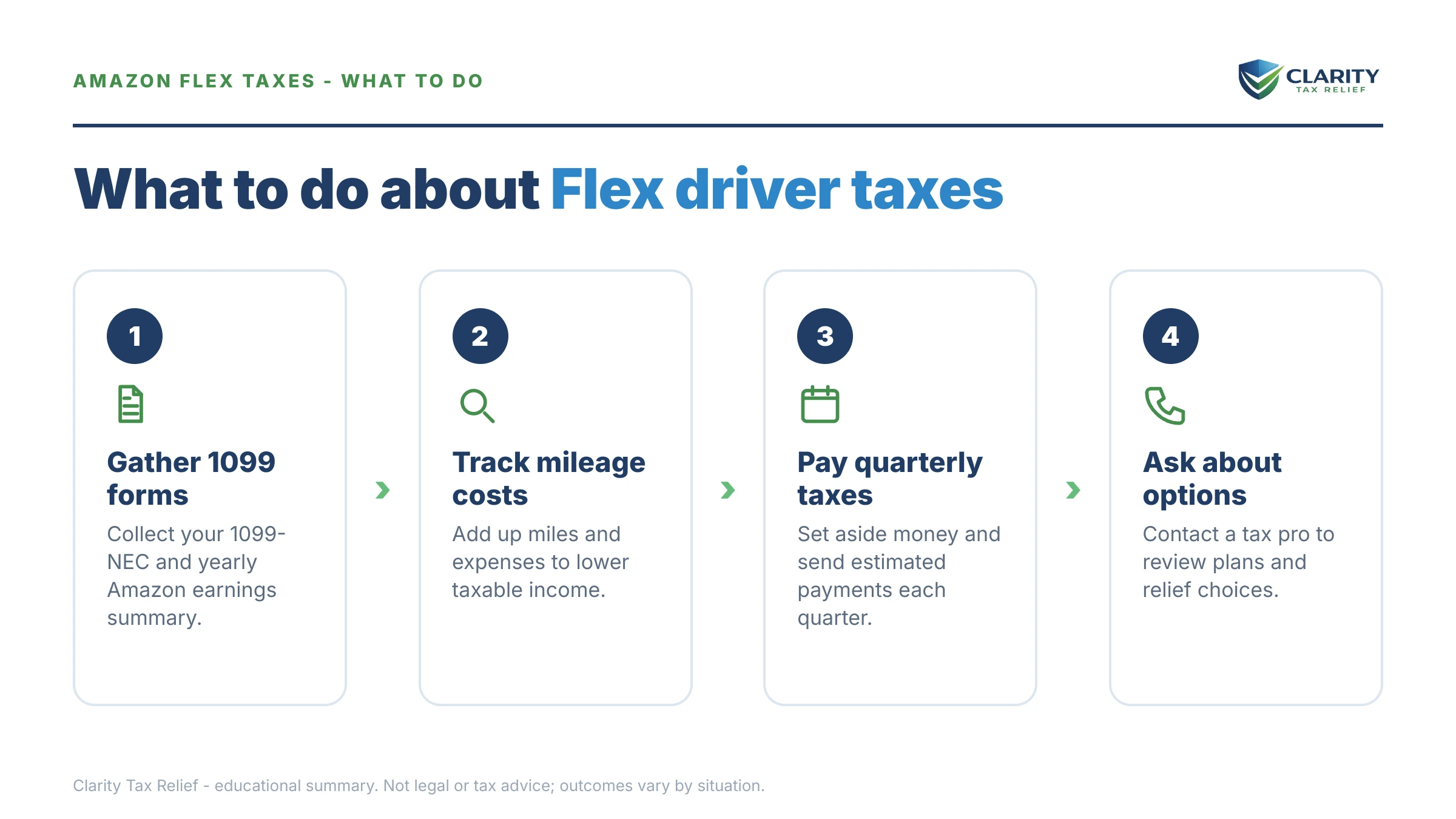
Amazon Flex owe taxes: what happens if you ignore the bill
An unpaid Flex tax balance enters the IRS's automated collection sequence, and each notice carries more enforcement power than the last. The system is fully automated — 2025's roughly 27% IRS workforce cut made humans harder to reach, but the notice stream and levies never stopped. Here's the sequence for a filed-but-unpaid balance:
- CP14 — the first bill, typically giving you about 21 days to pay or arrange payment. No enforcement yet; cheapest moment to act.
- CP501 / CP503 — reminder notices. Still just bills, but penalties and interest have been compounding the whole time.
- CP504 — Notice of Intent to Levy under IRC §6331(d). The IRS can now seize your state tax refund, and a federal tax lien becomes a live risk.
- LT11 / Letter 1058 — the final notice. A 30-day clock starts, along with your Collection Due Process appeal rights (Form 12153). After it runs, the IRS can levy your bank account (funds are held 21 days before they leave) and garnish wages — including the paycheck at your regular job, continuously, until the debt is resolved.
There's a second path worth naming: if you didn't report the Flex 1099-NEC at all, the underreporter system matches Amazon's copy against your return and mails a CP2000 notice proposing the tax plus an accuracy penalty — usually calculated with zero deductions, since the IRS doesn't know your mileage. Responding by the printed date with a corrected Schedule C is dramatically cheaper than accepting their math. And whichever path you're on, keep filing future returns on time — should i file taxes if i owe back taxes explains why one debt should never become two.
| Trigger | Your window | What's at stake if it passes |
|---|---|---|
| April 15 filing deadline | File on time even if you can't pay a cent | Failure-to-file penalty (5%/month) is 10× the failure-to-pay penalty (0.5%/month) |
| CP14 — first balance-due bill | Typically 21 days from the notice date | Escalation to reminder notices and the levy track begins |
| CP2000 — unreported 1099-NEC | The response date printed on the notice | Easiest chance to add mileage/deductions before the tax is assessed |
| CP504 — intent to levy | The pay-by date on the notice | IRS can take your state tax refund; lien risk rises |
| LT11 / Letter 1058 — final notice | 30 days to request a CDP hearing (Form 12153) | Wage and bank levies become legal; formal appeal rights lapse |
Staring at a Flex tax bill you can't pay?
Get your Amazon Flex balance reviewed free before another month of penalties and interest posts. An experienced tax professional will check whether missed mileage can shrink the debt, then map the cheapest payment path — no pressure, no obligation.
Your options for paying off Amazon Flex taxes owed
A Flex tax debt under $10,000 qualifies for the IRS's most accessible payment programs — including one the IRS is generally required to accept. At $7,400, the workhorse is the guaranteed installment agreement: if you owe $10,000 or less in tax, have filed and paid on time for the past five years, and agree to pay the balance within three years, the IRS must grant it. The full DIY playbook for setting any of these up — with scripts and the order to do things in — is in our pillar guide on how to settle tax debt yourself.
| Option | Eligibility at $7,400 | Cost and catch |
|---|---|---|
| Pay in full | Anyone | Stops penalty and interest immediately; cheapest total cost |
| Short-term plan (up to 180 days) | Can pay balance plus accruals within 180 days | $0 setup fee; interest and the 0.5%/month penalty continue until paid |
| Guaranteed installment agreement | Owe $10,000 or less in tax; clean 5-year filing/payment history; pay within 3 years | Setup fee applies; roughly $206/month over 36 months at $7,400, while accruals continue |
| Streamlined installment agreement | Balances up to $50,000; up to 72 months, set up online | Roughly $103/month base at 72 months — but far more total interest over time |
| Penalty relief (FTA / AEP) | Clean compliance the prior 3 years | Removes penalties, not the tax or interest; AEP becomes automatic starting summer 2026 |
| Currently Not Collectible | Paying anything would prevent basic living expenses | Collection pauses; debt and interest remain; future refunds are kept |
| Offer in Compromise | Must show $7,400 exceeds everything the IRS could ever collect — rare with steady W-2 wages | $205 fee plus 20% down on lump-sum offers (both waived with low-income certification); the IRS accepted roughly 1 in 5 offers in FY2024 |
Two honest notes on that table. First, an Offer in Compromise is usually a poor fit for a Flex driver with a full-time W-2 job — the IRS looks at your income and assets, and a steady paycheck typically means it can collect $7,400 in full. Don't pay anyone who promises otherwise. Second, penalty relief is worth checking even on a plan: if the past three years were clean, first-time abatement can strip the failure-to-pay penalty off the balance, and starting summer 2026 the new Automatic Exemption from Penalty (AEP) applies that relief automatically for those who qualify — no request needed.
Already filed without deductions? Amend before you overpay
You generally have three years from the filing deadline to amend a return and reclaim deductions you skipped. For Flex drivers, that's almost always mileage: every mile driven during a delivery block is a business mile, and even without a log you can rebuild the number from your Flex block history, warehouse addresses, and phone location data. Our guide on didn't track miles doordash taxes walks through the reconstruction method the IRS actually accepts — it applies identically to Flex.
The right order matters: set up your payment plan on the balance as assessed first, so collection stops, then file the amendment. When the IRS processes the 1040-X, the balance drops and your plan pays off early. The mechanics and the traps are covered in amend return to reduce tax debt. Don't forget the smaller line items either: a share of your phone bill, hot bags, phone mounts, and tolls all belong on Schedule C.
How to respond to an Amazon Flex tax bill, step by step
- Pull your real numbers — download your 1099-NEC from the Flex app's tax section and log into your IRS online account to confirm the exact balance, penalties, and interest posted so far.
- Rescue your deductions — reconstruct your block mileage from Flex history and phone location data; if the return you filed skipped it, price out a Form 1040-X amendment before you commit to paying the full balance.
- Pick a payment path before the notices escalate — set up a short-term plan or installment agreement online at IRS.gov; even a modest monthly plan stops the collection sequence cold.
- Fix your W-4 so 2026 doesn't repeat — add extra withholding at your day job or start quarterly estimated payments so next April's return doesn't stack a new balance on this one.
- Get a professional review if it's bigger than one year — multiple unfiled years, a CP2000 already assessed, or debt across several tax years changes the order you should fix things in.
Stopping next year's bill: the W-4 fix vs. quarterlies
A W-2 employee driving Amazon Flex can usually skip quarterly estimated payments entirely by adding extra withholding at the day job. The IRS treats withholding as paid evenly through the year no matter when it comes out — so raising the "extra withholding" line on your W-4 mid-year can cover your Flex tax and neutralize the underpayment penalty in a way a late estimated payment can't.
The rough math: set aside 25–30% of your net Flex profit (after mileage) for federal tax. Expecting $12,000 of net profit in 2026? That's about $3,000–$3,600 — roughly $125–$150 extra per biweekly paycheck. Prefer to keep your paycheck intact and pay the IRS directly four times a year instead? The schedule and safe-harbor rules are in how do quarterly estimated taxes work. And if your withholding problem runs deeper than Flex — say the day job itself under-withholds — two jobs owe taxes every year covers the multi-income W-4 trap.
When you can handle this yourself
Most single-year Flex tax debts under $10,000 are genuinely DIY-able. If you agree the balance is right (or you've already amended), one clean year is involved, and you have steady W-2 income, you can set up a guaranteed or streamlined installment agreement online in under an hour — no professional required. The step-by-step is in the how to settle tax debt yourself guide, and honestly, that's the right call for a lot of readers of this page.
Experienced help changes the outcome in specific situations: several unfiled years of Flex income (the IRS may have filed substitute returns with zero deductions), a CP2000 that already assessed tax without your mileage, a levy or garnishment already in motion, or Flex debt stacked on top of other balances pushing the total past $25,000. If this was your first year of any self-employment and the whole system blindsided you, first year self employed owe taxes covers the broader first-timer playbook.
Terms on your Flex tax paperwork, decoded
- 1099-NEC — the form Amazon files reporting your nonemployee compensation once you earn $600+; the IRS gets an identical copy.
- Self-employment tax — the 15.3% Social Security and Medicare tax on net self-employment profit; you pay both the employee and employer halves.
- Schedule C — the form where you report Flex income and subtract business expenses; only the net profit gets taxed.
- Standard mileage rate — the per-mile amount (70 cents for 2025) you can deduct for business miles instead of tracking actual car costs.
- Estimated tax (Form 1040-ES) — the four-times-a-year payments the IRS expects when no employer is withholding for you.
- CP2000 — the automated notice the IRS sends when income on a 1099 doesn't appear on your return; it proposes tax, not a final bill.
Amazon Flex tax questions, answered
Does Amazon Flex report my earnings to the IRS?
Yes. Amazon issues a Form 1099-NEC once you earn $600 or more in a year and sends the same copy to the IRS. That means the IRS already knows your Flex income before you file — if the number is missing from your return, the automated underreporter system typically flags the mismatch and sends a CP2000 notice proposing extra tax, penalties, and interest.
Why do I owe so much in taxes from Amazon Flex?
Because Flex income is hit by two taxes at once with nothing withheld. You pay 15.3% self-employment tax on your net profit from the first dollar, and then regular income tax on top — at your highest bracket, since side income stacks on your W-2 wages. A driver in the 22% bracket can lose roughly a third of every net Flex dollar to federal tax.
Can I deduct mileage for Amazon Flex?
Yes — the miles you drive during delivery blocks are deductible business miles, worth 70 cents each at the 2025 IRS standard rate. Even if you never kept a log, you can reconstruct mileage from your Flex block history, warehouse locations, and route records. On several thousand miles, that reconstruction routinely cuts a Flex tax bill by four figures.
What if I can't pay my Amazon Flex tax bill in full?
You have real options: a short-term plan gives you up to 180 days with no setup fee, and a balance under $10,000 usually fits the IRS's guaranteed installment agreement paid over up to three years. If paying anything would leave you unable to cover basic living costs, Currently Not Collectible status can pause collection. Interest and penalties keep accruing on any plan until the balance is paid.
Do I have to pay quarterly estimated taxes for Amazon Flex?
Generally yes, if you expect to owe $1,000 or more for the year — the IRS wants tax paid as you earn it, in four estimated payments. But as a W-2 employee, you have a simpler fix: add extra withholding on the W-4 at your day job so your paycheck covers the Flex tax. Withholding is treated as paid evenly through the year, which can also erase the underpayment penalty.
Can I amend my return if I forgot to claim Flex deductions?
Yes. File Form 1040-X to add the mileage, phone, and supply deductions you skipped, and the IRS recalculates what you owe — often knocking a four-figure chunk off the balance. You generally have three years from the original filing deadline to amend. Set up a payment plan on the current balance first, then amend; the plan adjusts when the debt drops.
Will the IRS garnish my paycheck at my regular job for Amazon Flex tax debt?
Not immediately — a wage levy only comes after the IRS mails a series of notices ending with a final notice of intent to levy (LT11 or Letter 1058) and gives you 30 days to respond. But once a wage levy starts, it is continuous, taking a slice of every paycheck until the debt is resolved. Acting during the notice stage prevents it entirely.
I heard 1099-K rules changed — do I still owe taxes on Amazon Flex under $20,000?
Yes. The $20,000 threshold applies to Form 1099-K from payment apps and marketplaces — Amazon Flex pays you directly and reports on Form 1099-NEC, which triggers at just $600. And regardless of any form, every dollar of Flex profit is taxable income you're required to report. The reporting threshold changes what Amazon files, not what you owe.
Your next 24 hours
- Find Box 1 on your 1099-NEC (Flex app → Tax Information) and log into your IRS online account so you're working from the exact assessed balance, not the number you remember from filing.
- Gather three things: your Flex block/earnings history, your most recent day-job pay stub, and last year's tax return — that's everything needed to reconstruct mileage and price a payment plan.
- Get your free case review — use the 2-minute form or call (888) 825-7779. Penalties and interest post every month the balance sits; an experienced tax professional can tell you in one call whether an amendment shrinks the debt and which plan costs the least.
The official resources referenced in this guide: the IRS Self-Employed Individuals Tax Center covers Schedule C and SE tax rules; every federal payment method lives at IRS.gov/payments; and current plan terms are on the IRS payment plans and installment agreements page.
This guide is general information, not tax or legal advice for your specific situation. Eligibility for IRS programs depends on individual facts and circumstances; no outcome is guaranteed.