
Trusts & Estates
Trust Tax Debt: What to Do When a Trust Owes IRS Back Taxes (2026)
The short answer: trust tax debt is income tax the trust itself owes on Form 1041, and the IRS collects it from trust assets first — not your personal money. A trustee becomes personally liable mainly by distributing trust funds while a known IRS balance sits unpaid. File correct 1041s, freeze distributions, then pay or set up a plan.
You agreed to serve as trustee because a parent or spouse asked you to — and now an IRS envelope addressed to the trust, not to you, is sitting on the kitchen table. Your first fear is that your Social Security check and your own savings are suddenly exposed. Mostly, they are not. The lines between the trust's debt and your money are clear, and once you know where they sit, protecting yourself is largely a matter of not crossing them.
If a notice came with the balance, the image below shows what the IRS's bill to a trust looks like and where the form number, tax year, and pay-by date sit — three details you'll need before you make a single call.
⏱ The clock that's running: if a notice is in front of you (usually a CP161 for a trust), the pay-by date printed on it controls. Even with no notice yet, the failure-to-pay penalty adds 0.5% every month and interest compounds daily on the trust's balance — waiting has a monthly price.
Trust tax debt vs. the Trust Fund Recovery Penalty: two different problems
Trust tax debt is income tax a trust owes on Form 1041; the Trust Fund Recovery Penalty is a payroll-tax penalty against individuals — they share a word and nothing else.
This matters because searching "trust tax debt" surfaces both, and the playbooks are opposites. The trust fund recovery penalty makes business owners and check-signers personally liable for employee withholding that never reached the IRS — the fallout of 941 back taxes, not of a family trust.
If your letter names Form 1041, an EIN, and a trust's name — "The Smith Family Irrevocable Trust" — you're in the right place. If it mentions Form 941, employees, or a "responsible person" interview, follow the payroll links above instead.
Why the trust owes back taxes
A trust owes back taxes for one main reason: income the trust kept instead of distributing gets taxed at compressed trust brackets that reach the top federal rate at roughly $16,000 of retained income — a threshold an individual doesn't hit until income is in the high six figures.
A trust must file Form 1041 once it has $600 or more of gross income for the year (or any taxable income at all). Interest on a trust CD, dividends, rent from a trust-owned property, or capital gain from selling the family home after a death can all cross that line quickly.
The most common paths to a trust balance we see:
- The successor trustee didn't know 1041s existed. A revocable living trust files nothing separate while the grantor is alive — the income goes on the grantor's own 1040. At death, the trust becomes irrevocable, gets its own EIN, and suddenly has annual filing duties nobody mentioned. (The grantor's last personal return is a separate problem — see deceased final tax return owes.)
- Income was retained instead of distributed. Distributed income flows out to beneficiaries on Schedule K-1 and is taxed at their rates. Retained income is taxed to the trust at compressed brackets. Same dollars, very different tax.
- The IRS assessed without the income distribution deduction. When no 1041 is filed, the IRS may assess tax on the trust's reported income as if every dollar was retained. Filing the actual return — showing what went out to beneficiaries — often shrinks the bill dramatically.
- A house or brokerage account was sold. Capital gains inside the trust, minus the step-up in basis at death, can leave a taxable gain the trustee never planned for.
One forward-looking note: trusts can elect to treat distributions made in the first 65 days of a year as made the prior year, shifting income to beneficiaries. It won't fix an old balance, but it prevents the next one.
If the assets went through probate rather than a trust, the rules differ in important ways — start with our guide to when an estate owes IRS back taxes instead.
A worked example: how a trust ends up owing $7,400
Say you're a retiree on Social Security serving as successor trustee of your late mother's trust. In the year after her death, the trust sold her house and parked the proceeds in a CD. Between CD interest and a small taxable gain, the trust's retained income produced $5,400 of federal tax — and because nobody told you a Form 1041 was due, it went unfiled for 14 months. Here's the hypothetical math:
- Tax on the 1041: $5,400
- Failure-to-file penalty: 5% per month (reduced to 4.5% while the failure-to-pay penalty also runs), capped here at 22.5% = $1,215
- Failure-to-pay penalty: 0.5% × 14 months = 7% = $378
- Interest, compounding daily on the growing balance: roughly $400
Total: about $7,400 — of which nearly $2,000 is penalties and interest on a $5,400 tax. Paid from the trust CD today, it ends there. Stretched over a 72-month installment agreement instead, the minimum runs about $103 a month before accruals — realistically $110–$125 with continuing interest. You can estimate your own buildup with our Penalty & Interest Calculator. Notice also what a penalty-abatement request is worth here: removing the $1,593 in penalties cuts the balance by more than a fifth before you pay a dime of tax.
Who the IRS can actually collect trust tax debt from
The IRS collects trust tax debt from trust assets first — trustees and beneficiaries become personally liable only in specific, avoidable situations.
This is the question that keeps trustees up at night, so here is the whole map:
| Who | When liability attaches | What's at risk |
|---|---|---|
| The trust itself | Always — the Form 1041 assessment sits on the trust's EIN | Trust bank and brokerage accounts; a federal tax lien on trust-owned real estate |
| The trustee, personally | Only if trust money goes to other debts or distributions after notice of the IRS claim (31 U.S.C. §3713) | Personal liability up to the amount paid out — never automatic for simply serving |
| Beneficiaries | Only as transferees, if they received distributions the trust needed to pay its tax (IRC §6901) | Capped at the value each beneficiary actually received |
| The grantor | Only for grantor trusts — e.g., a revocable living trust while the grantor is alive | The debt belongs on the grantor's personal 1040, not the trust's account |
The trustee rule deserves one more sentence, because it's the whole game. The federal priority statute says a fiduciary who pays other claims — including distributions to family — while knowing the government's claim is unpaid can be held personally liable up to the amount distributed. It's the same rule that makes an executor personally liable to the IRS. The defense is simple: once you know about the balance, nothing leaves the trust until the IRS is addressed.
For beneficiaries, transferee liability works like a clawback with a ceiling: the IRS can reach what you received from the trust, never your other assets. If you inherited through a trust and are worried, our guide to whether the IRS can take an inheritance walks through the limits. And note how differently this works from business entities, where the entity type drives everything — compare LLC back taxes personal liability.
What happens if you ignore a trust's IRS balance
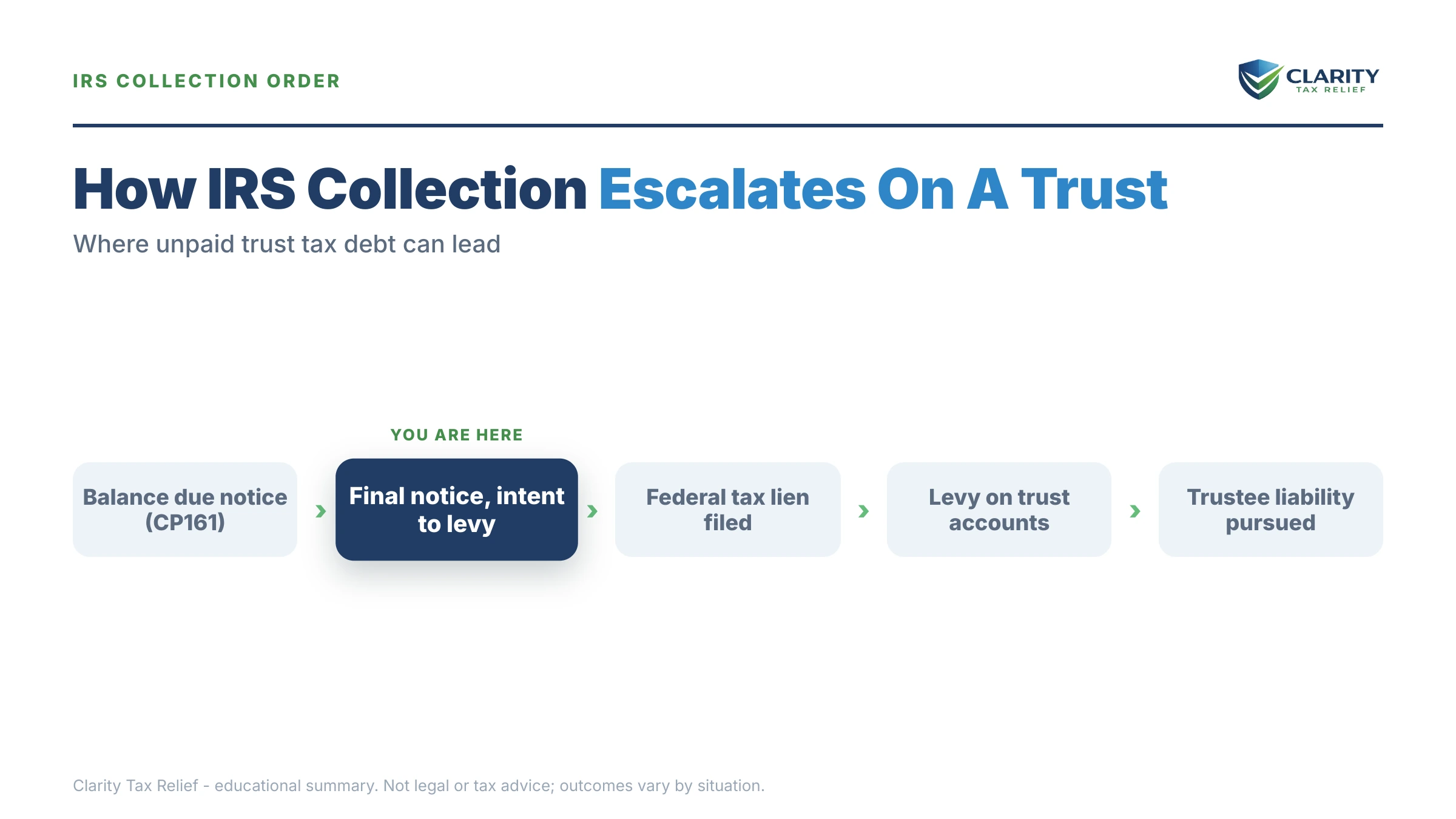
An ignored trust tax balance follows the IRS's business collection track: bill, reminder, intent to levy, then a final notice that opens a 30-day window before the IRS can levy the trust's accounts.
Because the debt sits on an EIN, the notices differ from the CP14 stream individuals get — but the machine behind them is the same, and in 2026 it's fully automated. IRS staffing fell roughly 27% in 2025; the humans are harder to reach, but the notice-and-levy systems never stopped. The sequence:
- CP161 — the trust's first bill, showing the 1041 year, the tax, and the penalty and interest breakdown. No enforcement yet; this is the cheapest moment to act. (Full guide: CP161 notice.)
- CP163 — a reminder that the balance remains, now larger, since penalties and interest have compounded in the gap between notices.
- CP504B — the intent-to-levy warning for business accounts. The IRS is now positioned to start reaching trust assets, and a federal tax lien becomes a live risk. (Full guide: CP504B notice.)
- Letter 1058 / LT11 — the final notice of intent to levy. It starts a 30-day clock and your Collection Due Process rights, requested on Form 12153. After the window closes, the IRS can levy without further warning.
- Levy and lien — the trust's bank and brokerage accounts can be levied, and a filed lien attaches to trust real estate, clouding title and blocking any sale or distribution of the property until it's resolved.
Two quieter consequences run alongside the notices. First, a lien on trust property effectively freezes the trustee's ability to wind the trust up — you can't distribute a house with a federal lien on it. Second, the 10-year collection statute (CSED) starts at assessment, so the timeline is long: this does not age out quickly, and distributions made during those years are exactly what creates personal exposure.
Trustee of a trust that owes the IRS?
Send us the notice. An experienced tax professional will confirm whether the balance is even correct, whether you have any personal exposure, and the cheapest way to close it out — free and confidential. Penalties and interest are compounding on the trust's account every month it waits.
Your options to resolve trust tax debt
A trust has the same core resolution menu as an individual taxpayer — pay in full, an installment agreement, an Offer in Compromise, hardship status, and penalty relief — with entity-specific twists at every step. (The general negotiating playbook lives in our guide to how to settle tax debt yourself; below is what changes when the taxpayer is a trust.)
| Option | Which trusts qualify | Key limit or cost |
|---|---|---|
| Pay in full from trust funds | Any trust with liquid assets | $0 beyond the balance; stops penalty accrual immediately |
| Short extension to pay | Trusts that can pay within a few months (typically up to 180 days) | $0 setup; interest and the 0.5%/month penalty continue |
| Installment agreement | Trusts with steady income — rents, dividends, interest | Requested via Form 9465 or by phone, not the individual online tool; a setup fee applies |
| Offer in Compromise | Trusts whose assets and income genuinely cannot cover the debt | $205 fee plus 20% down on lump-sum offers; no low-income waiver for entities |
| Currently not collectible | Trusts with no reachable assets or income | $0; collection pauses, but the balance and any lien remain |
| Penalty abatement | Clean prior 3 years (first-time abatement) or reasonable cause | Removes penalties only; tax and interest on the tax remain |
| Correct the assessment | Trusts whose income was actually distributed to beneficiaries | File or amend the 1041 with the income distribution deduction — this can shrink the tax itself |
Correct the assessment first. This is the option unique to trusts, and it comes before any payment talk. If the IRS assessed the trust as though every dollar of income was retained — common when 1041s went unfiled — a properly prepared return showing distributions to beneficiaries can move that income onto K-1s and off the trust's bill. Never negotiate a balance you haven't verified.
Installment agreements work for trusts, but the mechanics differ from an individual's: the trust generally can't use the individual online payment-agreement tool, so the request goes in on Form 9465 or through the phone number on the notice (our Form 9465 walkthrough covers the form line by line, and the IRS's own terms are on its payment plans page). Interest and the failure-to-pay penalty run through the plan, so a trust with assets should full-pay if it can.
An Offer in Compromise for a trust is real but rare. The trust files Form 656 with entity financials on Form 433-B (OIC), pays the $205 fee, and puts 20% down on a lump-sum offer — the low-income certification that waives those costs applies only to individual taxpayers. The IRS accepted roughly 1 in 5 offers in FY2024, and a trust holding a house or a funded brokerage account will almost never qualify, because the offer must show the IRS could not collect the balance from what the trust owns. By law, an offer the IRS doesn't decide within 2 years is deemed accepted — with narrow exceptions: a returned or rejected offer stops the clock, and time during court disputes does not count.
Penalty abatement is often the highest-value move on a trust balance, because late-filing penalties on a first-year 1041 are so common. First-time penalty abatement applies if the trust's account was clean for the prior three years — trivially true for a trust that just came into existence at a death. Reasonable cause is strong where a grieving or newly appointed trustee had no way to know a return was due. And starting in summer 2026, the IRS's Automatic Exemption from Penalty (AEP) begins granting qualifying relief automatically, with no request needed — so don't pay a penalty in 2026 without checking both paths.
| Option | Upfront cost | Typical time to resolution |
|---|---|---|
| Full payment | $0 (plus the balance) | Immediate; penalty accrual stops when it posts |
| Installment agreement | Setup fee (varies by how you apply) | Weeks to set up; months to years to pay off |
| Offer in Compromise | $205 + 20% of a lump-sum offer | Commonly close to a year; deemed accepted if not decided within 2 years (with narrow exceptions) |
| Currently not collectible | $0 | Weeks, after the IRS reviews the trust's finances |
| Penalty abatement | $0 | Weeks to a few months; can run alongside any option above |
| Corrected or late-filed 1041 | $0 (preparation aside) | Several months of IRS processing |
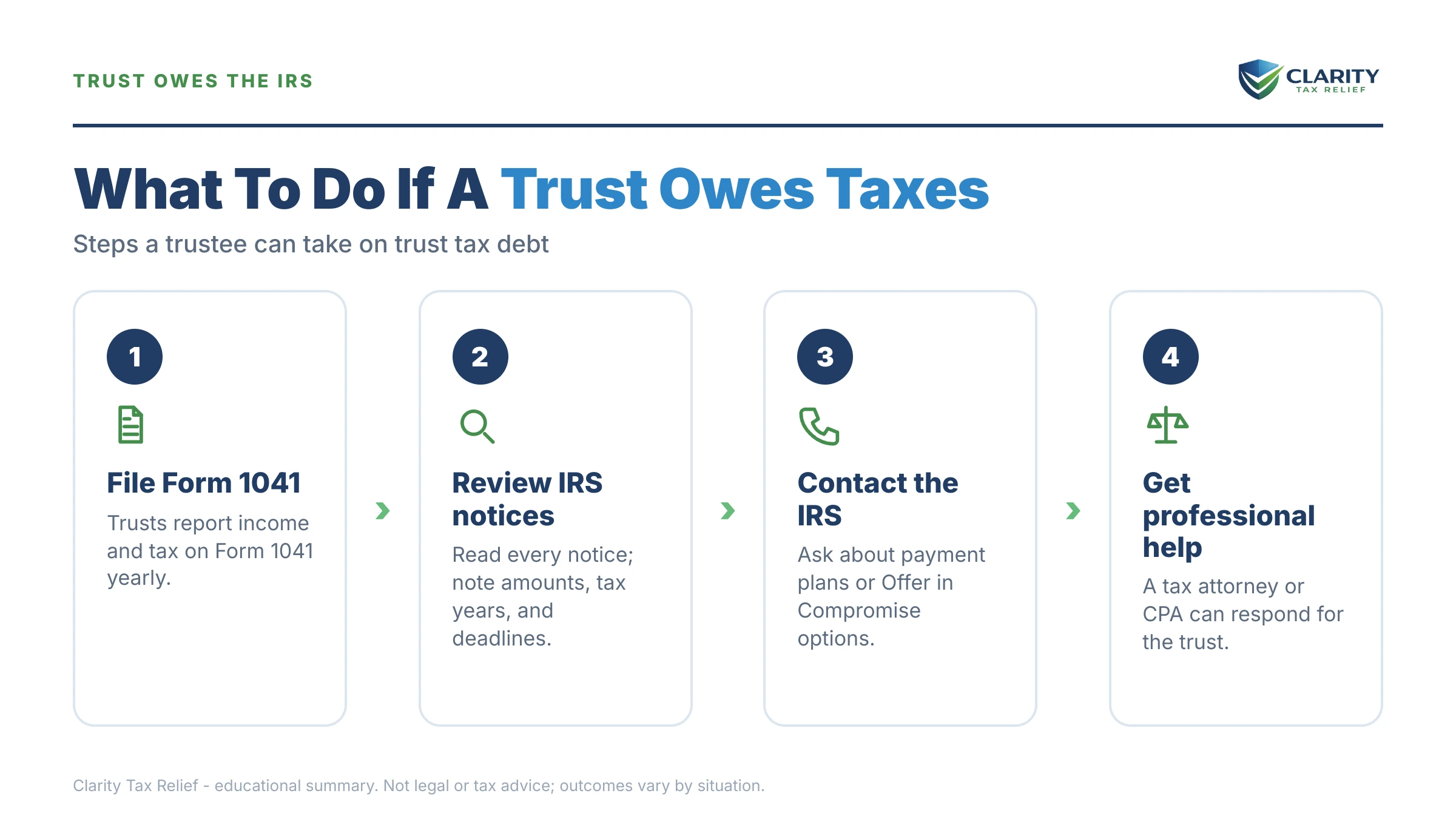
How to respond when a trust owes back taxes, step by step
- Read the notice and identify the account. Find the tax form (1041), the tax year, the amount, and the pay-by date printed on the notice — the debt belongs to the trust's EIN, not your Social Security number.
- Freeze distributions. Stop all distributions and non-essential payments from the trust until the IRS claim is resolved; this is what protects you from personal fiduciary liability.
- Pull the trust's records. Gather the trust instrument, the EIN letter, every filed Form 1041 and K-1, trust bank and brokerage statements, and a history of distributions.
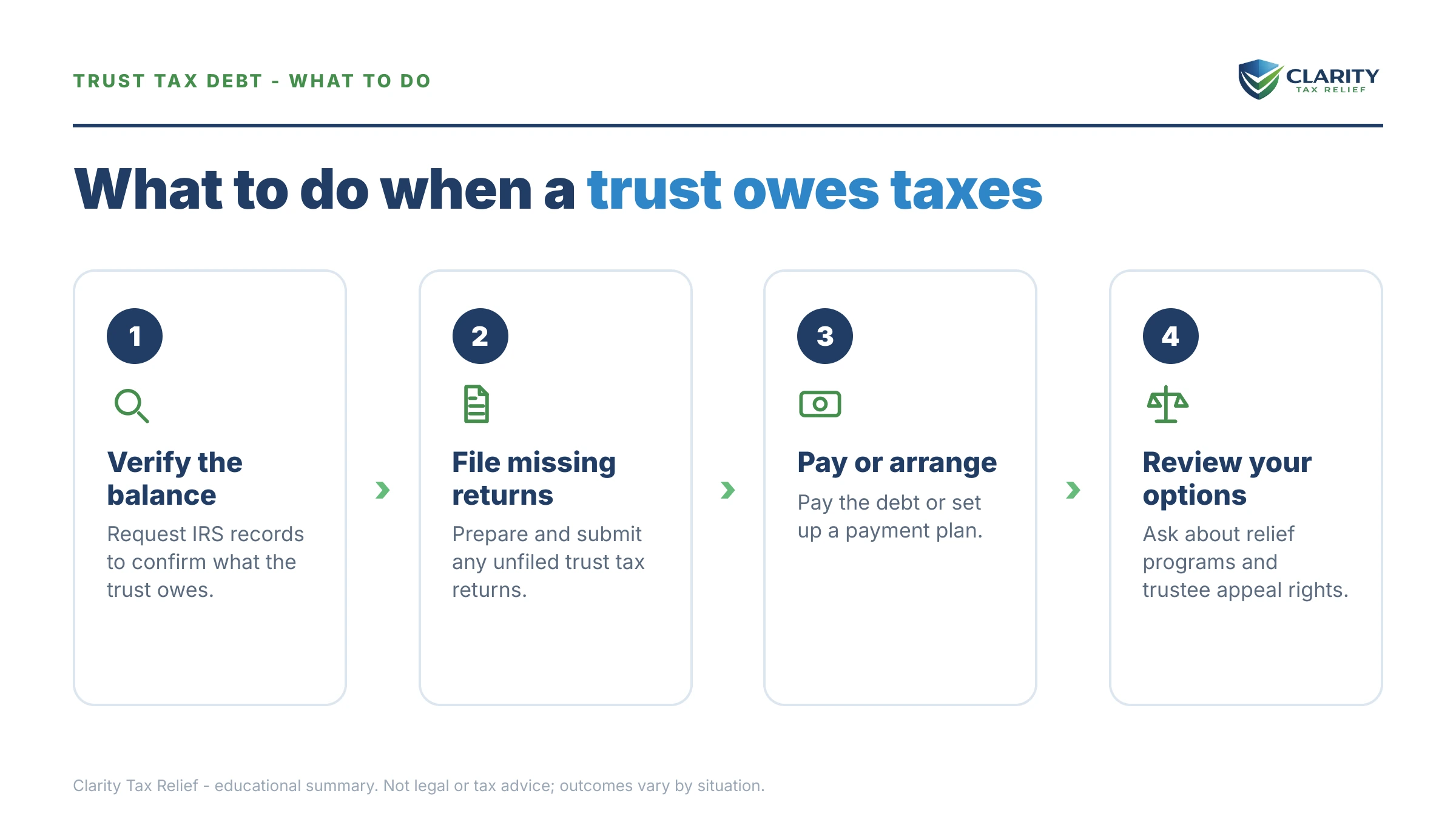
- Verify the balance is actually right. Check whether income was distributed to beneficiaries; a corrected or late-filed Form 1041 claiming the income distribution deduction can shrink or erase the assessed tax.
- Choose and set up a resolution. Pay in full from trust funds if possible; otherwise request an installment agreement, submit an Offer in Compromise, or document that the trust has nothing left.
- Request penalty relief in writing. Ask for first-time abatement or reasonable-cause relief on the failure-to-file and failure-to-pay penalties before paying them.
The form itself, its instructions, and filing addresses are on the IRS's About Form 1041 page.
When you can handle a trust's tax debt yourself
You can usually resolve a trust tax balance under about $10,000 yourself when the 1041s are filed and correct and the trust has funds to pay.
Handle it on your own if: the notice matches a return you (or the trust's preparer) actually filed, the trust has liquid assets to pay in full or over a few months, no distributions have gone out since you learned of the debt, and only one tax year is involved. Pay from trust funds, request first-time abatement on the penalties, and keep the confirmation with the trust's records — done. If money is tight but the numbers are right, a simple installment agreement by phone is well within a careful trustee's reach. If the IRS itself caused delays or you hit a wall, the independent Taxpayer Advocate Service exists for exactly that.
Experienced help changes the outcome when: multiple 1041 years are unfiled, the IRS assessed retained-income tax on money that actually went to beneficiaries (the distribution-deduction fix requires getting the returns exactly right), distributions already went out and §3713 or transferee exposure is in play, a lien is sitting on trust real estate someone needs to sell, beneficiaries are fighting about who bears the tax, or a levy notice has already started the 30-day clock. In those cases the order you fix things in — returns first, then penalties, then the balance — changes what the trust ultimately pays, and a misstep can convert the trust's problem into your personal one.
Terms on your notice, decoded
- Fiduciary — the person legally responsible for the trust's money and its tax duties; on a 1041, that's the trustee.
- Non-grantor trust — a trust taxed as its own entity on Form 1041; most trusts become non-grantor at the grantor's death.
- Income distribution deduction (DNI) — the mechanism that moves distributed income off the trust's return and onto beneficiaries' K-1s, taxed at their rates instead of the trust's compressed brackets.
- Federal priority statute (31 U.S.C. §3713) — the rule that makes a fiduciary personally liable, up to amounts paid out, for paying other claims ahead of a known federal tax debt.
- Transferee liability (IRC §6901) — the IRS's power to pursue beneficiaries for a trust's unpaid tax, capped at the value each one received.
- CSED — the Collection Statute Expiration Date; the IRS generally has 10 years from assessment to collect, with pauses for events like a pending offer.
If the trust's situation involves unfiled years or distributions that already went out, get a free trust tax debt review at the 2-minute form or (888) 825-7779 before you file anything — the sequencing determines what the trust pays and whether any of it lands on you.
Trust tax debt questions, answered
Is a trustee personally liable for a trust's tax debt?
Not automatically. The IRS collects a Form 1041 balance from the trust's own assets first. A trustee becomes personally exposed under the federal priority statute (31 U.S.C. §3713) mainly by paying other debts or making distributions while on notice of the unpaid federal claim — and only up to the amount that went out. Keep trust funds in place until the balance is resolved and that exposure is largely avoidable.
Can the IRS take my Social Security check for a trust's tax debt?
No — not for a balance assessed against the trust's EIN. The 15% Social Security levy under the Federal Payment Levy Program applies to your own personal tax debts. The exception is if the IRS separately assesses you as a fiduciary or transferee; that assessment becomes your personal debt, and normal collection tools can then reach your income.
Can the IRS go after beneficiaries for a trust's back taxes?
Yes, but only up to the value they received. Under transferee liability rules (IRC §6901), the IRS can pursue beneficiaries who took distributions from a trust that then couldn't pay its tax. A beneficiary who received $20,000 can be pursued for up to $20,000 of the trust's debt — never more — and the IRS must build that case separately from the trust assessment.
Does a trust qualify for an IRS payment plan?
Yes. A trust can enter an installment agreement on its Form 1041 balance, though it generally cannot use the individual online payment-plan tool — the request is made with Form 9465 or by calling the number on the notice. Interest and the 0.5% monthly failure-to-pay penalty keep accruing during the plan, so shorter is cheaper.
Can a trust get an Offer in Compromise?
Yes — trusts can file Form 656 with entity financials on Form 433-B (OIC). The application fee is $205, a lump-sum offer requires 20% down, and the low-income waiver applies only to individuals, so a trust pays both. The IRS accepted roughly 1 in 5 offers in FY2024, and approval requires showing the trust's assets and income genuinely cannot cover the debt.
What IRS notice does a trust get for back taxes?
Usually a CP161, the business balance-due notice, addressed to the trust's name and EIN. If it goes unpaid, reminders follow, then CP504B (intent to levy), then a final notice such as Letter 1058 that starts a 30-day window to request a Collection Due Process hearing before the IRS can levy the trust's accounts.
Is trust tax debt the same as the trust fund recovery penalty?
No — they are unrelated despite the similar names. Trust tax debt is income tax a trust entity owes on Form 1041. The Trust Fund Recovery Penalty is a personal penalty against individuals who failed to hand over payroll taxes withheld from employees' wages. If your letter mentions Form 941 or a responsible person interview, you are dealing with the payroll issue, not a trust's income tax.
Does a trust's IRS debt expire?
Yes — the 10-year collection statute (CSED) applies to a trust's assessment just as it does to an individual's. The clock runs from the date the tax was assessed, not the tax year, and it pauses during events like a pending Offer in Compromise. An unfiled Form 1041 has no assessment yet, so nothing is expiring on those years.
What if the trust has no money left?
The IRS looks at where the money went. If distributions were made while the tax was known and unpaid, it can pursue the trustee under the federal priority statute or beneficiaries as transferees. If the trust was emptied legitimately before the debt arose and no assets remain, the account can be reported uncollectible and the balance may simply expire at the CSED.
Can late-filing penalties on a Form 1041 be removed?
Often, yes. First-time abatement applies if the trust's account was clean for the prior three years, and reasonable cause covers situations like a death, serious illness, or a successor trustee who had no way to know a return was due. Starting in summer 2026, the IRS's Automatic Exemption from Penalty (AEP) begins applying qualifying relief without a request.
Your next 24 hours
- Find three things on the notice: the form number (1041), the tax year, and the pay-by date — and confirm the notice is addressed to the trust's name and EIN, not to you personally.
- Gather the trust's paper trail: the trust instrument, the last filed Form 1041 and K-1s, trust bank statements, and a list of every distribution made since the tax year in question — then make no new distributions.
- Get the free case review: use the 2-minute form or call (888) 825-7779. An experienced tax professional will check whether the assessment is even right and map the cheapest exit — before the next notice raises the stakes, while penalties and interest compound on the trust's balance every month.
This guide is general information, not tax or legal advice for your specific situation. Eligibility for IRS programs depends on individual facts and circumstances; no outcome is guaranteed.