
City Guides
Tax Relief Minneapolis: Every Real Option for IRS and Minnesota Tax Debt (2026)
The short answer: tax relief in Minneapolis means matching your IRS or Minnesota Department of Revenue debt to a real program — a payment plan, Offer in Compromise, hardship status, or penalty abatement. Balances over $50,000 require financial disclosure, over $66,000 your passport is at risk, and every legitimate path is mapped below.
If you're searching for tax relief Minneapolis-style — a back-tax balance, maybe a lender who just asked about it, maybe both federal and state letters in the same week — the map is the same, but the details decide everything. Maybe the refinance you've been planning suddenly hinges on a balance you'd been meaning to deal with. That balance is fixable, and in a specific order.
This guide covers both agencies a Minneapolis taxpayer can owe, every resolution program with its eligibility line, and the one issue that trips up homeowners here more than anything else: how a federal tax lien interacts with a mortgage refinance.
⏱ The clock that matters: there's no single deadline on a tax balance, but the failure-to-pay penalty adds 0.5% every month and interest compounds daily on top of it. And a Notice of Federal Tax Lien can be filed at any point once your debt is assessed — including the month your refinance goes to underwriting.
Why "tax relief Minneapolis" is really two problems
A Minneapolis taxpayer can owe two separate governments, and resolving one does nothing for the other. The IRS handles your federal income and self-employment tax; the Minnesota Department of Revenue runs its own collection system for state income tax, with its own payment agreements, its own penalties, and its own enforcement tools.
This matters because the programs don't transfer. An IRS installment agreement does not pause Minnesota collection, and a state payment agreement does not stop an IRS levy. If you owe both, you need two resolutions — and the sequencing (which agency first, which balance is growing faster) is a real strategic decision. For the state side in depth, see our guide to Minnesota back taxes.
There's a second local wrinkle: the Twin Cities housing market means many people searching this query are homeowners with meaningful equity. Equity changes the math on nearly every option below — it can make a refinance the cheapest fix, and it can quietly disqualify you from settlement. Both effects show up in the worked example.
What happens if you wait: the IRS escalation path
IRS collection is an automated sequence, and it runs in Minneapolis exactly as it runs everywhere else — staffing cuts in 2025 reduced the humans, not the notices. Each stage arrives with more enforcement power than the last:
- CP14 — the first bill. Typically about 21 days before the sequence advances (10 business days if the balance is $100,000 or more). No enforcement yet.
- CP501 / CP503 — automated reminders. Still just bills, but the balance compounds monthly.
- CP504 — Notice of Intent to Levy. The IRS can now seize your Minnesota state tax refund.
- Notice of Federal Tax Lien — can be filed once the debt is assessed and unpaid. It attaches to your home and appears in the public record your lender's title search will pull.
- LT11 / Letter 1058 — final notice of intent to levy. A 30-day clock starts, along with your right to a Collection Due Process hearing via Form 12153.
- Levy — bank accounts (a 21-day hold before funds leave) and wages (continuous until released).
For a homeowner planning a refinance, the lien stage is the one that changes your life first. It arrives before any levy, it's public, and it turns a routine loan approval into a negotiation.
| Stage | What it means | Your window |
|---|---|---|
| CP14 | First bill for the balance | Typically 21 days before the next notice queues (10 business days if the balance is $100,000 or more) |
| CP501 / CP503 | Automated reminders; penalties and interest still accruing | Weeks — the sequence advances automatically |
| CP504 | Intent to levy — your Minnesota refund is now seizable | Act now; a lien filing often follows |
| Letter 3172 / NFTL | Federal tax lien filed — public record, refinance obstacle | Appeal rights apply; the deadline is printed on the letter |
| LT11 / Letter 1058 | Final notice of intent to levy | 30 days to request a Collection Due Process hearing |
| Levy | Bank levy or continuous wage levy | 21 days to release a bank levy before funds leave |
Owe the IRS or Minnesota with a refinance on the line?
A federal tax lien can be filed at any point once your balance is assessed — and penalties and interest are compounding monthly either way. Get your Minneapolis case reviewed free by an experienced tax professional before the lien complicates your closing.
Tax relief options in Minneapolis, compared
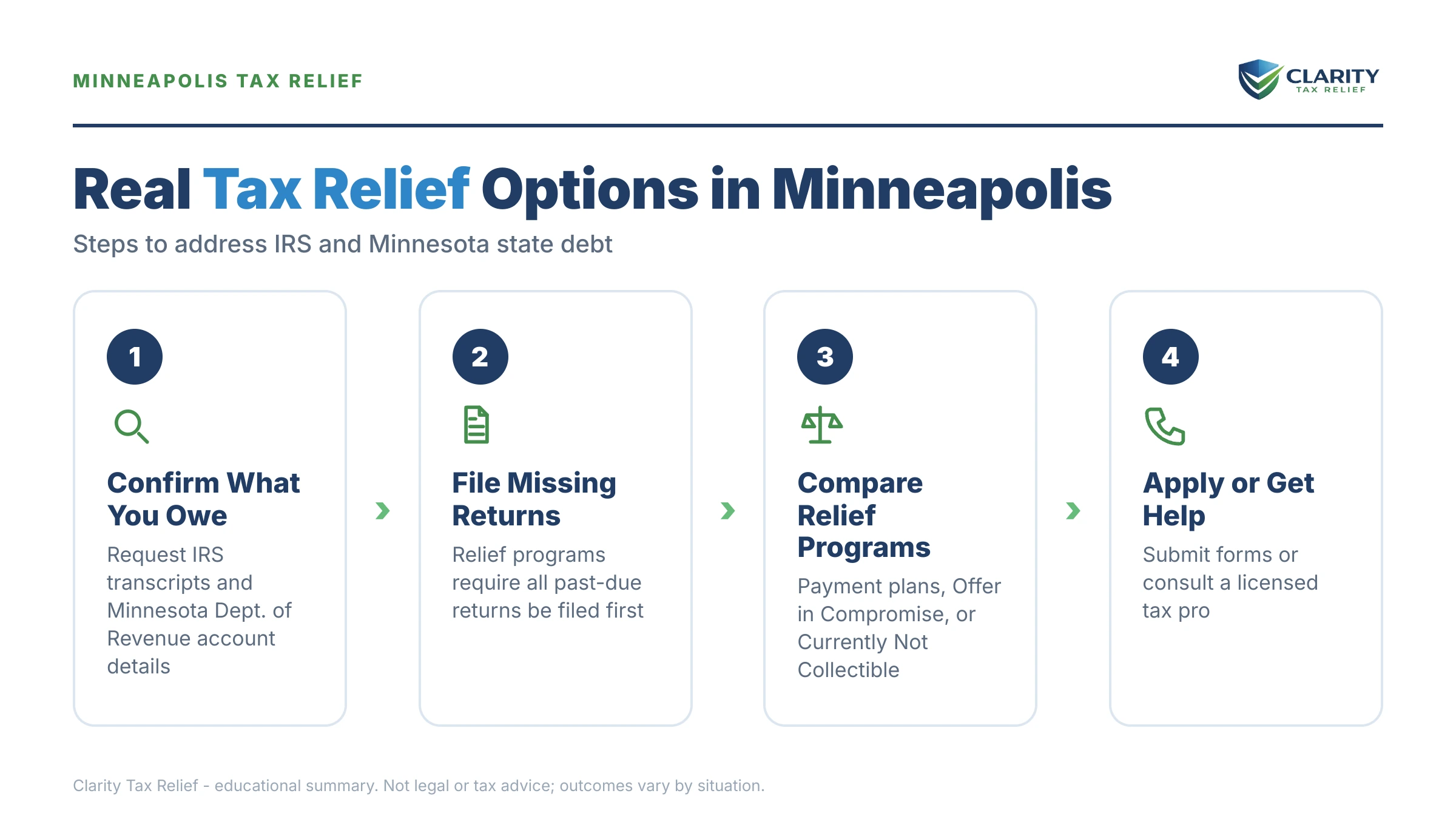
Every legitimate IRS resolution is means-tested — which program you get depends on your balance, income, and assets, not on which company you hire. If you want the full do-it-yourself playbook for each program, our pillar guide on how to settle tax debt yourself walks through them; here is how they line up:
| Option | Who typically qualifies | Cost & key notes |
|---|---|---|
| Short-term payment plan | Can pay in full within 180 days | $0 setup; penalties and interest continue until paid |
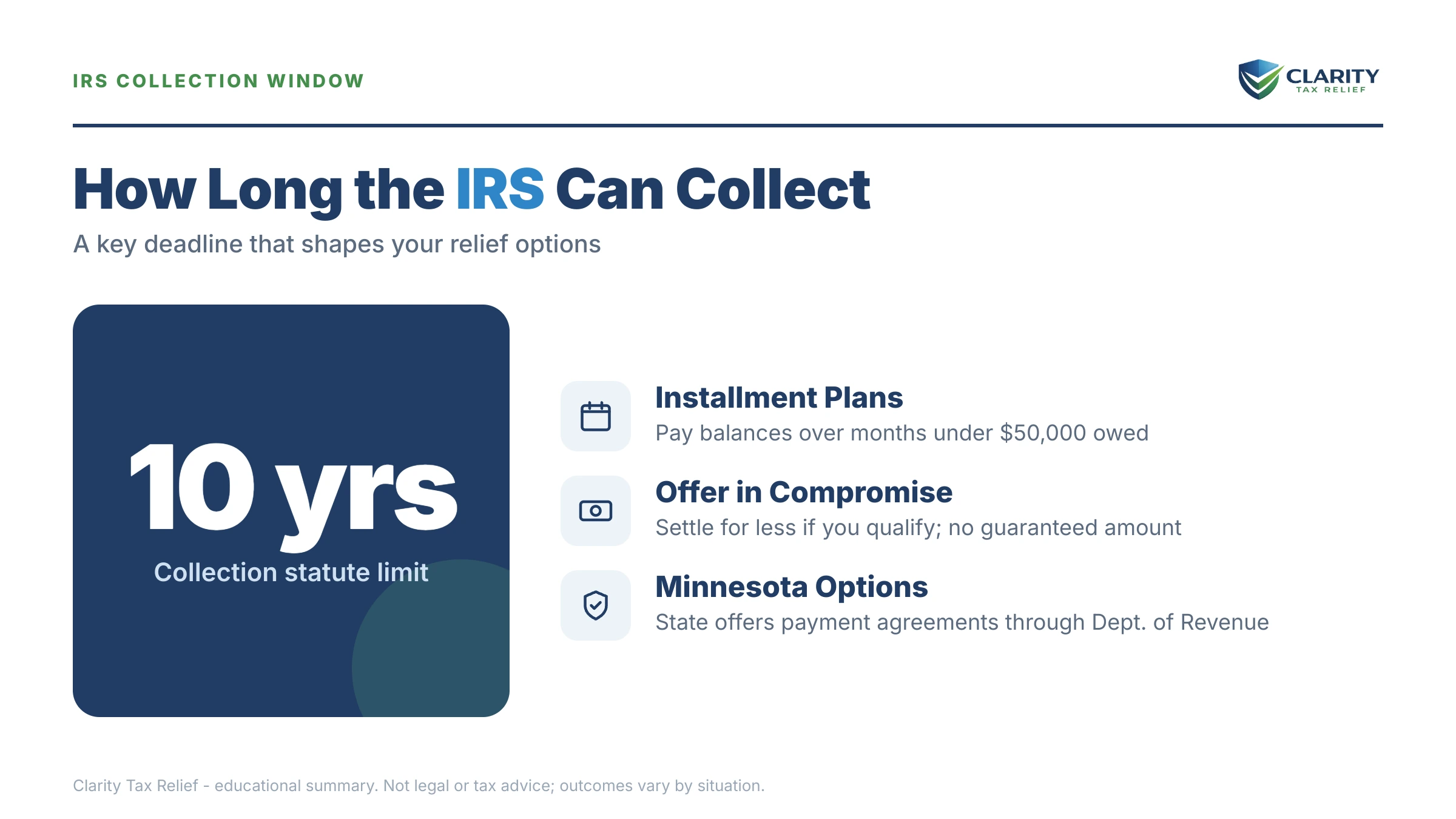
| Streamlined installment agreement | Balance of $50,000 or less | Up to 72 months, set up online, no financial statement; setup fee (reduced with direct debit) |
| Non-streamlined installment agreement | Balance over $50,000 | Requires financial disclosure (Form 433-F); payment based on ability to pay |
| Offer in Compromise | Assets plus future income genuinely below the balance | $205 fee; 20% down on lump-sum offers (both waived with low-income certification); ~1 in 5 accepted in FY2024 |
| Currently Not Collectible | Paying would leave you unable to cover basic living costs | $0; collection pauses, but the debt and interest remain |
| Penalty abatement (FTA / AEP) | Clean compliance for the prior 3 years | Removes penalties, not tax; the new AEP makes this automatic starting summer 2026 |
| Minnesota payment agreement | Minnesota Department of Revenue balances | Set up directly with the state — completely separate from any IRS plan |
Two notes the sales pitches skip. First, an Offer in Compromise turns on Reasonable Collection Potential — the IRS totals your net asset equity plus a multiple of your monthly surplus income, and it only accepts an offer at or above that number. You can estimate your own figure with our Offer in Compromise Calculator before anyone charges you a dime to "see if you qualify."
Second, penalty relief is quietly becoming easier: First-Time Abate is being replaced by the Automatic Exemption from Penalty (AEP) starting summer 2026, applied without a request. If your compliance history is clean, some of your balance may come off without a fight.
Say you owe $76,400 and want to refinance: the math
Here's a clearly hypothetical Minneapolis scenario. Say you owe the IRS $76,400 across two tax years, you own a home in the city with solid equity, and you're planning a refinance this fall.
The cost of waiting: the failure-to-pay penalty alone runs 0.5% per month — $76,400 × 0.005 = about $382 every month, roughly $4,600 over a year, before daily-compounding interest is added on top.
The passport problem: $76,400 is above the 2026 seriously-delinquent threshold of $66,000, so certification to the State Department is on the table. Entering a formal installment agreement generally prevents or reverses it — details in our guide to passport revocation for tax debt.
Path A — non-streamlined installment agreement: because the balance is over $50,000, you'd file Form 433-F and negotiate a payment based on ability to pay. As a rough frame, $76,400 ÷ 72 ≈ $1,061/month before accruals. See IRS payment plans over $50,000 for how that negotiation works.
Path B — pay down to streamlined: put $26,400 toward the balance to reach $50,000, and you can set up a streamlined plan online with no financial statement: $50,000 ÷ 72 ≈ $695/month. No 433-F, no disclosure of your home equity to a collection unit.
Path C — solve it at the closing table: if the refinance is cash-out, IRS payoff from proceeds can clear the whole balance at closing. If a lien has already been filed, lien subordination via Form 14134 lets the new lender take priority so the loan can close. Our guide to refinancing with an IRS lien covers the sequencing.
What's probably off the table: an Offer in Compromise. The same home equity that qualifies you for the refinance gets counted into Reasonable Collection Potential — if your equity alone approaches $76,400, the IRS has little reason to accept less. For this persona, honest advice is usually a payment plan or a closing-table payoff, not a settlement.
IRS vs. Minnesota Department of Revenue: two agencies, two playbooks
Federal rules never transfer to the state side — Minnesota sets its own collection periods, programs, and procedures. Here's the practical split for a Minneapolis taxpayer:
| Question | IRS | Minnesota Department of Revenue |
|---|---|---|
| What it collects | Federal income, self-employment, and payroll tax | Minnesota income tax and other state taxes |
| Where to check your balance | Your IRS online account at IRS.gov | The department's website or by phone |
| Collection time limit | 10 years from assessment (pausable by appeals, OIC, bankruptcy) | Set by state law — confirm your specific dates with the department |
| Can it take a refund? | Yes — including your Minnesota refund, after a CP504 | Yes — state refunds can be applied to state debt |
| Main resolution programs | Payment plans, Offer in Compromise, CNC, penalty abatement | Payment agreements; other relief evaluated case by case |
If you owe both, one balance is usually growing faster or closer to enforcement — that one generally gets addressed first. And if you're just across the river, the same two-agency logic applies to tax relief in St. Paul.
Choosing a tax relief company in Minneapolis
The right question isn't "local or national" — it's who is credentialed, what is the fee, and who actually works the case. IRS representation is federal: an enrolled agent, CPA, or tax attorney can represent a Minneapolis taxpayer from anywhere via power of attorney, so a firm's ZIP code matters far less than its people.
What to demand from anyone you consider: a transcript review before any quote, a flat fee and scope in writing, direct access to the professional handling your file, and zero promised outcomes. Our buyer's checklist on how to choose a tax relief company covers the full vetting process, and our tax relief red flags checklist lists the warning signs.
Minneapolis readers comparing the big national brands should also read our honest breakdowns of the Optima Tax Relief alternatives and Larson Tax Relief alternatives — including where those firms fit well and where they don't.
When you can handle this yourself
Plenty of Minneapolis tax problems don't need a firm. If you owe under $10,000 and agree with the balance, a guaranteed installment agreement is essentially yours for the asking. Under $50,000, the streamlined plan takes about 20 minutes to set up online. A first-ever penalty with a clean three-year history often comes off through First-Time Abate — soon automatic under AEP.
Experienced help changes outcomes in specific situations: a balance over $50,000 where the 433-F negotiation sets your payment, a lien already filed with a refinance or sale pending, a levy in motion, multiple unfiled years, business or payroll tax, or simultaneous IRS and Minnesota debt where sequencing matters. In those cases, the order you fix things in — returns, penalties, lien, then the balance — changes what you ultimately pay.
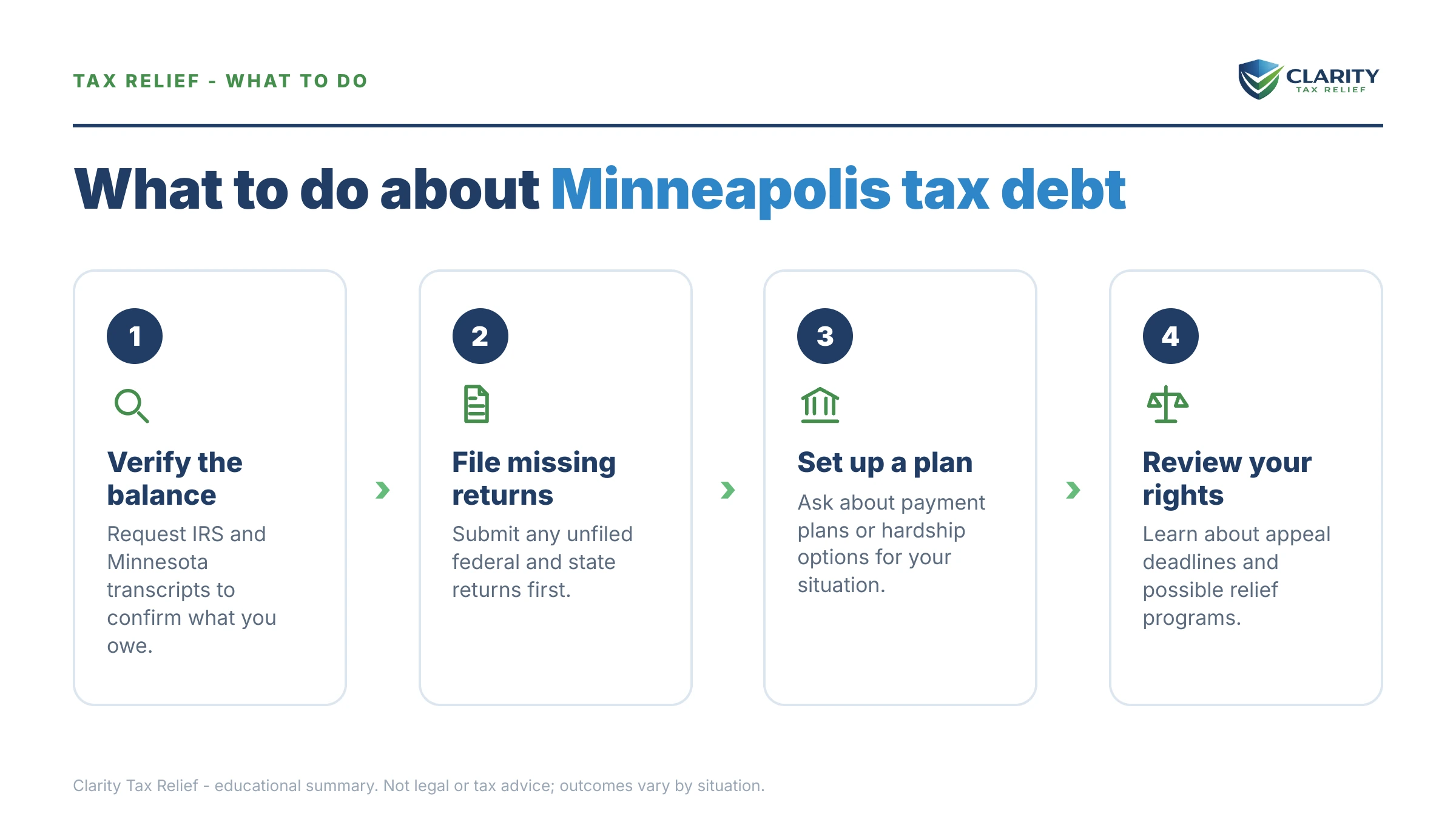
How to get tax relief in Minneapolis, step by step
- Pull your IRS balance and transcripts. Log into your IRS online account to confirm exactly what you owe, for which years, and how it splits between tax, penalties, and interest.
- Check public records for a filed lien. Search county recorder records for a Notice of Federal Tax Lien before you apply for a refinance — your lender's title search will find it if you don't.
- Confirm any Minnesota Department of Revenue balance separately. State debt is a separate account with separate collection powers; check with the department directly so nothing surprises you mid-resolution.
- Match your finances to one program. Compare your income, home equity, and monthly budget against the options table above — payment plan, Offer in Compromise, Currently Not Collectible, or penalty abatement.
- Set it up yourself or get a free professional review. Set up straightforward payment plans yourself at IRS.gov; bring in an experienced tax professional first if you owe over $50,000, have a filed lien, or have a refinance pending.
Payment plans can be started directly at the IRS payment plans page, and any balance can be paid at IRS.gov/payments. State balances go through the Minnesota Department of Revenue.
Terms you'll run into, decoded
- Notice of Federal Tax Lien (NFTL): a public filing that attaches the IRS's claim to everything you own, including your home — it secures the debt but takes nothing by itself.
- Lien subordination: the IRS agreeing (via Form 14134) to let a new lender jump ahead of its lien so a refinance can close.
- CSED: the Collection Statute Expiration Date — the end of the IRS's 10-year window to collect, though appeals, offers, and bankruptcy pause the clock.
- Streamlined installment agreement: a payment plan for balances of $50,000 or less that requires no financial statement and can run up to 72 months.
- Currently Not Collectible: a hardship status that pauses IRS collection when paying would leave you unable to cover basic living expenses; the debt and interest continue.
- Reasonable Collection Potential: the IRS's calculation of the most it could ever collect from you — the number every Offer in Compromise is measured against.
Tax relief in Minneapolis: your questions, answered
Do I need a Minneapolis-based tax relief company, or can a national firm help?
For IRS debt, location barely matters — enrolled agents, CPAs, and tax attorneys can represent you in any state through Form 2848, and almost all IRS collection work happens by phone, fax, and mail. Judge firms on credentials, flat-fee pricing, and who actually works your case, not the address. For Minnesota Department of Revenue debt, confirm the firm handles state cases too.
How much does tax relief cost in Minneapolis?
It depends on the work, not the city: setting up a simple payment plan costs far less than full Offer in Compromise representation, which involves months of financial documentation. Reputable firms quote a flat fee in writing after reviewing your IRS transcripts. Be wary of anyone quoting a price — or promising a result — before they have seen your records. Our guide to how much does tax relief cost breaks down typical pricing models.
Can I refinance my Minneapolis home if I owe the IRS?
Often yes, but the order of operations matters. If no federal tax lien has been filed yet, resolving the balance or getting into a formal agreement before you apply keeps the lien off the public record. If a lien is already filed, Form 14134 lien subordination can let the refinance close by putting the new lender ahead of the IRS, or the lien can be paid from proceeds at closing.
Does Minnesota have its own tax relief programs?
Yes — the Minnesota Department of Revenue runs its own collection system with its own payment agreements, entirely separate from anything you set up with the IRS. Resolving your federal debt does nothing for a state balance, and vice versa. Because state rules and timelines differ from federal ones, confirm your options directly with the department or through a professional who handles Minnesota cases.
Will the IRS take my Minnesota state tax refund?
It can. Once you receive a CP504 notice, the IRS is authorized to levy your state tax refund, and it routinely does so through the State Income Tax Levy Program. Minnesota can also apply your state refund to state tax debt. If you count on a refund each spring, assume it will be intercepted until your balances are resolved or in a formal agreement.
What is the $66,000 passport rule?
If your federal tax debt reaches $66,000 (the 2026 threshold) and becomes certified as seriously delinquent, the IRS can report it to the State Department, which can deny your passport application or renewal. Getting into an installment agreement or another formal resolution generally prevents or reverses certification. At $76,400, the Minneapolis homeowner in our worked example is already past that line — one more reason to formalize a plan.
How do I spot a tax relief scam?
Walk away from anyone who promises to settle your debt for "pennies on the dollar" before reviewing your finances — settlement through an Offer in Compromise is means-tested, and the IRS accepted roughly one in five offers in FY2024. Other warning signs: large upfront fees with vague deliverables, promised outcomes, and pressure to sign today. Legitimate firms review your transcripts first and put the fee and scope in writing.
Can the IRS garnish my wages in Minneapolis?
Yes — federal wage levies apply in every state, and once one starts it is continuous until released, not a one-time grab. The IRS must first send a final notice of intent to levy (LT11 or Letter 1058) and give you 30 days to respond or request a Collection Due Process hearing. If you are still at the first-bill stage, you have time to prevent a garnishment entirely.
Your next 24 hours
- Find your real numbers. Log into your IRS online account and note the exact balance, the tax years, and any notices on file — then check whether a lien has hit the public record.
- Gather three things: your most recent tax return, any IRS or Minnesota Department of Revenue letters, and a rough monthly income-and-expense picture (plus your refinance timeline, if one is pending).
- Get a free case review. An experienced tax professional can map which program fits your Minneapolis situation — and in what order to fix it — before penalties and interest add another month of growth. Call (888) 825-7779 or use the 2-minute form.
If you can't afford professional help, the Taxpayer Advocate Service is a free, independent option inside the IRS for cases causing hardship.
This guide is general information, not tax or legal advice for your specific situation. Eligibility for IRS programs depends on individual facts and circumstances; no outcome is guaranteed.