
City Guides
Tax Relief St. Paul: Your Real IRS and Minnesota Options for 2026
The short answer: tax relief in St. Paul means matching your IRS or Minnesota tax debt to a real program — a payment plan, hardship (Currently Not Collectible) status, penalty abatement, or, in limited cases, an Offer in Compromise. There is no city-specific forgiveness program; your income, assets, and balance decide what you qualify for.
You're renting in St. Paul, the paycheck already stretches to cover rent and heat, and the letter on the table says the IRS intends to take part of your wages over a balance you can't clear tonight. Take a breath: a levy is a process with defined off-ramps, not a done deal — and this guide maps every one of them, in the order they work.
St. Paul taxpayers face something most cities don't: two collectors on your doorstep. The IRS runs its automated sequence from service centers around the country, while the Minnesota Department of Revenue — headquartered in downtown St. Paul — pursues state balances under its own separate rules. This guide covers both sides and how they interact.
⏱ The clocks that matter: if an IRS bank levy has already hit, your bank holds the funds for 21 days before sending them to the IRS — that's your release window. If you're holding an LT11 or Letter 1058 final notice, you have 30 days from the notice date to request a Collection Due Process hearing. Everything else accrues monthly: penalties and interest grow until you act.
Why St. Paul taxpayers end up needing tax relief
Most St. Paul tax debt starts with under-withholding or untaxed 1099 income, not fraud. A second job downtown, gig driving, a 401(k) withdrawal during a layoff, or a first year of self-employment produces a balance the following April — and once you can't pay it in full, the IRS's automated collection machine takes over.
The Minnesota side often follows the same event. If your federal return produced a balance, your Minnesota return usually did too, and the Minnesota Department of Revenue bills, liens, and levies under its own authority — separate notices, separate deadlines, separate resolutions. Paying or settling one debt does nothing to the other.
The 2026 wrinkle: the IRS cut roughly 27% of its workforce in 2025, so reaching a human takes longer than ever — but the notice stream, refund offsets, and levies are generated by automated systems that never slowed down. Delay costs you options; it does not buy you obscurity.
What happens if you ignore IRS collection in St. Paul
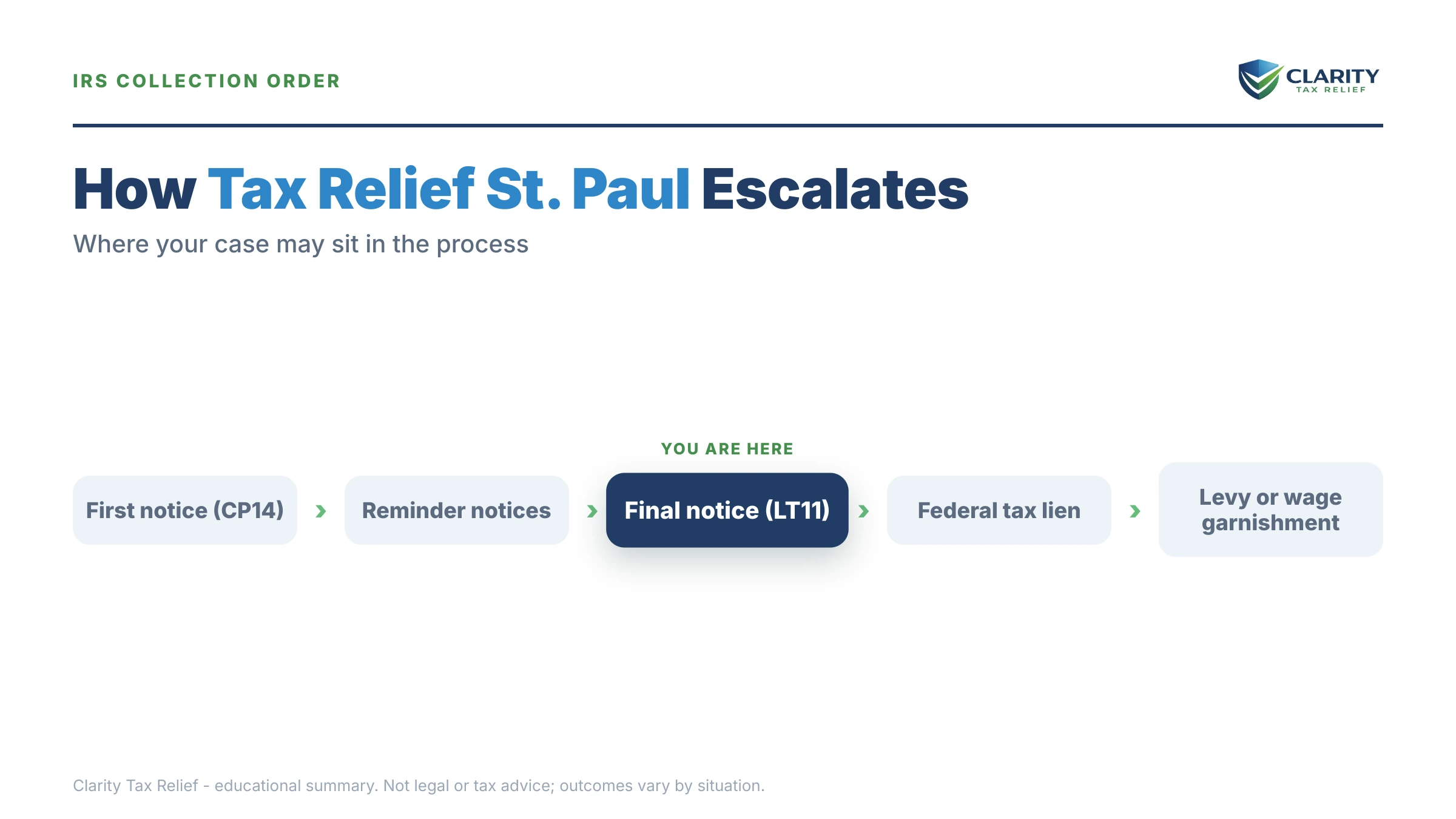
IRS collection escalates in a fixed sequence of notices, and each stage removes options the previous one still offered. For a typical unpaid balance, the order looks like this:
- CP14 — the first bill. Typically about 21 days to pay before the reminders start. Cheapest moment to fix anything.
- CP501 / CP503 — reminders. Still just bills, but the failure-to-pay penalty (0.5% per month) and daily interest keep compounding.
- CP504 — Notice of Intent to Levy. The IRS can now seize your Minnesota state tax refund under IRC §6331(d). This is not yet the final notice, but it's the last cheap warning.
- LT11 / Letter 1058 — Final Notice of Intent to Levy. A 30-day clock starts. Requesting a Collection Due Process hearing on Form 12153 within that window pauses levy action and preserves your appeal rights.
- Levy. A bank levy freezes your account with a 21-day hold before funds transfer. A wage levy goes to your employer and is continuous — it repeats every payday until released. Up to 15% of Social Security can be taken through the Federal Payment Levy Program.
For a renter, this sequence bites early. There's no home for a lien to sit quietly against — the enforcement lands directly on the two things you live on: your paycheck and your bank balance. If a levy is threatened or active, our how to stop IRS wage garnishment and IRS bank levy 21-day rule guides cover the release mechanics in detail, and our IRS Wage Garnishment Calculator can estimate how much of your paycheck a levy could reach.
Meanwhile, the Minnesota Department of Revenue runs its own collection track — it can file liens, levy wages and bank accounts, and apply your state refund to the debt. Its stages and windows are not the IRS's; use the dates printed on the department's own notices, not federal timelines.
Facing an IRS levy in St. Paul?
If a final notice has arrived or your wages are already being taken, the sequence above is in motion — and a wage levy repeats every payday until it's released. Get your notices reviewed free by an experienced tax professional and find the fastest release path for your numbers.
Tax relief options in St. Paul: what actually works
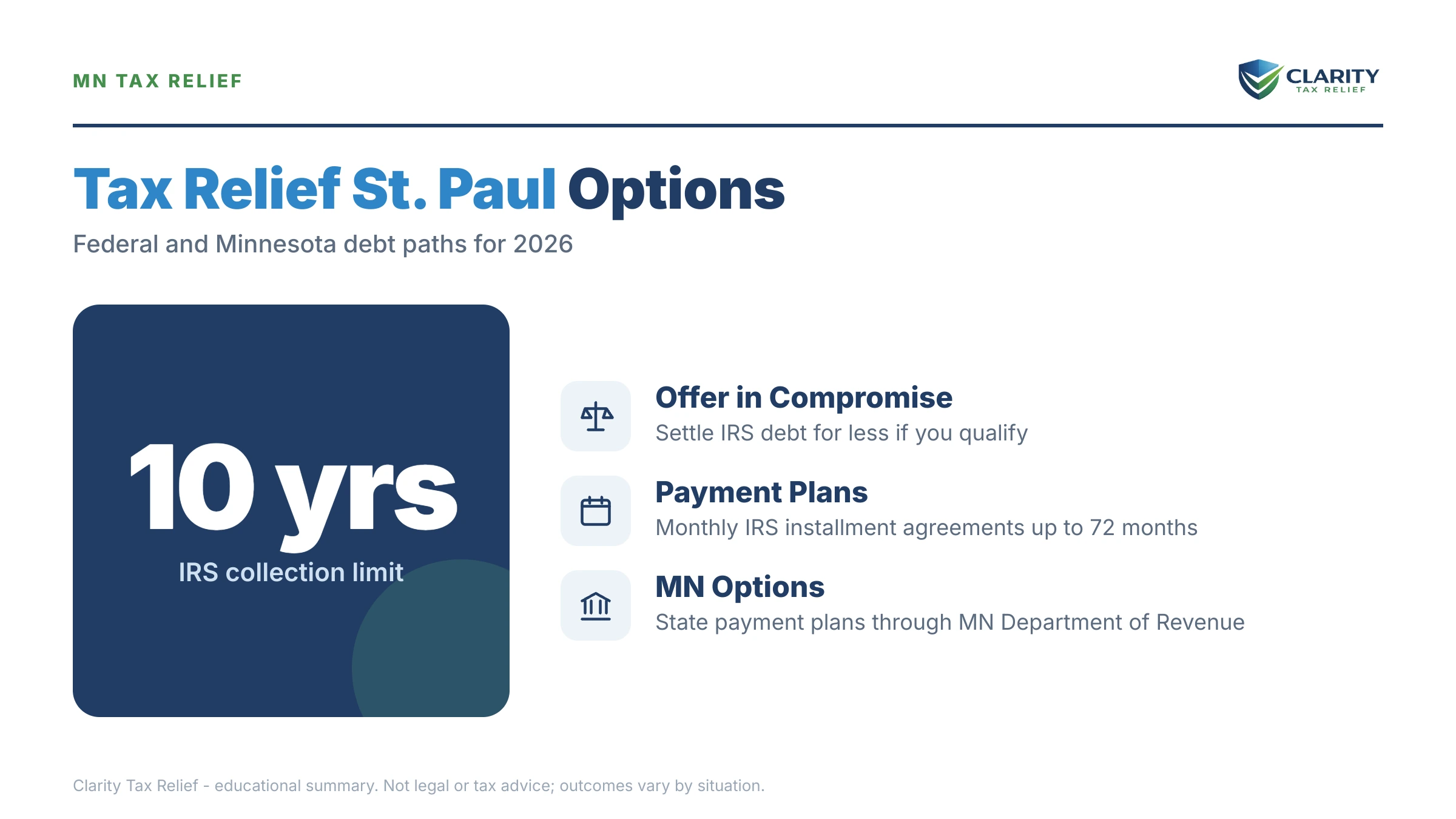
Every legitimate IRS resolution falls into one of five programs, each with a published eligibility threshold. The shared background on how each works lives in our guide to how to settle tax debt yourself; here's the decision-grade summary:
| Option | Who typically qualifies | Cost to set up | What it does |
|---|---|---|---|
| Short-term payment plan | Can pay in full within 180 days | $0 setup fee | Buys time; stops escalation while interest and penalties continue |
| Guaranteed installment agreement | Balance of $10,000 or less, returns filed | Setup fee applies (lower with direct debit) | Monthly plan the IRS must accept when the criteria are met |
| Streamlined installment agreement | Up to $25,000 (or up to $50,000 with direct debit); up to 72 months | Setup fee applies; set up online | Monthly plan without full financial disclosure |
| Currently Not Collectible | Financials (Form 433-F) show paying would prevent basic living expenses | $0 | Pauses levies and collection; debt and interest remain |
| Offer in Compromise | Assets + future income genuinely can't cover the debt before the CSED | $205 fee + 20% down on lump-sum offers (both waived if AGI ≤ 250% of poverty guidelines) | Settles for less than owed; IRS accepted roughly 1 in 5 offers in FY2024 |
| First-time penalty abatement | Clean compliance history for the prior 3 years | $0 | Removes qualifying penalties; being replaced by the automatic AEP starting summer 2026 |
Two honest cautions. First, an OIC is real but means-tested — the IRS runs the math on your assets and future income, and anyone promising a settlement before seeing your financials is selling, not advising. Second, every payment-plan option keeps interest running; a plan stops enforcement, not the meter.
What you owe changes what's realistic
The right move in St. Paul depends more on your balance than on anything else, because IRS program thresholds are drawn in dollar bands:
| Balance | Realistic options | What changes at this level |
|---|---|---|
| Under $10,000 | Short-term plan; guaranteed installment agreement; penalty abatement | Most DIY-friendly band — the IRS must accept a qualifying plan |
| $10,000–$25,000 | Streamlined agreement set up online; CNC if hardship | No financial disclosure needed; liens become more likely if ignored |
| $25,000–$50,000 | Streamlined agreement (direct debit required above $25,000) | Direct debit becomes the price of skipping financial disclosure |
| $50,000–$100,000 | Non-streamlined agreement with Form 433-F financials; OIC or CNC if the math supports it | Passport certification risk begins at $66,000 (2026 threshold) |
| Over $100,000 | Full financial review; possible revenue officer assignment; professional help strongly advised | Faster escalation and 10-business-day windows on some notices |
A worked example: $6,200 and a levy warning
Say you rent in the North End, owe the IRS $6,200 from an under-withheld year, and a final notice of intent to levy just arrived. This is clearly hypothetical, but the math is real:
- Do nothing: the failure-to-pay penalty alone adds about 0.5% × $6,200 = $31 per month, plus daily compounding interest — and after the 30-day window, a continuous wage levy can take a painful slice of every paycheck until the full balance is collected.
- Short-term plan: $6,200 ÷ 6 months ≈ $1,034/month — steep on a renter's budget, but $0 setup fee and the least total interest.
- Installment agreement: because the balance is under $10,000, a guaranteed installment agreement is on the table. Stretched toward 72 months the base math is $6,200 ÷ 72 ≈ $86/month — but at that pace accruals eat most of each payment early on, so something like $150–$200/month retires the debt years sooner and costs far less overall. The late-payment penalty rate also typically drops while a plan is active.
- Levy effect: setting up either plan before the levy takes effect generally prevents it; set up after, it's the standard path to getting a wage levy released.
At this balance, an Offer in Compromise almost never makes sense — the fee, paperwork, and months of review outweigh a debt a modest plan clears. The win here is speed: use the 30-day window, not the levy release process after the fact.
The Minnesota Department of Revenue side
Your Minnesota tax balance is a separate debt with a separate collector — one whose headquarters sits in downtown St. Paul. The department issues its own billing notices, can offset your state refund, file liens, and levy wages and bank accounts, all under Minnesota law rather than the Internal Revenue Code.
Never apply an IRS number to a Minnesota debt. The federal 10-year collection statute, the $50,000 online-plan threshold, the 21-day bank-levy hold — none of these are Minnesota rules. The state offers its own payment agreements, and the deadlines that control your case are the ones printed on the department's notices. When in doubt, contact the department directly or have a professional review both accounts side by side; our Minnesota back taxes guide covers the state track in depth.
If you owe both, resolve them in the right order: stabilize whichever agency is actively levying first, then set up both arrangements sized so the combined payment actually fits your budget. Promising the IRS every spare dollar and then defaulting on the state — or the reverse — restarts enforcement on the side you shorted.
How to respond, step by step
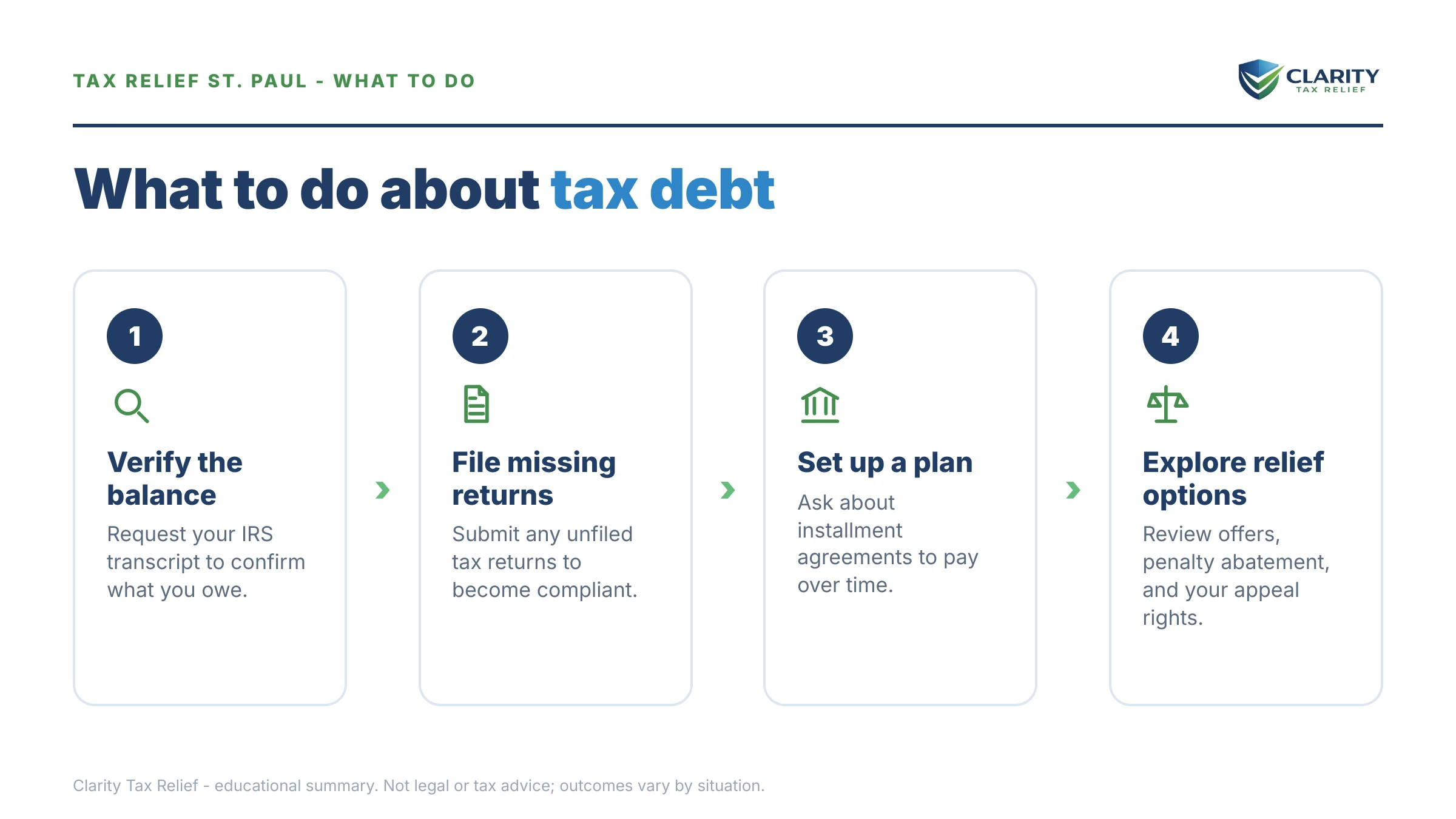
- Pull your IRS records. Set up an IRS online account or order transcripts to confirm exactly which years you owe for, how much of the balance is penalty and interest, and whether any returns are unfiled.
- Find your place in the collection sequence. Locate the most recent IRS notice. A CP14 or CP501 means you have breathing room; a CP504 or LT11 means enforcement is imminent and any 30-day appeal window on the notice controls your timeline.
- Stabilize any active levy first. If a wage or bank levy is already in motion, request release by setting up a payment plan, documenting hardship, or filing Form 12153 if your Collection Due Process window is still open.
- Match your balance to a program. Use the options table above: short-term plan or guaranteed installment agreement under $10,000, streamlined agreement up to $50,000, financial-disclosure options above that, or CNC and OIC if the numbers genuinely don't work.
- Request penalty relief. If your prior three years are clean, ask for first-time penalty abatement — and note the IRS's new Automatic Exemption from Penalty rolling out in summer 2026, which grants similar relief without a request.
- Resolve the Minnesota side separately. Contact the Minnesota Department of Revenue about any state balance and set up its own payment agreement — an IRS resolution does not pause state collection.
When you can handle this yourself — and when help changes the outcome
Plenty of St. Paul tax problems don't need a professional. If you agree with the balance, it's under about $10,000, your returns are filed, and no levy is active, you can set up a plan online in under an hour — our walkthrough on how to set up an IRS payment plan online shows every screen. A single clean-history penalty is often removed with one phone call.
Experienced help earns its fee when the stakes or complexity jump: a levy already in motion, multiple unfiled years that must be filed before any agreement is possible, both IRS and Minnesota debts that need coordinated payments, business or payroll tax exposure (see our tax relief for small business guide), or an Offer in Compromise where the financial-disclosure math decides everything. In those cases, the order and framing of what you submit changes what you end up paying.
If you do hire someone, choose carefully — the loudest national advertisers are not automatically the best fit. Our how to choose a tax relief company checklist and our Optima Tax Relief alternatives comparison cover the questions that separate real representation from a sales floor.
Free and low-cost tax help in St. Paul
St. Paul residents have real no-cost options before — or alongside — hiring anyone. Low Income Taxpayer Clinics serve the Twin Cities and can represent qualifying taxpayers in IRS disputes for free or a nominal fee; our Low Income Taxpayer Clinic guide explains eligibility. The Taxpayer Advocate Service, an independent arm of the IRS, can intervene when collection is causing hardship or your case is stuck — details at taxpayeradvocate.irs.gov.
For in-person federal help, IRS Taxpayer Assistance Centers work by appointment only — call ahead rather than showing up. For state balances, the Minnesota Department of Revenue publishes its payment-agreement and collection information directly, and IRS payment options live at IRS.gov/payments.
Terms on your notices, decoded
- Levy vs. lien: a levy takes property (wages, bank funds); a lien is a legal claim recorded against what you own — a renter mostly faces levies.
- CSED: the Collection Statute Expiration Date — the IRS generally has 10 years from assessment to collect, though appeals, an OIC, or bankruptcy pause the clock.
- CDP rights: Collection Due Process — your right to an appeals hearing (requested on Form 12153) within 30 days of a final levy notice, which pauses levy action.
- Currently Not Collectible (CNC): IRS hardship status that pauses collection when your financials show you can't pay basic living expenses and the tax.
- Continuous levy: a wage levy that repeats every payday until formally released — unlike a bank levy, which grabs only what's in the account the day it lands.
Tax relief in St. Paul: your questions, answered
How much does tax relief cost in St. Paul?
Professional representation for an individual IRS case typically runs from a few hundred dollars for a simple payment-plan setup to several thousand for an Offer in Compromise or levy release — the price depends on complexity, not your city. The IRS's own fees are modest: $0 for a short-term plan, a setup fee for installment agreements, and a $205 application fee for an OIC, waived if your income is at or below 250% of the federal poverty guidelines. Be wary of any firm quoting a price before reviewing your IRS transcripts.
Can the IRS levy my wages if I rent in St. Paul?
Yes. A wage levy has nothing to do with owning property — the IRS sends it to your employer, who must withhold part of each paycheck until the levy is released. Renters often feel levies faster because there is no home equity to negotiate around; wages and bank accounts are the first targets. A wage levy is continuous, so it repeats every payday until you get it released, usually by setting up a payment plan or proving hardship.
Does Minnesota have its own tax relief programs?
Yes. The Minnesota Department of Revenue offers payment agreements and, in genuine hardship cases, other collection alternatives — but its programs, deadlines, and rules are separate from the IRS's. Do not assume an IRS threshold or timeline applies to your Minnesota balance. Contact the department directly or have a professional review both accounts, because resolving the federal debt does nothing to stop state collection, and vice versa.
Do I need a local St. Paul tax firm, or can a national firm handle my case?
IRS cases are worked by phone, mail, and fax nationwide, so geography rarely matters for federal debt — an experienced tax professional in another state can represent you fully with a Form 2848 power of attorney. Local knowledge matters more for Minnesota Department of Revenue issues or if you want to meet in person. Judge any firm by its credentials, fee transparency, and willingness to review your transcripts before quoting — not by its ZIP code.
What can the IRS actually take from a renter?
The main targets are your paycheck, your bank accounts, your state and federal tax refunds, and — if you are self-employed — payments owed to you by clients. The IRS can also take up to 15% of Social Security benefits under the Federal Payment Levy Program. Your landlord does not owe the IRS your security deposit, and basic household goods are largely protected. For most St. Paul renters, the real exposure is wages and the bank account the rent comes out of.
What if I owe both the IRS and the State of Minnesota?
You will usually need two separate resolutions, and the order matters. The IRS balance often carries the heavier enforcement tools, but the Minnesota Department of Revenue can move quickly on smaller balances. A common approach is to stabilize whichever agency is actively levying first, then set up arrangements with both — sizing each payment so that the two together actually fit your budget, rather than promising the IRS every spare dollar and defaulting on the state.
Will a levy stop once I set up a payment plan?
Generally yes — an active installment agreement normally prevents new levies, and the IRS will usually release an existing wage levy once an agreement is in place, though the release paperwork can take time to reach your employer. A bank levy is different: the bank holds the seized funds for 21 days before sending them to the IRS, and that window is your chance to get the levy released. If a bank levy has already hit, act within those 21 days.
Your next 24 hours
- Find your most recent notice — the notice number in the corner and the date printed on it tell you exactly where you are in the sequence and whether a 30-day appeal window is running.
- Gather three things: your last filed tax return, every IRS and Minnesota Department of Revenue letter you've received, and a rough picture of your monthly income and rent.
- Get a free case review. If a levy is threatened or active, penalties and interest are compounding while you wait — an experienced tax professional can map your fastest path in one call. Use the 2-minute form or call (888) 825-7779.
This guide is general information, not tax or legal advice for your specific situation. Eligibility for IRS programs depends on individual facts and circumstances; no outcome is guaranteed.