
City Tax Guides
Tax Relief Buffalo: Your 2026 Guide to IRS and New York State Options
The short answer: tax relief in Buffalo usually means resolving two separate debts — your federal IRS balance and your New York State balance. Each agency has its own payment plans, hardship programs, and settlement options, and an IRS agreement does nothing for a New York tax warrant. Most balances qualify for a structured plan; real settlements are means-tested.
If you typed "tax relief Buffalo" into a search bar, chances are two different envelopes got you here — one from an IRS campus, one from the New York State Department of Taxation and Finance in Albany. Maybe you and your spouse filed jointly and the balance landed bigger than either of you expected. Both debts are fixable, and the order you fix them in matters — here's the full map for each agency.
⏱ The clock that's already running: there's no single deadline on a search, but two meters are ticking. The IRS failure-to-pay penalty adds 0.5% of your balance every month, plus interest — and once a New York State balance reaches $10,000, the state can move to suspend your driver's license. Every month you wait costs real money.
Why tax relief in Buffalo is usually a two-agency problem
Buffalo taxpayers who fall behind almost always owe two governments at once: the IRS and the New York State Department of Taxation and Finance. New York taxes wages, self-employment income, and most everything else the IRS taxes — so a bad year on a joint return typically produces two separate bills, two penalty streams, and two collection machines.
That's the detail most national tax-relief advertising skips. A radio ad about "the Fresh Start Program" is talking about federal programs only. Resolving your IRS balance leaves your Albany bill fully intact, still accruing, still headed toward a tax warrant filed with the Erie County clerk.
The two agencies also behave differently. The IRS is slower but relentless — its automated notice stream never stops, even with its workforce cut roughly 27% in 2025. New York is faster and more personal: a tax warrant is a public civil judgment, and the state is one of the few that can reach your driver's license. Our New York State back taxes help guide covers the Albany side in full; this page maps both fronts for Western New York readers.
For the mechanics of negotiating with the IRS on your own — transcripts, phone scripts, which form goes where — see our full guide on how to settle tax debt yourself. Below, we'll stay focused on what's specific to a Buffalo case: the dual escalation timeline, the program thresholds for each agency, and the math on a realistic Western New York balance.
What happens if you ignore IRS and New York State tax debt
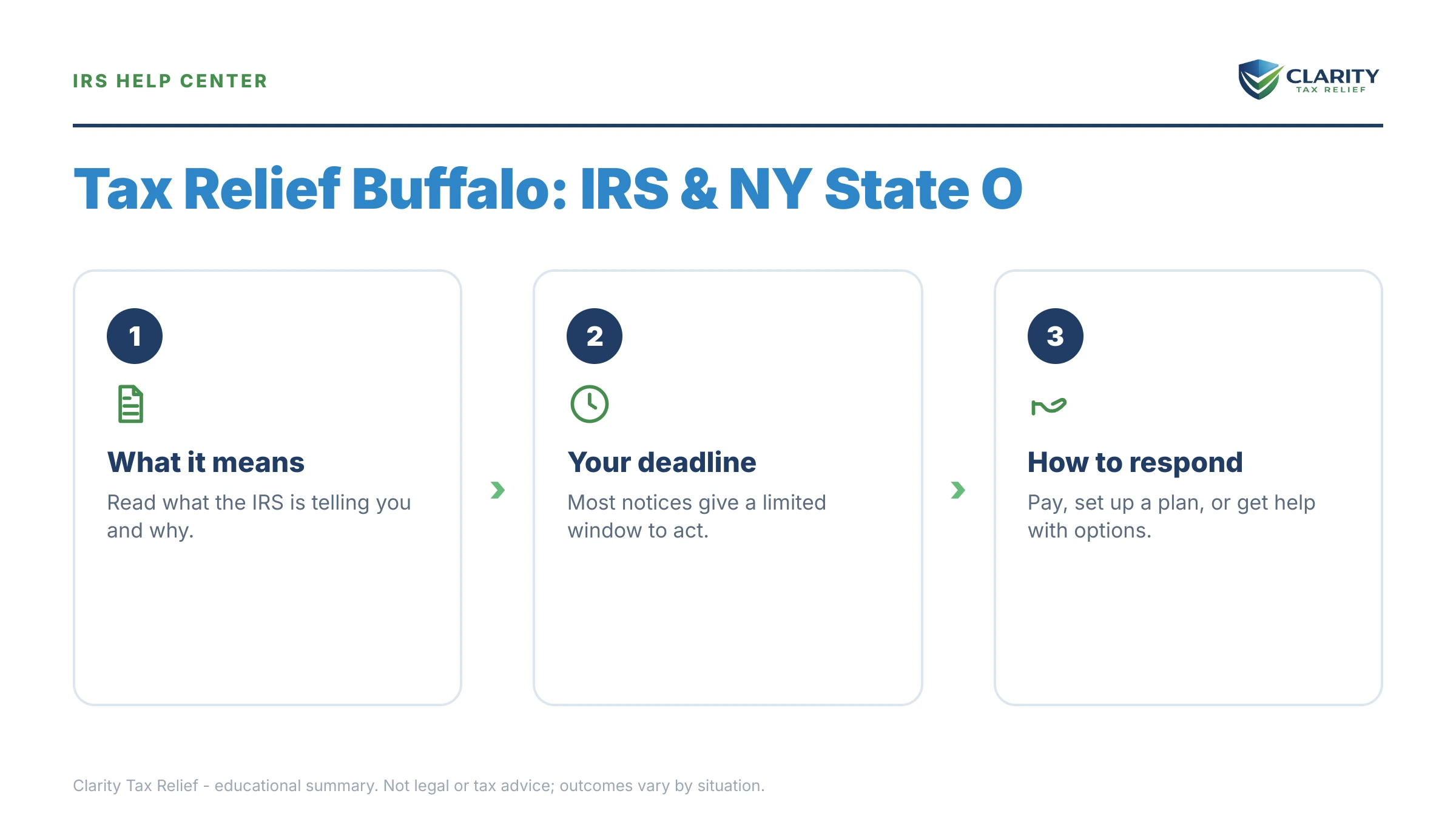
Ignored tax debt in Buffalo escalates on two independent tracks, and neither one waits for the other. Here's the sequence on each side:
- IRS: the bill stage. A CP14 balance-due notice arrives, followed by CP501 and CP503 reminders. No enforcement yet — just a balance growing monthly.
- IRS: CP504 — Notice of Intent to Levy. The IRS can now seize your New York State tax refund, and a federal tax lien becomes a live possibility.
- IRS: LT11 / Letter 1058 — Final Notice. This starts a 30-day clock and your Collection Due Process rights (requested via Form 12153). After the window closes, the IRS can levy bank accounts (with a 21-day hold before funds leave) and garnish wages continuously until released.
- New York: bills and demands. The Department of Taxation and Finance sends its own assessment and demand notices, with state penalties and interest stacking on top.
- New York: tax warrant. The state files a warrant with the county clerk and the Department of State — a public civil judgment that liens your property and appears in title and background searches. From here the state can serve an income execution on your employer and levy bank accounts.
- New York: license suspension. Once your state debt reaches $10,000 and you're not in an agreement, New York can move to suspend your driver's license — a uniquely painful lever in a city where most people drive to work.
Two warnings for 2026 specifically. First, IRS understaffing does not mean IRS inaction — notices, liens, and levies are generated by automated systems that never got laid off; only the humans who could fix problems did. Second, a filed NYS tax warrant is public record, which means it can surface during a mortgage application or refinance on an Erie County property long after you've forgotten the underlying year.
Owe the IRS or New York State from Buffalo?
Get both balances reviewed free before a warrant or levy changes your options. An experienced tax professional will map the IRS side and the New York side in one conversation — no pressure, no obligation.
Tax relief options for Buffalo taxpayers: programs and eligibility
Every IRS balance under $50,000 qualifies for some form of structured resolution — the question is which program costs you the least. Here's the federal menu with real thresholds:
| Program | Who qualifies | Cost & terms |
|---|---|---|
| Short-term payment plan | Any balance you can pay in full within 180 days | $0 setup; interest and penalties keep accruing until paid |
| Guaranteed installment agreement | Individuals owing $10,000 or less in tax, with recent returns filed and paid on time | Approval is effectively automatic; low setup fee, reduced or waived for low income |
| Streamlined installment agreement | Balances up to $50,000 — set up online, up to 72 months | No financial statement required; direct debit lowers the fee and the default risk |
| Non-streamlined / partial-pay agreement | Larger balances, or payments that won't fully pay the debt before the collection statute expires | Requires Form 433-F financial disclosure; the IRS reviews income and assets |
| Currently Not Collectible | Paying anything would leave you unable to cover basic living expenses | $0; collection pauses, but the debt and interest remain |
| Offer in Compromise (Form 656) | Assets plus future income genuinely can't cover the debt before the statute runs | $205 application fee; 20% down on lump-sum offers (both waived with low-income certification) |
| Penalty relief (FTA / AEP) | Clean compliance history for the prior 3 years | Free; removes penalties, not the tax or interest beneath them |
Three notes on that table. A payment plan can be requested online, by phone, or on Form 9465 — the online route is fastest and cheapest. Penalty relief is worth checking before you commit to any plan: first-time penalty abatement can strip penalties for a clean-history taxpayer today, and starting in summer 2026 the IRS's new Automatic Exemption from Penalty (AEP) begins applying similar relief automatically, no request needed. And IRS Currently Not Collectible status exists for genuine hardship — it's a pause, not forgiveness, but it stops levies while you recover.
On the settlement question: how an offer in compromise actually works is a math problem, not a negotiation. The IRS accepted roughly 1 in 5 offers in FY2024, and the ones that pass are the ones where the numbers — assets plus a multiple of monthly disposable income — genuinely come in below the balance owed.
The New York side has its own parallel menu. The state offers Installment Payment Agreements (IPAs) — smaller balances can usually be set up through your Online Services account, while larger ones require financial review. New York also runs its own offer in compromise program, generally aimed at insolvency or genuine hardship, with its own forms and standards. Full details, thresholds, and setup steps are in our guide to NYS tax payment plan options. Critically, an IPA is also what stops a pending license suspension — see our guide to NYS license suspension for tax debt if you've received that warning notice.
IRS vs. New York State: how each agency collects
The IRS and New York State use different tools, different thresholds, and different timelines — which is why one debt often needs to be resolved before the other. This side-by-side is the reference most Buffalo taxpayers are missing:
| Collection issue | IRS | New York State (DTF) |
|---|---|---|
| Lien on your property | Federal tax lien filed after demand goes unpaid | Tax warrant — a public civil judgment filed with the county clerk and Department of State |
| Wage garnishment | Continuous wage levy after the LT11 final-notice window closes | Income execution served on you first, then your employer |
| Bank account | Levy with a 21-day hold before funds are sent | Bank levy once a warrant is on file |
| Driver's license | No federal license action | Suspension possible at $10,000+ in unpaid state tax |
| Passport | Certification possible at $66,000+ in seriously delinquent debt (2026 threshold) | No passport authority |
| Payment plans | Online agreements up to $50,000 over up to 72 months | Installment Payment Agreement (IPA) through Online Services |
| Settlement program | Offer in Compromise — means-tested against assets and future income | New York's own offer in compromise, generally insolvency- or hardship-based |
| Collection time limit | 10 years from assessment (CSED), pausable by appeals, offers, or bankruptcy | State rules differ — a filed warrant stays enforceable for many years under state law |
The practical takeaway: New York usually reaches enforcement faster than the IRS does, but the IRS's tools cut deeper once they arrive. If a warrant or license action is already in motion on the state side, that's typically the fire to put out first — then structure the federal side around what's left of your monthly budget.
Say you owe $16,400: the math for a Buffalo couple
A hypothetical, with the arithmetic shown. Say you and your spouse in Buffalo owe $16,400 total from your 2024 joint return: $13,200 to the IRS and $3,200 to New York State.
The IRS side. $13,200 is above the $10,000 guaranteed-agreement line but far below the $50,000 streamlined ceiling — so you can set up a plan online with no financial disclosure. The 72-month minimum is $13,200 ÷ 72 ≈ $184/month. But at the minimum, accruals eat much of each payment: interest keeps compounding, and while the failure-to-pay penalty drops to 0.25% per month once an approved agreement is in place, that's still roughly $33/month at the start. Push the payment to $400/month and the balance clears in roughly three years, saving hundreds in accruals. You can estimate how much of your own balance is penalty and interest versus tax with our IRS Penalty & Interest Calculator.
The New York side. $3,200 is a small IPA, typically set up through your Online Services account at roughly $100/month over three years or faster. Because the state balance sits under $10,000, license suspension isn't in play — but only while the agreement stays current.
The settlement check. Could this couple settle instead? Run the math the IRS runs: say they earn $92,000 jointly and have $40,000 of equity in a Kenmore house. Their collection potential — equity plus future disposable income — far exceeds $13,200, so an Offer in Compromise would be rejected. Anyone quoting them a settlement fee before running that math is selling, not advising. What could genuinely help: if 2024 was their first slip after three clean years, first-time abatement could remove the failure-to-pay penalties on the federal side entirely.
Combined: about $500/month across two agreements, both agencies off their backs, no warrant ever filed. That's what a well-ordered resolution looks like at this balance level.
How to get tax relief in Buffalo, step by step
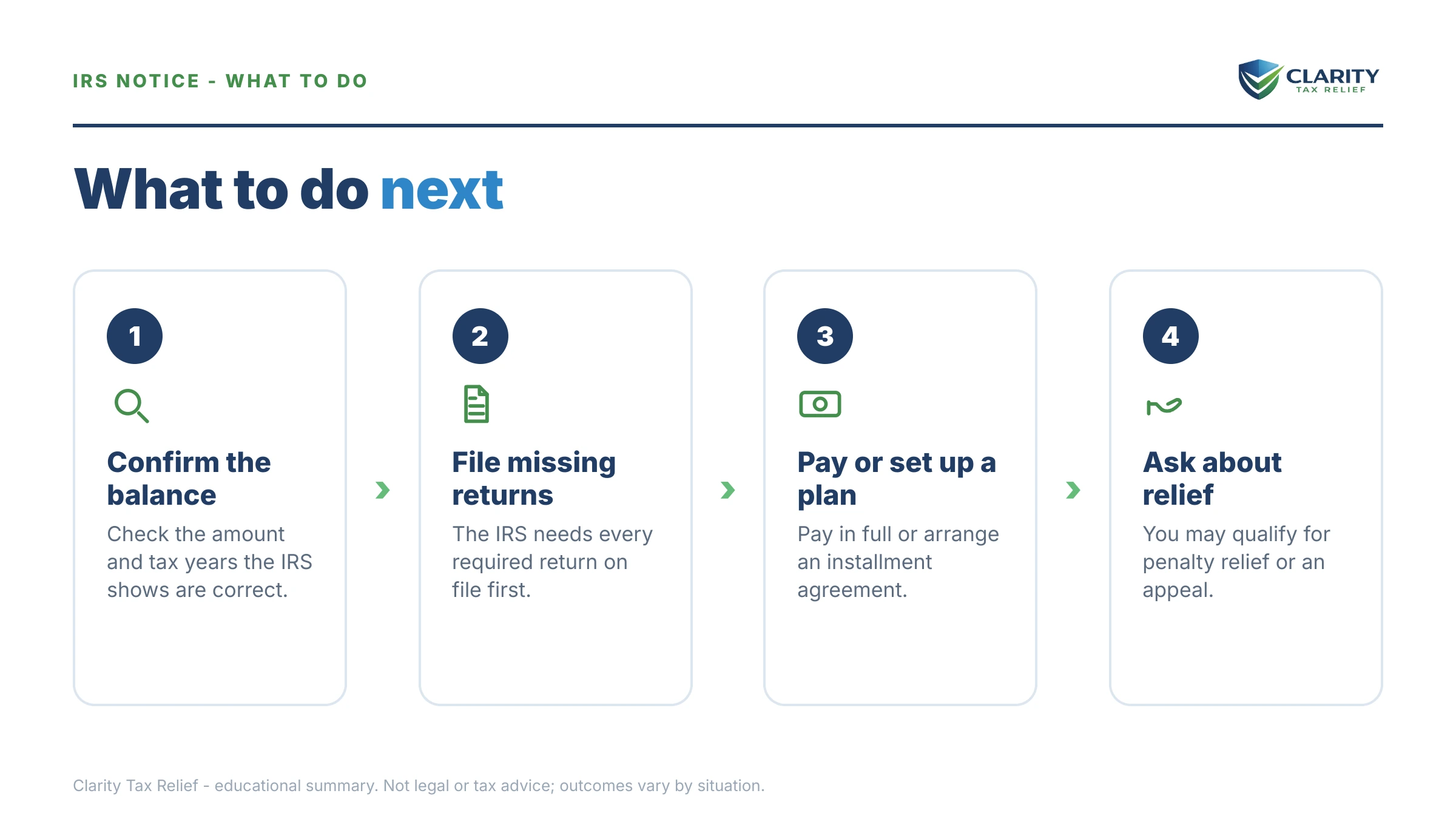
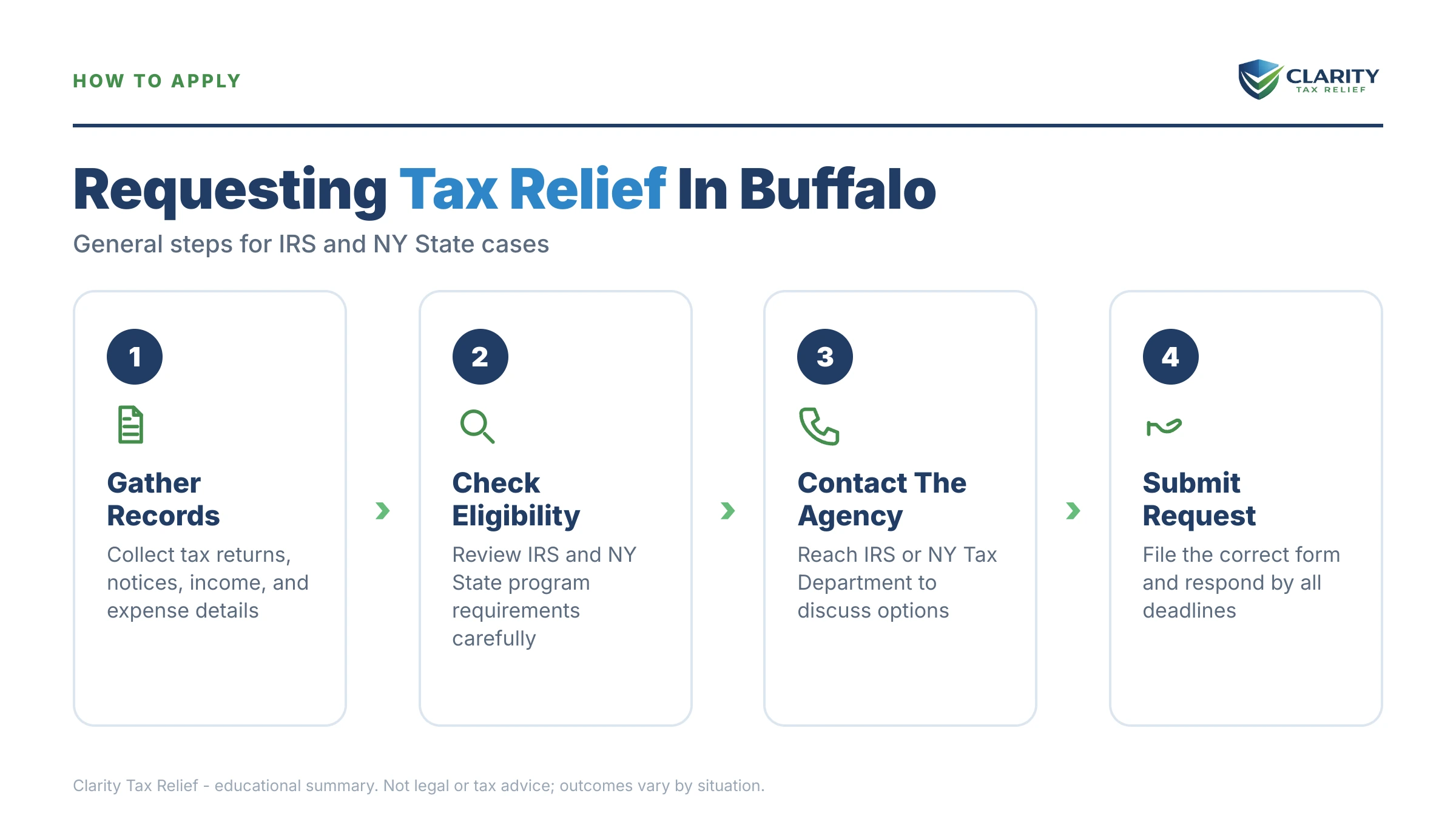
- Pull both balances. Log into your IRS online account and your New York Online Services account at tax.ny.gov so you're working from each agency's current numbers, not the last notice you opened.
- File every missing return. Neither the IRS nor New York will approve a payment plan or settlement while a required return is unfiled — compliance comes before resolution.
- Match each debt to a program. Use the options table above: a payment plan, hardship status, penalty relief, or an offer — chosen separately for the IRS and for New York.
- Set up the more urgent agreement first. If a warrant, levy, or license suspension is already in motion, resolve that agency first, then size the second payment to fit your budget.
- Confirm everything in writing. Save both approval letters, calendar the payment dates, and keep filing and paying on time — a new unpaid balance can default both agreements at once.
When you can handle this yourself — and when help changes the outcome
Plenty of Buffalo tax problems don't need professional help, and it would be dishonest to pretend otherwise. You can almost certainly handle it yourself if: you agree with both balances, the IRS side is under $25,000 and the state side is modest, and you just need payment plans — both portals are built for exactly that, and the setup takes an evening. A single first notice you agree with, or a balance you can pay within 180 days, is a DIY situation.
Experienced help tends to change outcomes in a narrower set of cases: a tax warrant already filed or a levy already in motion, multiple unfiled years on either side, business debt (payroll or sales tax — New York pursues both aggressively; see our tax relief for small business guide), a disputed balance, or Offer in Compromise math on either the federal or state program, where a badly-built financial statement is the most common reason viable offers get rejected. In those situations the fee usually buys sequencing — which agency first, which program, penalties challenged before balances get locked into plans.
Do you need a Buffalo tax relief company — or just the right one?
Location matters far less than most Buffalo searchers assume. IRS and New York State resolution work happens by phone, secure portal, and mail — there's no negotiation table on Delaware Avenue where cases get settled. What actually determines your outcome is whether the person on your case is an experienced tax professional (enrolled agent, CPA, or tax attorney) who handles New York State cases routinely, not just federal ones.
That cuts both ways: don't hire a firm just because it's local, and don't hire a national brand just because its ads are everywhere. Our buyer's checklist on how to choose a tax relief company covers the vetting questions; if you're comparing the big national names specifically, our Optima Tax Relief alternatives comparison shows what to look for and what to avoid. The universal red flags: anyone who quotes a settlement amount before seeing your finances, promises to make the debt disappear, or won't put a flat fee in writing.
If your case involves a levy already in motion or years of unfiled returns on both the IRS and New York sides, a free review costs nothing and tells you whether you're a DIY case or not — start with the 2-minute form or call (888) 825-7779.
Free and low-cost tax help in Buffalo
Income-eligible Buffalo taxpayers can get real IRS representation at no charge. Low Income Taxpayer Clinics serve Western New York and can represent qualifying taxpayers in IRS disputes for free — the current clinic list is maintained by the Taxpayer Advocate Service, which itself helps any taxpayer when normal IRS channels have failed. Our guide to the Low Income Taxpayer Clinic program explains who qualifies.
For in-person IRS account questions, Buffalo has an IRS Taxpayer Assistance Center — appointments are required, and current hours and location are listed on IRS.gov. For payments and payment-plan setup you never need an appointment: everything runs through IRS.gov/payments. On the state side, the New York State Department of Taxation and Finance handles balances, IPAs, and warrant questions through its Online Services portal. Note that these free resources are agency-specific — the LITC and TAS handle federal matters only.
Terms on your Buffalo tax notices, decoded
- Tax warrant — New York's version of a lien: a public civil judgment filed with the county clerk that also unlocks garnishment and bank levies.
- Lien vs. levy — a lien is a claim against your property (it secures the debt); a levy is the actual taking of wages, bank funds, or assets.
- IPA — Installment Payment Agreement, New York State's monthly payment plan.
- CSED — Collection Statute Expiration Date: the end of the IRS's 10-year window to collect, pausable by appeals, offers, and bankruptcy. New York's timeline runs under its own state rules.
- CNC — Currently Not Collectible, the IRS's hardship pause: collection stops, the debt doesn't.
- Income execution — New York's wage-garnishment instrument, served on you first and then your employer if you don't respond.
Tax relief in Buffalo: your questions, answered
Do I need a tax relief company located in Buffalo?
No — IRS and New York State tax resolution is done by phone, mail, and online portals, so a Buffalo office adds convenience, not results. What matters is that the person handling your case is an experienced tax professional (an enrolled agent, CPA, or tax attorney) authorized to represent you before the IRS and familiar with New York's Department of Taxation and Finance. Judge firms on credentials, written fee quotes, and reviews, not zip code.
Does New York State have an offer in compromise program?
Yes. New York runs its own offer in compromise program through the Department of Taxation and Finance, separate from the IRS version, with its own forms and eligibility rules. It is generally aimed at taxpayers who are insolvent or for whom full payment would create undue economic hardship. An accepted IRS offer does not settle your New York balance — each debt must be resolved on its own.
Can New York suspend my driver's license for back taxes?
Yes. New York can suspend the driver's license of a taxpayer who owes $10,000 or more in state tax debt and isn't in a payment arrangement. You get a written warning notice first, and entering an installment payment agreement (or resolving the balance) stops the suspension. The IRS cannot touch your license, but it can certify seriously delinquent debt over $66,000 for passport denial.
What is a New York tax warrant?
A New York tax warrant is a public civil judgment the state files against you for unpaid taxes — it creates a lien on your property and unlocks wage garnishment and bank levies. It is recorded with the county clerk and the Department of State, so lenders and employers can find it. Resolving the underlying balance is the only way to get it satisfied.
Should I pay the IRS or New York State first?
There is no universal rule — it depends on which agency is closer to enforcement in your case. New York often moves to a warrant and license suspension faster than the IRS moves to levy, so an imminent state action usually takes priority. Most Buffalo taxpayers end up with two parallel agreements sized so the combined monthly payment fits their budget.
How much does tax relief cost in Buffalo?
Simple cases are nearly free: an IRS online payment plan costs at most a modest setup fee, and a New York IPA can be set up through your Online Services account at no charge. Professional representation for more complex cases — multiple years, warrants, offers in compromise — typically runs from several hundred to a few thousand dollars depending on scope. Get a flat-fee quote in writing before paying anyone.
Will the IRS settle my tax debt for less than I owe?
Only if the numbers support it. An Offer in Compromise is accepted when your assets plus future income genuinely can't cover the balance before the collection statute expires — the IRS accepted roughly 1 in 5 offers in FY2024. If you can pay in full through a payment plan, the offer will be rejected no matter who files it. Be wary of anyone who promises a settlement before reviewing your finances.
Is there free tax help in Buffalo?
Yes, for those who qualify. Low Income Taxpayer Clinics serving Western New York represent income-eligible taxpayers in IRS disputes at no charge, the Taxpayer Advocate Service helps when normal IRS channels have failed, and Buffalo's IRS Taxpayer Assistance Center handles in-person account questions by appointment. These resources handle IRS matters; for state debt, start with your tax.ny.gov Online Services account.
Your next 24 hours
- Find your real numbers. Log into your IRS online account and your tax.ny.gov Online Services account and write down both current balances — the notices in your drawer are already out of date.
- Gather three things: your most recent joint return, every IRS and New York notice you've received, and a rough monthly income-and-expenses picture for your household.
- Get both debts reviewed free. Penalties and interest are accruing on both balances every month you wait — use the 2-minute form or call (888) 825-7779 and an experienced tax professional will map the IRS side and the New York side in one call.
This guide is general information, not tax or legal advice for your specific situation. Eligibility for IRS programs depends on individual facts and circumstances; no outcome is guaranteed.