
Tax Relief by City
Tax Relief El Paso: Your Real Options for IRS and Texas Tax Debt (2026)
The short answer: tax relief in El Paso works the same four ways it does anywhere the IRS collects: a payment plan, an Offer in Compromise, Currently Not Collectible status, or penalty abatement. Because Texas has no personal income tax, most El Pasoans face only the IRS — and every one of these programs is means-tested, not marketed.
If you're searching "tax relief El Paso," you're probably holding an IRS letter at your kitchen table — maybe a bill for a balance you and your spouse can't cover, maybe something worse. The good news: El Paso taxpayers usually fight one agency, not two, and the IRS's own programs resolve most cases without anyone touching your paycheck or your bank account.
This guide covers what makes El Paso cases different — the border, Fort Bliss, the no-income-tax advantage — then walks through every real option with 2026 numbers, honest costs, and a worked example built around a married couple who owe $54,600.
⏱ The real clock: there is no single deadline on "tax relief" itself — but penalties and interest are added to your balance every month you wait, and each IRS notice in the collection sequence carries its own window. If you're holding an LT11 or Letter 1058, you have 30 days from the notice date to request a hearing before levies can begin. Check the date printed on your letter; that date controls.
Why tax debt cases in El Paso look different
El Paso taxpayers have one structural advantage: Texas has no personal income tax, so there is no state revenue department chasing the same debt the IRS is. In most states, resolving back taxes means negotiating with two agencies on two different rulebooks. Here, for wage earners, it's the IRS alone.
Three local realities still change the playbook:
- The border. Federal law lets the IRS certify "seriously delinquent" debt of $66,000 or more (the 2026 threshold) to the State Department, which can deny passport renewal or revoke a passport outright. For a family that crosses to Ciudad Juárez to see relatives, that's not an abstract penalty — see passport revoked for tax debt for how certification works and how a payment arrangement reverses it.
- Fort Bliss. Active-duty service members and some spouses have collection protections civilians don't, including deadline postponements for combat-zone service. If that's you, start with combat zone IRS collection relief before agreeing to anything.
- Texas wage-garnishment law doesn't protect you from the IRS. Texas famously blocks most creditors from garnishing wages — but that's state law, and an IRS wage levy is federal. The IRS can and does levy El Paso paychecks, continuously, until the levy is released or the debt is resolved.
One more note for business owners: while there's no income tax, the Texas Comptroller aggressively collects sales tax and franchise tax, and unpaid sales tax you collected from customers can follow you personally. That's a separate fight covered in Texas Comptroller tax debt.
What happens if you ignore IRS debt in El Paso
IRS collection is an automated sequence, and it escalates whether or not a human ever reviews your file. With the IRS workforce down roughly 27% since 2025, reaching a person is harder than ever — but the notice-and-levy machinery never paused. Ignored, a balance moves through these stages:
- First bill (CP14). A statement of the balance, typically giving about 21 days before the next notice queues up. No enforcement yet — this is the cheapest moment to act.
- Reminder notices (CP501 / CP503). Still bills, but the balance grows monthly: a 0.5%-per-month failure-to-pay penalty plus daily-compounding interest.
- Intent to levy (CP504). The IRS can now seize your state tax refund — less relevant in Texas, where most people don't have one, but this notice also signals a federal tax lien is close. A lien attaches to your home even under the Texas homestead exemption.
- Final notice (LT11 / Letter 1058). This starts a 30-day clock and your Collection Due Process rights, requested on Form 12153. Miss the window and the IRS can levy without further warning.
- Levy. A bank levy freezes funds with a 21-day hold before the money leaves; a wage levy is continuous until released. Up to 15% of Social Security can be taken through the Federal Payment Levy Program. And at $66,000+, passport certification enters the picture.
Every stage above is more expensive than the one before it. You can estimate how fast your own balance is growing with our IRS Penalty & Interest Calculator.
Holding an IRS letter in El Paso right now?
Send us a photo of it. An experienced tax professional will tell you exactly which stage you're at and which program fits your numbers — free and confidential, before another month of penalties and interest posts to your account.
Tax relief El Paso residents can actually use: every option compared
The IRS runs five real relief programs, and eligibility for each is decided by math — your income, assets, and compliance history — not by a salesperson. Here's the full menu:
| Option | Typical eligibility | IRS cost to set up | Best for |
|---|---|---|---|
| Short-term payment plan | Can pay in full within 180 days | $0 setup fee | Temporary cash crunches |
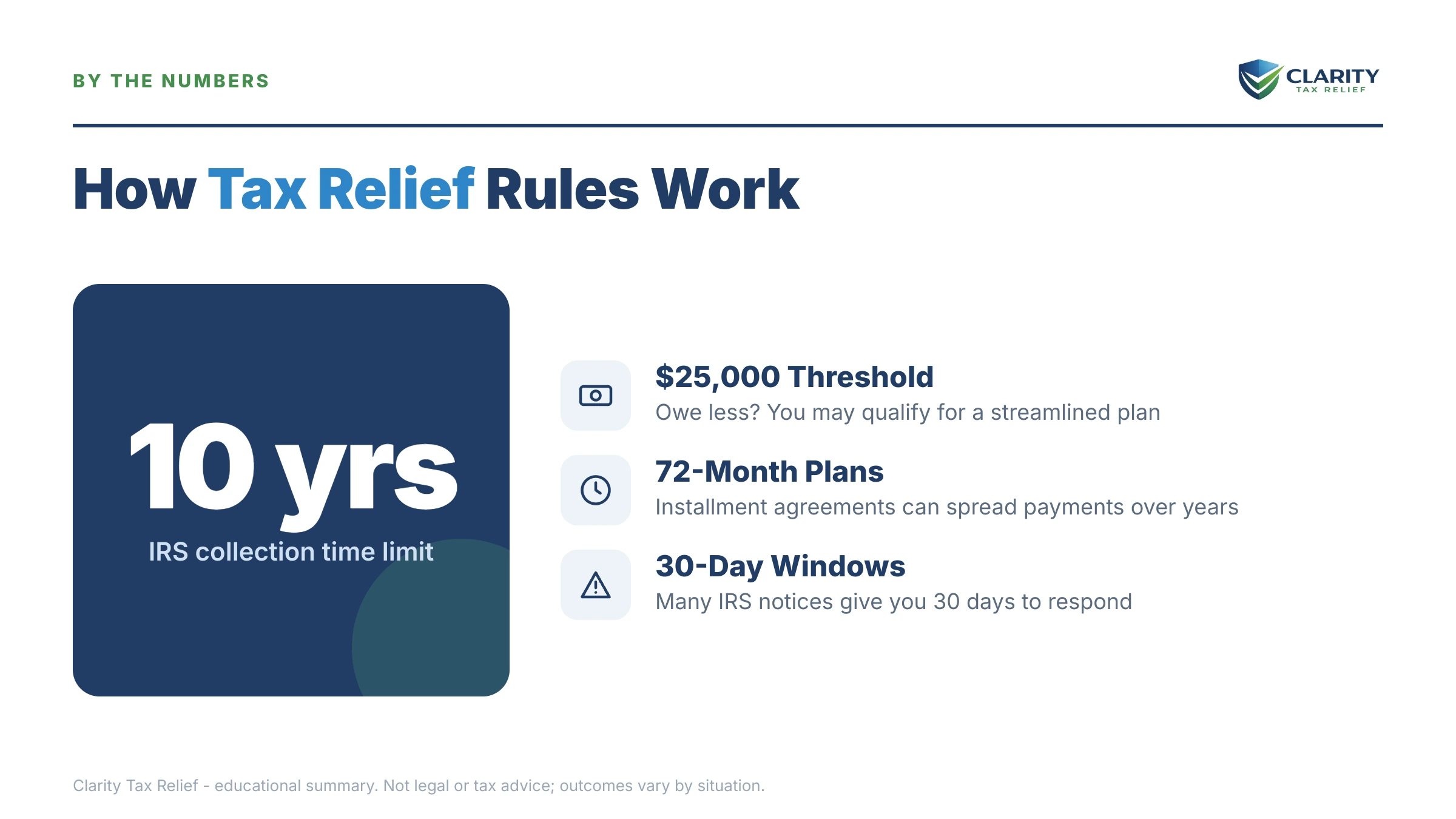
| Streamlined installment agreement | Balance ≤ $50,000; up to 72 months, set up online | Modest setup fee (lower with direct debit) | Most balances under $50k |
| Installment agreement over $50,000 | Financial disclosure (Form 433-F) usually required | Setup fee + documentation | Larger balances that can still be paid over time |
| Offer in Compromise | Assets + future income genuinely can't cover the debt | $205 fee + 20% down on lump-sum offers (both waived with low-income certification) | Low income, low equity — the IRS accepted roughly 1 in 5 offers in FY2024 |
| Currently Not Collectible | Paying anything would prevent basic living expenses | $0 (financial disclosure required) | Job loss, disability, fixed income |
| Penalty abatement (FTA / reasonable cause) | Clean compliance in the prior 3 years, or circumstances beyond your control | $0 to request | Shrinking the balance before resolving it |
A few honest notes the sales pitches leave out. An Offer in Compromise is real but strict — the IRS runs a formula, and most applicants don't qualify; if it isn't decided within 2 years, it's accepted automatically (with narrow exceptions - a returned or rejected offer stops the clock, and time during court disputes does not count), but most decisions come well before that. Currently Not Collectible pauses collection without erasing the debt, and interest keeps accruing. And starting summer 2026, First-Time Abate is being replaced by the Automatic Exemption from Penalty (AEP), which applies qualifying relief automatically — but if your penalties predate the rollout, an affirmative request under first-time penalty abatement is still the path.
The general mechanics of each program — forms, phone scripts, processing times — are covered in our DIY pillar on how to settle tax debt yourself. What follows is the part that's specific to your numbers.
A worked example: an El Paso couple owing $54,600
Say you and your spouse file jointly and owe $54,600 across two tax years — one W-2 income, one self-employed with no withholding. This is hypothetical, but the math is real:
- The $50,000 line matters most. At $54,600 you're just above the streamlined online threshold. Pay the balance down by $4,600 — tax refund, savings, anything — and you can set up a 72-month plan online with no financial disclosure: $50,000 ÷ 72 ≈ $695/month minimum, though interest and the reduced failure-to-pay penalty continue while you pay, so paying more shortens the real payoff.
- Can't pay it down? A plan on the full $54,600 works out to roughly $54,600 ÷ 72 ≈ $758/month, but above $50,000 the IRS will usually want Form 433-F financials first. The trade-offs at this level are covered in I owe the IRS $50,000.
- Is an OIC realistic? Only if the IRS's formula — equity in what you own plus a multiple of your monthly disposable income — totals less than $54,600. A couple with home equity and two incomes usually fails that test; a couple with no equity and $200/month of disposable income might not.
- Shrink it first. If, say, $6,300 of that balance is penalties and one year qualifies for first-time abatement, the debt drops before you ever negotiate the payment — and the monthly number drops with it.
Deadlines and rights: what each IRS notice takes off the table
Every notice in the collection sequence sets a window, and each missed window removes a protection you had the day before. The date printed on your notice controls — not an average.
| Notice or event | Your window | What's at stake if it passes |
|---|---|---|
| CP14 (first bill) | Typically about 21 days | Cheapest resolution point; escalation begins |
| CP504 (intent to levy) | 30 days per the notice | State refund can be seized; lien filing becomes likely |
| LT11 / Letter 1058 (final notice) | 30 days from the notice date | Collection Due Process hearing rights (Form 12153) — your strongest appeal — expire |
| CP508C (passport certification) | Triggered at $66,000+ in 2026 | Passport renewal denied or passport revoked |
| Bank levy served | 21-day hold before funds leave | Last realistic chance to get frozen funds released |
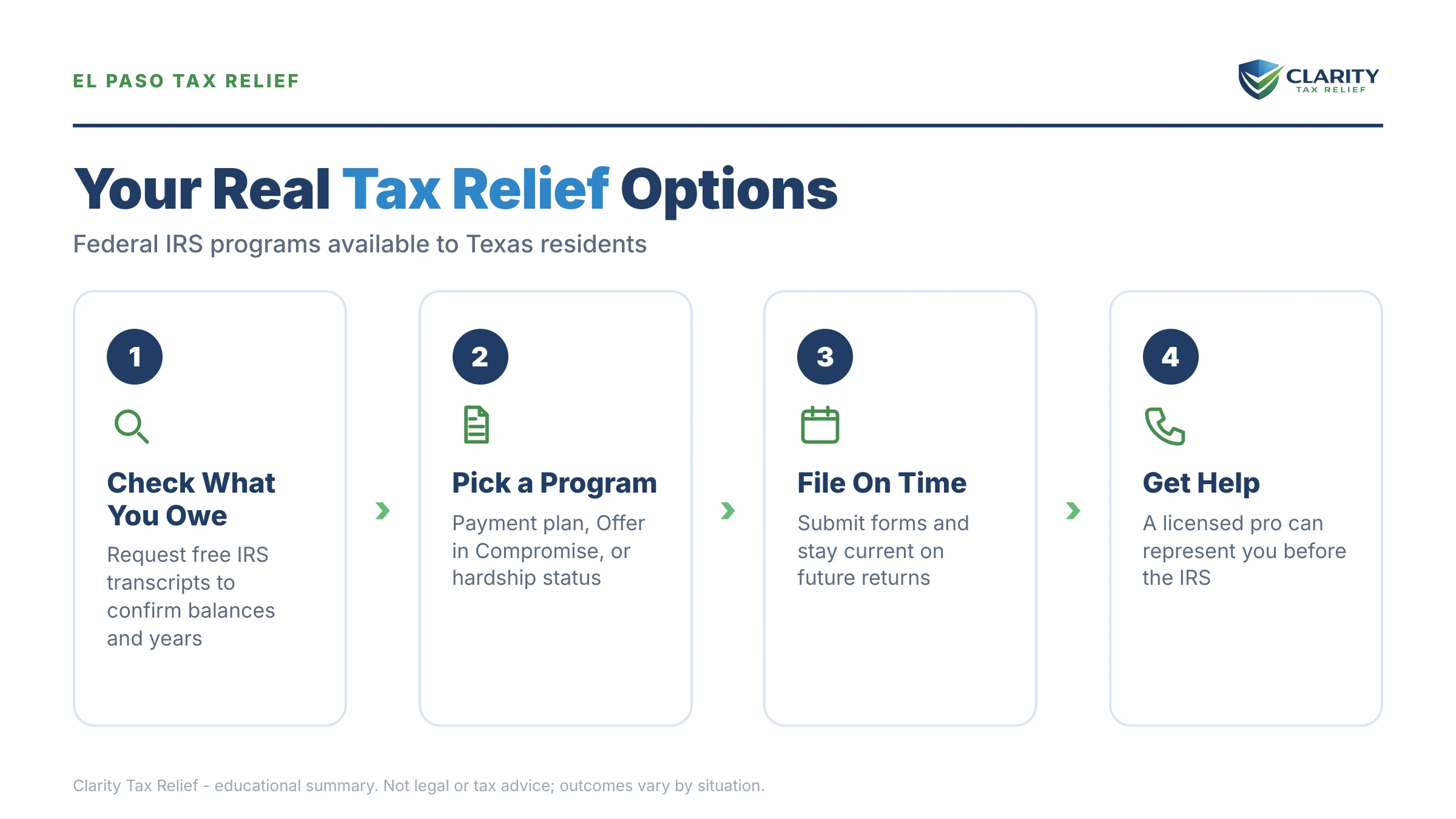
How to get tax relief in El Paso, step by step
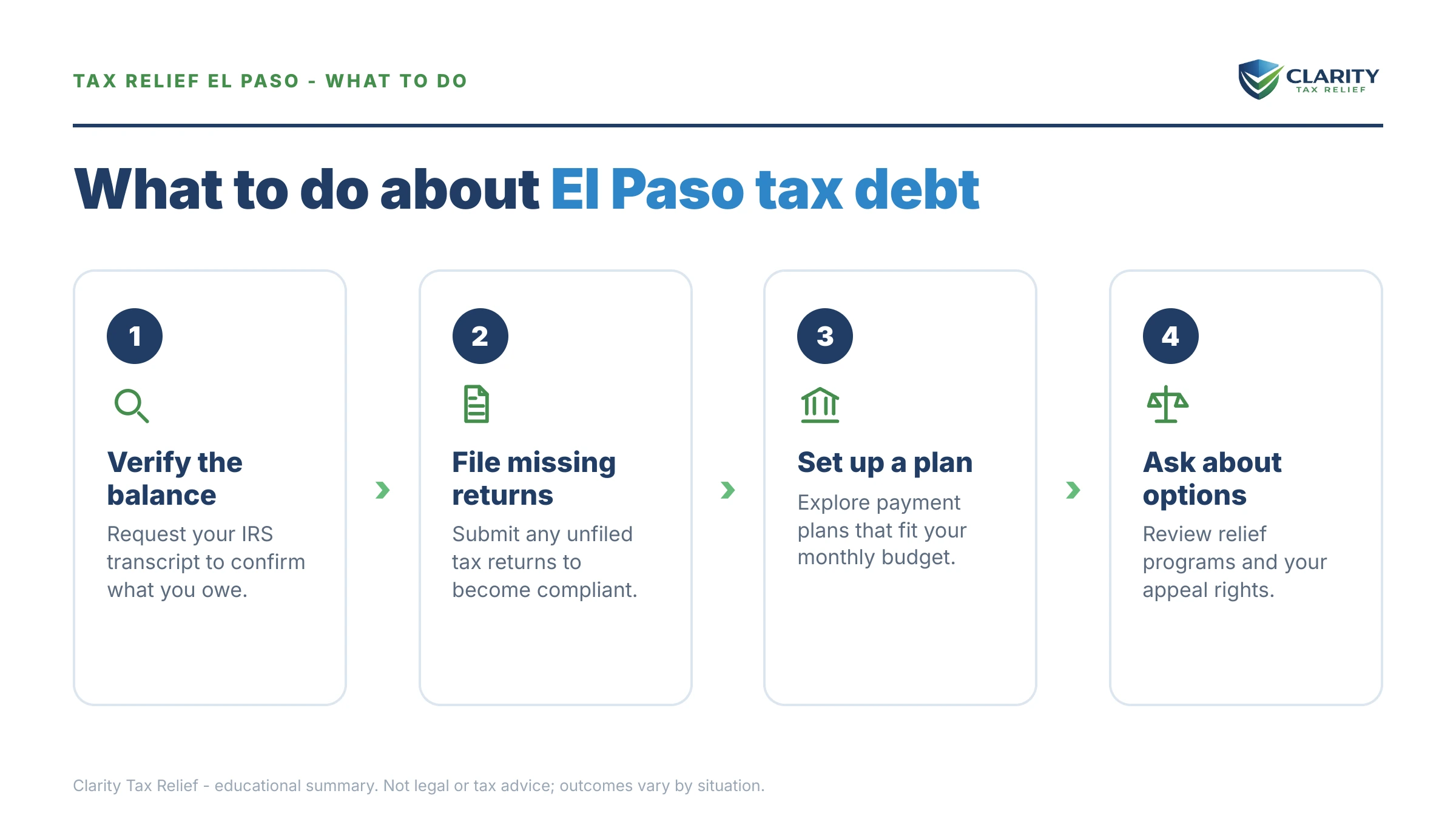
- Pull your IRS records — set up an IRS online account and download account transcripts so you know the exact balance, years, and penalties before anyone quotes you a fix.
- File every missing return — the IRS won't approve a payment plan, offer, or hardship status while required returns are unfiled, and the 5%-per-month failure-to-file penalty is ten times the late-payment penalty.
- Match your balance to the right program — under $50,000 usually means a streamlined online plan; genuine hardship points to Currently Not Collectible; low assets and income point to an Offer in Compromise review.
- Set it up before the next notice lands — an arrangement made at the CP14 or CP504 stage stops the escalation to levy; waiting past an LT11's 30-day window costs you appeal rights.
- Vet any firm before you pay — demand the name and credential of the person working your case, a flat fee in writing, and no settlement promises made before your financials are reviewed.
Local vs. national: do you need an El Paso tax relief company?
Almost no IRS resolution work actually happens in El Paso — it happens by phone, mail, and e-fax with IRS campuses and units across the country. Once you sign Form 2848, an enrolled agent, CPA, or tax attorney anywhere can represent you before the IRS, which is why national firms and local practitioners compete for the same cases on equal footing.
That cuts both ways. A local office you can walk into offers accountability; a larger firm may offer deeper resolution experience. What actually predicts your outcome is neither — it's whether a credentialed professional (not a "consultant" on commission) works your file, and whether the fee structure is honest. Our how to choose a tax relief company checklist covers exactly what to ask, and tax relief scams covers the pitches to walk away from — anyone promising to settle for "pennies on the dollar" before seeing your financials is describing a scam, not a program.
If you're comparing the big national names you've heard on the radio, start with our Optima Tax Relief alternatives comparison. And if your debt is business debt — payroll taxes, a restaurant or shop on the east side, Comptroller sales tax — the buyer's criteria change entirely; see tax relief for small business.
When you can handle this yourself — and when help changes the outcome
Most El Paso taxpayers with a balance under $25,000, all returns filed, and no notice past a CP503 can resolve it themselves in an afternoon. A streamlined plan set up through your IRS online account takes minutes, and a first-time abatement request is a phone call. You don't need to pay anyone for that.
Free help exists too. El Paso has an IRS Taxpayer Assistance Center (appointment only — verify the current location through IRS.gov), the region is served by Low Income Taxpayer Clinics that represent qualifying taxpayers at no charge, and the Taxpayer Advocate Service can intervene when IRS delays are causing you harm.
Experienced help earns its fee in specific situations: a wage or bank levy already in motion, multiple unfiled years, a balance over $50,000 where financial disclosure strategy matters, business or payroll debt where personal liability is on the line, or an Offer in Compromise where the difference between an accepted and rejected offer is how the Form 656 package presents your finances. In those cases, the fee is usually smaller than the cost of getting it wrong.
What about Texas state taxes?
For W-2 households, there's nothing to resolve at the state level — Texas collects no personal income tax. Business owners are the exception: the Texas Comptroller of Public Accounts collects sales tax and franchise tax on its own timeline with its own enforcement tools, and sales tax you collected from customers but didn't remit can become a personal liability even if the business closes. The Comptroller runs its own payment agreements; start at comptroller.texas.gov or our guide to Texas Comptroller tax debt. Never assume an IRS threshold or deadline applies to the Comptroller — the rulebooks are separate.
Terms you'll hear from tax relief companies, decoded
- Fresh Start: not a special program you enroll in — a 2011-era set of IRS policy changes that firms use as a brand name for ordinary payment plans and offers.
- Lien vs. levy: a lien is a legal claim against what you own (including a Texas homestead); a levy is the actual taking of wages or bank funds.
- CSED: the Collection Statute Expiration Date — the IRS generally has 10 years from assessment to collect, though appeals, offers, and bankruptcy pause the clock.
- CDP rights: your Collection Due Process appeal, requested on Form 12153 within 30 days of a final notice — the strongest formal protection in the collection process.
- RCP: Reasonable Collection Potential — the formula (asset equity plus future income) the IRS uses to decide whether an Offer in Compromise gets accepted.
Tax relief in El Paso: your questions, answered
Is there an IRS office in El Paso, Texas?
Yes — El Paso has an IRS Taxpayer Assistance Center, and it works by appointment only, scheduled through the IRS's toll-free appointment line. It can help with account questions, payments, transcripts, and identity verification. It cannot negotiate a settlement or approve an Offer in Compromise; those decisions happen at IRS campuses and offer units, not the local walk-in office.
Can the IRS garnish my wages in El Paso even though Texas limits wage garnishment?
Yes. Texas law blocks most ordinary creditors from garnishing wages, but that protection does not apply to federal tax levies — the IRS operates under federal law, which overrides state creditor protections. Once a wage levy starts, it is continuous until released, and only a small exempt amount of each paycheck is protected.
Do I owe Texas state income tax on top of my IRS debt?
No — Texas has no personal income tax, so most El Paso wage earners face only the IRS. The exception is business owners: the Texas Comptroller collects sales tax and franchise tax, and unpaid sales tax can become a personal liability. If you run a shop or restaurant, you may need to resolve two agencies, each with its own rules.
How much does tax relief cost in El Paso?
Professional fees commonly run from a few hundred dollars for a simple payment-plan setup to several thousand for an Offer in Compromise or multi-year case. The IRS's own charges are separate: online payment-plan setup fees are modest, a short-term 180-day plan costs $0 to set up, and an OIC carries a $205 application fee unless you meet the low-income waiver. Be wary of any firm that quotes a fee before reviewing your IRS records.
Do I need a local El Paso tax relief company, or can a national firm handle my case?
Location matters far less than credentials, because nearly all IRS resolution work happens by phone, mail, and e-fax with IRS campuses — not at a local office. Once you sign Form 2848, an enrolled agent, CPA, or attorney anywhere in the country can represent you. Judge any firm, local or national, on who actually works your case and whether fees are flat and in writing.
Will IRS tax debt stop me from crossing into Ciudad Juárez?
A balance alone won't stop you at the bridge — but seriously delinquent debt of $66,000 or more in 2026 can be certified to the State Department, which can then deny your passport renewal or revoke the passport you use to re-enter the U.S. In a border city where families cross weekly, that threshold matters more than almost anywhere else. Getting into a payment plan generally prevents or reverses certification.
Can the IRS take my house in El Paso if it's my Texas homestead?
The Texas homestead exemption does not stop a federal tax lien — the lien attaches to your home despite state protections. Actual seizure of a primary residence is rare and requires court approval, and the IRS strongly prefers payment arrangements over home seizures. The practical risk is the lien itself, which complicates selling or refinancing until it's resolved.
Does being stationed at Fort Bliss change how the IRS collects from me?
It can. Service members in a designated combat zone get collection and filing deadlines postponed during service plus a recovery period, and pre-service tax debts may qualify for interest limits under servicemember protections. These aren't automatic in every case — the IRS needs to know your status — so flag military service in any collection contact and get the account coded correctly.
Your next 24 hours
- Find the notice number and date on the letter you're holding — top right corner. That tells you which stage of the collection sequence you're in and whether a 30-day appeal window is running.
- Gather three things: your most recent tax return, every IRS letter you've received, and a rough picture of household income and monthly expenses. That's everything needed to match you to a program.
- Get a free case review — the 2-minute form at claritytaxrelief.com/#consult or a call to (888) 825-7779. There's no fixed deadline on getting help, but penalties and interest post to your balance every month you wait, and every option on this page is cheaper at today's balance than next month's.
This guide is general information, not tax or legal advice for your specific situation. Eligibility for IRS programs depends on individual facts and circumstances; no outcome is guaranteed.