
Tax Relief by City
Tax Relief in Cheyenne, Wyoming: Your Real Options for IRS Debt (2026)
The short answer: tax relief in Cheyenne is almost entirely a federal matter — Wyoming has no state income tax, so your debt is with the IRS. Real options include payment plans of up to 72 months (balances under $50,000), hardship status, penalty abatement, and, when your finances genuinely qualify, an Offer in Compromise.
If you're searching for tax relief in Cheyenne, you're likely holding an IRS letter, not a state one — maybe you drove home from a job site, opened the mailbox on Pershing or out in Saddle Ridge, and found a balance you can't cover this month. That's the most common Cheyenne tax problem there is: 1099 income from contract, energy, rail, or trades work with nothing withheld all year.
Here's the map. Wyoming's no-income-tax status changes which threats on your IRS letters are real, which options fit which balance, and where the actual deadlines sit — all covered below, in that order.
⏱ The clock that matters: there is no single "tax relief" deadline — but the IRS failure-to-pay penalty adds 0.5% of your balance every month, interest compounds on top, and every collection notice you receive prints its own response date. The controlling deadline is the one on your most recent letter.
Why tax debt in Cheyenne is almost always IRS debt
Wyoming is one of the few states with no personal income tax, so a Cheyenne resident's back-tax problem is nearly always owed to the IRS alone. There is no Wyoming income tax return, no state income tax bill, and no state income-tax collection agency chasing you — one creditor, one set of rules, one fix.
That's genuinely good news. Residents of California or New York often fight two collectors at once, on two different statutes. In Cheyenne, resolving the IRS balance resolves the whole problem for most individuals.
How the debt usually starts here: self-employment. Cheyenne's economy runs heavily on contract labor — construction subs, oilfield and wind-energy services, trucking along I-80 and I-25, rail work, and contractors serving F.E. Warren and the state government complex. Paid on a 1099, nothing is withheld, and self-employment tax alone takes roughly 15.3% of net earnings before income tax even starts. Skip the quarterlies and April delivers a bill. If that's your story, the mechanics are covered in self employment tax owe irs and didn't pay estimated taxes penalty.
The one state exception: businesses. The Wyoming Department of Revenue collects sales and use tax, and a Cheyenne shop, restaurant, or contractor that collected sales tax and didn't remit it owes the state — a separate problem with its own rules, covered briefly near the end of this guide.
What happens if you ignore IRS debt in Wyoming
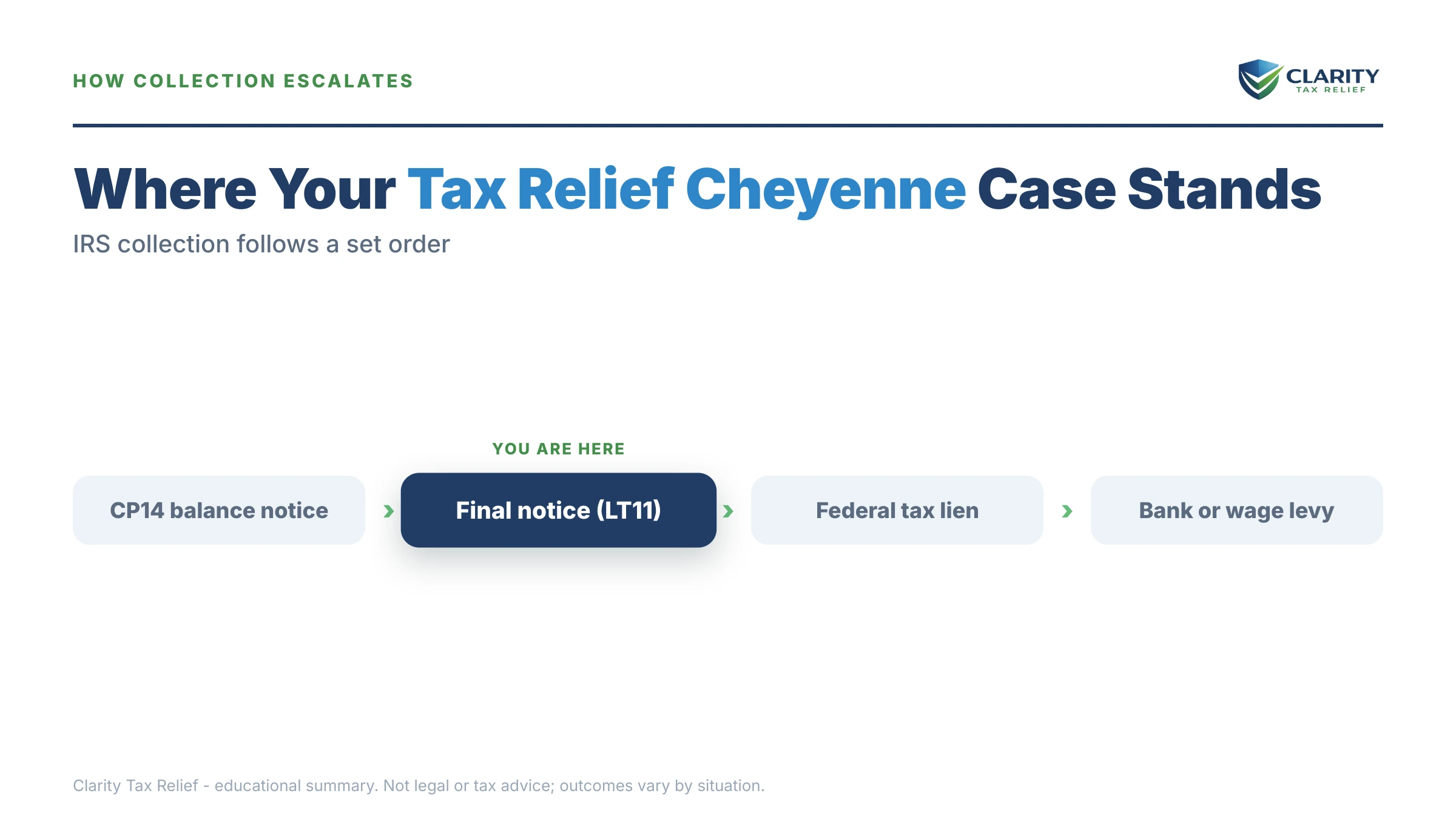
Ignoring an IRS balance in Cheyenne triggers the same automated notice sequence as anywhere in the country — and in 2026, that sequence runs itself. The IRS workforce was cut roughly 27% in 2025, so humans are harder to reach, but the notices, liens, and levies come from computers that never got laid off. The stages, in order:
- CP14 — the first bill. Typically about 21 days to pay before the next notice queues up. No enforcement yet; this is the cheapest moment to act.
- CP501 / CP503 — reminder notices. Still just bills, but the balance grows every month they sit on the counter.
- CP504 — Notice of Intent to Levy under IRC §6331(d). Its headline threat is seizing your state tax refund — and here's the Wyoming twist: with no state income tax, there is no Wyoming income-tax refund for the IRS to take. Don't get comfortable. The CP504 still signals that a federal tax lien is likely next, and it is the last stop before the final notice.
- LT11 / Letter 1058 — the final notice of intent to levy. This starts a 30-day clock and your Collection Due Process rights (requested on Form 12153). After day 30, bank and wage levies become legal.
- Levy — a bank levy freezes funds with a 21-day hold before the money leaves; a wage levy is continuous until released. For a 1099 contractor, the IRS instead levies your clients, capturing 100% of whatever they owe you on the day the levy lands — the details are in can irs garnish 1099 income.
Here is each stage as a deadline-and-rights map — the response window each notice sets, and what you lose when it closes:
| Notice | Your response window | What's at stake if it passes |
|---|---|---|
| CP14 (first bill) | Typically 21 days from the notice date | Penalties and interest keep compounding; reminder notices begin |
| CP501 / CP503 (reminders) | The pay-by date printed on each notice | Escalation to CP504; balance keeps growing monthly |
| CP504 (intent to levy) | 30 days from the notice date | State-refund levy (moot in Wyoming) — but a federal tax lien becomes likely and the final notice follows |
| LT11 / Letter 1058 (final notice) | 30 days to request a CDP hearing on Form 12153 | You lose the pre-levy appeal that pauses collection; bank, wage, and 1099-client levies become legal |
One more escalation worth knowing even at smaller balances: once a debt is "seriously delinquent" — $66,000 or more in 2026 — the IRS certifies it to the State Department, which can deny or revoke your passport. At $8,900 you're nowhere near it, but a few ignored years of 1099 income can get there faster than people expect.
Holding an IRS notice in Cheyenne right now?
Every month you wait adds another 0.5% penalty plus interest to the balance. Send us the notice — an experienced tax professional will map exactly where you are in the sequence and which option fits your numbers. Free, confidential, no pressure.
Your options for tax relief in Cheyenne, compared
The IRS runs five real resolution programs, and eligibility for each is set by your numbers — not by where you live and not by what any company promises. This table is the whole menu; the shared mechanics of each program live in our guide to how to settle tax debt yourself.
| Option | Who may qualify | Cost & terms |
|---|---|---|
| Short-term payment plan | Anyone who can pay in full within 180 days | $0 setup; interest and penalties continue until paid |
| Guaranteed installment agreement | Balance ≤ $10,000; filed and paid on time the prior 5 years; can pay within 3 years | IRS must accept; setup fee applies (lowest online with direct debit) |
| Streamlined installment agreement | Balance ≤ $50,000; up to 72 months; no detailed financials required online | Setup fee (reduced online / waived or reimbursed for low income); interest and penalties continue |
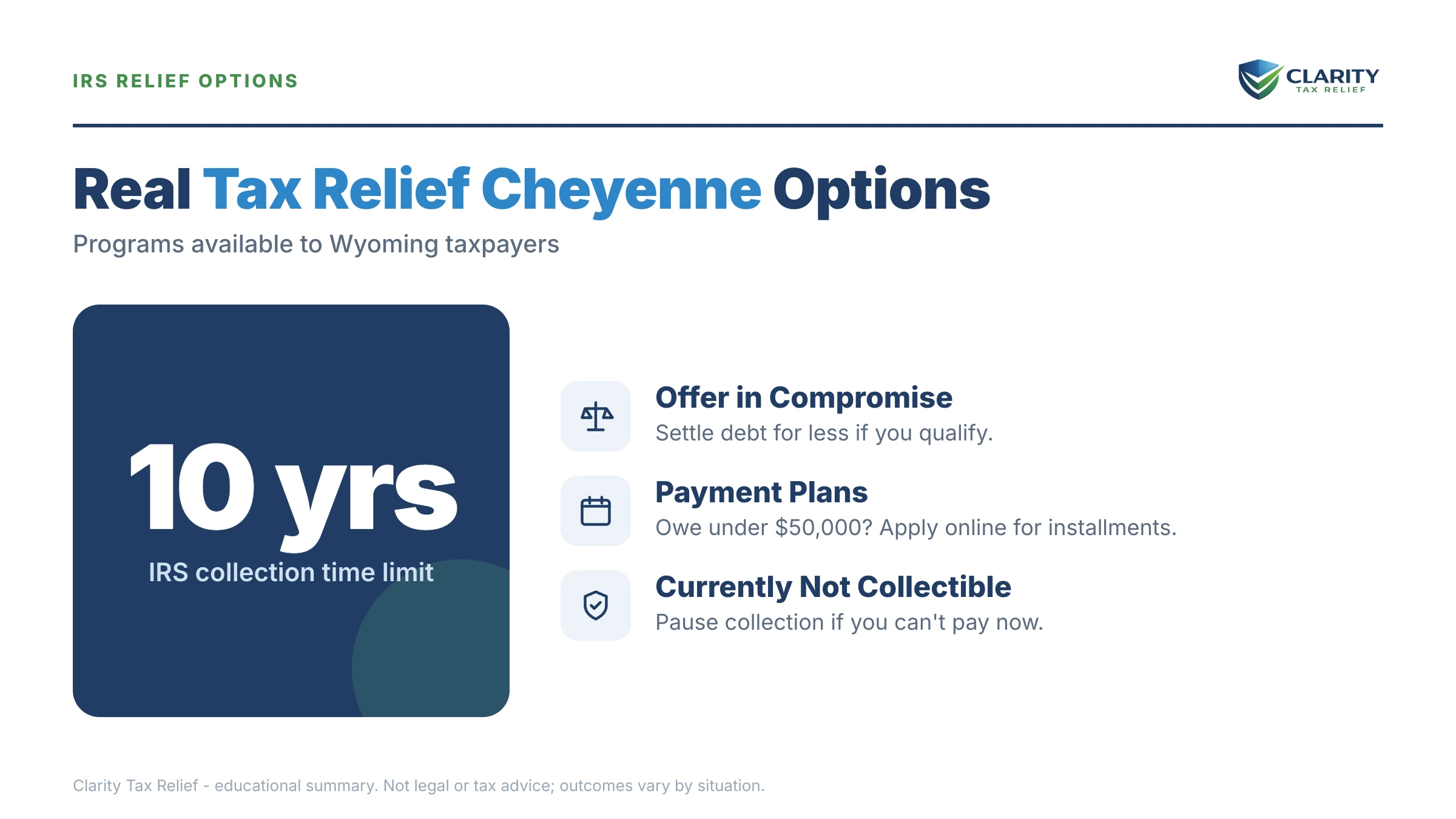
| Currently Not Collectible | Income covers only IRS-allowed living expenses; paying anything would cause hardship | $0; collection pauses, debt remains, interest accrues; reviewed periodically |
| Offer in Compromise | Income and assets genuinely can't cover the debt before the collection statute runs | $205 fee + 20% down on lump-sum offers (both waived with low-income certification); IRS accepted roughly 1 in 5 offers in FY2024 |
| Penalty abatement (FTA / AEP) | Clean compliance the prior 3 years, or reasonable cause (illness, disaster) | $0; removes penalties, not tax; AEP makes some relief automatic starting summer 2026 |
An honest note on the Offer in Compromise, because Cheyenne radio and mailers push it hard: it's real, but it's math, not mercy. The IRS accepts an offer only when what you offer equals or beats what it could ever collect from your income and assets — and most people with steady contractor income and equity in a truck or house don't qualify. Anyone promising settlement before seeing your finances is selling, not advising; our guide to how to choose a tax relief company shows what legitimate vetting looks like — as does the honest breakdown in optima tax relief alternative if you've been comparing the big national advertisers.
What an $8,900 IRS debt actually costs a Cheyenne contractor
A clearly hypothetical example — say you're a Cheyenne 1099 contractor who owes $8,900 from your 2025 return, mostly self-employment tax nothing was withheld for. Here's the real arithmetic on each path:
- Do nothing: the failure-to-pay penalty adds 0.5% per month — about $44.50 a month at the start — plus compounding interest, while the notice sequence above marches toward a levy on your clients.
- Short-term plan (180 days): roughly $8,900 ÷ 6 ≈ $1,483 a month. Steep, but $0 setup fee and the least total interest.
- Guaranteed installment agreement: because the balance is under $10,000, if you filed and paid on time the prior five years the IRS must accept a plan that pays it off within three years — $8,900 ÷ 36 ≈ $248 a month before ongoing accruals. Details in guaranteed installment agreement.
- 72-month streamlined plan: $8,900 ÷ 72 ≈ $124 a month — the lowest payment, but the most total interest and penalty, since both accrue the whole time.
- Penalty relief: if, say, $700 of that $8,900 is failure-to-pay penalty and your prior three years are clean, first time penalty abatement can remove it — an instant $700 haircut before you set up any plan.
Want to see how your own penalties and interest stack month by month? You can estimate them with our Penalty & Interest Calculator.
Notice what's not the right answer at $8,900: an Offer in Compromise. With steady contract income, the IRS's own math will almost always show it can collect $8,900 within the statute — so a plan plus penalty abatement beats chasing a settlement you'd likely pay fees to lose.
How to respond, step by step
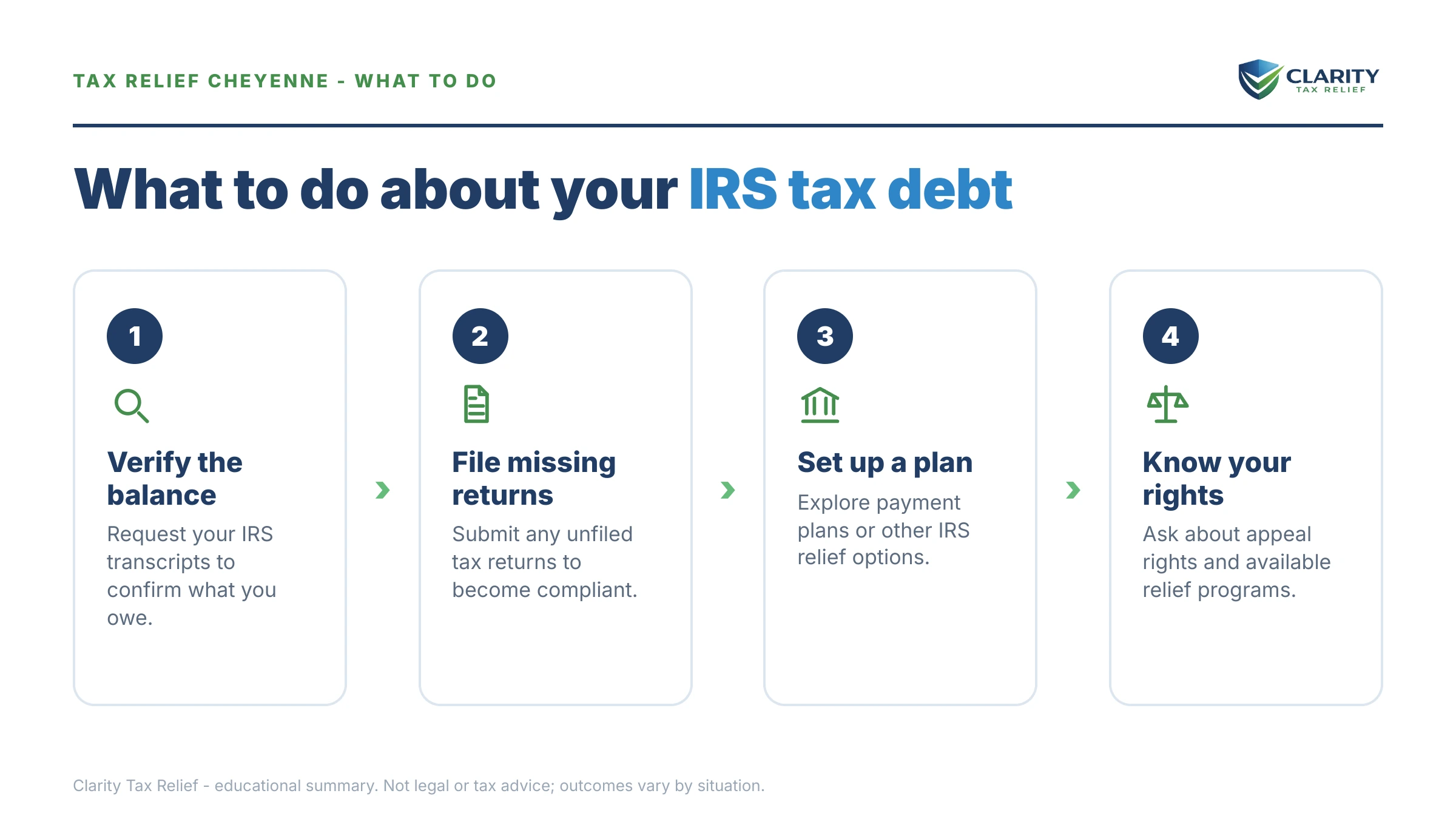
- Pull your IRS records. Log into your IRS online account to see every year with a balance, every penalty, and the assessment dates. Guessing at what you owe is how people fix the wrong year first.
- File any missing returns. The IRS won't approve a payment plan, hardship status, or an offer while returns are unfiled. Filing also cuts off the 5%-per-month failure-to-file penalty, which is ten times the failure-to-pay rate.
- Match your numbers to one option. Use the table above: under $10,000 with clean compliance points to a guaranteed installment agreement; income that barely covers living expenses points to Currently Not Collectible; a balance your income and assets can never cover points to an Offer in Compromise.
- Set it up before the next notice lands. Most plans can be arranged in one session through the IRS Online Payment Agreement tool at IRS.gov. An active agreement stops the notice sequence and takes levies off the table while you stay current.
- Request penalty relief. If your prior three years are clean, ask for first-time abatement on the failure-to-pay penalties — and note that the IRS's Automatic Exemption from Penalty (AEP) begins applying some of this relief automatically starting summer 2026.
The full online walkthrough — screens, fee tiers, and the direct-debit choice — is in how to set up irs payment plan online, and the IRS's own terms are on its payment plans page.
When you can handle this yourself — and when help changes the outcome
Most Cheyenne taxpayers with one year of debt under $10,000 can resolve it themselves in an afternoon. If you agree with the balance, your returns are filed, and no levy is in motion, the online agreement tool plus a first-time abatement request is genuinely all you need — no fee to anyone but the IRS.
Experienced help changes outcomes in specific situations: a final notice (LT11/1058) already received, since the 30-day CDP window is a one-shot right that's easy to waste; multiple unfiled years, where the order you file and resolve them changes the total; income low enough that Currently Not Collectible or an offer is realistic, because the financial-disclosure math on those forms decides everything; and any business debt — payroll or Wyoming sales tax — where personal liability rules bite owners. If you're comparing firms for a case like that, start with our buyer's checklist in how to choose a tax relief company.
Cheyenne business owners: the one state tax that does bite
Wyoming's no-income-tax rule does not cover sales and use tax, which the Wyoming Department of Revenue collects and enforces. Sales tax you collected from customers and didn't remit is treated as the state's money held in trust — and states pursue it aggressively, with liability that can follow owners personally even after a business closes. Wyoming's own procedures and payment options are on the Wyoming Department of Revenue site; the resolution playbook for state trust-fund debt is in sales tax debt help.
A Cheyenne business behind on federal payroll taxes faces a different and harsher track — personal liability through the Trust Fund Recovery Penalty — covered in our guide to tax relief for small business.
One consumer-protection note either way: if you can't get traction with the IRS on your own — a levy causing hardship, a case stuck in processing — the Taxpayer Advocate Service is a free, independent IRS unit that serves Wyoming taxpayers.
Tax relief in Cheyenne: your questions, answered
Does Wyoming have a state income tax I could owe?
No. Wyoming has no personal or corporate income tax, so residents never owe state income tax or file a state income tax return. That means back-tax problems in Cheyenne are almost always federal — owed to the IRS. The exception is business tax: the Wyoming Department of Revenue collects sales and use tax, and a business that fell behind on those owes the state, not the IRS.
Is there an IRS office in Cheyenne?
Yes — Cheyenne has an IRS Taxpayer Assistance Center, but it works by appointment only; call 844-545-5640 to schedule. With the IRS workforce cut roughly 27% in 2025, appointments can take weeks to get. For most balance-due problems you will resolve things faster through your IRS online account or the number printed on your notice than by going in person.
Can the IRS garnish my wages or 1099 pay in Wyoming?
Yes. Federal levy power applies in Wyoming the same as everywhere else — a wage levy is continuous until released, and only a small exempt amount of each paycheck is protected. For 1099 contractors, the IRS instead sends a one-time levy to your clients that captures 100% of whatever they owe you at that moment. Neither can begin until you have received a final notice (LT11 or Letter 1058) and your 30-day window has passed.
How much does tax relief cost in Cheyenne?
A payment plan you set up yourself costs only the IRS setup fee — lowest when you apply online with direct debit, and waived or reimbursed for low-income taxpayers. Professional representation typically runs from several hundred dollars for a straightforward installment agreement to a few thousand for an Offer in Compromise or levy defense. Get a flat-fee quote in writing before paying anyone, and walk away from any firm that quotes a settlement amount before reviewing your finances.
Do I need a local Cheyenne tax attorney, or can a national firm handle IRS debt?
IRS collection work is federal, so location doesn't matter — a representative anywhere in the country files Form 2848 and works your case with the same IRS units a local professional would call. Attorneys matter when there is criminal exposure or Tax Court litigation; for payment plans, penalty abatement, hardship status, and offers, enrolled agents and CPAs handle the work routinely. Judge any firm by its process and pricing transparency, not its zip code.
Does IRS debt go away after 10 years?
Generally the IRS has 10 years from assessment to collect — the Collection Statute Expiration Date, or CSED — and unpaid balances do expire. But the clock pauses during bankruptcy, a pending Offer in Compromise, certain appeals, and other events, so the real date is often later than 10 calendar years. Waiting it out also means living under lien and levy risk the entire time, so it's a real rule but rarely a plan.
What if I owe the IRS less than $10,000?
If you've filed and paid on time for the past five years, you may qualify for a guaranteed installment agreement — the IRS must accept a plan that pays the balance within three years. On an $8,900 balance that works out to roughly $248 a month. Most people at this level can set it up themselves unless there are unfiled returns or a levy already in motion.
Your next 24 hours
- Find the notice date and amount on your most recent IRS letter — top right corner. No letter? Log into your IRS online account and note every year showing a balance.
- Gather three things: your last filed return, every 1099 you received for the debt year, and a rough monthly picture of your income and expenses. Every option above starts from those numbers.
- Get your situation reviewed free — the 2-minute form at claritytaxrelief.com/#consult or (888) 825-7779. Penalties and interest are accruing every month you wait; an experienced tax professional can tell you in one call whether your case is a DIY payment plan or something worth representing.
This guide is general information, not tax or legal advice for your specific situation. Eligibility for IRS programs depends on individual facts and circumstances; no outcome is guaranteed.