
City Guides
Tax Relief Denver: Your Real Options for IRS and Colorado Tax Debt in 2026
The short answer: tax relief in Denver means resolving debt with two separate agencies — the IRS and the Colorado Department of Revenue. Federal options include payment plans (up to 72 months under $50,000), Currently Not Collectible status, penalty abatement, and, for those whose finances qualify, an Offer in Compromise. Colorado runs its own separate programs.
If you searched "tax relief Denver," you probably have a letter — or a stack of them — and a balance you can't clear in one payment. Maybe it's a retirement-account withdrawal that landed harder than expected, or a pension that wasn't withheld enough. The debt is real, but so is the map out of it — and it's shorter than the ads make it sound.
Here's what makes Denver different from a generic "I owe taxes" search: you may be answering to two collectors at once. The IRS handles your federal balance, and the Colorado Department of Revenue — headquartered just west of the city in Lakewood — collects the state side under its own rules and its own timeline. Resolving one does nothing for the other.
⏱ The clock that's actually running: there's no single deadline on tax debt itself — but if you've received an IRS or Colorado notice, the response date printed on that notice controls. Meanwhile, interest and the IRS's 0.5%-per-month failure-to-pay penalty accrue every month the balance sits unresolved.
Why You're Searching "Tax Relief Denver"
Most Denver taxpayers looking for tax relief owe one of two agencies — and about the worst-positioned owe both. The searches that lead here usually start with one of these situations:
- A federal balance you can't pay — an underwithheld pension or Social Security year, a 401(k) or IRA withdrawal, a 1099 side income year, or a return you filed knowing you couldn't pay it.
- A Colorado Department of Revenue bill — the state processes your return separately, bills separately, and enforces separately. Its notices look different from IRS mail and carry their own response dates.
- Enforcement already in motion — a levy warning, a lien filing, or money already taken from a refund or benefit payment.
One local fact worth knowing early: Denver has an IRS Taxpayer Assistance Center, but it's appointment-only (call 844-545-5640 to schedule). It can take payments and answer account questions — it cannot negotiate a settlement. Resolutions happen through IRS collection channels and written applications, which is why where your help is located matters far less than what that help knows.
A second fact: in 2026, the IRS workforce is down roughly 27% after the 2025 cuts. Reaching a human is harder than ever — but the notices, liens, and levies come from automated systems that never stopped running. Slow phones do not mean slow enforcement.
What Happens If You Ignore IRS or Colorado Tax Debt
Unpaid federal tax debt in Denver follows the same automated escalation sequence as everywhere else — and it does not stall because the IRS is understaffed. Each stage arrives with more enforcement power than the last:
- CP14 — the first bill. A statement of the balance with roughly 21 days to respond. No enforcement yet; this is the cheapest stage to fix anything.
- CP501 / CP503 — reminders. Still just bills, but interest and the monthly late-payment penalty are compounding underneath them.
- CP504 — intent to levy your state refund. Under IRC §6331(d), the IRS can now take your Colorado refund, and a federal tax lien becomes a live possibility.
- LT11 / Letter 1058 — final notice. This starts a 30-day clock and your Collection Due Process rights (requested on Form 12153). After 30 days, the IRS can levy bank accounts and garnish income.
- Levy on retirement income. For retirees, this is the stage that hurts: through the Federal Payment Levy Program, the IRS can take up to 15% of every Social Security check — continuously, until the debt is resolved or released. Our guide to the 15% Social Security levy covers how it starts and how it stops.
The Colorado side runs on its own track. The Department of Revenue issues its own billing notices, can file liens, and can garnish wages and bank accounts for unpaid state tax. Its deadlines and procedures are not the IRS's — the response date on a DOR notice is the one that controls, and when a state timeline matters to your case, confirm it with the DOR directly rather than assuming a federal rule applies. Our Colorado back taxes guide walks through the state process in detail.
| Notice | Response window | What's at stake if it passes |
|---|---|---|
| CP14 (first bill) | Typically 21 days from the notice date | Escalation to reminder notices; penalties and interest keep compounding |
| CP501 / CP503 (reminders) | The date printed on the notice | Escalation to CP504 with real enforcement behind it |
| CP504 (intent to levy) | The date printed on the notice | Your Colorado state refund can be seized; lien filing becomes likely |
| LT11 / Letter 1058 (final notice) | 30 days | Your Collection Due Process appeal right (Form 12153) — then bank levies and garnishment |
| CP91 (Social Security levy warning) | The date printed on the notice | Up to 15% of each Social Security payment, taken continuously |
Behind with the IRS or the Colorado DOR?
Every month unresolved adds penalties and interest — and each notice in the sequence carries more enforcement power than the last. Send us your latest IRS or Colorado notice and an experienced tax professional will map your exact options, free and confidential.
Tax Relief Options for Denver Taxpayers, Compared
The IRS has five real resolution paths, and eligibility for each is set by hard numbers — your balance, your income, and your assets. None of them requires a Denver office; all of them require filed returns.
| Option | Who qualifies | Cost & terms |
|---|---|---|
| Short-term payment plan | Anyone who can pay in full within 180 days | $0 setup fee; interest and penalties continue until paid |
| Guaranteed installment agreement | Balance of $10,000 or less, returns filed and current | Approval is essentially automatic; monthly payments, interest accrues |
| Streamlined installment agreement | Up to $50,000 owed — set up online, up to 72 months | Setup fee varies by method (direct debit is cheapest); no financial disclosure required |
| Currently Not Collectible (CNC) | Income covers only IRS-allowed basic living expenses | Free to request (Form 433-F); collection pauses, but the debt and interest remain |
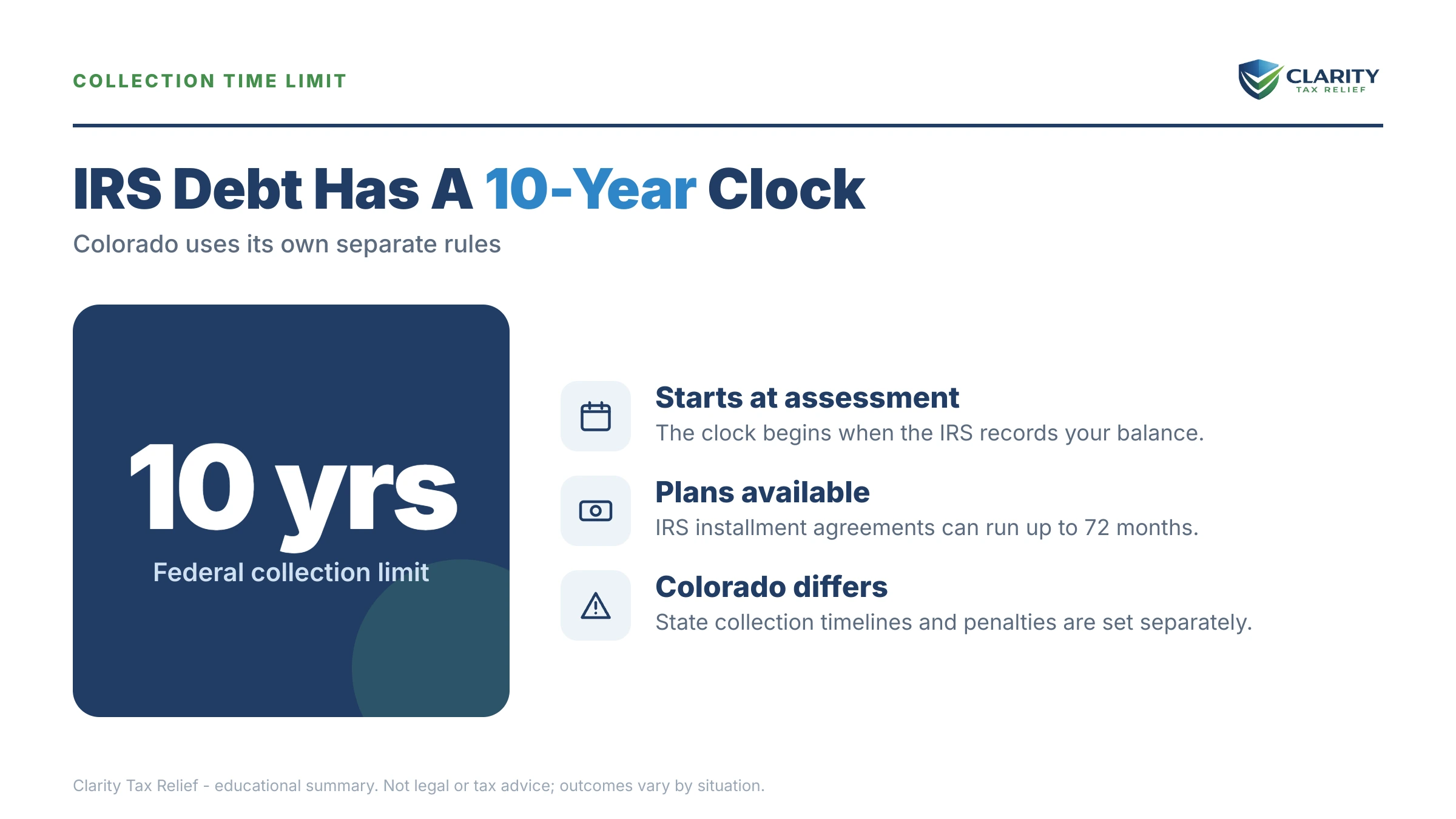
| Offer in Compromise (OIC) | Assets plus future income genuinely can't cover the debt; the IRS accepted roughly 1 in 5 offers in FY2024 | $205 fee + 20% down on lump-sum offers — both waived with low-income certification (AGI ≤ 250% of the poverty level) |
| Penalty abatement | Clean compliance the prior 3 years (First-Time Abate), or reasonable cause such as serious illness | Free to request; from summer 2026, the Automatic Exemption from Penalty (AEP) applies some relief with no request needed |
For a state balance, the Colorado Department of Revenue offers its own payment plans, most easily arranged through its Revenue Online portal. Colorado's programs are narrower than the IRS menu above, and its thresholds and terms are its own — never assume a federal figure carries over. The full DIY playbook for working these programs yourself, federal side, lives in our guide to how to settle tax debt yourself.
A worked example: a Denver retiree who owes $7,400
Say you're retired in Denver, living on a $1,850 monthly Social Security check plus a small pension, and an underwithheld IRA withdrawal left you owing $7,400 to the IRS. Here's how the real options price out — all figures hypothetical:
- Do nothing: the notice sequence runs, and eventually the Federal Payment Levy Program can take 15% of your benefit — $1,850 × 0.15 = $277.50 out of every check, continuously, on top of the growing balance.
- Guaranteed installment agreement: because $7,400 is under $10,000, approval is close to automatic once your returns are filed. Spread over 36 months, that's roughly $7,400 ÷ 36 ≈ $206/month (a bit more in practice, since interest keeps accruing). Stretched toward 72 months on a streamlined plan, roughly $7,400 ÷ 72 ≈ $103/month.
- Currently Not Collectible: if rent, utilities, food, and medical costs consume the full $1,850 — Denver housing costs make this common — even $103/month may fail the IRS's allowable-expense math. CNC pauses collection entirely while your situation holds. See IRS hardship on Social Security for how the fixed-income version works.
- Offer in Compromise: if your assets are minimal and your income never exceeds allowable expenses, the IRS may accept less than $7,400. With AGI at 250% of the poverty level or below, low-income certification waives the $205 fee, the 20% down payment, and payments during review. Roughly 1 in 5 offers were accepted in FY2024 — it's real, but it's math, not mercy. You can estimate how fast penalties and interest are growing your balance while you weigh the options.
Notice what the comparison shows: at this balance, the levy the IRS could impose ($277.50/month) costs more than the payment plan that stops it ($103–$206/month). Acting early is literally cheaper than being collected from. More retiree-specific detail is in retired and owe back taxes.
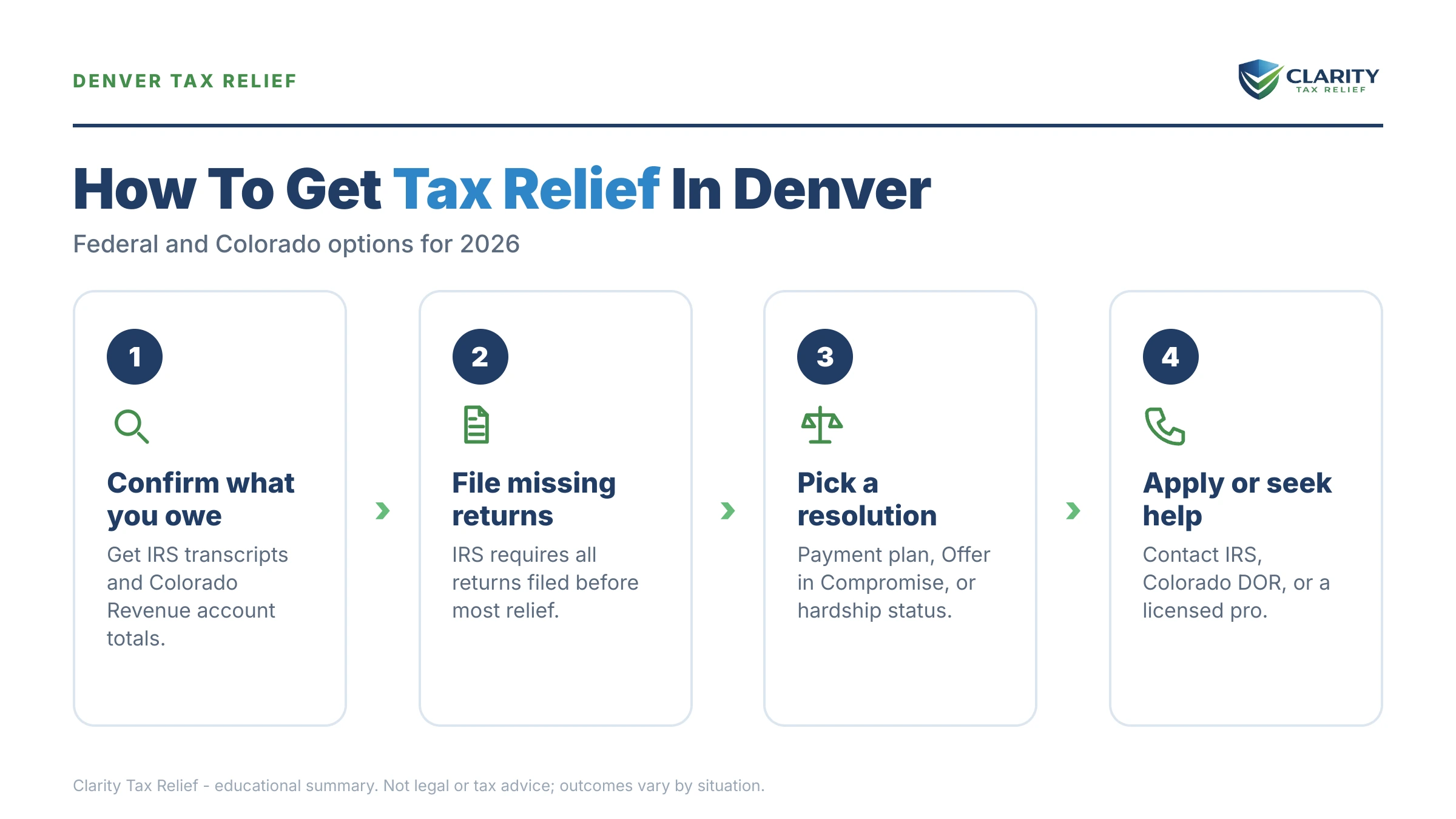
How to Get Tax Relief in Denver, Step by Step
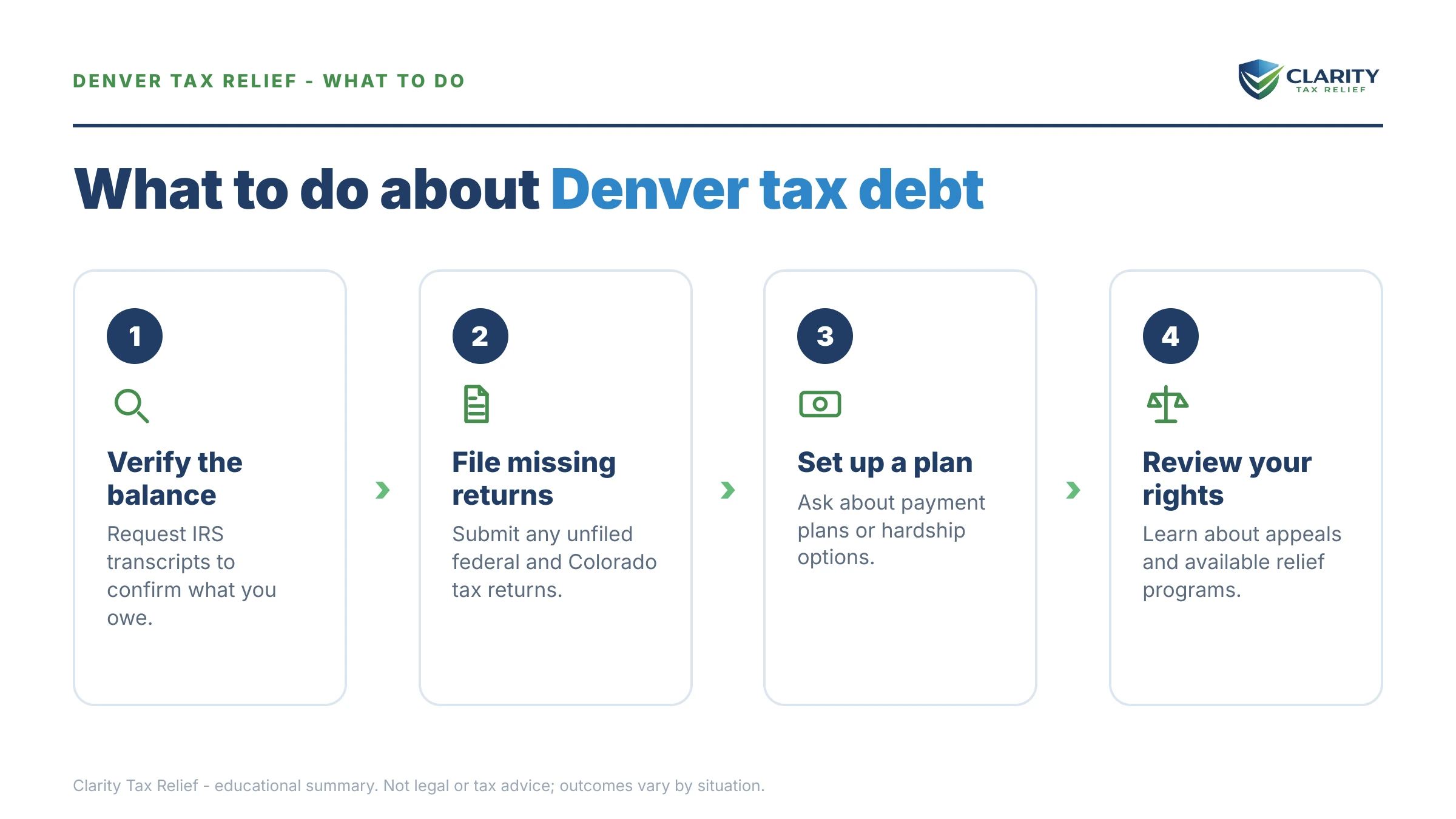
- Pull your IRS transcripts and Colorado account records. Log into your IRS online account to see every year with a balance, then check your Colorado account through the Department of Revenue's Revenue Online portal. You can't pick the right program until you know the full number on both sides.
- File any missing returns first. The IRS won't approve a payment plan, hardship status, or an Offer in Compromise while required returns are unfiled — and the failure-to-file penalty (5% per month) is ten times the failure-to-pay penalty (0.5% per month).
- Match your finances to a program. Under $10,000, a guaranteed installment agreement is close to automatic. Under $50,000, a streamlined plan runs up to 72 months online. If your income only covers basic living expenses, Currently Not Collectible or an Offer in Compromise may fit better than any payment plan.
- Request penalty relief before you pay penalties. If your prior three years were clean, First-Time Abatement can remove failure-to-pay or failure-to-file penalties — and starting summer 2026, the IRS's Automatic Exemption from Penalty applies some relief with no request at all. Ask before you pay, not after.
- Set up the Colorado side separately. A federal resolution does nothing for a Colorado Department of Revenue balance. Arrange a state payment plan through Revenue Online or by contacting the DOR directly — the two agencies never coordinate for you.
When You Can Handle This Yourself — and When Denver Help Pays Off
Many Denver tax debts don't need professional help at all. You can confidently handle it yourself if:
- You owe under $10,000, agree with the amount, and just need a guaranteed installment agreement — a 30-minute online task.
- You can pay in full within 180 days — a short-term plan costs $0 to set up.
- You got a first notice, checked it against your records, and it's simply correct.
Experienced help changes the outcome when the stakes or the math get harder:
- A levy is already in motion — Social Security offsets, a bank levy's 21-day hold, or a garnishment. Release requests have specific procedures and evidence standards, and errors cost real money in real time.
- You owe both the IRS and Colorado — sequencing matters, because every dollar committed to one agency changes what you can offer the other.
- Multiple years are unfiled — the order you file and resolve in changes penalties, and sometimes the total.
- You're weighing an Offer in Compromise — the IRS's Reasonable Collection Potential formula is unforgiving, and a rejected offer costs months while interest runs.
Choosing Tax Relief Help in Denver Without Getting Burned
The firms that dominate "tax relief Denver" search results and drive-time radio are mostly national marketing operations — and quality varies enormously. Any pitch promising to settle your debt for "pennies on the dollar" is the classic warning sign: that phrase describes an outcome the IRS grants only when strict financial math supports it, never something a firm can promise. Before signing anything, run the pitch through our buyer's checklist for choosing a tax relief company — and if you're comparing the big national brands, start with our Optima Tax Relief alternatives and Precision Tax Relief alternative breakdowns. Fee structures vary widely too; how much tax relief costs explains what's normal and what's a gouge.
Denver also has genuinely free options that the ads never mention. Low Income Taxpayer Clinics represent income-qualified taxpayers in IRS disputes for free or a nominal fee — see how Low Income Taxpayer Clinics work and how to find the nearest one. The Taxpayer Advocate Service, an independent office inside the IRS with a Colorado presence, takes cases where IRS action is causing financial hardship. For a retiree on a fixed income with a modest balance, these free routes deserve a look before any paid one.
Terms Denver Tax Relief Ads Use, Decoded
- Fresh Start: not a special program you enroll in — it's the IRS's umbrella branding for the ordinary payment plans, lien thresholds, and OIC rules described above.
- Offer in Compromise (OIC): a formal application (Form 656) to settle for less than you owe, granted only when the IRS's math shows it can't collect the full amount.
- Reasonable Collection Potential (RCP): the IRS's formula — your asset equity plus future monthly income above allowed expenses — that decides whether an offer gets accepted.
- Currently Not Collectible (CNC): a hardship status that pauses IRS collection when paying anything would leave you unable to cover basic living expenses.
- FPLP: the Federal Payment Levy Program, the automated system that takes up to 15% of federal payments — including Social Security — for unpaid tax debt.
- CSED: the Collection Statute Expiration Date — the IRS generally has 10 years from assessment to collect, though appeals, offers, and bankruptcy pause that clock.
Tax Relief in Denver: Your Questions, Answered
Do I need a Denver-based tax relief company, or can a national firm help?
IRS work is federal — representation happens by phone, mail, and the IRS's electronic systems, so a firm's zip code rarely changes the outcome. What matters is who actually works your case (an enrolled agent, CPA, or tax attorney) and whether the fee is flat and quoted in writing. If you also owe the Colorado Department of Revenue, ask specifically whether the firm handles state cases — some national firms only work federal debt.
How much does tax relief cost in Denver?
Professional fees for a straightforward payment-plan setup commonly run a few hundred to around a thousand dollars; full resolutions involving an Offer in Compromise or a levy release commonly run several thousand. The IRS's own fees are separate and small by comparison — $0 for a short-term plan and a $205 Offer in Compromise application fee that is waived entirely for low-income applicants. Be wary of any firm that quotes a price before reviewing your transcripts.
Can the IRS take my Social Security if I live in Colorado?
Yes — the IRS can take up to 15% of your monthly Social Security benefit through the Federal Payment Levy Program, and the rule is the same in every state. You get written warning first, typically a CP91 notice, before the levy starts. If losing 15% would leave you unable to cover basic living expenses, hardship status or a levy release can stop it — the IRS does not levy benefits it has agreed you can't spare.
Does Colorado have its own tax relief programs?
Yes, but they are separate from the IRS's and generally narrower. The Colorado Department of Revenue offers payment plans, most easily set up through its Revenue Online portal, and will consider hardship circumstances case by case. Colorado's programs have their own rules and timelines — never assume an IRS threshold or deadline applies to your state balance. When in doubt, confirm directly with the DOR at tax.colorado.gov.
Is there free tax help in Denver?
Yes. Low Income Taxpayer Clinics represent income-qualified taxpayers in IRS disputes for free or a small fee — Denver has clinic coverage, and the Taxpayer Advocate Service directory lists current locations. The Taxpayer Advocate Service itself, an independent arm of the IRS with a Colorado office, takes cases where IRS action is causing financial hardship. For filing help, VITA and TCE sites prepare returns free for qualifying taxpayers, including seniors.
What if I owe both the IRS and the Colorado Department of Revenue?
You have two separate debts requiring two separate resolutions — neither agency honors the other's payment plan, and paying one does not pause the other. As a rule, address whichever agency is furthest along in enforcement first: an active levy or garnishment beats a bill that's still just accruing interest. Then set up the second agency's plan so both balances are covered before either escalates.
Is there an IRS office in Denver I can walk into?
Yes — Denver has an IRS Taxpayer Assistance Center, but it is appointment-only; call 844-545-5640 to schedule. The office can take payments, verify your identity, and answer account questions. It cannot negotiate a settlement or approve an Offer in Compromise — those decisions run through IRS collection channels and written applications, not a walk-in counter.
Your Next 24 Hours
- Find your most recent notice — IRS or Colorado DOR — and locate two things: the total balance and the response date printed on it. That date is the only deadline that matters right now.
- Gather three documents: your last filed tax return, every notice you've received, and a summary of your monthly income (Social Security statement, pension stub, or 1099s). That's everything needed to match you to a program.
- Get a free case review. Penalties and interest accrue every month a balance sits — send us your notice through the 2-minute form or call (888) 825-7779, and an experienced tax professional will tell you which of these options actually fits your numbers.
Primary sources: the IRS's official payment plans and installment agreements page, the Taxpayer Advocate Service (including its Low Income Taxpayer Clinic directory), and the Colorado Department of Revenue, Taxation Division.
This guide is general information, not tax or legal advice for your specific situation. Eligibility for IRS programs depends on individual facts and circumstances; no outcome is guaranteed.