
City Guides
Tax Relief Colorado Springs: Your Real Options in 2026
The short answer: the tax relief Colorado Springs residents actually qualify for comes from a short list of real programs — IRS payment plans, the Offer in Compromise, Currently Not Collectible status, penalty abatement, and separate Colorado Department of Revenue agreements. Most people qualify for at least a payment plan; settling for less is means-tested, never automatic.
Maybe you've been running 1099 contract work off a Peterson or Fort Carson support contract, or building houses out in Banning Lewis Ranch, and the quarterly tax payments never quite happened. Now the IRS letters landing at your door name a number with a comma in it. That knot in your stomach is normal — and the problem is fixable. Which program fits depends on your numbers, not your fear. Here's the full 2026 map.
⏱ The real clock: there's no single deadline on "owing the IRS" — but the failure-to-pay penalty adds 0.5% of your balance every month, interest compounds daily on top of it, and each automated notice moves you one step closer to a levy. The cheapest month to fix this is this one.
Why tax debt hits Colorado Springs differently
Colorado Springs is a 1099 town wrapped around five military installations, and that combination produces a specific kind of tax debt. Fort Carson, Peterson, Schriever, Cheyenne Mountain, and the Air Force Academy feed a huge ecosystem of defense subcontractors, IT consultants, and trades workers paid on 1099s — with zero tax withheld from any of it.
When no one withholds, you owe income tax plus 15.3% self-employment tax on your net profit, due in quarterly installments. Miss a year or two of quarterlies and a five-figure balance appears fast — the pattern we break down in our guide to the self-employment tax shock.
Add the city's real-estate and short-term-rental boom, VA and military retirement income layered on second careers, and a state that files its own returns, and it's common for one household here to owe two agencies at once. Which brings us to the first thing to sort out.
You may owe two collectors: the IRS and the Colorado Department of Revenue
Federal and Colorado tax debts are completely separate accounts, collected by two different agencies on two different tracks. The IRS collects your federal income and self-employment tax. The Colorado Department of Revenue collects the state's flat income tax — and it runs its own payment agreements, its own notices, and its own enforcement, none of which follow IRS rules or thresholds.
Resolving one does not resolve the other. An IRS installment agreement won't stop a DOR collection letter, and a DOR plan won't stop an IRS levy. If you owe Denver's federal machinery and the state, our Colorado back taxes payment plan guide covers the state side in full — this page focuses on the federal programs, where the bigger dollars usually sit.
One more overlap worth knowing: once your IRS account escalates far enough, the IRS can seize your Colorado state refund through the State Income Tax Levy Program. If you owe either agency, stop counting on refunds from both.
What happens if you ignore IRS debt: the escalation sequence
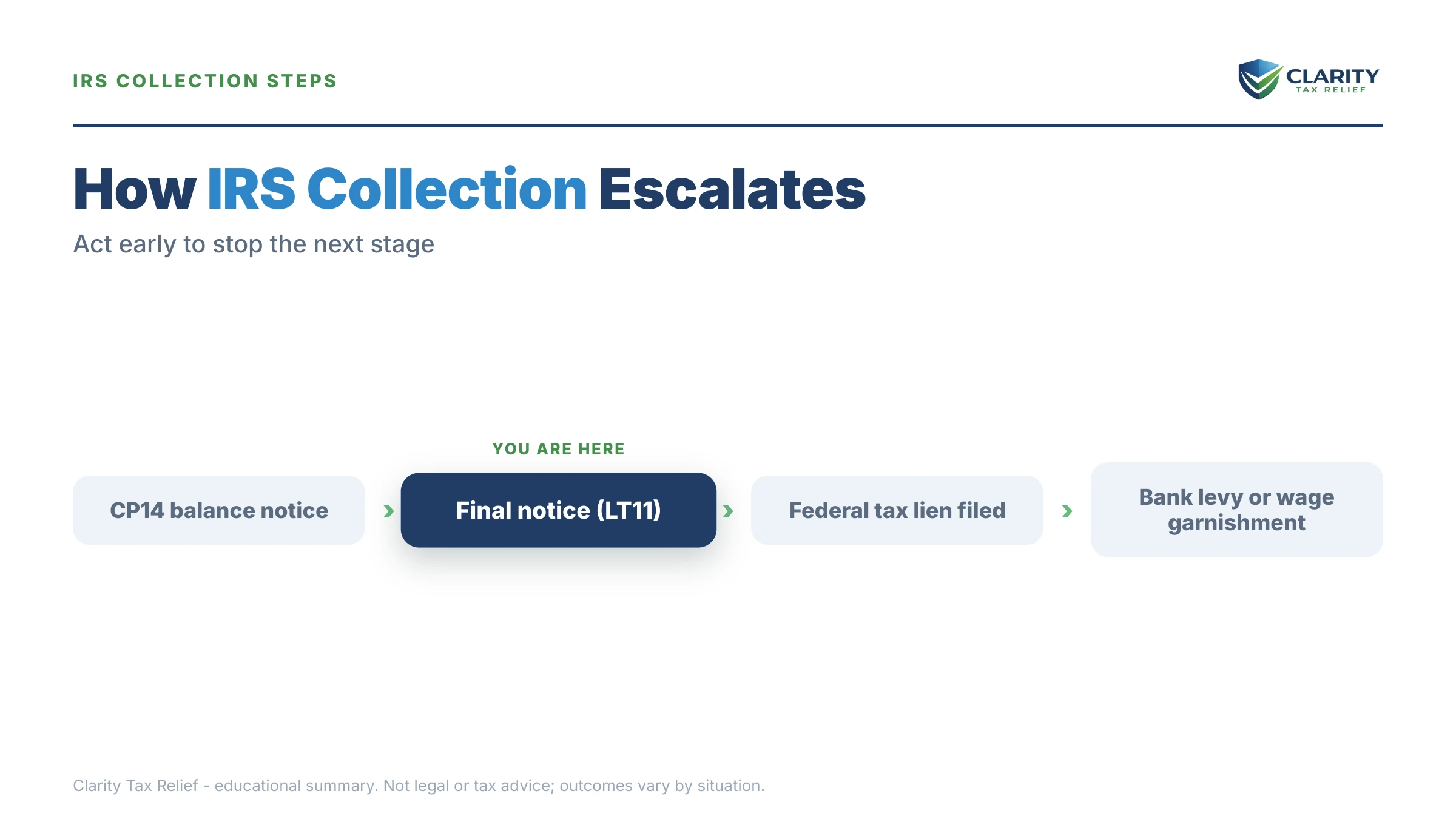
The IRS sends a predictable series of notices before it can take money — and the final one, the LT11, starts a 30-day clock. The sequence is fully automated. IRS staffing fell roughly 27% in 2025, so humans are harder to reach than ever, but the notice-and-levy machinery never stopped running. Ignoring the mail doesn't pause anything; it just spends your options.
- CP14 — the first bill. Typically about 21 days before the next notice queues up. No enforcement yet; the cheapest moment to act.
- CP501 / CP503 — automated reminders, usually weeks apart. Still just bills, but the balance grows every month they sit.
- CP504 — Notice of Intent to Levy under IRC §6331(d). The IRS can now take your Colorado state refund, and a federal tax lien becomes a real possibility. Despite the scary name, this is not yet the final notice.
- LT11 / Letter 1058 — the Final Notice of Intent to Levy. You have 30 days to request a Collection Due Process hearing on Form 12153. After that window, the IRS can levy bank accounts and income.
- Active enforcement — a bank levy freezes funds for a 21-day hold before they're sent to the Treasury; a wage levy is continuous until released; Social Security can lose up to 15% through the Federal Payment Levy Program; and contractor pay can be levied straight from your clients, as we explain in can the IRS garnish 1099 income.
| Notice | What it means | Your window / right |
|---|---|---|
| CP14 | First bill for the balance due | Typically 21 days before escalation begins |
| CP501 / CP503 | Automated reminders | Weeks apart; penalties and interest keep compounding |
| CP504 | Intent to levy your state tax refund (IRC §6331(d)) | Colorado refund at risk; lien filing possible; not the final notice |
| LT11 / Letter 1058 | Final Notice of Intent to Levy | 30 days to request a CDP hearing (Form 12153) — a right you lose if it passes |
| After LT11 | Levy authority: bank accounts (21-day hold), wages (continuous), 1099 receivables | Options narrow sharply; act before this line |
Owe the IRS in Colorado Springs and not sure which notice you're on?
Every month you wait adds another 0.5% penalty plus daily interest to the balance. Send us your most recent letter — an experienced tax professional will map exactly where you sit in the sequence and which program fits your numbers. Free, confidential, no pressure.
Your tax relief options in Colorado Springs for 2026
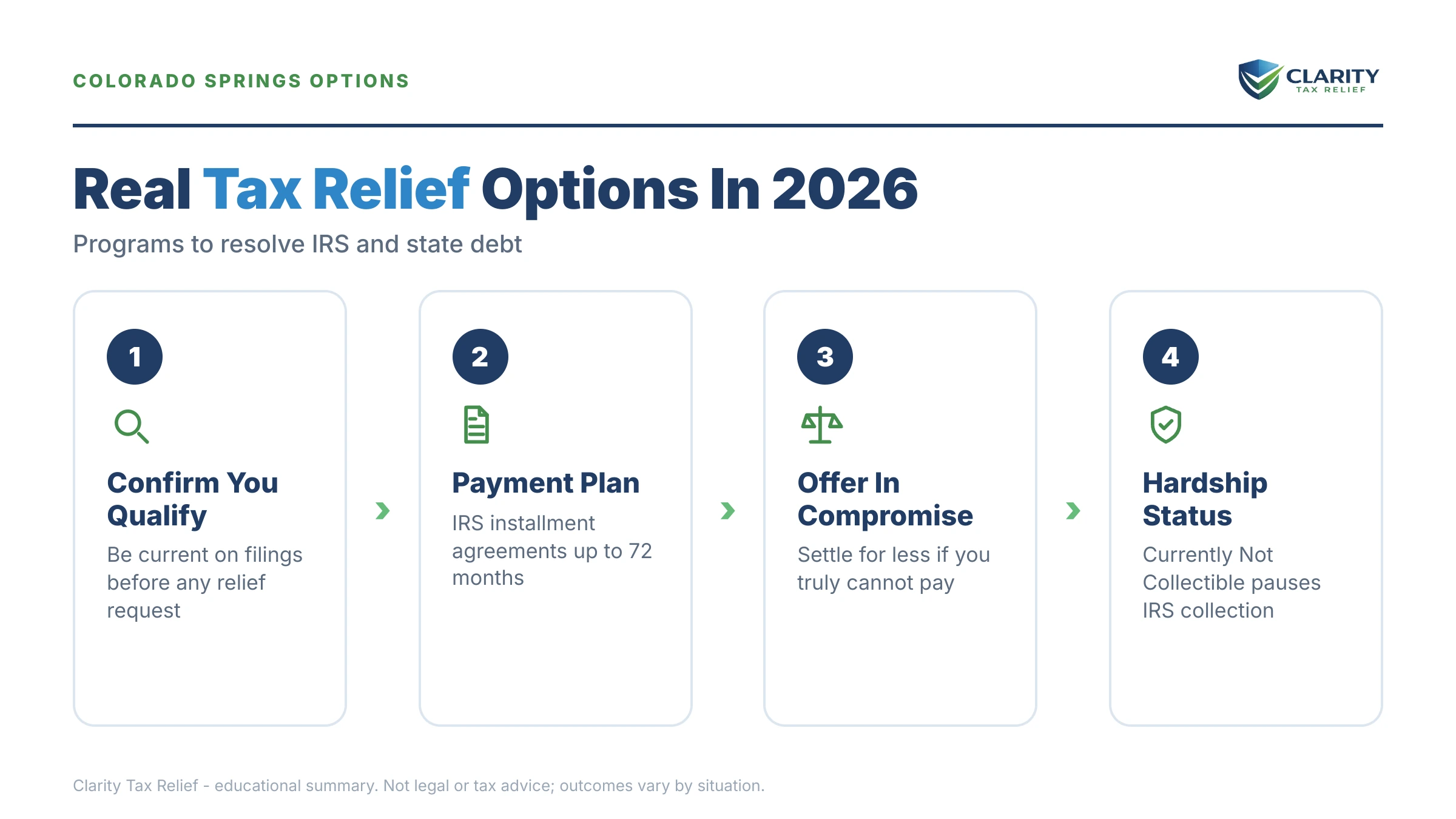
The IRS runs a handful of resolution programs in 2026, and eligibility for each turns on specific dollar thresholds — not on how convincing your story sounds. Here's the full menu:
| Option | Who it fits (2026 rules) | What it costs |
|---|---|---|
| Short-term payment plan | You can pay in full within 180 days | $0 setup; interest and penalties continue until paid |
| Guaranteed installment agreement | You owe $10,000 or less in tax and are current on filings | Online setup fee; acceptance is required by law if you meet the conditions |
| Streamlined installment agreement | You owe $50,000 or less; up to 72 months; no financial statement | Online setup fee (lower with direct debit); interest accrues |
| Non-streamlined agreement | You owe more than $50,000; Form 433-F financials required | Setup fee plus the documentation work |
| Offer in Compromise | Your assets plus future income (RCP) fall below the balance | $205 fee + 20% down on lump-sum offers — both waived with low-income certification |
| Currently Not Collectible | Allowable living expenses meet or exceed your income | $0; the debt remains, interest accrues, refunds are offset |
| Penalty abatement (FTA / AEP) | Clean penalty history for the prior 3 years, or reasonable cause | $0 to request; AEP becomes automatic starting summer 2026 |
Payment plans: the workhorse option
A streamlined installment agreement covers balances of $50,000 or less over up to 72 months, set up online with no financial disclosure. Under $10,000, a guaranteed installment agreement means the IRS must say yes if you're current on filings. Above $50,000, you'll submit Form 433-F financials, and the payment is negotiated from your income minus IRS allowable expenses. Interest and the monthly penalty keep accruing on every plan — a plan stops enforcement, not the meter.
Offer in Compromise: real, but math-gated
The IRS accepted roughly 1 in 5 Offers in Compromise in FY2024 — real relief, nowhere near a sure thing. Acceptance rests on one number: your Reasonable Collection Potential, the IRS's calculation of your asset equity plus what it could squeeze from your future income before the collection statute expires. Offer at or above your RCP and you have a case; offer below it and you'll be rejected regardless of hardship stories. You can estimate your own numbers with our Offer in Compromise Calculator, and the full mechanics live in how an offer in compromise actually works. Low-income certification (AGI at or below 250% of the poverty line) waives the $205 fee, the 20% down payment, and payments during review.
Currently Not Collectible: the pause button
If paying anything would leave you unable to cover basic living expenses under IRS standards, Currently Not Collectible status pauses levies and garnishments while your situation improves. The debt doesn't vanish — interest accrues and refunds get offset — but the 10-year collection statute keeps running while you're in it.
Penalty abatement: often the fastest dollar savings
If your compliance history was clean for the three years before the penalty year, first-time penalty abatement can wipe failure-to-file and failure-to-pay penalties on request. Starting summer 2026, the new Automatic Exemption from Penalty (AEP) begins applying this relief automatically — no request needed — so before you pay a penalty, check whether it should simply come off.
A worked example: a Colorado Springs contractor who owes $61,200
Say you're a self-employed electrician running base subcontracts and you owe the IRS $61,200 across two tax years of missed quarterlies. Here's how the options actually play out — all numbers hypothetical:
- The threshold problem: $61,200 is above the $50,000 streamlined ceiling, so the easy online 72-month plan isn't available at this balance.
- Path 1 — pay down, then streamline: pay $11,200 to bring the balance to $50,000, then set up a streamlined plan online. $50,000 ÷ 72 months ≈ $695/month as a floor — real payments run higher because interest and the 0.5% monthly penalty keep accruing during the plan.
- Path 2 — non-streamlined agreement: submit Form 433-F on the full $61,200. Your payment is set by income minus allowable expenses, which can come out lower than $695 if your legitimate costs are high — but the IRS now sees your full financial picture.
- Path 3 — Offer in Compromise: suppose the quick-sale value of your truck and tools is $9,000 and, after allowable expenses, $250/month of income remains. On a lump-sum offer, that's roughly $9,000 + ($250 × 12) = $12,000 of Reasonable Collection Potential. If those financials verify, an offer around $12,000 is at least viable — with the $205 fee and a $2,400 (20%) down payment due up front unless you qualify for the low-income waiver. Viable is not accepted: the IRS took about 1 in 5 offers in FY2024.
- The passport trap at this balance: at 0.5% per month, the penalty alone adds about $306/month, plus daily interest on top. A $61,200 balance left alone can cross the $66,000 passport-certification threshold in under a year — triggering a CP508C and putting your passport at risk, as we cover in passport revoked for tax debt. For a contractor, a defense-sector clearance holder, or anyone who travels, that's a reason to move before the math does.
How to start resolving your tax debt in Colorado Springs, step by step
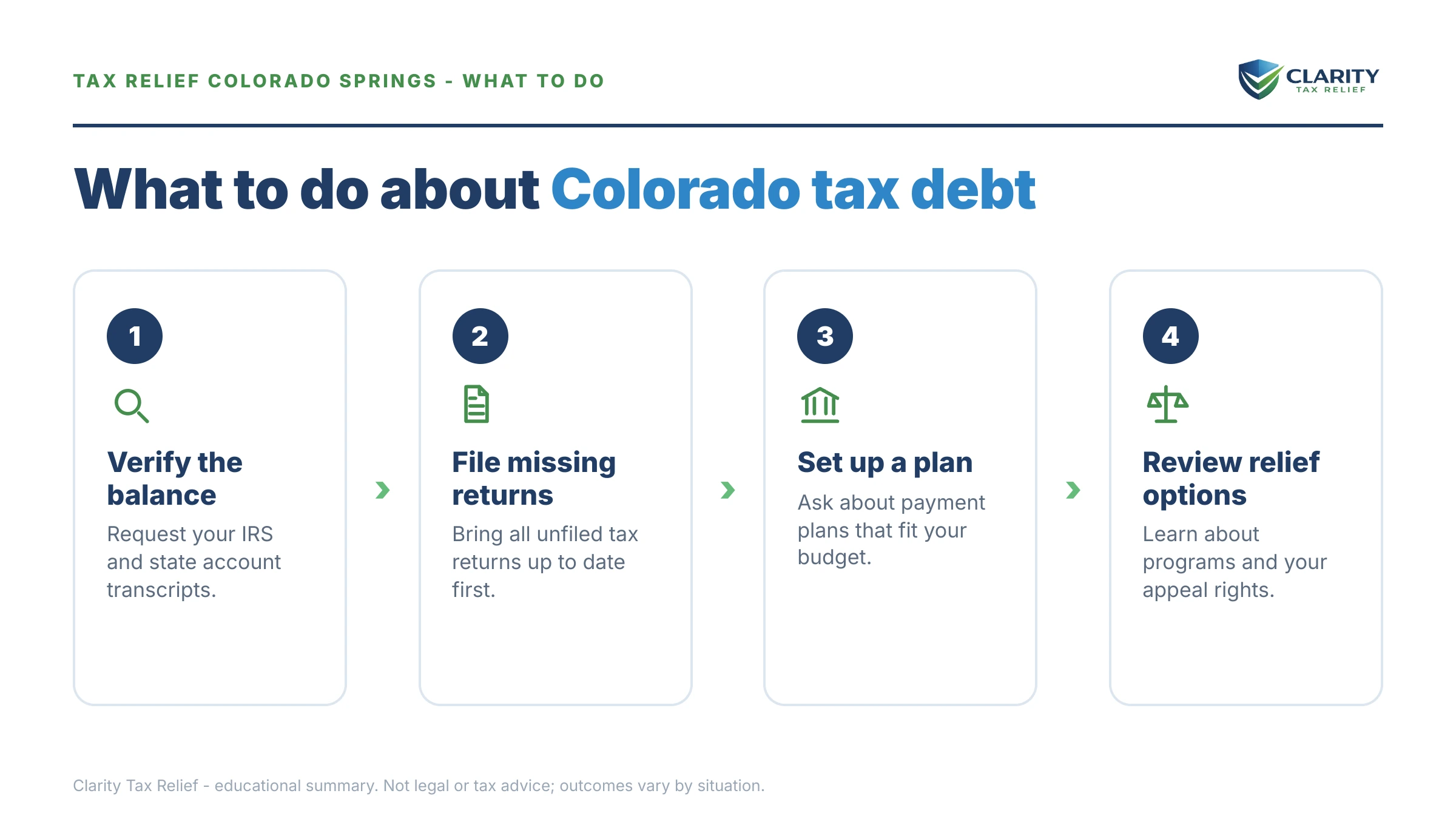
- Pull your IRS transcripts. Set up an IRS online account and confirm every year with a balance or a missing return — the notice in your hand rarely shows the whole picture.
- File anything unfiled. The failure-to-file penalty runs 5% per month — ten times the failure-to-pay rate — so filing stops the most expensive bleeding even if you can't pay a dollar yet.
- Check your Colorado account. Log in to Revenue Online at tax.colorado.gov to see whether the state shows a separate balance; the DOR collects on its own track.
- Match your numbers to a program. Use the eligibility table above: $50,000 or less usually means a streamlined plan, genuine hardship points to Currently Not Collectible, and a balance your assets and income can't cover may support an Offer in Compromise.
- Set it up before enforcement starts. An agreement in place stops the notice sequence. Apply at the IRS payment plans page, or get a free professional review first if the balance tops $50,000 or the math is close.
Military, veterans, and the base-contractor economy
Combat-zone service pauses IRS collection and extends filing and payment deadlines — generally for the deployment plus at least 180 days after you leave the zone. If you or your spouse deployed while a balance was building, that timeline matters and is often applied wrong; our guide to combat zone IRS collection relief walks through it.
Stateside status doesn't pause anything, and two Springs-specific groups get hit hardest. Military retirees stacking a pension, VA benefits, and a second career often under-withhold across the combined income — and once collection escalates, up to 15% of Social Security can be levied through the Federal Payment Levy Program. And 1099 defense subcontractors face a levy risk W-2 workers don't: the IRS can send levies directly to your prime contractor or clients, which announces your tax problem to the people who decide whether you get the next task order.
When you can handle this yourself — and when help changes the outcome
Plenty of Colorado Springs tax problems don't need professional help. Handle it yourself if you owe $10,000 or less (the guaranteed agreement is yours by law), you can pay in full within 180 days (the short-term plan is free to set up), or you agree with a single first notice and just need a simple online plan under $50,000. Those take an evening, not a retainer.
Experienced help genuinely changes outcomes when the balance exceeds $50,000 and financial disclosure becomes a negotiation, when a levy is already in motion or an LT11's 30-day window is running, when multiple years are unfiled, when you owe the IRS and the Colorado DOR at the same time, or when you're weighing an Offer in Compromise — where how your finances are presented determines whether the RCP math works at all. If money is tight, the Taxpayer Advocate Service is a free, independent resource for cases stuck inside the IRS.
How to choose tax relief help in Colorado Springs
Most of the ads you'll see for "Colorado Springs tax relief" are national call centers buying local keywords — the sales rep answering has never seen your transcripts and often isn't a tax professional at all. Any pitch promising to settle for "pennies on the dollar" before anyone has analyzed your finances is a sales script, not advice; that phrase is the signature of the mills the FTC has been shutting down.
A legitimate firm reviews your IRS transcripts before quoting a resolution, names the credentialed person who will handle your case, and prices in stages rather than demanding thousands up front. Our how to choose a tax relief company checklist and rundown of tax relief scams cover exactly what to ask and what to walk away from.
Terms you'll hear, decoded
- Lien vs. levy: a lien is a legal claim against what you own; a levy is the actual taking — from a bank account, a paycheck, or a client payment.
- CSED: the Collection Statute Expiration Date — the IRS generally has 10 years from assessment to collect, though offers, appeals, and bankruptcy pause the clock.
- RCP: Reasonable Collection Potential — the IRS's math for the most it could ever collect from you; an Offer in Compromise succeeds only when your offer meets or beats it.
- CNC: Currently Not Collectible — hardship status that pauses active collection while the debt, and its interest, remain.
- Streamlined agreement: a payment plan of up to 72 months for balances of $50,000 or less, set up without submitting a financial statement.
Tax relief questions Colorado Springs residents ask
Is there an IRS office in Colorado Springs?
Yes — Colorado Springs has an IRS Taxpayer Assistance Center, and all visits are by appointment only (call 844-545-5640 to schedule). Keep expectations realistic: TAC staff can take payments and answer account questions, but they don't negotiate resolutions on complex balances. Most collection cases are resolved by phone, mail, or online — and with IRS staffing down roughly 27% since 2025, appointments can take weeks to get.
Can the IRS garnish my pay if I'm a 1099 contractor?
Yes, but differently than a W-2 wage garnishment. A wage levy is continuous — it keeps taking pay every check until it's released. A levy on 1099 income attaches to what a client owes you on the day the levy arrives, so the IRS generally has to send a new levy to each client, each time. That's disruptive in its own way: your clients learn about your tax debt, which for many contractors is worse than losing the money.
Does Colorado have its own tax relief programs?
Yes. The Colorado Department of Revenue runs its own payment agreements and its own collection process, and none of the IRS's thresholds or timelines apply to it. If you owe both agencies, the debts must be resolved separately — an IRS installment agreement does nothing to stop state collection. Check your state balance through Revenue Online or contact the DOR directly before assuming the state will wait.
How much does tax relief cost in Colorado Springs?
It depends on what your case needs, not where you live. A simple payment plan you set up yourself costs only the IRS's setup fee, while professional representation on a levy, an Offer in Compromise, or multiple unfiled years typically runs from several hundred to several thousand dollars. Be wary of any firm quoting a large flat fee before anyone has reviewed your IRS transcripts — the diagnosis has to come before the price.
I'm stationed at Fort Carson — does military status change IRS collection?
It can. Service in a designated combat zone generally suspends IRS collection actions and extends filing and payment deadlines for the deployment plus at least 180 days after you leave the zone. Stateside duty at Fort Carson, Peterson, or Schriever doesn't pause collection by itself, but servicemember-specific rules can change your deadlines and penalty exposure — flag your status at the start of any resolution, not the end.
Will the IRS take my Colorado state tax refund?
It can, and often does. Once your account reaches the CP504 stage, the IRS can levy your state refund through the State Income Tax Levy Program — no court order needed. Colorado also offsets state refunds against state tax debts. If you're counting on a refund from either agency while you owe the other, assume it will be intercepted and plan your budget around losing it.
Can the IRS really settle tax debt for less than I owe?
Yes — the Offer in Compromise program is real, but it's means-tested math, not a discount for asking. The IRS accepted roughly 1 in 5 offers in FY2024, and acceptance turns on whether your assets and future income genuinely can't cover the balance before the collection statute runs out. Anyone who promises you a settlement before analyzing your finances is selling, not advising.
Your next 24 hours
- Find your most recent IRS notice and note the notice number (top right corner) and its date — that tells you exactly where you sit in the escalation table above, and how much room you have.
- Gather three things: your last filed return, your 1099s or income records for any unfiled years, and a rough monthly income-and-expense picture. That's everything needed to match you to a program.
- Get a free case review — the 2-minute form at claritytaxrelief.com/#consult or (888) 825-7779. Whether it's a $61,200 contractor balance or a first notice you don't understand, the penalty and interest meters are running monthly; the review tells you what to do before they compound further.
This guide is general information, not tax or legal advice for your specific situation. Eligibility for IRS programs depends on individual facts and circumstances; no outcome is guaranteed.