
State Tax Debt
NYS Tax Payment Plan: Setting Up a New York State Installment Payment Agreement in 2026
The short answer: a NYS tax payment plan — officially an Installment Payment Agreement (IPA) — lets you pay New York State back taxes monthly through the Department of Taxation and Finance. Owe $20,000 or less and able to pay within 36 months? You can request it online. Larger balances require a phone request and usually a financial review.
Payroll clears Friday, the sales tax return is due on the 20th, and now Albany says you owe $68,500 you don't have in the account. That sinking feeling is real — but so is this: New York runs a formal monthly payment program, and a business that keeps operating and keeps filing has genuine leverage to use it. This guide walks through exactly how the IPA works, where the $20,000 line changes everything, and what to do when your balance sits well above it.
⏱ The real clock: there's no single statutory response window for requesting an IPA — but interest and penalties accrue every month on the unpaid balance, and once your debt becomes "fixed and final," DTF can file a tax warrant — a public civil judgment — without ever going to court. Respond by the date printed on your bill; every month of delay costs money and options.
How a NYS tax payment plan works in 2026
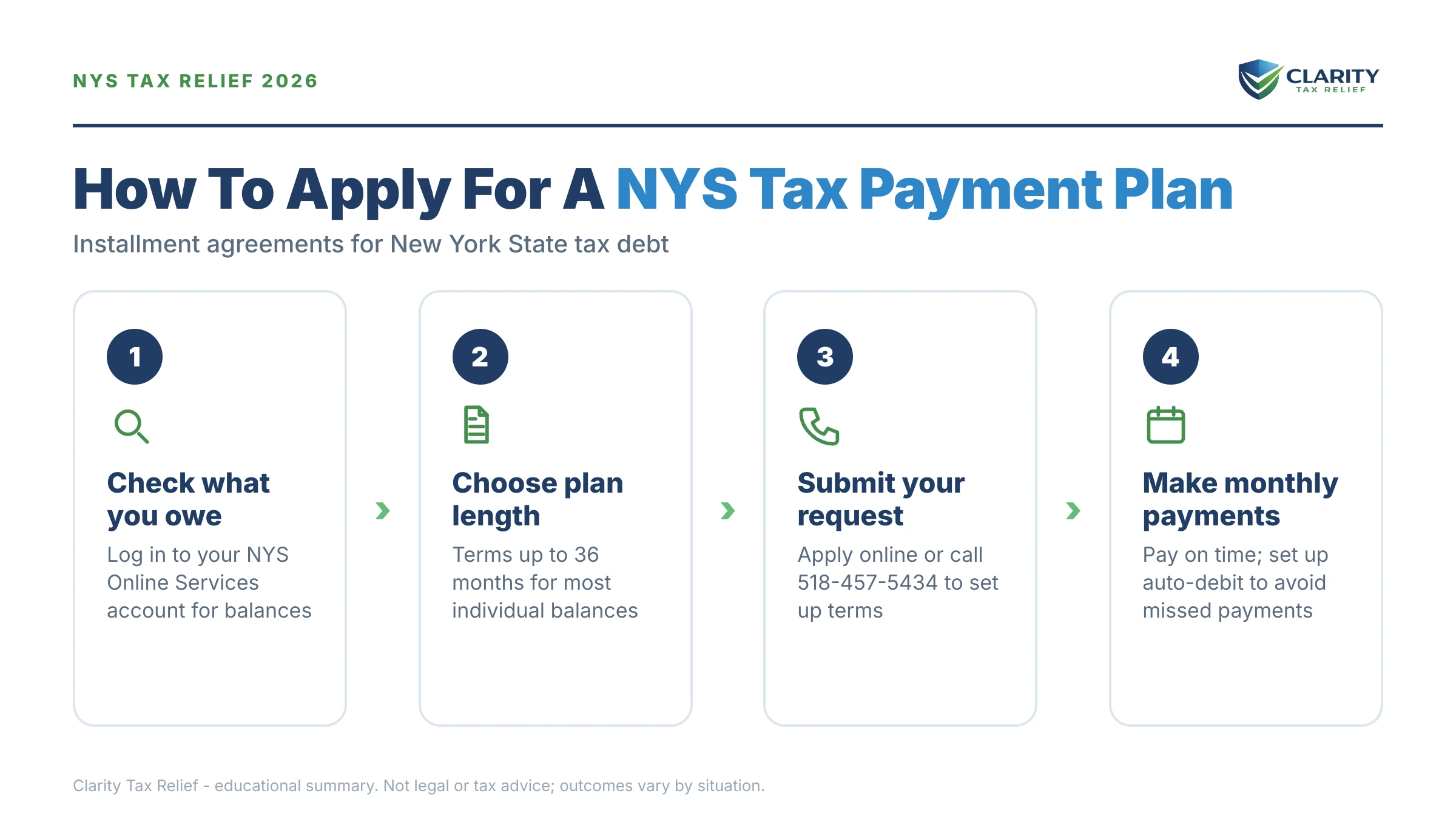
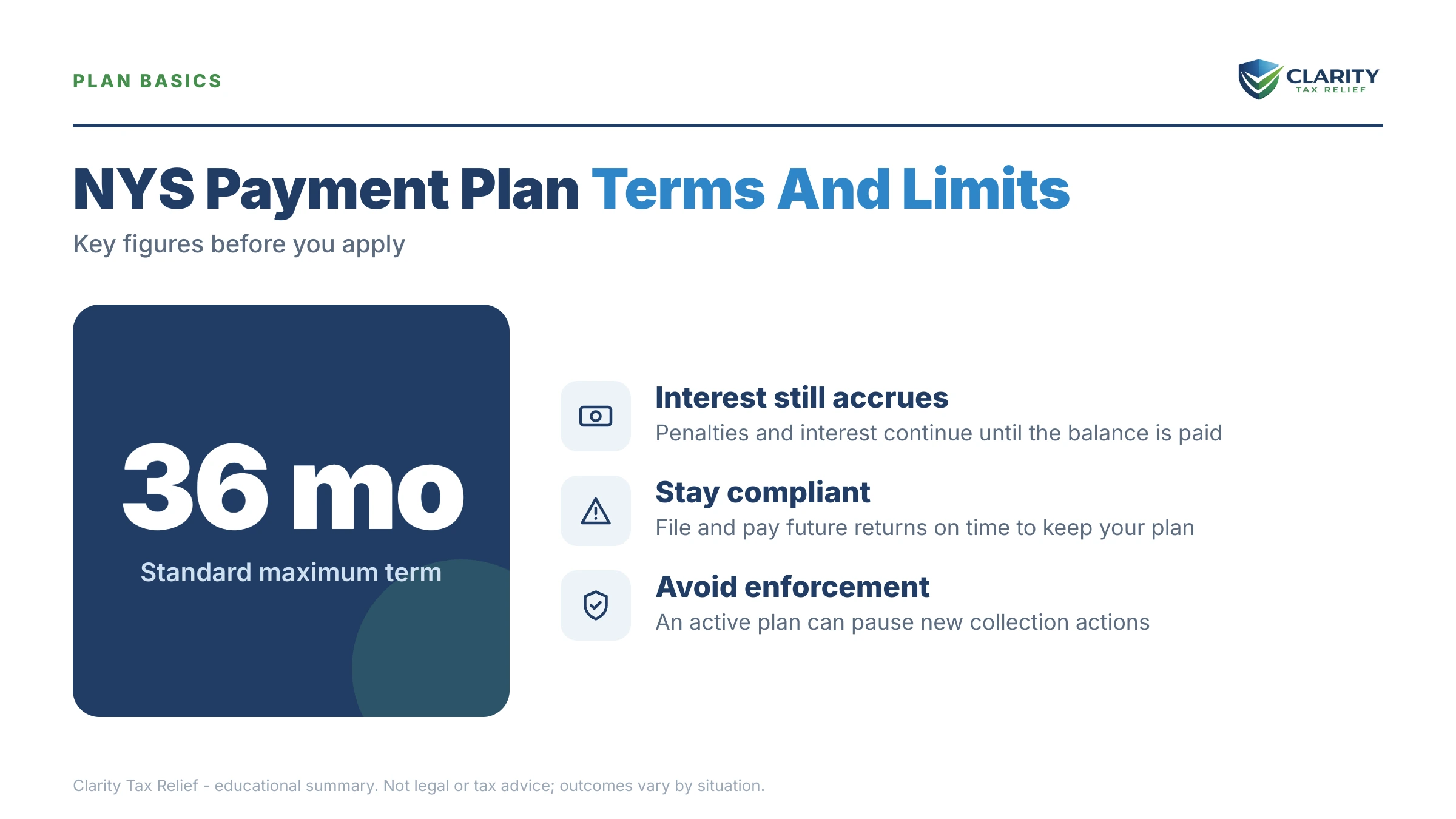
New York State's payment plan is called an Installment Payment Agreement, and you can request one online if you owe $20,000 or less and can pay within 36 months. Both conditions must be true. Miss either one — a bigger balance or a longer runway — and the request moves to a phone call with the Tax Department, where a human decides based on your finances.
The agency behind all of this is the New York State Department of Taxation and Finance (DTF), not the IRS. If you're used to the federal system — the one covered in our guide to setting up an IRS payment plan online — reset your assumptions. Different agency, different thresholds, different enforcement tools, and a much longer memory.
Three things are true of every IPA, at any balance:
- You must be current on filings. DTF won't approve a plan while any New York return is outstanding.
- Interest keeps running. An IPA stops enforcement, not accrual. New York sets its interest rates quarterly, and the meter runs for the life of the agreement.
- New debt breaks the deal. An IPA defaults if you fail to file or pay any tax that comes due while it's active — which, for a business owner, means every withholding deposit and every sales tax return going forward.
For a broader look at everything New York can do to collect — and every program it offers — see our full guide to New York State back taxes help. This page stays focused on the payment plan itself.
What happens if you ignore a New York State tax bill
An unresolved New York tax bill ends in a tax warrant — a public civil judgment DTF can file without ever going to court. New York doesn't need to sue you. The sequence is administrative, and it runs in this order:
- Bill or Notice of Assessment. DTF states what it says you owe for each period. Interest is already accruing. This is the cheapest moment to act.
- Collection and demand notices. The account moves toward the Civil Enforcement Division. You still have full access to an IPA — but the window to resolve things quietly is narrowing.
- Tax warrant filed. Once the debt is fixed and final, DTF files a warrant with the county clerk and the Department of State. It functions as a civil judgment and a lien against everything you own in New York, it's a public record lenders and customers can find, and it stays collectible for up to 20 years. Our guide to New York tax warrants covers what one does to financing, property sales, and business contracts.
- Active enforcement. With a warrant in place, DTF can issue an income execution (typically 10% of gross wages), levy bank accounts, and seize business assets. Separately, if your fixed and final debt reaches $10,000 or more, New York can suspend your driver's license — see our guide to NYS driver's-license suspension for tax debt.
Here's what each collection action means if it has already started — and the move that answers it:
| Collection action | What it means | What to do |
|---|---|---|
| Bill / Notice of Assessment | DTF's statement of what you owe; interest is accruing but no enforcement yet | Verify the numbers, then pay or request an IPA by the date on the bill |
| Tax warrant | Public civil judgment + lien on your NY property; collectible up to 20 years | Get into an IPA or other resolution; ask about warrant satisfaction terms at payoff |
| Income execution | Ongoing wage collection, typically 10% of gross wages, until the debt is resolved | An approved IPA generally replaces it — call DTF before the next pay cycle |
| Bank levy | Funds in the account frozen and taken toward the warranted debt | Move fast — an agreement or documented hardship is the path to release |
| Driver's license suspension notice | Triggered at $10,000+ in fixed and final debt (commercial licenses exempt) | Entering an IPA is a listed way to resolve or prevent the suspension |
| Refund offset | Your NY refund — and potentially your federal refund via the offset program — applied to the debt | Adjust withholding so you stop lending the state money; keep the IPA current |
Owe New York State more than you can pay this month?
Get your DTF balance reviewed free before a tax warrant becomes a public judgment against you. An experienced tax professional will map your IPA options — including what changes above $20,000 — in one call.
Your options when you can't pay New York in full
New York offers at least five ways to resolve a balance you can't pay at once — the payment plan is only the most common. Which one fits depends on your balance, your finances, and whether the debt includes trust taxes:
| Option | Who it fits | Cost & key terms |
|---|---|---|
| Pay in full | You can free the cash within weeks | Stops accrual and the collection sequence; no agreement needed |
| Online IPA | Balance ≤ $20,000, payable ≤ 36 months, all returns filed | Requested through Online Services at tax.ny.gov; interest continues during the plan |
| Phone IPA with financial review | Balance over $20,000, or you need more than 36 months | DTF reviews income and expenses (often on Form DTF-5); a warrant may still be filed to secure the debt |
| NYS Offer in Compromise | Insolvent, discharged in bankruptcy, or full payment would create undue economic hardship | Full financial disclosure on Form DTF-5; DTF verifies the math — this is not a negotiation gimmick |
| Hardship hold on collection | Any payment would prevent basic living expenses | Temporary and documented, not a formal named program like the IRS's CNC status; interest continues |
| Penalty relief for reasonable cause | Circumstances genuinely beyond your control caused the lapse | Reduces penalties, not tax or interest — worth requesting before you size the monthly payment |
One strategic note: request penalty relief before finalizing the IPA when you have a real reasonable-cause story. A smaller balance means a smaller monthly payment — sequencing matters more than most people realize.
What a $68,500 balance looks like on a New York installment agreement
Say you owe $68,500 — a hypothetical S-corp owner with six employees, hit with two years of New York personal income tax assessments after strong revenue years with thin estimated payments. Here's the math:
- 36 months: $68,500 ÷ 36 ≈ $1,903 a month, before the interest that keeps accruing on the declining balance.
- 60 months: $68,500 ÷ 60 ≈ $1,142 a month — easier on cash flow, but two extra years of interest and a term DTF only grants after reviewing your finances.
Because $68,500 is well over the $20,000 online ceiling, this plan can't be set up in Online Services. It's a phone negotiation, and DTF will ask about business receipts, personal income, and expenses — possibly on Form DTF-5. Expect the agency to push for the shortest term your numbers support, and expect it to reserve the right to file a warrant while you pay.
The trap for a business owner isn't the $1,903 — it's the next obligation. Every new withholding deposit and every new estimated payment has to land on time, or the agreement defaults and the whole $60,000-plus remainder goes back into active collection. Size the payment so the business can carry both the plan and its current taxes, even in a slow month.
NYS installment agreement vs. IRS payment plan: don't confuse the two
A NYS tax payment plan and an IRS payment plan are separate agreements with separate agencies — one does nothing for the other. Plenty of taxpayers set up a federal plan, exhale, and get blindsided by a New York warrant six months later. The systems also differ on nearly every number that matters:
| Feature | New York State (DTF) | IRS |
|---|---|---|
| Online setup limit | $20,000 balance, terms up to 36 months | Up to $50,000, terms up to 72 months |
| Collection window | Up to 20 years on a warranted debt | 10 years from assessment (the CSED) |
| Lien tool | Tax warrant — a public civil judgment, no court needed | Notice of Federal Tax Lien |
| License / travel consequence | Driver's license suspension at $10,000+ fixed and final | Passport certification at $66,000+ (2026 threshold) |
| Where to apply | Online Services at tax.ny.gov, or by phone above the limit | IRS Online Payment Agreement |
If you owe both, you generally need both plans — and the order you tackle them in can change your total cost. New York tends to warrant faster and hits licenses at a much lower threshold, which is why many practitioners stabilize the state side first; our guide to state tax debt vs IRS works through the decision. On the federal side, note that the irs payment plan changes 2026 shifted some thresholds — don't assume last year's federal numbers, and never assume any federal number applies to New York. Current IRS terms live at the IRS payment plans page.
Payroll and sales tax debt: why business balances get stricter treatment
New York treats sales tax and payroll withholding as trust taxes, and it can collect them from you personally even if the business closes. That money was never the business's — it was collected from customers and employees on the state's behalf — so New York law reaches through the entity to "responsible persons": owners, officers, and anyone with real control over the finances.
Practically, that changes the IPA conversation three ways. DTF wants trust-tax balances retired faster than income-tax balances. It watches your ongoing filings more closely, because a business that fell behind once is a business it expects to fall behind again. And it's quicker to file a warrant to secure its position while you pay.
Before you call, get the current quarter perfect: this period's withholding deposits made, this period's sales tax return filed. Walking into the negotiation current is the single strongest signal you can send. And if the same business is also behind on federal payroll taxes, that's a parallel fire with its own rules — see our guides to a business irs installment agreement and 941 back taxes, because the IRS's trust-fund penalty machinery runs on its own clock regardless of what you work out with Albany.
How to set up a NYS tax payment plan, step by step
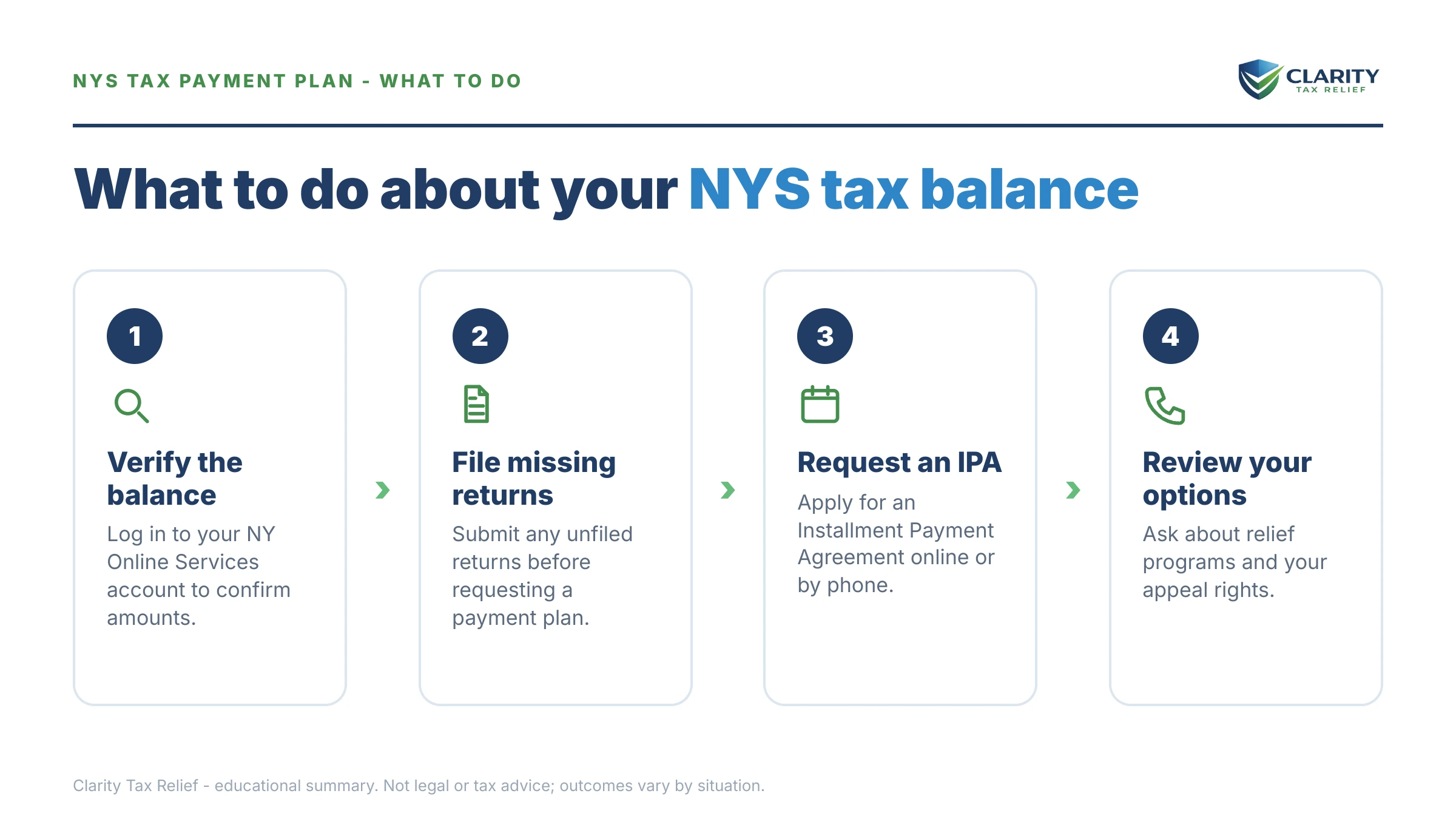
- File every missing New York return first. DTF will not approve an installment payment agreement while returns are outstanding, and unfiled periods let it estimate inflated balances against you.
- Confirm your exact balance in Online Services. Create or log into your account at tax.ny.gov and pull the current total for every assessment — the bill in your hand is already behind, because interest keeps accruing.
- Request the IPA through the right channel. Owe $20,000 or less, payable within 36 months? Request it online. Owe more, or need longer? Call the Tax Department at the number printed on your bill and be ready to talk numbers.
- Set a payment your cash flow can survive. Budget for the interest that keeps accruing and for every new quarterly obligation before you commit — an aggressive payment you default on is worse than a modest one you keep.
- Calendar every payment and every new filing. One missed installment or one late new return can default the entire agreement and put the full balance back into active collection.
When you can handle this yourself — and when help changes the outcome
Plenty of New York payment plans need no professional at all. If your balance is under $20,000, every return is filed, and the 36-month math fits your budget, the online request takes minutes — set it up today and skip the consultation.
Experienced help earns its cost in a different set of situations:
- A warrant is filed or an income execution is running. The order of moves — release, agreement, warrant handling — determines how fast the bleeding stops.
- Trust taxes with responsible-person exposure. What you say in the financial review can shape who New York pursues personally. Answers here should be planned, not improvised.
- Balances over $20,000 requiring disclosure. The same DTF-5 that supports your payment request also hands DTF a map of your bank accounts and assets. You want it accurate — and framed correctly.
- You owe the IRS and New York at once. Two agreements have to fit inside one budget, and sequencing them wrong means defaulting one to feed the other.
- Multiple unfiled years. The returns have to go in first, and how they're prepared sets the balance you'll be paying on for years.
Terms on your New York tax bill, decoded
- Installment Payment Agreement (IPA): New York's official name for a monthly tax payment plan with the Department of Taxation and Finance.
- Tax warrant: a public civil judgment DTF files with the county clerk and Department of State — it creates a lien on your property without any court case.
- Income execution: New York's version of a wage garnishment, typically taking 10% of gross wages until the debt is resolved.
- Fixed and final: a debt you can no longer protest or appeal — the trigger point for warrants and license suspension.
- Form DTF-5: the Statement of Financial Condition — New York's full financial disclosure form, used for larger IPAs, hardship claims, and offers in compromise.
- Civil Enforcement Division: the DTF unit that handles warrants, levies, income executions, and seizures once a bill goes unpaid.
NYS tax payment plan questions, answered
Can I set up a NYS tax payment plan online?
Yes, if you owe $20,000 or less and can pay it off within 36 months. You request it through your Online Services account at tax.ny.gov, and approval is usually quick if all your returns are filed. Owe more than $20,000 or need longer terms? You'll have to call the Tax Department at the number on your bill, and expect questions about your income and expenses.
How long can a New York State payment plan last?
Online agreements run up to 36 months. Longer terms exist, but only by phone and only after the Tax Department reviews your finances — it decides case by case rather than publishing a fixed maximum the way the IRS does with its 72-month plans. The longer the term, the more interest you pay and the more likely DTF is to file a tax warrant to secure the balance.
Does a NYS payment plan stop a tax warrant?
Not automatically. An IPA stops levies and income executions while you pay, but the Tax Department can still file a tax warrant to protect its position, especially on larger balances. If a warrant matters to you — because you're financing a home, selling property, or bidding on contracts — ask directly whether your agreement includes holding off on the warrant before you accept it.
Will New York suspend my driver's license if I owe back taxes?
New York can suspend your driver's license if you owe $10,000 or more in fixed and final state tax debt. Entering an installment payment agreement is one of the listed ways to resolve the suspension, so getting a plan in place typically restores or protects your license. Commercial driver's licenses are exempt from the suspension itself, but the debt and the warrants keep growing either way.
Do penalties and interest stop during a NYS installment payment agreement?
No. Interest and applicable penalties keep accruing on the unpaid balance for the life of the agreement, which is why a five-year plan costs meaningfully more than a three-year one. New York sets its interest rates quarterly — check tax.ny.gov for the current rate. If you can pay the balance faster than the schedule requires, do it; there's no prepayment penalty for finishing an IPA early.
What happens if I miss a payment on my NYS IPA?
You risk defaulting the agreement, which puts the full balance back into active collection — warrants, income executions, and bank levies included. An IPA also defaults if you fail to file or pay any new tax that comes due while it's active. If you see a payment problem coming, call the Tax Department before the due date; modifying an agreement is far easier than reinstating a dead one.
Can I get a New York payment plan for sales tax or payroll withholding debt?
Yes, but expect stricter terms. Sales tax and withholding are trust taxes — money you collected on the state's behalf — and New York can hold owners, officers, and anyone who controls the finances personally liable for them. DTF typically wants trust-tax balances paid faster, watches your ongoing filings closely, and is quicker to file a warrant. Get every current-quarter deposit and return in on time before you ask for the plan.
Is a NYS tax payment plan the same as an IRS payment plan?
No — they're completely separate agreements with separate agencies. A federal installment agreement does nothing for a New York balance, and vice versa. The systems differ in real ways: New York's online limit is $20,000 versus the IRS's $50,000, and New York can collect on a warranted debt for 20 years versus the IRS's 10-year statute. If you owe both, you generally need both plans, sized so you can afford the combined payment.
Your next 24 hours
- Find the assessment ID and total balance on your most recent DTF bill — or pull the live number from your Online Services account, which includes interest the paper bill doesn't.
- Gather three things: your last filed New York return, the bill itself, and an honest monthly figure your cash flow can sustain after payroll and current taxes.
- Get a free case review — use the 2-minute form or call (888) 825-7779. Interest is compounding on that balance every month, and the closer the debt gets to fixed and final, the closer New York gets to filing a warrant.
This guide is general information, not tax or legal advice for your specific situation. Eligibility for IRS programs depends on individual facts and circumstances; no outcome is guaranteed. New York State programs are governed by New York law and the Department of Taxation and Finance's own criteria.