
State Tax Debt
New York State Back Taxes Help: Warrants, Levies & Your Options in 2026
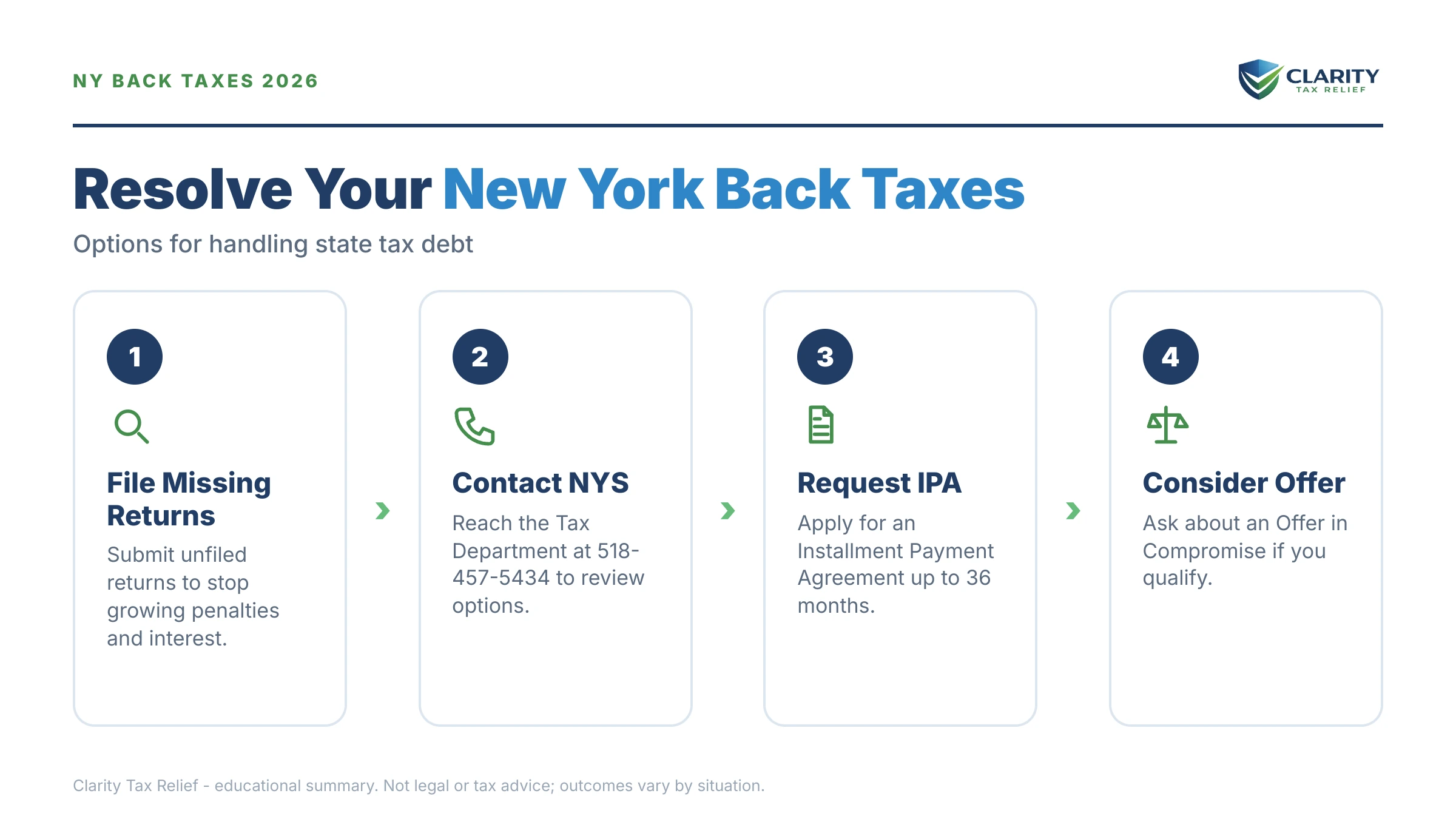
The short answer: New York State back taxes help runs through the NYS Tax Department: payment plans (IPAs), penalty relief, hardship deferral, and a strict state Offer in Compromise. Act before a tax warrant is filed — a warrant is a public judgment that unlocks 10% wage garnishment, bank levies, and driver's-license suspension over $10,000.
Maybe you found the levy notice taped inside your mailbox door, or HR just told you Albany is taking a slice of your next paycheck. You don't own a house they can lien, so it feels like the state went straight for the only things you have — your pay and your bank account. That's exactly how New York collects, and it's also fixable: every enforcement tool the state uses has a release path, and this page maps all of them.
One warning up front: New York is not a slower, smaller IRS. It moves faster, garnishes on a different formula, and can chase a debt for roughly twice as long. Further down the page, you'll see exactly what New York's collection paperwork looks like and where to find the figures that control your case.
⏱ Your real clock: New York interest compounds daily on an unpaid balance, and once your bill passes the response date printed on your notice, the Tax Department can file a tax warrant — a public civil judgment — without going to court. Check the date on YOUR most recent notice; that date, not a generic rule, controls your window.

Why you owe New York State — and why it collects differently than the IRS
New York State generally has 20 years to collect a tax debt once a warrant could be filed — roughly double the IRS's 10-year window. That single fact changes strategy: with a New York balance, "wait it out" is almost never a plan, and every year of delay is a year of daily-compounding interest.
Most NYS back-tax cases start one of four ways. You filed a New York return but couldn't pay in full. The state audited or adjusted a return — often a residency or telecommuting question for people who moved or work across state lines. You didn't file, and the Tax Department estimated a return for you, almost always at a higher figure than reality. Or you ran a business and fell behind on withholding or sales tax.
Collections are handled by the department's Civil Enforcement Division, and its process is heavily automated. Bills go out, a demand follows, and if nothing happens, the system files a tax warrant and starts enforcement. Nobody has to review your file for the machine to reach your paycheck.
Business debts deserve a special flag: New York treats unpaid sales tax as trust-fund money, and responsible people can be held personally liable even after the business closes. If that's your situation, start with our sales tax debt help guide alongside this one.
What happens if you ignore New York State back taxes
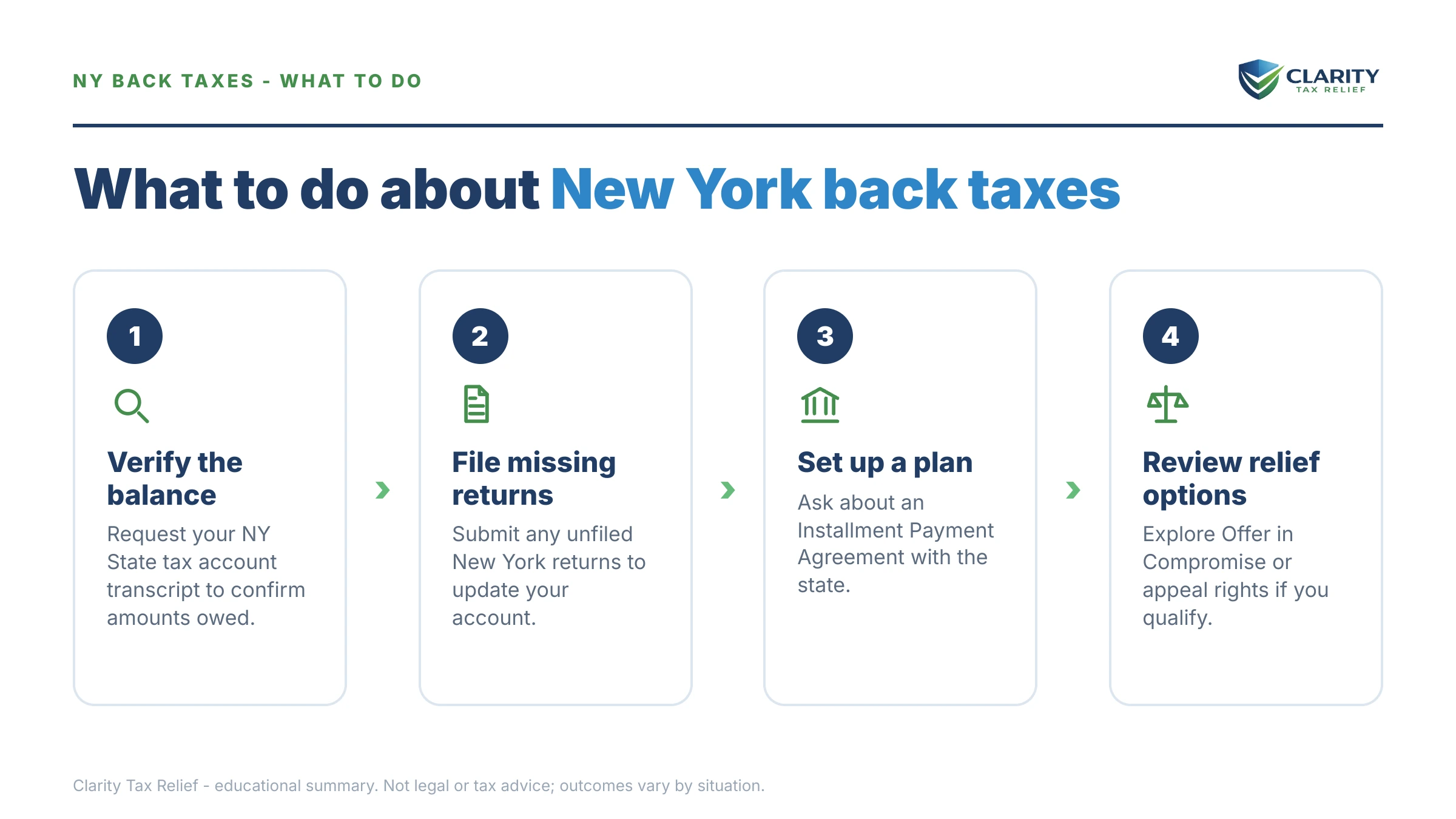
Once a New York tax warrant is filed, the state can garnish 10% of your gross wages and levy your bank accounts without ever going before a judge. The escalation runs in a fixed sequence, and each stage takes options off the table:
- Assessment and bill. The state notifies you of a balance due. Interest starts compounding daily; penalties stack on top. This is the cheapest moment you will ever have.
- Collection notices and demand for payment. Routine-looking letters that are actually the last stop before enforcement. Miss the response date on the demand and the file moves to Civil Enforcement.
- Tax warrant filed. The state dockets a warrant with the county clerk and the Department of State. It's a public civil judgment and a lien — no courtroom, no hearing. Landlords, lenders, and employers who run public-record searches will see it. Full details in our NYS tax warrant guide.
- Income execution and bank levy. With a warrant in place, the state can take up to 10% of your gross wages continuously and freeze and seize bank account funds. It can also seize other property, though for most renters the paycheck and the bank account are the targets.
- Driver's-license suspension and refund offsets. Owe $10,000 or more with no arrangement in place, and the Tax Department can refer you to the DMV for suspension. Meanwhile the state keeps your NY refunds, and state tax debt can intercept federal refunds through the offset program.
| Stage | What New York does | What you lose |
|---|---|---|
| Bill / assessment | States the balance; interest compounds daily | Money — the balance grows every single day |
| Demand for payment | Final ask before the enforcement machinery starts | Your chance to resolve quietly, off the public record |
| Tax warrant filed | Public civil judgment + lien, filed without court | Clean public record; mortgages and some jobs get harder |
| Income execution / bank levy | Takes up to 10% of gross wages; freezes accounts | Part of every paycheck; access to your cash |
| License suspension ($10,000+) | Refers you to the DMV after written notice | Your ability to legally drive to work |
The image below shows you exactly what New York's collection paperwork looks like and where the balance, tax years, and response information appear — so you can match it against what's in your hands.
Facing a NYS levy or income execution right now?
Once a warrant is filed, every pay period and every bank deposit is exposed. Get your New York State back-tax situation reviewed free — an experienced tax professional will map which stage you're at and the fastest release path. Call (888) 825-7779 or use the 2-minute form.
Your options for New York State back taxes help in 2026
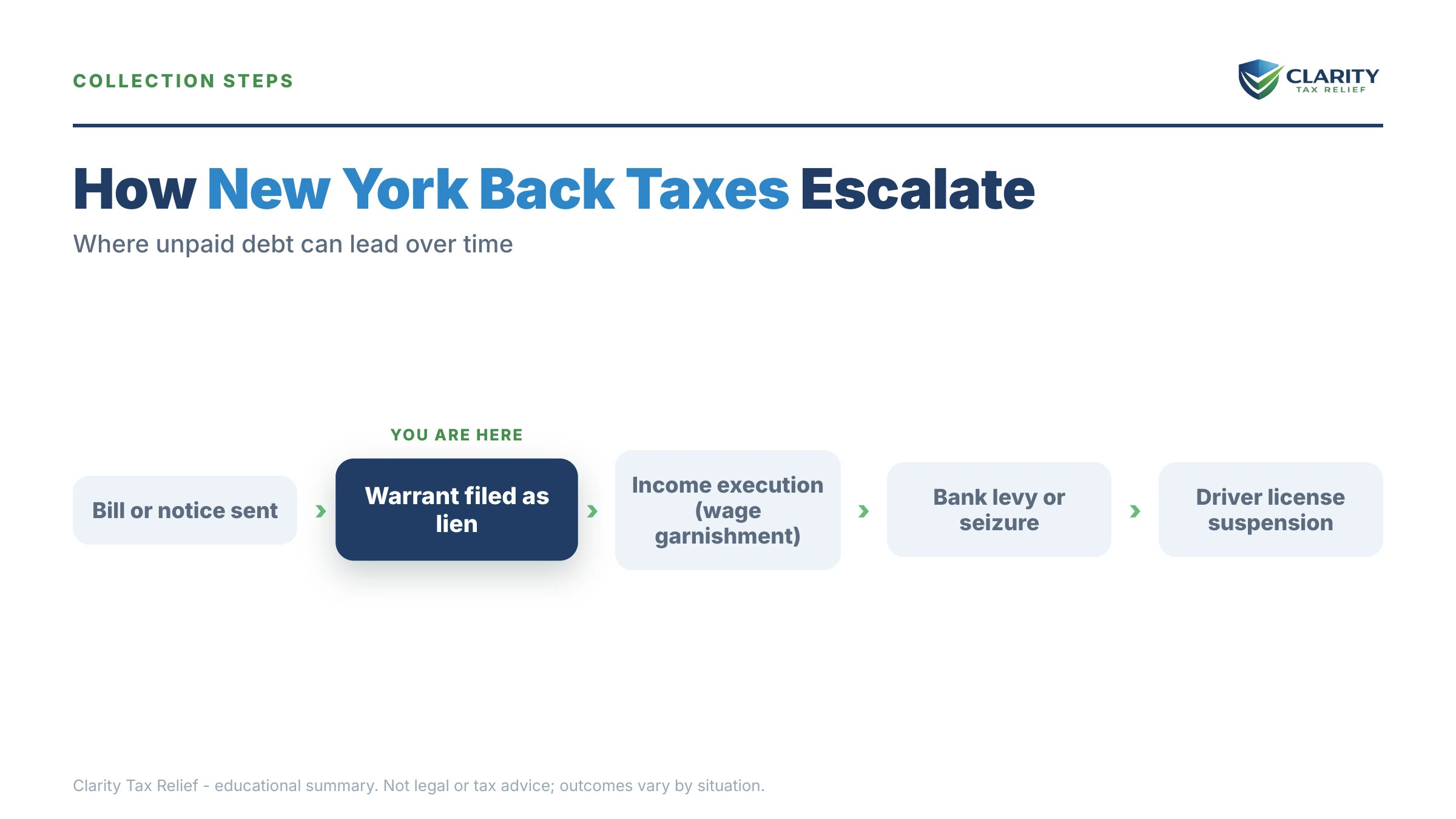
New York offers five real resolution paths, and eligibility for each is means-tested — the right one depends on your balance, income, and filing history. Here's the full menu before the detail:
| Option | Who it generally fits | Key limits and notes |
|---|---|---|
| Pay in full | Anyone who can raise the money | Stops daily interest and enforcement immediately; warrants are satisfied after payment |
| Installment Payment Agreement (IPA) | Most people with steady income | Smaller balances often set up online; larger ones need financial disclosure; interest continues |
| NYS Offer in Compromise | Insolvent taxpayers, bankruptcy discharges, or genuine undue economic hardship | Filed on Form DTF-4 with a DTF-5 financial statement; far stricter than the IRS program |
| Hardship deferral | People who cannot pay anything without losing basics | Case-by-case; requires full financial disclosure; the debt and interest keep growing |
| Penalty abatement | People with reasonable cause — illness, disaster, bad advice | Removes penalties, not tax or interest; documentation carries the request |
| Voluntary Disclosure and Compliance | Non-filers the state hasn't contacted yet | Penalty waiver + no criminal referral, but only if you come forward first |
Installment Payment Agreement (IPA)
The IPA is New York's workhorse — a monthly payment plan that stops new enforcement while you pay. Balances payable within about 36 months can typically be requested through your Online Services account; bigger or older debts require a call and financial disclosure. An active IPA also protects your driver's license and can replace an income execution. The mechanics, documents, and negotiation angles are in our NYS tax payment plan guide.
New York State Offer in Compromise
New York will accept less than the full balance, but the door is narrow. For individuals, the state generally requires that you be insolvent, have received a bankruptcy discharge, or show that full payment would create undue economic hardship — all proven through Form DTF-4 and the DTF-5 financial statement. A wage earner with steady income and no extraordinary circumstances usually is not a candidate, and anyone promising otherwise is selling, not advising.
Hardship deferral
If paying anything would leave you unable to cover rent, food, or medical care, the state can hold off on active collection while your situation improves. It's a pause, not a fix — interest keeps compounding the entire time — but it beats losing 10% of every paycheck when you genuinely can't spare it.
Penalty abatement
New York can waive penalties for reasonable cause: serious illness, a disaster, reliance on bad professional advice, or other circumstances beyond your control. On a multi-year balance, penalties can be a meaningful slice of the total, so a well-documented abatement request is often the first dollar-reducing move — before any talk of settling.
Voluntary Disclosure and Compliance
If your problem is unfiled New York returns and the state hasn't contacted you yet, the Voluntary Disclosure and Compliance Program lets you come forward, pay tax and interest, and receive penalty waiver plus protection from criminal referral. The window closes the moment the state reaches out first — the timing logic mirrors what we cover in voluntarily file old tax returns.
Bankruptcy — the edge case
Some older New York income tax debts can be discharged in bankruptcy if they pass the same age and filing tests federal taxes do, though a warrant filed before the case survives as a lien against property you own. It's rarely the first move, but for insolvent taxpayers weighing every path, our guide to discharge taxes in bankruptcy explains the tests.
A worked example: owing New York $68,500 as a renter
Say you owe New York State $68,500 across two tax years, you rent in Queens, and an income execution notice just arrived. You gross $6,250 a month — $75,000 a year. Here's the honest math on each path:
- Let the income execution run: 10% of gross is $625 a month. $68,500 ÷ $625 ≈ 110 months — over nine years — before counting interest, which compounds daily the whole time. The garnishment barely outruns the accrual, and your license stays exposed because the debt tops $10,000.
- Negotiate an IPA: if the state agrees to a five-year term, $68,500 ÷ 60 ≈ $1,142 a month plus accruing interest. It's a bigger payment, but it replaces the execution, protects your license, and actually retires the debt.
- NYS Offer in Compromise: at $75,000 of income with no extraordinary hardship, you're unlikely to meet the insolvency or undue-hardship test — this path is probably closed, and knowing that early saves you months and fees.
- Penalty abatement: if part of the $68,500 is penalties and you have documented reasonable cause — say, a hospitalization the year the returns went sideways — an abatement request could shrink the number every other option is built on.
This is a hypothetical, and your allowable-expense picture changes the answer — but the pattern holds: on a large NY balance, the negotiated plan usually beats the default garnishment on every axis.
How to respond to New York State back taxes, step by step
- Get your exact NYS balance. Log into (or create) an Online Services account at tax.ny.gov, or call the number on your most recent notice, and get the balance broken down by tax year — tax, penalties, and interest.
- File every missing New York return. The state won't approve a payment agreement or offer with returns outstanding, and replacing an estimated assessment with an accurate return often shrinks the balance.
- Find out whether a tax warrant has been filed. Your notices will say so, and warrants are public records — warrant status changes both your urgency and which options remain open.
- Choose and request your resolution. Pay in full if you can, request an Installment Payment Agreement if you can't, or pursue hardship deferral or a state Offer in Compromise if your finances genuinely support it.
- Move fast on any active levy. If an income execution or bank levy is already running, contact the Civil Enforcement Division with your financial information — an approved agreement can replace ongoing enforcement.
- Stay compliant going forward. Fix your withholding or estimated payments now, because a new balance due next April can default the agreement you just fought to get.
If you owe both New York State and the IRS
Owing Albany and Washington at the same time is common — and the two debts play by different rules, so the order you tackle them in matters. The full sequencing framework lives in our state tax debt vs IRS guide; here's the side-by-side that drives it:
| Collection feature | New York State | IRS |
|---|---|---|
| Collection window | Generally 20 years tied to the warrant | 10 years from assessment (pausable) |
| Wage garnishment | Income execution: up to 10% of gross wages | Levy formula that exempts a set amount, takes the rest |
| Public record | Tax warrant = public civil judgment | Notice of federal tax lien (filed in bigger cases) |
| License / passport pressure | Driver's-license suspension at $10,000+ | Passport certification at $66,000+ (2026) |
| Settlement program | OIC limited to insolvency or undue hardship | OIC based on collection potential; ~1 in 5 accepted in FY2024 |
Two practical notes. First, both agencies can garnish simultaneously — New York's 10% plus an IRS wage levy can gut a paycheck, so whoever is actively levying gets stopped first. Second, when you set up plans with both, size each payment so it doesn't force a default on the other; the IRS side's plan mechanics are at IRS.gov/payments.
When you can handle NYS back taxes yourself — and when help changes the outcome
Plenty of New York cases don't need a professional. If your balance is modest, your returns are filed, and no warrant exists yet, setting up an IPA through your Online Services account is genuinely a do-it-yourself job — pick a payment you can sustain and set it up today. Same if the bill is simply wrong and you have the proof: respond in writing with documentation.
Experienced help earns its cost in a different set of situations: an income execution or bank levy already in motion, a balance north of $20,000 that requires negotiated financial disclosure, multiple unfiled years where voluntary disclosure timing matters, a residency audit, business sales-tax or withholding debt with personal-liability exposure, or a combined NYS-plus-IRS problem where the two plans have to be built together. In those cases, the order of operations — returns, penalties, then the balance — often changes what you ultimately pay. If you do hire someone, vet them first with our how to choose a tax relief company checklist, and know that tax relief new york covers what representation looks like statewide — upstate readers can also see tax relief buffalo.
If your balance has already reached the warrant or income-execution stage, get a free New York case review or call (888) 825-7779 before another pay cycle runs through the garnishment.
Terms on your New York notices, decoded
- Tax warrant — New York's lien-plus-judgment, filed publicly with the county clerk and Department of State without a court hearing.
- Income execution — the state's wage garnishment: up to 10% of gross wages, continuous until the debt is resolved.
- Installment Payment Agreement (IPA) — New York's monthly payment plan; active status pauses enforcement.
- Notice and Demand — the final bill before the file moves to enforcement; its printed date is the clock that matters.
- Form DTF-5 — the Statement of Financial Condition the state uses to evaluate offers and hardship claims.
- Civil Enforcement Division — the Tax Department's collections arm; it files warrants and issues levies and executions.
New York State back taxes: your questions answered
How long can New York State collect back taxes?
Generally 20 years. New York's collection statute runs 20 years from the first date the Tax Department could have filed a warrant for the debt — roughly double the IRS's 10-year window. That means waiting out the state is rarely a realistic strategy, especially since a warrant filed early in that window keeps enforcement tools like income executions and bank levies available for the duration.
Does New York State ever forgive back taxes?
Yes, but narrowly. New York's Offer in Compromise program can resolve a debt for less than the full balance, but for individuals it generally requires insolvency, a bankruptcy discharge, or proof that full payment would create undue economic hardship. It is stricter than the IRS version, and most people who owe end up resolving the balance through an Installment Payment Agreement instead.
What is a NYS tax warrant?
A tax warrant is New York's version of a tax lien — a public civil judgment filed with the county clerk and the Department of State, no court hearing required. Once filed, it attaches to your property, shows up in the public-record searches lenders and landlords run, and legally authorizes income executions, bank levies, and seizure of assets. It stays enforceable until the debt is resolved.
Can New York suspend my driver's license for back taxes?
Yes. If you owe $10,000 or more in state tax debt and are not in a payment arrangement, the Tax Department can refer you to the DMV for license suspension. You get written notice and a chance to resolve first, and certain taxpayers — such as those already under wage garnishment for the same debt — are exempt. Entering an Installment Payment Agreement is usually the fastest way to stop or reverse a suspension.
How much can New York State garnish from my paycheck?
New York's income execution takes up to 10% of your gross wages, and it continues until the debt is paid or you make other arrangements. Unlike an IRS wage levy, which uses an exemption table that can consume most of a paycheck, the state's 10% is a fixed slice — but on a large balance it can run for years while interest keeps accruing, which is why many people replace it with a negotiated payment plan.
Can NYS levy my bank account without warning?
Not without any warning — the state must bill you and demand payment first, and a bank levy generally follows a filed tax warrant. But the warning comes as routine-looking mail, not one dramatic final notice, so many people are blindsided. If your account has been levied, speed matters: contact the Civil Enforcement Division or an experienced tax professional about a release before the funds are transferred.
Should I pay New York State or the IRS first if I owe both?
It depends on who is closer to enforcement, but New York often deserves priority: its garnishment starts faster, its warrant is a public judgment, and its 20-year collection window means the debt will not simply age off. The usual play is to stop whichever agency is actively levying first, then structure payment arrangements with both so neither defaults the other's budget.
Does a New York tax warrant show up on my credit report?
Not on your credit report — the major bureaus stopped reporting tax liens and judgments in 2018. But a warrant is still a public record filed with the county clerk and the Department of State, so mortgage lenders, landlords, and employers who run public-record or title searches will find it. It can block a home purchase or refinance until it is paid or otherwise resolved.
Can I set up a NYS tax payment plan online?
Often, yes. Smaller balances — typically those payable within about 36 months — can usually be set up through your Online Services account at tax.ny.gov without talking to anyone. Larger or older debts, or accounts already at the warrant or levy stage, generally require a phone call and financial disclosure before the state agrees to terms. Either way, all required returns must be filed first.
What if I haven't filed New York returns in years?
File before the state finds you. New York's Voluntary Disclosure and Compliance Program lets qualifying non-filers come forward, pay the tax and interest, and receive penalty waiver plus protection from criminal referral — but only if the state has not already contacted you about those years. Once the Tax Department estimates a return for you, the assessed balance is usually far higher than what an accurate filing would show.
Your next 24 hours
- Find the response date and warrant language on your newest notice. The printed date tells you how close enforcement is; any mention of a warrant, income execution, or levy tells you it has already started.
- Gather three things: your last filed New York return, every state notice you've received, and a snapshot of your income and monthly bills — that's everything needed to price an IPA or test hardship. Your balance details are in your Online Services account at the NYS Department of Taxation and Finance.
- Get your free case review. If a warrant is filed or a levy is running, every pay period and deposit is exposed until an agreement replaces it — call (888) 825-7779 or use the 2-minute form and an experienced tax professional will map your fastest path out.
This guide is general information, not tax or legal advice for your specific situation. Eligibility for IRS programs depends on individual facts and circumstances; no outcome is guaranteed. Eligibility for New York State programs is likewise determined by the NYS Department of Taxation and Finance based on individual facts.