
Tax Relief Companies
Tax Defense Network Alternative: How to Choose Better Tax Debt Help in 2026
The short answer: the best Tax Defense Network alternative is any firm that names the enrolled agent, CPA, or tax attorney who will sign your Form 2848, quotes one flat written fee for the complete resolution, and builds the plan around your actual numbers — because every company uses the same IRS programs, not special access.
You have a quote in one tab, reviews in another, and a $68,500 IRS balance that keeps growing while you compare. If a refinance or another deadline is riding on getting this resolved, picking the right Tax Defense Network alternative isn't about brand names — it's about who does the work and what it costs. Here's how to compare, plus exactly what a balance this size lets the IRS do while you decide.
⏱ The clock that's actually running: there's no deadline on choosing a tax firm — but the failure-to-pay penalty adds 0.5% of your balance every month, plus interest, the whole time you compare. On $68,500, each month of deliberation costs roughly $342 in penalty alone before interest. Estimate your own accrual with our IRS penalty and interest calculator.
Why people look for a Tax Defense Network alternative
Most searches for a Tax Defense Network alternative come down to fit, not fraud — Tax Defense Network is an established national firm, and comparing before you sign is exactly what a smart consumer does. Four things are worth pressure-testing at any large tax-resolution company, ours included:
- Who actually represents you. At high-volume firms, the person who sold you may never touch your case. What matters is the credentialed representative — enrolled agent, CPA, or tax attorney — whose name goes on your power of attorney.
- How the fee is structured. Much of the industry prices in two phases: a smaller "investigation" fee up front, then a larger "resolution" quote after they've reviewed your records. That model isn't inherently dishonest, but it means the number you were first quoted may not be the number you pay. Our guide to tax relief flat fee pricing breaks down the models.
- Whether the plan fits your case type. A $68,500 balance with a refinance on the calendar needs lien strategy and timing — not the same template used for a $9,000 balance with no assets in play.
- Communication. If your case manager changes every time you call, you'll re-explain your situation at exactly the moments deadlines matter.
None of those are accusations against any one firm. They're the checklist. A genuine alternative has to beat the incumbent on those four points, not on louder advertising.
Every alternative to Tax Defense Network uses the same IRS programs
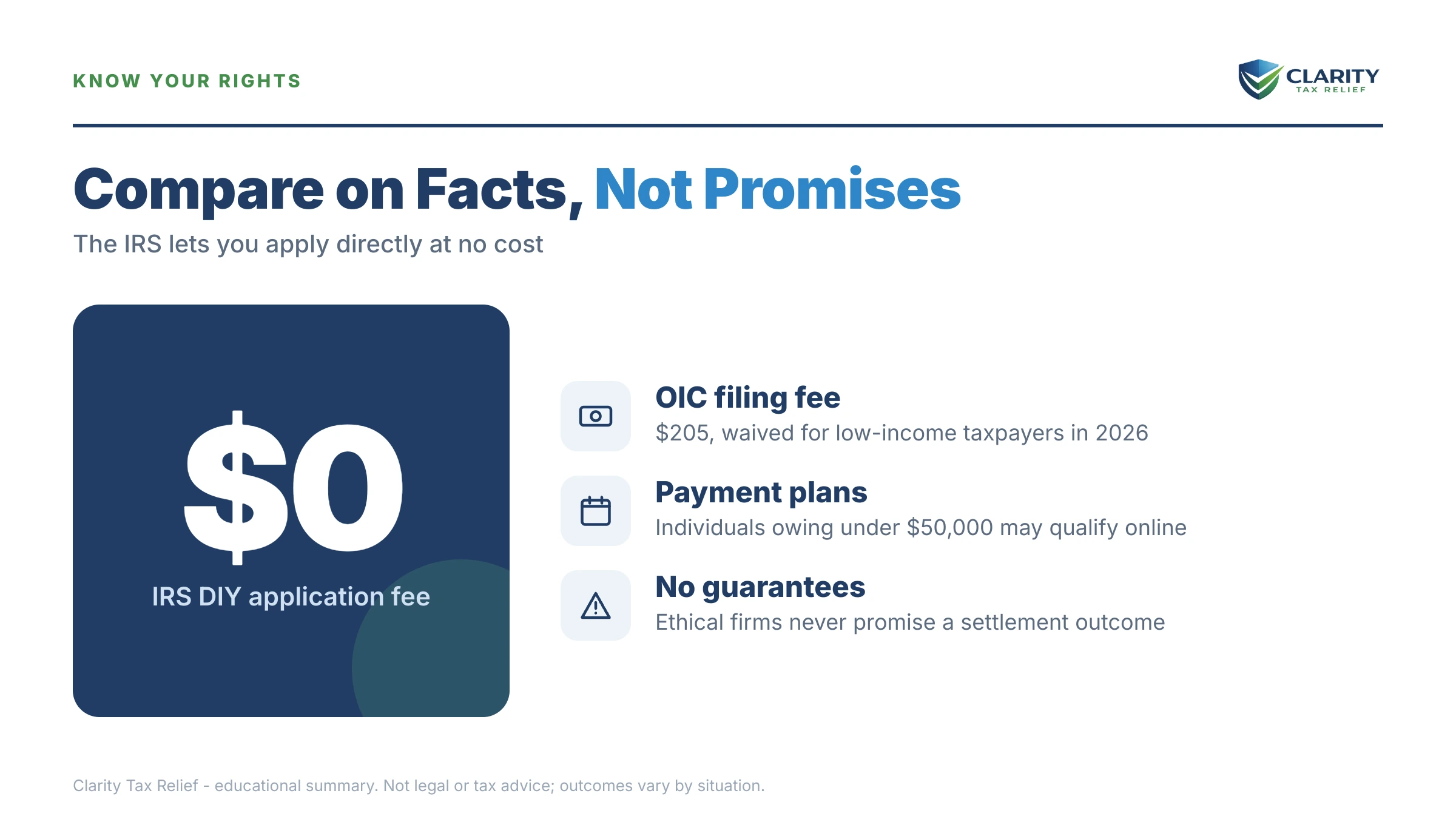
No tax relief company — not Tax Defense Network, not Clarity, not anyone — has private access to IRS programs, and the IRS decides eligibility from your financials, not from who files the paperwork. The entire menu is public: payment plans, Currently Not Collectible status, penalty abatement, and the Offer in Compromise. You can read the DIY mechanics in our pillar on how to settle tax debt yourself.
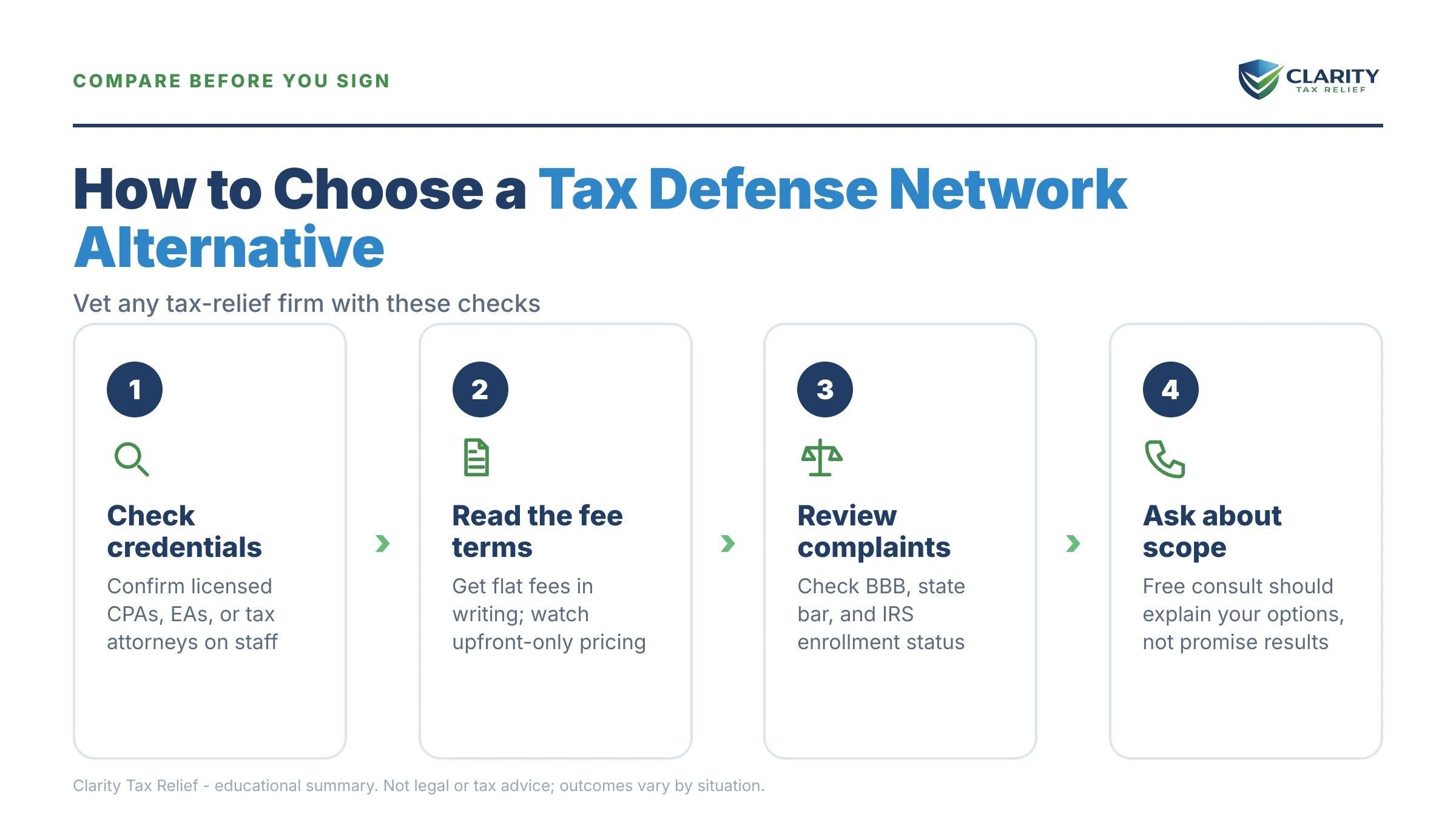
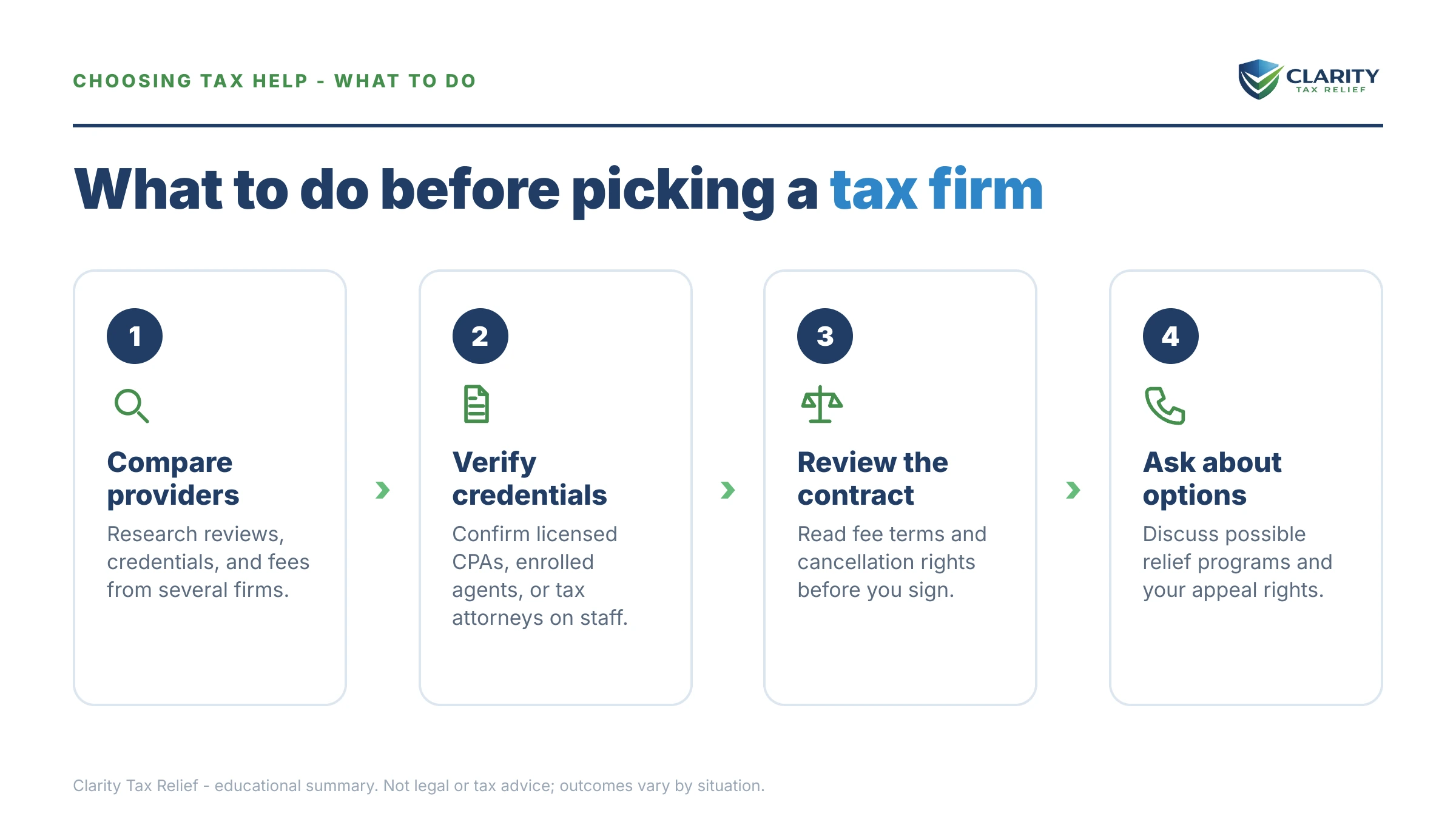
So what are you actually buying when you hire a firm? Three things: strategy sequencing (unfiled returns first, then penalties, then the balance — the order changes what you pay), accurate financial presentation (the Form 433-F or 433-A numbers that determine what the IRS will accept), and a representative who answers IRS correspondence on time. Those are the axes to compare firms on — our full how to choose a tax relief company checklist goes deeper.
What the IRS does while you compare companies
IRS collection notices escalate on an automated schedule that does not pause while you shop for representation. In 2026 the IRS workforce is down roughly 27% from 2025 cuts — humans are harder to reach, but the notice-and-levy system is automated and never stopped. The sequence runs like this:
- The bills stack up. CP14, then CP501 and CP503 reminders — each one adds another month of penalty and interest to the balance.
- CP504 arrives. Under IRC §6331(d), the IRS can now seize your state tax refund, and a Notice of Federal Tax Lien becomes a live risk — the direct threat to a refinance.
- Passport certification. At $66,000 of seriously delinquent debt for 2026, the IRS can certify your account to the State Department. A $68,500 balance is over that line once a lien is filed or a levy issued with no resolution in place.
- LT11 / Letter 1058 — the final notice. This starts a 30-day clock and your Collection Due Process rights (requested on Form 12153). After the window, wage garnishment and bank levies are on the table.
The point isn't panic — it's that "still deciding between firms" reads to the IRS computer exactly like "ignoring the debt."
| Notice | Your response window | What it unlocks for the IRS |
|---|---|---|
| CP14 (first bill) | About 21 days from the notice date (10 business days if the balance is $100,000 or more) | Nothing yet — but the escalation queue starts |
| CP501 / CP503 (reminders) | The pay-by date printed on each notice | Balance keeps compounding; sequence continues |
| CP504 (intent to levy) | The date printed on the notice | State tax refund seizure; lien filing likely |
| LT11 / Letter 1058 (final notice) | 30 days to request a CDP hearing (Form 12153) | Wage garnishment and bank levies after the window — and you lose CDP appeal rights if it passes |
Comparing firms while the balance grows?
Get a second opinion on any quote you're holding — free. An experienced tax professional will pull your IRS records, tell you which program your numbers actually support, and give you one flat written fee to compare against.
The options any firm should walk you through at $68,500
A $68,500 balance sits above the $50,000 streamlined installment agreement threshold, which means financial disclosure — or a pay-down strategy — is part of any honest plan. Here is the complete menu, with the eligibility line for each:
| Option | Who qualifies | Cost and the catch |
|---|---|---|
| Short-term payment plan | Can pay in full within 180 days | $0 setup fee; interest and penalties continue until paid |
| Streamlined installment agreement | Balance ≤ $50,000, all returns filed | Set up online, up to 72 months, no financial statement — at $68,500 you'd need to pay down $18,501 first |
| Non-streamlined installment agreement | Balances over $50,000 | Requires Form 433-F financial disclosure; payment set by ability to pay, not a formula |
| Offer in Compromise | Assets + future income genuinely below the balance | $205 fee plus 20% down on lump-sum offers (both waived with low-income certification); roughly 1 in 5 offers accepted in FY2024 |
| Currently Not Collectible | Paying anything would create hardship | Collection pauses, but the debt, interest, and lien risk remain |
| Penalty abatement (FTA / AEP) | Clean compliance the prior 3 years | Removes penalties, not tax; the new Automatic Exemption from Penalty makes this automatic starting summer 2026 |
One note on the Offer in Compromise, because it's the program every sales pitch leads with: the IRS computes your Reasonable Collection Potential — your net asset equity plus a multiple of your monthly disposable income — and accepts an offer only when that figure is below what you owe. A homeowner with equity usually has an RCP well above the balance, which is why OIC pitches to homeowners deserve skepticism. You can sanity-check your own numbers with our Offer in Compromise Calculator before any firm charges you to find out.
A worked example: $68,500 owed and a refinance on the calendar
Say you owe the IRS $68,500 and plan to refinance your home in about six months. This is hypothetical, but the math is the math:
- The threshold problem. $68,500 − $50,000 = $18,500 over the streamlined line. Pay down $18,501 to reach $49,999 and you can set up a streamlined plan online: $49,999 ÷ 72 ≈ $694/month, no financial statement, while interest and the 0.5% monthly penalty continue on the shrinking balance.
- The no-pay-down path. Keep the full $68,500 and you're in non-streamlined territory: Form 433-F disclosure, and a payment the IRS sets from your budget. Spread over 72 months that's roughly $68,500 ÷ 72 ≈ $951/month before accruals — but the IRS may demand more if your disposable income supports it.
- The refinance stakes. If a Notice of Federal Tax Lien records before your loan closes, it generally sits ahead of the new mortgage — most lenders won't close over it. The fixes are getting a resolution in place before a lien is filed, or requesting tax lien subordination on Form 14134 so the new loan can jump ahead. Our guide to whether you can refinance with an IRS lien covers the lender side.
- The passport line. At $68,500 you're $2,500 over the $66,000 certification threshold for 2026 — one more reason the agreement should be in place before enforcement starts, not after. See passport revoked for tax debt for how certification and reversal work.
Notice what this example proves: the right plan for this reader is driven by the $50,000 threshold, the lien-versus-refinance timing, and the passport line — three facts a one-size sales script never mentions. Any firm you're comparing, on any side of this decision, should raise all three unprompted. The deeper mechanics of balances in this range are in our guide to an irs payment plan over 50000.
How to choose a Tax Defense Network alternative, step by step
- Pull your own IRS records first. Log into your IRS online account and confirm the exact balance, tax years, and any lien or levy activity before anyone quotes you a fee. A firm that quotes before seeing your records is pricing blind.
- Verify the person, not the brand. Ask which enrolled agent, CPA, or tax attorney will sign your Form 2848 power of attorney — and get that name in writing before you pay anything.
- Get one flat, written fee for the complete resolution. If the quote only covers an investigation phase, ask what the resolution phase costs for a case exactly like yours — same balance, same programs — before signing.
- Match the plan to your numbers. At $68,500 you are above the $50,000 streamlined threshold, so any credible plan must address financial disclosure, lien risk, and any timing event like a refinance. A generic pitch that ignores those is a red flag.
- Set a start date before the next notice lands. The failure-to-pay penalty adds 0.5% of your balance every month, plus interest, while you deliberate. Whoever you hire, the resolution request should go in before the IRS's next notice escalates your case.
For the exact scripts to use on a sales call, see our list of questions to ask before hiring a tax relief firm, and screen every quote against the tax relief company red flags checklist.
When you don't need any company at all
If your balance is under $50,000 with all returns filed, you can usually resolve this yourself online without paying anyone. A streamlined installment agreement takes under an hour on the IRS payment plans page, a balance you can clear within 180 days needs only a short-term plan with a $0 setup fee, and a first-ever penalty often comes off with a simple first-time abatement request — no representation required. Guaranteed installment agreements exist for balances of $10,000 or less, which is as close to automatic as the IRS gets.
Experienced help changes outcomes in the situations where mistakes are expensive: a balance over $50,000 where the 433-F presentation sets your payment for years, a lien threatening a refinance or sale, a levy already in motion, multiple unfiled years, business or payroll debt, or OIC math where an inflated asset value sinks the offer. If money is the obstacle, the Taxpayer Advocate Service and Low Income Taxpayer Clinics are free for those who qualify — a legitimate alternative no sales team will mention.
Terms tax-relief sales teams use, decoded
- Investigation phase: the firm pulls your IRS transcripts and account records — useful work, but you can see most of it free in your own IRS online account.
- Resolution phase: the actual filing and negotiation of your payment plan, offer, or hardship status — this is where the real fee (and the real value) lives.
- Form 2848: the power of attorney naming who represents you before the IRS — the single document that reveals whether a credentialed professional is on your case.
- Fresh Start: a marketing label for IRS collection policies that have existed since 2011–2012 — it is not a program you "enroll" in or a limited-time offer.
- Reasonable Collection Potential (RCP): the IRS's formula — asset equity plus future income — that decides whether an Offer in Compromise can be accepted at all.
- Lien subordination: the IRS agreeing (via Form 14134) to let a new loan take priority over its lien so a refinance can close; the lien itself stays until resolved.
Tax Defense Network alternative FAQs
Is Tax Defense Network a legitimate company?
Yes — Tax Defense Network is an established national tax-resolution firm, and searching for an alternative does not mean the company is a scam. Most people compare alternatives over fit: the pricing model, how much of the work is done by credentialed representatives, and how a firm handles their specific case type. Compare any firm — including us — on those factors, not on advertising.
What is the best alternative to Tax Defense Network?
The best alternative is whichever firm puts a named enrolled agent, CPA, or tax attorney on your Form 2848 and quotes a flat, written fee for the complete resolution. There is no single best company for everyone because the right strategy depends on your balance, income, and assets. Judge firms on credentials, fee transparency, and a plan that matches your numbers — not on who advertises most.
Can I switch tax relief companies in the middle of my case?
Yes. You can revoke a power of attorney at any time by writing REVOKE on a copy of the Form 2848 and sending it to the IRS, or your new representative can file a fresh 2848 that supersedes the old one. Check your existing service agreement for refund terms on unfinished work before you switch, and request your case file — the IRS does not restart anything just because you changed firms.
Do I need a tax relief company at all, or can I resolve this myself?
If you owe under $50,000 with all returns filed, you can usually set up a streamlined installment agreement yourself at IRS.gov in under an hour — no company required. Professional help earns its fee when the balance is over $50,000, a lien threatens a refinance or sale, a levy is already in motion, or you are pursuing an Offer in Compromise where the financial-disclosure math decides everything.
Will hiring a tax relief company stop IRS collections?
Not automatically — filing a power of attorney does not pause anything by itself. Collection generally holds while the IRS considers a properly filed installment agreement or Offer in Compromise, and a levy can often be released once a resolution is in place, but interest and penalties keep accruing throughout. Be wary of any firm that promises to stop all collections instantly; every form of relief has conditions.
Can a company really settle my tax debt for less than I owe?
Only if the IRS's own math shows it cannot collect the full amount — the Offer in Compromise program is means-tested, not negotiated on sales skill. The IRS accepted roughly 1 in 5 offers in FY2024, and acceptance depends on your assets and future income, not on which company files the paperwork. Any firm quoting a settlement percentage before reviewing your finances is guessing at best.
Does owing $68,500 put my passport at risk?
It can. The IRS certifies seriously delinquent tax debt to the State Department at $66,000 for 2026, so a $68,500 balance is over the line once a lien has been filed or a levy issued and no resolution is in place. Getting into an installment agreement or having an Offer in Compromise pending generally prevents or reverses certification.
How much should a Tax Defense Network alternative charge?
Expect a written flat fee tied to the specific work — a payment-plan setup should cost far less than an Offer in Compromise with full financial disclosure and a possible appeal. Watch for two-stage pricing where a low investigation fee is followed by a much larger resolution quote you never agreed to. Any firm should tell you the total in writing before you sign.
Your next 24 hours
- Confirm your real balance. Log into your IRS online account (or check the "amount due" box on your most recent notice) and note the total across all years — every firm you talk to should be working from the same number, and payments made through IRS.gov/payments post directly against it.
- Gather your comparison file. Your latest IRS notice, your most recent tax return, a rough monthly income-and-expense picture, and — if you're refinancing — your lender's timeline. Ten minutes of gathering turns every sales call into a real quote.
- Get a free second opinion before you sign anything. Call (888) 825-7779 or use the 2-minute form. We'll review your numbers against every program above and give you one flat written fee to compare — while the only clock that's running, monthly penalties and interest, is still small.
Clarity Tax Relief is not affiliated with Tax Defense Network; references to other companies are for general comparison education only. This guide is general information, not tax or legal advice for your specific situation. Eligibility for IRS programs depends on individual facts and circumstances; no outcome is guaranteed.