
Business & Self-Employed Tax Debt
Salon Owner Tax Debt: Booth Renters, Cash Income, and How to Fix It (2026)
The short answer: salon owner tax debt usually comes from four sources — untaxed booth-rent and service income, unreported cash and tips, misclassified stylists that create payroll liability, and unfiled returns. Balances of $50,000 or less generally qualify for a 72-month IRS payment plan, but every missing return must be filed first.
You've kept the chairs full, the rent paid, and the shelves stocked — but the tax side never got the same attention, and now the returns are years behind and the IRS letters are stacking up next to the appointment book. That's the most common version of salon owner tax debt we see, and it is fixable in a specific order.
This guide covers what makes a salon or spa balance different from ordinary back taxes: the booth-renter classification trap, how the IRS reconstructs cash income, why unfiled years must be filed before anything can be negotiated, and exactly which resolution program fits which balance. The image below shows you what the key IRS paperwork in a case like this looks like and where to look on it.
⏱ Your real clock: there's no single printed deadline on a multi-year salon debt — the clock is the penalty math. The failure-to-file penalty grows at 5% per month, ten times the failure-to-pay penalty's 0.5%, until it caps at 25% of each unfiled year's unpaid tax. Every month a return stays unfiled is the most expensive month on the calendar.
Why salon and spa owners end up owing the IRS
Salon income arrives with zero withholding from four directions at once: services, tips, retail product sales, and booth rent. Nobody takes taxes out of any of it — you're responsible for income tax plus self-employment tax on the profit, paid quarterly, and most owners learn that after the first big balance posts.
The mix creates specific failure points that generic small-business advice misses:
- Booth rent is taxable income to you. If six renters pay you $250 a week, that's $78,000 a year of income the IRS expects to see on your return — even in years when the salon barely broke even after its own rent and utilities.
- Card processors report your revenue. Square, Vagaro, GlossGenius, and similar processors issue Form 1099-K once you cross $20,000 and 200 transactions (the threshold reverted for 2026). A busy salon blows past that easily — so the IRS sees your card revenue whether or not you file. Cash doesn't show up on a 1099-K, which is exactly why examiners assume it exists.
- Tips complicate payroll. If you have W-2 employees, their reported tips carry withholding and FICA obligations for you as the employer — a common source of quiet 941 back taxes.
- Retail sales create state debt too. Product sales usually mean collected sales tax, which most states treat as their money held in trust — see our guide to sales tax debt help, because state collectors often move faster than the IRS.
If you're a stylist renting a chair rather than the owner renting them out, your situation is different — start with our guide to hair stylist taxes owed on 1099 income instead.
The booth-renter trap: your biggest hidden liability
A booth renter is an independent contractor only if they genuinely run their own business — their own hours, their own prices, their own clients, their own money. The IRS doesn't care what your rental agreement says; it looks at who actually controls the work.
The dangerous middle ground is common in salons: the "renter" works your posted hours, clients pay at your front desk, and you cut the stylist a weekly commission check. To the IRS, that pattern looks like an employee. If a stylist files Form SS-8 asking the IRS to decide their status — which unhappy ex-stylists do, often when they're denied unemployment — a reclassification can land years of employment taxes, penalties, and interest on you at once.
Two things matter if this is your exposure. First, Section 530 relief can shield employers who consistently treated workers as contractors, filed 1099s, and had a reasonable basis — our worker misclassification penalty guide walks through it. Second, if payroll tax was withheld from actual employees and never paid over, the withheld portion can be assessed against you personally through the Trust Fund Recovery Penalty — that piece never dies with the business. The same dynamics drive construction payroll tax debt; the IRS treats the industries almost identically once withheld money is involved.
Behind on filing? File before you negotiate
The IRS will not approve any payment plan, hardship status, or settlement while required returns are unfiled. For a salon owner three years behind — the most common pattern we see — the sequence is fixed: returns first, resolution second.
There's a second reason to file fast. If you don't, the IRS eventually files a substitute for return (SFR) for you, built from your 1099-K totals with no deductions for booth rent paid, product cost, supplies, insurance, or chair depreciation. An SFR routinely doubles or triples what a real return would show. Your own late-filed return usually replaces those numbers — and if an SFR year was already assessed too high, amending a return to reduce tax debt or filing the original return can still bring it down.
One more non-filer fact that surprises people: the IRS's 10-year collection statute (CSED) doesn't start until tax is assessed. On unfiled years, the clock isn't running at all — waiting isn't running out any statute; it's just adding penalties. Our guide to haven't filed taxes in 3 years covers the reconstruction process in detail.
What happens if you ignore salon tax debt
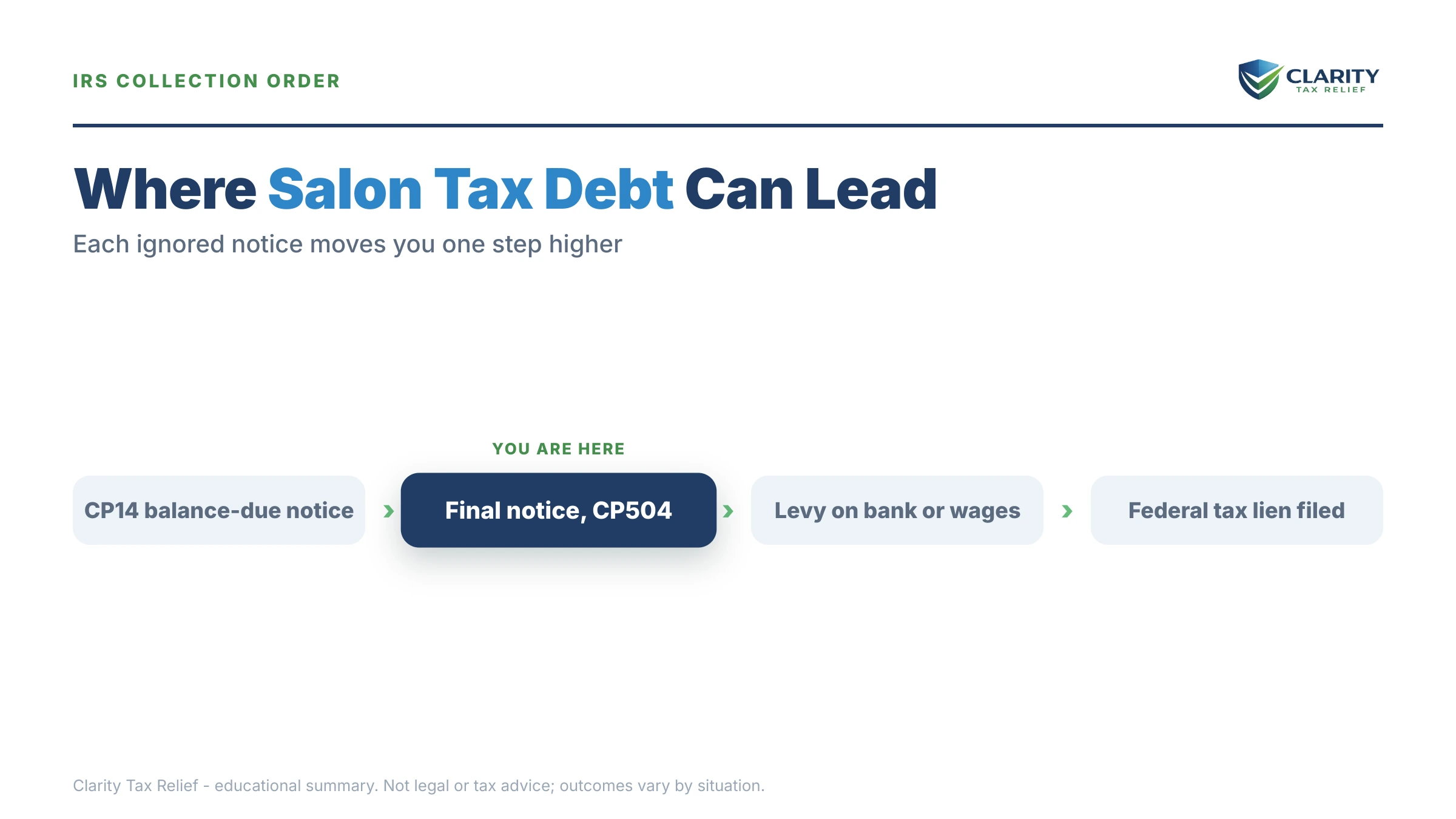
An unfiled-return salon case escalates on two tracks at once: notices demanding the missing returns, then collection notices once a balance is assessed. Both tracks are automated — 2026's IRS staffing cuts made humans harder to reach, but the notice system never slowed down.
- CP59, then CP516/CP518 — the IRS asks for, then demands, the unfiled returns. No enforcement yet, but you're now flagged as a non-filer.
- SFR proposal (CP2566 / CP3219N) — the IRS computes tax for you with no deductions. A CP3219N is a notice of deficiency: respond or petition Tax Court within 90 days, or the inflated amount becomes final.
- CP14 — the first bill on the assessed balance, with roughly 21 days before the next notice queues.
- CP501 / CP503 — reminder bills while penalties and interest compound.
- CP504 — intent to levy your state refund; a federal tax lien against the salon's assets becomes realistic.
- LT11 / Letter 1058 — final notice. After 30 days the IRS can levy your business bank account (a bank levy carries a 21-day hold before funds leave), garnish any wages, and reach receivables. This notice also opens your Collection Due Process appeal rights via Form 12153.
For a salon, the bank levy stage is the existential one: a frozen operating account means payroll, rent, and product orders stop at once. Everything in this article is cheaper and easier than fixing a levy already in motion.
| Notice | What it means | Your window |
|---|---|---|
| CP59 / CP516 / CP518 | The IRS wants your unfiled returns | No fixed count — file before the IRS files for you |
| CP2566 / CP3219N | Substitute-for-return proposal, no deductions | 90 days to respond or petition Tax Court (CP3219N) |
| CP14 | First bill on the assessed balance | Typically 21 days before escalation |
| CP501 / CP503 | Reminder bills; balance compounding | The date printed on each notice |
| CP504 | Intent to levy your state refund; lien risk | Respond by the printed date |
| LT11 / Letter 1058 | Final notice — bank levy and garnishment power next | 30 days to request a CDP hearing (Form 12153) |
Salon behind on returns and holding IRS mail?
Every month adds another 5% failure-to-file penalty to each unfiled year until it caps. An experienced tax professional will review your notices, transcripts, and booth-renter setup free — before the notice sequence reaches your operating account.
Your options for resolving salon owner tax debt in 2026
A salon owner owing $50,000 or less can usually get a 72-month IRS payment plan without submitting a full financial statement — but only after every required return is filed. Here is the full menu, with what each one costs and who it fits. (For the general mechanics of each program, our how to settle tax debt yourself pillar covers them in depth — below is how they apply to a salon balance.)
| Option | Who qualifies | Cost to set up | Key trade-off |
|---|---|---|---|
| Short-term plan (180 days) | Can pay in full within 180 days | $0 | Interest and 0.5%/mo penalty continue until paid |
| Guaranteed installment agreement | Owe $10,000 or less, compliant history | Standard setup fee | Small balances only; approval is by statute |
| Streamlined installment agreement | Owe $50,000 or less; all returns filed | Setup fee (lower with direct debit) | Up to 72 months; no full financials, but interest accrues |
| Currently Not Collectible | Allowable living/business expenses consume income | $0 (Form 433 financials required) | Pauses collection; debt and interest keep growing, lien possible |
| Offer in Compromise | Assets + future income genuinely below the balance | $205 fee + 20% down on lump-sum (waived if AGI ≤ 250% of poverty) | Means-tested; roughly 1 in 5 offers accepted in FY2024 |
| Penalty abatement (FTA / AEP) | Clean prior 3 years (FTA) or reasonable cause | $0 | Removes penalties, not the underlying tax or most interest |
Two salon-specific notes. If part of your balance is withheld payroll tax, the rules tighten: trust-fund debt is treated far more strictly in every program, and an offer on it is rare. And if the debt is old, mostly income tax, and your finances are wrecked, bankruptcy can sometimes discharge qualifying years — the trade-offs are covered in Chapter 7 vs 13 for tax debt.
Worked example: say you owe $41,800 across three unfiled years
This is hypothetical, but the math is real. Say you ran the salon for three years without filing, and once the returns are prepared they show $32,600 in combined tax across the three years. Here's how that becomes $41,800:
- Failure-to-file penalty, capped at 25% of each year's unpaid tax: $32,600 × 25% = $8,150
- Failure-to-pay penalty and compounding interest to date: roughly $1,050 and climbing
- Total balance: ≈ $41,800
Because $41,800 is under the $50,000 streamlined threshold, a 72-month plan works out to roughly $581 per month ($41,800 ÷ 72) — realistically closer to $600+ because interest keeps accruing on the unpaid balance. A 180-day short-term plan would demand about $6,967 a month, which few salons can absorb. An Offer in Compromise only enters the picture if your equipment equity plus what the IRS calculates you can pay from future income totals less than $41,800 — possible for a struggling salon, but it's the IRS's math, not yours. And if the first delinquent year followed three clean years, first-time abatement on that year alone could remove a meaningful slice of the $8,150 penalty stack. You can rough out your own penalty and interest buildup with our IRS penalty & interest calculator.
How to respond to salon owner tax debt, step by step
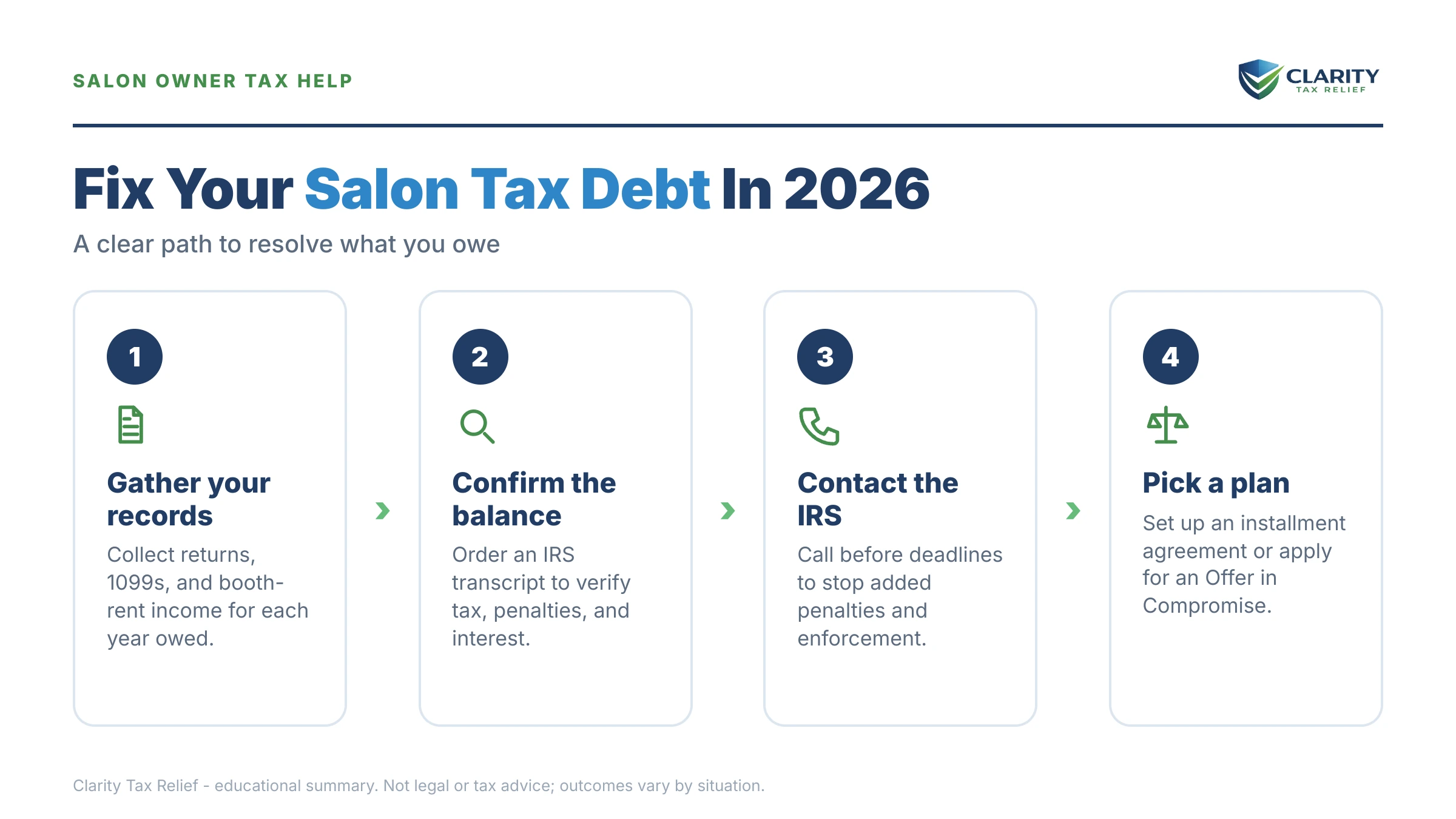
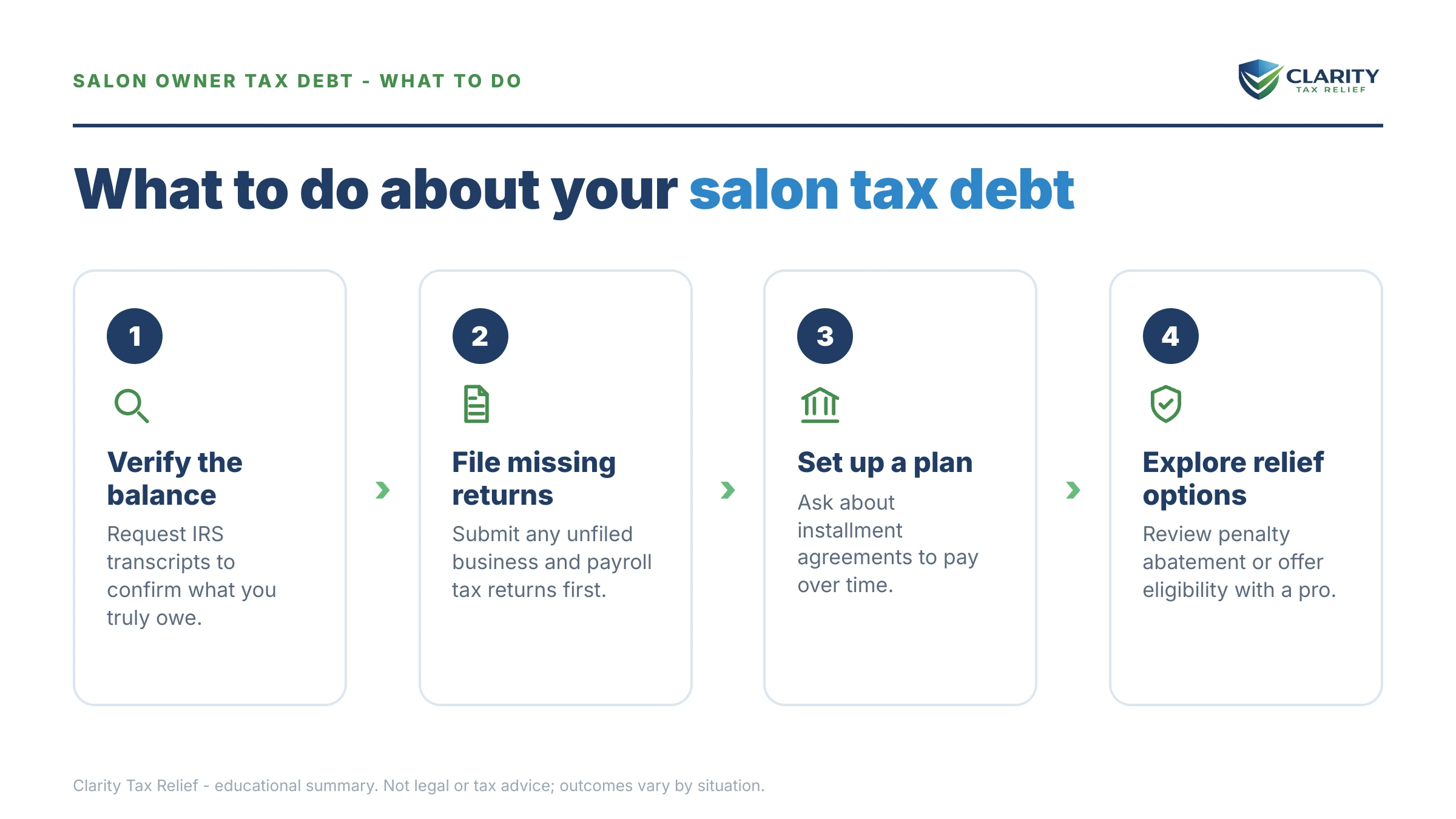
- Pull your IRS transcripts. Get your wage and income transcripts and account transcripts for every open year — they show the 1099-Ks and other income the IRS already has, and whether any substitute for return was filed.
- File every missing return. Reconstruct income and expenses from bank statements, card-processor reports, and booth-rent records, and file real returns for all unfiled years. Real returns almost always beat the IRS's deduction-free numbers.
- Fix worker classification going forward. Restructure booth-rent agreements so renters genuinely control their hours, prices, and payments — or put commission stylists on payroll — so the debt stops growing on a new front.
- Set up the resolution that fits. Choose a short-term plan, a streamlined installment agreement, hardship status, or an Offer in Compromise based on your balance and finances, and get it in place before the notice sequence escalates.
- Request penalty relief. Ask for first-time abatement or reasonable-cause relief on the penalty portion — and watch for the 2026 Automatic Exemption from Penalty, which applies some relief with no request at all.
When you can handle this yourself — and when help changes the outcome
Plenty of salon tax problems don't need professional help. If you're current on filing, owe a single year you agree with, and can pay within 180 days — or can comfortably carry a streamlined monthly payment — set the plan up yourself online and keep your money for the business. The same goes for a first notice on an amount you recognize.
Experienced help earns its cost in a narrower set of situations: multiple unfiled years with incomplete records (reconstruction quality directly changes the assessed tax), any hint of a worker-classification challenge or SS-8 filing, withheld payroll or state sales tax in the balance (personal-liability exposure), a levy or lien already in motion, or Offer in Compromise math where the difference between a defensible valuation of your equipment and goodwill and a sloppy one is the difference between acceptance and rejection. In those cases, the order and packaging of the fix changes what you end up paying — not just how stressful it is.
Terms on your IRS mail, decoded
- Booth renter — a stylist who pays you rent and runs their own business inside your salon; the IRS tests the reality of that independence, not the contract label.
- Trust fund taxes — money withheld from employee paychecks (and, in most states, collected sales tax) that the government considers its own funds held by you in trust.
- Trust Fund Recovery Penalty (TFRP) — the IRS's tool for assessing unpaid withheld taxes personally against owners, managers, and check signers.
- Substitute for Return (SFR) — a return the IRS files for a non-filer using reported income and no deductions, almost always overstating the tax.
- Self-employment (SE) tax — the 15.3% Social Security and Medicare tax on net self-employment profit, owed on top of income tax.
- CSED — the collection statute expiration date: 10 years from assessment, pausable by appeals, offers, and bankruptcy — and not running at all on unfiled years.
Salon owner tax debt questions, answered
Are my booth renters employees or independent contractors?
It depends on control, not the label on your rental agreement. A true booth renter sets their own hours, sets their own prices, books their own clients, collects their own money, and pays you flat rent. If you set the schedule, take the client payments at your front desk, and pay stylists a commission, the IRS is likely to treat them as employees — which makes you liable for payroll taxes on their pay.
Can I get an IRS payment plan for $41,800 in salon tax debt?
Yes — balances of $50,000 or less generally qualify for a streamlined installment agreement of up to 72 months, and you can usually set it up online without submitting detailed financial statements. On $41,800 that works out to roughly $581 per month before ongoing interest. The catch: the IRS will not approve any agreement until every required return is filed.
What happens if I never filed tax returns for my salon?
The IRS can file a substitute for return (SFR) for you using 1099-K card-processing data — with no deductions for booth rent paid, supplies, or product costs — and assess a far larger balance than you would owe on a real return. Filing your own returns, even years late, usually replaces those inflated numbers. The IRS generally wants your last six years of returns to consider you compliant.
Does the IRS know about my cash income?
Often, yes — indirectly. In a cash-business audit, the IRS uses the bank deposit method: it totals every deposit into your accounts and treats unexplained amounts as income. Card sales reported on Form 1099-K set a floor under your revenue, and examiners compare what you reported against industry norms for a salon your size. Underreported cash is one of the most common audit adjustments for salon owners.
Can the IRS take my salon equipment or shut down my business?
It can, but seizing a working business is a late-stage step, not a first move. The IRS must first send a final notice of intent to levy (LT11 or Letter 1058) and give you 30 days to request a Collection Due Process hearing. Setting up a payment plan or hardship status before that point keeps chairs, equipment, and bank accounts out of reach.
Am I personally liable for my salon's payroll tax debt?
If the debt includes taxes withheld from employees' paychecks, yes — the Trust Fund Recovery Penalty lets the IRS assess the withheld portion against any responsible person who willfully failed to pay it over, including owners, managers, and check signers. That liability survives even if you close or sell the salon. Employer-side taxes and penalties generally stay with the business entity.
Can penalties on my salon back taxes be removed?
Frequently, yes. First-time penalty abatement can remove failure-to-file and failure-to-pay penalties for one year if the prior three years were clean, and reasonable-cause relief covers illness, disaster, and other events outside your control. Starting in summer 2026, the IRS's Automatic Exemption from Penalty (AEP) begins applying some relief automatically, with no request required. Interest on the tax itself is rarely removed.
Your next 24 hours
- Find every IRS envelope in the drawer and note the notice number in the top corner and the tax years listed — that tells you exactly where in the sequence above you stand.
- Gather the reconstruction basics: business and personal bank statements, card-processor annual summaries, booth-rent records, and your last filed return.
- Get a free case review — the 2-minute form at claritytaxrelief.com/#consult or (888) 825-7779. The failure-to-file penalty posts month by month until each return is in; the sooner the returns are filed, the smaller the number you're negotiating.
For the IRS's own resources: you can pay or set up a plan directly at IRS.gov/payments, review plan terms on the IRS payment plans page, and — if the IRS system itself is causing you harm, like a levy despite a pending agreement — contact the Taxpayer Advocate Service.
This guide is general information, not tax or legal advice for your specific situation. Eligibility for IRS programs depends on individual facts and circumstances; no outcome is guaranteed.