
Tax Debt by Profession
Photographer Tax Debt: How to Resolve Back Taxes From Your Photography Income (2026)
The short answer: photographer tax debt almost always traces to 1099 and 1099-K income with zero withholding, plus the 15.3% self-employment tax on net profit. It's resolved through the same IRS programs as any debt — payment plans, hardship status, penalty abatement, or an Offer in Compromise — but any unfiled Schedule C years must be fixed first.
Every retainer hit your account clean, the gallery deliveries went out on time, and the gear paid for itself in bookings. What nobody withheld was tax — and now two or three seasons of it have landed at once. That knot in your stomach is normal; the situation itself is very fixable, and the order you fix it in decides what it ultimately costs.
⏱ The clock that's actually running: there's no letter deadline on tax debt itself, but the balance grows every month you wait. The failure-to-pay penalty adds 0.5% of the balance per month — about $306 a month on a $61,200 debt — with interest compounding on top. If any year is unfiled, the failure-to-file penalty runs 5% per month, ten times faster. File first, always.
Why photographers end up owing the IRS
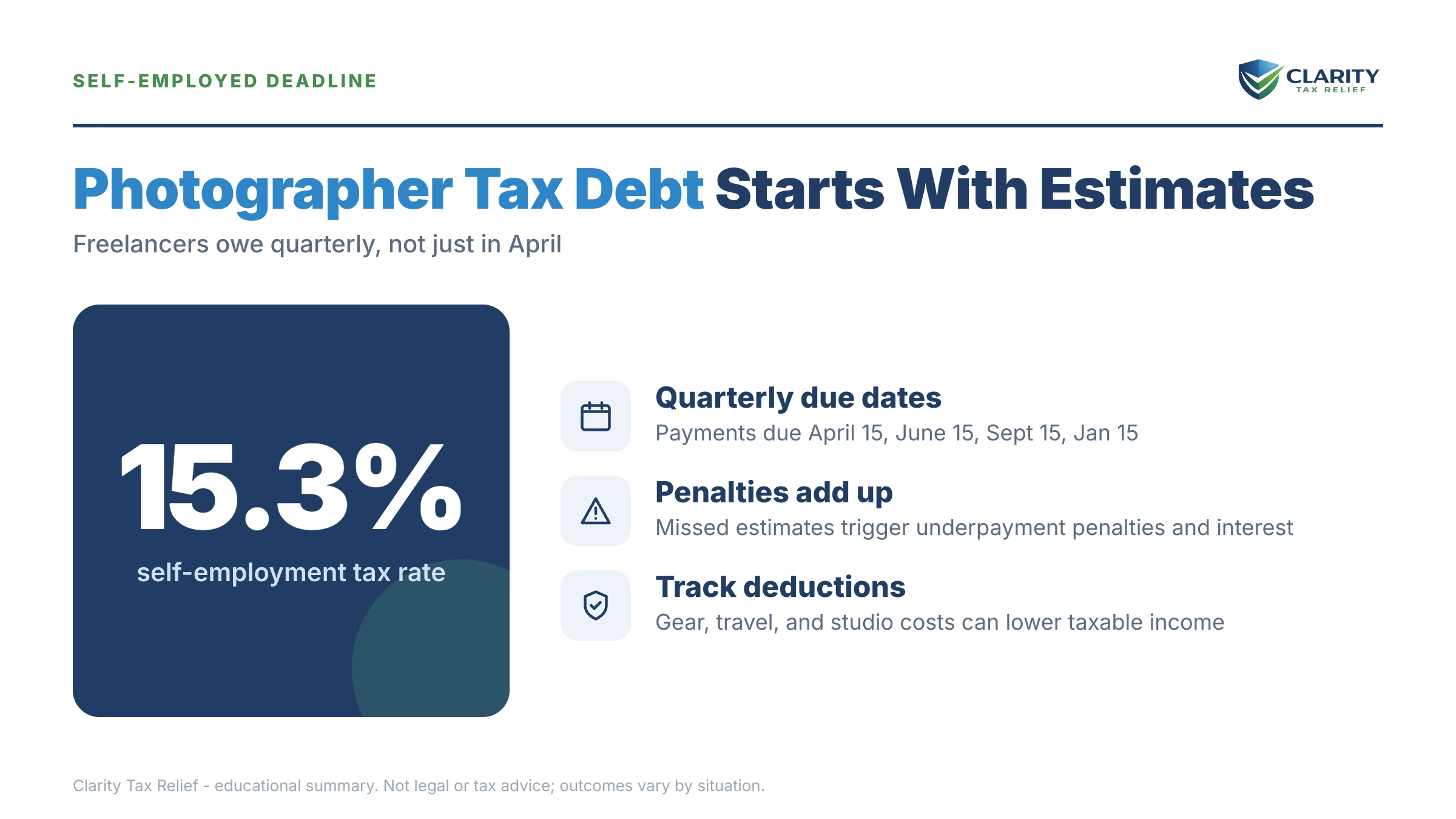
Self-employment tax takes 15.3% of net photography profit before ordinary income tax even applies. That single number explains most photographer tax debt: nobody withholds it, no client warns you about it, and it stacks on top of whatever bracket your other income already put you in. The mechanics are covered in our guide to self employment tax owe irs; here's how it plays out for photographers specifically.
1099 shoot income arrives gross. Studios, agencies, magazines, and lead photographers who pay you $600 or more file a 1099-NEC with the IRS. Nothing was withheld from any of it. If you're used to a W-2 paycheck, it's easy to spend money that was never fully yours.
Side income gets taxed at your top rate. If you have a day job, your W-4 withholding is calibrated to your salary alone. Every dollar of weekend wedding profit lands on top of that salary — taxed at your highest marginal rate, plus the 15.3% — while your paycheck withholding covers none of it.
Quarterly estimates get skipped. The IRS expects self-employed income to be paid in four times a year, not at filing. Miss the quarters and you owe the whole year at once plus an underpayment penalty — the schedule is in how do quarterly estimated taxes work.
Gear doesn't cancel tax the way people think. A $4,000 lens reduces your taxable income by $4,000 — not your tax bill by $4,000. At a combined rate near 30%, it saves roughly $1,200 in tax. Photographers who "bought gear instead of paying taxes" usually discover they covered about a third of the liability.
The 1099-K reports gross, not profit. Card and app processors report every dollar that moved — including sales tax you collected, refunds you issued, and processing fees you never kept. If you don't file a Schedule C that backs those amounts out, the IRS's number is bigger than reality.
Retainers count when received. On the cash basis most photographers use, a December deposit for a June wedding is December income — a timing trap that quietly inflates the year you booked heavily.
How the IRS finds photography income
The IRS receives its own copy of every 1099-NEC over $600 and every 1099-K over the $20,000/200-transaction threshold — and its computers match those forms against your return automatically. A mismatch generates a cp2000 notice proposing additional tax, usually about two years after the return was filed, which is why photographer tax debt so often shows up as a surprise from an old year.
| Where the money came from | What the IRS receives | What usually creates the debt |
|---|---|---|
| Second-shooting for studios, agencies, publications | Form 1099-NEC (any payer at $600+) | Zero withholding; full self-employment tax due |
| Square, Stripe, and card readers | Form 1099-K above $20,000 / 200 transactions | Gross figure includes fees, refunds, and sales tax you must back out on Schedule C |
| Venmo / PayPal goods-and-services payments | Form 1099-K at the same threshold | Earlier years' lower-threshold data stays in IRS files and still drives matching |
| Print sales, stock and licensing platforms | Form 1099-NEC or 1099-MISC | Small amounts across several platforms add up past what you reported |
| Cash weddings and portrait sessions | No form | Bank-deposit analysis in an audit; unexplained deposits become income |
| Your W-2 day job | Form W-2 | Withholding calibrated to salary only — none of it covers shoot income |
One 2026 wrinkle worth knowing: the 1099-K threshold reverted to $20,000 and 200 transactions — the $600 rule is dead — so fewer photographers will receive the form going forward. That changes nothing about older years, where lower-threshold reporting already happened. The full story is in 1099-k 20000 threshold 2026.
What happens if you ignore photographer tax debt
Ignored photographer tax debt moves through an automated notice sequence that ends in levies on your paycheck, your bank account, and even payments your clients owe you. Nothing about the sequence requires a human at the IRS — and although the IRS workforce was cut roughly 27% in 2025, the automated collection system never stopped issuing notices, liens, or levies.
- CP14 — the first bill. Typically about 21 days to pay before the sequence advances. No enforcement yet; this is the cheapest moment to act.
- CP501 / CP503 — reminders. Still just bills, but penalties and interest are compounding the whole time.
- CP504 — intent to levy your state refund. Under IRC §6331(d), the IRS can now take your state tax refund, and a federal tax lien becomes a live possibility. This is not yet the final notice.
- LT11 / Letter 1058 — final notice of intent to levy. A 30-day clock starts, along with your Collection Due Process appeal rights (requested on Form 12153). This is the last cheap exit.
- Enforcement. A bank levy freezes funds with a 21-day hold before the money leaves. A wage levy on your day job is continuous until released. And the IRS can send one-time levies to studios and clients who owe you for delivered work — a uniquely painful move for a working photographer, covered in can irs garnish 1099 income.
Two more consequences run alongside the notices. A federal tax lien, once filed, attaches to everything you own — including your gear — and complicates financing. And once the total balance is certified as seriously delinquent, the State Department can deny your passport: the 2026 threshold is $66,000, and destination-wedding photographers should read passport revoked tax debt before booking anything abroad.
Carrying photographer tax debt right now?
Every month adds roughly another half-percent in penalties plus compounding interest — and a $61,200 balance is closer to the $66,000 passport line than it looks. Get your situation reviewed free by an experienced tax professional: which years are assessed, what the IRS actually has on file, and which option fits your numbers.
Your options for resolving photographer back taxes
A $61,200 balance sits above the $50,000 streamlined installment agreement line — and that single fact changes which options you can set up online versus which require full financial disclosure. Here's the whole menu; the general DIY sequence lives in our pillar guide on how to settle tax debt yourself.
| Option | Typically fits when | Cost / requirements | At a $61,200 balance |
|---|---|---|---|
| Pay in full | You can liquidate or borrow at a lower rate than IRS accruals | None | Ends penalties and interest immediately |
| Short-term plan (up to 180 days) | Full payment possible within six months | $0 setup fee | Only realistic with a windfall or a big season ahead |
| Streamlined installment agreement | Balance ≤ $50,000; up to 72 months, set up online | Setup fee; no financial disclosure | Available only after paying the balance below $50,000 |
| Non-streamlined installment agreement | Balance over $50,000 | Form 433-F financial disclosure | Available now; payment based on ability to pay |
| Partial-pay installment agreement | You can't full-pay before the 10-year collection statute expires | Financial disclosure; periodic re-review | Possible if allowable expenses eat most of your income |
| Currently Not Collectible | Any payment would create genuine hardship | Free; Form 433-F | Pauses collection; balance keeps growing |
| Offer in Compromise | Assets + future income genuinely can't cover the debt | $205 fee + 20% down on lump-sum offers (both waived with low-income certification) | Means-tested; roughly 1 in 5 offers accepted in FY2024 |
| Penalty abatement (FTA / AEP) | Clean compliance in the prior 3 years, or reasonable cause | Free to request | Removes failure-to-pay/file penalties for a qualifying year |
A few photographer-specific notes on that table. First, penalty relief comes before payment terms: first time penalty abatement can wipe the penalties from a qualifying year, and starting summer 2026 the IRS is replacing FTA with the Automatic Exemption from Penalty (AEP), applied automatically with no request needed — so don't assume a written request is your only path.
Second, the Offer in Compromise is real but ruthlessly mathematical. The IRS computes your reasonable collection potential: the quick-sale value of your assets — yes, including equity in camera bodies, lenses, and lighting — plus a multiple of your monthly disposable income. A steady W-2 paycheck often pushes that number higher than photographers expect. You can estimate your own numbers with our Offer in Compromise Calculator before spending anything to pursue one; the formal application is filed on Form 656.
Third, your entity doesn't shield you. Most photography LLCs are disregarded entities — the income tax debt is personally yours either way, as explained in llc back taxes personal liability. And if you've grown to the point of putting second shooters or an editor on payroll and fell behind on withholding deposits, that's a different and more dangerous category of debt — see 941 back taxes, because trust-fund payroll debt carries personal liability rules that ordinary income tax debt does not.
A worked example: $61,200 across three seasons
Say you owe $61,200 — a single filer with a salaried day job who shot weddings and portraits on weekends for three years, filed every return, but never paid the balances: roughly $14,700 from year one, $21,800 from year two, and $24,700 from the biggest season. This is a hypothetical, but the math is real.
The cost of waiting: the failure-to-pay penalty alone runs 0.5% × $61,200 ≈ $306 per month, with interest compounding daily on top. You need only $4,800 of growth to cross the $66,000 passport-certification threshold — on penalties and interest combined, a balance this size can get there in roughly a year to eighteen months of doing nothing.
Path A — set up a plan now. At $61,200 you're above the streamlined line, so a non-streamlined installment agreement requires a Form 433-F financial disclosure. If your income and allowable expenses support roughly $900–$1,000 a month, the debt full-pays well inside the collection statute — but the IRS sets the number from your financials, not from what feels comfortable.
Path B — buy your way under $50,000. Pay $11,300 first — savings, a strong booking season, or selling the backup body you never use — and the remaining $49,900 qualifies for a streamlined agreement you can set up online the same day, no financial disclosure: $49,900 ÷ 72 ≈ $693 a month before accruals. For many photographers this is the single highest-leverage move on the board; the over-$50k mechanics are detailed in irs payment plan over 50000.
Path C — test the offer math. Suppose your gear would fetch $15,000 retail; the IRS values it at quick-sale (roughly 80%), about $12,000, plus $3,000 in savings. If your monthly disposable income after IRS allowable-expense standards is $600, a lump-sum offer values future income at 12 months: $7,200. Reasonable collection potential ≈ $12,000 + $3,000 + $7,200 = $22,200 — less than $61,200, so an offer near that figure is at least arguable. But shift disposable income to $2,000 a month and RCP jumps to $39,000-plus — and the IRS's expense standards are far stricter than a real budget. This is exactly why offers are means-tested case by case, never promised.
How to respond to photographer tax debt, step by step
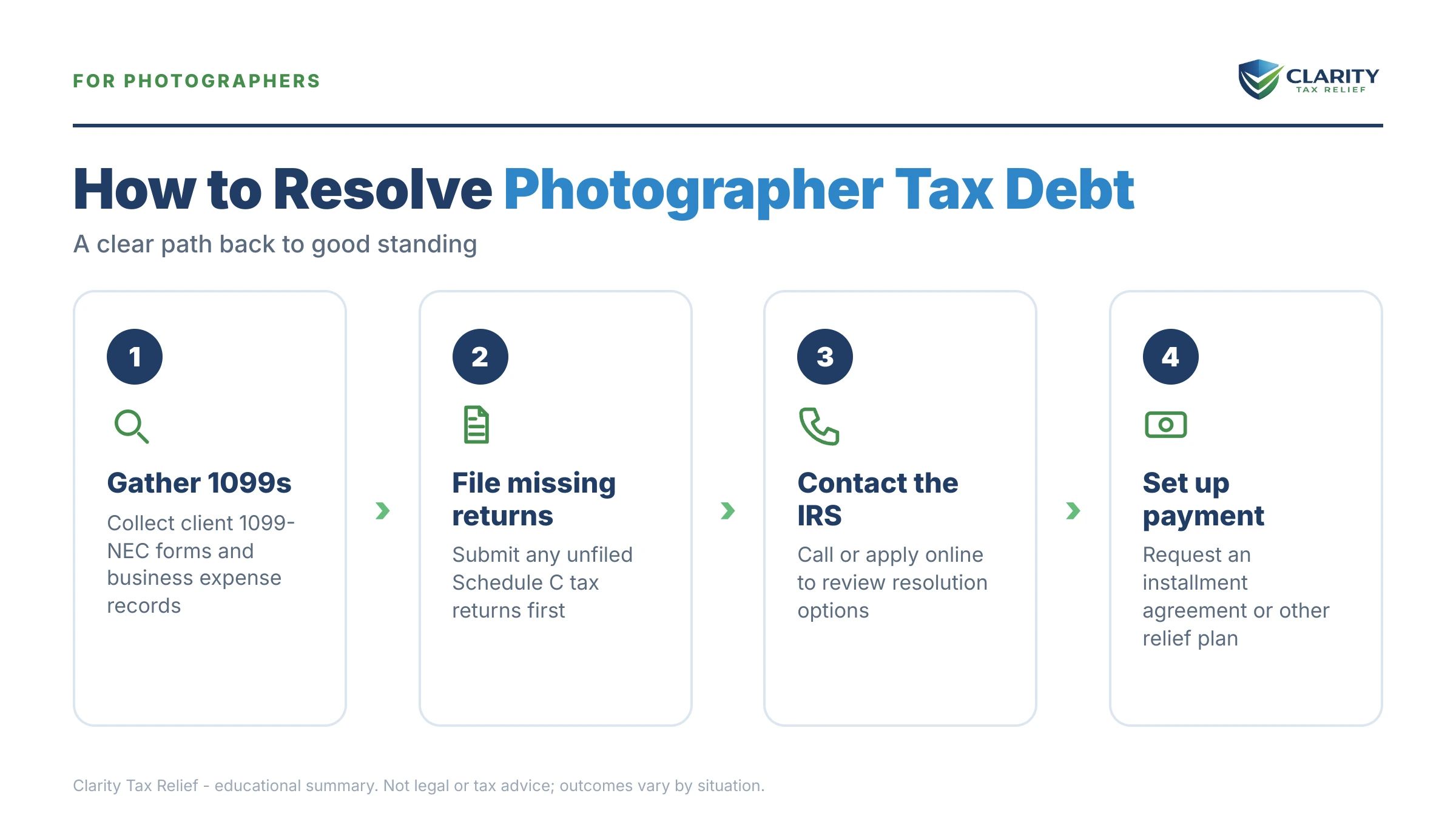
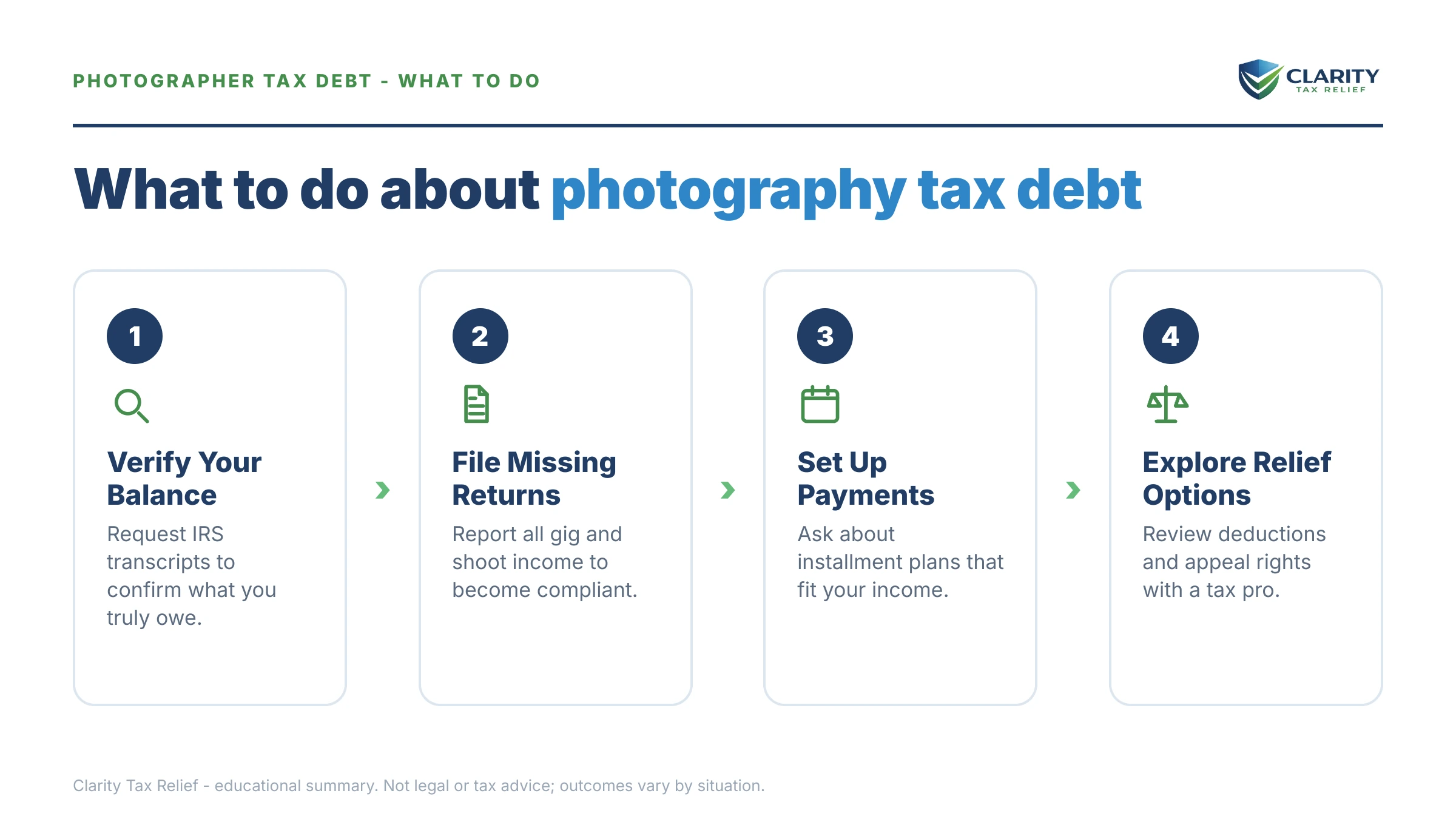
- Pull your IRS transcripts. Log into your IRS online account and download the wage-and-income and account transcripts for every year involved — they show every 1099-NEC and 1099-K the IRS holds and exactly what has been assessed against you.
- File every missing return. Prepare a real Schedule C for each unfiled year with mileage, depreciation, insurance, and second-shooter costs — your actual numbers almost always beat the IRS's estimates, and no resolution program will accept you with returns outstanding.
- Attack the penalties first. Request first-time abatement for the earliest qualifying year before locking in payment terms — every dollar of penalty removed shrinks the balance that every other option is calculated on.
- Set up your resolution. Choose the payment plan, hardship status, or offer that fits your numbers and get it in place before a final notice of intent to levy starts the 30-day levy clock.
- Fix the leak. Raise the withholding at your W-2 job or start quarterly estimated payments so next April doesn't rebuild the debt you just resolved.
For step 2, missing records are not a dead end: bank statements, calendar bookings, gallery-delivery logs, and mileage reconstruction can rebuild a defensible Schedule C — the method is in file back taxes without records, and IRS policy generally wants the last six years, per how many years of back taxes do i have to file. Payments and plan setup happen directly at IRS.gov/payments and the IRS payment plans page.
When you can handle this yourself — and when help changes the outcome
Plenty of photographer back-tax cases are genuinely DIY. If every return is filed, you agree with the balance, and you can either pay within 180 days or the total is under $50,000, you can set up your own plan online in an evening — no professional needed. A single year of penalties with a clean prior history is also a straightforward self-serve abatement request. And if the IRS is moving against you while money is truly tight, the Taxpayer Advocate Service is a free, independent resource.
Experienced help earns its cost in specific situations: multiple unfiled years where the IRS has already assessed substitute returns from gross 1099 totals; a balance over $50,000 where the Form 433-F presentation determines your monthly payment; a levy already in motion against your paycheck or a client; Offer in Compromise math, where asset valuation and allowable expenses decide everything; or payroll debt from employees, where personal liability is on the line. In those cases the order of operations — returns, then penalties, then terms — routinely changes the final number by thousands.
If your season is booked solid and untangling three years of Schedule C math isn't how you want to spend it, a free photographer tax debt review at (888) 825-7779 or through the 2-minute form will map the sequence in one call.
Photographer back taxes on your IRS transcript: codes decoded
Your IRS account transcript shows exactly where your photography tax debt sits in the collection pipeline — every assessment, penalty, hold, and status change carries a three-digit code. Pull the transcript for each year and read it against this table:
| Code | What it means | What to do |
|---|---|---|
| 150 | Return filed and tax assessed | Confirms the year is on file; this is the base balance everything else builds on |
| 806 | W-2/1099 withholding credited | Verify your day-job withholding posted; missing credits inflate the debt |
| 276 | Failure-to-pay penalty assessed | Count the months — this is the exact charge penalty abatement targets |
| 196 | Interest assessed | Accrues until paid; removing penalties also stops future interest on them |
| 570 | Hold on the account | Something is under review — confirm before assuming the balance is final |
| 971 | Notice issued | Match the transcript date to the letter in your mailbox to see what's coming |
| 582 | Federal tax lien indicator | A lien has been filed — it affects financing and gear loans; act before selling anything |
| 480 | Offer in Compromise pending | Collection generally pauses during review; keep estimated payments current |
| 530 | Currently Not Collectible | Hardship status is active; the debt remains and the 10-year clock keeps running |
Terms you'll see, decoded
- Self-employment tax — the 15.3% Social Security and Medicare tax on net Schedule C profit, owed on top of income tax.
- 1099-K — the form payment processors file reporting your gross card and app receipts once you pass $20,000 and 200 transactions.
- Reasonable collection potential (RCP) — the IRS's calculation of the most it could ever collect from you; the floor for any Offer in Compromise.
- Quick-sale value — the discounted value (roughly 80% of market) the IRS assigns your assets, including camera gear, in offer math.
- CSED — the collection statute expiration date: 10 years from assessment, though offers, appeals, and bankruptcy pause the clock.
- Lien vs. levy — a lien is a legal claim against everything you own; a levy is the actual taking of wages, bank funds, or client payments.
Photographer tax debt questions, answered
Do photographers have to pay self-employment tax?
Yes — net profit from photography reported on Schedule C is subject to 15.3% self-employment tax on top of regular income tax. That combination is why a profitable side business can generate a tax bill of 25 to 40 cents per dollar earned. The exception is true hobby income, which escapes self-employment tax but also loses all expense deductions.
Can the IRS take my camera equipment?
It's legally possible but rare — the IRS levies bank accounts, paychecks, and client payments first, because used gear is hard to seize and sell. Your equipment matters more in settlement math: the IRS counts your equity in bodies, lenses, and lighting at quick-sale value when it evaluates an Offer in Compromise.
I never got a 1099-K from Venmo or Square — do I still owe tax on that income?
Yes. Every dollar of photography income is taxable whether or not a form was issued. The 1099-K threshold reverted to $20,000 and 200 transactions, so fewer photographers receive the form now — but processors reported lower amounts in earlier years, and that data stays in IRS files and still drives matching notices for those years.
Can the IRS garnish my W-2 paycheck for photography tax debt?
Yes. Once the IRS sends a final notice of intent to levy (LT11 or Letter 1058) and 30 days pass, it can place a continuous levy on your day-job wages that stays in place until the debt is resolved or released. It can also send one-time levies to studios and clients who owe you money for completed work.
Will the IRS settle my photographer tax debt for less than I owe?
Only when the math supports it. The IRS accepted roughly one in five Offers in Compromise in FY2024, and acceptance depends on your income, expenses, and assets — not on hardship stories. A steady W-2 paycheck often raises your reasonable collection potential enough that a payment plan plus penalty abatement saves more than an offer would.
How many years of unfiled tax returns do I have to file?
IRS policy generally requires the last six years of returns to be considered compliant, though the IRS can demand more in some situations. File the oldest required years first, with a complete Schedule C for each — your real expenses almost always produce a lower balance than what the IRS estimates from raw 1099 totals.
Is my photography a business or a hobby to the IRS?
It depends on profit motive — regular bookings, marketing, separate accounts, and profit in some years point to a business. Business status means Schedule C deductions plus 15.3% self-employment tax; hobby status means the income is still taxable but expenses are not deductible at all under current law. Reclassification after years of claimed losses can create back taxes.
Can photographer tax debt affect my passport?
Yes, once it is certified as seriously delinquent — the threshold is $66,000 for 2026, including penalties and interest. Certification lets the State Department deny a passport application or renewal. Entering an installment agreement or having an Offer in Compromise accepted prevents certification or reverses it.
What if the IRS filed a substitute return for my photography income?
A substitute for return (SFR) is the IRS's version of your return, built from gross 1099 totals with no expenses, no gear costs, and no mileage. It nearly always overstates what you owe. Filing your own accurate return to replace it typically reduces the assessed balance and restarts your resolution options on a smaller number.
Your next 24 hours
- Find your real number. Log into your IRS online account and write down the assessed balance for each year — the total decides your options, and you need to know how close you sit to the $66,000 passport line.
- Gather your records. Your last filed return, every 1099-NEC and 1099-K, gear purchase receipts, your booking calendar, and any IRS letters — everything a resolution gets built from.
- Get your photographer tax debt reviewed free. Call (888) 825-7779 or use the 2-minute form — penalties and interest are adding to the balance every month, and the review costs nothing.
This guide is general information, not tax or legal advice for your specific situation. Eligibility for IRS programs depends on individual facts and circumstances; no outcome is guaranteed.