
State Tax Debt
Nebraska Back Taxes: How to Resolve Nebraska DOR and IRS Debt in 2026
The short answer: Nebraska back taxes are collected on two separate tracks — the Nebraska Department of Revenue for state income and sales tax, and the IRS for federal tax. Both charge interest that compounds monthly, both can garnish wages and file liens, and both offer payment plans — but their programs and rules are completely different.
You run your own business, you filed (or meant to file), and now there's a balance in Lincoln and another one with the IRS — and no employer withholding to quietly cover either. That's the most common Nebraska back-tax story we see, and it's fixable. The map below covers both collectors, in order.
⏱ Your real clock: there is no single statutory deadline on Nebraska back taxes — but the clock still runs. Interest accrues monthly on both your Nebraska DOR and IRS balances, and every notice either agency mails prints its own respond-by date. The date on your most recent notice is your real deadline.
Why you owe Nebraska back taxes
A Nebraska back-tax balance almost always starts with income that had no withholding attached. If you're a sole proprietor, every dollar of profit carries federal self-employment tax of 15.3% plus federal income tax plus Nebraska income tax — and none of it comes out automatically. Miss your quarterlies, and by filing time the combined bill can be five figures. Our guide to the self-employment-tax shock breaks down why the federal side balloons first.
On the state side, Nebraska's individual return — Form 1040N — is built directly from your federal figures. That means an unfiled or underpaid federal year almost always creates a matching Nebraska problem, and fixing one without the other leaves half the debt untouched.
If your business sells goods, there's a third layer: Nebraska sales and use tax, with a 5.5% state rate plus local rates in many cities. Sales tax you collected from customers but didn't remit is treated as trust money, and it's the debt the state pursues hardest — more on that in the escalation section below. Our sales tax debt help guide covers that category in depth.
One more 2026 wrinkle: the 1099-K reporting threshold reverted to $20,000 and 200 transactions, so fewer platform sellers will get forms going forward — but that reversion changes nothing about balances already assessed from earlier years. Old debt remains fully collectible.
Two collectors, one bank account: the Nebraska DOR vs. the IRS
Nebraska back taxes are enforced by two independent agencies that do not coordinate on your behalf — the Nebraska Department of Revenue and the IRS. Each has its own lien, its own garnishment power, its own payment programs, and its own timeline. Resolving one does not pause the other.
| Collection power | Nebraska DOR (state taxes) | IRS (federal taxes) |
|---|---|---|
| What it collects | Nebraska income tax (Form 1040N), sales & use tax, business taxes | Federal income tax, self-employment tax, payroll taxes |
| Tax lien | Yes — state tax lien, filed as a public record | Yes — federal tax lien attaches to everything you own |
| Wage garnishment | Yes, after notice and demand | Yes — continuous until released |
| Bank levy | Yes | Yes — 21-day hold before funds leave |
| Refund offset | Applies your Nebraska refund to your state balance | Keeps your federal refund — and can take your Nebraska refund too after a CP504 |
| Payment plans | Yes — arranged with the DOR, terms set case by case | Short-term up to 180 days ($0 setup); long-term up to 72 months online under $50,000 |
| Settle for less | No advertised OIC-style program — ask the DOR directly | Offer in Compromise — means-tested; roughly 1 in 5 accepted in FY2024 |
| Collection time limit | State-specific — never assume the federal rule applies | 10 years from assessment (the CSED), pausable by appeals, OIC, or bankruptcy |
The strategy question — which balance to attack first when you can't fund both — is its own decision framework. We cover it fully in state tax debt vs. IRS: which to resolve first; the short version is that you stabilize whichever agency is closest to enforcement, then set up arrangements with both.
What happens if you ignore Nebraska back taxes
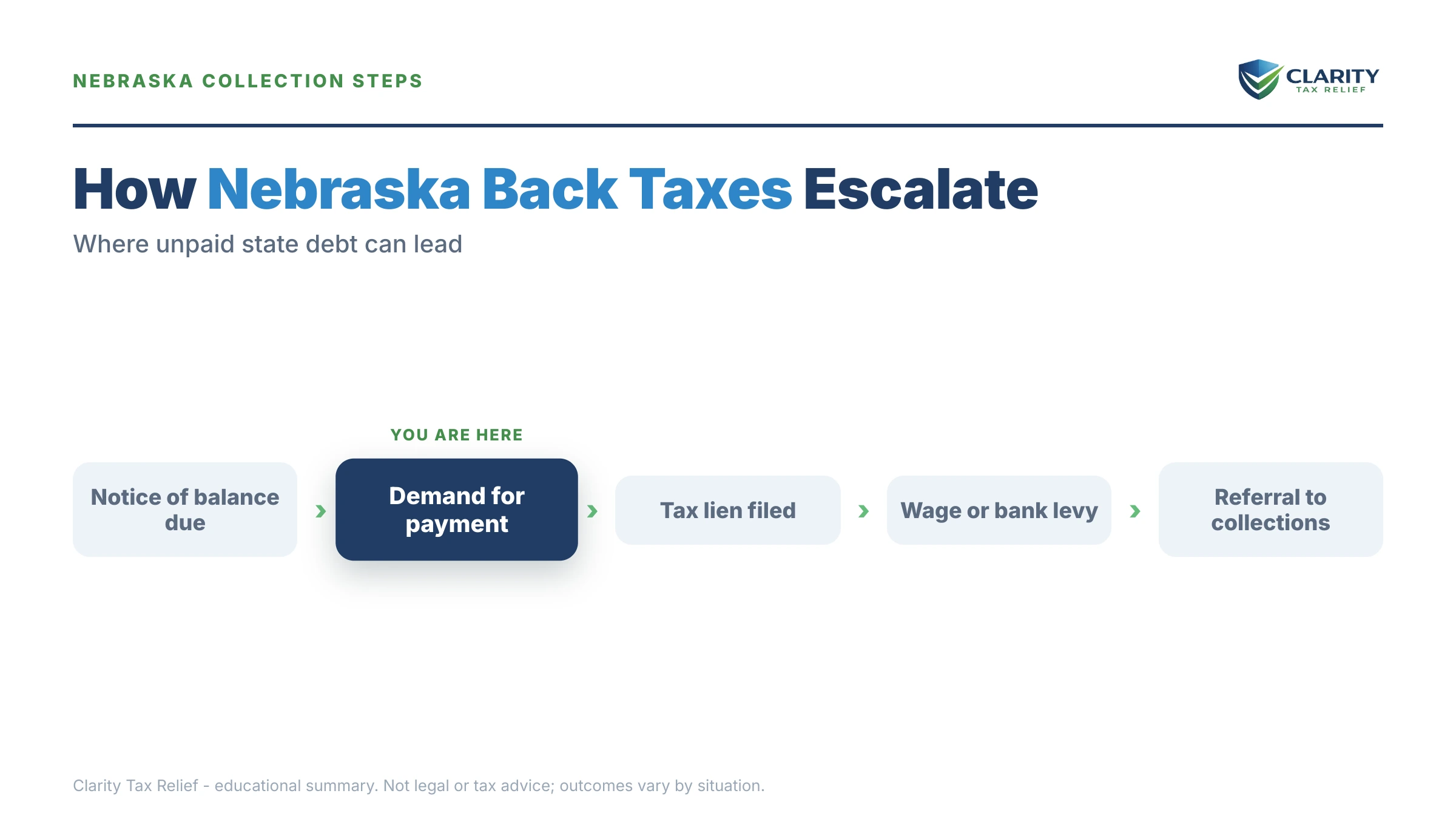
An unpaid Nebraska tax balance escalates through a fixed sequence on each track, and neither track requires a human to decide to escalate. Here's the order of operations if you do nothing:
On the Nebraska DOR track, the stages run in this order — the state doesn't publish a fixed day count for each step, so treat every printed date as live:
- Balance-due notice — the DOR's bill showing the year, tax, penalty, and interest it says you owe.
- Demand for payment — the warning that enforcement is next if the balance stays unresolved.
- State tax lien — a public-record claim against your property that surfaces in title searches and business credit checks.
- Bank levy and wage garnishment — the DOR takes funds directly; a garnishment generally continues until the debt is handled.
- For business owners: personal pursuit of trust taxes — unremitted sales tax follows the responsible individuals even after the business closes.
Two cautions about that state track. First, a state's notice chain is typically much shorter than the IRS's long letter sequence — don't assume you'll get five warnings. Second, refund interception is automatic: every future Nebraska refund gets applied to the balance until it's gone.
On the IRS track, the sequence and day counts are well established:
| Notice | What it means | Your window |
|---|---|---|
| CP14 | First bill for the balance due | Typically 21 days from the notice date |
| CP501 / CP503 | Reminder notices — balance grows monthly | The date printed on each notice |
| CP504 | Intent to levy — your Nebraska state refund is now reachable | 30 days per the notice |
| LT11 / Letter 1058 | Final notice of intent to levy, with appeal rights | 30 days to request a CDP hearing (Form 12153) |
| Levy | Wages, bank accounts, 1099 receivables | Bank levy: 21-day hold; wage levy: continuous |
Note the crossover at CP504: through the State Income Tax Levy Program, the IRS reaches into Nebraska and takes your state refund for a federal debt. Owing both agencies means your refunds are spoken for twice over.
And don't count on 2026 IRS staffing cuts to save you. The workforce is down roughly 27% since 2025, which makes the IRS harder to reach — but the notices, liens, and levies are generated by automated systems that never stopped running.
Behind on Nebraska and federal taxes?
Get your DOR and IRS notices reviewed free before a lien or garnishment lands. An experienced tax professional will map both balances and the smartest order to resolve them — no pressure, no obligation.
Your options for resolving Nebraska back taxes
Every Nebraska back-tax case resolves through some combination of the options below — one arrangement for the state balance, one for the federal. Here's the full menu with the eligibility lines that actually matter:
| Option | Debt it covers | Eligibility & cost |
|---|---|---|
| Pay in full | Either | Stops the penalty clock immediately; cheapest total cost |
| IRS short-term plan | IRS | Up to 180 days; $0 setup fee; interest and penalties continue |
| Streamlined installment agreement | IRS | Balance ≤ $50,000; up to 72 months, set up online; guaranteed installment agreement available at ≤ $10,000 |
| Currently Not Collectible | IRS | Must show allowable living expenses consume your income; collection pauses but debt and interest remain |
| Offer in Compromise | IRS | $205 fee plus 20% down on lump-sum offers (both waived with low-income certification, AGI ≤ 250% of poverty); strictly means-tested |
| Penalty abatement / AEP | IRS | First-time abatement with 3 clean prior years; Automatic Exemption from Penalty (AEP) begins rolling out summer 2026 — no request needed |
| Nebraska DOR payment plan | Nebraska | Arranged directly with the DOR; interest continues; separate from any IRS plan |
| Nebraska hardship handling | Nebraska | No advertised settlement program — negotiated case by case with the DOR |
A few option-specific notes. A streamlined installment agreement is the workhorse for most federal balances under $50,000 — no financial disclosure, set up online in an afternoon. Currently Not Collectible status fits when a bad year has genuinely wiped out your ability to pay anything. And an Offer in Compromise is real but narrow: the IRS runs the math on your assets and future income, and if that math says you can full-pay, the offer fails no matter how it's packaged. See how an offer in compromise actually works before spending money chasing one.
On penalties: if the year that started your problem is your first slip after three clean years, first-time penalty abatement can strip the federal failure-to-file and failure-to-pay penalties from that year — and starting summer 2026, the IRS's new Automatic Exemption from Penalty applies similar relief automatically. Nebraska's penalty relief is its own request to the DOR; never assume a federal abatement carries over.
A worked example: $19,700 in Nebraska back taxes
Say you're a sole proprietor who owes $19,700 total — $14,600 to the IRS and $5,100 to the Nebraska DOR — from two years of missed quarterlies. Here's the realistic math:
- Federal track: $14,600 is under $50,000, so a 72-month online installment agreement works — roughly $203/month at the minimum ($14,600 ÷ 72). But interest plus the 0.5%-per-month failure-to-pay penalty keep accruing, so a minimum-payment plan costs meaningfully more than $14,600 over its life. Paying $350–$400/month instead retires the debt years sooner and cuts the accrual sharply. You can model your own penalty and interest growth with our IRS Penalty & Interest Calculator.
- Offer in Compromise check: suppose you have $9,000 of equity in your work truck and about $600/month left after allowable expenses. The IRS's collection math comes to roughly $9,000 + ($600 × 12) = $16,200 of collection potential — more than the $14,600 owed. That means the IRS believes it can collect in full, and an OIC would be rejected. This is exactly why "settle for less" marketing fails most self-employed filers with steady income.
- Nebraska track: the $5,100 state balance needs its own arrangement with the DOR — call and set a plan before the demand stage. Expect any Nebraska refunds to be intercepted until it's paid.
- Penalty angle: if the older year was your first miss in three-plus years, first-time abatement on that year's federal penalties could remove hundreds of dollars from the balance before you ever start paying.
This example is hypothetical, but the shape is typical: two agreements, penalties trimmed where eligible, and quarterlies fixed going forward so the debt stops regenerating.
How to respond to Nebraska back taxes, step by step
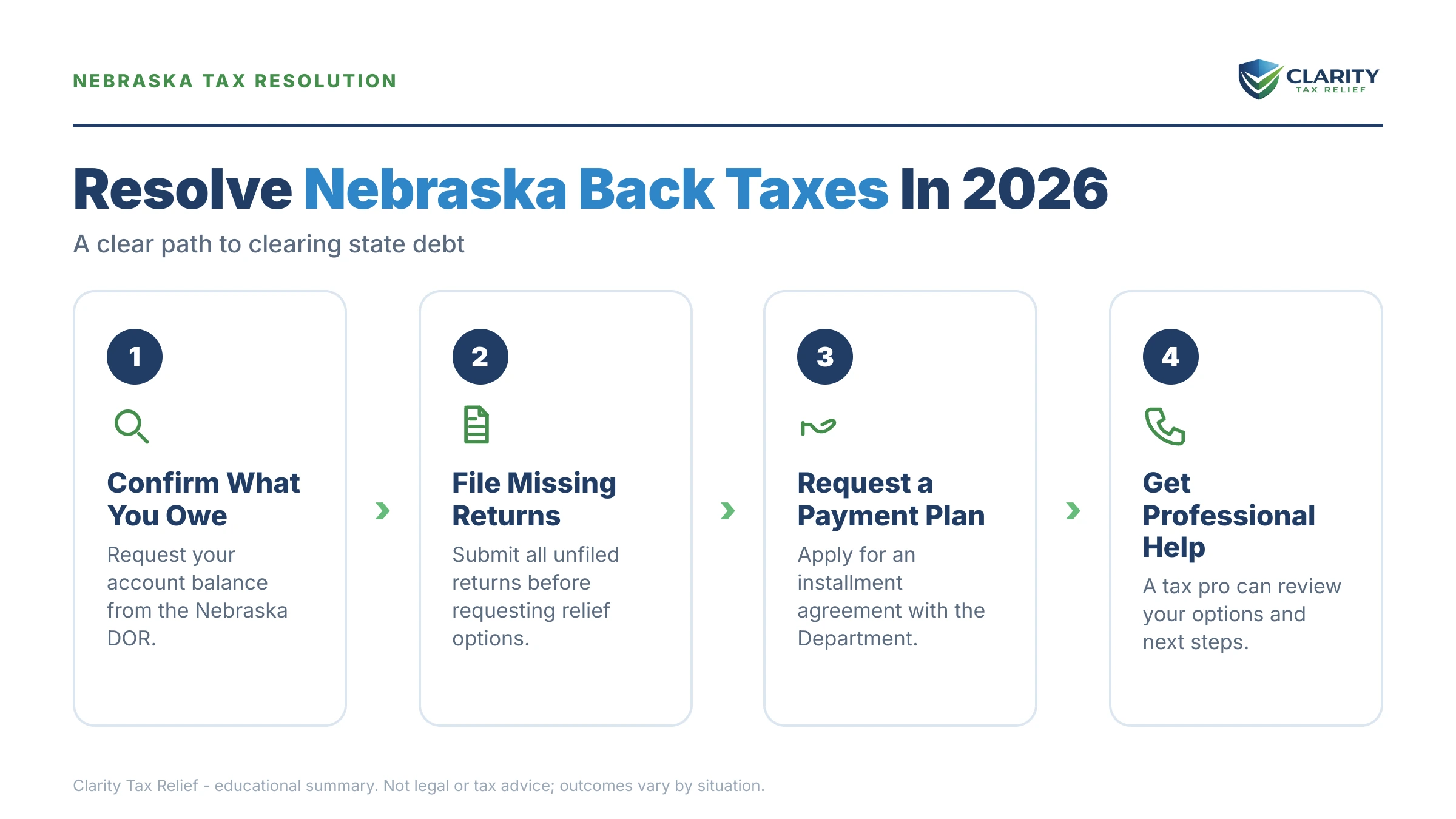
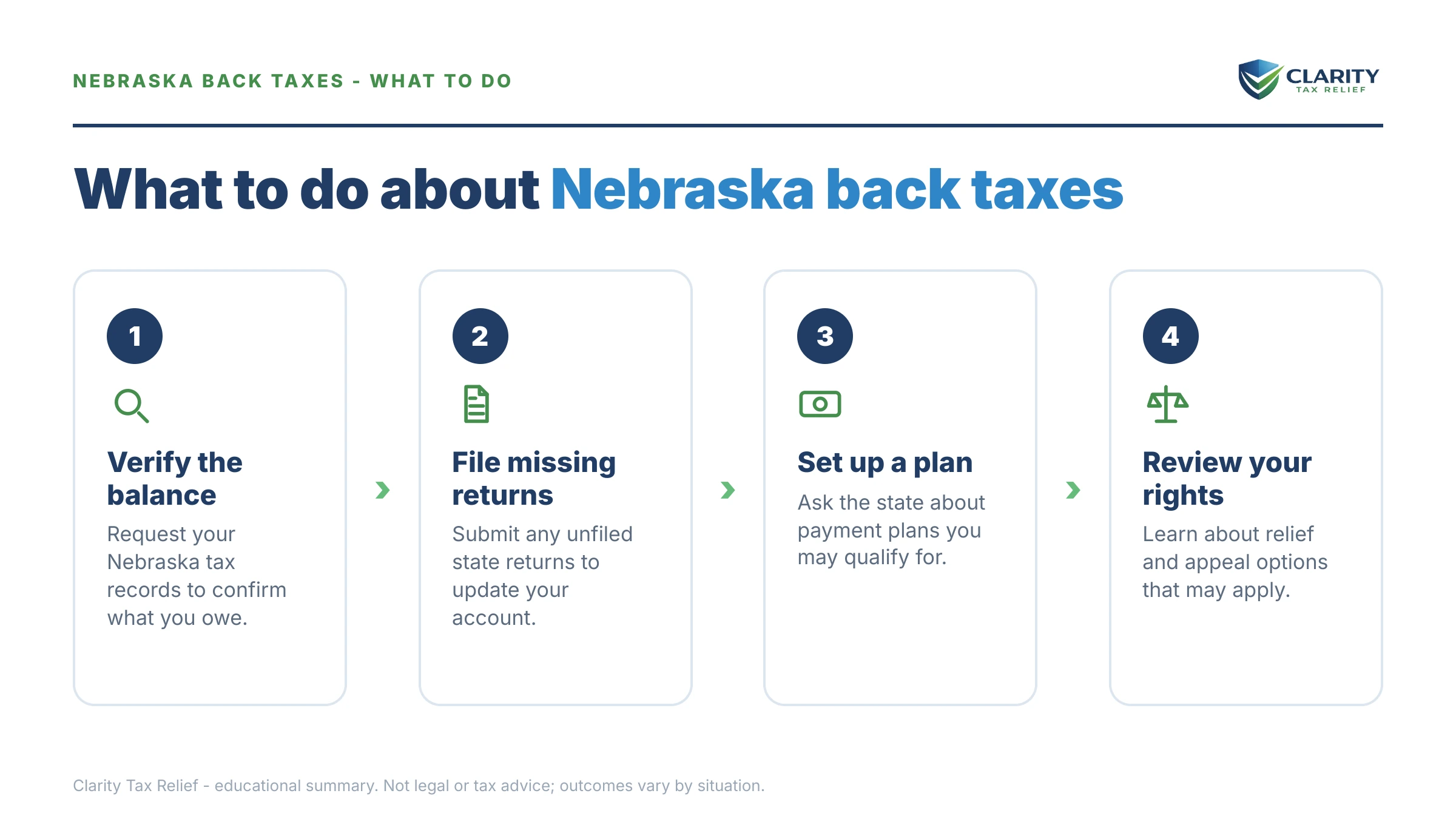
- Confirm both balances — Log into your IRS online account for the federal number, and gather every Nebraska DOR notice (or call the DOR) for the state number — broken down by year, tax, penalty, and interest.
- File every missing return — Prepare the federal returns first, then the Nebraska Form 1040N for each year, since the state return builds on your federal figures. Neither agency will approve a resolution while returns are missing.
- Stop new debt from forming — Set up 2026 quarterly estimated payments for both federal and Nebraska tax so this year doesn't get added to the pile.
- Choose a resolution track for each debt — Pick a payment plan, hardship status, or settlement path for the IRS balance, and contact the DOR to arrange the state balance — they are two separate agreements.
- Get a professional review if the case is complicated — If a garnishment has started, you owe sales tax, or multiple years are unfiled, have an experienced tax professional map the sequence before you commit to payments.
On step two: if you're several years behind, you generally don't need to file everything ever missed. The IRS's compliance standard is usually the last six years of returns — and Nebraska's returns follow from those same federal filings.
Self-employed in Nebraska: why your back taxes grow faster
Self-employed Nebraskans accumulate back taxes faster than W-2 earners because three separate taxes go unpaid at once: federal income tax, 15.3% self-employment tax, and Nebraska income tax. A W-2 employee who under-withholds misses one stream by a little; a sole proprietor who skips quarterlies misses all three by a lot.
The fix going forward is mechanical: four quarterly estimated payments a year, to each agency, sized off last year's liability. Getting current-year estimates running is also a practical requirement — the IRS can default a payment plan if you keep generating new balances, and the DOR takes the same dim view of a plan that's underwater before it starts.
Two more self-employed traps specific to Nebraska cases. If you sell taxable goods or services, keep the sales tax account current above everything else — collected-but-unremitted sales tax is the one state debt that reliably becomes personal, even through an LLC. And if a client levy is your fear: the IRS can serve a levy on your customers for your 1099 receivables, which is a one-time grab per payment but devastating to cash flow mid-project.
If your situation matches this section — 1099 income, a state and federal balance, quarterlies in arrears — a free review before you set up either plan usually changes the order of operations: request one here or call (888) 825-7779.
When you can handle this yourself
Plenty of Nebraska back-tax cases don't need professional help. You can confidently handle it alone when:
- Both balances are small and you can pay them off within about six months — pay the state directly and use the IRS's $0-setup short-term plan;
- You agree with the numbers, all your returns are filed, and you just need a straightforward monthly plan (the IRS online agreement takes minutes; the DOR plan is a phone call);
- Your only issue is a first-time penalty on an otherwise clean record — that abatement request is a simple ask.
Experienced help changes the outcome in a narrower set of situations: a garnishment or bank levy already in motion, sales tax or other trust-fund debt with personal liability on the line, multiple unfiled years across both agencies, or a hardship/OIC case where the financial-disclosure math decides everything. In those cases, the sequencing — which returns first, which agency first, which program first — is where money is won or lost, and it's worth getting right before the first payment goes out.
Terms on your Nebraska notices, decoded
- Assessment — the official act of putting a tax debt on the books; penalties and interest run from here.
- Tax lien — a public-record legal claim against your property securing the debt; it doesn't take anything by itself, but it clouds titles and credit checks.
- Levy / garnishment — the actual taking: a levy grabs bank funds or property, a garnishment diverts wages, and both agencies can use both tools.
- Trust tax — money you collected on the government's behalf (like sales tax); the state treats it as never yours, which is why responsible people can be pursued personally.
- Offset — a refund intercepted and applied to a debt instead of paid to you; both Nebraska and the IRS do this automatically.
- CSED — the federal Collection Statute Expiration Date, 10 years from assessment on IRS debt only; Nebraska runs on its own rules.
Nebraska back taxes: your questions, answered
Does Nebraska have a tax settlement program like the IRS Offer in Compromise?
Nebraska does not advertise a broad settle-for-less program the way the IRS advertises the Offer in Compromise. The federal OIC only resolves federal debt — the IRS accepted roughly 1 in 5 offers in FY2024, and acceptance is means-tested, never guaranteed. For a Nebraska balance, contact the Department of Revenue directly about payment plans or hardship handling rather than assuming a state settlement program exists.
Can the Nebraska Department of Revenue garnish my wages?
Yes. Once a balance goes unpaid after notice and demand, the Nebraska DOR can garnish wages, levy bank accounts, and file a state tax lien against your property. A wage garnishment generally continues until the debt is resolved or you set up an approved payment arrangement — which is why acting during the notice stage, before enforcement starts, matters so much.
Will Nebraska take my state tax refund for back taxes?
Yes — the DOR applies your Nebraska refund to your unpaid state balance before sending you anything. Your state refund is also exposed on the federal side: once the IRS issues a CP504, it can seize your Nebraska refund through the State Income Tax Levy Program. If you are owed a refund and carry debt to either agency, expect it to be intercepted.
How long can Nebraska collect back taxes?
Don't assume Nebraska's collection window matches the IRS's 10-year collection statute — states set their own rules, and state liens can extend how long a debt stays enforceable. The federal 10-year clock (the CSED) applies only to IRS debt, and even that clock pauses during appeals, an Offer in Compromise, or bankruptcy. For the exact status of an old Nebraska balance, confirm directly with the Department of Revenue.
Do I owe both Nebraska and the IRS if I haven't filed?
Usually, yes. Nebraska's individual return (Form 1040N) starts from your federal figures, so unfiled years typically mean two balances, two penalty streams, and two collection tracks. File the federal return first, then build the Nebraska return from it. The IRS generally wants the last six years of returns before it will consider you compliant enough to approve a resolution.
Can I set up a payment plan with the Nebraska Department of Revenue?
Yes. The DOR works out payment plans on delinquent balances, and getting one in place is the fastest way to stop enforcement from escalating on the state side. Interest continues to accrue while you pay. Nebraska's plan is completely separate from any IRS installment agreement — if you owe both agencies, you'll need to budget for two monthly payments.
Am I personally liable for Nebraska sales tax my business collected?
Very likely, yes. Sales tax you collect from customers is trust money — it was never yours — and Nebraska, like most states, can pursue the responsible individuals personally when a business fails to remit it, even after the business closes. Sales tax is typically the most aggressively collected state debt, and it generally cannot be walked away from by shutting the business down.
Should I pay Nebraska or the IRS first?
It depends on which agency is closer to enforcement and how the two balances compare — there is no universal answer. A common approach: stabilize whichever collector is actively garnishing or about to levy, then set up arrangements with both, because neither agency pauses just because you're paying the other. Our guide comparing state tax debt vs. IRS debt walks through the decision in detail.
What happens if I never pay my Nebraska back taxes?
The balance grows with interest while the DOR's tools escalate: a state tax lien on your property, garnished wages, levied bank accounts, and intercepted refunds year after year. For business owners, unresolved sales tax puts personal assets at risk even after the business closes. Unlike some debts, ignoring state tax debt does not reliably run out any clock you can count on.
Your next 24 hours
- Find the numbers. Pull the balance, tax year, and respond-by date off your most recent Nebraska DOR notice and your most recent IRS notice — those two printed dates are your working deadlines.
- Gather the file. Last year's federal and Nebraska returns, every notice from both agencies, and a rough picture of your monthly business income — that's everything needed to size a plan for each balance.
- Get the free review. Interest is compounding on both balances every month you wait. Have an experienced tax professional map the DOR and IRS tracks side by side — start with the 2-minute form or call (888) 825-7779.
Primary sources: the Nebraska Department of Revenue for state balances, notices, and payment arrangements; IRS.gov/payments to pay or view a federal balance; the IRS payment plans page for federal installment terms; and the Taxpayer Advocate Service if an IRS action is causing hardship the normal channels won't fix.
This guide is general information, not tax or legal advice for your specific situation. Eligibility for IRS programs depends on individual facts and circumstances; no outcome is guaranteed.