
State Back Taxes
Iowa Back Taxes: How to Resolve Iowa Department of Revenue Debt in 2026
The short answer: Iowa back taxes are collected by the Iowa Department of Revenue, which can file a tax lien, garnish wages, and levy bank accounts without suing you first — often faster than the IRS moves. A payment plan requested through the GovConnectIowa portal stops enforcement, but interest keeps accruing monthly until the balance is resolved.
Maybe the envelope from the Iowa Department of Revenue has been sitting on your kitchen counter for a week. If your newest notice mentions garnishment, levy, or lien — words the earlier ones didn't use — enforcement is likely getting closer. And even if you don't own a home, an Iowa lien can still attach to vehicles and other personal property, and Iowa's other tools reach exactly what you live on: your paycheck and your bank account. That's frightening, and it's also the moment when acting still changes everything — Iowa releases and prevents levies for people who engage, and this guide maps every route.
If you're not sure which Iowa letter you're actually holding, the image below shows what a Department of Revenue notice looks like and where to find the balance, the tax period, and the date that controls your response.
⏱ Your deadline: the response date printed on your Iowa notice controls — Iowa sets its windows notice by notice, not with one universal rule, so read yours. The clock that never pauses: interest accrues monthly on the full balance, at a rate Iowa resets each year, and any fraction of a month counts as a whole month.
Why you have Iowa back taxes in the first place
Iowa back taxes come from one of four places: a return you filed but couldn't pay, an adjustment Iowa made to your numbers, a year you never filed that Iowa assessed for you, or an unpaid business obligation like withholding or sales tax. Which one applies to you changes the fix — so identify it before you pay anything.
Filed but couldn't pay. The most common case. The balance is real, and the goal is structuring it before enforcement starts — penalties and interest are the only things still growing.
Iowa adjusted your return. Iowa and the IRS share information. If the IRS changed your federal return — a CP2000, an audit — Iowa often follows with its own assessment, sometimes a year or more later. Iowa's move to a flat individual income tax also caught taxpayers whose withholding never adjusted, producing surprise balances at filing.
You never filed. Iowa can estimate your tax from W-2s, 1099s, and federal data — without your deductions, credits, or correct filing status. These estimated assessments usually run high, which is why filing back taxes without records is almost always the first move: the real return often shrinks the balance before you negotiate anything.
Business trust taxes. If the debt is sales tax or employee withholding your business collected but didn't remit, Iowa treats it far more aggressively than income tax, and responsible individuals can be pursued personally. That path has its own playbook — see sales tax debt help — and it's the one category where you should not negotiate alone.
What happens if you ignore Iowa back taxes
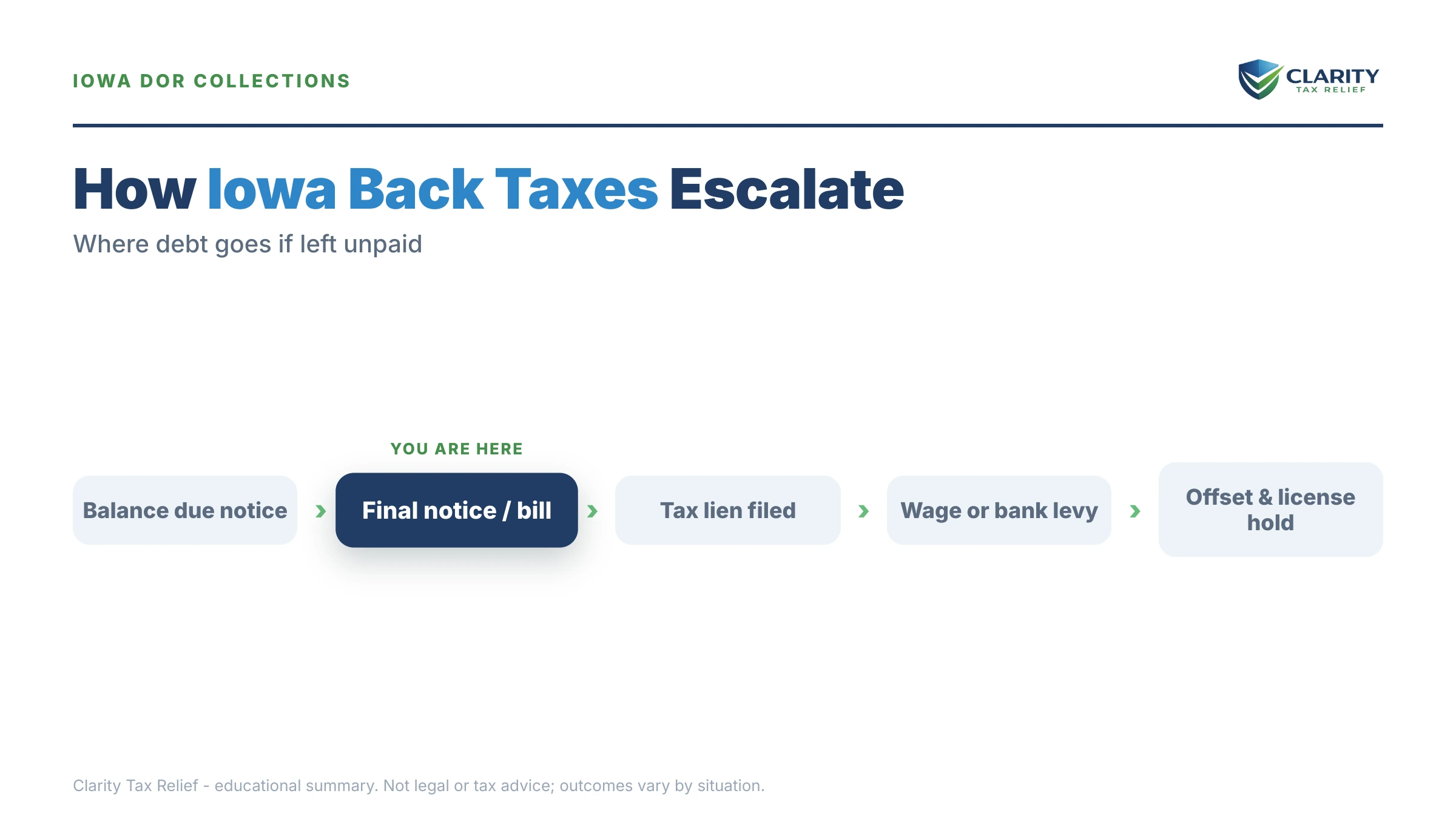
The Iowa Department of Revenue can garnish wages and levy bank accounts administratively — no lawsuit and no court judgment required — once a final assessment goes unpaid. The sequence below is how an unanswered Iowa bill becomes money leaving your account. The stages are fixed; the pace varies by case, so treat the date on your own notice (the image shows where it sits) as the only timeline that matters.
- Assessment and billing notice. Iowa records the balance and mails a bill showing tax, penalty, and interest by period. There's also a short protest window printed on an assessment itself — miss it and the amount becomes final even if it's wrong.
- Demand for payment. Follow-up notices arrive with firmer language. Interest has compounded monthly since the first bill. This is the last cheap moment: a payment plan set up here prevents everything below.
- Tax lien. Iowa files a lien in the county records — a public claim against everything you own or later acquire. For a renter it doesn't take anything today, but it damages financing, security-clearance checks, and some job screens, and it tells you enforcement is next.
- Wage garnishment and bank levy. Iowa orders your employer to divert part of each paycheck and orders your bank to freeze and surrender funds. A garnishment continues pay period after pay period until the debt is resolved or replaced with an arrangement.
- Distress warrant and remaining tools. Iowa can issue a distress warrant — a seizure order that can be delivered to the county sheriff to take property. Alongside everything above, Iowa keeps your state refund every year, may request a federal refund offset through the Treasury Offset Program, and Iowa law allows license sanctions for unresolved state debt in some cases.
One 2026 reality check: state collection systems are automated, just like the IRS's. Nobody at the Department is deciding you deserve a garnishment — the system escalates on schedule, and it de-escalates the moment an arrangement is in place.
Facing an Iowa garnishment or levy right now?
Once Iowa reaches your paycheck or bank account, every pay cycle you wait is money gone — and interest is compounding monthly on top of it. Send us your Iowa notice and an experienced tax professional will map your fastest release path, free and confidential.
Your options for resolving Iowa back taxes
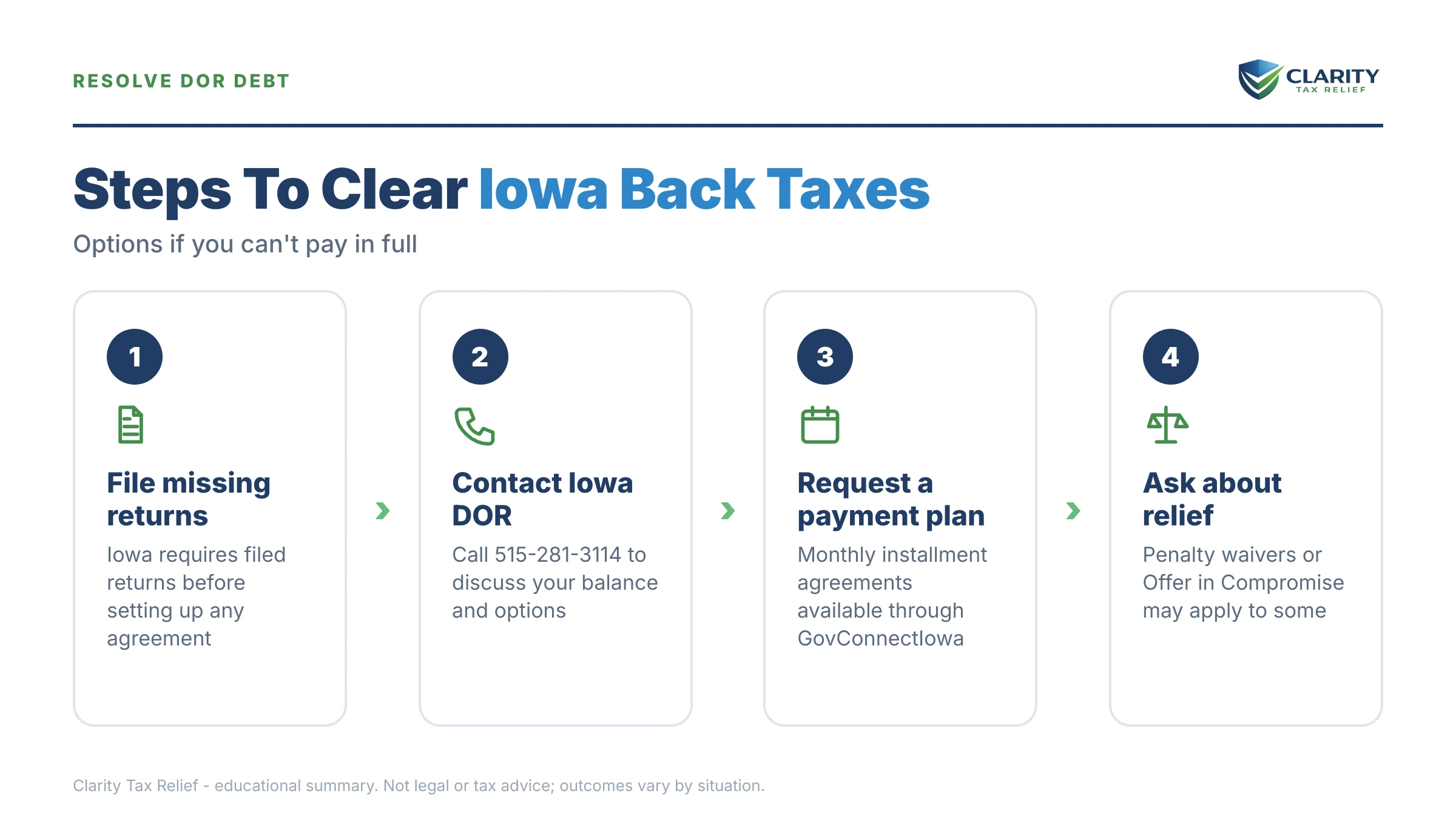
Iowa offers full payment, payment plans, penalty waivers for reasons listed in Iowa law, hardship consideration, and case-by-case settlement — every one of them requires your missing returns filed first. Here's what each option demands and who it fits:
| Option | Best for | What Iowa requires |
|---|---|---|
| Pay in full | Balances you can cover without hardship | Payment through GovConnectIowa or by mail; stops further interest and all enforcement |
| Payment plan | Steady income, balance too big to pay at once | Request via GovConnectIowa or collections; all returns filed; larger balances need financial disclosure; interest continues |
| Penalty waiver | Late penalties caused by circumstances listed in Iowa law | A written request with documentation; Iowa waives penalties only for statutory reasons, not because you ask nicely |
| Hardship / suspended collection | Income that can't cover basic living costs plus any payment | Full financial disclosure; the debt remains and interest accrues, but active enforcement can pause |
| Settlement (case-by-case) | Debt your assets and income genuinely can never cover, or a disputed liability | Discretionary — complete financials, no standing program like the federal OIC; approvals are not routine |
| Protest / appeal the assessment | Balances that are simply wrong (residency, estimated assessments, IRS-adjustment errors) | A written protest within the window printed on the assessment; after it closes, the amount is final |
What each path costs you — in dollars and in time — differs more than the eligibility rules do:
| Option | What it costs | Typical timeline |
|---|---|---|
| Pay in full | The balance — but interest stops the day it posts | Days; enforcement ends almost immediately |
| Payment plan | Monthly payment plus interest accruing on the shrinking balance | Setup in days to weeks online; runs until paid off |
| Penalty waiver | Time and documentation; can remove the penalty layer entirely if a statutory reason fits | Weeks to months for a written decision |
| Hardship / settlement | Full financial disclosure; settlement may require a lump sum you can document | Months — Iowa reviews these individually, not by formula |
| Do nothing | Interest monthly, penalties, then lien, garnishment, levy, refund offsets | Escalation continues automatically until the debt is resolved |
How to respond to Iowa back taxes, step by step
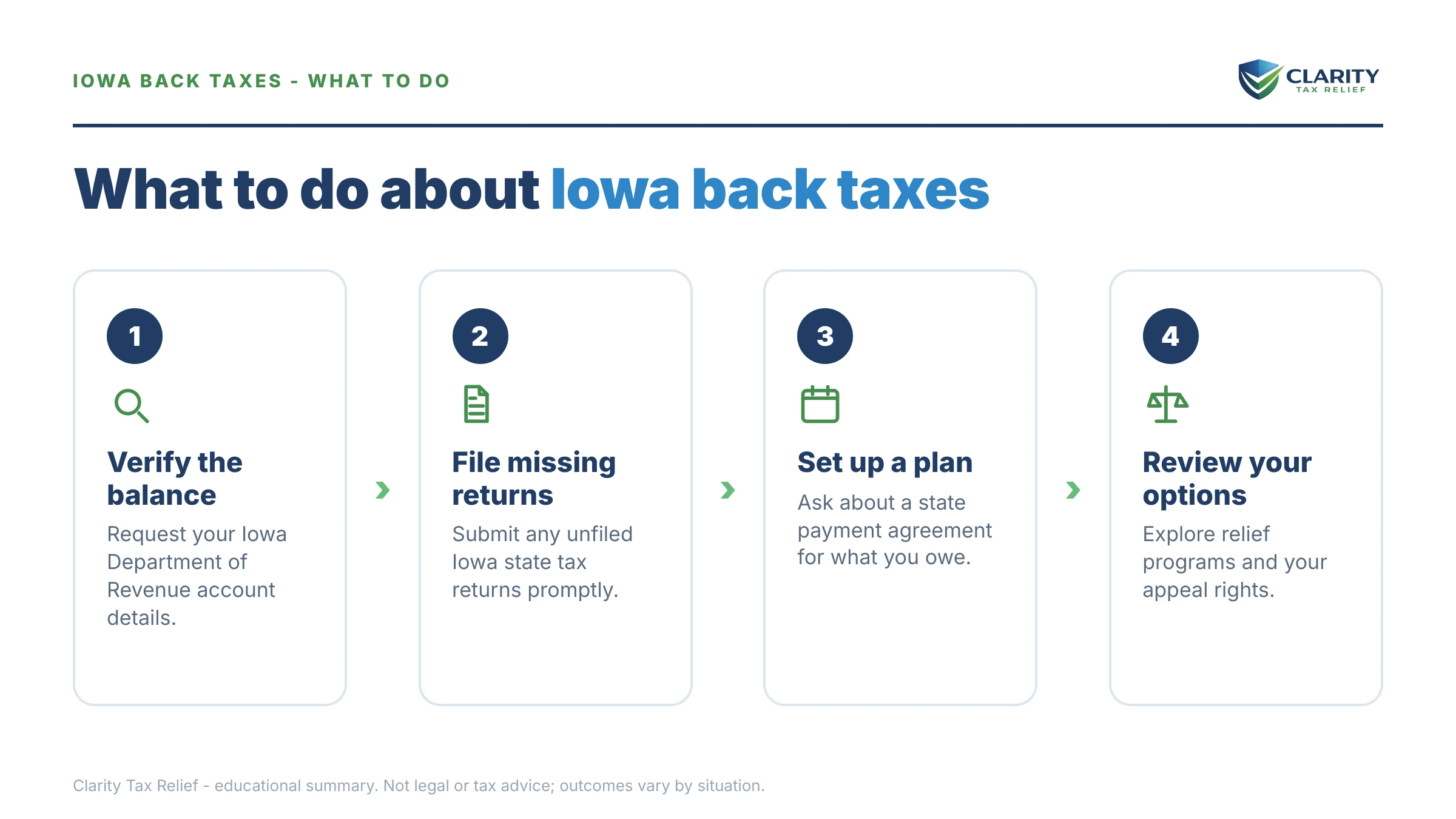
- Confirm what Iowa says you owe. Create or log in to a GovConnectIowa account, or call the Department of Revenue, and pull your balance by tax year — verify the tax, penalty, and interest breakdown before paying anything.
- File every missing Iowa return. If any year is unfiled, file the real return first — Iowa's estimated assessments usually overstate what you owe, and no plan gets approved while required returns are missing.
- Stop the enforcement in motion. If a garnishment, levy, or lien notice has arrived, contact Iowa collections before the date printed on it and ask exactly what arrangement releases or prevents that action.
- Choose and set up your resolution. Pay in full if you can; otherwise request a payment plan through GovConnectIowa, ask about a penalty waiver, or raise hardship or settlement if your documented finances support it.
- Get a professional review for large or levy-stage debt. If you owe five figures or more, have multiple unfiled years, or a levy is active, have an experienced tax professional review the account before you commit to terms.
What resolving $76,400 in Iowa back taxes actually looks like
A worked example makes the trade-offs concrete. Say you owe Iowa $76,400 across four tax years — you rent, take home about $4,600 a month, and a garnishment notice just arrived. Every number here is hypothetical, but the arithmetic is the arithmetic:
- Straight payment plan: $76,400 over 36 months is roughly $2,122 a month before the interest that keeps accruing on the unpaid balance. Against $4,600 of take-home pay and rent, that's not a budget — it's a default waiting to happen, and a defaulted plan puts the garnishment right back.
- Longer term with financial disclosure: spread over 72 months, the same balance is about $1,061 a month plus accruing interest. Iowa isn't obligated to grant any particular term — a balance this size means opening your finances — but a payment the Department can see you sustaining beats an aggressive one you'll miss.
- Shrink the balance first: suppose two of the four years were estimated assessments because you never filed, and Iowa's estimates ignored your filing status and deductions. If filing the actual returns knocks those years from $31,000 down to $19,000, the total drops to $64,400 — about $894 a month over 72 months. Filing first changed the monthly payment more than any negotiation would.
- Hardship or settlement: if documented essentials genuinely consume your income and you own nothing Iowa could reach, suspended collection or a discretionary settlement enters the picture. Both demand complete financials, and neither is granted routinely — but for a renter with no assets and modest income, they're the honest endgame to evaluate, not a marketing slogan.
The sequence matters as much as the option: returns first, enforcement stopped second, structure third. Do it in reverse and you'll negotiate a payment against a balance that was never right.
When you owe Iowa and the IRS at the same time
Iowa and federal balances usually travel together, because the same bad year produced both — and the two agencies collect on independent tracks that occasionally collide. The general rule: stabilize whichever agency is closer to taking money first, and the full decision framework lives in our guide to state tax debt vs IRS — which to resolve first.
Three collisions specific to an Iowa case. First, the IRS can seize your Iowa refund for a federal debt through the State Income Tax Levy Program, and Iowa can reach a federal refund the other direction — a state refund taken for IRS debt surprises Iowans every spring. Second, an IRS adjustment you never reported to Iowa can spawn a fresh Iowa assessment years later, so resolving the federal side without checking Des Moines leaves a landmine. Third, your budget is one pot: an Iowa payment plan you agree to today is money the IRS will still expect room for tomorrow, so set both payments as one plan, not two.
On the federal side, a balance under $50,000 can usually be handled when you set up an IRS payment plan online over up to 72 months — and if you're wondering how fast that federal balance is growing while you deal with Iowa, you can estimate it with our IRS Penalty & Interest Calculator. For where a federal debt sits in the enforcement ladder, the IRS collection process step by step guide covers the whole sequence.
When you can handle Iowa back taxes yourself
Plenty of Iowa cases don't need professional help, and you should know honestly which kind yours is. Handle it yourself when the balance is small enough to pay within a few months, you agree with the numbers, all your returns are filed, and no enforcement notice has arrived — GovConnectIowa exists precisely so you can see the balance and request a plan without calling anyone.
Experienced help changes outcomes in a narrower set of situations: a garnishment or bank levy already in motion, where release speed is measured in pay cycles; multiple unfiled years sitting under inflated estimated assessments; a five-figure or larger balance where the plan terms Iowa first offers aren't the terms your budget can survive; business withholding or sales tax with personal liability exposure; and any case where you owe Iowa and the IRS simultaneously and one agreement will squeeze the other. In those cases the fee buys sequencing and negotiation you can't easily replicate on a first phone call — if you're weighing it locally, our tax relief in Des Moines guide covers what to expect.
If your Iowa notice already has an enforcement date on it and you'd rather not decode it alone, a free case review takes about two minutes to start — request it here or call (888) 825-7779.
Terms on your Iowa notice, decoded
Iowa's collection letters use a handful of terms worth knowing precisely:
- Assessment — Iowa's formal recording of what it says you owe for a tax period; once final, it's collectible.
- Tax lien — a public claim filed in county records against your property; it secures the debt but doesn't take anything by itself.
- Garnishment vs. levy — a garnishment diverts part of each paycheck continuously; a levy seizes what's in an account or asset at a point in time.
- Distress warrant — Iowa's seizure order, which can be delivered to a county sheriff to take property for unpaid tax.
- Offset — the interception of a refund or other government payment and its application to your balance.
- GovConnectIowa — the Department of Revenue's online portal, where you can view balances, make payments, and request payment plans.
Iowa DOR vs. the IRS: how the two collectors differ
Iowa is a smaller collector than the IRS, but on several fronts it moves faster and forgives less — never assume a federal rule applies to your Iowa balance.
| Feature | Iowa DOR | IRS |
|---|---|---|
| Online account | GovConnectIowa | IRS Online Account |
| Payment plans | Requested online or through collections; terms set case by case, larger balances need financials | Up to 72 months online for balances of $50,000 or less; up to 180 days short-term at $0 setup |
| Settling for less | Discretionary, case-by-case; no standing program | Offer in Compromise: $205 fee, roughly 1 in 5 accepted in FY2024 |
| Collection window | Set by Iowa law — not the federal 10-year rule; don't assume it expires | 10 years from assessment (CSED), pausable by appeals, an OIC, or bankruptcy |
| Signature enforcement | Lien, garnishment, bank levy, distress warrant via sheriff, refund offsets | Lien, levy, garnishment, plus passport certification above $66,000 (2026) |
Iowa back taxes: your questions answered
Does Iowa offer a payment plan for back taxes?
Yes — the Iowa Department of Revenue accepts payment plan requests through its GovConnectIowa portal or through its collections unit. Interest continues to accrue monthly while you pay, and the Department sets the term based on your balance and finances. Larger balances usually require financial disclosure before a plan is approved, and missing a payment can put enforcement back in motion.
Can the Iowa Department of Revenue garnish my wages?
Yes. Once your Iowa balance is final and billing notices have gone unanswered, the Department can garnish wages and levy bank accounts without suing you first. A garnishment continues until the debt is resolved or replaced with a payment arrangement. If a garnishment or levy is already in motion, contact the Department — or an experienced tax professional — immediately; waiting only lets more paychecks get taken.
Does Iowa have an offer in compromise to settle tax debt for less?
Iowa handles settlement case by case rather than through a standing program like the federal Offer in Compromise. The Department has discretion to accept less than the full balance when your finances genuinely cannot cover the debt or the liability itself is in doubt, but approvals are not routine. You will need complete financial documentation, and you should never assume settlement is available before verifying your numbers.
How long can Iowa collect back taxes?
Iowa's collection window is set by Iowa law and is not the same as the IRS's 10-year federal collection statute — don't assume the federal clock applies to your Iowa balance. Once Iowa files a tax lien or issues a distress warrant, collection can continue for many years. Waiting out an Iowa debt is not a realistic strategy, because interest accrues monthly the entire time.
Will Iowa take my state or federal tax refund for back taxes?
Iowa will keep your state refund and apply it to your balance until the debt is resolved. Iowa may also request an offset of your federal refund through the Treasury Offset Program for state income tax debt. A refund offset does not replace the need to resolve the balance — it is applied on top of whatever plan or enforcement is already in place.
What happens if I never filed Iowa tax returns?
Iowa can assess tax based on the income information it already has — W-2s, 1099s, and federal data — without your deductions or credits, which usually produces an inflated balance. Filing the actual returns is almost always step one, because it can shrink the assessed amount before you negotiate payment. The Department will not typically approve a payment plan or settlement while required returns are missing.
Can Iowa levy my bank account without warning?
By the time a bank levy happens, Iowa has already sent billing notices to your address on file — but if you moved and never updated it, the levy can feel like it came from nowhere. Once funds are frozen, act the same day: verify the debt, contact the Department, and ask what arrangement will release or prevent further levies. Every pay cycle you wait is money you may not get back.
I moved out of Iowa — do I still owe Iowa back taxes?
Yes. Leaving the state does not erase a final Iowa assessment. Iowa can still keep refunds, pursue offsets, and use collection tools that reach across state lines, and a filed lien stays in the public record. If part of the balance comes from a year you weren't actually an Iowa resident, that is a residency dispute worth raising — but it must be raised, not assumed.
Should I pay Iowa or the IRS first if I owe both?
It depends on which agency is closer to taking money — a levy in motion outranks a notice in the mail. State agencies often move from notice to garnishment faster than the IRS, but the IRS has bigger long-term tools, like passport certification once a federal debt tops $66,000 in 2026. In most two-agency cases you stabilize the one about to levy first, then structure the other.
Does Iowa charge penalties and interest on back taxes?
Yes. Iowa adds separate late-filing and late-payment penalties, plus interest at a rate the state resets each year — charged by the month, with any fraction of a month counted as a full month. Penalties can be waived only for reasons listed in Iowa law, and you must request the waiver with documentation. Interest generally continues even while a payment plan is active.
Your next 24 hours
- Find the controlling date and balance on your Iowa notice. The response date and the balance by tax period are printed on the notice itself — that date, not any general rule, is your deadline.
- Gather your last filed Iowa and federal returns, every Iowa notice you've received, and your current income proof (recent pay stubs or bank statements). These are what any plan, waiver, or hardship request will be built from.
- Get your Iowa notice reviewed free. If a garnishment or levy is in motion, the review is where the release path starts — request your free case review or call (888) 825-7779. Interest is compounding monthly either way; the balance only moves in one direction until you act.
Primary sources for this guide: the Iowa Department of Revenue (balances, GovConnectIowa, payment plan requests, and current penalty and interest rules), the IRS payments page, and the IRS payment plans page for the federal side of a two-agency case.
This guide is general information, not tax or legal advice for your specific situation. Eligibility for IRS programs depends on individual facts and circumstances; no outcome is guaranteed.