
City Tax Relief Guides
Tax Relief Des Moines: How to Resolve IRS and Iowa Tax Debt in 2026
The short answer: tax relief in Des Moines means matching your balance to a real program — IRS payment plans of up to 72 months, hardship (Currently Not Collectible) status, penalty abatement, or an Offer in Compromise if you genuinely can't pay — plus separate Iowa Department of Revenue options for any state debt. Most balances under $50,000 can be resolved online.
Maybe you invoiced clients across the metro all year — no employer, no withholding — and the return you just filed shows a balance instead of a refund. Or the IRS envelopes have been landing at your Beaverdale or Ankeny address for months and the number keeps climbing. Either way, the fix isn't a late-night radio ad promising to erase the debt. It's matching your numbers to a real program, and that part is very doable.
⏱ The real clock: tax debt has no single deadline — but the IRS failure-to-pay penalty adds 0.5% of your balance every month, with interest compounding on top, until a resolution is in place. On a $4,800 balance, that's roughly $24 a month in penalty alone, before interest.
Why Des Moines taxpayers end up owing back taxes
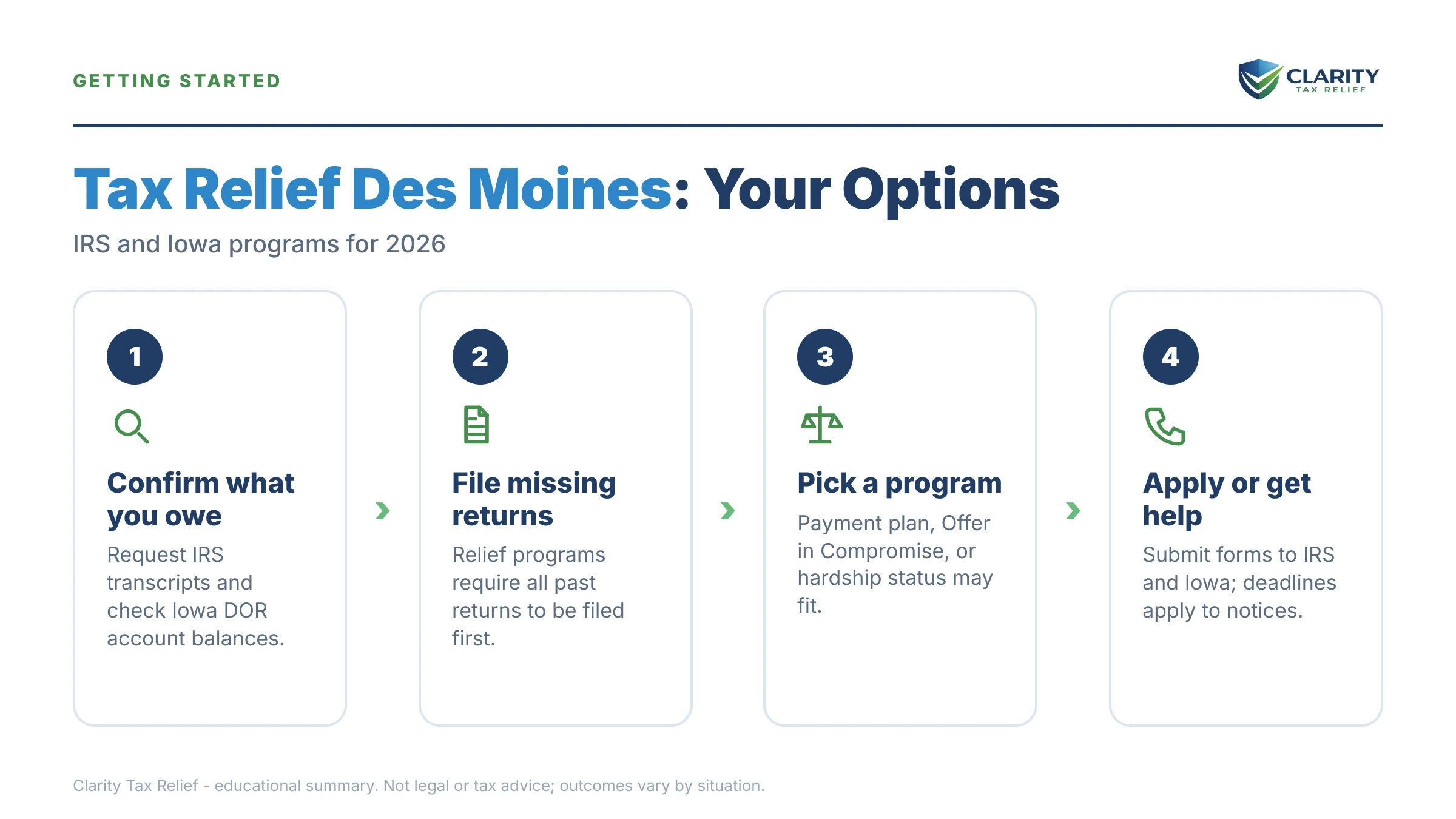
Des Moines taxpayers face a two-agency problem: the IRS and the Iowa Department of Revenue — headquartered right here in Des Moines — each collect on their own track, with their own notices and their own programs. Resolving one does nothing about the other.
The metro's biggest employers — insurance, banking, healthcare — withhold taxes from every paycheck, so most W-2 workers never see a balance due. The debt problem concentrates in everyone else: construction subs and tradespeople paid on 1099, delivery and rideshare drivers, real estate agents, consultants serving the insurance corridor, and side-hustle sellers. No withholding means the tax is entirely on you, and self-employment tax adds roughly 15.3% on top of income tax — the classic first year self-employed owing taxes shock. A W-2G from a good night at Prairie Meadows produces the same surprise for plenty of Polk County filers.
The other common path is quarterly drift: skipping estimated payments all year because cash was tight, then meeting the full bill in April. If that's you, our guide to how quarterly estimated taxes work shows how to stop the cycle after you fix this year's balance.
What happens if you ignore IRS tax debt in Des Moines
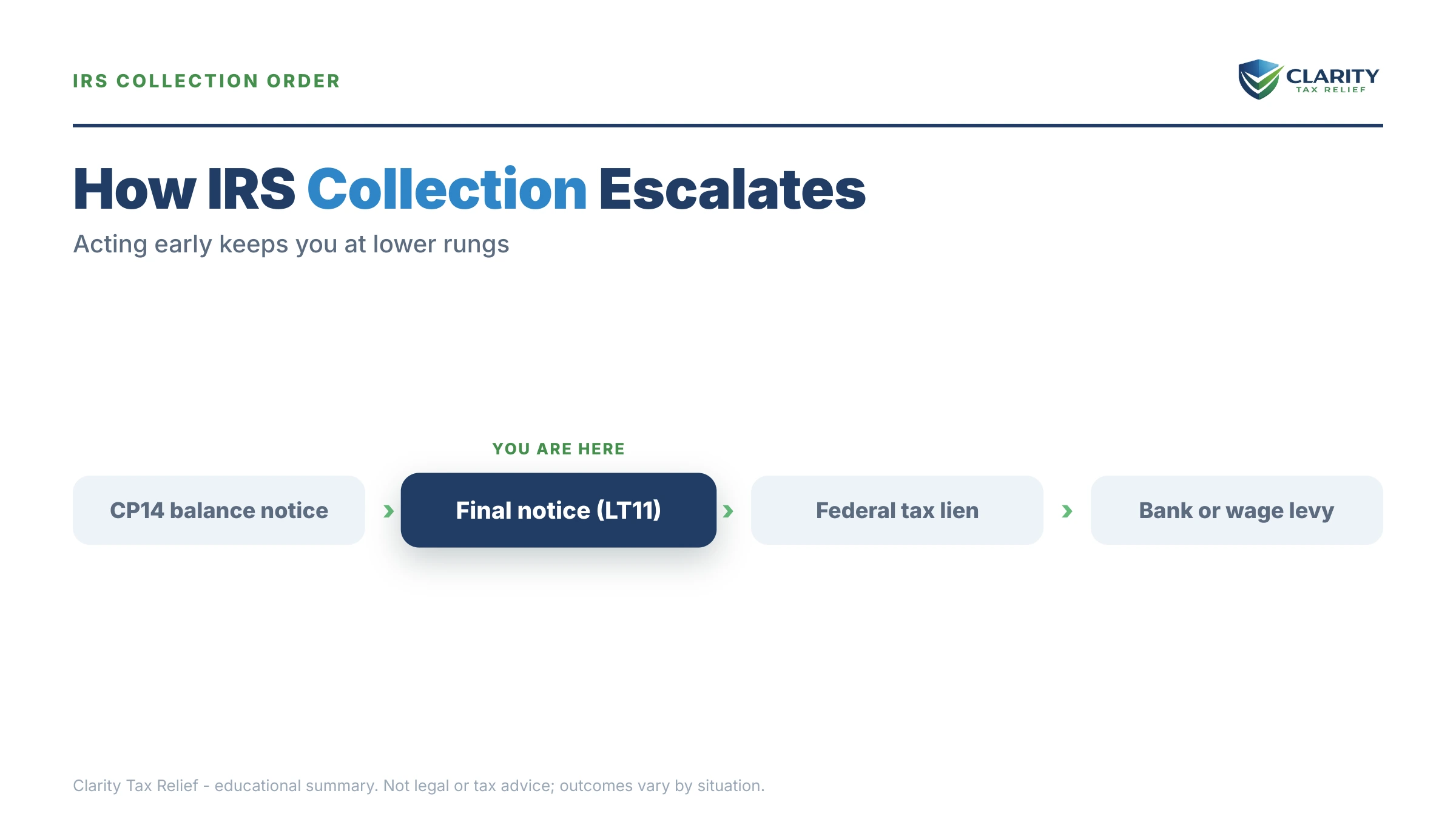
IRS collection escalates in a fixed, automated sequence — and in 2026, with the IRS workforce down roughly 27% after the 2025 cuts, the notices still go out on schedule even when no human answers the phone. Here's the order:
- CP14 — the first bill. You typically have about 21 days from the notice date before the reminder cycle starts. No enforcement yet; this is the cheapest moment to act.
- CP501 / CP503 — reminders. Still just bills, but the balance compounds monthly while they arrive.
- CP504 — intent to levy your state refund. The IRS can now seize your Iowa income tax refund through the State Income Tax Levy Program — usually the first asset it actually takes.
- LT11 / Letter 1058 — final notice of intent to levy. A 30-day clock starts on your Collection Due Process rights (requested on Form 12153). This is your last structured chance to stop a levy before it happens.
- Levy. A bank levy freezes funds with a 21-day hold before the money leaves; a wage levy on a W-2 paycheck is continuous until released. For larger debts, passport certification kicks in at $66,000 in 2026.
Each window in that sequence protects a specific right. Here's what each one is worth:
| Notice | Response window | What you lose if it passes |
|---|---|---|
| CP14 (first bill) | Typically 21 days from the notice date | The cheapest, quietest resolution point — reminders and penalties keep stacking after it |
| CP504 (intent to levy) | 30 days | Your Iowa state refund becomes seizable, and a federal tax lien filing gets more likely |
| LT11 / Letter 1058 (final notice) | 30 days | Your right to a Collection Due Process hearing (Form 12153) before bank and wage levies begin |
| CP523 (defaulted payment plan) | The date printed on the notice | Your installment agreement terminates and full collection resumes where it left off |
IRS or Iowa notices stacking up at your Des Moines address?
Get your exact position reviewed free — which notice you're on, what the next one costs you, and which program your numbers actually fit. Penalties and interest accrue monthly until a resolution is in place, so the review is worth doing this week, not next month.
Tax relief options in Des Moines: what you may actually qualify for
Every legitimate tax relief outcome in Des Moines runs through the same handful of IRS programs — the only question is which one your income, assets, and balance fit. The full DIY mechanics of each live in our guide to how to settle tax debt yourself; here's the eligibility map:
| Option | Typical eligibility | Setup cost |
|---|---|---|
| Short-term payment plan | Can pay in full within 180 days | $0 |
| Guaranteed installment agreement | Owe $10,000 or less, returns filed, full pay within 3 years | Modest setup fee (lower with direct debit; waived for low income) |
| Streamlined installment agreement | Up to $25,000 — or $50,000 with direct debit — over up to 72 months | Setup fee (lowest applying online with direct debit) |
| Currently Not Collectible (CNC) | Paying anything would leave you unable to cover basic living expenses | $0 |
| Offer in Compromise (Form 656) | Your assets plus future income are genuinely less than the balance | $205 fee + 20% down on lump-sum offers (both waived with low-income certification) |
| Penalty abatement (FTA / AEP) | Clean compliance for the prior 3 years; AEP becomes automatic starting summer 2026 | $0 |
Three honest notes on that table. First, payment plans stop enforcement but not accrual — interest and a reduced late-payment penalty keep running until the balance is zero. Second, the Offer in Compromise is real but means-tested: the IRS accepted roughly 1 in 5 offers in FY2024, and acceptance turns entirely on the IRS's collection-potential formula, not on negotiation skill. Anyone promising you a settlement before seeing your financials is selling, not advising.
Third, penalty relief is quietly getting easier. First-Time Penalty Abatement can wipe the failure-to-pay penalty if your prior three years are clean — and starting summer 2026, the IRS's new Automatic Exemption from Penalty (AEP) applies that relief automatically, no request needed. If you've already paid penalties you might not have owed, that's worth checking before you settle the rest.
CNC deserves its own sentence: it pauses collection during genuine hardship — a layoff, a health crisis — but the debt remains and interest keeps accruing, and the IRS revisits your finances periodically. It's a shelter, not a solution.
Say you owe $4,800: the math for a Des Moines 1099 contractor
A $4,800 balance — common for a metro contractor who invoiced around $35,000 in 1099 income and never sent quarterly payments — has three realistic paths, and the price gap between them is measured in hundreds, not thousands. This is a hypothetical, but the arithmetic is real:
- Do nothing: the failure-to-pay penalty starts at about $24 a month (0.5% of $4,800), interest compounds on top at a rate that adjusts quarterly, and the notice sequence above marches toward your Iowa refund. The balance grows by several hundred dollars a year while your options narrow.
- Short-term plan (180 days), $0 setup: pay roughly $800 a month for six months. The penalty on the declining balance totals about $84 ($4,800 + $4,000 + $3,200 + $2,400 + $1,600 + $800 = $16,800 × 0.5%), plus a similar amount of interest — call it under $200 in total added cost to be done by year-end.
- Guaranteed installment agreement at $200/month: at $4,800 you're under the $10,000 guaranteed installment agreement threshold, so approval is essentially mechanical if your returns are filed. The failure-to-pay rate drops to 0.25% per month while the agreement is active, and payoff lands around the two-year mark with accruals included.
What about settling? At this size, an Offer in Compromise rarely pencils out: if you can afford $200 a month, the IRS's formula generally concludes you can full-pay $4,800, so the $205 fee and 20% down payment would buy you a likely rejection. You can estimate your own accrual either way with our IRS Penalty & Interest Calculator.
Owe Iowa back taxes too? The two-agency problem
The Iowa Department of Revenue collects on its own track, with its own notices, its own payment plans, and no obligation to honor anything the IRS agrees to. State payment plans are set up through the Department's GovConnectIowa portal, and penalty relief exists in limited circumstances — but Iowa's thresholds, timelines, and collection statute are its own, so confirm current terms directly with the Department rather than assuming federal rules carry over. Our Iowa back taxes guide covers the state side in full.
When you owe both, sequence matters. The working rule: address whichever agency is closer to levy action first, then build the other agency's payment into the same monthly budget — an IRS plan that leaves no room for Iowa's payment (or vice versa) just trades one default for another. The full decision framework is in state tax debt vs IRS — which to resolve first.
How to get tax relief in Des Moines, step by step
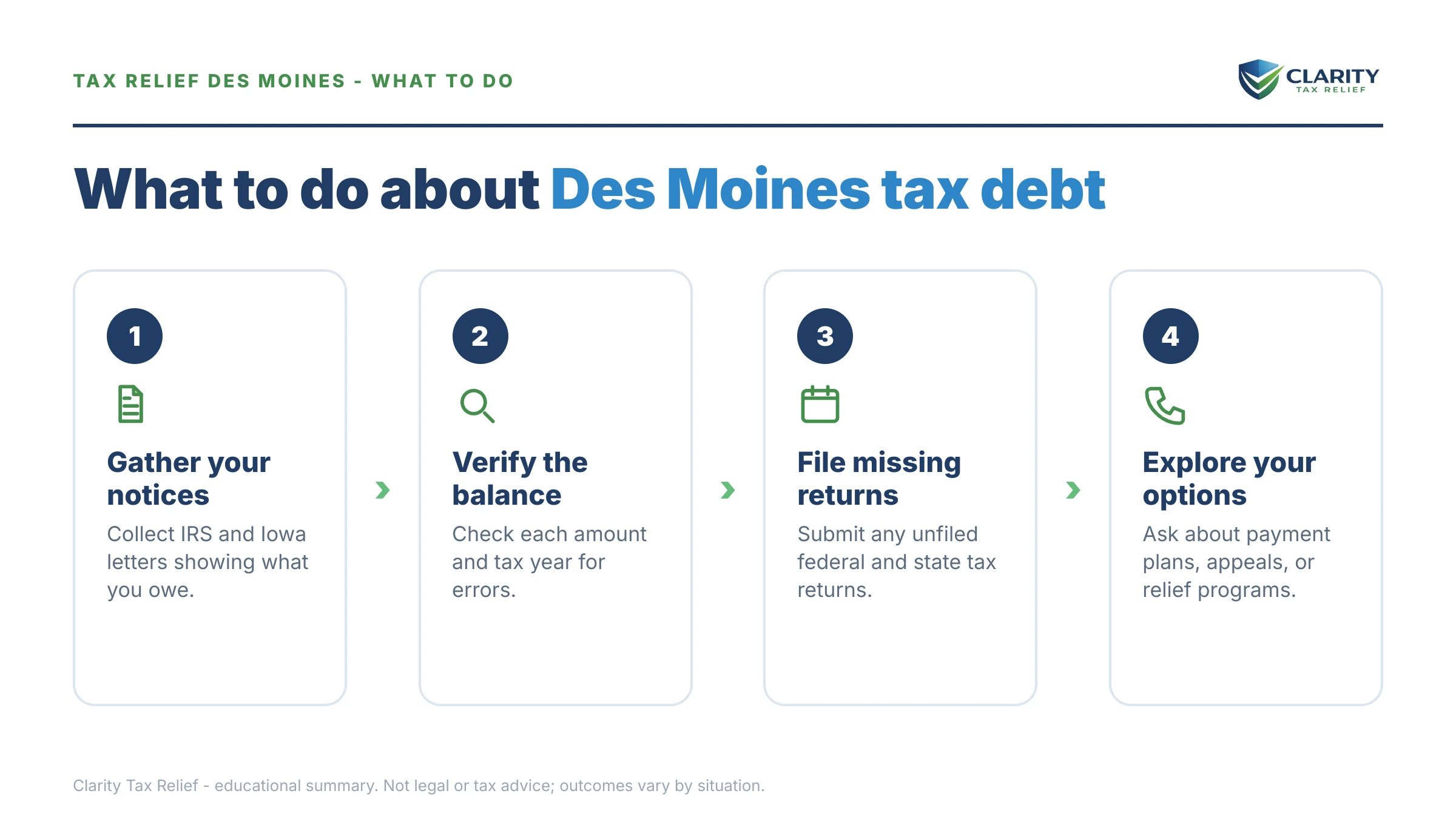
- Confirm your federal balance. Create or log into your IRS online account and verify every year with a balance and every unfiled return before you commit to anything.
- Confirm your Iowa balance. Log into GovConnectIowa or contact the Iowa Department of Revenue so a state debt doesn't blindside your federal plan.
- File any missing returns. The IRS will not approve a payment plan or an offer while required returns are unfiled — filing also stops the 5%-per-month failure-to-file penalty.
- Match your balance to a program. Use the options table above: under $10,000 points to a guaranteed installment agreement, under $50,000 can usually be set up online, and genuine hardship points to CNC or an offer.
- Get a second set of eyes if the numbers are big. If you owe over $10,000, have multiple unfiled years, or face both agencies at once, get a free case review at (888) 825-7779 before you lock in terms.
Payment plans themselves are applied for at the IRS's payment plans and installment agreements page, and one-time payments go through IRS.gov/payments — never through anyone asking for gift cards or payment apps.
When you can handle this yourself — and when help changes the outcome
Most Des Moines taxpayers with a single year of debt under $10,000 can resolve it themselves online in under an hour. If you agree with the amount, your returns are filed, and your income is steady, a short-term plan or guaranteed installment agreement needs no professional — the IRS's own portal does the work, and the setup cost is $0 to modest.
Experienced help earns its fee when the situation is layered: multiple unfiled years (the order you file and resolve them changes the total), a levy already in motion or a final notice with the 30-day CDP clock running, business or payroll tax debt, Offer in Compromise math where a small error in your financial statement sinks the application, or IRS and Iowa balances that have to be budgeted against each other. If the free stops matter to you first, the Taxpayer Advocate Service can intervene when IRS delays are causing you harm, and the Iowa Department of Revenue publishes its own collection guidance for state balances.
Choosing a tax relief company in Des Moines
The tax relief industry sells hardest to the scared, so choose on verifiable criteria, not urgency. Because IRS collection work happens by phone, mail, and e-services, a national firm can represent a Des Moines taxpayer exactly as well as a local one — what matters is who actually works your file: an enrolled agent, CPA, or attorney, named in writing, with a flat fee quoted after reviewing your IRS records, not before. Our buyer's checklist on how to choose a tax relief company walks through the vetting questions, and the tax relief company red flags list covers the warning signs — settlement promises before a financial review, percentage-of-savings pricing, pressure to sign today.
If you've been quoted by one of the big national brands, compare before you sign — our Optima Tax Relief alternative comparison shows what to weigh. And if the debt belongs to your business rather than to you personally — payroll, 941s, an LLC balance — start with tax relief for small business instead; business collection runs on different rules and moves faster.
Tax relief in Des Moines: your questions, answered
Is there an IRS office in Des Moines, Iowa?
Yes — the IRS maintains a Taxpayer Assistance Center in downtown Des Moines, but it is appointment-only; call 844-545-5640 to schedule and confirm the current location. With the IRS workforce cut roughly 27% in 2025, appointments can book out weeks ahead. Most collection tasks — checking a balance, setting up a payment plan, pulling transcripts — are faster through your IRS online account than in person.
Can a Des Moines tax relief company settle my IRS debt for less than I owe?
Only if your finances qualify for an Offer in Compromise, and the IRS accepted roughly 1 in 5 offers in FY2024. The IRS runs a formula on your income, assets, and allowable expenses — no firm, local or national, can change that math. Treat any company that quotes a settlement amount before reviewing your full financials as a red flag.
Does Iowa have its own tax relief programs for back taxes?
Yes. The Iowa Department of Revenue offers payment plans, set up through its GovConnectIowa portal, and considers penalty relief in limited circumstances. Iowa's programs are completely separate from the IRS's — resolving a federal balance does nothing for a state one, and vice versa. If you owe both, each debt needs its own resolution, worked in parallel.
How much does tax relief cost in Des Moines?
Doing it yourself, IRS costs range from $0 for a short-term payment plan to a $205 application fee for an Offer in Compromise. Professional representation typically runs a few hundred dollars for a straightforward payment plan to several thousand for a full offer or multi-year cleanup. Avoid any firm that charges a percentage of 'savings' or demands the entire fee before reviewing your IRS records.
Can the IRS take my Iowa state tax refund?
Yes. Once the IRS issues a CP504 notice, it can seize your Iowa state refund through the State Income Tax Levy Program without any further warning. That is usually the first asset the IRS actually takes, because it requires no court action and no final notice. If you count on a spring refund, that alone is a reason to set up a resolution before the CP504 stage.
Do I need a local Des Moines tax professional, or can a national firm handle my case?
For IRS debt, geography rarely matters — collection cases are handled by phone, mail, and the IRS's electronic systems, and an experienced tax professional anywhere in the country can represent you with a Form 2848 power of attorney. Local familiarity helps more with Iowa Department of Revenue issues or when a revenue officer is assigned to your case in person. Judge firms on transparency and credentials, not zip code.
What should I do first if I owe both the IRS and the Iowa Department of Revenue?
Confirm both balances first — your IRS online account for federal, GovConnectIowa for state — then prioritize whichever agency is closer to levy action. In most cases that's the one that has already sent an intent-to-levy notice. Any IRS payment plan you propose should leave room in your budget for the state plan too, or one agreement will end up defaulting the other.
Your next 24 hours
- Find your numbers. Pull the most recent IRS letter and note the notice code (CP14, CP504, LT11), the tax year, and the amount — then log into your IRS online account and confirm the balance matches.
- Gather three things: your last filed return, every IRS and Iowa Department of Revenue letter you've received, and a rough list of monthly income and expenses. That's everything a program decision needs.
- Get the free review. Use the 2-minute form at claritytaxrelief.com/#consult or call (888) 825-7779. Whichever notice stage you're at, the balance is accruing penalty and interest every month it sits — the review costs nothing and tells you exactly which option fits your numbers.
This guide is general information, not tax or legal advice for your specific situation. Eligibility for IRS programs depends on individual facts and circumstances; no outcome is guaranteed.