
City Tax Relief Guides
Tax Relief Fargo: Your 2026 Guide to IRS and North Dakota Tax Debt Options
The short answer: tax relief in Fargo means resolving IRS or North Dakota tax debt through real programs — payment plans, Offers in Compromise, Currently Not Collectible status, and penalty abatement. The IRS handles federal debt; the North Dakota Office of State Tax Commissioner handles state debt. Each runs separate programs on separate timelines.
Maybe it started with a side business or a trucking season that outran your withholding, and now the two of you are looking at an IRS balance no Cass County paycheck can cover in one check. The number keeps growing while you decide. Here's the honest map: what each program costs, who qualifies, and what to do first — whether the debt is federal, state, or both.
⏱ The clock that's actually running: there's no single deadline on tax debt itself — but interest compounds and a 0.5% monthly failure-to-pay penalty accrues every month you wait, and each IRS notice in the collection sequence removes options you have today. If you're holding a specific notice, the response date printed on it controls.
Why Fargo taxpayers end up owing the IRS
Most tax debt in the Fargo–Moorhead metro comes from income that has no withholding attached to it. Farm income, owner-operator trucking, 1099 contract work, real estate commissions, and side businesses stacked on a W-2 job all generate tax bills that arrive in April with nothing set aside — and self-employment tax adds roughly 15% on top of income tax before deductions.
The metro adds a wrinkle most cities don't have: it straddles the North Dakota–Minnesota line. Wages are generally covered by the two states' reciprocity agreement, but self-employment and business income are not — so a Fargo consultant with Moorhead clients, or vice versa, can end up owing a state they never expected, on top of the IRS.
Common Fargo-area patterns we see: a couple where one spouse has NDSU or hospital W-2 wages and the other runs an unincorporated business with no quarterly payments; a farm year where equipment purchases ate the cash needed for the tax bill; and early retirement-account withdrawals during a rough stretch that triggered both tax and the 10% early-distribution penalty. If your situation involves a business with employees, the stakes change — see our tax relief for small business guide, because payroll tax debt carries personal liability that ordinary income tax doesn't.
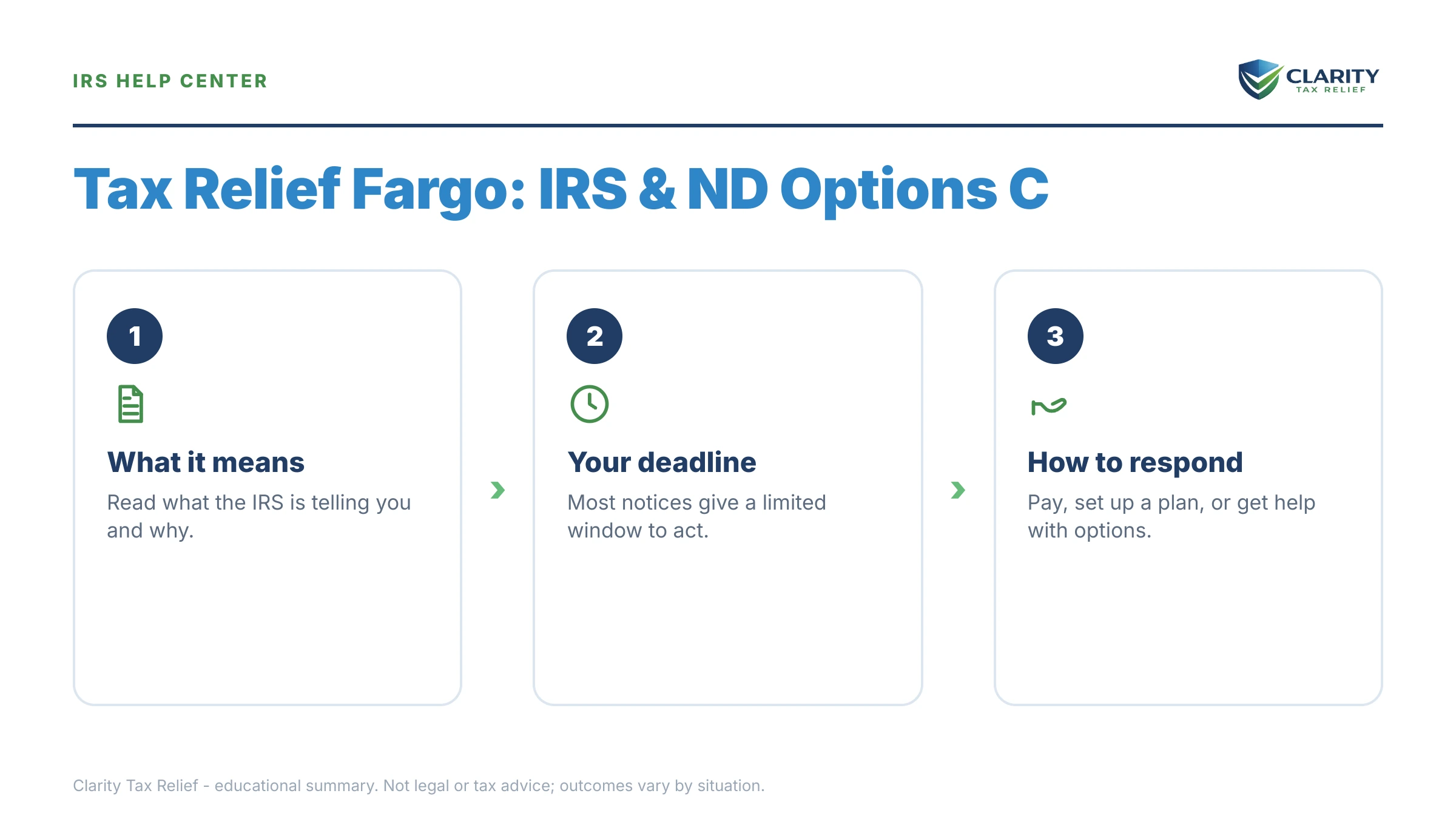
What happens if you ignore IRS tax debt in Fargo
IRS collection is automated and escalates in a fixed sequence whether or not a human ever reads your file. The IRS workforce shrank roughly 27% in 2025, which makes the agency harder to reach — but the notice stream, lien filings, and levies run on systems that never stopped. The sequence looks like this:
- CP14 notice — the first bill. Typically about 21 days to pay or arrange something before the reminders start. No enforcement yet; this is the cheapest moment to act.
- CP501 / CP503 — reminder notices. Still just bills, but the balance grows monthly and the file keeps moving.
- CP504 notice — Notice of Intent to Levy under IRC §6331(d). The IRS can now seize your North Dakota state tax refund. Despite the alarming language, this is not the final notice.
- LT11 notice / Letter 1058 — the true final notice. It starts a 30-day clock to request a Collection Due Process hearing on Form 12153. Miss it, and the IRS can levy wages and bank accounts without further warning.
- Enforcement — a bank levy freezes funds with a 21-day hold before the money leaves; a wage levy is continuous until released; a federal tax lien attaches to your home and vehicles. Once a balance passes $66,000 (the 2026 threshold), the IRS can also certify it to the State Department, blocking passport issuance or renewal.
Here's each stage in one reference table:
| Notice | What it means | Your window |
|---|---|---|
| CP14 | First bill for the balance due | Typically 21 days from the notice date |
| CP501 / CP503 | Automated reminders; balance growing | The pay-by date printed on each |
| CP504 | Intent to levy — ND state refund now reachable | The date printed on the notice |
| LT11 / Letter 1058 | Final notice; appeal rights attach | 30 days to file Form 12153 |
| After LT11 | Bank levy (21-day hold), continuous wage levy, lien | Act during the holds — then options narrow fast |
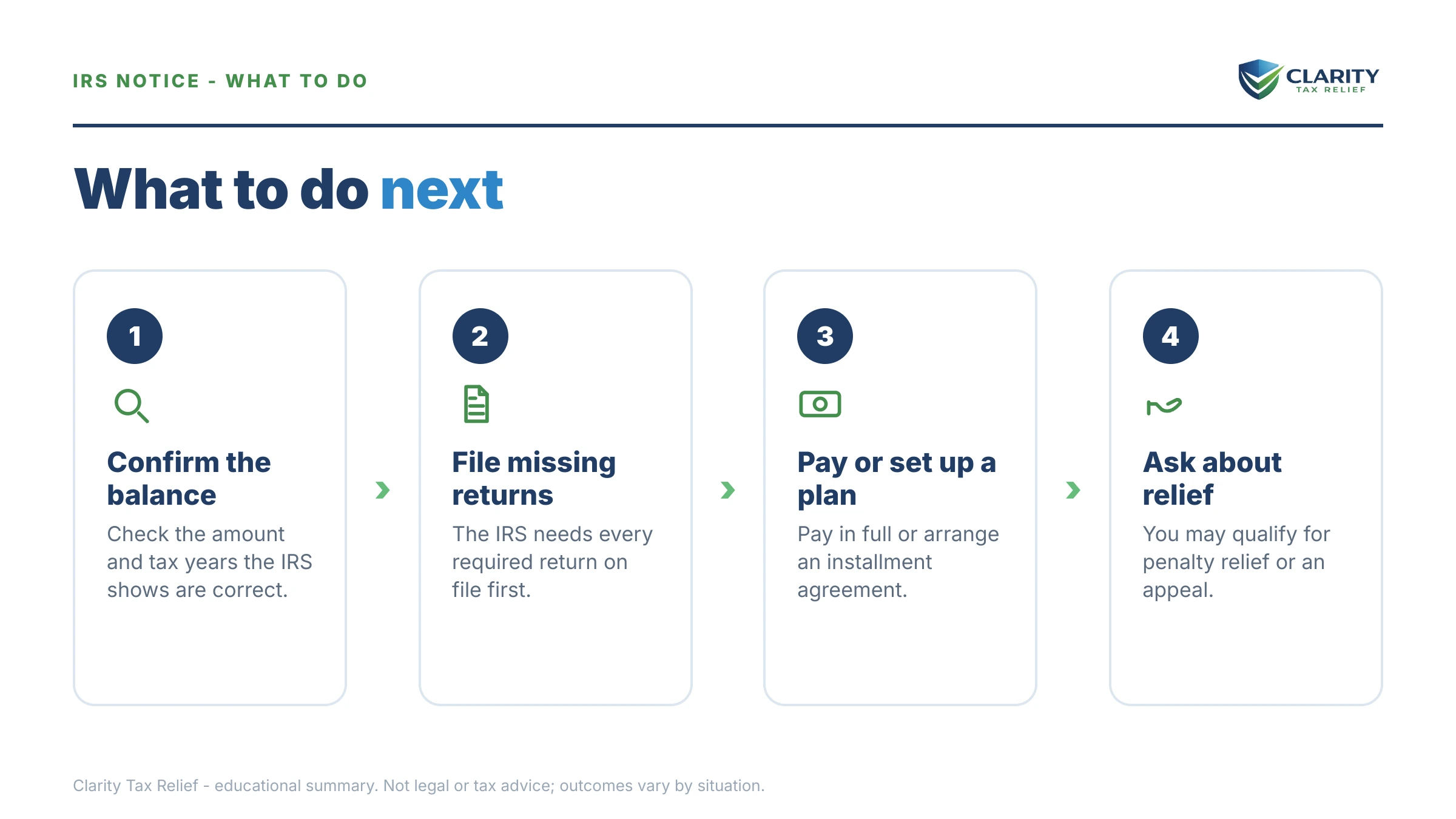
Behind with the IRS in Fargo?
Interest and the monthly failure-to-pay penalty are accruing right now, and each notice in the sequence closes doors the previous one left open. Get a free, confidential review of your notices and balance before the next letter posts — an experienced tax professional will map exactly which programs your numbers support.
Tax relief in Fargo: your options compared
The IRS runs five real resolution programs, and eligibility for each is set by hard numbers — your balance, your income, and your equity. Here's the full menu; for the do-it-yourself mechanics of each, our guide on how to settle tax debt yourself walks through every application.
| Option | Typical eligibility | What it costs |
|---|---|---|
| Short-term payment plan | Can pay in full within 180 days | $0 setup; interest and penalties continue |
| Guaranteed installment agreement | Owe $10,000 or less; pay within 3 years | Setup fee; IRS must accept if criteria met |
| Streamlined installment agreement | Up to $50,000 with direct debit; up to 72 months, no financial disclosure | Setup fee; interest and penalties continue |
| Non-streamlined agreement | Over $50,000, or longer terms needed | Requires Form 433 financial disclosure |
| Offer in Compromise | Assets + future income genuinely can't cover the debt | $205 fee + 20% down on lump-sum offers (waived with low-income certification) |
| Currently Not Collectible | Paying anything would create hardship (Form 433-F showing) | $0 — but debt, interest, and refund offsets remain |
| Penalty abatement | Clean 3-year compliance history, or reasonable cause | $0 to request; can remove penalties entirely |
Three of these deserve extra Fargo-specific context:
The Offer in Compromise is the program every ad is selling, and it's real — but the IRS accepted roughly 1 in 5 offers in FY2024. Acceptance turns on your Reasonable Collection Potential: your equity in everything you own plus a stretch of your monthly disposable income. Home equity matters here, and it cuts both ways — Fargo's housing costs are modest, so a couple with a mostly-paid-off house often has too much equity to qualify, while renters with thin savings can be strong candidates. You can estimate your own offer with our Offer in Compromise Calculator before spending anything; our how an offer in compromise works guide covers the full process. One useful backstop: if the IRS doesn't decide your offer within 2 years, it's accepted automatically.
Currently Not Collectible pauses collection when your budget shows nothing left after allowable living expenses — common after a layoff or a bad farm year. The debt doesn't go away; interest accrues and refunds get kept, but levies stop. Details in our currently not collectible guide.
Penalty abatement is the most underused option. If the prior three years were clean, first-time penalty abatement can strip penalties from one year with a phone call or letter — and starting in summer 2026, the IRS's new Automatic Exemption from Penalty (AEP) begins applying similar relief automatically, with no request needed. Blizzard closures, medical crises, and disaster declarations can also support reasonable-cause relief for additional years.
Worked example: a Fargo couple owing $48,300
Say you and your spouse file jointly and owe $48,300 across two tax years — one spouse's hospital W-2 withheld correctly, the other's contracting business paid no quarterlies. This is hypothetical, but the math is how the IRS actually runs it:
- Streamlined installment agreement: $48,300 is under the $50,000 direct-debit ceiling, so you can set up a plan online without handing over a financial statement. Spread over the maximum 72 months, the principal alone is about $671/month ($48,300 ÷ 72) — budget somewhat more, because interest and the failure-to-pay penalty keep accruing until it's paid off.
- Offer in Compromise: suppose your reachable equity (vehicles, savings, small retirement cash-out value) totals $9,600 and your budget shows $200/month left after IRS allowable expenses. A lump-sum offer generally adds 12 months of that disposable income: $9,600 + ($200 × 12) = $12,000. Filing it costs the $205 fee plus 20% down ($2,400) unless you meet the low-income certification (AGI at or below 250% of the poverty level), which waives both. Whether $12,000 flies depends entirely on whether the IRS agrees that's truly the most it could ever collect — a means test, not a discount program.
- If one income disappears: lose the contracting revenue and the same couple might show zero disposable income — making Currently Not Collectible, or a much smaller partial-payment arrangement, the realistic path instead.
One more number worth knowing: $48,300 sits below the $66,000 passport-certification threshold for 2026 — but penalties and interest on an untouched balance can push it across that line over time. Acting early keeps that risk off the table.
IRS debt vs. North Dakota state tax debt: two separate fights
The IRS collects federal tax; the North Dakota Office of State Tax Commissioner collects state tax — and resolving one does nothing for the other. North Dakota's individual income tax rates are among the lowest in the country, so state balances here tend to be smaller than the federal one — but the state has its own billing, lien, and collection process, and its programs don't mirror the IRS's. For a state balance, contact the Office of State Tax Commissioner directly about payment arrangements rather than assuming IRS rules apply.
Two cross-border points matter in this metro. First, once federal collection reaches the CP504 stage, the IRS can intercept your North Dakota refund and apply it to the federal debt. Second, if you or your spouse work or do business across the river, Minnesota may be in the picture too — reciprocity protects wages, not business income, and Minnesota's Department of Revenue collects aggressively. Our Minnesota back taxes guide covers that side of the line.
When you owe both, sequence by enforcement: whichever agency is closest to levying gets addressed first, then the other gets its own arrangement. Don't promise one agency money your budget needs for the other — both plans have to survive on the same income.
How to respond to tax debt in Fargo, step by step
- Confirm exactly what you owe. Log into your IRS online account or request account transcripts so you can see every year with a balance — tax, penalties, and interest — before committing to any plan.
- File every missing return. The failure-to-file penalty runs 5% per month, ten times the 0.5% failure-to-pay penalty, so filing stops the fastest-growing cost even if you can't pay a dollar yet.
- Identify which notice you're holding. The number in the corner — CP14, CP504, LT11 — tells you how much time and which appeal rights you have left.
- Match your finances to one program. Full payment, a payment plan, Currently Not Collectible, or an Offer in Compromise — the right fit turns on your income, your equity, and the balance.
- Set it up before the next notice posts. Balances of $50,000 or less can usually be arranged online in one sitting; larger balances and hardship cases require financial disclosure on Form 433-F.
- Handle North Dakota separately. Resolving your IRS balance does nothing for a state one — contact the Office of State Tax Commissioner about any North Dakota debt.
When you can handle this yourself — and when help changes the outcome
Plenty of Fargo tax problems don't need a professional. If you owe under $10,000 with all returns filed, or you can pay in full within 180 days, set it up yourself on the IRS payment plans page — it takes less than an hour and costs little or nothing. A first notice you agree with, on an amount you can manage, is a phone-and-laptop problem. If money for representation is genuinely the barrier, the Taxpayer Advocate Service and Low Income Taxpayer Clinics exist for exactly that.
Experienced help earns its fee in specific situations: a levy or garnishment already in motion, multiple unfiled years that need reconstructing, business or payroll tax debt (where personal liability attaches), balances over $50,000 that require negotiated financial disclosure, and Offer in Compromise math — where how your income and expenses are documented can move the accepted number substantially. The dividing line isn't fear; it's whether professional judgment changes what you end up paying.
Choosing tax relief help in Fargo: local firm vs. national company
Fargo has capable local CPAs and enrolled agents, and IRS representation doesn't require anyone local — an authorized professional can represent you before the IRS from anywhere. What matters is who does the work: a credentialed professional (enrolled agent, CPA, or attorney) reviewing your transcripts, not a salesperson reading a script. Any firm promising to settle for "pennies on the dollar" before it has seen a single transcript is selling marketing, not tax work — eligibility for every program above is means-tested.
Before signing anywhere, run through our checklist on how to choose a tax relief company — it covers fee structures, credentials to verify, and the questions that expose a mill in one call. If you've already been burned by a heavily advertised national brand, our Optima Tax Relief alternatives comparison explains what to look for the second time around.
Terms you'll see on IRS letters, decoded
- Levy vs. lien: a levy takes property (wages, bank funds); a lien is a legal claim against property that complicates selling or refinancing it.
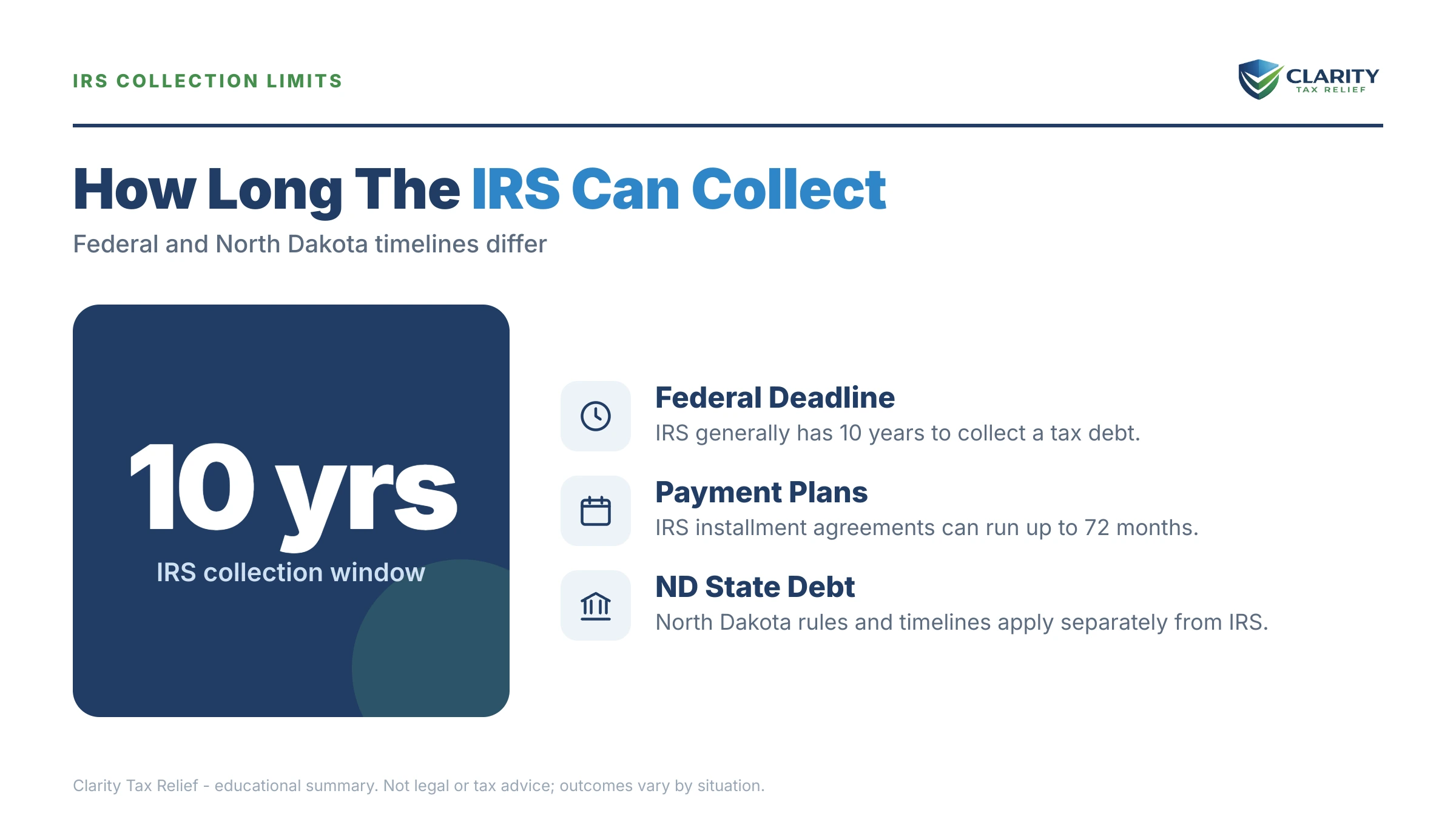
- CSED: the Collection Statute Expiration Date — the IRS generally has 10 years from assessment to collect, though offers, appeals, and bankruptcy pause the clock.
- CDP rights: Collection Due Process — the formal appeal the LT11 triggers; requesting a hearing on Form 12153 within 30 days pauses levy action while your case is heard.
- Reasonable Collection Potential (RCP): the IRS's math for an Offer in Compromise — your equity plus a multiple of your monthly disposable income.
- Currently Not Collectible (CNC): a documented hardship status that pauses collection without erasing the debt.
- Installment agreement: the IRS's official name for a monthly payment plan, requested online or on Form 9465.
Tax relief in Fargo: frequently asked questions
Is it worth hiring a tax relief company in Fargo?
It depends on the size and complexity of the debt. Below roughly $10,000 with all returns filed, you can usually set up an IRS payment plan yourself online in under an hour. Above $25,000, with unfiled years, business or payroll tax, or a levy already in motion, experienced representation typically changes the outcome — because the resolution you qualify for depends on how your financial disclosure is prepared and presented.
How much does tax relief cost?
Legitimate firms typically charge flat fees that scale with case complexity — a simple installment agreement costs far less than an Offer in Compromise layered on multiple unfiled years. Be wary of any firm that quotes a fee or promises a result before pulling your IRS transcripts to see what the case actually involves. Investigation first, price second is the honest order.
Can the IRS garnish wages in North Dakota?
Yes. After the final notice (LT11 or Letter 1058) and the 30-day window it starts, the IRS can levy wages anywhere in the country, including North Dakota — no court order required. A wage levy is continuous until released, leaving you only an exempt amount based on your filing status and dependents. A bank levy works differently: the bank holds the funds for 21 days before sending them, and that hold is your window to act.
What if I owe both the IRS and North Dakota state taxes?
Treat them as two separate cases, because they are. The IRS and the North Dakota Office of State Tax Commissioner run different programs on different timelines, and neither pauses because you're working with the other. The IRS can also intercept your North Dakota refund once federal collection escalates. Most people address whichever agency is closest to enforcement first, then set up an arrangement with the other.
I live in Moorhead but work in Fargo — which state taxes do I owe?
Under the long-standing Minnesota–North Dakota reciprocity agreement, wages are generally taxed by the state you live in, not the state you work in — so a Moorhead resident working in Fargo typically owes Minnesota, provided the right exemption paperwork is on file with the employer. Reciprocity covers wages only; self-employment and business income follow normal sourcing rules, which is where many two-state balances start.
Is there an IRS office in Fargo?
The IRS operates Taxpayer Assistance Centers by appointment only — check the current Fargo listing through the office locator at IRS.gov and call 844-545-5640 to schedule. In practice, most balance-due issues get resolved faster through your IRS online account or by mail than by waiting for an appointment, especially with 2026 staffing levels down sharply.
Can the IRS take my house or farm in Fargo?
It's rare. Seizing a primary residence requires federal court approval and is a last resort the IRS uses sparingly; a federal tax lien — a claim against the property that complicates selling or refinancing — is far more common. Farm equipment and business assets carry more exposure once a revenue officer is assigned, which is one more reason to lock in a resolution before the final-notice stage.
Your next 24 hours
- Find your most recent IRS letter and note the notice number in the top corner and the response date printed on it — those two items define exactly where you stand in the sequence.
- Gather three things: your last filed return, every IRS or North Dakota letter you've received, and a rough picture of household income and monthly expenses. That's everything a real options analysis needs.
- Get a free case review. Interest and the monthly failure-to-pay penalty are accruing whether you act or wait — send us your notices through the 2-minute form or call (888) 825-7779, and an experienced tax professional will tell you which of these programs your numbers actually support.
This guide is general information, not tax or legal advice for your specific situation. Eligibility for IRS programs depends on individual facts and circumstances; no outcome is guaranteed.