
Tax Relief by City
Tax Relief in Hartford, CT: Your Real IRS and DRS Options (2026)
The short answer: tax relief in Hartford usually means resolving two separate debts — one with the IRS and one with the Connecticut Department of Revenue Services. Real options include IRS payment plans up to 72 months, an Offer in Compromise, hardship status, penalty abatement, and a separate DRS arrangement through myconneCT. Interest accrues monthly at both agencies until you act.
You're searching for tax relief in Hartford because the letters have started — maybe one from the IRS, maybe one from the DRS building on Columbus Boulevard, maybe both in the same week. That's unnerving, especially when you're self-employed and the balance grew quietly while you were busy running the business. It's also fixable: both agencies have structured programs, and this guide maps every one of them, with real numbers.
Here's the fact that changes everything for Hartford taxpayers: Connecticut is a two-collector state. Unlike friends in Florida or Texas who only face the IRS, you can owe federal income and self-employment tax to the IRS and state income tax to DRS on the same earnings — and each agency collects on its own track, with its own liens, its own levies, and its own relief programs. Settling one does nothing for the other.
⏱ The clock that's actually running: there's no single deadline on a tax debt, but the meter never stops. The IRS adds a 0.5% failure-to-pay penalty every month plus daily-compounding interest, and Connecticut DRS charges interest at 1% per month — 12% a year. On a $23,800 federal balance, one year of waiting adds roughly $1,428 in federal late-payment penalty alone, before interest and before Connecticut's meter.
Why Hartford taxpayers end up owing both the IRS and Connecticut
Most tax debt in Hartford starts with income that had no withholding — and both agencies bill the same untaxed dollars. The metro area runs on exactly that kind of income: independent insurance producers and financial-services contractors working 1099 around the big carriers downtown, tradespeople and contractors across Frog Hollow and the South End, healthcare and gig workers stacking side income on a W-2.
When quarterly estimated payments get skipped — because revenue was lumpy, or because nobody explained that self-employment tax adds roughly 15.3% on top of income tax — April produces a bill you can't pay. You file (or worse, don't), and two collection machines start up: the IRS's automated notice stream, and DRS billing the Connecticut side of the same income.
The other common Hartford paths: a state audit adjustment that DRS shares with the IRS (or vice versa — the agencies exchange data), an underreported 1099 that triggers a federal CP2000 and then a matching state bill, or years of unfiled returns where the IRS filed a substitute return that overstates what you owe.
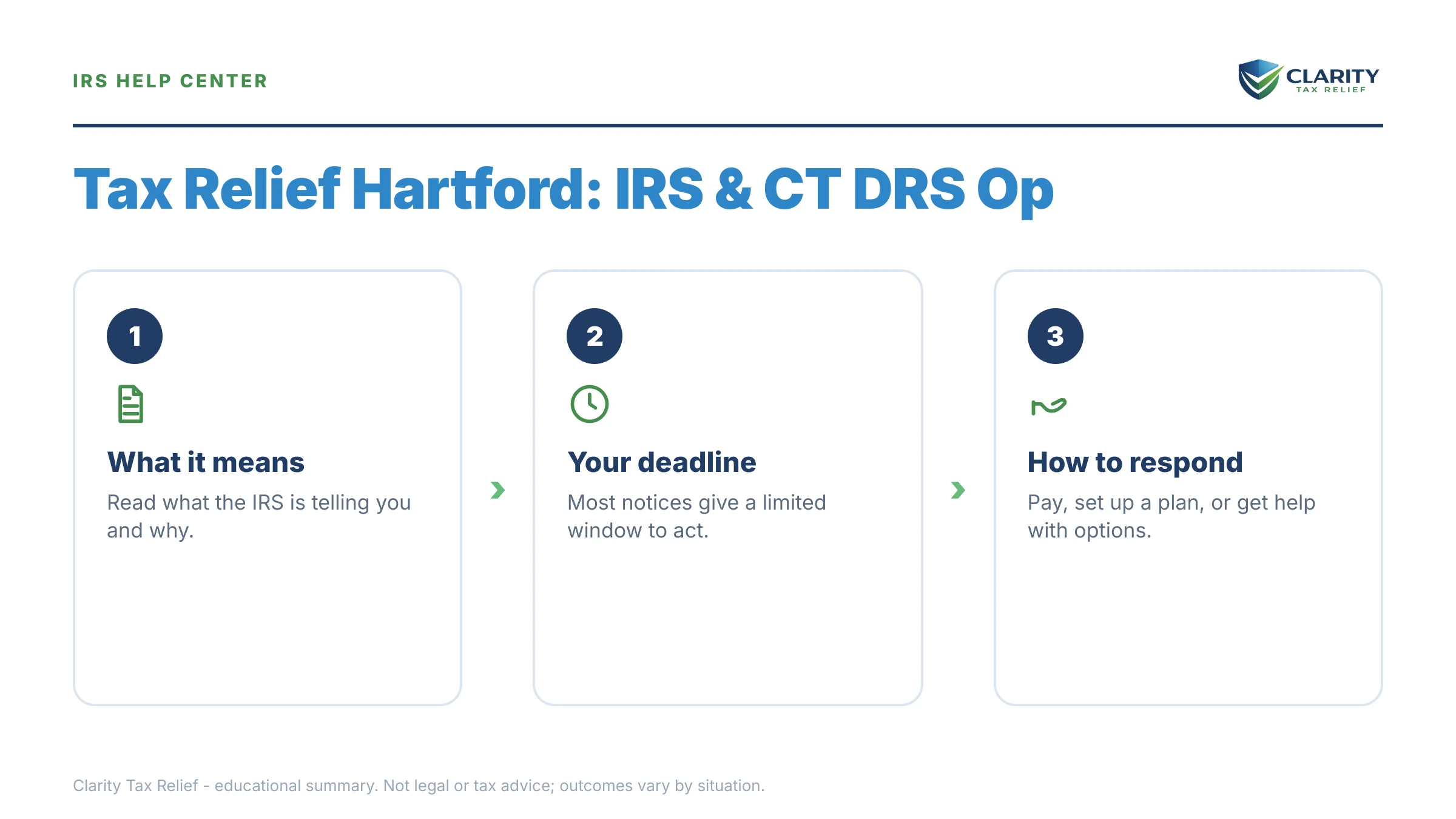
What happens if you ignore IRS and DRS collection
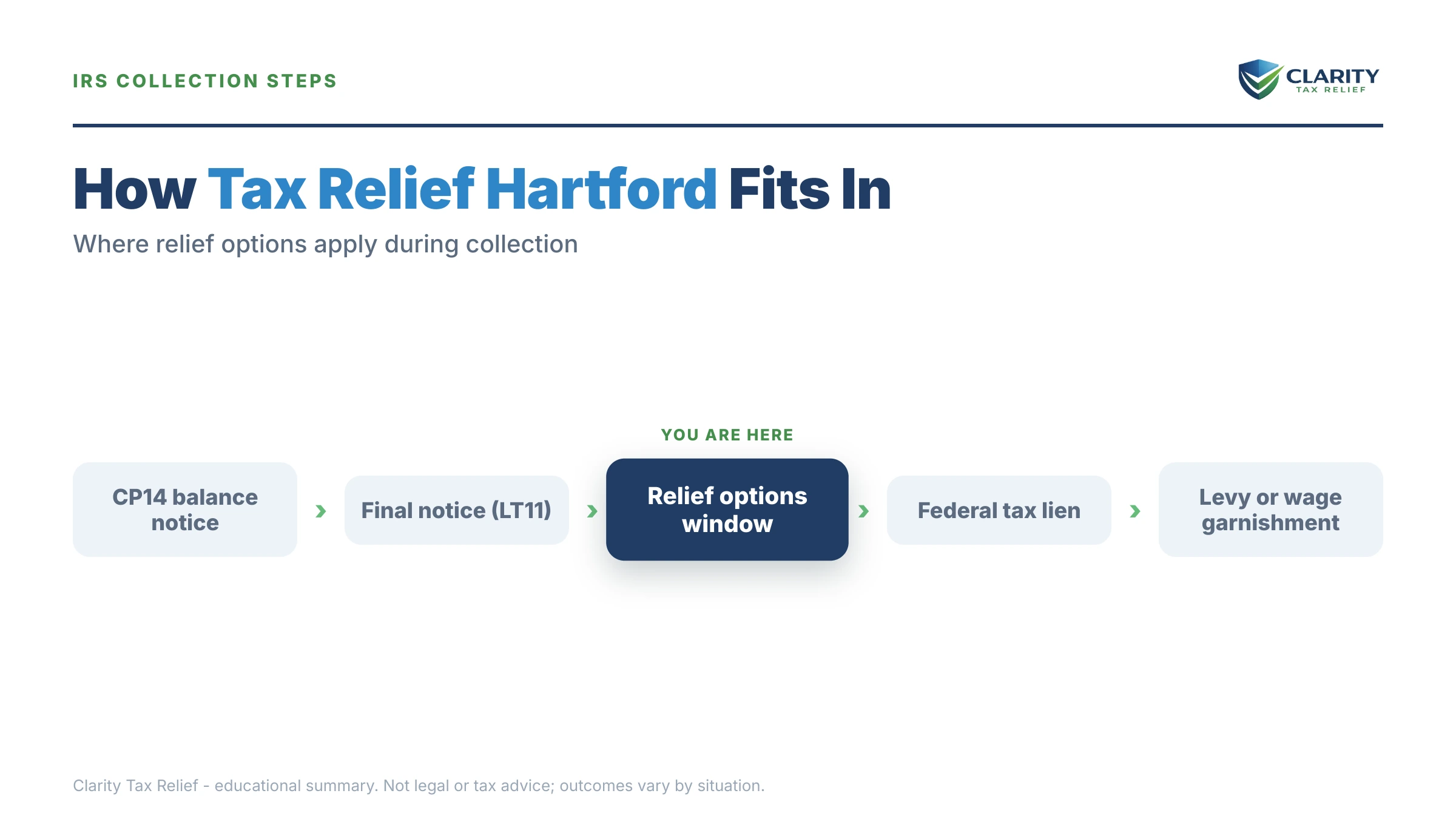
IRS collection escalates in a fixed, automated sequence — and in 2026, with the IRS workforce down roughly 27%, those notices are issued by systems that never got smaller. The stages, in order:
- First bill (CP14). A statement of the balance with a pay-by date — typically about 21 days out. No enforcement yet; this is the cheapest moment to act.
- Reminder notices (CP501, CP503). Still just bills, but the failure-to-pay penalty and interest have been compounding the whole time.
- Intent to levy (CP504 notice). The IRS can now seize your Connecticut state tax refund, and a federal tax lien — public record, attached to everything you own — becomes a live possibility.
- Final notice (LT11 / Letter 1058). This starts a 30-day clock and your Collection Due Process rights (requested on Form 12153). It is the last formal stop before enforcement.
- Enforcement. A bank levy freezes funds with a 21-day hold before the money leaves; a wage levy is continuous until released. For a sole proprietor, the IRS can also levy payments your business clients owe you.
DRS runs its own parallel track. It can file a state tax lien, garnish wages, levy bank accounts, and intercept your state refund under Connecticut law — and it publishes lists of its top delinquent taxpayers, a public-shaming step the IRS never takes with individuals. Because DRS is a smaller operation collecting inside one state, many practitioners find it moves from notice to enforcement faster than the IRS. Our Connecticut back taxes guide covers the DRS side in full.
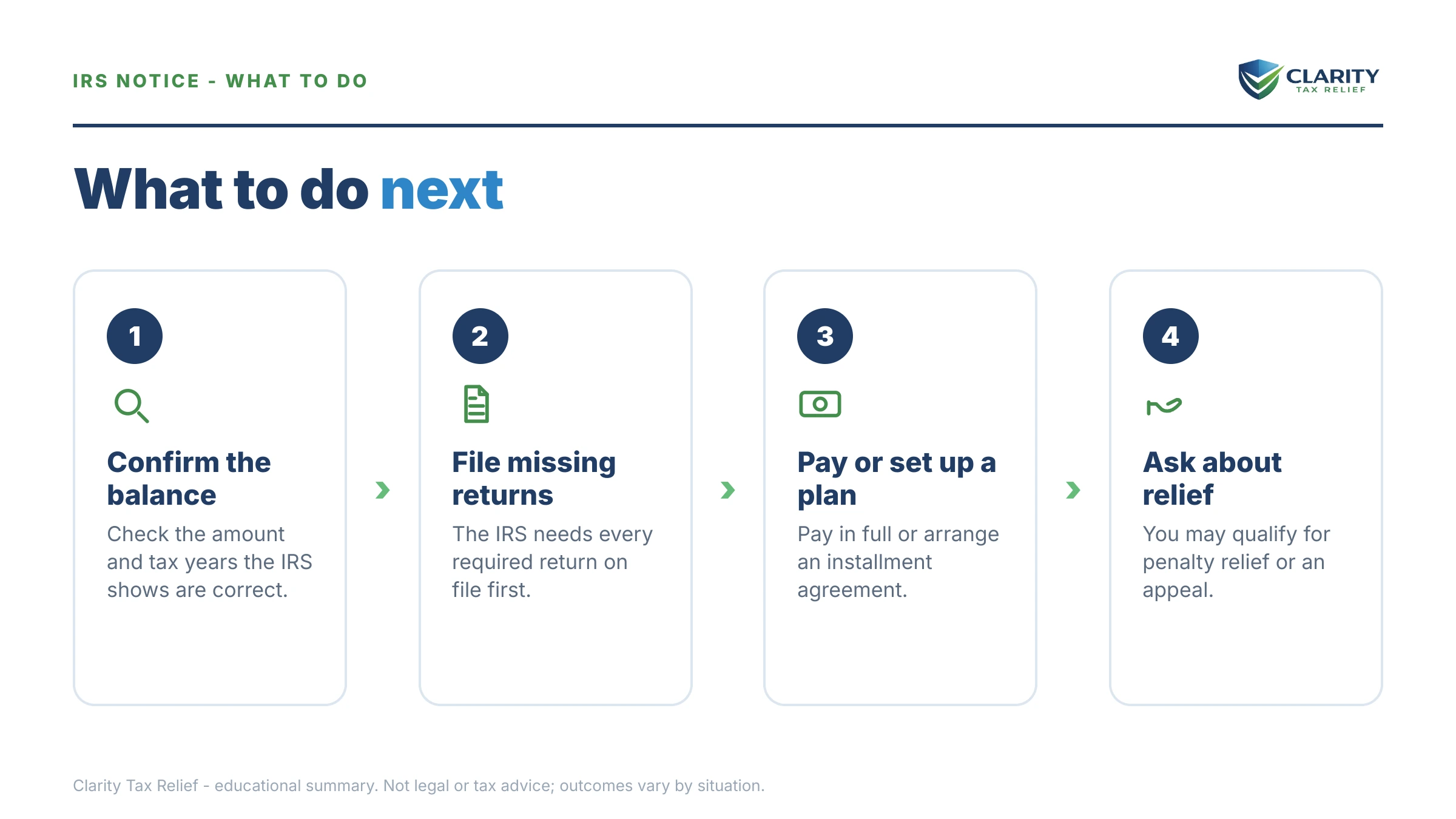
Getting letters from the IRS or the DRS — or both?
Two agencies can move on the same paycheck, and penalties and interest are accruing monthly at each one while you decide. Get your Hartford IRS and DRS letters reviewed free by an experienced tax professional — we'll map exactly where each debt stands and which option fits your numbers.
How tax relief works in Hartford: every option compared
Every legitimate tax relief path in Hartford runs through a government program with published rules — there is no secret negotiation. (For the general mechanics of resolving a balance on your own, our guide to how to settle tax debt yourself walks through each program in depth; here's how they apply when you owe in Connecticut.)
| Option | Agency | Who typically qualifies |
|---|---|---|
| Short-term payment plan (180 days) | IRS | You can pay in full within 180 days; $0 setup fee |
| Long-term installment agreement | IRS | Balance ≤ $50,000 sets up online for up to 72 months; larger balances require financial disclosure |
| Guaranteed installment agreement | IRS | You owe $10,000 or less in tax and have kept current on recent filings and payments |
| Offer in Compromise | IRS | Your assets plus future income (reasonable collection potential) total less than the balance — means-tested, never automatic |
| Currently Not Collectible | IRS | Paying anything would leave you unable to cover basic living expenses (proven on Form 433-F) |
| First-time abatement / AEP | IRS | Clean compliance in the prior 3 years; the new Automatic Exemption from Penalty becomes automatic starting summer 2026 |
| DRS payment arrangement | Connecticut DRS | Set up through the myconneCT portal; terms set case-by-case by DRS |
| DRS penalty waiver / offer of compromise | Connecticut DRS | Reasonable cause for penalty relief; compromise considered only in limited hardship cases |
Payment plans resolve the majority of Hartford cases. Under $50,000 total, a streamlined installment agreement sets up online in minutes with no financial disclosure — the IRS doesn't ask what you spend, only that the balance divides into 72 months or fewer. Interest and penalties continue accruing inside a plan, but enforcement stops and the failure-to-pay rate is cut in half while a direct-debit agreement is in effect.
An Offer in Compromise settles the debt for less than the full balance — but only when the IRS's own formula says it could never collect more. Roughly 1 in 5 offers were accepted in FY2024, almost always because the taxpayer's numbers genuinely fit, not because someone negotiated hard. If your AGI is at or below 250% of the federal poverty level, the $205 application fee, the 20% down payment, and payments during review are all waived. See how an offer in compromise works before assuming it fits — most people who owe under $25,000 with steady income don't qualify, and that's fine, because a plan costs less than a failed offer.
Currently Not Collectible status pauses IRS collection entirely when your Form 433-F financials show that any payment would create hardship. The debt remains and interest accrues, but levies stop and the 10-year collection statute keeps running. Details in our guide to Currently Not Collectible status.
Penalty relief is the most underused option. If your prior three years were clean, first-time penalty abatement removes failure-to-file and failure-to-pay penalties on one year — often a four-figure reduction on a request that costs nothing. Starting summer 2026, the IRS is replacing FTA with the Automatic Exemption from Penalty (AEP), applied automatically with no request needed — so if you qualify, relief may arrive on its own, but don't wait on it to set up your resolution.
The Connecticut side is separate, always. DRS payment arrangements run through myconneCT, penalty waivers require a written reasonable-cause request, and DRS considers offers of compromise only in genuine hardship situations. Because Connecticut's terms are set case-by-case rather than by published federal-style thresholds, confirm your specific terms with DRS directly rather than assuming IRS rules carry over.
| Option | Upfront cost | Typical timeline |
|---|---|---|
| Short-term IRS plan | $0 setup | Minutes to set up online; up to 180 days to pay |
| IRS installment agreement | Setup fee (lowest for online direct-debit; reduced or waived for low-income) | Minutes to set up online; up to 72 months to pay |
| Offer in Compromise | $205 fee + 20% of the offer for lump-sum (both waived with low-income certification) | Commonly many months of review; auto-accepted if the IRS doesn't decide within 2 years |
| Currently Not Collectible | $0 (Form 433-F financials required) | Weeks to establish; reviewed periodically as income changes |
| First-time abatement / AEP | $0 | Often resolved with a single call or letter; AEP applies automatically from summer 2026 |
| DRS payment arrangement | Confirmed at setup in myconneCT | Terms and duration set by DRS case-by-case |
A worked example: owing $23,800 as a Hartford sole proprietor
Say you're a self-employed electrician working out of Hartford's South End who owes the IRS $23,800 across 2024 and 2025 — underpaid quarterlies both years — plus a smaller Connecticut balance. Here's the actual math on each path. (This is a hypothetical illustration, not a client case.)
Do nothing: the federal failure-to-pay penalty runs 0.5% × $23,800 = $119 per month, plus daily-compounding interest, plus DRS's 1% monthly interest on the state side — and the notice ladder above keeps climbing toward a lien and levy. You can estimate your own accruals with our IRS penalty and interest calculator.
Streamlined installment agreement: $23,800 is under the $50,000 online threshold, so no financial disclosure is needed. The 72-month floor is $23,800 ÷ 72 ≈ $331/month; because interest and penalties accrue inside the plan, paying closer to $425–$450/month retires the debt years sooner and saves meaningfully on accruals. Setting it up on direct debit also halves the monthly penalty rate from $119 to roughly $59.50 at the starting balance.
Offer in Compromise: only worth pursuing if the numbers fit. Suppose work has dried up: your truck and tools carry $4,000 in usable equity, and after the IRS's allowable living expenses your disposable income is $600/month. A lump-sum offer prices at $4,000 + ($600 × 12) = $15,200 — a real saving versus $23,800, but requiring a $205 fee and $3,040 down (20%) unless you certify low-income. If your disposable income were $900/month instead, the formula exceeds the balance and the offer fails — which is why running the math first beats paying anyone to file a doomed offer.
The Connecticut balance: handled separately through myconneCT regardless of which federal path you take. Budget for both payments before committing to either.
How to respond to tax debt in Hartford, step by step
- Confirm both balances. Log into your IRS online account and the DRS myconneCT portal so you're working from real numbers, not the notice that crossed in the mail with a payment.
- File every missing return. Submit unfiled federal and Connecticut returns first; neither agency will approve a resolution while returns are outstanding, and filing stops the 5%-per-month failure-to-file penalty.
- Match your numbers to an option. Use the tables above: full pay within 180 days, a monthly installment agreement, hardship status, or an offer — chosen for each agency separately.
- Set up the federal resolution before the next notice. Apply online for a payment plan at IRS.gov, or submit Form 656 with Form 433-A (OIC) only if the offer math genuinely works in your favor.
- Arrange the Connecticut side and request penalty relief. Set a DRS payment plan through myconneCT, then ask the IRS for first-time abatement once your plan is active — and watch for the automatic penalty exemption arriving in summer 2026.
When you can handle this yourself — and when help changes the outcome
Most Hartford taxpayers who owe under $25,000 to one agency can resolve it themselves in an afternoon. If your returns are filed, you agree with the balance, and it's under the streamlined threshold, the online payment plan takes minutes and no firm on earth adds value worth its fee. The same goes for a first notice you agree with and can pay within 180 days, or a straightforward first-time abatement call.
Experienced help changes outcomes in specific situations: a levy or garnishment already in motion (release requires fast, correctly-sequenced contact with the right unit), multiple years unfiled at both agencies (the order you file and resolve changes the total), business or payroll tax debt (where personal liability rules apply), offer-in-compromise math near the line, and any case where the IRS and DRS are both enforcing at once — because two collectors competing for the same self-employment income is exactly where a coordinated strategy pays for itself.
Free and low-cost tax help in Hartford
Hartford has more free tax-controversy resources than most cities its size — use them if money is tight:
- IRS Taxpayer Assistance Center, downtown Hartford. In-person help by appointment only — call 844-545-5640 to book and confirm the current location before you go.
- UConn School of Law Tax Clinic. Hartford is home to a Low Income Taxpayer Clinic that represents qualifying taxpayers in IRS disputes at no charge.
- Taxpayer Advocate Service. The IRS's independent watchdog maintains a Connecticut presence and can intervene when normal channels stall or a collection action creates hardship — start at taxpayeradvocate.irs.gov.
- Connecticut DRS. State balances, payment arrangements, and penalty waiver requests run through the DRS website and its myconneCT portal; the agency is headquartered at 450 Columbus Boulevard in Hartford.
- IRS payment tools. Plans and payments set up directly at the IRS payment plans page — no third party required.
Choosing tax relief help in Hartford
Representation before the IRS isn't geographic — an enrolled agent, CPA, or tax attorney can handle a Hartford case from anywhere, so judge firms on transparency, not proximity. Our buyer's checklist for choosing a tax relief company covers the questions that separate real practitioners from sales floors; if the debt sits on your business rather than you personally, start with our guide to tax relief for small business. And if you've already been quoted by a big national brand, compare before signing — our Optima Tax Relief alternatives comparison and our breakdown of how much tax relief costs show what fair, flat-fee pricing looks like. Walk away from anyone promising "pennies on the dollar" — that phrase is a sales script, not a program, and eligibility for every real program is means-tested.
Tax relief Hartford: your questions answered
Does Connecticut offer its own tax relief programs?
Yes — the Connecticut DRS runs its own payment plans (set up through the myconneCT portal), accepts penalty waiver requests, and in limited hardship cases considers an offer of compromise on state tax. These programs are completely separate from the IRS: resolving your federal balance does nothing for your Connecticut balance, and vice versa. If you owe both, you need two arrangements.
Can the IRS take my Connecticut state tax refund?
Yes. Once you receive a CP504 notice, the IRS can seize your Connecticut refund through its state refund levy authority — it's usually the first thing taken. DRS can also intercept your state refund on its own for a Connecticut balance. If you're expecting a refund from either agency while you owe the other, assume it will be applied to the debt.
How much does tax relief cost in Hartford?
Doing it yourself costs only the government's own fees — $0 for a short-term IRS plan, a modest setup fee for an installment agreement, and $205 for an Offer in Compromise application (waived for low-income filers). Professional representation varies with complexity: a simple payment-plan case costs far less than a multi-year offer case. Get any quote flat-fee and in writing before you sign.
Do I qualify for an Offer in Compromise?
Only if the IRS's own math says so — an offer is accepted when your assets plus future disposable income (your reasonable collection potential) add up to less than you owe. The IRS accepted roughly 1 in 5 offers in FY2024, so treat any firm that promises acceptance as a red flag. You may qualify for the $205 fee and down-payment waiver if your AGI is at or below 250% of the federal poverty level.
Do I need a Hartford tax attorney, or will any experienced tax professional do?
For most collection cases — payment plans, offers, penalty relief, levy releases — an enrolled agent or CPA can represent you before the IRS from anywhere in the country, and DRS matters work much the same way. An attorney becomes important when there's potential criminal exposure, a Tax Court petition, or complex business litigation. Location matters less than experience with cases like yours.
What if I haven't filed federal or Connecticut returns for several years?
File before you negotiate — the IRS generally requires your last six years of returns before it will approve a payment plan or offer, and DRS expects missing Connecticut returns too. Filing also stops the far larger failure-to-file penalty (5% per month federally, versus 0.5% for late payment) and replaces any substitute return the IRS filed against you, which usually overstates what you owe.
Can tax debt in Hartford affect my passport?
Yes, once it's large enough. If your federal debt reaches $66,000 (the 2026 threshold) and is considered seriously delinquent, the IRS can certify it to the State Department, which can deny or revoke your passport. Getting into an installment agreement or submitting a valid offer generally prevents certification or gets it reversed. State DRS debt does not trigger passport action.
I'm self-employed — how do I stop owing every April?
Pay quarterly estimated taxes and treat them like rent — for most sole proprietors, setting aside 25–30% of net profit covers federal income and self-employment tax, with a separate amount for Connecticut. The deadlines fall in April, June, September, and January. Fixing the current year matters even while you resolve old debt: the IRS won't approve most resolutions if you keep falling behind on new taxes.
Your next 24 hours
- Sort your mail by agency. Find the most recent letter from the IRS and the most recent from DRS, and note the notice type, tax year, and amount on each — those three facts determine which stage you're at on each track.
- Gather your numbers. Pull your last filed federal and Connecticut returns, your income records for any unfiled years, and log into (or create) your IRS online account and myconneCT so both balances are in front of you.
- Get the free case review. Bring both balances to the 2-minute form or call (888) 825-7779 — an experienced tax professional will map the IRS and DRS options side by side while penalties and interest are still small.
This guide is general information, not tax or legal advice for your specific situation. Eligibility for IRS programs depends on individual facts and circumstances; no outcome is guaranteed.