
Tax Relief by City
Tax Relief Omaha: Your 2026 Guide to Resolving IRS and Nebraska Tax Debt
The short answer: tax relief in Omaha means resolving tax debt with two separate agencies — the IRS and the Nebraska Department of Revenue — through payment plans, hardship status, penalty abatement, or an Offer in Compromise. Federal programs work identically in Nebraska; which one fits depends on how much you owe and what you can pay.
Maybe the joint return came up a few thousand dollars short and now a bill from the IRS is sitting on the kitchen counter next to one from Lincoln. That double-envelope feeling — federal and state, both wanting money you don't have loose — is exactly why searches for tax relief in Omaha spike every summer. Here's the good news: at most balances Omaha households carry, the fix is a defined program with published rules, not a negotiation you can lose.
Three things make Omaha different from the generic advice you'll find elsewhere. First, two collectors can pursue you at once — the IRS and the Nebraska Department of Revenue run completely separate cases. Second, the Omaha–Council Bluffs metro straddles the Iowa line, so cross-border commuters can end up owing two states plus the IRS. Third, no tax relief option requires a local office — every program in this guide is applied for by phone, mail, or online, from your own living room.
⏱ The real clock: a tax debt has no single printed deadline — it has a monthly one. The failure-to-pay penalty adds 0.5% of your unpaid balance every month, and interest compounds on top of it. The same $8,900 debt costs more to resolve in October than it does today. You can estimate what penalties and interest are adding to your balance before you pick an option.
Tax relief in Omaha: how it works when two agencies can collect
Omaha taxpayers with back taxes can owe two governments at once — the IRS and the Nebraska Department of Revenue — and each must be resolved separately. There is no combined application, and paying one does nothing to pause the other.
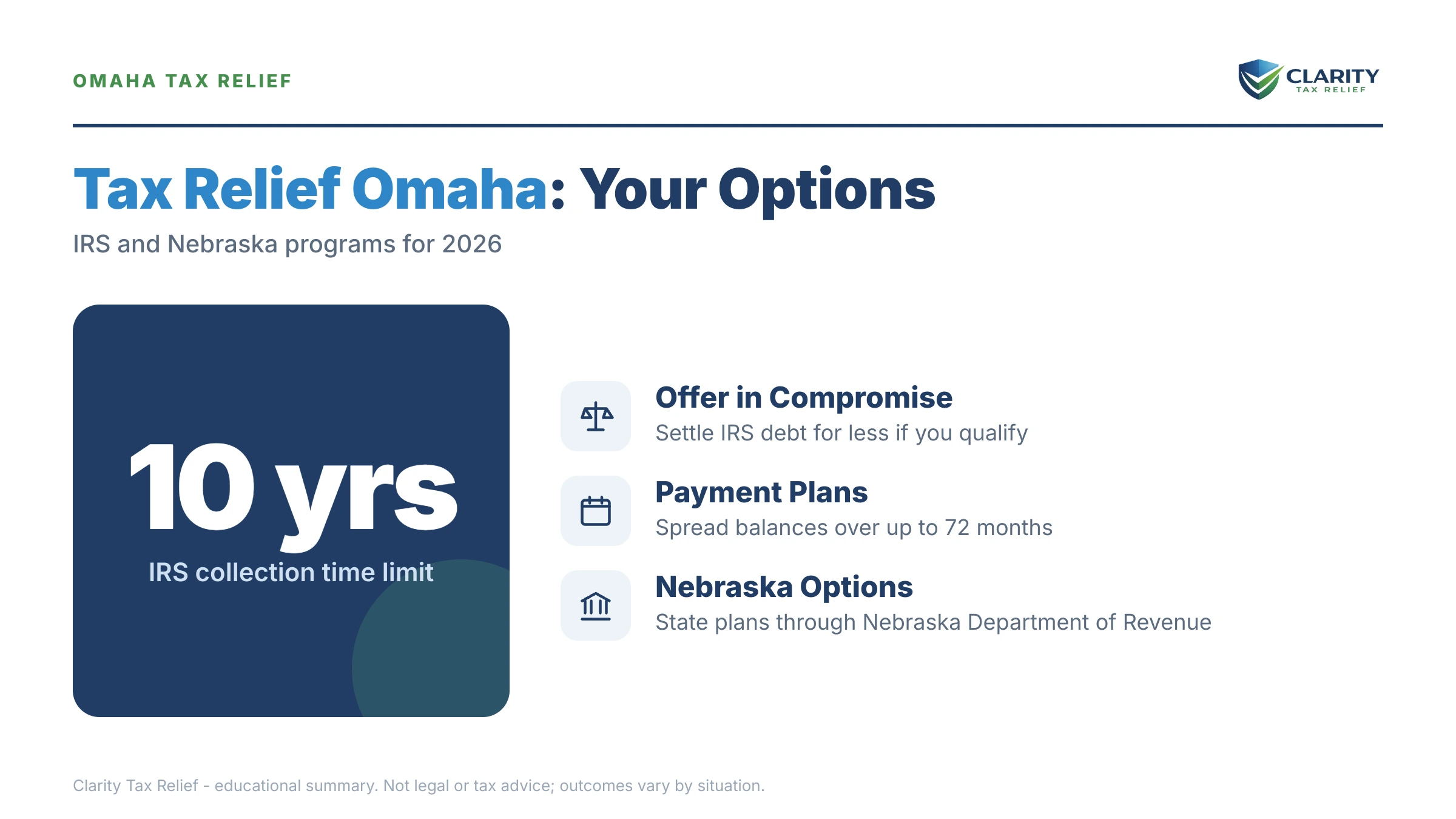
The federal side is the bigger machine but also the more generous one: the IRS publishes national programs — installment agreements, Currently Not Collectible status, the Offer in Compromise, penalty abatement — with the same eligibility rules in Omaha as anywhere else. "Fresh Start" is simply the marketing umbrella over those programs, not a special application.
The state side is smaller and quieter. The Nebraska Department of Revenue sends its own balance-due notices, applies your Nebraska refund to any state debt, and accepts its own payment arrangements. Its rules are not the IRS's rules — never assume a federal figure or timeline applies to Nebraska. If most of your problem is the state balance, start with our guide to Nebraska back taxes.
Why Omaha households end up owing
Most Omaha tax debt comes from under-withholding, not wrongdoing. The common local patterns:
- Two W-2 incomes, one joint return. When both spouses work — insurance, healthcare, rail, banking — each employer withholds as if its paycheck were the only one. The shortfall shows up in April, on a return you both signed, which means both spouses are liable for the full balance on a joint filing.
- 1099 side income. Rideshare, delivery, freelance work, or a booth-rental chair adds income with zero withholding and a self-employment-tax surprise.
- Small business and payroll. Owner-operators and small employers face a different, more serious track — see tax relief for small business if payroll or business balances are part of your picture.
- Cross-border work. Living in Omaha and working in Council Bluffs (or the reverse) means two state returns; miss one and both states can assess you independently.
- Military moves. With Offutt Air Force Base next door in Bellevue, PCS years and deployments scramble filings for a lot of local families — service members have specific protections covered in our guide to combat zone IRS collection relief.
What happens if you ignore tax debt in Omaha
IRS collection escalates in a fixed, automated sequence — staffing cuts slowed the humans in 2025, but the notice-and-levy computers never stopped. Here is the federal track, in order:
- CP14 — the first bill. No enforcement yet; you typically have about 21 days from the notice date before the sequence advances. This is the cheapest moment to act.
- CP501 / CP503 — reminders. Still just bills, arriving weeks apart while penalties and interest stack monthly.
- CP504 — Notice of Intent to Levy. The IRS can now seize your Nebraska state tax refund under IRC §6331(d), and a federal tax lien becomes a live possibility. It is not the final notice, but it's the last cheap exit.
- LT11 / Letter 1058 — Final Notice of Intent to Levy. A 30-day clock starts, along with your Collection Due Process appeal rights (requested on Form 12153). Miss the window and you lose the strongest appeal right in the collection process.
- Levy. A bank levy freezes funds with a 21-day hold before the money leaves; a wage levy on an Omaha employer is continuous — it repeats every payday until released.
Nebraska runs its own parallel track. The Department of Revenue can offset your state refund, file liens, and pursue collection under its own statutes and timelines — which are not the IRS's. A federal payment plan does not switch any of it off.
| Notice | What it means | Your window |
|---|---|---|
| CP14 | First bill for the balance due | Typically 21 days from the notice date |
| CP501 / CP503 | Reminder bills; balance growing monthly | The "pay by" date printed on each notice |
| CP504 | Intent to levy — state refund now reachable | The date printed on the notice |
| LT11 / Letter 1058 | Final notice; levy authority next | 30 days to pay, arrange, or file Form 12153 |
| Levy | Bank funds held 21 days; wage levy continuous | Release requires an agreement or hardship showing |
Owe the IRS or Nebraska from Omaha?
Get your notices and transcripts reviewed free before the automated sequence advances — while a payment plan is still a form, not a fight. An experienced tax professional will map exactly where your case stands with both agencies.
Your Omaha tax relief options, with eligibility and costs
Every legitimate tax relief option is a published IRS or Nebraska program with defined eligibility — nothing here requires a company to "unlock" it for you. The table below covers the federal side; state balances are arranged separately with the Nebraska Department of Revenue.
| Option | Who typically qualifies | Cost to set up | Key limit |
|---|---|---|---|
| Short-term payment plan | Can pay in full within 180 days | $0 | Interest + 0.5%/month penalty continue until paid |
| Guaranteed installment agreement | Individuals owing $10,000 or less in income tax (excluding penalties and interest); all returns filed; timely filing and payment for the past 5 years with no installment agreement in that period | Modest setup fee (lower online / with direct debit) | Must pay in full within 3 years |
| Streamlined installment agreement | Owe $50,000 or less; up to 72 months, set up online | Setup fee; reduced for direct debit, waivable for low income | No financial disclosure, but accruals continue |
| Currently Not Collectible | Paying anything would prevent basic living expenses | $0 | Debt remains; refunds offset; status reviewed periodically |
| Offer in Compromise | Assets + future income genuinely below the balance | $205 fee + 20% down on lump-sum offers (both waived if AGI ≤ 250% of the poverty line) | Means-tested; roughly 1 in 5 offers accepted in FY2024 |
| Penalty abatement / AEP | Clean prior 3 years, or reasonable cause (illness, disaster) | $0 | Removes penalties only — not tax or interest |
Three notes on that table. The guaranteed installment agreement is the one arrangement the IRS generally cannot refuse when you meet its conditions — a genuine right, not a request. Those conditions are specific: it's available to individuals only, on an income-tax balance of $10,000 or less excluding penalties and interest, with all required returns filed, timely filing and payment for the past five years with no installment agreement in that period, and an agreement to pay in full within three years. The Offer in Compromise is real but math-driven: the IRS compares your offer to what it could ever collect from you, and a dual-income Omaha couple with home equity usually fails that test — read how an offer in compromise works before anyone charges you to file one.
And on penalties: first-time penalty abatement can wipe the failure-to-pay penalties if your prior three years were clean — and starting in summer 2026, the IRS's new Automatic Exemption from Penalty (AEP) begins applying that relief automatically, with no request needed. Don't pay anyone hundreds of dollars for relief the system may grant on its own.
A worked example: an Omaha couple who owes $8,900
Say you and your spouse filed jointly, both work W-2 jobs, and the return showed $8,900 due to the IRS that you couldn't pay. This is a hypothetical, but the math is the real math:
- Short-term plan (fastest, cheapest): $8,900 ÷ 6 months ≈ $1,483/month, $0 setup fee, done inside 180 days. Total penalty and interest cost stays small because the balance dies quickly.
- Guaranteed installment agreement: because $8,900 is under $10,000, a clean five-year history means the IRS must accept a plan that pays within 3 years — $8,900 ÷ 36 ≈ $248/month toward the tax, while the 0.5% monthly penalty (about $44 the first month, shrinking as the balance drops) and interest accrue alongside. Easier on the budget; more expensive in total.
- Offer in Compromise: almost certainly not your tool at this balance. With two incomes and any equity, the IRS's collection-potential math will exceed $8,900, and a rejected offer costs months while accruals run.
- Penalty relief: if this is your first slip, first-time abatement (or AEP once it's live) can strip the failure-to-pay penalties off the balance — on a debt this size, that's real money back for a $0 request.
The pattern to notice: at $8,900, the decision isn't whether you can resolve this — it's how fast you want the accruals to stop.
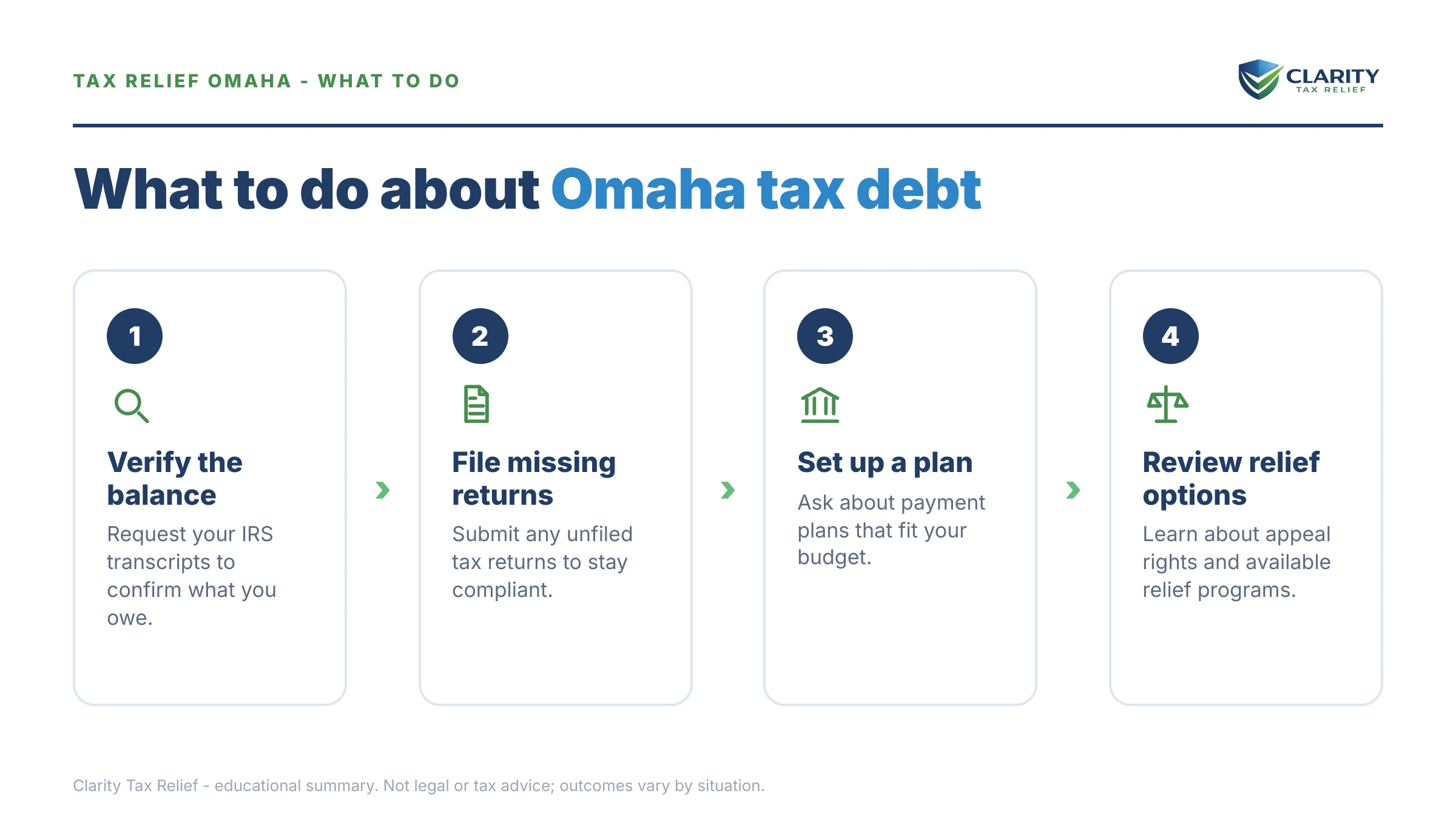
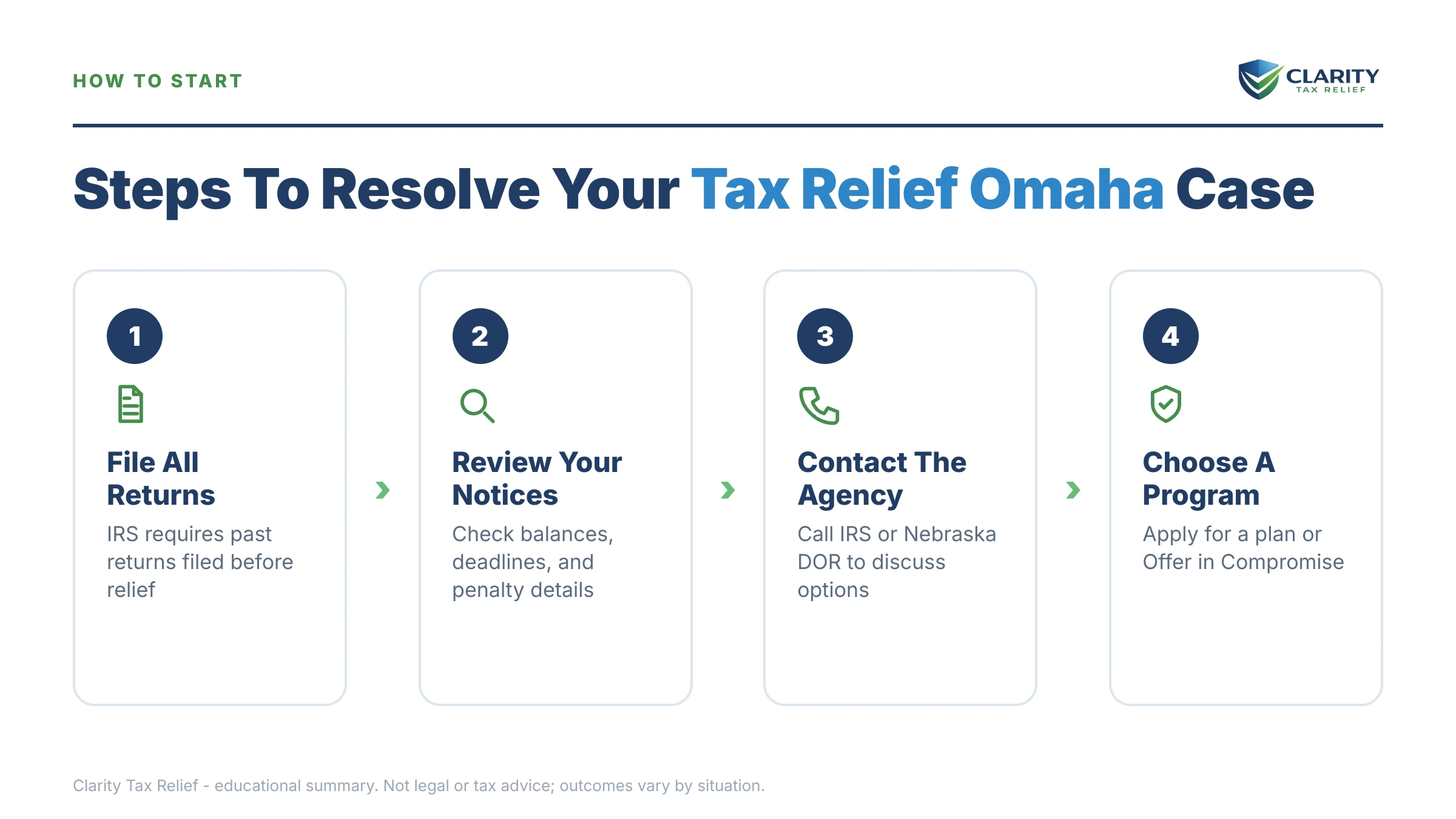
How to respond to tax debt in Omaha, step by step
- Verify both balances. Log into your IRS online account for the federal number, and check any Nebraska Department of Revenue notices against your state records — never work from memory or a collector's phone call.
- File every missing return. Unfiled federal or Nebraska returns block almost every agreement, so filing comes before negotiating — even if you can't pay a dime yet.
- Match your numbers to an option. Use the options table above: under $10,000 usually means a guaranteed installment agreement, under $50,000 a streamlined plan, and genuine hardship points to Currently Not Collectible or an Offer in Compromise.
- Set the agreement up before the next notice. IRS payment plans can be established online in one sitting; the Nebraska Department of Revenue arrangement is a separate request made directly to the state.
- Request penalty relief. Ask about first-time abatement — or the new Automatic Exemption from Penalty rolling out in summer 2026 — so penalties don't ride along on a debt you're already fixing.
When you can handle this yourself in Omaha
Most Omaha taxpayers with a single-year balance under $10,000 that they agree with can resolve it without paying anyone. If your returns are filed, the amount looks right, and a 180-day plan or a three-year guaranteed agreement fits your budget, the setup is a form, not a case — our guide to settling tax debt yourself walks through the whole DIY path.
Experienced help changes outcomes in specific situations: a wage or bank levy already in motion, multiple unfiled years across the IRS and Nebraska (or Nebraska and Iowa), business or payroll tax debt, a balance you dispute, or an Offer in Compromise where the financial-disclosure math decides everything. In those cases the order of operations — returns first, then penalties, then the balance — often changes what you ultimately pay, and getting it wrong is expensive.
Choosing tax relief help in Omaha: local office vs. national firm
A firm's Omaha zip code has no effect on your case — the IRS and the Nebraska Department of Revenue work by phone, mail, and electronic systems, and an enrolled agent, CPA, or tax attorney can represent you from anywhere. What actually separates good help from bad:
- Credentials named up front. Ask exactly who will hold your power of attorney. "Tax consultants" who can't practice before the IRS are a sales floor, not representation.
- Investigation before quotes. A legitimate firm pulls your transcripts before naming a fee or a strategy. Our buyer's checklist for choosing a tax relief company covers the full vetting process.
- No settlement promises. Anyone guaranteeing a specific reduction before seeing your finances is describing marketing, not the means-tested programs above. The warning signs are cataloged in our tax relief red flags checklist, and typical pricing in how much tax relief costs.
- Comparison shop the big names. If a national brand's TV ad brought you here, read an honest breakdown like our Optima Tax Relief alternatives comparison before signing anything.
Tax relief Omaha: your questions answered
Do I need a tax relief company with an office in Omaha?
No — tax resolution work happens by phone, mail, and the IRS's electronic systems, so a firm's street address changes nothing about your case. What matters is who actually represents you: an enrolled agent, CPA, or tax attorney can practice before the IRS from anywhere in the country. Judge firms on credentials, flat-fee pricing, and reviews, not on a local storefront.
How much does tax relief cost in Omaha?
Most reputable firms charge a flat fee based on the complexity of the case — commonly a few hundred dollars for a simple payment-plan setup, up to several thousand for an Offer in Compromise with multiple unfiled years. A legitimate firm quotes the fee after reviewing your IRS transcripts, not before. Be wary of anyone demanding a large upfront fee based on one phone call.
Can the IRS garnish my wages at an Omaha employer?
Yes. After the final notice (LT11 or Letter 1058) and its 30-day window pass, the IRS can send a wage levy to any employer, and that levy is continuous — it stays on every paycheck until the debt is resolved or the levy is released. Setting up a payment plan or hardship status before that point prevents the garnishment entirely.
Does the Nebraska Department of Revenue offer payment plans?
Yes — the Nebraska Department of Revenue accepts payment arrangements on state tax balances, and it's a separate application from any IRS agreement. Terms depend on your balance and compliance history, so work directly with the department through revenue.nebraska.gov. Remember that a federal installment agreement does nothing to stop Nebraska's collection activity, and vice versa.
I live in Omaha but work in Iowa — could I owe both states?
Possibly, which is why cross-border commuters in the Omaha–Council Bluffs metro see two-state tax problems more than most. As a Nebraska resident you generally owe Nebraska tax on all your income but can claim a credit for income tax properly paid to Iowa. If returns went unfiled, both states can assess you independently — resolving one does not resolve the other.
Is the IRS Fresh Start program available in Nebraska?
Yes. Fresh Start isn't a separate application — it's the umbrella term for standard IRS programs like streamlined installment agreements and the Offer in Compromise, and those work identically in all 50 states. Eligibility depends on your balance, income, and assets, not on where you live. Anyone claiming Nebraska residents get special federal forgiveness is selling marketing, not law.
What are our options if we owe the IRS less than $10,000?
A balance under $10,000 puts you in the strongest position. If you're an individual owing $10,000 or less in income tax (excluding penalties and interest), have filed all required returns, and have filed and paid on time for the previous five years without using an installment agreement in that window, the IRS is generally required to accept a guaranteed installment agreement that pays the debt within three years — no financial disclosure needed. If you can move faster, a 180-day short-term plan has no setup fee at all.
Will the IRS take our Nebraska state tax refund?
It can. Once a CP504 notice has been issued, the IRS may levy your state income tax refund through the State Income Tax Levy Program, and Nebraska will also apply your state refund to any Nebraska balance you owe. If you're expecting a refund from either government while you owe the other, assume it will be intercepted until the debt is resolved.
Your next 24 hours
- Pull out every notice you've received — IRS and Nebraska — and note the tax year, amount, and notice code on each. That tells you exactly where each case sits in the sequence above.
- Gather three things: your most recent tax return, the notices, and a rough picture of monthly household income and expenses. Every option in this guide starts from those numbers.
- Get the free case review. Penalties and interest are adding to the balance every month you wait — send us what you're holding at the 2-minute form or call (888) 825-7779, and an experienced tax professional will map your federal and Nebraska options side by side.
Primary sources for this guide: the IRS's official payment options at IRS.gov/payments, the independent Taxpayer Advocate Service, and the Nebraska Department of Revenue for state balances and payment arrangements.
This guide is general information, not tax or legal advice for your specific situation. Eligibility for IRS programs depends on individual facts and circumstances; no outcome is guaranteed.