
Gig & 1099 Tax Debt
Lyft Driver Back Taxes: What the IRS Knows and How to Fix It (2026)
The short answer: Lyft driver back taxes exist because nobody withheld tax from your fares — Lyft reports your gross ride payments to the IRS on Form 1099-K, and the IRS bills the gap. You fix it by filing accurate Schedule C returns, then choosing a payment plan, hardship status, or — if the math supports it — an Offer in Compromise.
You finished a shift, checked your driver dashboard, and the year's earnings looked fine — until a letter arrived matching "Lyft, Inc." income to your Social Security number, with a balance you never budgeted for. Nobody at Lyft ever mentioned that you were running a one-person business the whole time. The good news: this is one of the most common tax debts in the country, and every stage of it has a defined fix.
The single biggest trap is that Lyft's 1099-K reports your gross fares — before Lyft's commission, platform fees, and your mileage. If you don't file a return showing your real expenses, the IRS taxes the whole gross number. The image below shows you exactly what these forms look like and where the gross figure the IRS matches actually sits.
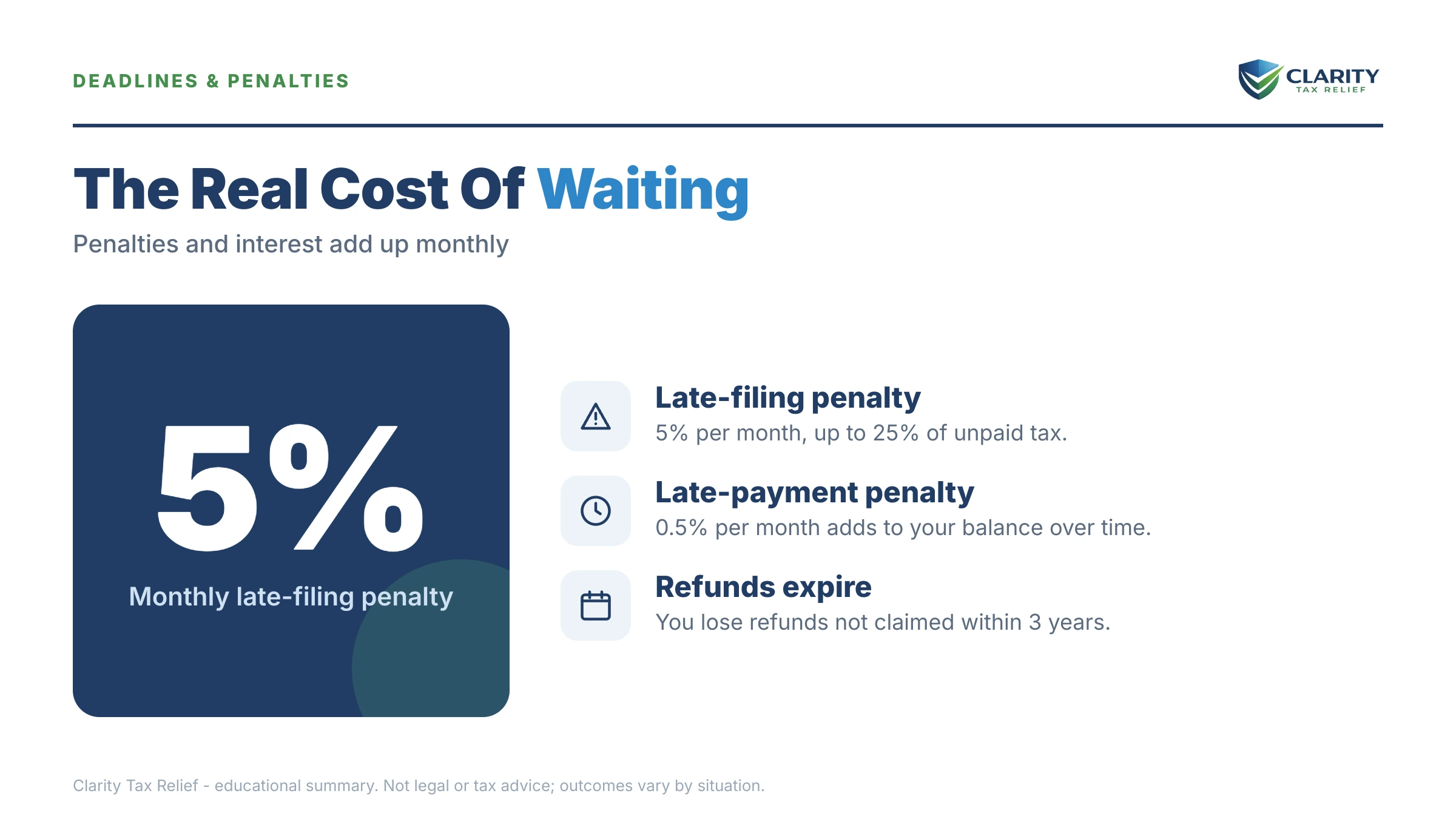
⏱ Your clock: there's no single printed deadline on Lyft back taxes — the cost compounds monthly. An unfiled return adds a failure-to-file penalty of 5% of the unpaid tax per month, up to 25%. A filed-but-unpaid balance adds 0.5% per month, and interest compounds daily on top of both. Every month you wait, the number gets worse.
Why Lyft drivers end up with back taxes
Lyft withholds no income or self-employment tax from driver pay — you owe roughly 15.3% self-employment tax plus regular income tax on every dollar of net profit. To the IRS, you're not an employee. You're a sole proprietor who happens to find customers through an app, which means self-employment tax you owe the IRS on top of income tax, computed on Schedule SE.
That structure produces the same debt over and over, four ways:
- No withholding, no quarterlies. W-2 jobs pay tax every paycheck. Driving pays you 100% now and bills you 25–30% later. If you didn't send quarterly estimated taxes, the whole year's tax lands in April — plus an underpayment penalty.
- Gross-income matching. The IRS computer compares Lyft's 1099-K against your return. File nothing, or leave the driving income off, and the mismatch generates a notice automatically — no human involved.
- Lost deductions. Drivers who didn't track miles or can't separate Lyft's fees from their deposits end up taxed on income they never kept.
- Multiple small years. A $2,000 shortfall three years running, each growing with penalties and interest, quietly becomes a five-figure problem across stacked tax years.
If you formed an LLC for your driving, nothing above changes — a single-member LLC is disregarded for income tax, and the debt is personally yours either way (more in LLC back taxes personal liability).
What Lyft actually reports to the IRS
Lyft files a Form 1099-K with the IRS once your gross ride payments cross $20,000 and 200 transactions — the threshold that took effect after the $600 rule was repealed (full story in the 1099-K $20,000 threshold for 2026 guide). Bonuses, streak pay, and referral income go on a separate 1099-NEC. Two things matter here.
First, the 1099-K number is gross — it includes Lyft's commission, booking fees, and other charges that never hit your bank account. Second, no 1099 means no free pass: income below the reporting threshold is still taxable, and the IRS can still see deposits.
| Document | What it shows | Why it matters to your back taxes |
|---|---|---|
| Form 1099-K | Gross ride payments — before Lyft's commission and fees | This is the number the IRS matches. Filing a Schedule C is how you subtract what you never kept. |
| Form 1099-NEC | Bonuses, referrals, and other non-ride payments | Also matched to your SSN — leaving it off triggers underreporter notices. |
| Driver dashboard Annual Summary | Online miles, Lyft fees, tolls (not sent to the IRS) | Your best evidence for deductions — download it before you file or respond to any notice. |
What happens if you ignore Lyft driver back taxes
Unpaid Lyft taxes move through an automated IRS notice sequence that ends in bank levies and a levy on your Lyft payouts. The path depends on whether you filed:
- The mismatch stage. If you filed but left off driving income, the IRS underreporter unit proposes extra tax via a CP2000 notice. If you never filed, a CP59 demands the return — and if you stay silent, the IRS files a substitute return (SFR) for you using Lyft's gross 1099 numbers with zero expenses and zero mileage.
- Assessment and first bill. Once tax is on the books, a CP14 arrives with roughly 21 days to pay (10 business days if the balance is $100,000 or more) before the reminder cycle starts.
- Reminders, then CP504. CP501 and CP503 restate the growing balance. The CP504 authorizes the IRS to seize your state tax refund under IRC §6331(d).
- LT11 — the final notice. This starts a 30-day clock and your Collection Due Process rights (requested on Form 12153). After it expires, levies are legally authorized.
- Levy stage. A bank levy freezes your account with a 21-day hold before the money leaves. A levy served on Lyft grabs whatever Lyft owes you that day — a one-time hit for 1099 contractors, explained in can the IRS garnish 1099 income. A federal tax lien can also attach to everything you own.
Don't count on 2026 staffing chaos to save you. The IRS workforce shrank roughly 27% in 2025, per TIGTA reports, which makes a human hard to reach — but every notice above is generated by computers that never got cut. The system escalates on schedule whether anyone reads your file or not.
Behind on taxes from driving Lyft?
Get your situation reviewed free before the next automated notice posts — penalties and interest are compounding on your balance every month. A ten-minute call maps your years, your real balance, and your best option.
Your options to resolve Lyft back taxes
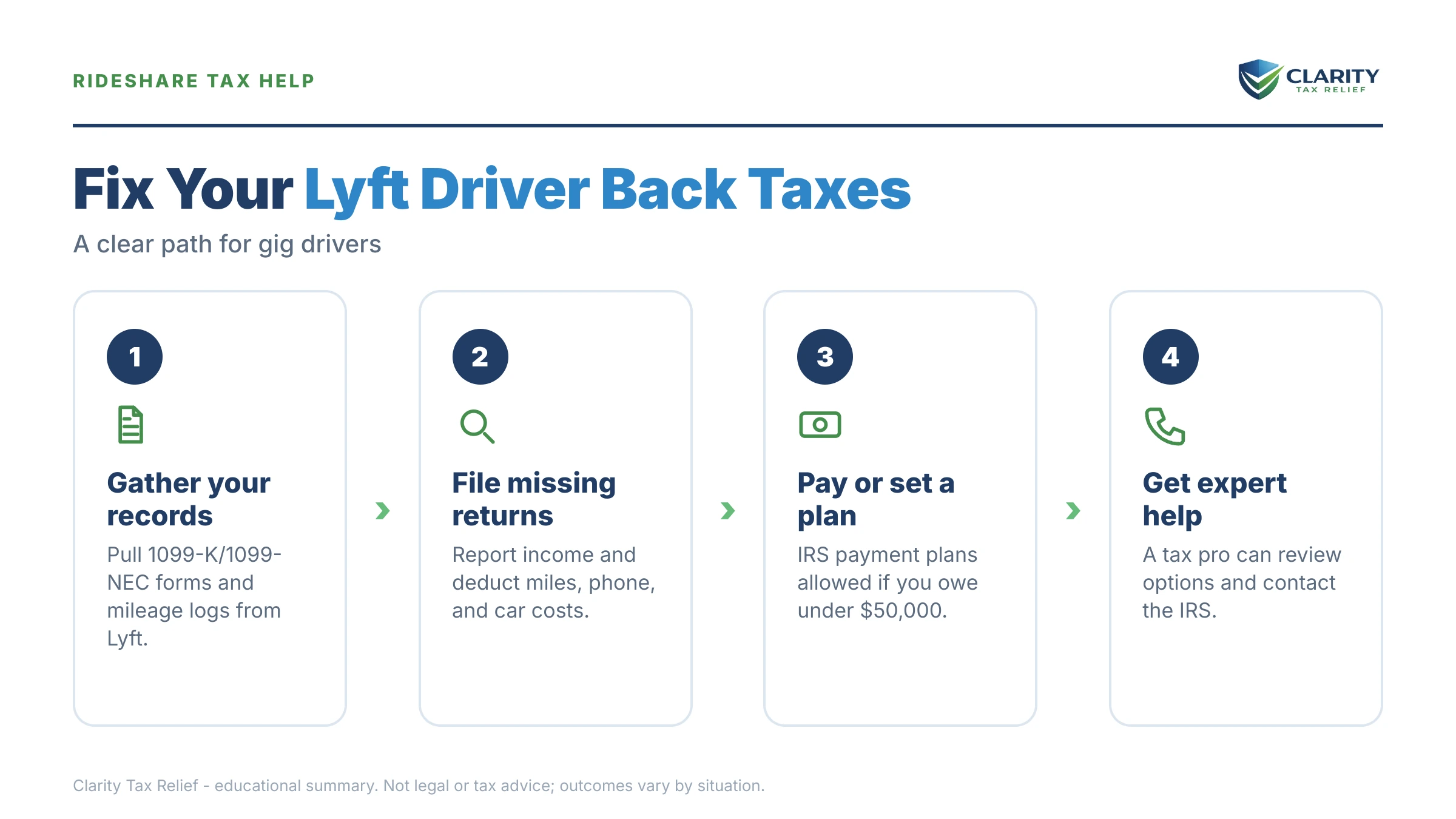
Most Lyft drivers with back taxes qualify for an IRS payment plan set up online — balances under $50,000 can be stretched over up to 72 months. The general playbook for choosing and setting up each program lives in our guide to how to settle tax debt yourself; here's how each option maps to a driver's numbers:
| Option | Who qualifies | Cost & the catch |
|---|---|---|
| Short-term payment plan | Can pay in full within 180 days | $0 setup. Interest and the 0.5%/month penalty still accrue until paid. |
| Guaranteed installment agreement | Owe $10,000 or less; full pay within 3 years; returns filed | The IRS must accept it — no financial disclosure needed. Interest continues. |
| Streamlined / online installment agreement | Up to $50,000; up to 72 months (Form 9465 or online) | Setup fee applies (lower with direct debit). No income/expense proof under the streamlined limits. |
| Currently Not Collectible (CNC) | Paying anything would leave you unable to cover basic living costs (shown on Form 433-F) | $0. Collection pauses, but the debt, interest, and possible lien remain; the IRS re-checks your income. |
| Offer in Compromise (OIC) | Income and assets show the IRS can't collect the full balance before the collection statute runs | $205 fee + 20% down on lump-sum offers (both waived if AGI ≤ 250% of the poverty line). Roughly 1 in 5 offers accepted in FY2024. |
| Penalty relief (FTA / AEP) | Clean compliance the prior 3 years, or reasonable cause | Free. Removes penalties, not tax. Starting summer 2026, Automatic Exemption from Penalty applies without a request. |
Three driver-specific notes. First, every option requires your missing returns to be filed first — the IRS won't approve a plan or an offer while a year is open. Second, if your debt came from an SFR or a CP2000 you never answered, filing or amending an accurate return can shrink the balance before you negotiate anything. Third, an OIC is real but means-tested: a driver with steady weekly deposits and a paid-off car often shows too much collection potential to qualify, which is why the payment plan is the workhorse at typical driver balances. Details on the guaranteed installment agreement under $10,000 and first-time penalty abatement are worth reading before you call the IRS.
A worked example: say you owe $7,400 from driving Lyft
This is hypothetical, but the arithmetic is real. Say you drove Lyft through 2024 as a 1099 contractor, filed on time in April 2025, and the return showed $7,400 due — self-employment tax plus income tax you hadn't set aside. You couldn't pay, so you did nothing.
By July 2026, roughly 15 months later:
- Failure-to-pay penalty: 0.5% × 15 months = 7.5% of $7,400 ≈ $555
- Interest: compounding daily on the growing balance, roughly $700 more at recent rates
- Balance now: roughly $8,650 — and still climbing monthly
Because you're under $10,000 with returns filed, the guaranteed installment agreement fits: $8,650 over 36 months is about $240/month (interest keeps accruing, so the last payments run slightly higher). Stretch it online over 72 months and the minimum drops near $120/month — but you pay meaningfully more total interest. If the prior three years were clean, first-time abatement could strip that $555 penalty on request. You can estimate your own penalty and interest buildup with our Penalty & Interest Calculator before you pick a term.
Now the contrast that matters most: if you hadn't filed, the failure-to-file penalty — 5% per month, ten times the late-payment rate — would have capped out at 25%, adding $1,850 to the same $7,400. And if the IRS had built the number itself from your gross 1099-K — say $34,000 in gross fares with no deductions — the assessed tax could easily have doubled. An accurate Schedule C showing $6,100 in Lyft fees and 22,000 business miles (about $15,400 at the 70-cents-per-mile 2025 rate; the 2026 mileage rate adjusts annually) turns $34,000 of "income" into roughly $12,500 of actual profit. Filing the real return is the single highest-leverage move a driver has.
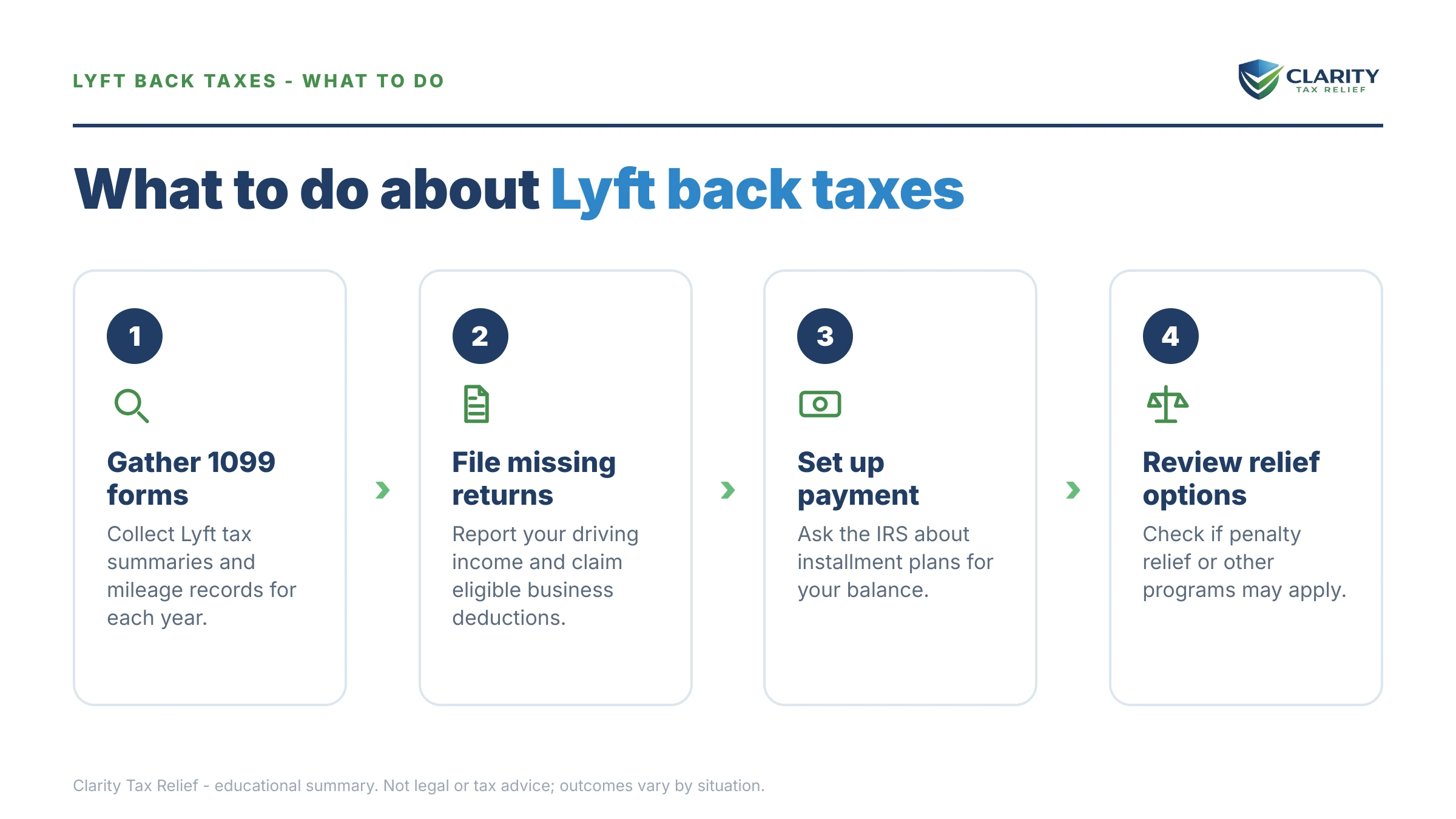
How to respond to Lyft back taxes, step by step
- Pull your IRS wage and income transcripts. See exactly which 1099-K and 1099-NEC amounts Lyft reported to the IRS for every year in question.
- File every missing return with a real Schedule C. Claim your mileage, Lyft's platform fees, and phone costs — this alone often shrinks the assessed balance.
- Verify the corrected balance in your IRS online account. Confirm what you actually owe, by year, after your returns and payments post.
- Set up the resolution that fits your numbers. A payment plan, hardship status, or an Offer in Compromise if the financial math genuinely supports one.
- Request penalty relief. Ask for first-time abatement once your returns are in — or watch for automatic AEP relief starting summer 2026.
Reading your IRS transcript as a rideshare driver
Your IRS account transcript shows every Lyft 1099 the IRS matched, every assessment, and every penalty it added — line by line, by code. Before you negotiate anything, these are the codes drivers see most:
| Code | What it means on a driver's transcript | What to do |
|---|---|---|
| 150 | A return posted and tax was assessed — yours, or an IRS-prepared substitute return | Check the assessed amount against what you actually filed. If it's an SFR, file your real return. |
| 922 | Underreporter review — the computer found a 1099 mismatch; a CP2000 usually follows | Pull your wage & income transcript now and prepare your Schedule C numbers before the notice lands. |
| 290 | Additional tax assessed, often after an unanswered CP2000 or exam | Verify the figure. If it ignores your expenses, amending or audit reconsideration can reduce it. |
| 570 | A hold on the account — something is under review before processing continues | Don't panic; check your online account and watch for a companion notice code. |
| 276 / 196 | Failure-to-pay penalty and interest posted to the balance | Once you're compliant, request abatement — penalties are the most removable part of the debt. |
| 971 | A notice was issued — a letter is on its way | Match the date to whatever arrives in the mail; it tells you which stage of collection you're in. |
When you can handle Lyft back taxes yourself
One filed year and a balance under $10,000 is usually a do-it-yourself fix. If you agree with the number, have no other open years, and can afford roughly the balance divided by 36 each month, set up the payment plan online in an afternoon and request first-time abatement by phone — no representation needed, no fee beyond the IRS's setup charge.
Experienced help changes the outcome in specific situations: multiple unfiled years where the filing order and the six-year lookback matter; an SFR or CP2000 assessment built on gross 1099-K numbers that a reconstructed Schedule C can cut down; a levy already served on your bank or your Lyft payouts; driving income mixed with other gig platforms or a business entity; or genuine hardship where CNC or an Offer in Compromise requires financial disclosure done right the first time. In those cases, the money saved by getting the assessment corrected typically dwarfs the cost of help.
If your situation is in that second list — several years, a levy in motion, or an inflated IRS-computed balance — have an experienced tax professional map the sequence before you call the IRS yourself: the free case review at (888) 825-7779 covers exactly that.
Staying out of tax debt next driving year
The fix that prevents a repeat is mechanical, not motivational. Set aside 25–30% of net earnings — after Lyft's cut — into a separate account every payout. Send the IRS quarterly estimated payments in April, June, September, and January so the underpayment penalty never starts. And log every business mile from the day you go online; the mileage deduction is the largest number on most drivers' Schedule C, and drivers who didn't track miles spend far more effort reconstructing them later than tracking would have cost.
The same mechanics apply across gig platforms — if you also drive for the other app, the uber driver back taxes guide covers that platform's forms, and drivers who've gone independent with their own rig should see owner operator truck driver back taxes, where fuel and depreciation change the math entirely.
Terms on your IRS notice, decoded
- Self-employment tax: the 15.3% Social Security and Medicare tax you pay on net driving profit because no employer pays half for you.
- Gross amount (1099-K, Box 1a): total rider payments processed — including Lyft's commission and fees you never received.
- Substitute for Return (SFR): a return the IRS files on your behalf from 1099 data, with no expenses, no mileage, and the least favorable filing status.
- Levy: actual seizure of money — a bank account, or payments Lyft owes you. A lien is the legal claim that attaches to your property first.
- CSED: the collection statute expiration date — the IRS generally has 10 years from assessment to collect, though offers, appeals, and bankruptcy pause the clock.
- Estimated tax: the four pay-as-you-earn payments self-employed drivers owe during the year instead of paycheck withholding.
Lyft driver tax debt questions, answered
Does Lyft report my income to the IRS?
Yes. Lyft files a Form 1099-K with the IRS reporting your gross ride payments once you cross $20,000 and 200 rides in a year, and a 1099-NEC for bonus and referral income. The IRS computer matches those forms to your Social Security number automatically. Even if you earn less than the reporting thresholds, the income is still taxable and you're still required to report it.
What happens if a Lyft driver doesn't file taxes?
The IRS eventually files a substitute for return (SFR) using Lyft's 1099 figures — with zero business expenses, so the assessed tax is far higher than what you'd owe on an accurate return. It then bills and collects on that inflated number. You can undo most of the damage by filing your real return with a Schedule C, even years late.
How much do Lyft drivers actually owe in taxes?
Plan on roughly 25% to 30% of your net profit — self-employment tax alone is 15.3%, and federal income tax stacks on top based on your bracket. "Net profit" means fares minus mileage, Lyft's fees, and other business expenses, which is why accurate expense records often cut a driver's bill dramatically. State income tax adds more in most states.
Can the IRS garnish my Lyft earnings?
Yes, but differently than a W-2 paycheck. Because you're a 1099 contractor, an IRS levy on Lyft reaches only the money Lyft owes you on the day the levy hits — it's a one-time grab, not a continuous garnishment. Bank levies are the bigger risk: the IRS can freeze your account, and after a 21-day hold the funds go to the Treasury.
Can I deduct my miles if I never tracked them?
Often, yes. Lyft's driver dashboard annual summary shows your online miles, which is a documented starting point the IRS will generally consider, and you can reasonably reconstruct additional business miles from trip history. It's harder than a contemporaneous log, but reconstructed mileage regularly cuts thousands off an assessed balance.
Can I settle Lyft back taxes for less than I owe?
Only through an Offer in Compromise, and only if your income and assets show the IRS could never collect the full balance. The application costs $205 (waived, along with the down payment, if your AGI is at or below 250% of the poverty line), and the IRS accepted roughly 1 in 5 offers in FY2024. For a working driver with steady income, a payment plan is usually the more realistic path.
Do Lyft drivers have to pay quarterly estimated taxes?
Yes, if you expect to owe $1,000 or more for the year. The IRS wants tax paid as you earn — April, June, September, and January deadlines — and charges an underpayment penalty when you skip them. Setting aside 25–30% of each weekly payout is the simplest way to stay ahead of the quarterlies.
Will the IRS take my car for back taxes from driving?
It's rare. Vehicle seizures are among the least-used IRS tools because equity is usually low and the car is how you earn — the IRS would rather levy a bank account or set up a payment plan than take your work vehicle. Seizure becomes a realistic risk only at large balances after you've ignored a final notice of intent to levy.
Is the $600 1099-K rule still in effect for 2026?
No. The 1099-K threshold reverted to $20,000 and 200 transactions, so fewer part-time drivers will get the form for 2026. That changes reporting paperwork, not your obligation: all driving income remains taxable, and back taxes from years when lower thresholds or old matching caught you still exist and still accrue interest.
Your next 24 hours
- Find your real numbers. Log into your IRS online account (or find the balance and tax years on the letter you're holding) and note exactly which years are open and what the IRS says you owe.
- Gather your driver records. Download your Lyft Annual Summary for each year — online miles and platform fees — plus your last filed return and any 1099-K or 1099-NEC you received.
- Get the free case review. Interest and penalties are compounding on your balance every month you wait — call (888) 825-7779 or use the 2-minute form and we'll map your years, your corrected balance, and your best resolution, free.
Primary sources worth bookmarking: the IRS Gig Economy Tax Center covers rideshare reporting rules, the IRS payment plans page handles online setup, and the Taxpayer Advocate Service can intervene when collection creates hardship.
This guide is general information, not tax or legal advice for your specific situation. Eligibility for IRS programs depends on individual facts and circumstances; no outcome is guaranteed.