
IRS Notices
IRS LT33 Notice: Payment Received but You Still Owe (2026)
The short answer: an LT33 notice means the IRS received your payment but its records still show a balance due. Either the payment covered only part of the debt, it posted to a different tax year than you intended, or penalties and interest grew the balance. Pay or arrange the remainder by the date printed on the notice.
You sent the IRS money — maybe every dollar you thought you owed — and instead of a receipt marked "paid," the LT33 notice in your hand says a balance is still on the books. It's an aggravating letter to get after writing a check. The good news: an LT33 is the tamest letter in the collection stream, and the gap it describes is usually small, traceable, and fixable in an afternoon.
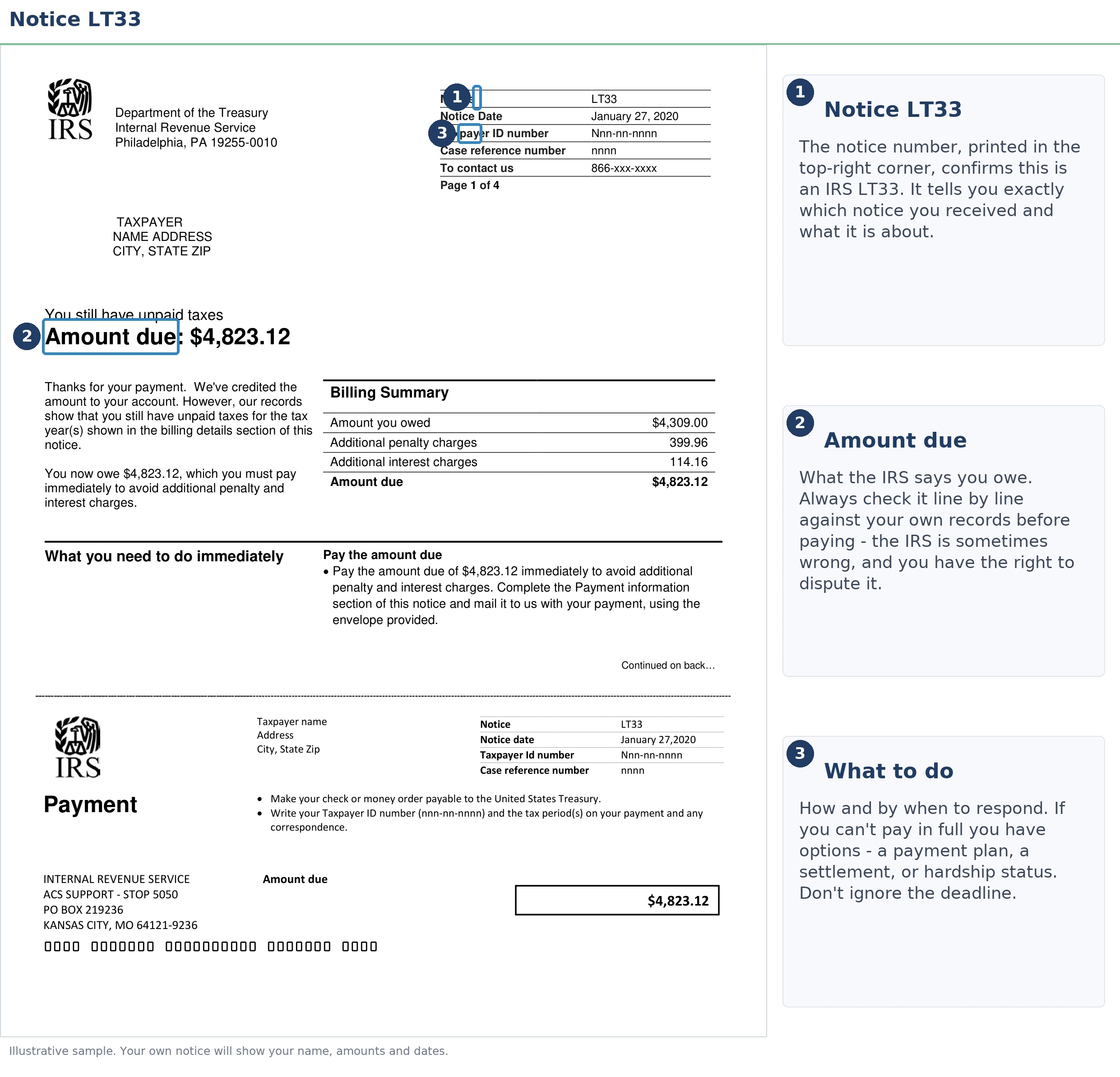
Unlike the CP-series bills mailed by IRS service centers, the LT33 comes from the Automated Collection System (ACS) — the enforcement arm that handles accounts already in active collection. That's why it matters more than its polite tone suggests: your file is sitting in the same queue that eventually issues levy notices. The image below shows exactly what an LT33 looks like and which lines to check first — the payment the IRS says it applied, and the balance it says remains.
⏱ Your clock: the pay-by date printed on your LT33. There's no separate statutory window with this notice — but the failure-to-pay penalty (0.5% per month) and daily-compounding interest keep accruing on the remaining balance every day past that date, and the automated system queues the next, more serious notice behind it.
Why you got an LT33 notice
An LT33 notice means the IRS Automated Collection System received a payment from you, applied it to your account, and still shows a balance due. Three situations produce almost all LT33s:
- You paid part of what you owe. If you sent what you could afford — say $3,500 against a $31,000 self-employment bill — the LT33 is the IRS acknowledging the payment and billing the rest. A voluntary partial payment does not create a payment plan, so the notice stream continues around it.
- Penalties and interest outran your payment. The balance on your original bill was a snapshot. If weeks passed before you paid, the failure-to-pay penalty and daily interest kept running, so even a "full" payment can leave a remainder of a few hundred dollars — enough to keep the account open and the notices coming.
- Your payment posted to the wrong place. A check that didn't specify a tax year, or an online payment pointed at the wrong period, can pay down a year you didn't intend while the year on the LT33 keeps accruing. In rarer cases a payment bounces or gets reversed — that scenario usually arrives as a CP60 notice, but the downstream LT33 looks the same.
If you're not sure why the IRS wrote to you at all, our decoder on why you got a letter from the IRS maps the whole notice system. The rest of this page is specifically about closing out the balance behind an LT33.
First: find out where your payment actually went
Most surprise LT33 balances trace to a payment that posted somewhere other than where you intended, so verify before you pay anything twice.
- Log into your IRS online account. It lists every payment by date and by the tax year it was applied to, plus the live balance for each open year. Compare that against the payment and remaining balance printed on the LT33.
- Check the tax year on the notice. If you owe for more than one year, the IRS may have applied your money to the oldest balance while the LT33 bills a different one. That's not an error — it's default application order — but it changes which year you're actually short on.
- Pull your payment proof. A Direct Pay confirmation, EFTPS receipt, canceled check, or bank statement showing the amount and date is what the IRS will want if something needs to be moved or credited.
If the payment posted to the wrong year, ask the IRS to reapply it — by phone using the number on the notice, or in writing with your proof attached. Never pay a second time to "cover" a payment you can prove the IRS already has. Get the first one applied correctly; the corrected balance is usually far smaller than the notice suggests.
What happens if you ignore an LT33
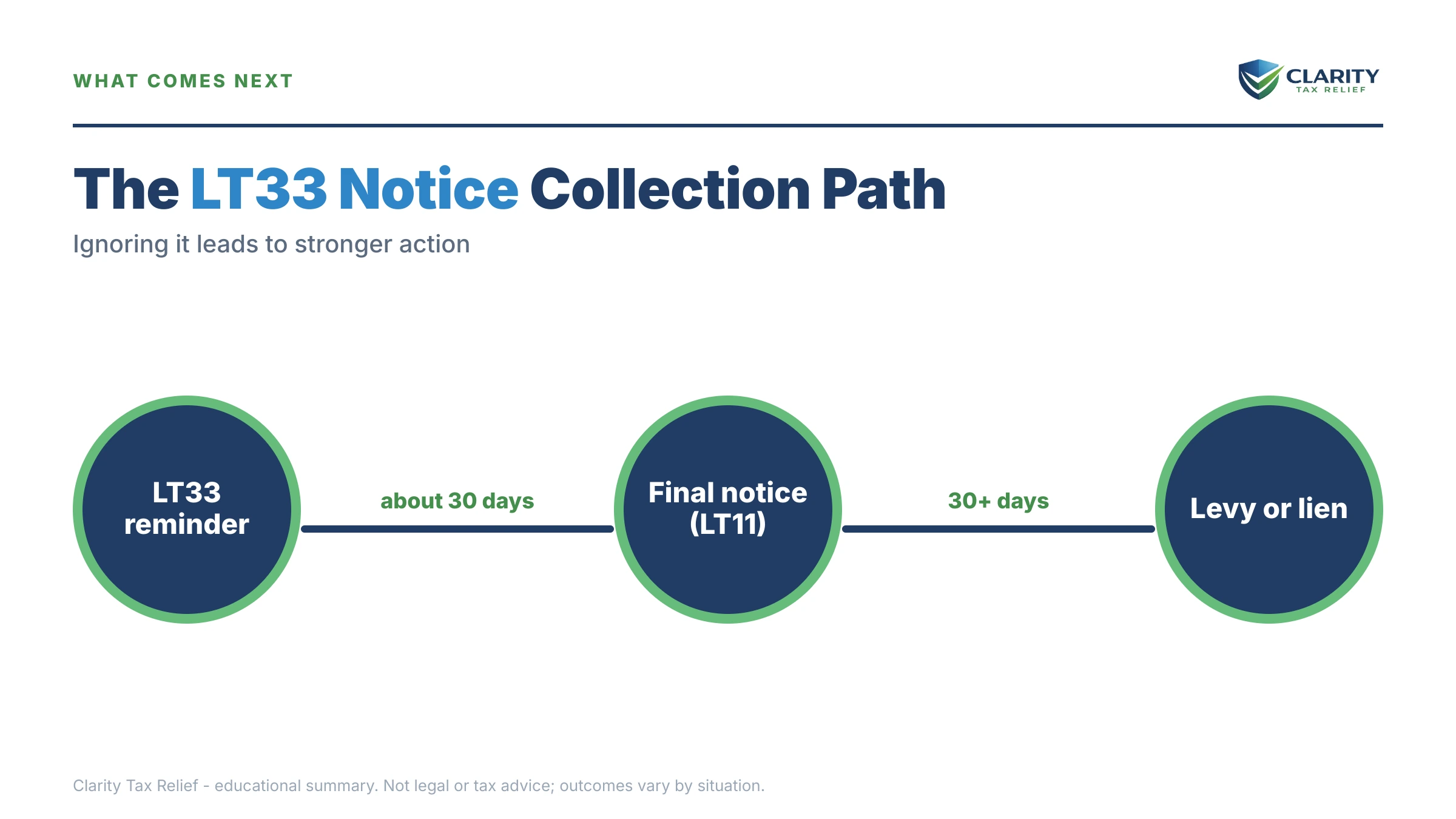
Ignoring an LT33 keeps your account in active IRS collections, where the notices that follow carry levy power the LT33 doesn't. The sequence is automated — and in 2026, with the IRS workforce down roughly 27%, it's the automation that keeps running while humans are hard to reach. Stage by stage:
- LT33 — you are here. A bill for the remainder. No enforcement action yet, but the failure-to-pay penalty and interest accrue monthly.
- Further ACS demands — letters like the LT16 notice and LT19 notice press for payment of the same balance with firmer language.
- CP504 — Notice of Intent to Levy. Under IRC §6331(d), the IRS can now seize your state tax refund, and a federal tax lien becomes a realistic next step.
- LT11 / Letter 1058 — Final Notice of Intent to Levy. This starts a 30-day clock and your Collection Due Process rights (requested on Form 12153). Our LT11 guide covers that stage in full.
- Levy. A bank levy comes with a 21-day hold before funds transfer. A wage levy is continuous until released. And if you're a 1099 contractor, the IRS can send a levy directly to your clients — a single levy on 1099 contractor income can capture an entire invoice payment the day it's due to you.
| Notice | What it tells you | Typical window |
|---|---|---|
| CP14 | First bill for a balance due | ~21 days from the notice date |
| LT16 / LT19 | ACS payment demands on an open balance | Date printed on the notice |
| LT33 | Payment received; a balance remains | Pay-by date printed on the notice |
| CP504 | Intent to levy your state tax refund (§6331(d)) — not the final notice | Date printed on the notice |
| LT11 / Letter 1058 | Final notice of intent to levy | 30 days, with Collection Due Process rights |
Sent the IRS money and got an LT33 anyway?
Send us a photo of the notice before the pay-by date passes. An experienced tax professional will trace where your payment actually posted, confirm the real remaining balance, and map your cheapest way to close it — free and confidential.
Your options if you can't pay the remaining balance
An LT33 arrives early enough in the collection stream that every IRS resolution option is still on the table — and this is the cheapest point to use one.
- Pay in full at IRS.gov/payments. This stops the failure-to-pay penalty, stops the notice stream, and closes the year.
- Short-term plan — up to 180 extra days to pay in full, with a $0 setup fee. Interest and penalties continue, but the escalation stops.
- Installment agreement — a monthly plan you can set up online for balances up to $50,000, spread over as long as 72 months. Under $25,000 (or under $50,000 with direct debit), a streamlined installment agreement requires no detailed financial disclosure; Form 9465 works if you'd rather apply on paper. Once the agreement is in effect, the failure-to-pay penalty rate drops from 0.5% to 0.25% per month.
- Currently Not Collectible status — if paying anything would leave you unable to cover basic living expenses, collection can be paused. The debt remains and interest accrues, but levies stop. See how Currently Not Collectible status actually works before assuming you qualify — it's means-tested against IRS expense standards.
- Offer in Compromise — settling for less than the full balance is real but strictly means-tested: the IRS accepted roughly 1 in 5 offers in FY2024, and approval depends on whether your assets and future income genuinely can't cover the debt before the collection statute runs out. On a mid-five-figure balance with steady 1099 income, an installment agreement is usually the more realistic path — but the math is worth checking before you commit.
- Penalty relief — if your prior three years were clean, first-time penalty abatement can remove the failure-to-pay penalty on the year the LT33 covers. And starting in summer 2026, the IRS's new Automatic Exemption from Penalty (AEP) applies similar relief automatically, without a request. Reasonable cause (illness, disaster, events outside your control) is a separate route if your history isn't clean.
| Stage | Response window | What's at stake |
|---|---|---|
| LT33 (now) | Pay-by date printed on the notice | Every option still open — plans, hardship status, penalty relief — at the lowest cost point |
| CP504 | Date printed on the notice | Your state tax refund can be seized; a federal tax lien becomes likely |
| LT11 / Letter 1058 | 30 days | Your Collection Due Process hearing rights (Form 12153) — miss the window and levies can begin |
| Bank levy issued | 21-day hold before funds transfer | Your last chance to prove hardship or error before the money leaves the account |
| Wage or receivables levy | Continuous until released | For 1099 contractors, a levy sent to a client can take an entire invoice payment |
A worked example: $27,500 left after your payment
Say you're a 1099 contractor who owed about $31,000 after your first big self-employment year — no withholding, no quarterlies. You scraped together $3,500 and mailed it in. The LT33 arrives confirming the payment and showing $27,500 still due. Here's the math on your choices, all figures hypothetical and rounded:
- Do nothing for a year: the failure-to-pay penalty runs 0.5% per month — about $137 a month on $27,500, roughly $1,650 over twelve months — plus daily-compounding interest at the federal rate. Your balance heads past $29,000 while the notice stream escalates toward levy territory. You can estimate your own accrual with our IRS Penalty & Interest Calculator.
- 72-month installment agreement: $27,500 ÷ 72 ≈ $382 a month before interest — expect the actual payment to land somewhat higher so the balance clears within the collection statute. Because $27,500 is under $50,000, you can set this up online without submitting financial statements, and the penalty rate drops to 0.25% per month once the agreement is in effect.
- Aggressive 24-month payoff: roughly $1,146 a month plus accruing interest — more painful monthly, but it cuts total penalty and interest by finishing four years sooner.
One more move that matters for a contractor: start current-quarter estimated payments now. A new balance next April defaults any agreement you set up today — how quarterly estimated taxes work walks through the amounts and dates.
How to respond to an LT33, step by step
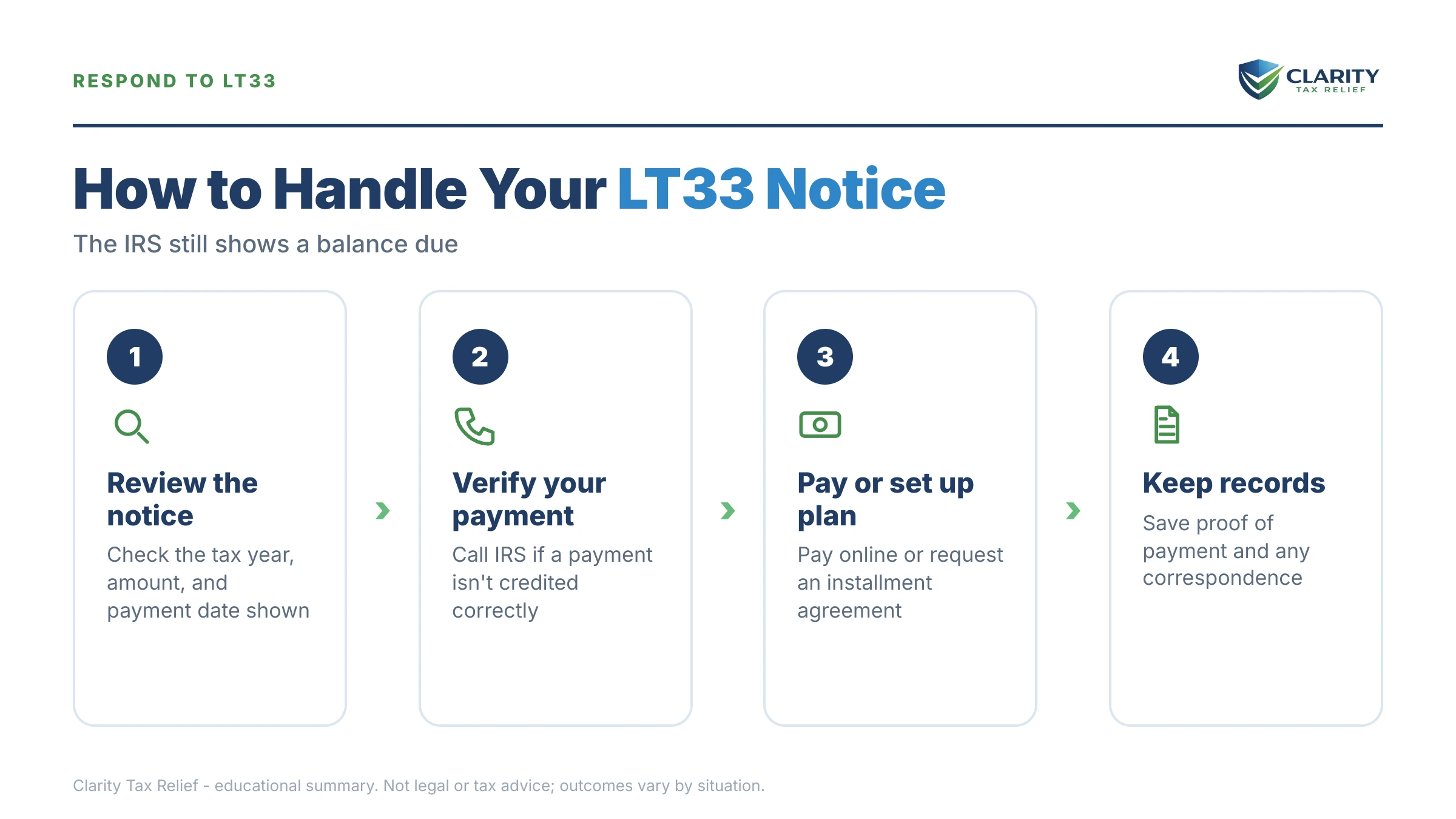
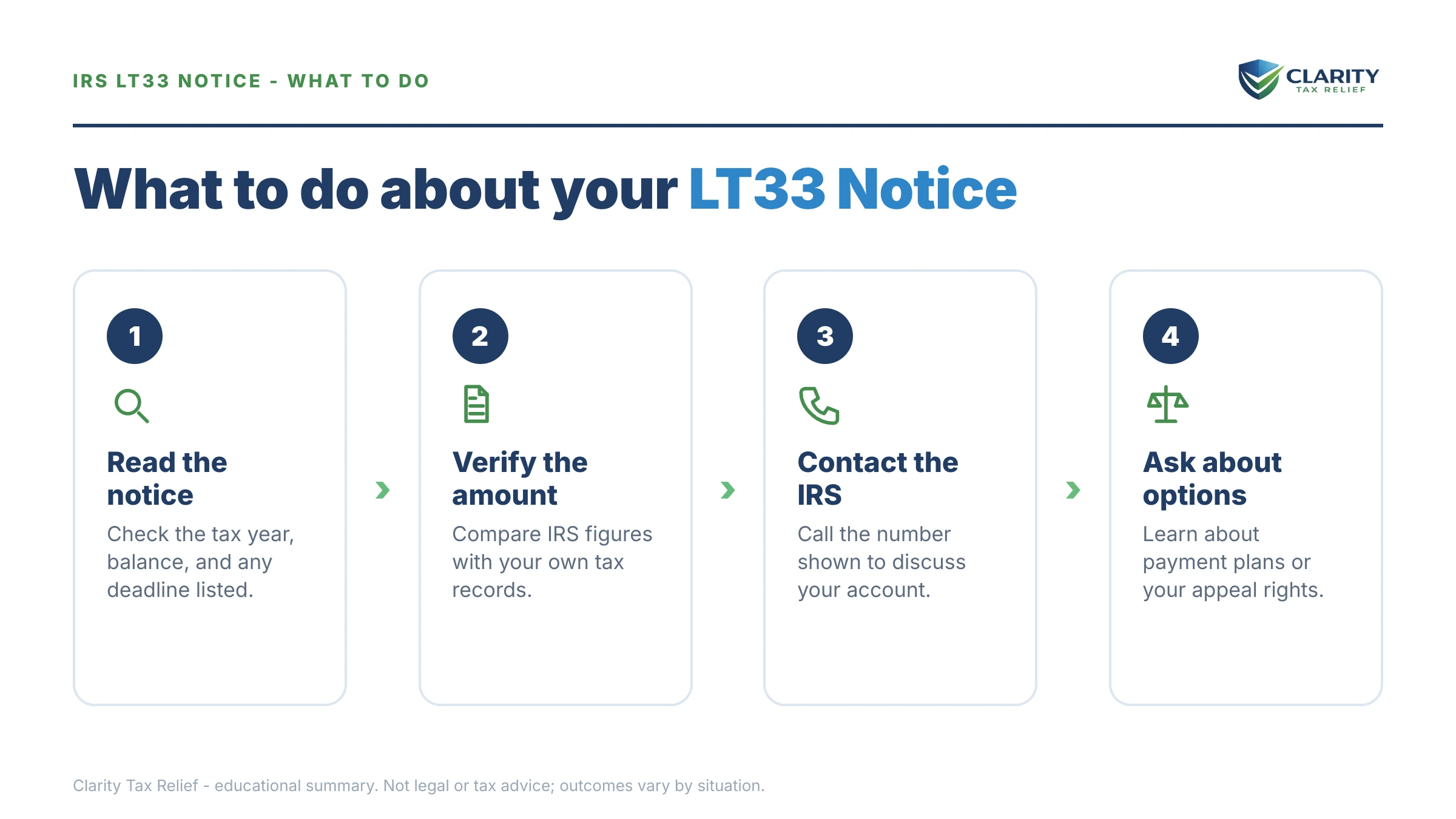
- Pull up your IRS online account — confirm the payment the IRS received, the tax year it posted to, and the current balance for every open year.
- Match the LT33 to your records — compare the notice's tax year, payment amount, and remaining balance against your bank statement or payment confirmation.
- Fix a misapplied payment — if your money posted to the wrong year or was reversed, call the number on the notice or respond in writing with proof of payment and ask that it be reapplied.
- Pay or set up an agreement by the pay-by date — pay the remainder at IRS.gov/payments, or set up a short-term plan or installment agreement online or with Form 9465 before the printed date.
- Get a professional review if the balance is large or spans years — if you owe more than $10,000, have multiple open years, or dispute the amount, have an experienced tax professional sequence the fix before you commit to a plan.
Plan details and eligibility rules are on the IRS payment plans page, and you can verify everything on the notice through your IRS online account.
When you can handle an LT33 yourself
You can usually resolve an LT33 on your own when the balance covers one tax year, you agree with the number, and you can either pay it within 180 days or set up a streamlined online plan. The remainder after a good-faith payment is often small enough that a ten-minute online session closes the whole file — no professional needed.
Experienced help changes outcomes in a narrower set of situations: the payment trail is tangled across multiple years and the IRS's application order is costing you money; you have unfiled returns feeding the balance; the remainder is large enough that plan structure, penalty abatement, and settlement math interact (typically $25,000 and up); or a later-stage notice like a CP504 or LT11 has already arrived alongside the LT33. In those cases, the order you fix things in — returns first, then penalties, then the balance — often determines what you ultimately pay.
If you've been struggling to reach the IRS by phone to fix a misapplied payment, that's not you — 2026 staffing cuts have made human contact genuinely difficult. If the amount is small, persistence works. If it's five figures, that phone problem is itself a reason to put a representative on it.
Terms on your LT33, decoded
- ACS (Automated Collection System): the IRS's computerized collection unit that mails LT-series notices and can issue levies without a human revenue officer ever touching your file.
- Amount applied: the payment the IRS credited to this tax period — check that it matches what you actually sent, and to the year you meant.
- Failure-to-pay penalty: 0.5% of the unpaid tax per month (0.25% while an installment agreement is in effect), on top of interest.
- Statutory interest: interest set by law at the federal rate, compounding daily on tax and penalties; it generally can't be waived, but it shrinks when penalties are removed.
- CSED (Collection Statute Expiration Date): the IRS generally has 10 years from assessment to collect, though certain actions pause that clock.
- Levy vs. lien: a lien is a legal claim against your property; a levy is the actual seizure of money or assets. An LT33 is neither — but both sit further down the path it's on.
LT33 notice FAQs
What is an IRS LT33 notice?
An LT33 is a letter from the IRS Automated Collection System confirming that a payment you sent was received — but that your account still shows a balance due. It is a bill for the remainder, not a levy notice. The unpaid amount keeps accruing the 0.5%-per-month failure-to-pay penalty plus interest until you pay it or set up an arrangement.
I paid my taxes in full — why does the LT33 say I still owe?
Usually because penalties and interest accrued between the date your balance was assessed and the date your payment posted, so a payment matching the original bill leaves a small remainder. The other common causes are a payment applied to the wrong tax year or a payment the IRS later reversed. Your IRS online account shows exactly where every payment posted, so check it before you pay anything twice.
Can the IRS levy my bank account after an LT33?
Not based on the LT33 itself — the IRS must first send a final notice of intent to levy (LT11 or Letter 1058), which starts a 30-day clock and Collection Due Process rights. But an unresolved LT33 keeps your account in active collections and moving toward that final notice. For 1099 contractors, a later levy can attach to bank accounts and to payments your clients owe you.
What if my payment was applied to the wrong tax year?
Ask the IRS to move it. Call the number printed on your LT33 with your payment confirmation, or respond in writing with proof — a bank statement, canceled check, or IRS Direct Pay confirmation showing the amount and date. Misapplied payments are common when a check doesn't specify the tax year and multiple years are open. Until it's corrected, the wrong year looks paid and the right year keeps accruing penalties.
Does sending partial payments stop IRS collection?
No. Voluntary partial payments reduce the balance but do not create an agreement, so the automated notice stream keeps escalating around them — which is exactly why an LT33 follows a payment. To actually stop escalation you need a formal arrangement: a short-term plan of up to 180 days, an installment agreement, or hardship status. Once an installment agreement is in effect, the failure-to-pay penalty rate also drops from 0.5% to 0.25% per month.
Can the penalties on my LT33 balance be removed?
Often, yes. If your prior three years were clean, first-time penalty abatement can remove the failure-to-pay penalty on the year in question — and starting in summer 2026, the IRS's Automatic Exemption from Penalty (AEP) applies similar relief automatically, with no request needed. Reasonable-cause relief is also available for illness, disaster, or other events outside your control. Interest on the tax itself generally cannot be waived, but it shrinks when penalties come off.
How long do I have to respond to an LT33?
Your deadline is the pay-by date printed on the notice — there is no separate statutory window attached to an LT33. Missing that date doesn't trigger an immediate levy, but the failure-to-pay penalty and daily-compounding interest keep accruing, and the automated system queues the next, more serious notice. The cheapest day to resolve the remainder is the day the LT33 arrives.
Your next 24 hours
- Find three things on your LT33: the tax year it covers, the payment the IRS says it applied, and the remaining balance with its pay-by date. Circle all three.
- Gather your proof: the bank statement or payment confirmation for what you sent, the return for that tax year, and a rough picture of your monthly income — that's everything needed to verify the balance and pick a plan.
- Get the balance reviewed free before the pay-by date passes: the 2-minute form at claritytaxrelief.com/#consult or a call to (888) 825-7779. An experienced tax professional will confirm where your payment actually went and whether the remainder is even right — before another month of penalties posts. If you'd rather escalate a stuck misapplied-payment case yourself, the Taxpayer Advocate Service can also intervene when normal channels fail.
This guide is general information, not tax or legal advice for your specific situation. Eligibility for IRS programs depends on individual facts and circumstances; no outcome is guaranteed.