
IRS Letters
IRS Letter 5699: Missing 1094-C/1095-C ACA Filings — What It Means and How to Respond (2026)
The short answer: Letter 5699 means the IRS believes your business was an Applicable Large Employer — roughly 50 or more full-time employees — but never filed Forms 1094-C and 1095-C for the year shown. You typically have 30 days to respond using one of five options printed on the letter; ignoring it invites per-form penalties and a Letter 226-J.
There's no dollar amount anywhere on this letter — and that's what makes it different from almost everything else the IRS mails. Letter 5699 is a question, not a bill: the IRS counted the W-2s filed under your EIN, decided you may have crossed the 50-employee line, and wants to know why it never received your health-coverage forms. The box you check decides whether this closes quietly or becomes the most expensive letter your business ever ignored.
The image below shows exactly what Letter 5699 looks like and where to find the two facts that control your case: the reporting year the IRS is asking about and the date your response is due.
⏱ Your deadline: the respond-by date printed on your Letter 5699 — typically 30 days from the letter date. Miss it and the IRS can assess failure-to-file penalties for every missing form and open an Employer Shared Responsibility Payment review without hearing your side at all.
Why you got Letter 5699
Letter 5699 goes to businesses whose W-2 counts suggest 50 or more full-time employees but that filed no Forms 1094-C or 1095-C for the year in question. Under the Affordable Care Act, an Applicable Large Employer (ALE) must file a 1095-C for each full-time employee and a 1094-C transmittal every year — whether or not it offered health coverage. The IRS cross-matches the W-2s and payroll returns filed under your EIN against the ACA filings it received; where W-2s exist and ACA forms don't, Letter 5699 goes out.
Two quirks matter. First, the W-2 match over-counts: the IRS's screen includes part-time and seasonal workers, so businesses that were never actually ALEs get this letter regularly. Second, the year on the letter is usually two or more years back — the ACA compliance unit runs well behind the calendar, which is why a 2023 question can land in a 2026 mailbox.
One thing Letter 5699 is not: an audit of your income tax return, and it's not addressed to you personally as a worker — it's an employer-reporting inquiry tied to your business EIN. For a plain-English map of how IRS letters differ, see why did I get a letter from the IRS.
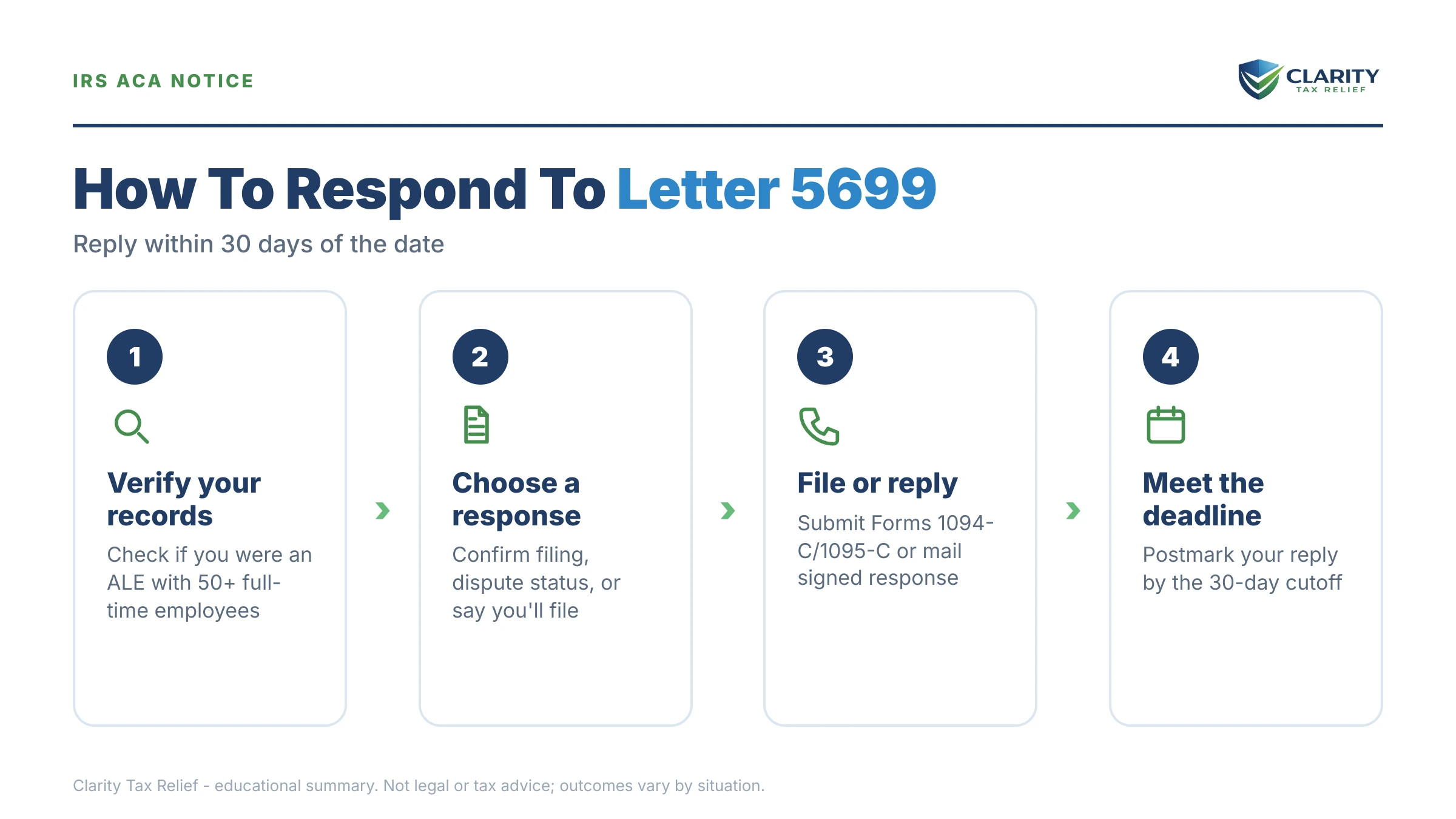
First: confirm whether you were actually an ALE that year
You were an Applicable Large Employer for a year only if you averaged 50 or more full-time employees plus full-time equivalents during the prior calendar year. That test has moving parts, and each one is a place the IRS's W-2 screen can get it wrong:
- Full-time means 30+ hours per week (or 130 hours per month). A staff of 60 people where 25 work part-time may not be an ALE at all.
- Part-timers count fractionally. Add all part-time hours in a month and divide by 120 to get full-time equivalents, then add those to your full-time count.
- The prior year controls. Letter 5699 asking about 2023 means the headcount test runs on 2022.
- The seasonal-worker exception: if your workforce exceeded 50 for 120 or fewer days and the excess was seasonal workers, you're generally not an ALE for that year.
- Aggregation cuts the other way: companies under common ownership are counted together as one employer. Two 30-employee companies with the same owner can be a 60-employee ALE — this is the trap that catches owners who assumed each entity stood alone.
Run this math before you touch the response form. If the honest answer is "under 50," your entire response is a headcount worksheet — and the case can close with nothing owed.
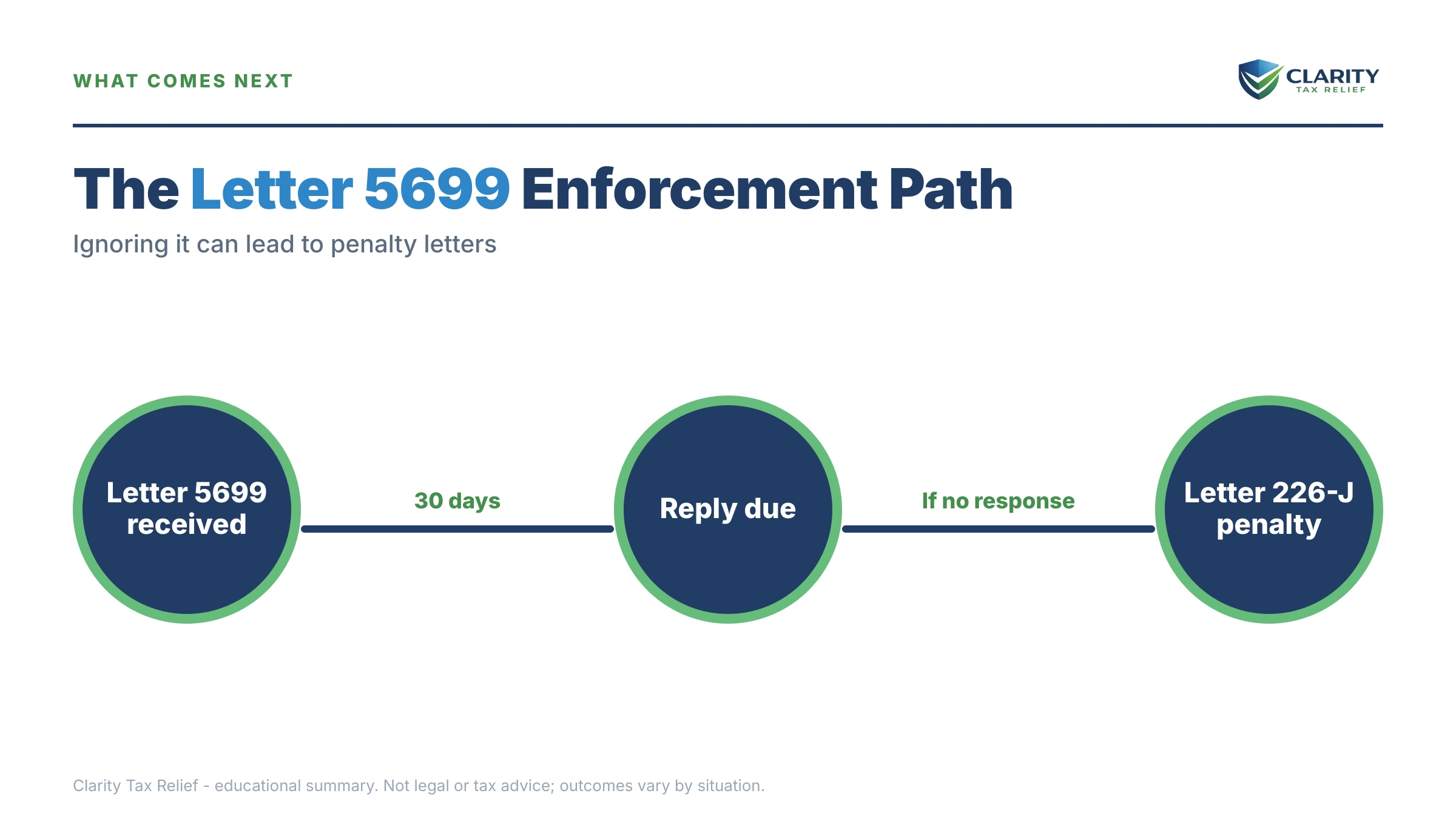
What happens if you ignore Letter 5699
Ignoring Letter 5699 lets the IRS assess penalties for every missing form and compute an ACA employer penalty without your input. The sequence runs in stages, and each stage takes options off the table:
- Letter 5699 — the inquiry stage. You are here. Nothing has been assessed; every good outcome is still available.
- Non-response — the IRS is not obligated to send another warning. Your file moves from "question" to "non-filer."
- Information-return penalties — failure-to-file penalties under IRC §6721 (forms owed to the IRS) and §6722 (statements owed to employees), often proposed on Notice 972CG or billed on a CP215 notice. Silence also risks the "intentional disregard" label, which raises the per-form amount and removes the annual cap.
- Letter 226-J — a proposed Employer Shared Responsibility Payment, computed from IRS data alone, with its own short response window (typically 30 days). Because you never filed, the IRS's numbers — not yours — set the starting point.
- Letter 227 — the IRS's decision on your 226-J response, followed by assessment and a demand for payment.
- Collection — once assessed, the balance moves into the standard business collection track: demand notices, then federal tax lien and levy authority against business accounts.
One more reason non-response is uniquely dangerous here: the IRS's position is that no statute of limitations runs on the Employer Shared Responsibility Payment for a year in which the 1094-C/1095-C were never filed. Income tax exposure eventually ages out; an unfiled ACA year stays open until you file. Doing nothing doesn't run out the clock — it stops the clock from ever starting.
Holding a Letter 5699 right now?
The wrong checkbox — or silence — can turn a records question into a six-figure ACA assessment. Get your Letter 5699 and your headcount math reviewed free before the response date printed on your letter passes.
Letter 5699 escalation sequence: what happens when
| Stage | What the IRS sends or does | Your window |
|---|---|---|
| ACA filing inquiry | Letter 5699 — five response options, no amount due | Typically 30 days from the letter date |
| Non-response | File flagged as ACA non-filer; IRS may act without further warning | None guaranteed |
| Form penalties | §6721/§6722 penalties proposed (Notice 972CG) or billed (CP215) | Contest window stated on the notice |
| ESRP proposal | Letter 226-J with a computed Employer Shared Responsibility Payment | Typically 30 days to agree or dispute |
| IRS decision | Letter 227 (several versions), then assessment and demand | Window stated on the letter |
| Collection | Demand notices, then lien and levy authority | Standard collection deadlines apply |
Your five response options on Letter 5699
Letter 5699 gives you five checkboxes, and exactly one of them fits your situation. No payment goes with the response — this stage is about facts, not money. The table below decodes each box:
| Response option | When it applies | What to include |
|---|---|---|
| Already filed | You filed the 1094-C/1095-C for that year — possibly under a different EIN or business name | The EIN and name used, the date filed, and how (paper or electronic) |
| Filing now | You're enclosing the missing returns with your response | Complete Form 1094-C plus a 1095-C for every full-time employee |
| Will file within 90 days | You need time to reconstruct hours and coverage data | The date you'll file by and a short explanation for the delay |
| Not an ALE | You averaged under 50 full-time employees plus FTEs in the prior calendar year | Your headcount worksheet — including any commonly owned companies |
| Other | None of the above fits — business closed, wrong entity, successor issues | A full written explanation with supporting records |
Two tactical notes. If you commit to the 90-day option, treat that date as immovable — a second miss is what earns the intentional-disregard treatment. And if you're preparing the forms now, remember the e-file rule: 10 or more information returns must be filed electronically through the IRS's AIR system, not on paper.
What a missed year can cost: the math, worked out
Say you own a courier company that put 55 W-2 drivers on payroll in 2023 — and never filed a 1094-C or any 1095-Cs for that year or the two after it. Letter 5699 arrives asking about 2023. This is hypothetical, and it uses an illustrative $250 per form (actual per-form penalty amounts are inflation-adjusted each year), but the structure is exactly how the exposure stacks:
- §6721 — forms never filed with the IRS: 55 × $250 = $13,750
- §6722 — statements never furnished to employees: 55 × $250 = $13,750
- One year's information-return exposure: $27,500 — every missing 1095-C counts twice, once for each copy the law required.
With three years unfiled, that same math runs three times — roughly $82,500 before anyone even asks about health coverage. Then comes the separate question Letter 226-J exists to ask: if the company never offered coverage to substantially all full-time employees and even one driver bought a marketplace plan with a premium tax credit, the §4980H(a) payment applies to all full-time employees minus 30. At a rate that has run near $3,000 per employee per year in recent years, that's 25 × ~$3,000 ≈ $75,000 per year — on top of the form penalties.
Now the other side of the ledger: respond on time, file the missing returns with a reasonable-cause explanation, and the picture changes. Penalties for late-but-voluntary filing are lower than intentional-disregard penalties, annual caps apply, and reasonable-cause penalty abatement can reduce or remove §6721/§6722 charges where the failure had a genuine explanation — a payroll provider that dropped the ball, a first year over the 50-employee line, records lost in a disaster. And if coverage was actually offered, documenting it in the filings is what prevents the 226-J math from ever being run against you.
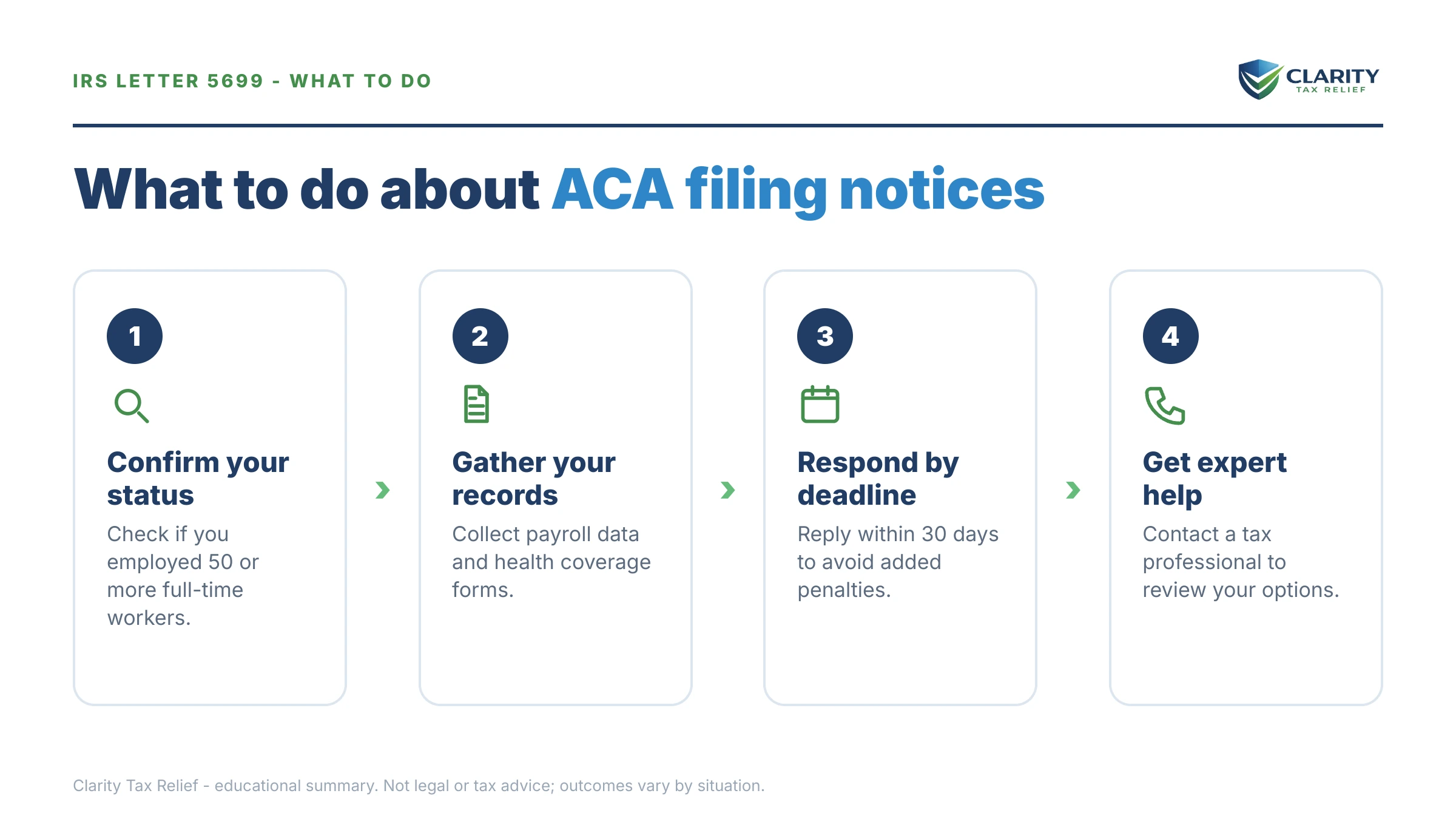
How to respond to Letter 5699, step by step
- Find the tax year and response date. Page one of Letter 5699 names the reporting year in question and the date your response is due — those two facts control everything that follows.
- Run the ALE test for that year. Count full-time employees (30+ hours per week) plus full-time equivalents for the prior calendar year, combining any companies under common ownership.
- Check the one box that matches. Pick exactly one of the five response options — already filed, filing now, filing within 90 days, not an ALE, or other — and attach the proof that option calls for.
- Prepare the missing returns if you owe them. Complete Form 1094-C and a Form 1095-C for every full-time employee; 10 or more information returns must be e-filed through the IRS AIR system.
- Respond by the printed date with proof of delivery. Send your response to the address or fax number on the letter, keep a complete copy, and use a delivery method you can track.
- Get a review if multiple years are open. Three unfiled years or a likely coverage gap means real Letter 226-J exposure — have an experienced tax professional check the math before you respond.
When you can handle this yourself — and when help changes the outcome
Many Letter 5699 responses are safely do-it-yourself. If you already filed and just need to point the IRS to the right EIN, check the first box with your filing details and you're done. If you're a single entity with no related companies and your prior-year average was clearly under 50 full-time employees plus FTEs, the non-ALE box with a clean headcount worksheet usually closes the case. If you missed one recent year, offered coverage, and your payroll software can generate the 1095-Cs, filing them with your response is straightforward.
Experienced help earns its cost in four situations. Multiple unfiled years — the sequencing of what you file, and the reasonable-cause story you attach, changes the total. Aggregation questions — common ownership across entities is technical, and getting it wrong in either direction is expensive. A real coverage gap — if no plan was offered, filing accurately while preparing the coming Letter 226-J defense is a strategy problem, not a paperwork problem. And penalties already assessed — a CP215 on the account means the fight has moved to business penalty abatement, with its own deadlines and standards. If your business also has unfiled income returns, know that the IRS runs a separate track for those — a Letter 1085 proposing a substitute return — and the two problems are best solved together, not one letter at a time.
Terms on your letter, decoded
- Applicable Large Employer (ALE): a business that averaged 50 or more full-time employees plus full-time equivalents in the prior calendar year, counting commonly owned companies together.
- Full-time equivalent (FTE): part-time hours converted into fractional employees — add all part-time hours in a month and divide by 120.
- Form 1094-C: the cover-sheet transmittal an ALE files with the IRS summarizing its 1095-C forms and coverage offers.
- Form 1095-C: the per-employee statement showing what coverage was offered to each full-time employee, filed with the IRS and given to the employee.
- Employer Shared Responsibility Payment (ESRP): the ACA penalty under IRC §4980H for not offering adequate, affordable coverage — proposed via Letter 226-J.
- AIR system: the IRS's Affordable Care Act Information Returns e-filing platform, required when you file 10 or more information returns.
Letter 5699 FAQs
What is IRS Letter 5699?
Letter 5699 is the IRS asking why it never received Forms 1094-C and 1095-C from a business it believes was an Applicable Large Employer. It is an inquiry, not a penalty bill — no dollar amount has been assessed yet. The IRS builds its mailing list from W-2 counts, so businesses that were never actually ALEs receive it too. Your response determines whether the case closes quietly or moves toward penalties.
How long do I have to respond to Letter 5699?
Typically 30 days from the date printed on the letter — the exact respond-by date is on page one, and that date controls. If you need more time to prepare the missing returns, the letter itself allows you to commit to filing within 90 days. If you truly can't meet the date, contact the IRS at the number on the letter before it passes rather than letting it lapse silently.
What happens if I ignore Letter 5699?
The IRS can assess failure-to-file penalties under IRC §6721 and §6722 for every missing form and open an Employer Shared Responsibility Payment review without your input — that review arrives as Letter 226-J with a proposed dollar amount. Because you never filed, the IRS takes the position that no statute of limitations protects those years, so the exposure never ages out.
What if my business was not an Applicable Large Employer?
Check the box on the letter stating you weren't an ALE for that year and explain why — for example, you averaged fewer than 50 full-time employees plus full-time equivalents in the prior calendar year. Attach your headcount math. Remember the aggregation rule: companies under common ownership are counted together, so confirm the combined group falls under 50 before claiming non-ALE status.
Can I still file Forms 1094-C and 1095-C late?
Yes, and Letter 5699 is built for exactly that: one response option lets you enclose the returns, another lets you commit to filing within 90 days. Late filing still risks per-form penalties, but filing voluntarily with a reasonable-cause explanation is far cheaper than letting the IRS assess maximum penalties for intentional disregard. If you're filing 10 or more information returns, you must file electronically through the IRS AIR system.
Will Letter 5699 lead to a penalty?
Not automatically. A prompt, complete response — especially one that files the missing forms or shows you weren't an ALE — often closes the inquiry with no assessment, or with penalties that reasonable cause can reduce. Silence is what converts the letter into penalties: per-form charges for the missing filings, and potentially an Employer Shared Responsibility Payment that has run near $3,000 per full-time employee per year in recent years.
Is there a statute of limitations on ACA filing penalties?
The IRS's position is that the statute of limitations never starts on an Employer Shared Responsibility Payment if the 1094-C/1095-C returns were never filed — the clock only begins when you file. That means a missed year from long ago remains open indefinitely until you respond and file. Filing the overdue returns is what starts the clock and eventually closes the exposure.
Your next 24 hours
- Pull two facts off page one of the letter: the reporting year the IRS is asking about and the respond-by date. Write both on your calendar today — the printed date is the only deadline that matters.
- Gather the headcount evidence: payroll reports and W-2 counts for the letter's year and the year before it, hours data for part-timers, and the ownership structure of any related companies.
- Get the letter reviewed free before you check a box. Send us a photo of your Letter 5699 at the 2-minute form or call (888) 825-7779 — an experienced tax professional will run the ALE math with you and map the response that closes this before the printed date passes.
For the IRS's own employer guidance, start with the ACA information center for employers at IRS.gov. If penalties are later assessed and you need to pay while contesting them, payment options are at IRS.gov/payments, and businesses facing hardship from IRS delays can contact the Taxpayer Advocate Service.
This guide is general information, not tax or legal advice for your specific situation. Eligibility for IRS programs depends on individual facts and circumstances; no outcome is guaranteed.