
IRS Letters
IRS Letter 226-J: The ACA Employer Penalty, Your 30-Day Response, and How to Fight It (2026)
The short answer: Letter 226-J proposes an Employer Shared Responsibility Payment — the ACA employer-mandate penalty under IRC §4980H — built from the Forms 1094-C and 1095-C your business filed. It is not a bill yet. You generally have 30 days to respond on Form 14764, and proposed amounts often drop sharply once the coding errors behind them are corrected.
You wound the company down, retired, and thought the paperwork era was over — and now the IRS is proposing a five-figure health-coverage penalty for a year when you were still running payroll. Take a breath: this letter is a proposal, it is often wrong, and there is a formal process — with your name on the response form — for cutting it down before a single dollar is assessed.
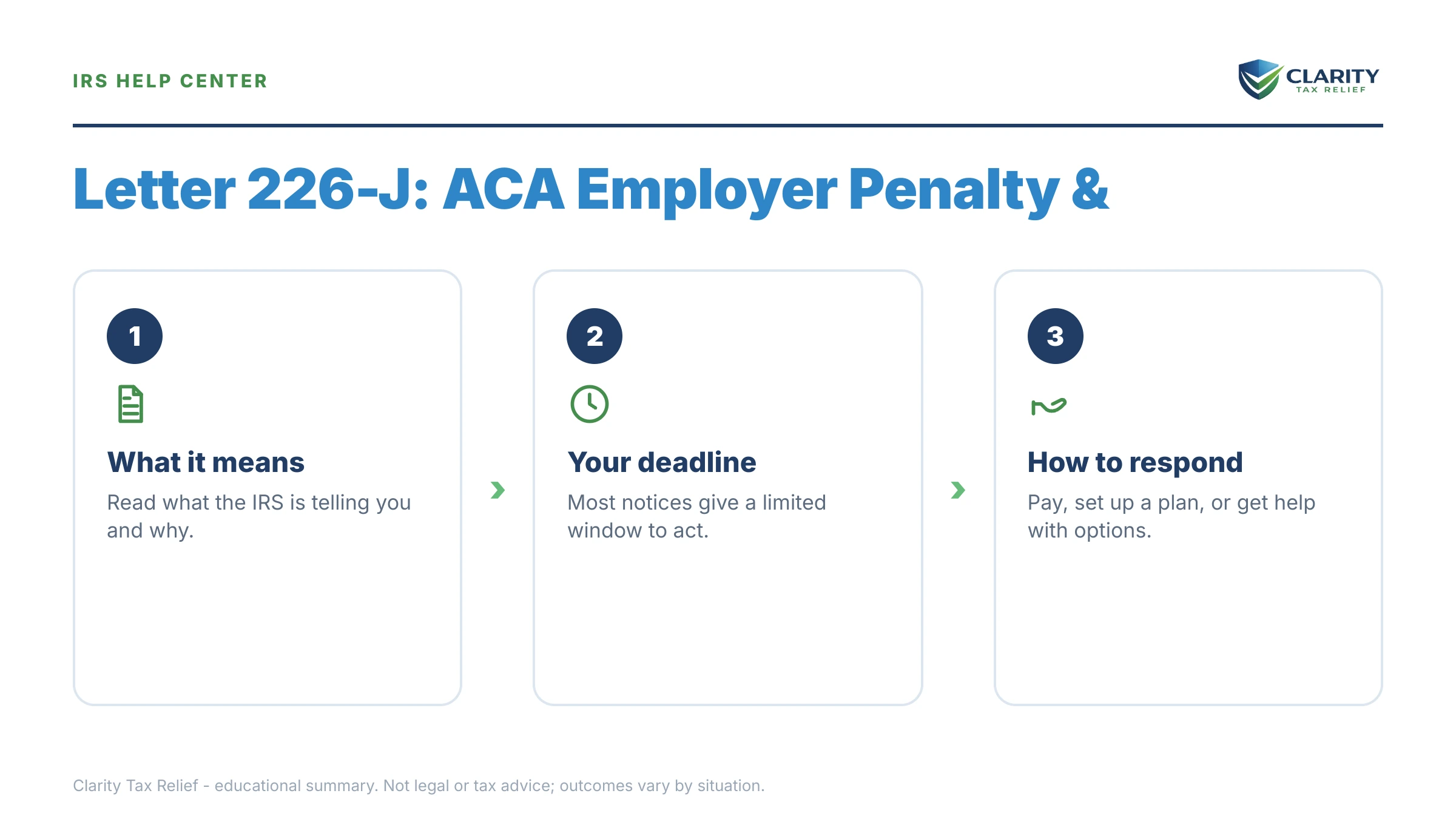
The image below shows exactly what a Letter 226-J looks like and where to find the three things that matter most: the proposed amount, the tax year it covers, and the response date that controls everything else on this page.
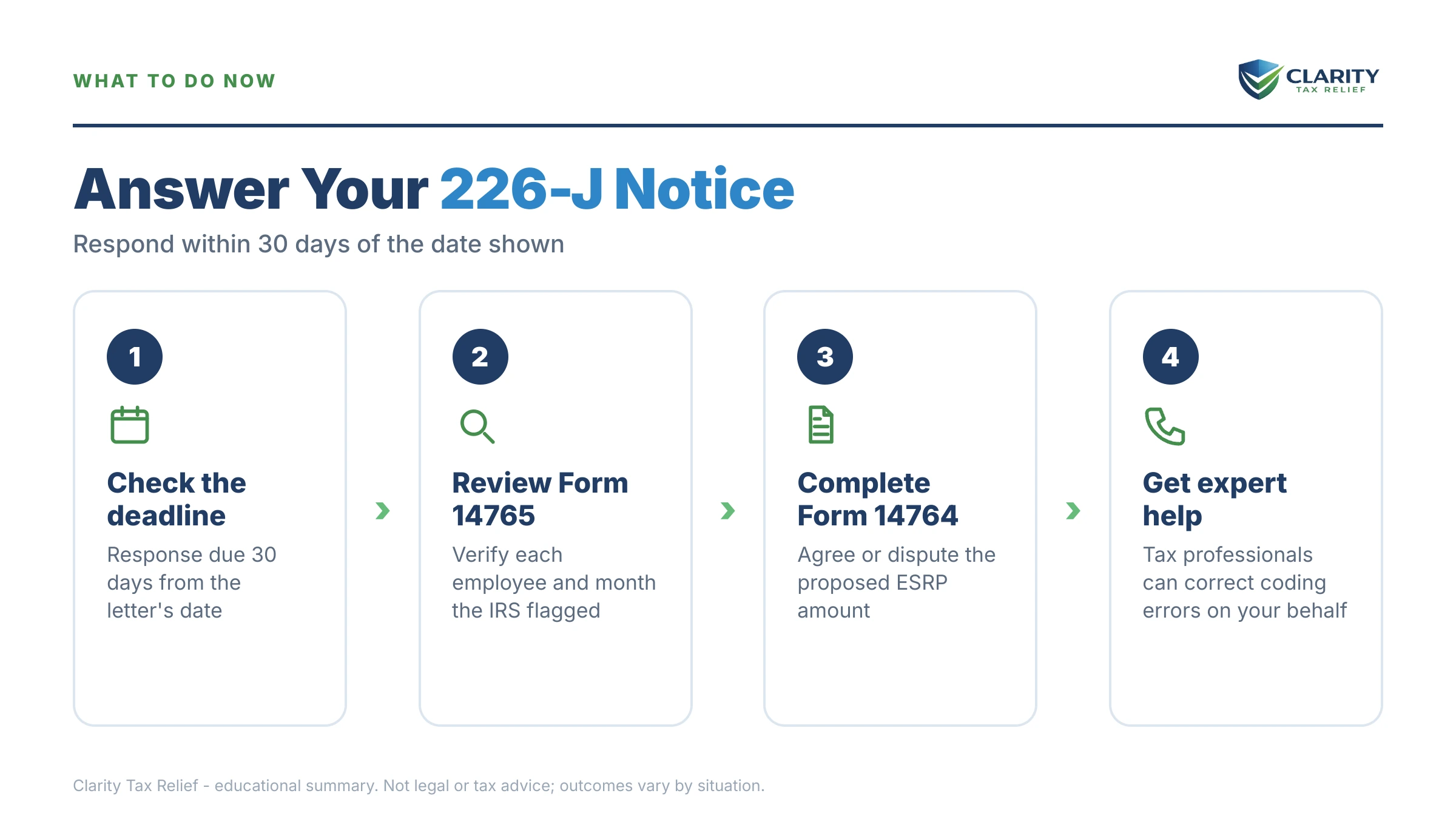
⏱ Your deadline: the response date printed on page 1 of Letter 226-J — generally 30 days from the letter date. Respond on Form 14764 by that date, or call the number on the letter to request more time before it passes. If the date lapses with no response, the IRS can assess the full proposed amount.
Why you got Letter 226-J
Letter 226-J goes to Applicable Large Employers — businesses that averaged 50 or more full-time employees plus full-time equivalents — when at least one full-time employee claimed the premium tax credit on a Marketplace health plan. The IRS's computers cross-matched three data sets: the Form 1094-C and 1095-C returns your business filed, your employees' individual tax returns, and Marketplace subsidy records. Where they collide, a proposed Employer Shared Responsibility Payment (ESRP) comes out.
Two things make this letter different from an ordinary tax notice. First, it usually arrives two or more years after the coverage year — a 2026 letter commonly covers 2023 or 2024, long after the benefits administrator who filed the forms is gone. Second, the amount is computed entirely from the codes on those forms, not from what actually happened. A wrong code on Line 14 or 16 of a 1095-C, or a missed checkbox on Line 23 of the 1094-C, produces a penalty even when you offered perfectly compliant coverage.
Inside the envelope you'll find the proposal itself, an ESRP Summary Table breaking the amount down by month, and Form 14765 — the roster of employees whose premium tax credits triggered the math. That roster is where most winnable fights live. (If your business never filed the 1094-C/1095-C returns at all, the IRS typically opens with Letter 5699 instead — a different problem with a different fix. And for a general map of why IRS mail shows up, see why did I get a letter from the IRS.)
How the ACA employer mandate penalty is calculated
The ESRP comes in two very different sizes, and your letter tells you which one the IRS is proposing. The §4980H(a) penalty applies when the IRS believes you failed to offer minimum essential coverage to at least 95% of full-time employees — it's computed on all full-time employees minus 30, which is why (a) proposals routinely reach six and seven figures. The §4980H(b) penalty applies when coverage was offered but deemed unaffordable or below minimum value — it's computed only per employee who actually claimed the premium tax credit, month by month.
Both started at $2,000 and $3,000 per employee per year in 2015 and are indexed annually. Your letter states the rate for the year it covers — verify the table below against the figures printed on your letter:
| Tax year on your letter | §4980H(a) — per full-time employee (minus 30) | §4980H(b) — per employee who claimed the credit |
|---|---|---|
| 2023 | $2,880/year ($240/month) | $4,320/year ($360/month) |
| 2024 | $2,970/year ($247.50/month) | $4,460/year (about $371.67/month) |
| 2025 | $2,900/year (about $241.67/month) | $4,350/year ($362.50/month) |
One structural mercy: the (b) penalty for any month can never exceed what the (a) penalty would have been for that month. But the reverse trap is common — a single unchecked box on Form 1094-C Line 23 can convert a business that offered coverage to 99% of its staff into a proposed (a) penalty across the entire workforce.
Why so many 226-J amounts are wrong
A large share of proposed ESRPs shrink — sometimes to zero — once the underlying forms are corrected through the response process. The proposal is only as accurate as the codes a payroll vendor or benefits administrator typed years ago. The recurring culprits:
- The Line 23 checkbox: Form 1094-C asks whether minimum essential coverage was offered to at least 95% of full-time employees each month. Leaving it blank — even accidentally — generates a workforce-wide (a) proposal.
- Wrong 1095-C codes: Lines 14 and 16 carry offer-of-coverage and safe-harbor codes. A missing affordability safe-harbor code (like the Form W-2 or rate-of-pay safe harbor) makes compliant coverage look unaffordable.
- Misclassified employees: part-timers, seasonal workers, or employees in a waiting period listed as full-time on Form 14765 when they weren't.
- Employees who declined coverage: an employee who waived a compliant offer and bought a subsidized Marketplace plan anyway shouldn't generate a (b) penalty — if the offer is documented and coded correctly.
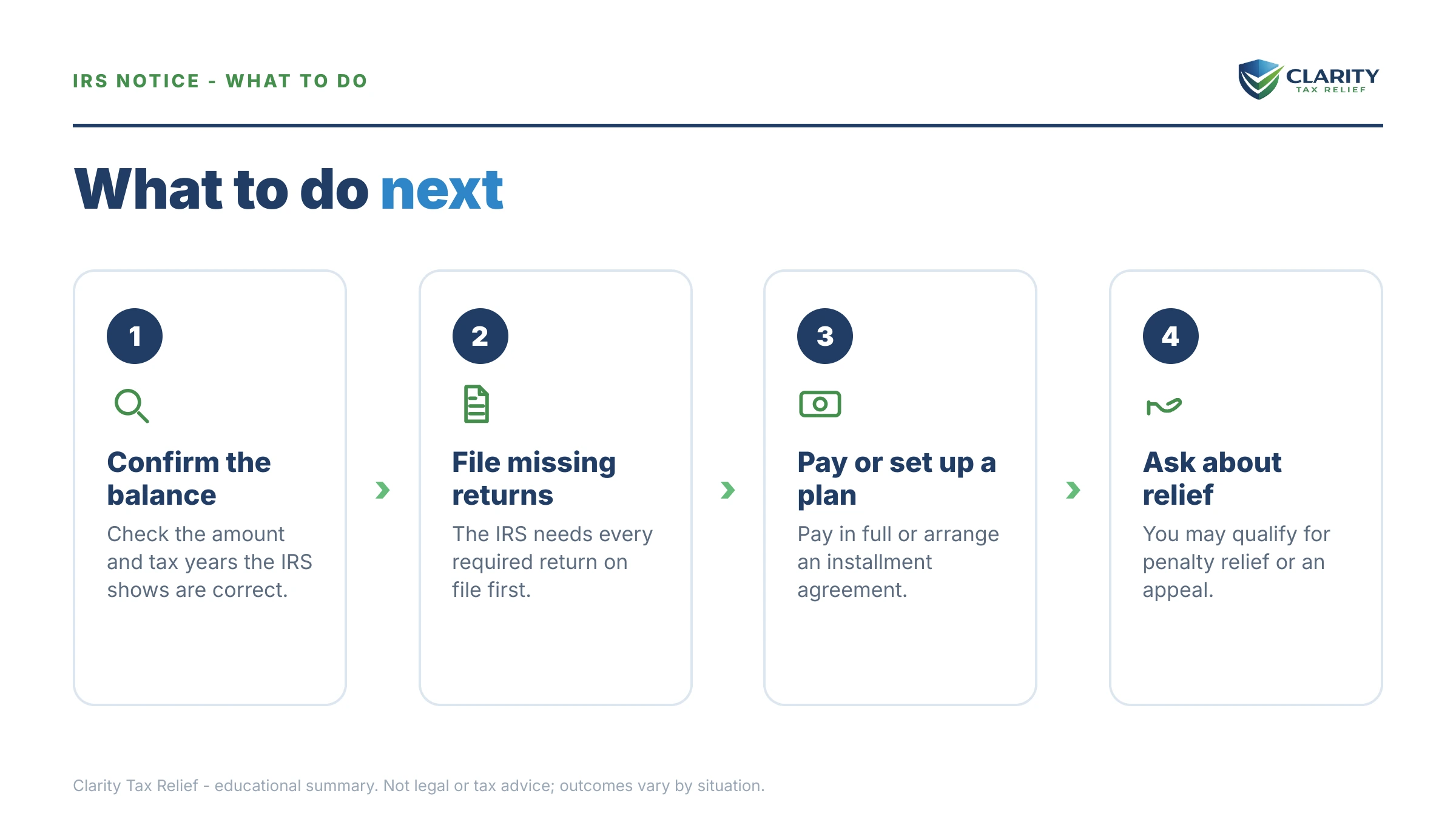
Important mechanical point: you do not fix these by filing corrected 1094-C/1095-C forms. Corrections go on Form 14765 itself, with a signed statement, inside the Letter 226-J response. The image below shows where these pieces sit on the letter so you can match each one to your records.
What happens if you ignore Letter 226-J
Silence converts a negotiable proposal into an assessed debt with interest running. The sequence is fixed, and each stage closes a door the previous one left open:
- Letter 226-J — the proposal. You are here. Respond by the printed date and the amount is still fully contestable.
- Response date passes with no reply — the IRS assesses the ESRP exactly as proposed. No one re-checks the codes for you.
- Letter 227 — if you did respond, the IRS answers with one of five versions of Letter 227, ranging from "case closed, nothing owed" to "we still disagree." A revised proposal carries its own response date.
- Appeals window — if you still disagree after Letter 227, you can request a pre-assessment conference with the IRS Independent Office of Appeals by the date on that letter. This is your last stop before the debt becomes real — the ESRP carries no 90-day Tax Court letter, so there is no pre-assessment court option.
- Notice CP220J — the assessment and demand for payment. The proposal is now a legal debt accruing interest.
- Business collection — unpaid CP220J balances feed the standard machine: balance-due notices, a possible federal tax lien, a CP504B notice, and eventually a final notice of intent to levy like Letter 1058 — after which the IRS can levy business bank accounts and receivables 30 days later.
In 2026 the human side of the IRS is thinner than ever after the 2025 workforce cuts — but this entire sequence is automated. Nobody has to look at your file for the assessment and the levy notices to keep coming.
Holding a Letter 226-J right now?
The response date on page 1 controls everything — and most proposed amounts drop once the forms behind them are checked. Send us the letter before your 30-day window closes and an experienced tax professional will review the proposal, the Form 14765 listing, and your real options — free and confidential.
Your options after Letter 226-J: costs and timelines
Every path starts with the same 30-day window, but they end in very different places. Here's what each option costs and where it leads:
| Option | Upfront cost | What happens next |
|---|---|---|
| Agree and pay in full (Form 14764) | The full proposed amount | Case closes once payment processes; the IRS confirms with a Letter 227. Only sensible after you've verified the math. |
| Disagree in part or in full (Form 14764 + corrected Form 14765) | $0 to respond | The IRS reviews your corrections and replies with Letter 227 — often with a reduced or zeroed proposal when documentation is solid. |
| Pre-assessment Appeals conference | $0 (requested in writing by the Letter 227 date) | An independent Appeals officer reviews the case before assessment. Typically a months-long process — and your last pre-assessment forum. |
| Assessed and can't pay (after CP220J) | Setup fee may apply | A business IRS installment agreement spreads the balance monthly while interest continues to accrue. |
| Do nothing | $0 today — the most expensive path | Full proposed amount assessed, interest accrues, and collection escalates toward liens and levies. |
Note what's not on the list: reasonable-cause abatement. Unlike late-filing or late-payment penalties, the §4980H payment has no reasonable-cause waiver — the fight is about whether the facts and codes support the penalty at all, which is why the response and Appeals stages carry all the weight.
How to respond to Letter 226-J, step by step
- Calendar the response date. Find the response date on page 1 of Letter 226-J and mark it everywhere. If you can't meet it, call the number on the letter before it passes and ask for more time — the IRS often grants it when you ask early.
- Pull the year's records. Gather the Forms 1094-C and 1095-C the business filed, payroll records, plan documents, and proof of every coverage offer for the tax year on the letter.
- Audit the Form 14765 listing. Check every employee the IRS lists, month by month: were they actually full-time, and were they offered affordable, minimum-value coverage the 1095-C failed to code correctly?
- Complete Form 14764. Mark agree or disagree. If you disagree in whole or in part, attach the corrected Form 14765 and a signed statement explaining each change — never file corrected 1094-C/1095-C forms in response; changes go through the 226-J process.
- Send it and track what comes back. Mail or fax the response package by the deadline, keep proof of delivery, and calendar the response date on the Letter 227 the IRS sends next — that letter carries your Appeals window.
A worked example: the $27,500 proposal that wasn't
Say you retired two years ago after winding down a 60-employee landscaping company, and a Letter 226-J arrives proposing roughly $27,500 for tax year 2023 — in this hypothetical, $27,360 on the nose. The ESRP Summary Table shows it's a §4980H(b) proposal: Form 14765 lists seven former employees who claimed the premium tax credit, covering 76 employee-months in total. At 2023's (b) rate of $360 per month, 76 × $360 = $27,360.
You pull the old benefits files and find that three of the seven were offered affordable, minimum-value coverage and declined it — but the payroll vendor coded their 1095-Cs without the affordability safe-harbor code. Those three account for 32 employee-months. Marking the corrections on Form 14765 with the offer documentation attached removes 32 × $360 = $11,520, cutting the proposal to $15,840 (44 months × $360) — before anyone even examines the remaining four employees' full-time status.
That's the pattern with 226-J letters: the number on page 1 is a starting position generated by old codes, not a verdict. Every employee-month you can document off the list is $360-plus back in your pocket — and none of it requires a courtroom, just a complete response before the printed date.
When you can handle this yourself — and when help changes the outcome
You can reasonably self-handle a 226-J when the proposal is small, you agree with it after checking the math, and the business can pay — sign Form 14764, pay, and close the file. The same goes if you still have the year's benefits records organized and the dispute comes down to one or two obviously miscoded employees you can document cleanly.
Experienced help tends to change outcomes in four situations: a §4980H(a) proposal driven by the Line 23 checkbox, where the dollars are enormous and the fix is technical; a business that has closed or been sold, where who (if anyone) can be pursued depends on entity type and state dissolution law; a case heading to the Appeals conference after an unfavorable Letter 227, where the argument has to be framed in the IRS's own safe-harbor language; and any case where the records are gone and the offer history has to be reconstructed from payroll data. And keep the liability types straight: the ESRP is generally the entity's debt — it is not a personal-liability regime like the trust-fund penalty proposed in Letter 1153, unless the business was a sole proprietorship.
Terms on your Letter 226-J, decoded
- ESRP — Employer Shared Responsibility Payment: the official name of the ACA employer-mandate penalty this letter proposes.
- ALE — Applicable Large Employer: a business that averaged 50+ full-time employees plus full-time equivalents in the prior year, and is therefore subject to §4980H.
- §4980H(a) — the "no offer" penalty, computed on all full-time employees minus 30 when coverage wasn't offered to at least 95% of them.
- §4980H(b) — the "bad offer" penalty, computed only per employee who claimed a premium tax credit because coverage was unaffordable or below minimum value.
- Premium Tax Credit (PTC) — the Marketplace subsidy an employee claimed; each PTC claim by a full-time employee is what triggers the penalty math.
- ESRP Summary Table — the month-by-month breakdown inside the letter showing exactly how the IRS built the proposed amount.
- Affordability safe harbor — one of three IRS-approved shortcuts (Form W-2, rate of pay, federal poverty line) proving coverage was affordable; a missing safe-harbor code is the most common cause of a wrongful (b) penalty.
For the IRS's own materials, see Understanding your Letter 226-J and the employer shared responsibility provisions page. If you end up owing after assessment, payment options live at IRS.gov/payments.
Letter 226-J questions, answered
Is Letter 226-J a bill I have to pay?
No — Letter 226-J is a proposed Employer Shared Responsibility Payment, not an assessed debt. Nothing is owed until the IRS finishes the response process and issues Notice CP220J. Because the proposal is built entirely from the codes on your Forms 1094-C and 1095-C, responding with corrected information often reduces the amount substantially — paying the letter as printed, without checking it, is frequently the most expensive choice.
How long do I have to respond to Letter 226-J?
You must respond by the response date printed on page 1 — generally 30 days from the letter date. If you can't gather the year's payroll and benefits records that fast, call the number on the letter before the date passes; the IRS often grants additional time when you ask early. Missing the date without asking lets the IRS assess the full proposed amount.
What are Form 14764 and Form 14765?
Form 14764 is the ESRP Response — the form where you tell the IRS whether you agree or disagree with the proposed penalty. Form 14765 is the Employee Premium Tax Credit Listing — the month-by-month roster of employees who claimed the premium tax credit, which drives the penalty math. If you disagree, you mark the corrections directly on Form 14765 and attach a signed statement explaining each change.
Can I fight a Letter 226-J penalty in Tax Court?
Not before it's assessed — the ESRP is not subject to the deficiency procedures that produce a 90-day Tax Court letter. Your pre-assessment shots are the Letter 226-J response itself and a conference with the IRS Independent Office of Appeals, requested by the date on the Letter 227 that follows. After assessment, disputing the merits generally means paying and pursuing a refund claim, which is why the response stage matters so much.
Am I personally liable if my business gets Letter 226-J?
If the employer was a corporation or an LLC taxed as one, the ESRP is generally the entity's liability — unlike trust-fund payroll taxes, there is no equivalent personal-liability penalty for owners or officers. The big exception is a sole proprietorship, where business and owner are legally the same person, so the assessment reaches personal assets. Entity structure and state dissolution law control the details, so confirm your exposure before assuming either way.
My business is closed and I'm retired — do I still have to respond?
Yes — respond by the printed date even if the company no longer operates. The proposed penalty attaches to the employer for the year it was running payroll, and ignoring the letter simply lets the IRS assess the full amount against the entity. Whether the IRS can then collect from anyone depends on the entity type, how it was dissolved, and what happened to its assets — questions worth professional review before the response date, not after assessment.
Is there a statute of limitations on the ACA employer penalty?
The IRS has taken the position in Chief Counsel guidance that no statute of limitations restricts when it can assess the Employer Shared Responsibility Payment, because the information returns employers file don't start a clock for this liability. That's why 226-J letters routinely arrive two or more years after the coverage year — and why old ACA filing errors don't quietly expire. Keep the year's benefits records until any exposure is resolved.
Your next 24 hours
- Find the response date and the penalty type. Page 1 of the letter shows the response date, the tax year, and whether the IRS is proposing a §4980H(a) or (b) payment — write all three down.
- Gather the year's coverage evidence. Pull the filed Forms 1094-C and 1095-C, payroll records, plan documents, and any signed coverage waivers for the employees listed on Form 14765.
- Get the proposal reviewed free before the window closes. Use the 2-minute form at claritytaxrelief.com/#consult or call (888) 825-7779 — an experienced tax professional will check the Form 14765 listing against your records while your 30-day response date is still open.
This guide is general information, not tax or legal advice for your specific situation. Eligibility for IRS programs depends on individual facts and circumstances; no outcome is guaranteed.