
IRS Letters
IRS Letter 227: What Each Version Means and How to Respond (2026)
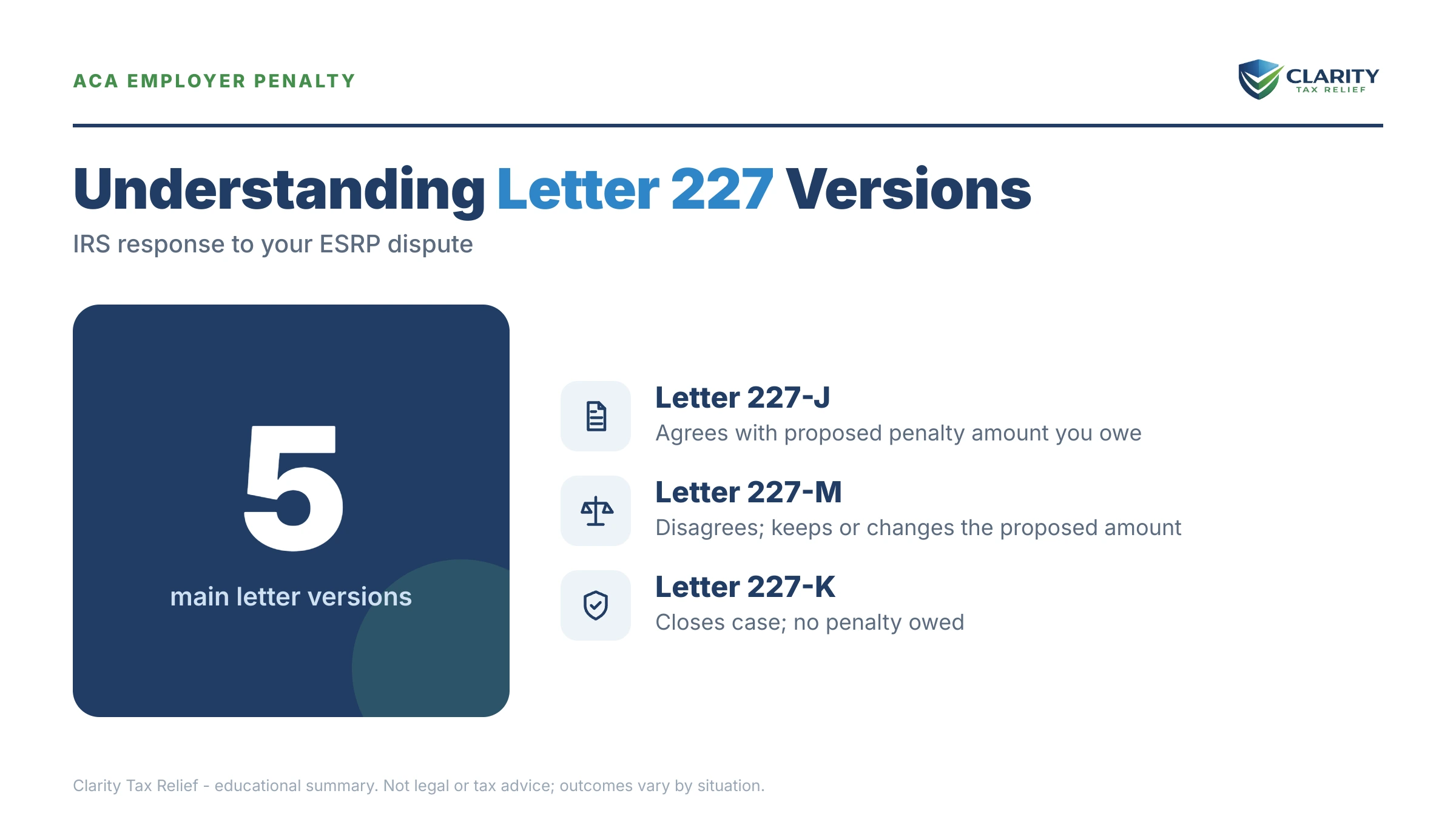
The short answer: Letter 227 is the IRS's reply to your Letter 226-J response about a proposed ACA employer penalty. It comes in five versions: 227-K closes your case at zero, 227-J and 227-N close it with a balance due, and 227-L and 227-M restart the clock — typically 30 days to agree or appeal.
You already fought round one: you got a Letter 226-J proposing an Employer Shared Responsibility Payment, sent your response, and waited. Now the IRS has answered with a Letter 227 — and whether that answer means "case closed" or "pay up in 30 days" depends entirely on one letter in the corner: J, K, L, M, or N.
Two of those versions end the matter. Two of them start a new deadline that, if missed, lets the IRS assess the full penalty with no further argument from you. So the first job is figuring out exactly which one you're holding — the image below shows what this letter looks like and where to find the version number and the response date.
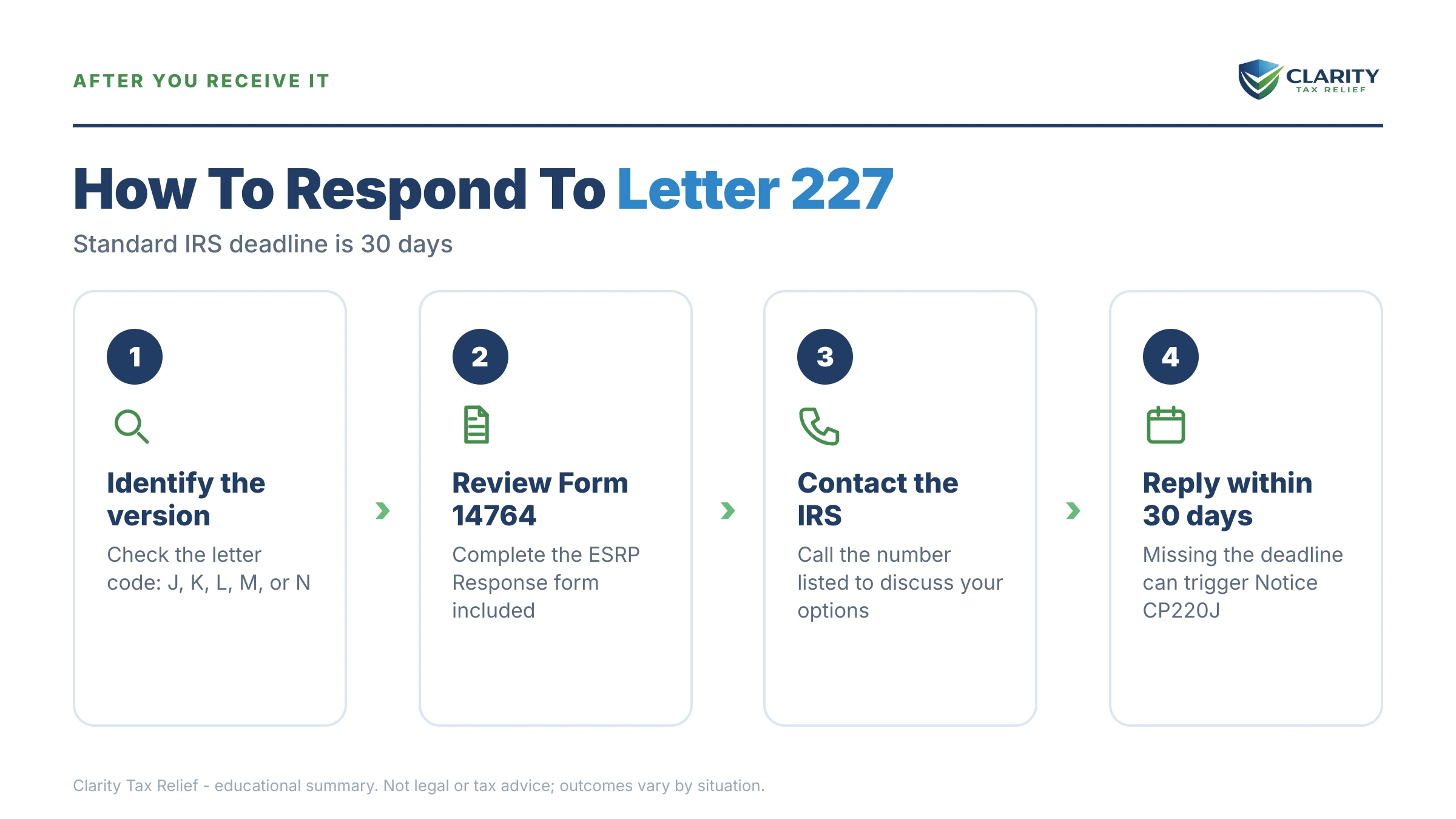
⏱ Your deadline (227-L and 227-M only): the response date printed on the letter — typically 30 days from the letter date. That date is also the cutoff to request a pre-assessment conference with IRS Appeals. Miss it and the IRS assesses the proposed ESRP and moves your account toward collection.
Why you got Letter 227 — and which version you're holding
Letter 227 is the IRS's written verdict on the response you sent to Letter 226-J, and it comes in five versions with five different meanings. The IRS's Employer Shared Responsibility unit reviewed the Form 14764 and corrected Form 14765 you submitted, compared them against the Forms 1094-C and 1095-C on file, and issued the version that matches its conclusion.
If you're wondering why the IRS writes to businesses this way at all, the short version is that almost everything in ACA enforcement is document-driven and automated — our guide to why did I get a letter from the IRS covers the general system. What matters here is only this letter, and only its version:
| Version | What it means | What to do |
|---|---|---|
| 227-J | You signed Form 14764 agreeing to the full proposed ESRP. The IRS will assess it. Case closed. | Pay or arrange payment. No other response is expected. |
| 227-K | Your response resolved everything. The ESRP is reduced to zero. Case closed. | Nothing to pay. Keep the letter permanently with your ACA records as proof. |
| 227-L | The IRS accepted part of your response and revised the ESRP to a lower amount. An updated Form 14765 is attached. | Agree and pay, respond again with documentation, or request an Appeals conference — by the response date. |
| 227-M | The IRS rejected your response. The original 226-J amount stands unchanged. | Respond with stronger documentation or request an Appeals conference — by the response date. |
| 227-N | Appeals has issued its decision, and the case is closed at the amount Appeals determined. | Pay or arrange payment on any balance the decision left standing. |
It also helps to see where this letter sits in the full ACA penalty chain — because a 227-L or 227-M is the last stop where you're still negotiating a proposed number instead of an assessed debt:
| Stage | What arrives | Your window |
|---|---|---|
| 1 | Letter 5699 — the IRS asks why no Forms 1094-C/1095-C were filed | The response date printed on the letter, typically about 30 days |
| 2 | Letter 226-J — proposed ESRP, with Forms 14764 and 14765 | Typically 30 days from the letter date to respond |
| 3 | Letter 227 (J, K, L, M, or N) — the IRS's reply to your response | 227-L / 227-M: printed response date, typically 30 days. J, K, N: none |
| 4 | Notice CP220J — the ESRP is assessed; formal demand for payment | Pay or arrange payment; interest starts running on the unpaid balance |
| 5 | Business collection notices — intent to levy, then a final levy notice | After the final notice, levies become legal in 30 days |
If your case started at stage 1 because 1094-C/1095-C filings never went in, the companion guide to Letter 5699 explains that entry point. This article assumes you're at stage 3, holding the IRS's answer.
What happens if you ignore Letter 227
Ignoring a 227-L or 227-M lets the IRS assess the full proposed ESRP without hearing another word from you. Unlike an income-tax dispute, there is no 90-day letter and no Tax Court petition before assessment — the ESRP is an "assessable payment" under IRC §4980H, so the deficiency procedures that protect income-tax cases don't apply. Once your response date passes, the sequence is mechanical:
- Response date passes — your right to a pre-assessment Appeals conference expires with it. The dispute phase is over.
- Notice CP220J — the IRS assesses the ESRP and sends a formal notice and demand for payment. Interest begins accruing on the unpaid balance from here.
- Business collection notices — reminders escalate to an intent-to-levy notice like the CP504B, which lets the IRS take your state refund and signals that a federal tax lien is on the table.
- Final notice of intent to levy — a Letter 1058-class final notice starts a 30-day clock, after which levies on business bank accounts and accounts receivable become legal. You get Collection Due Process rights at that stage — but by then you're defending assets, not contesting a number.
One 2026 reality worth knowing: the IRS workforce shrank roughly 27% in 2025, so a human may take months to answer your correspondence — but the assessment and levy systems are automated and never paused. Slow replies to you do not mean slow enforcement against you.
Holding a 227-L or 227-M right now?
Get it reviewed free before your response date passes — an experienced tax professional will decode the version, check the Form 14765 listing against your records, and tell you whether to agree, push back, or take it to Appeals.
Your options on a 227-L or 227-M
A 227-L or 227-M gives you three real moves: agree and pay, push back with better documentation, or request a pre-assessment conference with the IRS Independent Office of Appeals. One thing you do not have on the ESRP itself: there is no first-time abatement or reasonable-cause waiver for the §4980H payment. Your leverage lives entirely in the accuracy fight — which employees actually belonged on the Form 14765 listing, and for which months — not in an after-the-fact forgiveness request.
| Option | When it fits | Cost and clock |
|---|---|---|
| Sign Form 14764 and pay in full | The revised number is right and cash flow can absorb it | No interest builds if paid promptly after assessment; done by the response date |
| Agree, but pay over time | The number is right but you can't pay at once | Balance is assessed; interest accrues until paid; a setup fee may apply to the agreement |
| Respond again with documentation | You can prove coverage offers, correct full-time status, or fix listing errors for remaining employees | Free — but it must arrive by the response date, and a 227-M means your first attempt already failed |
| Request a pre-assessment Appeals conference | The facts are genuinely disputed and the dollars justify a formal fight | Free to request by the response date; adds months, but it is your last forum before assessment |
On the payment route: an assessed ESRP can go on a business IRS installment agreement like other federal business debt. Two cost notes the letter won't volunteer. First, the ESRP is not deductible as a business expense, so an $8,900 payment costs a full $8,900 in after-tax dollars. Second, interest generally doesn't start until assessment — so time spent legitimately contesting the number before assessment isn't inflating the bill.
On the Appeals route: because the ESRP skips Tax Court's front door, the pre-assessment conference is where close cases get decided. Appeals officers weigh "hazards of litigation" — if your documentation makes some months genuinely arguable, a partial concession is a realistic outcome. Whatever Appeals decides arrives later as your Letter 227-N.
A worked example: how an $8,900 Letter 227-L happens
Most 227-L letters are the IRS agreeing with most of your response — and holding firm on a few employees. Say you run a delivery company with 58 W-2 drivers plus a bench of 1099 contractors. Your 226-J proposed roughly $45,000 because twelve employees appeared on the Form 14765 listing as having received Premium Tax Credits. Your response proved ten of them were offered qualifying coverage and declined it.
The 227-L that comes back keeps two employees on the listing — two drivers who genuinely weren't offered coverage and took marketplace credits all twelve months. At the §4980H(b) rate for the year at issue — call it roughly $370 per employee per month in this hypothetical — the math is:
2 employees × 12 months × ~$370/month ≈ $8,900 revised ESRP.
Now the decision is practical, not emotional. If the two employees really got credits and really weren't offered coverage, fighting on costs more than it saves — sign Form 14764 and either pay the $8,900 or put it on a payment agreement. But if either driver averaged under 30 hours in some of those months, each month you knock out is worth about $370 per employee — and that's exactly the month-by-month re-check worth doing before the response date. (The exact per-month figure is indexed each year; use the amount shown on your own letter, not this hypothetical.)
One trap specific to businesses built on contractors: if the IRS or your state reclassifies 1099 workers as employees, they count toward both the 50-full-time-equivalent threshold and the penalty headcount. If that's what's driving your numbers, the worker misclassification penalty fight has to run alongside — not after — your Letter 227 response, because conceding the ESRP math can undercut the classification argument.
How to respond to Letter 227, step by step
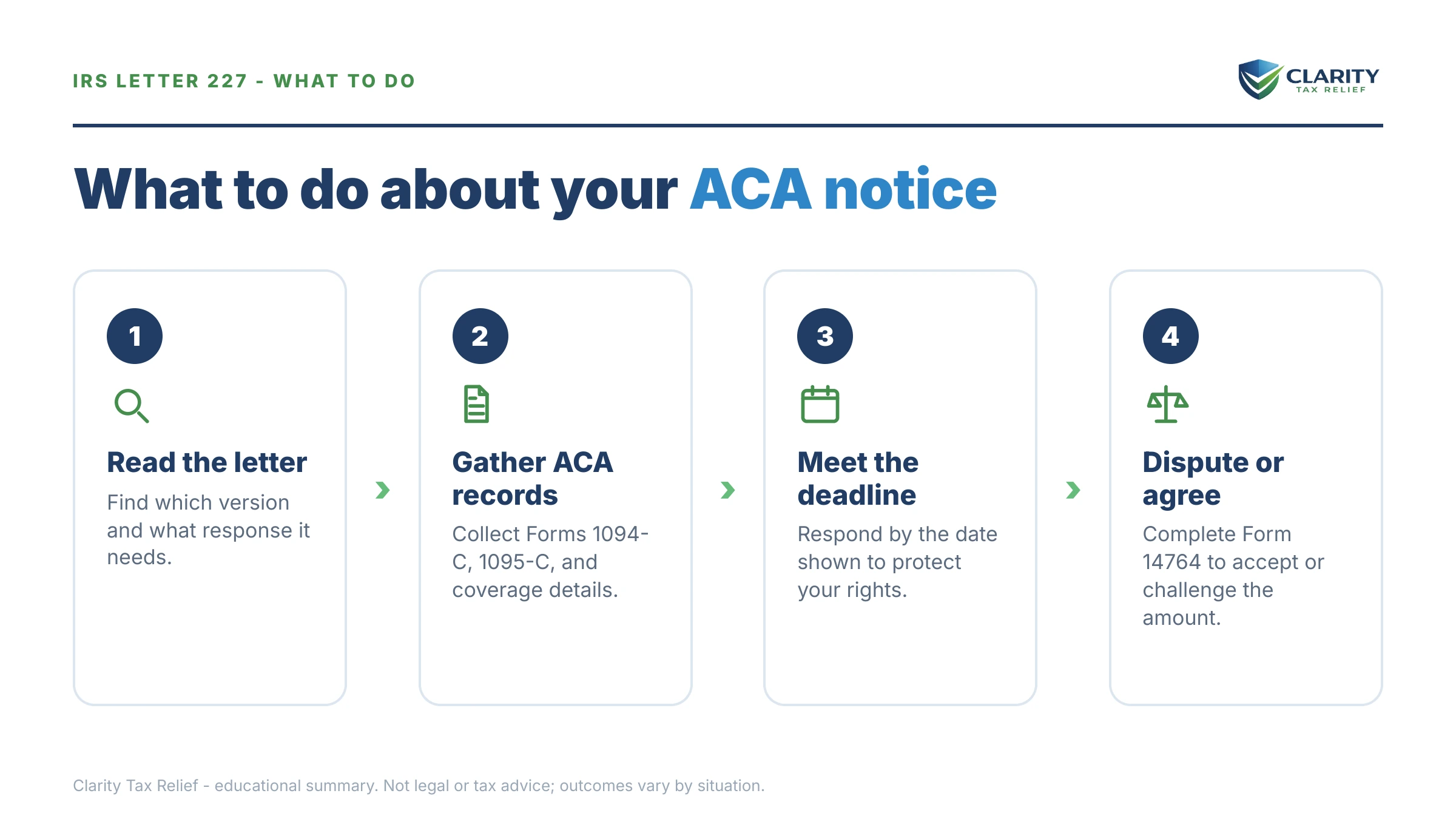
- Identify your version — find the letter number (227-J, 227-K, 227-L, 227-M, or 227-N) and the response date printed on the letter. The version determines everything that follows.
- Pull your 226-J file — gather your original Letter 226-J, the response you sent, the Form 14765 employee listing, and the Forms 1094-C and 1095-C you filed for the year at issue.
- Re-check every employee still on the list — go month by month through the updated Form 14765 and verify whether each remaining employee was actually offered qualifying coverage or was not full-time in the flagged months.
- Respond by the printed date — sign and return Form 14764 if you agree with the revised amount, or send corrected documentation and request a pre-assessment Appeals conference if you don't.
- Arrange payment or prepare for Appeals — pay any agreed balance or set up a business installment agreement; if you requested a conference, organize your coverage-offer evidence before Appeals contacts you.
When you can handle Letter 227 yourself — and when help changes the outcome
You can usually handle two versions alone. A 227-K needs nothing but a filing cabinet — keep it forever as proof the case closed at zero. A 227-J (or 227-N) with a balance your business can pay is also self-serve: pay it or set up the agreement, and you're done.
Experienced help earns its cost in three situations. First, a 227-M — the IRS already rejected your best argument once, and the next submission or Appeals conference is effectively your final shot before assessment. Second, any disputed amount large enough that a few conceded months materially matter; the fight is won or lost in payroll records, hours data, and coverage-offer documentation, and knowing what Appeals actually credits is the whole game. Third, anything tangled up with worker classification, since what you say in the ESRP file can be used in the classification exam. Whoever represents you will need a Form 2848 power of attorney on file to speak to the IRS unit handling the case.
Terms on your Letter 227, decoded
- ESRP — Employer Shared Responsibility Payment: the ACA penalty proposed on your 226-J and resolved (or restated) on this letter.
- ALE — Applicable Large Employer: a business that averaged 50 or more full-time-equivalent employees, which is what makes §4980H apply at all.
- Form 14764 — the ESRP Response form; signing it tells the IRS you agree with the stated amount.
- Form 14765 — the Employee Premium Tax Credit Listing: the month-by-month roster of employees driving the penalty math. The 227-L/M attaches an updated one.
- Premium Tax Credit (PTC) — the marketplace insurance subsidy; an employee receiving one is what triggers penalty months for the employer.
- Pre-assessment conference — your hearing with the IRS Independent Office of Appeals before the ESRP is assessed; because there's no Tax Court route here, it's the main formal review you get.
Letter 227 questions, answered
Is Letter 227 good news or bad news?
It depends entirely on the version letter after "227." A 227-K is the best outcome — your case is closed with no penalty. A 227-L means the IRS lowered the proposed amount but still wants something; a 227-M means it rejected your response and the original amount stands. Check the letter number in the corner before you read anything else.
What is the difference between Letter 227-L and Letter 227-M?
A 227-L means the IRS accepted part of your Letter 226-J response and revised the proposed ESRP to a lower amount; a 227-M means it accepted none of it and the original amount stands. Both come with an updated Form 14765 employee listing and a response date — typically 30 days from the letter date — by which you must agree, respond again, or request an Appeals conference.
Do I have to respond to a Letter 227-J or 227-K?
No further argument is expected on either one — both close the case. A 227-K reduces the ESRP to zero, so you simply keep it with your ACA records. A 227-J confirms the agreement you signed on Form 14764, so your only remaining task is paying the balance or setting up a payment arrangement before interest builds on the assessed amount.
Can I appeal Letter 227?
Yes — a 227-L or 227-M lets you request a pre-assessment conference with the IRS Independent Office of Appeals, but you must ask by the response date printed on the letter. The ESRP is not subject to deficiency procedures, so there is no 90-day letter and no Tax Court petition before assessment. That makes the Appeals conference your last real forum before the IRS assesses the amount.
What happens if I ignore a Letter 227-M?
The IRS assesses the full proposed ESRP and sends Notice CP220J, a formal demand for payment. From there the account moves into business collections: reminder notices, an intent-to-levy notice, and eventually a final notice that makes levies on business bank accounts and receivables legal 30 days later. Your Appeals conference right also expires with the response date — silence forfeits it.
Can I get a payment plan for the ESRP on my Letter 227?
Yes — once the ESRP is assessed, a business can request an installment agreement the same way it would for other federal tax debt. Interest continues to accrue until the balance is paid, and the ESRP is not deductible as a business expense, so the true cost is higher than the sticker number. If the amount is genuinely unpayable, a professional review of collection alternatives is worth doing before you sign anything.
Why did my business get ACA penalty letters when I mostly use 1099 contractors?
Usually because reclassified or miscounted workers pushed you over the 50 full-time-equivalent employee threshold that makes a business an Applicable Large Employer. If the IRS or a state agency treats your 1099 contractors as employees, they count toward that threshold — and toward the penalty math. If misclassification is the real issue underneath your Letter 227, that fight has to be run alongside the ESRP response, not after it.
How long does the Letter 227 process take?
Expect months, not weeks. Letter 227 often arrives several months after your 226-J response, and requesting an Appeals conference adds more time — especially with IRS staffing down sharply since 2025. The good news: interest on the ESRP generally does not start until the amount is actually assessed and demanded, so time spent contesting the number before assessment is not running up the bill the way an unpaid income-tax balance would.
Your next 24 hours
- Find two things on the letter: the version number (227-J, K, L, M, or N) in the corner and — on a 227-L or 227-M — the response date. Write that date somewhere you can't miss it.
- Gather your file: the original Letter 226-J, the response you sent, the updated Form 14765 listing, and the Forms 1094-C/1095-C and payroll hours records for the year at issue.
- Get the letter reviewed free: if you're holding a 227-L or 227-M, the response date is also your Appeals cutoff — send it over through the 2-minute form or call (888) 825-7779 before that window closes.
Primary sources: the IRS's own explainers at Understanding your Letter 227 and Understanding your Letter 226-J, and payment options at IRS.gov/payments.
This guide is general information, not tax or legal advice for your specific situation. Eligibility for IRS programs depends on individual facts and circumstances; no outcome is guaranteed.