
IRS Letters
IRS Letter 1153 Trust Fund Recovery Penalty: What to Do in Your 60-Day Window (2026)
The short answer: IRS Letter 1153 means the IRS intends to assess the Trust Fund Recovery Penalty — a business's unpaid withheld payroll taxes — against you personally. The proposed amount is on the attached Form 2751, and you have 60 days from the letter's date to file a written protest with IRS Appeals before it becomes your personal debt.
This letter isn't addressed to the business — it's addressed to you. Somewhere between the missed 941 deposits and the revenue officer's questions, the IRS decided you were a person responsible for the withheld payroll taxes that never got paid over, and Letter 1153 is the formal move to put that debt on your Social Security number. It's a gut-punch to read. It is also, by a wide margin, the best moment in the entire trust fund recovery process to push back.
Two documents came in that envelope: Letter 1153 itself and Form 2751, which lists each quarter and the exact dollar amount the IRS wants from you. The image below shows exactly what this letter package looks like, so you can match it against the pages in your hand and confirm what stage you're really at.
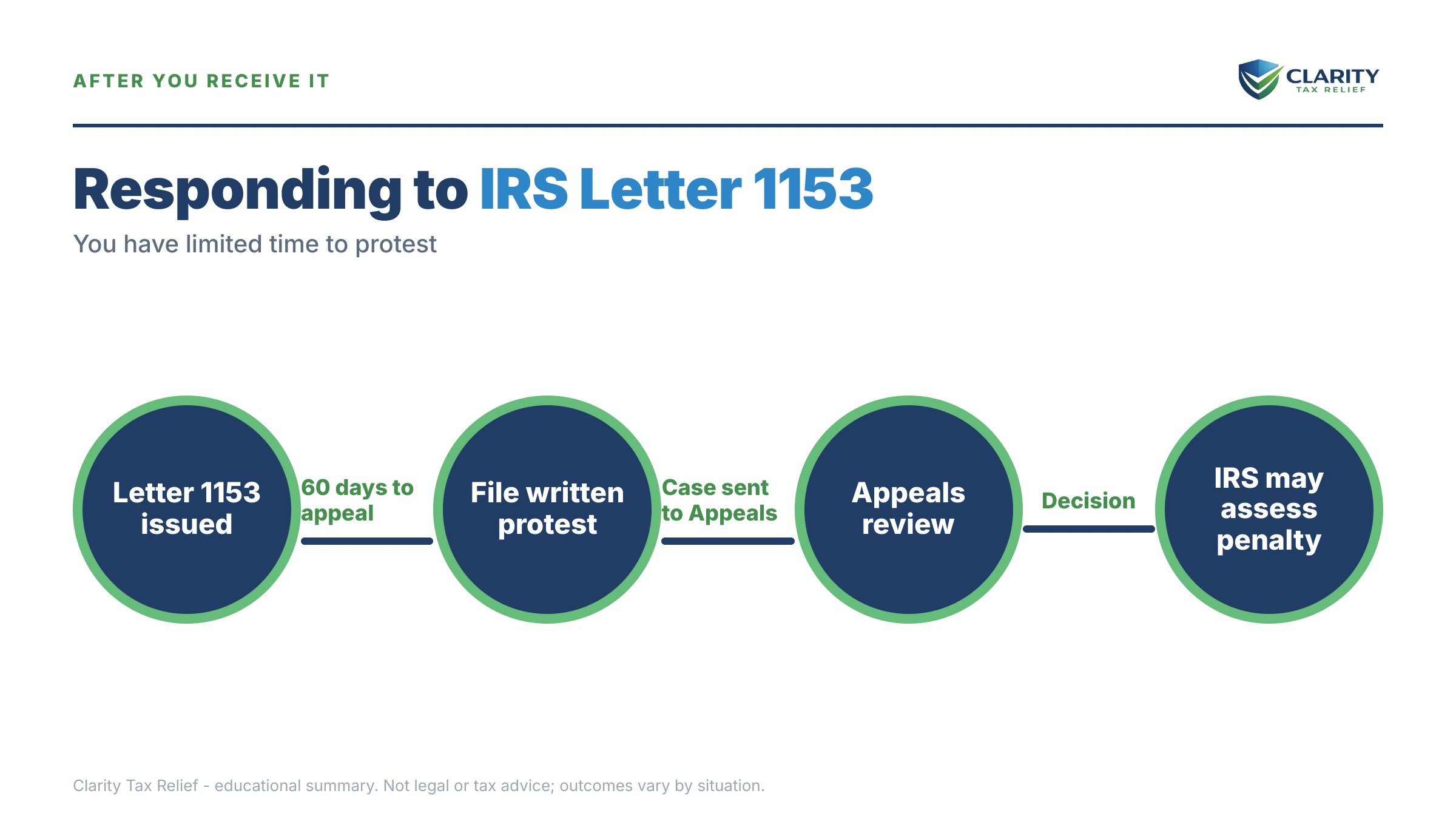
⏱ Your deadline: you have 60 days from the date printed on Letter 1153 to file a written protest before the IRS assesses the trust fund recovery penalty against you personally (75 days if the letter was addressed to you outside the United States). Miss that date and the free appeal disappears — the debt posts to your name and collection begins.

Why you got IRS Letter 1153 (the trust fund recovery proposal)
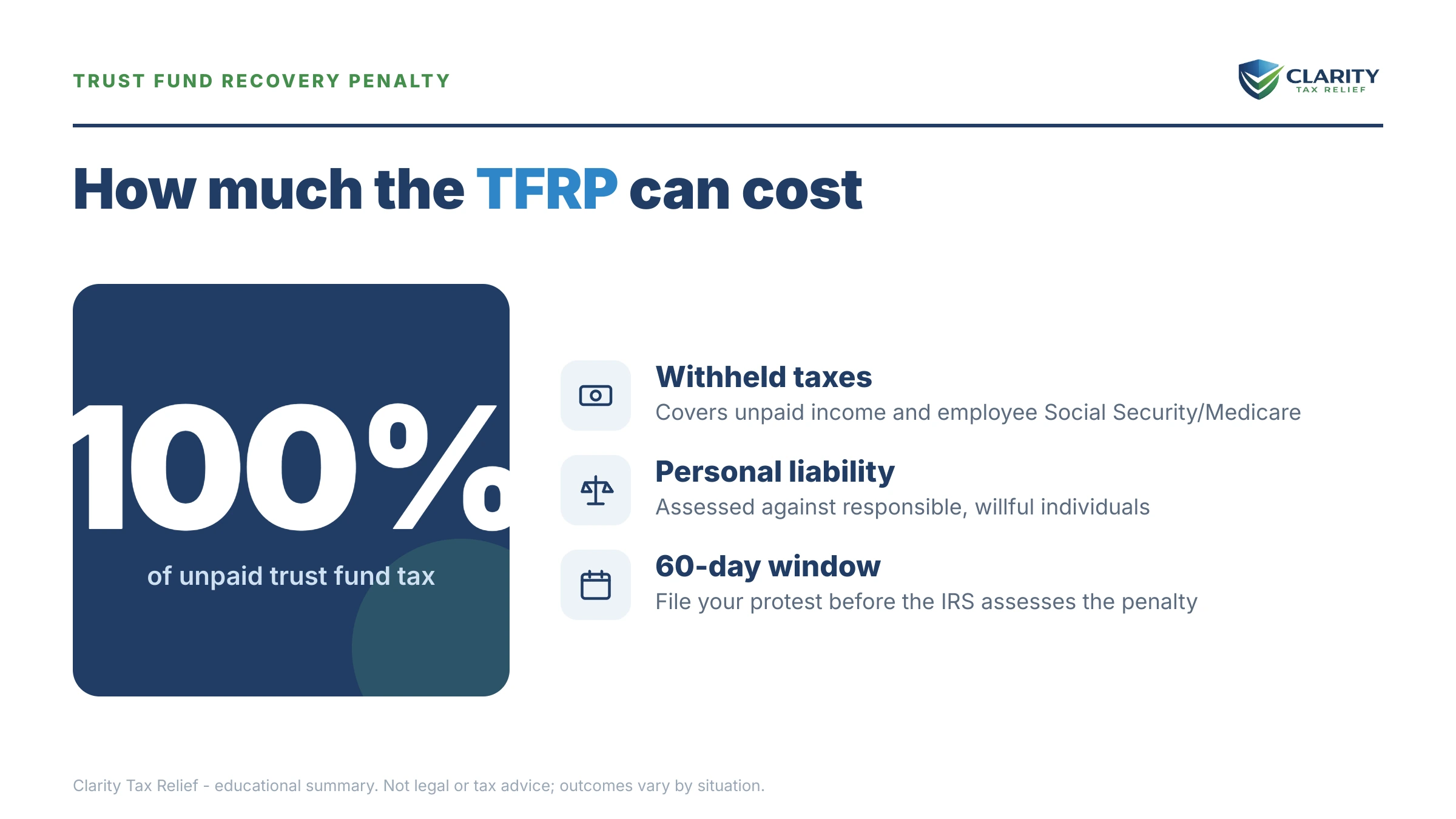
Letter 1153 is the notice IRC §6672 requires the IRS to send before it can charge a business's unpaid trust fund payroll taxes to an individual. When an employer withholds income tax, Social Security, and Medicare from paychecks, that money legally belongs to the employees and the government — the business only holds it "in trust." When it isn't deposited, the IRS doesn't have to stop at the business. It can pursue the people who controlled the money.
By the time this letter arrives, an investigation has usually already happened. Most cases start with a revenue officer contact or Letter 3164, followed by the Form 4180 interview — the "responsible person" questionnaire about who signed checks, who hired and fired, and who decided which bills got paid. Letter 1153 means the IRS has weighed those answers and concluded you qualify.
Look at Form 2751 first. It breaks the proposed penalty down by quarter and shows the trust fund calculation for each period. Those numbers are frequently wrong — misapplied payments, quarters after you left the company, or trust fund math that doesn't match the actual 941s — and every error is a protest argument. (For a plain-English map of IRS mail generally, see why did I get a letter from the IRS — but Letter 1153 is in a different weight class than a routine notice.)
One critical point: your LLC or corporation does not protect you here. The entity shield that works for ordinary business debts does not apply to trust fund taxes, because the law treats the withheld money as never having belonged to the business at all.
Who counts as a "responsible person" — and what "willful" really means
The IRS must prove two separate things to sustain the penalty: that you were a responsible person, and that you acted willfully — and knocking out either one defeats the entire proposal.
Responsibility is about actual control, not job titles. The IRS looks at who had signature authority on the bank account, who could hire and fire, who signed the 941s, and — above all — who decided which creditors got paid when money was short. Owners and officers are the obvious targets, but the IRS also sends Letter 1153 to office managers, controllers, and family members on the account. If you're not sure where you fall, our guide to being personally liable for payroll taxes walks through the factors position by position.
Willfulness is where most people misunderstand their exposure. It does not require bad intent or personal benefit. Paying any other creditor — rent, suppliers, even net payroll — while knowing the withheld taxes were unpaid counts as willful. "I was keeping the business alive" is precisely the fact pattern the statute was written to reach.
The edge cases matter, because they're where the penalty gets beaten:
- The bookkeeper or check-signer who followed orders. Mechanical authority without real decision-making power is a genuine defense — see when a bookkeeper is personally liable to the IRS.
- The person who discovered the problem late. If you learned of the unpaid taxes after they accrued, your exposure generally turns on what you did — and what money was available — once you knew.
- The victim of a payroll service. If a provider took the deposits and never remitted them, the trust fund liability still exists, but the facts change the willfulness analysis entirely — start with payroll company didn't pay taxes.
- Multiple candidates. The IRS often proposes the identical penalty against several people at once — every partner, the CFO, the spouse on the account. Each person can be assessed the full amount; the IRS collects the total only once, and someone who overpays their share has a federal contribution right against the others. If two of you received Letter 1153, coordinate — but understand your interests may not align.
What the trust fund recovery penalty includes — and what stays with the business
The TFRP equals only the trust fund portion of the payroll debt — the money withheld from employees — not the business's entire 941 balance. That means the number on your Form 2751 should be noticeably smaller than what the company owes, and if it isn't, something is likely miscalculated. Our full guide to the trust fund recovery penalty covers the mechanics in depth; here is the split at a glance:
| Payroll item | In your Letter 1153 amount? |
|---|---|
| Federal income tax withheld from employee paychecks | Yes |
| Employees' share of Social Security and Medicare | Yes |
| Employer's matching share of Social Security and Medicare | No — business only |
| Federal unemployment tax (Form 940) | No — business only |
| Failure-to-deposit and late-filing penalties on the 941 account | No — business only |
| Interest accrued on the business's balance | No — but interest runs on your penalty once it's assessed |
The business remains fully liable for everything, including the trust fund portion — the TFRP is a second collection source, not a transfer. Every dollar the business (or another responsible person) pays toward the trust fund amount reduces what the IRS can collect from you.
What happens if you ignore IRS Letter 1153
If the 60-day window closes with no protest, the IRS assesses the full proposed amount against your Social Security number — automatically, with no further warning. From there the sequence runs like any personal tax debt, except this one is harder to escape:
- Day 60 passes — assessment. The penalty posts to your personal account as a civil penalty. Your free Appeals protest is gone.
- A bill arrives in your name. Not the business's name — yours. Interest starts accruing on the assessed penalty from that point forward. (You can estimate how interest compounds on an unpaid balance with our IRS Penalty & Interest Calculator.)
- Final notice of intent to levy. Ignored bills escalate to Letter 1058 or LT11 — the final notice that starts a 30-day clock and your Collection Due Process rights (Form 12153).
- Federal tax lien. A lien can be filed against everything you own. If you rent, don't assume you're insulated — the lien attaches to your bank accounts, vehicle, security deposit, and any property you acquire later, and it surfaces in public-record searches landlords and lenders run.
- Levies. A bank levy freezes funds for a 21-day hold before the money leaves; a wage levy is continuous, paycheck after paycheck, until released.
- The 10-year clock starts. Once assessed, the IRS has ten years to collect — and the debt survives Chapter 7 bankruptcy no matter how old it gets.
Here is the full arc of a TFRP case, so you can see exactly where Letter 1153 sits and which windows are still open:
| Stage | What arrives | Your window |
|---|---|---|
| Investigation opens | Letter 3164 or revenue officer contact | Cooperate carefully — liability isn't decided yet |
| Responsible-person interview | Form 4180 | Scheduled by the revenue officer; you may bring representation |
| Proposal | Letter 1153 + Form 2751 (you are here) | 60 days to file a written protest |
| Assessment | Civil penalty posted to your personal account | Interest begins; a bill arrives in your name |
| Final warning | Letter 1058 / LT11 final notice of intent to levy | 30 days to request a CDP hearing (Form 12153) |
| Enforcement | Federal tax lien, bank levy (21-day hold), continuous wage levy | Runs until the debt is resolved |
In 2026 the human side of the IRS is thinner — the workforce shrank roughly 27% in 2025 — but TFRP assessments and the collection notices that follow are processed by systems that never stopped running. A shorter-staffed IRS makes it harder to fix a mistake later, not less likely to enforce.
Holding Letter 1153 right now?
The 60-day protest window is the cheapest, strongest chance you will get to fight this penalty — Appeals is free, but only if you file in time. Send us your Letter 1153 and Form 2751 and an experienced tax professional will map your responsibility exposure and your options — free and confidential.
Your options in the 60-day window (and after it closes)
A written protest filed within 60 days costs nothing and preserves every argument you have — which is why the do-nothing path is the only truly bad one. Here is each route, what it costs, and when it fits:
| Option | When available | What it costs | Best when |
|---|---|---|---|
| Sign Form 2751 (agree to assessment) | Within the 60 days | Full trust fund amount, plus interest after assessment | You clearly were responsible and willful, the math checks out, and you want to move straight to payment terms |
| Written protest to IRS Appeals | Within the 60 days | Free to file; typically months to an Appeals conference | You dispute responsibility, willfulness, or the numbers |
| Do nothing | — | The full amount, plus the permanent loss of your free appeal | Never |
| Pay a divisible portion + Form 843 refund claim | After assessment | One employee's trust fund share for one quarter (often a few hundred dollars), plus significant time | You missed the 60-day window but still dispute liability |
| Installment agreement | After assessment | Setup fee plus ongoing interest; balances of $50,000 or less can generally be spread over up to 72 months | You accept the debt but can't pay it at once |
| Currently Not Collectible or Offer in Compromise | After assessment | $0 for CNC; $205 OIC application fee (waived with low-income certification) | Your income and assets genuinely can't cover the balance |
Three of these deserve a closer look. The divisible tax route exists because the TFRP is legally divisible: after assessment, you can pay just the trust fund portion attributable to a single employee for a single quarter, then file a refund claim — the Form 843 walkthrough covers the mechanics — and take the dispute to court if it's denied. It works, but it's slower and harder than the protest you can file for free today.
An Offer in Compromise on trust fund debt is real but strict — the IRS accepted roughly 1 in 5 offers overall in FY2024, and trust fund cases get extra scrutiny because the money was employees' withholding. If your finances are genuinely underwater, see business offer in compromise on payroll debt before assuming it's an option.
And Currently Not Collectible matters for exactly the situation many Letter 1153 recipients are in: the business failed, you're renting, and your paycheck barely covers living expenses. CNC doesn't erase the penalty — interest keeps accruing and the IRS reviews your income periodically — but it stops levies while you can't pay.
What a winning Letter 1153 protest actually argues
A protest succeeds by attacking one of three things: responsibility, willfulness, or the math — and the strongest protests attack all three with documents, not adjectives.
- "I wasn't responsible." Show who really controlled the checkbook: bank signature cards, emails where the owner directed payments, corporate resolutions, evidence you couldn't pay a bill without approval. Titles on paper lose to facts about control.
- "I wasn't willful." Show you didn't know the taxes were unpaid — or that once you knew, no unencumbered funds were available to pay them. Bank statements and the timeline of your knowledge are the spine of this argument.
- "The numbers are wrong." Reconcile Form 2751 against the actual 941s. Look for payments applied to the wrong quarter or the wrong tax, quarters after your departure date, and trust fund calculations that quietly include employer-side amounts. For quarters filed years ago, the IRS's legal window to assess the TFRP may already have closed — a protest can raise that too.
Formally, the protest is a signed written statement to the address on the letter: your name and contact information, the letter's date, the periods and amounts you dispute, your factual and legal grounds, and a penalties-of-perjury declaration. It goes first to the office that issued the letter, then to the IRS Independent Office of Appeals, which is separate from the collection function that proposed the penalty. For structuring the arguments and what Appeals officers actually weigh, see our trust fund recovery penalty defense guide.
Filing a protest does one more quiet, valuable thing: the penalty can't be assessed against you while the appeal is pending, which means personal collection can't start either.
How to respond to Letter 1153, step by step
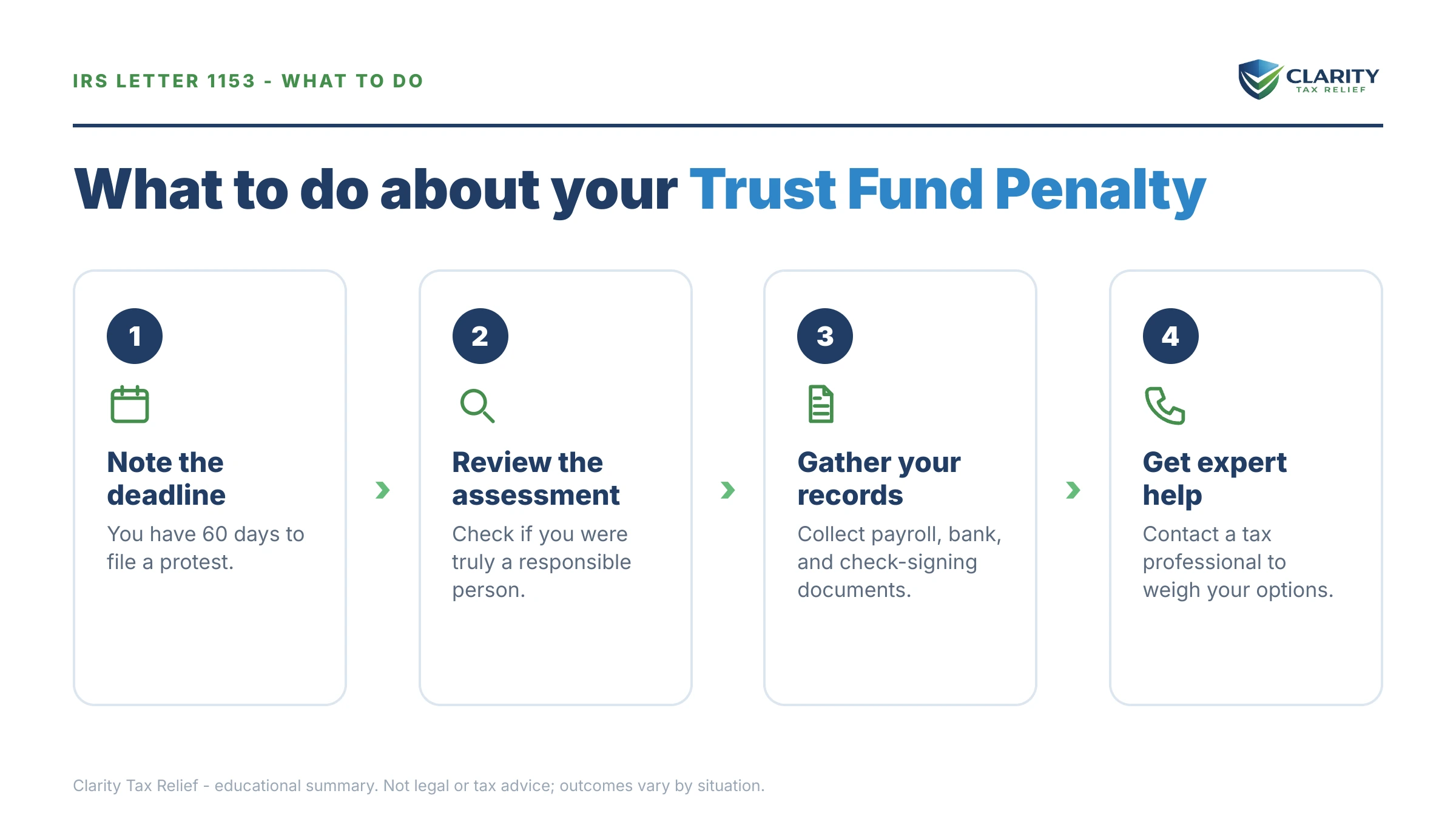
- Mark your deadline. Count 60 days from the date printed at the top of Letter 1153 — the free Appeals protest closes on that date.
- Hold off on signing Form 2751. Signing consents to immediate assessment of the full amount against you personally.
- Verify the numbers. Pull the 941s and payroll records for each quarter listed and check the trust fund calculation on Form 2751.
- Decide your position. Either agree and plan how you'll pay, or identify which element you dispute — responsibility, willfulness, or the amount.
- File a written protest within 60 days. Send it to the address on the letter, request Appeals consideration, and keep proof of mailing.
- Line up a payment strategy in parallel. If Appeals does not eliminate the penalty, you want a plan ready before personal collection notices start.
A worked example: a $13,600 trust fund penalty against a renter
Say you managed a small café that fell two quarters behind before it closed. The business's total 941 balance is $21,300. Here's how the IRS splits it:
- Federal income tax withheld from staff paychecks: $8,700
- Employees' share of Social Security and Medicare: $4,900
- Trust fund portion — the amount on your Form 2751: $8,700 + $4,900 = $13,600
- Employer's matching FICA ($4,900) plus deposit penalties and interest ($2,800) = $7,700 — stays with the business only
Letter 1153 proposes $13,600 against you, not $21,300. Now play out the paths. If you sign Form 2751 and it's assessed, a payment plan at 72 months runs about $189 a month before interest ($13,600 ÷ 72 ≈ $188.89) — interest keeps accruing, so paying faster costs less overall, and you can set the plan up at IRS.gov/payments once the bill arrives.
If instead you ignore the letter: assessment on day 61, a bill, a final levy notice, and then — because you rent and have no home equity to lien — the IRS goes where the money is. A levy freezes your checking account for 21 days before the funds leave, and a wage levy takes a slice of every paycheck until the $13,600 plus interest is resolved.
But suppose your records show $2,400 of the proposed amount comes from a quarter that ended after you'd already quit, and one business payment of $1,800 was posted to the wrong period. A protest with those documents could cut the proposal to around $9,400 before you ever discuss payment — which is why verifying Form 2751 always comes before deciding how to pay it.
When you can handle Letter 1153 yourself — and when help changes the outcome
Be honest with yourself about which case you have, because they call for very different responses.
You can likely handle it alone if you were the sole owner, you unquestionably controlled the bank account, you've verified Form 2751 against the 941s and the math is right, and the amount is one you can pay in full or through a straightforward payment plan. In that case, signing Form 2751 and arranging payment yourself is a legitimate, cheap resolution — no one needs to be paid to tell you what you already know.
Experienced help tends to change the outcome when responsibility is genuinely contested (you were a bookkeeper, minority partner, or check-signer without control); you already gave a Form 4180 interview and worry your answers hurt you; several people received the same letter and the IRS is deciding who pays; the proposed amount is large relative to your income; a levy is already moving against the business or you; or the business also has unfiled payroll returns — the revenue officer can propose substitute business returns via Letter 1085, which inflates the very balance your penalty is built on. TFRP protests are fact fights, and the record you build in the next 60 days is the record Appeals decides on.
One more resource worth knowing: if enforcement is causing immediate financial harm while your case is pending, the Taxpayer Advocate Service is an independent, free channel inside the IRS for hardship cases.
If your Form 2751 total looks wrong — or half your 60 days are already gone — a free Letter 1153 review with an experienced tax professional takes minutes, not weeks: call (888) 825-7779.
Terms on your Letter 1153, decoded
- Trust fund taxes: money withheld from employee paychecks that the employer holds in trust for the government — it was never the business's money to spend.
- Responsible person: anyone with the status, duty, and authority to decide which bills got paid; actual control matters far more than job titles.
- Willfulness: knowing the withheld taxes were unpaid and paying anyone else anyway — no bad intent or personal benefit required.
- Form 2751: the enclosure listing each quarter and the proposed penalty amount; signing it consents to immediate assessment against you.
- Divisible tax: the rule that lets you dispute the TFRP after assessment by paying only one employee's share for one quarter and filing a refund claim.
- CDP rights: your right, after a final levy notice, to a Collection Due Process hearing (requested on Form 12153) before enforcement proceeds.
Letter 1153 questions, answered
What is IRS Letter 1153?
Letter 1153 is the IRS's formal proposal to assess the Trust Fund Recovery Penalty against you personally under Section 6672 of the tax code. It arrives with Form 2751, which lists the exact quarters and dollar amounts, and it opens a 60-day window to file a written protest with IRS Appeals. It is a proposal, not an assessment — the debt is not in your name yet.
How long do I have to respond to Letter 1153?
You have 60 days from the date printed on the letter to file a written protest (75 days if the letter was addressed to you outside the United States). If the window closes without a protest, the IRS assesses the penalty against you personally. After that, your main way to dispute liability is paying a small divisible portion and filing a refund claim — a slower, harder road.
Should I sign Form 2751?
Only sign Form 2751 if you agree you were a responsible person, you acted willfully under the legal definition, and the dollar amounts are correct. Signing consents to immediate assessment and gives up your free protest to Appeals. You are allowed to take the form home, verify the numbers against payroll records, and get advice before deciding.
Can the IRS really collect a company's payroll taxes from me personally?
Yes — the trust fund portion. Withheld income tax and the employees' share of Social Security and Medicare are legally the employees' money, held in trust, and Section 6672 lets the IRS assess 100% of that amount against any responsible person who willfully failed to pay it over. A corporation or LLC does not shield individuals from trust fund taxes.
How much of the business's 941 debt goes into the trust fund recovery penalty?
Only the trust fund portion: federal income tax withheld from paychecks plus the employees' share of Social Security and Medicare. The employer's matching share, federal unemployment (940) tax, and the penalties and interest on the business account stay with the business. That usually makes the Form 2751 figure meaningfully smaller than the total the business owes — verify it quarter by quarter.
Can the IRS assess the same trust fund penalty against more than one person?
Yes. The IRS routinely sends Letter 1153 to every owner, officer, or manager it believes qualifies as a responsible person, and each can be assessed for the full amount. The government only collects the total once, but it can pursue everyone simultaneously until it is paid. A person who pays more than their share has a federal right to seek contribution from the others.
Does bankruptcy wipe out the trust fund recovery penalty?
No. Trust fund taxes are priority debts that survive a Chapter 7 bankruptcy, no matter how old they are. A Chapter 13 case can force a structured repayment schedule and stop levies while it is open, but the trust fund debt itself must generally be paid in full through the plan. Bankruptcy strategy around a TFRP needs case-specific advice.
What happens if I ignore Letter 1153?
After the 60-day window closes, the IRS assesses the full proposed amount against your Social Security number and interest starts running. Collection notices follow, ending in a final notice of intent to levy that allows wage garnishment and bank levies 30 days later. A federal tax lien can also be filed against everything you own. Ignoring the letter converts a fixable proposal into an enforced personal debt.
I only signed checks when the owner told me to — am I still liable?
Maybe not. Check-signing authority alone does not make you a responsible person; the test is whether you had real authority to decide which bills got paid. Bookkeepers, office managers, and employees who acted purely at an owner's direction have beaten the penalty by documenting that they lacked control. That argument belongs in a written protest filed within the 60-day window.
Your next 24 hours
- Find the date printed at the top of Letter 1153, count 60 days forward, and write that protest deadline somewhere you'll see it every day.
- Gather your records: Form 2751, the business's 941s and payroll records for the quarters listed, and anything showing who controlled the bank account and payment decisions.
- Get the letter reviewed free — the 2-minute form at claritytaxrelief.com/#consult or (888) 825-7779 — while most of your 60-day window is still open. Appeals is free, but only for people who file in time.
This guide is general information, not tax or legal advice for your specific situation. Eligibility for IRS programs depends on individual facts and circumstances; no outcome is guaranteed.