
IRS Data & Studies
IRS Refund Delay Statistics (2026): 3.6 Million Taxpayers Waited Past the Normal Window
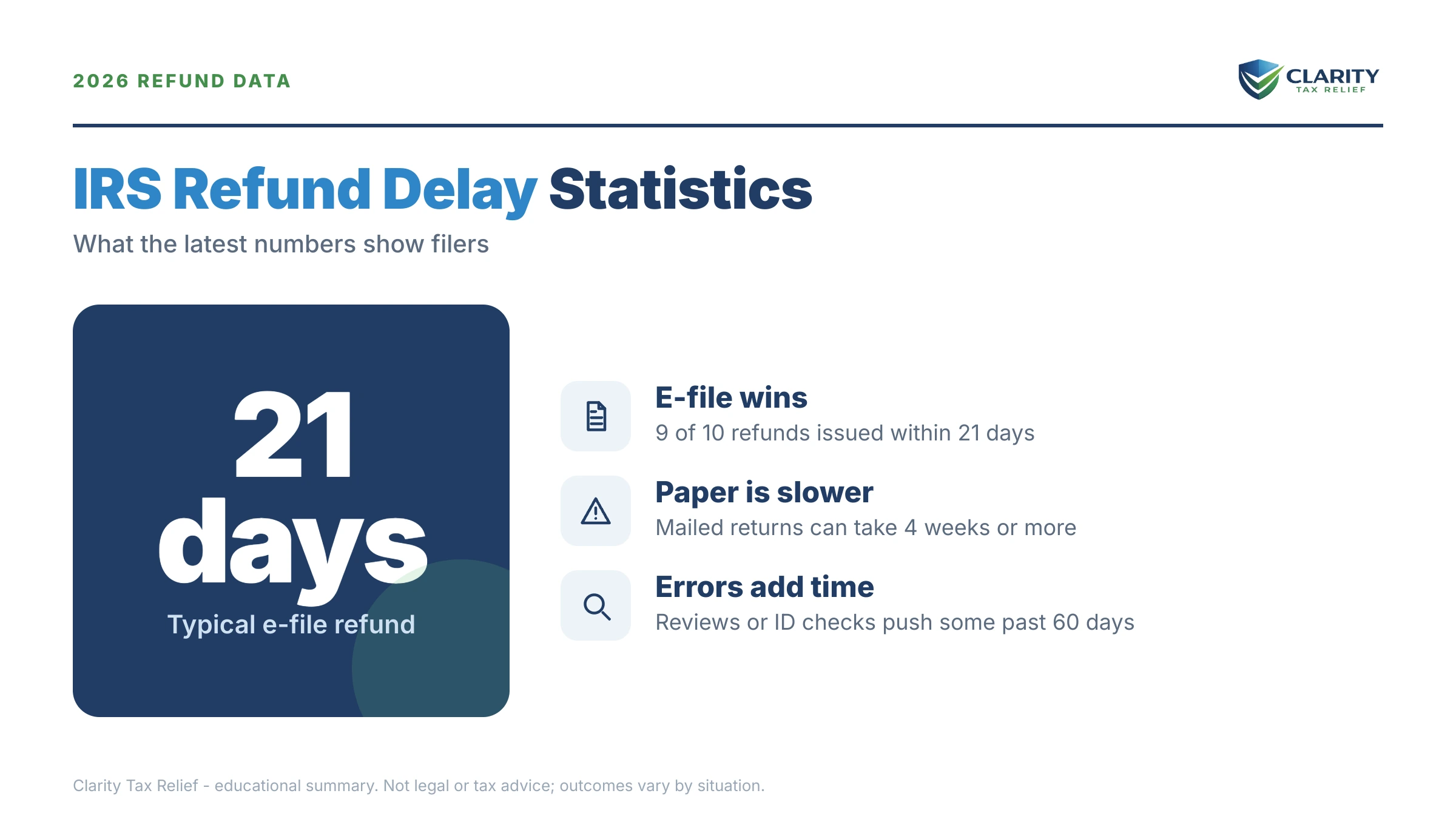
The short answer: about 3.6 million taxpayers received their 2025 refunds beyond the IRS's normal processing time. Delayed e-filers waited an average of 7 weeks; delayed paper filers waited an average of 14 weeks. Identity-theft victims waited an average of more than 21 months for the IRS to resolve cases and issue refunds.
Maybe your divorce changed everything on this year's return — a new filing status, withholding split down the middle, and a refund you'd already earmarked for the deposit on your own place. You filed months ago, and "Where's My Refund" still says processing. You're not imagining the wait, and you're not alone in it.
These IRS refund delay statistics come from the National Taxpayer Advocate's annual report to Congress, released in early 2026, covering the 2025 filing season. The image below shows exactly how the delay numbers break down — who waited, how long, and through which filing channel.
⏱ The clock that matters: the IRS typically issues e-filed refunds within 21 days. Once yours passes that window, every added week is real money sitting idle — and if the IRS pays your refund more than 45 days after the filing deadline (or your filing date, if later), it owes you interest on top.

IRS refund delay statistics: the 2025 numbers
About 3.6 million taxpayers received their 2025 refunds beyond the IRS's normal processing time. Set against the full season, that's the minority — 104 million taxpayers (63% of filers) received a refund in 2025 — but for the filers caught in the delayed group, the waits were long and the reasons were rarely explained.
How long? Delayed e-filers waited an average of 7 weeks; delayed paper filers waited an average of 14 weeks. And in the worst category, identity-theft victims waited an average of more than 21 months for the IRS to resolve cases and issue refunds.
Filing method was the single biggest fork in the road. 94% of returns were filed electronically, the fastest route to payment. Meanwhile, about 11 million returns (6%) were filed on paper, the slowest path to a refund — every paper return must be manually transcribed before processing even begins.
| Measure | 2025 figure |
|---|---|
| Taxpayers who received a refund | 104 million (63% of filers) |
| Returns filed electronically | 94% |
| Returns filed on paper | About 11 million (6%) |
| Refunds delayed past normal processing time | About 3.6 million |
| Average wait for delayed e-filed refunds | 7 weeks |
| Average wait for delayed paper refunds | 14 weeks |
| Average identity-theft case resolution | More than 21 months |
One more piece of context for 2026: the IRS workforce shrank by roughly 27% in 2025, per TIGTA reporting. Returns that sail through automated processing are unaffected — but any return that needs a human to look at it now joins a longer queue behind fewer people. The 3.6 million figure measures exactly that population: returns kicked out of automation.
Why 3.6 million refunds ran late
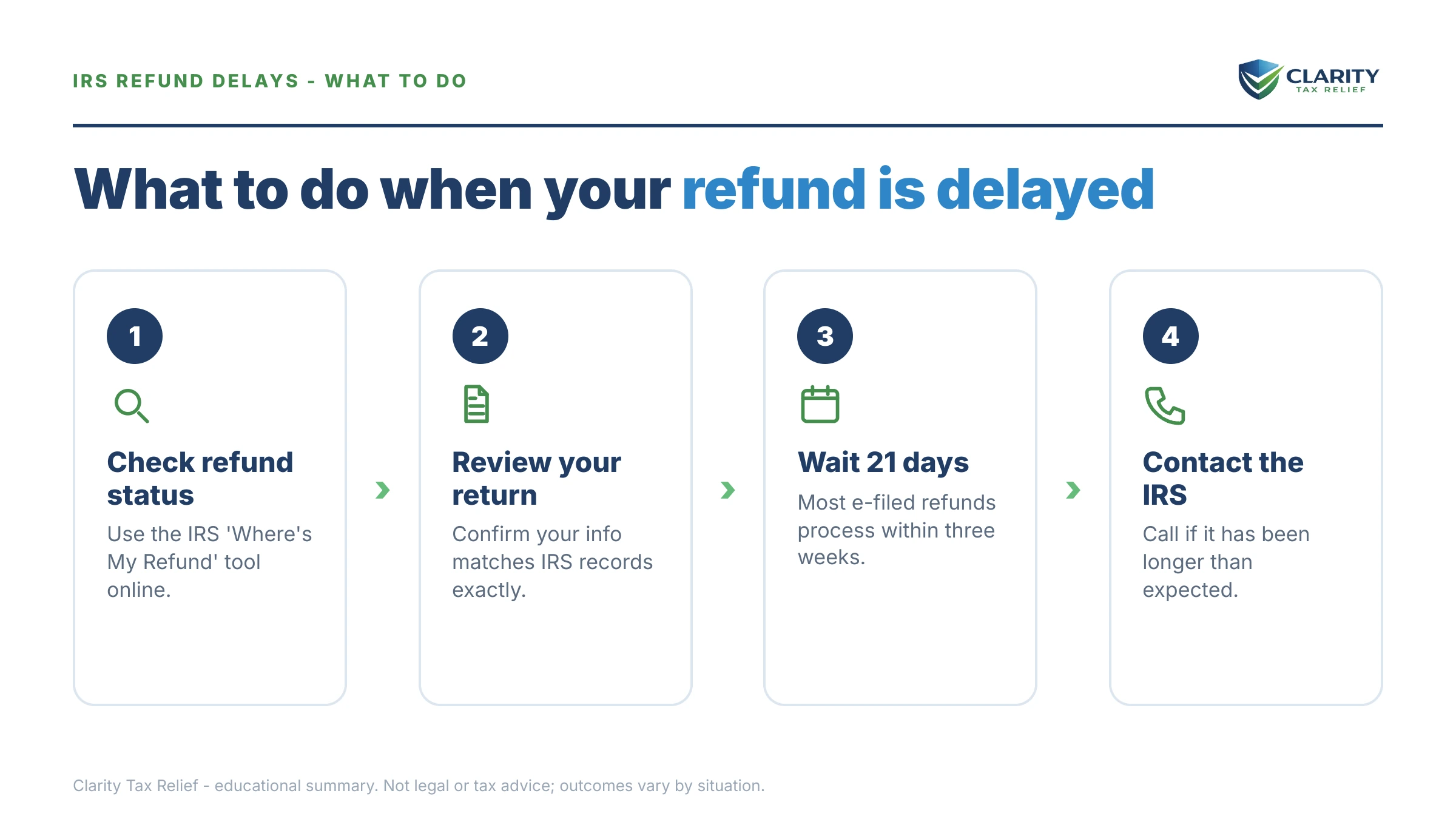
A refund gets delayed when something on the return trips a filter that only a manual review can clear. The most common triggers fall into six buckets:
- Paper filing. No error required — the format itself is the delay. Paper returns wait for transcription before any processing starts.
- Identity verification. The IRS suspends the refund and mails a letter (often a 5071C) asking you to prove you filed the return. Nothing moves until you respond.
- Identity theft. Someone else filed under your Social Security number first. These cases averaged more than 21 months to resolve — the deep dive on that backlog is in our how long does the IRS take to resolve identity theft cases study.
- Income or credit review. A CP05-type review compares your reported wages, withholding, and credits against employer filings before releasing anything.
- Statutory holds. Returns claiming the EITC or Additional Child Tax Credit can't be paid before mid-February by law — see the eitc refund hold path act data study for how many filers that touches.
- Offsets. The refund processed fine — then the Treasury applied it to back taxes, child support, or defaulted student loans. Our treasury offset program refund seizure statistics study covers how often that happens.
For a closer look at the review-and-suspension pipeline specifically — the returns the IRS pulls aside and parks — see our companion study on irs refund delays statistics for suspended returns.
What happens the longer your refund stays stuck
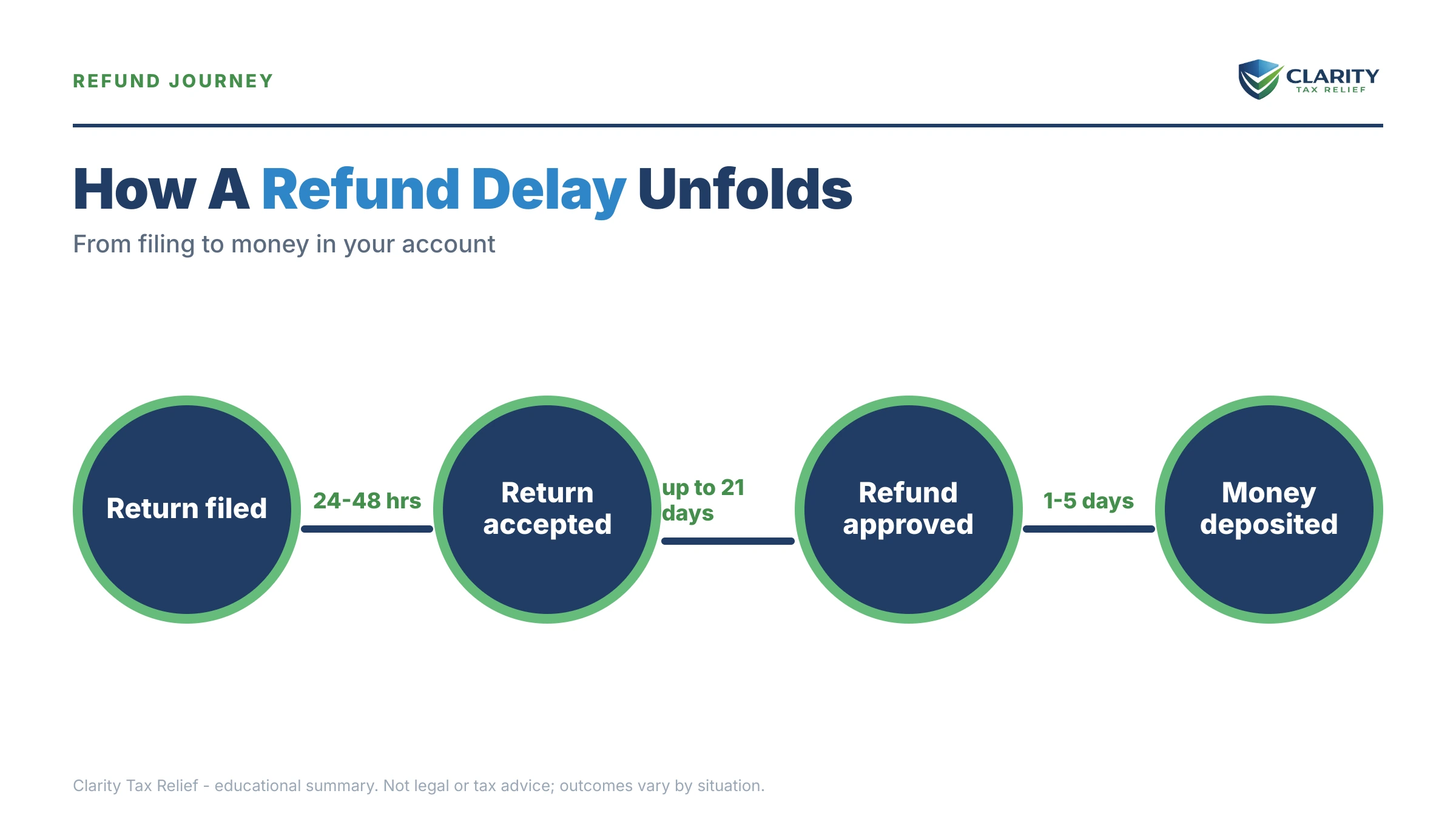
A refund claim does not stay open forever — you generally have three years from the return's due date to claim it before the money is forfeited to the Treasury. Between "a little late" and "gone," a stuck refund moves through recognizable stages:
- The normal window passes. E-filed refunds typically arrive within 21 days; "Where's My Refund" keeps showing a generic processing message with no explanation.
- A letter goes out — or doesn't. If the IRS needs something (identity verification, wage documentation), it mails a letter. If that letter is ignored — or never reaches you because you moved after a divorce — the return sits suspended indefinitely.
- Freeze codes appear on your transcript. A 570 hold or 810 freeze posts to your account, and the refund cannot release until the code that set it is reversed.
- Unresolved cases stretch into months or years. The 2025 averages — 7 weeks for e-filers, 14 weeks for paper, more than 21 months for identity-theft victims — measure people who eventually got paid. Cases nobody pushes can run longer.
- The claim window closes. If a refund year is never filed or never resolved and three years pass, the money is permanently forfeited. There is no appeal from a missed refund statute.
The pattern in the data is consistent: refunds that get unstuck get unstuck because the taxpayer acted — verified identity, answered the letter, filed the right form, or escalated. Waiting quietly is the one strategy with no success rate behind it.
Refund stuck and nobody will tell you why?
If your refund is frozen behind a hold code, an offset, or an unfiled year, a free case review can pinpoint which — and what actually releases it. Every month it sits unresolved is a month the freeze does not fix itself.
What can you do about a delayed refund? Your options by cause
The right move depends entirely on why the refund is stuck — and each cause has one action that actually shortens the wait:
| Cause of delay | What the 2025 data shows | Your fastest move |
|---|---|---|
| Filed on paper | Delayed paper filers averaged 14 weeks — double the e-file average | Nothing speeds this year; e-file with direct deposit next year |
| Routine e-file review | Delayed e-filers averaged 7 weeks | Check your transcript weekly; respond to any letter same week |
| Identity verification letter | Return suspended until you respond — no automatic release | Verify online or by phone the day the letter arrives |
| Identity theft | Victims averaged more than 21 months to resolution | File Form 14039, get an IP PIN, open a TAS case if it drags |
| Refund offset | Refund was issued — to a creditor, not to you | Call 800-304-3107; file Form 8379 if the debt is only your ex's |
| Wage or credit review (CP05) | Held until documents verify your income and withholding | Send pay stubs / W-2 proof exactly as the letter requests |
One caution the data supports: if part of the delay traces back to a balance you owe the IRS from another year, the refund will keep feeding that debt every year until the debt itself is resolved. The full playbook for that is in our guide on how to settle tax debt yourself — fixing the debt is what fixes the refund.
Transcript codes that explain a delayed refund
Your account transcript names the reason for a delay days or weeks before any letter arrives. Five codes account for most stuck-refund situations:
| Code | What it means | What to do |
|---|---|---|
| 570 | Additional account action pending — a general hold on the refund | Wait for the paired 971 letter; respond to it immediately |
| 810 | Refund freeze — often identity or credit verification | Complete verification; the freeze releases with code 811 |
| 971 | Notice issued — a letter explaining the hold is on its way | Watch the mail; the letter names what the IRS needs from you |
| 898 | Refund applied to a non-IRS debt through the Treasury Offset Program | Call the offset hotline; consider Form 8379 if the debt isn't yours |
| 846 | Refund issued — the date next to it is your payment date | Nothing; direct deposits typically land within days of that date |
A divorced filer's delayed refund: a worked example
Offsets are where divorce and refund delays collide, because joint debts follow joint returns. Here's a hypothetical to show the math.
Say your final joint return with your ex showed a $4,850 refund — and the whole thing was seized for his defaulted federal student loans, a debt that predates the marriage and was never yours. Your transcript shows code 898; the refund was "issued," just not to you.
Your W-2 withholding was $6,300 of the couple's $9,000 in total payments — 70% of everything paid in. File Form 8379 injured spouse and the IRS re-allocates the refund between spouses based on each person's income, withholding, and credits. On these numbers, your recoverable share is roughly 70% of $4,850 — about $3,395 — while his 30% stays applied to his loans.
Two honest caveats: the allocation isn't always a straight percentage (community-property states use different rules), and injured-spouse processing adds weeks to months on top of the original delay. But the alternative is $0. If this is your situation, our guide on ex husband's tax debt my refund taken walks through the whole sequence — including how to file Form 8379 with next year's return so the seizure never happens again.
How to track down a delayed refund, step by step
- Check "Where's My Refund" — look up your status at IRS.gov/refunds with your SSN, filing status, and exact refund amount — and write down the exact message it shows.
- Pull your account transcript — log into your IRS online account and check the transcript for hold codes — 570, 810, 971, or 898 will usually tell you why the refund is stuck.
- Answer any IRS letter the week it arrives — identity-verification (5071C) and review (CP05) cases stay suspended until you respond; verifying the same week is the single fastest fix available to you.
- Rule out an offset — call the Treasury Offset Program hotline at 800-304-3107 to hear whether your refund was applied to another government debt.
- Escalate if you're past normal timeframes — file Form 911 taxpayer advocate if the delay is causing hardship, or have an experienced tax professional pull and read your file.
When you can handle this yourself — and when help changes the outcome
Most of the 3.6 million delayed refunds resolved without professional help, and yours probably can too. Handle it yourself when: you're inside the average delay windows (7 weeks e-file, 14 weeks paper), your transcript shows a routine 570/971 pair, or the fix is simply completing an identity verification you've been putting off. Those are patience-and-paperwork problems.
Experienced help changes outcomes in a narrower set of cases: an 810 freeze that won't release after you've verified, an identity-theft case drifting toward that 21-month average with no assigned resolution, an offset tangled up with an ex-spouse's debt across multiple years, or a refund frozen because an earlier year is unfiled or carries a balance. In those cases, the problem isn't the refund — it's the account underneath it, and someone who reads transcripts daily can find the actual blocker in one pass instead of six phone calls.
Refund-delay terms, decoded
- Refund hold (TC 570): a temporary pause while the IRS reviews something — the refund still exists, it just can't release yet.
- Refund freeze (TC 810): a harder stop, usually for identity or credit verification, requiring a specific reversal (TC 811) to lift.
- Offset: your refund was paid — to a government creditor (back taxes, child support, student loans) instead of to you.
- RSED (Refund Statute Expiration Date): the deadline — generally three years — after which an unclaimed refund is forfeited permanently.
- IP PIN: a six-digit Identity Protection PIN that blocks anyone else from e-filing under your Social Security number.
- TAS: the Taxpayer Advocate Service, an independent office inside the IRS that intervenes in stalled and hardship cases at no cost.
Refund delay questions, answered
How many tax refunds were delayed in 2025?
About 3.6 million taxpayers received their 2025 refunds beyond the IRS's normal processing time, according to the National Taxpayer Advocate's annual report to Congress. That is out of 104 million taxpayers (63% of filers) who received a refund in 2025. Most refunds still arrived on time — but when a return got pulled out of normal processing, the wait stretched to weeks or months.
How long is a delayed tax refund taking right now?
When a refund misses the normal window, delayed e-filers waited an average of 7 weeks and delayed paper filers waited an average of 14 weeks in 2025. Those are averages, not caps — identity-verification and review cases can run far longer. If your transcript shows a 570 hold or 810 freeze, the clock doesn't restart until the underlying issue is resolved.
Why is my refund taking longer than 21 days?
Your return was likely pulled out of automated processing for a manual reason: an identity-verification letter (5071C), a review of your income or credits (CP05), a math or mismatch error, an offset for another debt, or simply because you filed on paper. Check 'Where's My Refund' first, then your account transcript — the hold code on the transcript usually names the reason the tool won't.
How long do identity-theft refund delays take?
Identity-theft victims waited an average of more than 21 months for the IRS to resolve cases and issue refunds in 2025 — the longest delay category by far. If someone filed using your Social Security number, file Form 14039, respond to any verification letter immediately, and request an Identity Protection PIN so it can't happen again next year.
Does the IRS pay interest on a late refund?
Yes. If the IRS issues your refund more than 45 days after the filing deadline (or after the date you filed, if you filed late), it must add interest at the federal overpayment rate. The interest is automatic — you don't apply for it — but it's also taxable income the following year, and it rarely comes close to offsetting a months-long wait.
Can the IRS keep my refund for my ex-spouse's debt?
It can if the debt is attached to a jointly filed return or a joint federal obligation. If your refund was taken for a debt that is solely your ex's — like their student loans or their separate back taxes — Form 8379 (injured spouse allocation) lets you recover your share of the refund based on your income and withholding. A divorce decree alone does not stop an offset.
When should I contact the Taxpayer Advocate Service about a delayed refund?
Contact TAS when the delay has passed the IRS's normal timeframes and you either can't get an answer through regular channels or the delay is causing financial hardship — an eviction notice, utility shutoff, or inability to cover basics. File Form 911 to open a case. TAS is independent, free, and can force movement on files the automated system has stalled.
Your next 24 hours
- Check "Where's My Refund" and write down two things: the exact status message it shows and the date you filed. Those two facts determine whether you're inside or past the normal window.
- Gather your paper trail: your copy of the return, every IRS letter you've received this year, and your account transcript if you can log in online.
- If your refund is stuck behind a freeze code, an offset, or an old balance, get a free case review — the 2-minute form at /#consult or (888) 825-7779. Freezes and offsets don't resolve themselves; the account underneath them has to be fixed first.
Where these numbers come from
Every figure in this study comes from the National Taxpayer Advocate's annual report to Congress, published by the IRS, covering the 2025 filing season. You can track your own refund at the IRS's Where's My Refund tool, and learn more about escalating a stalled case at the Taxpayer Advocate Service.
This guide is general information, not tax or legal advice for your specific situation. Eligibility for IRS programs depends on individual facts and circumstances; no outcome is guaranteed.