
IRS Data & Studies
How Many IRS Levies on Third Parties Per Year? The 2026 Data Study
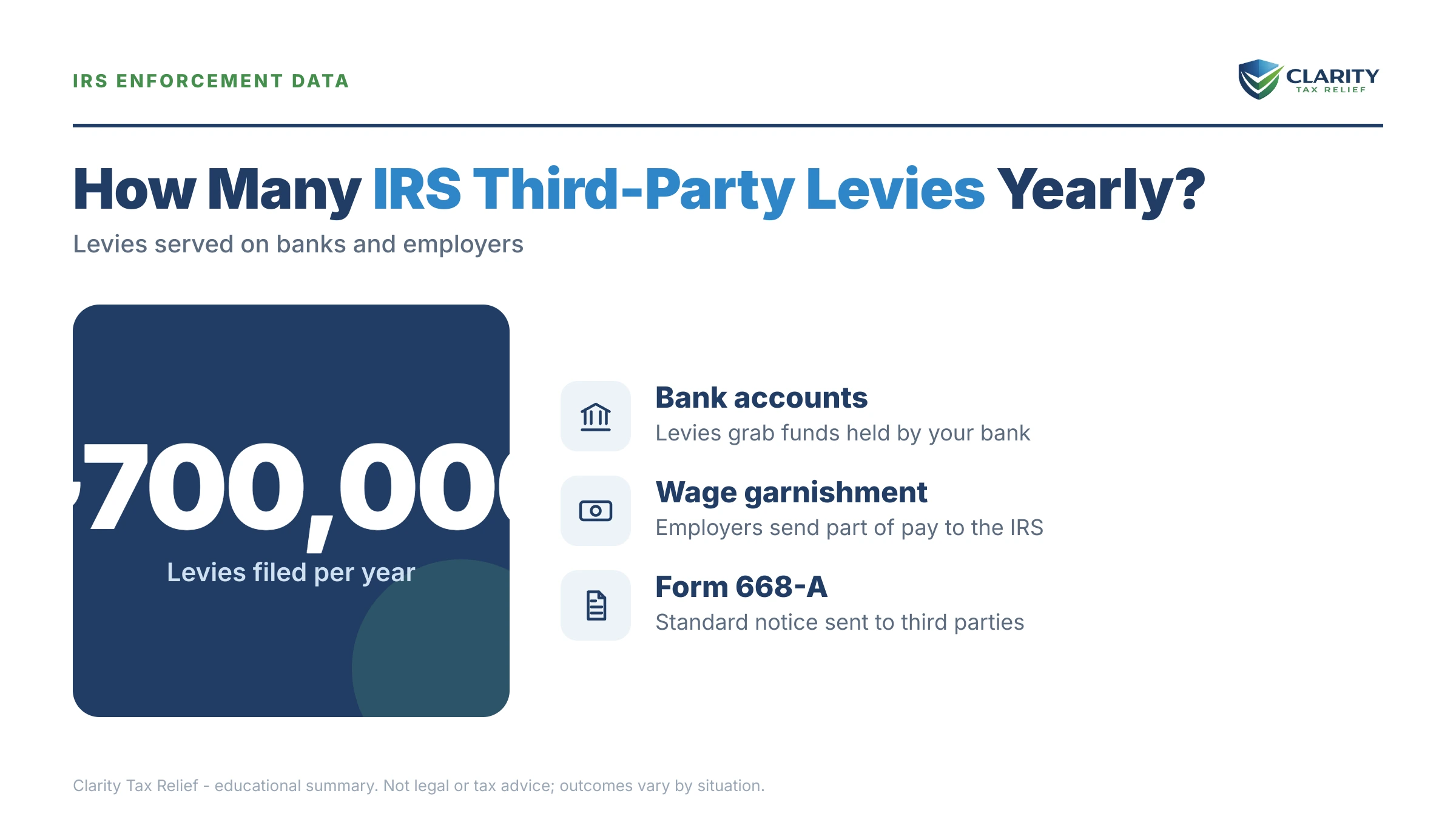
The short answer: The IRS served 339,137 levies on third parties in FY2025 — roughly 930 bank, wage, and other third-party levies every single day. That's an 8% year-over-year increase from the 313,792 notices of levy requested on third parties in FY2024, per the IRS's own Data Book.
If you're asking how many IRS levies on third parties per year actually go out, you're probably not writing a term paper. You owe, the letters are stacking up, and you want to know whether the levy warnings are real or mostly bluff. The data answers that question directly — and the answer is that the IRS follows through hundreds of times a day.
Here's the good news buried in the numbers: every one of those 339,137 levies traveled the same predictable notice path first, and every stop on that path is an exit ramp. This page gives you the verified data, the exact sequence a levy follows, and what stops one before it lands. The image below shows exactly how third-party levy volume has moved year over year — and why the direction of that trend line matters more than the raw total.
⏱ The real clocks in the levy process: once a bank levy is served, your bank holds the funds for 21 days before sending them to the IRS. Before any levy, an LT11 or Letter 1058 gives you 30 days to request a Collection Due Process hearing. Between notices, penalties and interest accrue monthly — the balance never sits still.

How many IRS levies on third parties per year: the FY2025 numbers
The IRS requested 339,137 notices of levy on third parties in FY2025 — about 930 per calendar day (339,137 ÷ 365). The year before, FY2024, the count was 313,792, which makes FY2025 an 8% year-over-year increase. These aren't door-knock seizures of houses or cars; they're paper orders sent to banks, employers, and other parties holding money that belongs to a delinquent taxpayer.
| Fiscal year | Notices of levy requested on third parties | What it means |
|---|---|---|
| FY2024 | 313,792 | Baseline year in the current Data Book series |
| FY2025 | 339,137 | An 8% year-over-year increase — about 930 levies per calendar day |
Two IRS programs generate this volume: third-party levies are issued by the Automated Collection System and Field Collection programs. The Automated Collection System (ACS) works cases systematically from IRS campuses — no revenue officer, no phone call, just a case that crossed a threshold and triggered a levy. Field Collection is the human side: a revenue officer assigned to larger or more complex balances, who can levy faster and reach further.
That split is the single most useful thing in the data. For most readers of this page, the threat isn't a person deciding to come after you. It's software that escalates your case on schedule whether or not anyone at the IRS ever reads your file.
What a "third-party levy" actually reaches
A third-party levy is an order to someone who holds your money — not a seizure of your physical property. In practice, the 339,137 levies in FY2025 landed on a handful of targets:
- Your bank. The bank freezes what's in the account on the day the levy arrives, then holds it for 21 days before remitting it to the IRS. Our guide to the IRS bank levy 21 days rule explains what that window is for.
- Your employer. A wage levy is continuous — it takes everything above a small exempt amount from every paycheck until it's released. You can estimate the bite with our IRS Wage Garnishment Calculator, and see how to stop IRS wage garnishment if one is already running.
- Your clients, if you're self-employed. The IRS can levy accounts receivable — the people who owe you money get the levy, which means your customers learn about your tax debt.
- Federal payments. Through the Federal Payment Levy Program, the IRS can take up to 15% of Social Security benefits, plus certain other federal payments.
Notice what's not on the list: houses, cars, retirement accounts seized in person. Those direct seizures happen through a separate, far rarer process — the data on that is in our companion study on how often the IRS seizes property. The third-party levy is the IRS's everyday tool precisely because it never has to leave the building.
Why levy volume rose 8% while IRS staffing fell 27%
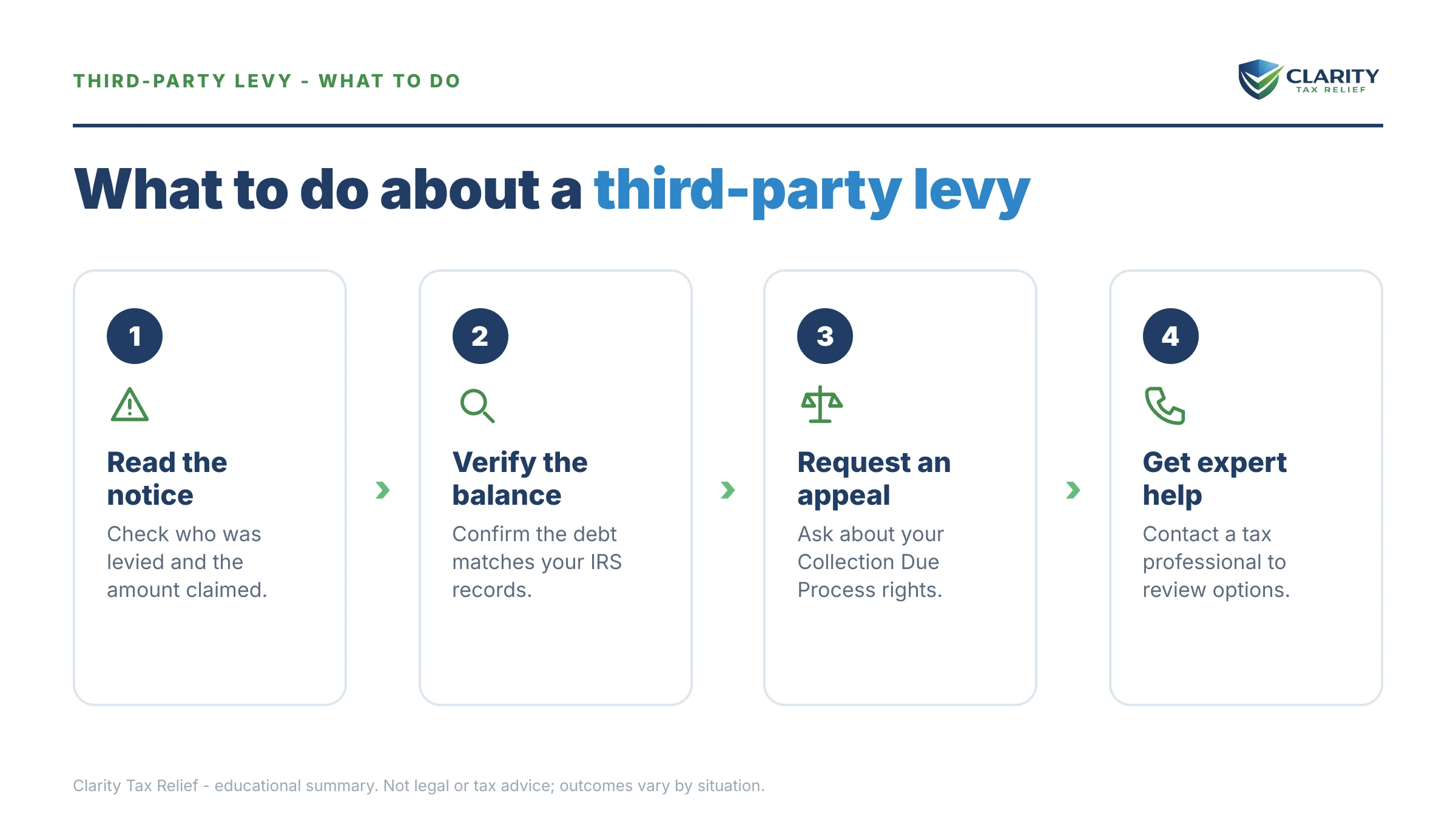
Third-party levies increased 8% in FY2025 even though the IRS workforce shrank roughly 27% in 2025, per TIGTA reporting. That combination looks contradictory until you remember who issues the levies: the Automated Collection System doesn't take buyouts. Fewer humans means longer phone waits and slower case resolution — but the notice stream, the escalation triggers, and the levy requests are systemic and kept running at full speed.
For a taxpayer with a balance due, that creates a lopsided reality in 2026: it's harder than ever to reach the IRS, but the IRS has no trouble reaching your bank. The practical takeaway is to act early in the notice sequence, when your options are self-service and cheap, instead of trying to get a human on the phone after a levy is already served.
It's worth noting the levy is only one lane of enforcement. The IRS also files public liens against taxpayers at scale — a different tool with different consequences, covered in our IRS notice of federal tax lien filings statistics study. A lien claims your property on paper; a levy actually takes the money.
The notice path that ends in a levy — and what happens if you ignore it
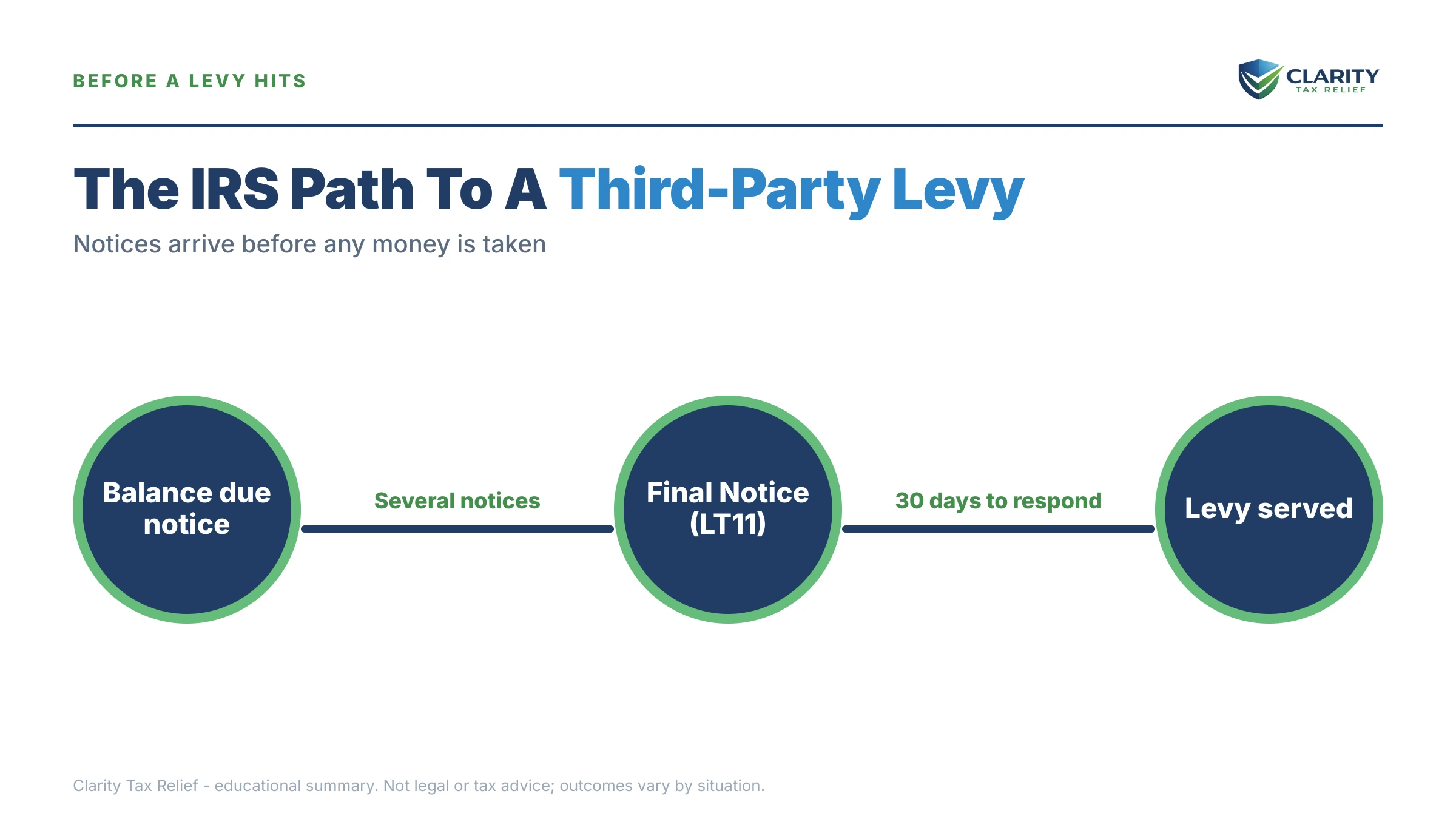
None of the 339,137 FY2025 levies came out of nowhere; each one followed a mailed notice sequence required by law. If you're not sure which letter you're holding or why you got it, start with our hub on why you got a letter from the IRS. The escalation runs in this order:
- CP14 — the first bill. You typically have about 21 days before the sequence advances. No enforcement power yet.
- CP501 / CP503 — reminder notices. Still just bills, but interest and the monthly failure-to-pay penalty keep compounding between letters.
- CP504 — Notice of Intent to Levy under IRC §6331(d). The IRS can now take your state tax refund. Despite the scary name, the CP504 notice is not the final notice.
- LT11 / Letter 1058 — the Final Notice of Intent to Levy, usually arriving as a certified letter from the IRS. This starts a 30-day clock and your Collection Due Process rights. This is the last exit before your case joins the levy count.
- The levy is served — on your bank (funds held 21 days), your employer (continuous until released), or another third party. At this point you're negotiating for a release instead of preventing the levy.
One common misconception is worth killing here: the IRS cannot legally levy a bank account with no notice at all — the final notice and 30-day window come first. But the notice goes to your last known address, so people who moved or stopped opening IRS mail experience the levy as a surprise. We break that down in can the IRS freeze my bank account without notice.
| Notice | What it allows the IRS to do | Verified clock |
|---|---|---|
| CP14 | Bill you — no enforcement yet | ~21 days before escalation |
| CP501 / CP503 | Remind you while penalties and interest accrue | No fixed statutory clock — use the date printed on yours |
| CP504 | Seize your state tax refund (IRC §6331(d)) | Respond by the date on the notice |
| LT11 / Letter 1058 | Levy banks, wages, and other third parties after the window closes | 30 days to request a CDP hearing |
| Levy served | Take funds from the third party | Bank: 21-day hold. Wages: continuous until released |
An intent-to-levy notice on your table?
Roughly 930 third-party levies went out every day in FY2025 — and each one started with the letter you're holding. If it's an LT11 or Letter 1058, a real 30-day clock is running. Get it reviewed free by an experienced tax professional before your case joins the count.
Your options for staying out of the levy count
Every resolution option below takes your case out of active levy status — the IRS levies people who ignore the sequence, not people inside an agreement. Which option fits depends on your balance and your finances:
| Option | Who's eligible | Cost / key detail |
|---|---|---|
| Short-term payment plan | Can pay in full within 180 days | $0 setup; interest and penalties still accrue |
| Guaranteed installment agreement | Individuals owing $10,000 or less, all returns filed | Approval is required by law when the criteria are met |
| Streamlined installment agreement | Balances up to $25,000 (up to $50,000 with direct debit) | No detailed financial disclosure needed |
| Online long-term plan | Balances of $50,000 or less | Up to 72 months; set up without calling |
| Currently Not Collectible | Financials show any payment creates hardship | Collection pauses; the debt and interest remain |
| Offer in Compromise | Assets plus future income genuinely can't cover the debt | $205 fee and 20% down on lump-sum offers (both waived with low-income certification); the IRS accepted roughly 1 in 5 offers in FY2024 |
| CDP hearing (Form 12153) | Anyone within 30 days of an LT11 / Letter 1058 | Free; a timely request generally pauses levy action during review |
The Collection Due Process hearing deserves special mention because it's the one option tied directly to the levy itself. A timely Form 12153 CDP hearing request forces an independent Appeals review before the levy proceeds — and lets you propose a payment plan or other resolution inside the hearing. Miss the 30 days and you lose that pre-levy review.
If a levy has already been served, the fight shifts from prevention to release — full payment, a new agreement, or documented hardship can all get one lifted. That process has its own moving parts, covered in how to get an IRS levy released.
A worked example: say you and your spouse owe $8,900
Say a married couple filing jointly owes $8,900 from an underwithheld year — both spouses are fully liable for the whole balance, and a levy can reach either spouse's paycheck or a joint account. This is a purely hypothetical illustration, but the math is real:
- Act early: at $8,900, the couple is under the $10,000 ceiling for a guaranteed installment agreement — the IRS must accept it, provided this is individual income tax, the balance is $10,000 or less excluding penalties and interest, all returns are filed, they've timely filed and paid for the past 5 years with no installment agreement in that period, and they can pay the balance in full within 3 years. Paid over 36 months, that's roughly $247 a month ($8,900 ÷ 36) before accruing interest and penalties. Stretched to 72 months on an online plan, it's about $124 a month. Total time to set up: one online session. Levy risk: effectively off the table while they stay current.
- Ignore the letters: the same $8,900 rides the CP14 → CP504 → LT11 escalator while the failure-to-pay penalty (0.5% per month) and interest grow it. After the 30-day final-notice window closes, ACS can levy the higher earner's wages — continuous, every paycheck — and freeze the joint checking account, with 21 days before the frozen funds leave. Same debt, radically worse month.
The lesson in the data is that the IRS runs both versions of this story about 930 times a day. Which version you get is mostly a function of when you engage.
How to respond if you're headed toward one of these levies, step by step
- Find your most recent IRS notice. Locate the newest letter and its notice code. A CP504 means the IRS can take your state tax refund; an LT11 notice or Letter 1058 means a third-party levy can follow in 30 days.
- Check your balance and filing status online. Log into your IRS online account to confirm the total owed, the years involved, and whether every return is filed — nearly every resolution option requires filing compliance first.
- Request a CDP hearing if you received a final notice. File Form 12153 within 30 days of an LT11 or Letter 1058. A timely request generally pauses levy action while IRS Appeals reviews your case.
- Set up a resolution before a levy is served. Choose the option that fits your balance — a payment plan, Currently Not Collectible status, or an Offer in Compromise — and get it in place. An active agreement takes you out of the levy pipeline.
- If a levy already hit, use the 21-day window. Contact the IRS or an experienced tax professional immediately. Levied bank funds don't transfer for 21 days, and levies can be released for hardship, error, or a new agreement.
When you can handle this yourself — and when help changes the outcome
Most people at the front of the notice sequence do not need to hire anyone. If you agree with the balance, it's under $50,000, and every return is filed, an online payment plan takes minutes to set up and immediately removes you from levy territory. The $8,900 couple above is a textbook do-it-yourself case.
Experienced help tends to change outcomes in a narrower set of situations: a levy already served and the 21-day clock running, a continuous wage levy squeezing your paycheck, a revenue officer assigned to your case, multiple unfiled years that block every agreement, business or payroll tax debt, or a balance large enough that Offer in Compromise math is worth running properly. In those cases, the cost of a wrong first move — a missed CDP deadline, a financial statement that overstates your ability to pay — usually exceeds the cost of getting it done right.
Terms in the levy data, decoded
- Notice of levy: the legal document the IRS sends a third party ordering them to turn over your money.
- Levy vs. lien: a lien is a public legal claim against your property; a levy is the actual taking of money or property.
- Automated Collection System (ACS): the IRS's computerized campus program that works balance-due cases and issues most third-party levies without a human assigned to your file.
- Field Collection: the program where a revenue officer personally works larger or more complex collection cases, including levies and seizures.
- Collection Due Process (CDP): your right, after a final notice, to a 30-day window to request an independent Appeals hearing before a levy proceeds.
- Continuous levy: a levy that keeps attaching to future payments — like each new paycheck — until it's formally released, unlike a one-time bank levy.
IRS third-party levy questions, answered
How many levies does the IRS issue on third parties each year?
The IRS requested 339,137 notices of levy on third parties in FY2025, up 8% from 313,792 in FY2024. That works out to about 930 levies every calendar day, served on banks, employers, and other parties who hold money that belongs to a delinquent taxpayer. The figures come from the IRS Data Book, the agency's own annual enforcement report.
What is a third-party levy?
A third-party levy is an IRS order to someone who holds your money — your bank, your employer, a client who owes you payment — telling them to hand it over toward your tax debt. It's the IRS's workhorse collection tool because it doesn't require seizing physical property; the money moves on paper. Direct seizures of homes, cars, and other assets are far rarer.
Are IRS levies increasing in 2026?
Yes — third-party levy volume rose 8% year over year, from 313,792 in FY2024 to 339,137 in FY2025. That increase happened even as the IRS workforce shrank roughly 27% in 2025, per TIGTA reporting, because most levies are generated by the Automated Collection System, which doesn't need staff to keep escalating cases. Expect the automated trend to continue.
Can the IRS levy my bank account without warning?
Not legally without notice — before levying, the IRS must send a final notice of intent to levy (LT11 or Letter 1058) and give you 30 days to request a Collection Due Process hearing. But the notice goes to your last known address, so if you've moved or ignored the mail, the levy can feel like it came from nowhere. The warning is the letter, not a phone call.
How long do I have after a bank levy hits?
Your bank must hold the levied funds for 21 days before sending them to the IRS. That window exists specifically so you can contact the IRS, prove hardship or error, or arrange a resolution and get the levy released before the money leaves. A wage levy works differently — it's continuous, taking part of every paycheck until it's formally released.
How much of my paycheck can an IRS wage levy take?
An IRS wage levy leaves you only an exempt amount based on your filing status and number of dependents — everything above that goes to the IRS from every paycheck. Unlike a bank levy, it doesn't stop on its own; it continues until the debt is paid or the levy is released. For many workers the exempt amount is far less than their normal take-home pay.
Can a levy be released once it's served?
Yes. The IRS releases levies when you pay in full, enter an installment agreement, prove the levy creates economic hardship, show the levy was wrongful, or show the collection statute has expired. On a bank levy, the 21-day hold is your release window; on a wage levy, release can happen at any point but nothing comes back retroactively for pay already taken.
Who actually issues these levies — a person or a computer?
Both, but mostly the computer. The IRS Data Book attributes third-party levies to two programs: the Automated Collection System, which generates levies systematically from IRS campuses, and Field Collection, where a revenue officer personally works larger or more complex cases. If a revenue officer is assigned to you, your case has already been prioritized — levies tend to come faster and broader.
Your next 24 hours
- Find your newest IRS letter and read the code in the corner. If it says LT11 or Letter 1058, check the date — your 30-day Collection Due Process window is counted from it. Anything earlier in the sequence means you still have prevention-stage options.
- Gather three things: your most recent tax return, every IRS notice you've received, and a rough picture of your monthly income and expenses. That's everything needed to match you to a payment plan, hardship status, or settlement analysis.
- Get a free case review. The IRS issued about 930 third-party levies a day in FY2025, and interest and penalties on your balance accrue every month you wait. Call (888) 825-7779 or use the 2-minute form to have an experienced tax professional map your exit before the sequence advances.
Sources: the FY2024 and FY2025 third-party levy figures come from the IRS Data Book, Publication 55-B (PDF). Payment plan terms and thresholds are published on the IRS payment plans page, and independent help with an active levy is available through the Taxpayer Advocate Service.
This guide is general information, not tax or legal advice for your specific situation. Eligibility for IRS programs depends on individual facts and circumstances; no outcome is guaranteed.