
State Tax Debt
Illinois Tax Lien: What It Means, How to Search It, and How to Remove It (2026)
The short answer: an Illinois tax lien is the Illinois Department of Revenue's public legal claim against everything you own — real estate, business assets, personal property — for unpaid state taxes. Since 2018, IDOR files liens in one statewide State Tax Lien Registry that anyone can search for free. The lien stays until the debt is paid or resolved.
You probably didn't learn about the lien from a letter. You found out when the bank paused your equipment-loan application, or a vendor's credit check came back with a flag, and a search of your business name pulled up an IDOR filing with two tax quarters attached to it.
That's the uncomfortable part of an Illinois tax lien: it's already public, statewide, the moment it's filed. The workable part: a lien is a claim, not a seizure — nothing has been taken yet, and every path to a release is still open. The image below shows exactly what an Illinois lien record looks like and where to find the tax periods, filing date, and amount that control your payoff.
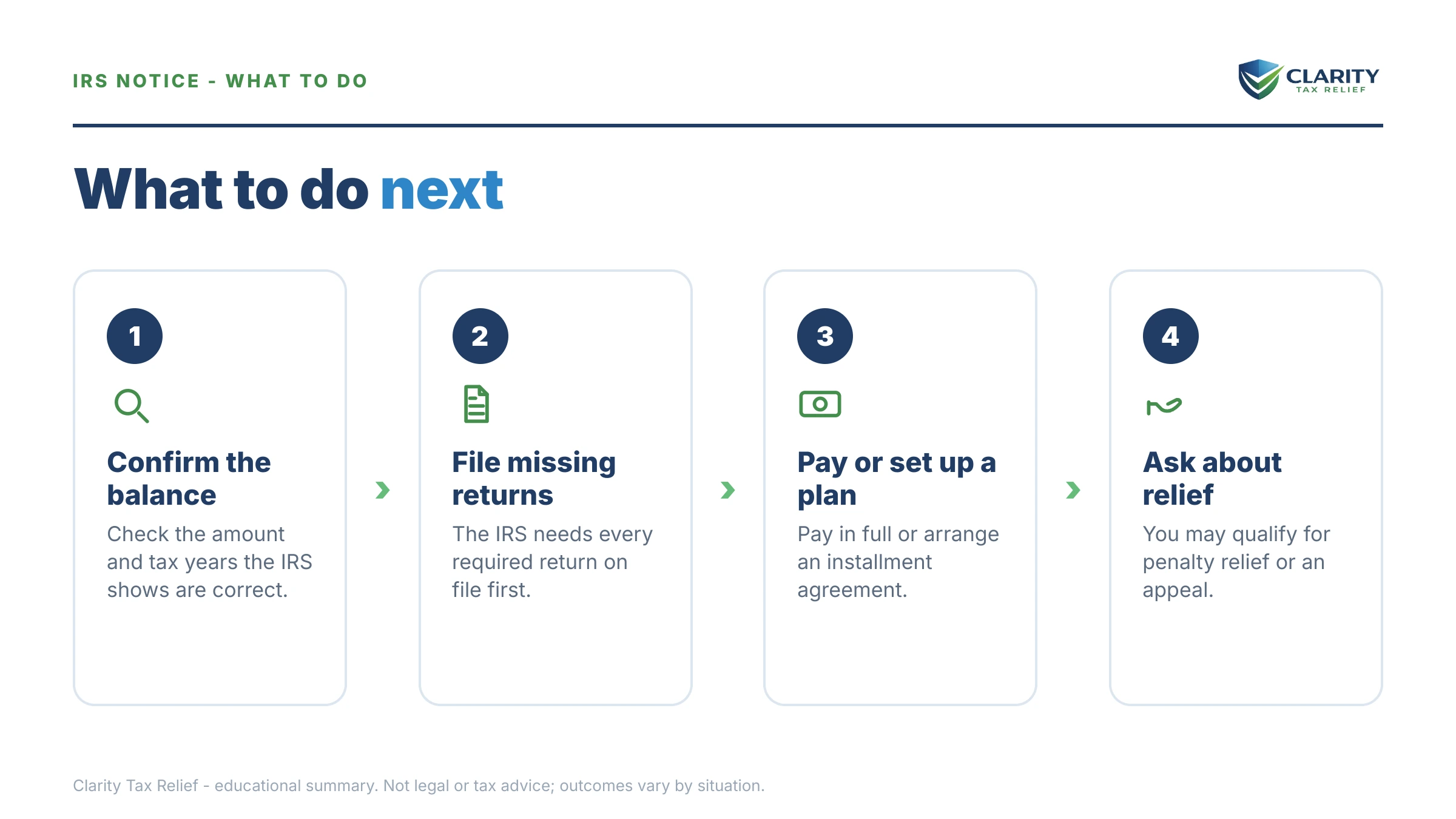
This guide covers the lien itself — how the registry works, what enforcement follows it, and every way to get it released. For how IDOR billing, installment plans, and hardship relief work more broadly, see our guide to Illinois back taxes and payment plans.
⏱ The clock that matters: a lien filing has no printed countdown — but penalties and interest accrue on the underlying balance every month the lien sits on the registry, and the lien is the signal that levies and garnishments are next. If you received an IDOR notice before the lien, the response date printed on that notice controls your remaining appeal rights.
Why IDOR filed a tax lien against you
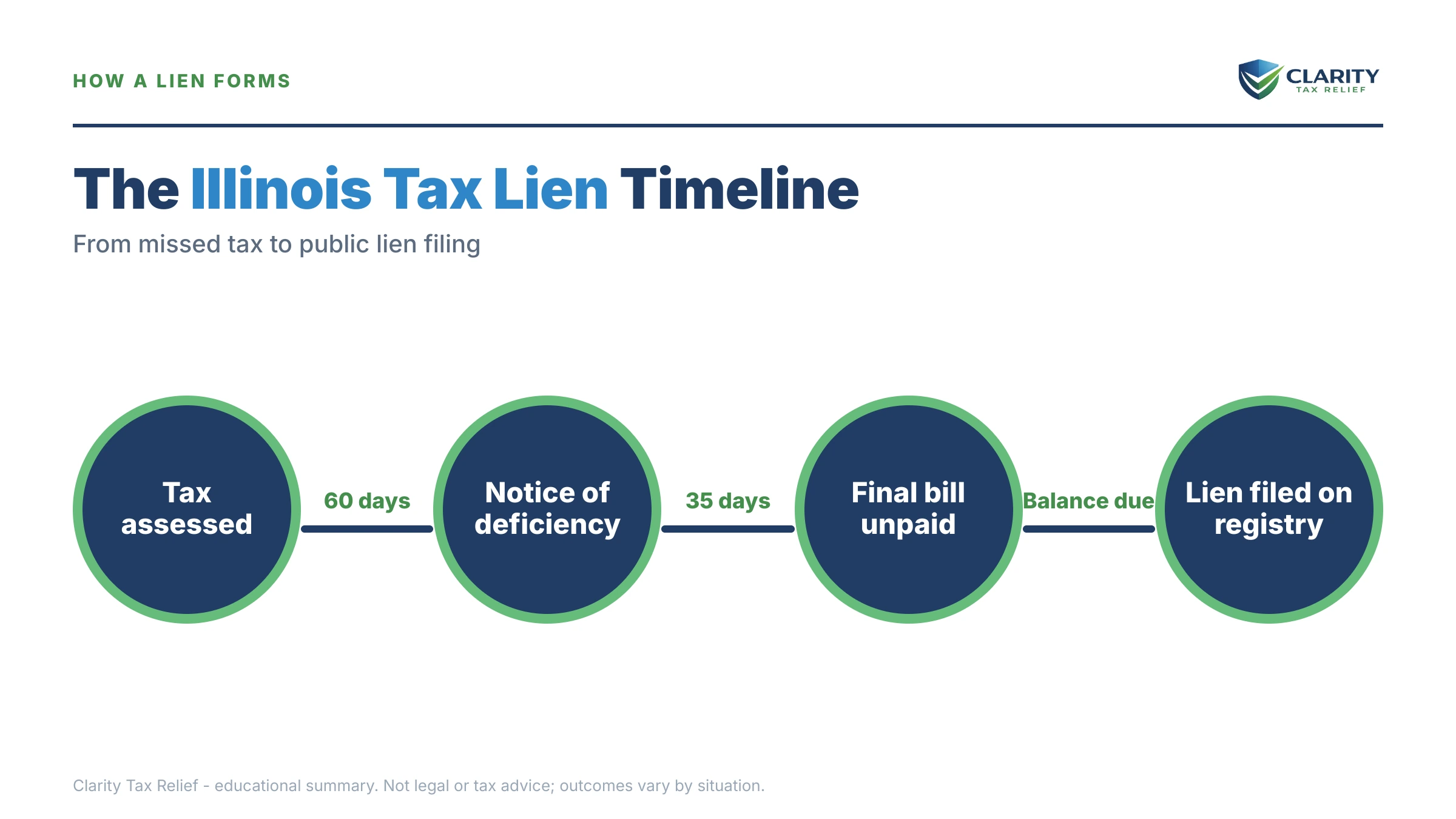
IDOR files a Notice of Tax Lien when a final, unpaid Illinois tax liability sits on your account after billing. For individuals, that's usually IL-1040 income tax that was filed but not paid, or an audit adjustment that became final. For business owners, it's most often ST-1 sales tax or IL-941 withholding — the "trust taxes" Illinois pursues hardest, because that money was collected from customers or withheld from employees and never sent in.
Three other triggers show up constantly. IDOR estimated your liability because returns went unfiled, and the estimate became final when nobody protested it. A protest window on a Notice of Tax Liability passed unused. Or a payment plan defaulted and IDOR moved to protect its position.
One thing the lien is not: a judgment that a court reviewed. It's an administrative filing. If the underlying assessment is wrong — an estimate, a misapplied payment, a period you already paid — you attack the assessment, not the lien. Larger disputed assessments in Illinois can be heard by the Illinois Independent Tax Tribunal, but only if you act within the window printed on your notice.
Illinois tax lien search: how the State Tax Lien Registry works
Illinois files every state tax lien in a single online State Tax Lien Registry instead of county courthouses. Since January 1, 2018, one filing there is effective against your property everywhere in Illinois — IDOR doesn't need to record in your county, and there's no county-by-county cleanup when it's released.
The registry is free and public. Anyone — a mortgage underwriter, a title company, a commercial landlord, an equipment-finance desk, a curious competitor — can search your name or business name in seconds and see active and released liens, with the tax types and periods covered.
Two practical notes. First, the amount on the registry record is a snapshot from the filing date; interest has accrued since, so your actual payoff is higher — get a payoff figure from IDOR before writing a check. Second, the registry shows released liens too, which works in your favor: once you resolve the debt, the same public record proves it's cleared. For how federal liens are recorded differently, see our guide to the tax lien public record search.
What the lien attaches to is broad: your home and other Illinois real estate, vehicles, business equipment, inventory, and accounts receivable. If the lien names your business, our guide to a tax lien on business assets covers what that reach means for inventory and receivables in practice.
What happens if you ignore an Illinois tax lien
An Illinois tax lien is the midpoint of IDOR's collection sequence, not the end of it. Everything after the lien takes money or capability away from you, and none of it requires a courtroom:
- Lien filed — you are here. The claim is public on the statewide registry and attaches to everything you own in Illinois. Nothing has been seized yet, but financing and property sales now run through IDOR.
- Bank levies and wage garnishment. IDOR can take funds from bank accounts and a slice of wages administratively — no lawsuit, no judge. For a business, a levy can also reach money customers owe you.
- State payment offsets. The Illinois Comptroller can redirect state payments — your Illinois income tax refund, and payments the state owes your business — straight to IDOR until the debt is gone.
- Business enforcement. For sales tax debt, IDOR can move against your certificate of registration — the license you need to legally make retail sales — and can assess owners, officers, and other responsible people personally for unpaid trust taxes.
- The long tail. The lien doesn't quietly age off. An Illinois lien is generally enforceable for up to 20 years from filing, with interest compounding the entire time — every refinance, sale, and loan application in that window hits the same wall.
The order of stages is fixed; the pace isn't. Some accounts sit quietly for months after the lien, others see a bank levy within weeks — and IDOR's automation doesn't pause because a case feels dormant. Here's what you can still do at each point:
| Stage | What IDOR can do | What you can still do |
|---|---|---|
| Bill / Notice of Tax Liability | Assess the tax and add penalties and interest | Protest by the date printed on the notice; larger disputes can go to the Illinois Independent Tax Tribunal |
| Final demand for payment | Finalize the balance and prepare enforcement | Pay or set up a payment plan before enforcement starts |
| Notice of Tax Lien filed | Publish a statewide claim against all your Illinois property | Resolve the balance — the lien releases only when the debt does |
| Levy and garnishment | Take bank funds and wages administratively; offset state payments via the Comptroller | Request release through an approved plan or documented financial hardship |
| Business enforcement | Act against a sales tax certificate of registration; assess responsible people personally | Request a hearing and negotiate compliance terms before the business is locked out |
An Illinois lien is already public — levies come next
Send us your registry record or IDOR notices. An experienced tax professional will confirm what the lien covers, whether the balance is even right, and which release path fits your finances — free, confidential, no pressure. Interest is accruing on the balance every month it sits.
How to remove an Illinois state tax lien: your real options
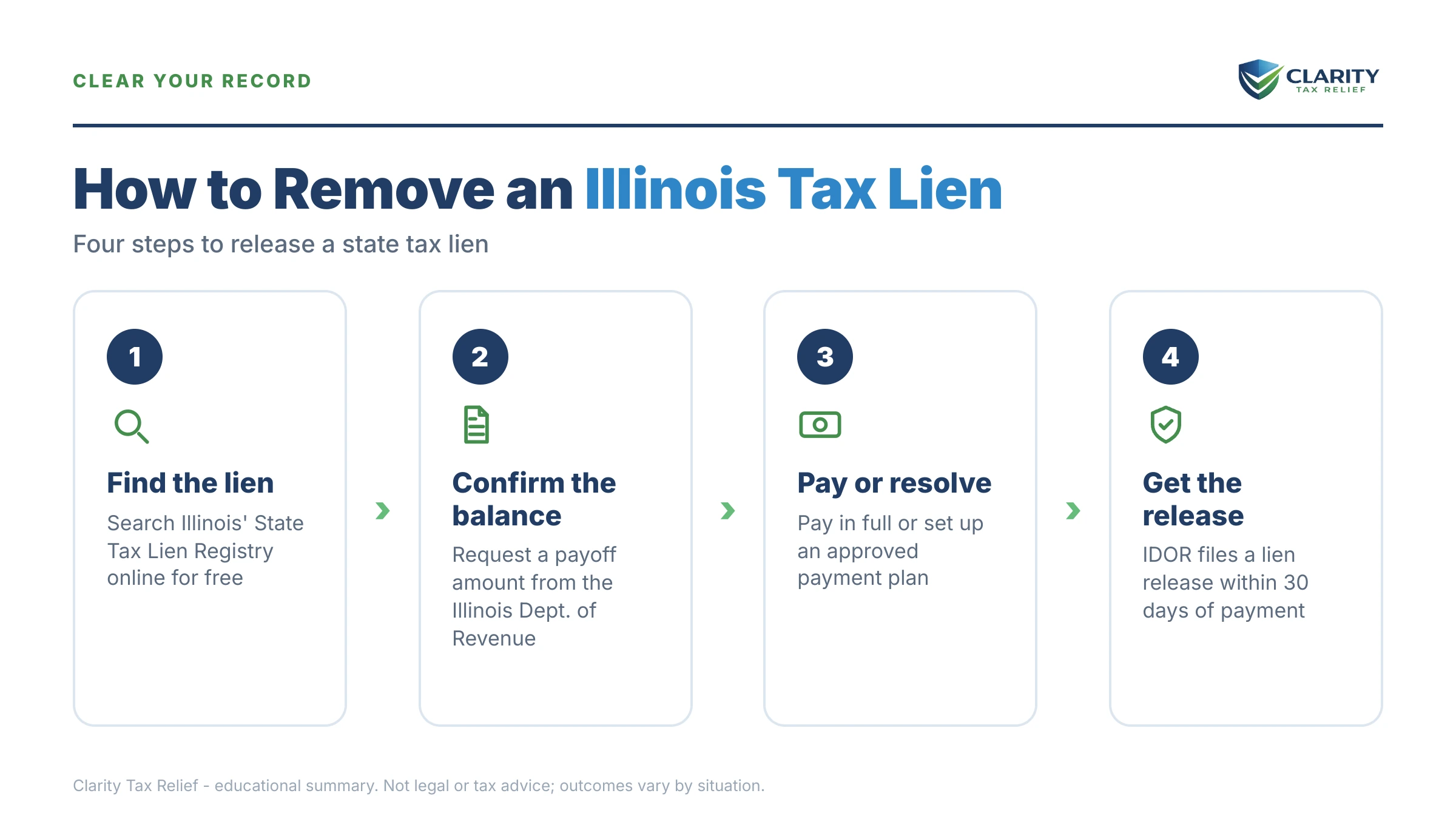
Every path off the registry runs through the underlying debt — Illinois has no shortcut that erases a lien while the balance stands. Which path fits depends on whether the assessment is right and what you can actually pay:
| Option | Who it fits | What happens to the lien | What to know |
|---|---|---|---|
| Pay in full | You can raise the money — savings, a refinance, sale proceeds | Released after payment posts; registry record updated | Fastest path; stops interest immediately |
| Installment plan (Form CPP-1) | The balance is correct but you can't pay it at once | Generally stays on the registry until the last payment | Stops escalation to levies while you pay; interest continues |
| Board of Appeals petition | Genuine hardship, or penalties and interest are the real problem | Remains until the reduced balance is resolved | Discretionary and means-tested; documentation-heavy |
| Protest / correction | The assessment is wrong, estimated, or already paid | Adjusted or withdrawn if you win | Act by the date on your notice — late protests lose rights |
| Bankruptcy | Older income tax debt inside a broader insolvency | Personal liability may discharge; the lien usually survives | Trust taxes never discharge; get lien-specific advice first |
A few details the table can't hold. The installment plan is requested with Form CPP-1 or through your MyTax Illinois account, and IDOR will want your returns filed and current-period taxes being paid before it approves anything — a plan on old debt while new debt piles up is a non-starter. The Board of Appeals route is Illinois's closest cousin to a settlement program: it can abate penalties and interest, and in documented can't-pay situations accept less than the full liability, but it's a discretionary petition, not an entitlement, and nothing about it is guaranteed.
If your debt includes sales tax, resolve that component first — it carries the personal-liability risk and the certificate-of-registration risk. Our sales tax debt help guide covers why states treat collected-but-unremitted sales tax as their most serious collection priority.
And if you owe both Illinois and the IRS, sequencing matters more than most people expect — see state tax debt vs IRS: which to resolve first before committing your monthly cash flow to one agency.
What a $13,600 Illinois tax lien actually costs: a worked example
Say you run a six-person shop outside Rockford and IDOR files a lien for $13,600 — $8,200 in unpaid ST-1 sales tax and $5,400 in IL-941 withholding ($8,200 + $5,400 = $13,600) from two quarters when a big customer paid late and payroll came first. This is a hypothetical, but the math is the math.
On a 24-month installment plan, that's roughly $13,600 ÷ 24 ≈ $567 per month, plus the interest that keeps accruing on the declining balance — so the real total lands somewhat above $13,600. Compress it to 12 months and it's about $1,133 per month, with less total interest and a release a year sooner. The plan stops levies; it does not take the lien off the registry until the final payment posts.
Two things make this example more dangerous than a personal income-tax lien of the same size. First, every dollar of it is trust tax — money collected from customers and withheld from employees — so IDOR can assess you personally, and closing the LLC doesn't erase that. See personally liable for payroll taxes and what happens with a closed business that still owes sales tax. Second, the lien sits between you and working capital: the equipment lender who searches the registry sees a $13,600 state claim ahead of them and either declines or reprices. For a business owner, the lien's real cost is often the financing it blocks, not the interest it accrues.
How to respond to an Illinois tax lien, step by step
- Pull your lien record. Search the State Tax Lien Registry for your name and note the tax types, periods, filing date, and amount on the lien.
- Verify the balance. Compare the lien against your MyTax Illinois account and your filed returns — a wrong or estimated assessment should be disputed, not paid.
- Stop new debt from joining the lien. If you run a business, get current on this quarter's withholding and sales tax deposits so new periods don't stack onto the old ones.
- Choose your resolution. Pay in full for the fastest release, request an installment plan with Form CPP-1, or petition the Board of Appeals if hardship or penalties are the real problem.
- Confirm the release. After the final payment posts, verify the registry shows the lien released and keep the confirmation for lenders and title companies.
Illinois tax lien vs. federal IRS tax lien: the differences that matter
An Illinois lien and a federal lien can sit on the same property at the same time, but they run on different rules — and the Illinois version outlives the federal one by a decade. If both agencies have filed against you, know which rules apply to which claim:
| Feature | Illinois (IDOR) | IRS (federal) |
|---|---|---|
| Where it's filed | One statewide State Tax Lien Registry (since 2018) | County recorder and/or state filing offices |
| How long it lasts | Generally enforceable up to 20 years from filing | 10 years from assessment — the lien self-releases at the CSED unless refiled |
| Removal paths | Payment and release; Board of Appeals relief in hardship cases | Release, withdrawal, subordination, and discharge programs |
| Credit reports | Off credit reports since 2018, but public on the registry | Same — off credit reports, still a searchable public record |
| Who enforces after filing | IDOR administrative levies; Comptroller payment offsets | IRS Automated Collection System and revenue officers |
The duration gap is the one that changes strategy. Federal debt runs against a 10-year collection statute, and the federal lien dies with it — our guide on whether an IRS tax lien expires covers that mechanism. Illinois gives itself roughly twice that runway, which is why "wait it out" plans that occasionally make sense on old federal debt almost never make sense on an Illinois lien. The federal side also offers formal withdrawal and subordination programs the Illinois registry system doesn't mirror; the general concepts of a claim versus a seizure are the same in both systems — see lien vs. levy for that distinction. The IRS's own primer on the federal version is at Understanding a federal tax lien.
Selling or refinancing property with an Illinois tax lien
A lien doesn't freeze your property — it stakes IDOR's place in line whenever the property changes hands or gets refinanced. Because the registry is statewide, every Illinois title search will surface it, so the practical question isn't whether the lien comes up at closing; it's whether you planned for it.
On a sale, the title company requires a payoff letter from IDOR and pays the lien from your proceeds at closing. If your equity covers the balance, the sale itself becomes your resolution — the debt clears and the release follows. Request the payoff figure weeks ahead, not days; it's the single most common cause of delayed Illinois closings with state liens attached.
On a refinance, the lien is a bigger obstacle, because the new lender wants first position and IDOR is already there. Some deals close by paying the lien from loan proceeds; others stall entirely. The mechanics parallel the federal versions we cover in selling a house with an IRS lien and refinancing with a tax lien — but for the Illinois lien, the negotiation runs through IDOR, and its accommodation options are narrower than the IRS's formal subordination program. Build the payoff into the deal from the start.
When you can handle this yourself — and when help changes the outcome
Plenty of Illinois liens get resolved without hiring anyone. You can reasonably handle it yourself when the lien covers personal IL-1040 income tax you agree you owe, the balance is one you can pay in full or over a modest plan, and no levy is in motion — MyTax Illinois and a CPP-1 request will get you there, and the release follows the final payment automatically.
Experienced help changes outcomes in a narrower set of situations, and they're the expensive ones: a bank levy or garnishment already running; a lien covering trust taxes where personal assessment against you or a co-owner is on the table; a certificate-of-registration action that threatens the business's ability to operate; an estimated assessment built on unfiled returns, where filing the real numbers first can shrink the debt before you negotiate it; overlapping IRS and Illinois debt competing for the same cash flow; or a Board of Appeals petition, where the documentation standard decides the result. In those cases the order of operations — returns first, disputes second, payment terms last — often matters more than the payment amount itself.
If your lien covers withholding or sales-tax periods and enforcement is moving, get an experienced tax professional's review before your next deposit date — start with a free Illinois lien case review or call (888) 825-7779.
Chicago-area readers juggling city, state, and federal obligations can also start with our tax relief in Chicago guide.
Terms on your lien record, decoded
The registry record and IDOR notices use a handful of terms worth knowing precisely:
- Notice of Tax Lien — the document IDOR files in the registry announcing its claim against everything you own for a specific set of tax periods.
- State Tax Lien Registry — Illinois's single statewide, free, public database of state tax liens, in use since 2018 in place of county recording.
- Lien vs. levy — a lien is a claim that follows your property; a levy is the actual taking of money or assets. The lien comes first and signals the levy.
- Certificate of registration — the IDOR-issued authorization a business needs to make retail sales in Illinois; unpaid sales tax puts it at risk.
- Trust tax — sales tax collected from customers and income tax withheld from employees; Illinois can assess responsible individuals personally for it.
- Lien release — the registry update showing the lien is satisfied; it's your proof for lenders and title companies that the claim is gone.
Illinois tax lien questions, answered
How do I look up a tax lien in Illinois?
Search the Illinois State Tax Lien Registry, the free statewide database the Illinois Department of Revenue has maintained since 2018 — you can search by name without creating an account. The registry shows both active and released liens, including the tax types and periods covered. For your exact current payoff, check your MyTax Illinois account or contact IDOR directly, because the registry amount does not include interest that has accrued since filing.
How long does an Illinois tax lien last?
Far longer than a federal lien — an Illinois tax lien is generally enforceable for up to 20 years from the date it is filed, twice the IRS's 10-year collection window. Waiting one out is not a realistic strategy for most people. Confirm the filing date on your registry record, and remember interest keeps accruing on the underlying balance the entire time.
Does an Illinois tax lien show up on my credit report?
No — the three credit bureaus removed all tax liens, state and federal, from credit reports in 2018. But the lien is still fully public on the State Tax Lien Registry, and mortgage lenders, title companies, commercial landlords, and business lenders search public records directly. In practice, the lien blocks or complicates financing even though it never touches your credit score.
Can IDOR garnish wages or levy a bank account without a court order?
Yes. Once the liability is final and the required notices have gone out, the Illinois Department of Revenue can levy bank accounts and garnish wages administratively — no lawsuit or judge is required. Business taxpayers face additional tools, including action against a sales tax certificate of registration. The lien filing is usually the signal that these enforcement steps are now on the table.
Will a payment plan remove the Illinois tax lien?
Generally no — the lien stays on the registry until the balance is paid in full, even while you make payments on an approved installment plan. What the plan does is stop enforcement from escalating to levies and garnishments while you pay. Once the final payment posts, IDOR releases the lien and the registry record is updated to show it.
Is an Illinois tax lien the same as a tax warrant?
Practically yes, procedurally no. Some states, like New York, enforce tax debt through a 'tax warrant' filed with county clerks as a civil judgment. Illinois instead files a Notice of Tax Lien in its statewide registry. The effect is the same — a public claim against your property that follows you until the debt is resolved — but the document and the place it lives are different.
Can I sell my house in Illinois with a state tax lien?
Usually yes — the lien doesn't prevent a sale, but it must be dealt with at closing. The title company will find the lien on the registry and require a payoff letter from IDOR; the balance is typically paid from your sale proceeds before you receive anything. Start the payoff-letter request early, because waiting until the week of closing is the most common cause of delayed sales.
Does bankruptcy remove an Illinois tax lien?
Rarely. Bankruptcy can discharge your personal liability for some older income taxes, but a lien filed before your bankruptcy generally survives against property you owned at the time. Trust taxes — sales tax you collected and income tax you withheld from employees — are not dischargeable at all. If bankruptcy is on your radar, get advice that accounts for the lien specifically, not just the debt.
Am I personally liable for my business's Illinois tax lien?
For trust taxes, very possibly. Illinois can personally assess owners, officers, and other responsible people for sales tax the business collected and payroll tax it withheld but never paid over — and an LLC or corporation does not shield you. Ordinary corporate income tax generally stays with the entity. If the lien covers ST-1 or withholding periods, treat personal exposure as a live issue.
Does Illinois have an offer in compromise program?
Not in the IRS's format, but IDOR's Board of Appeals can relieve penalties and interest and, in genuine hardship cases, accept less than the full liability through a petition process. Relief is means-tested and discretionary — you must document that full payment is beyond your ability. It is a different animal from the federal Offer in Compromise, with its own paperwork and standards.
Your next 24 hours
- Find your lien record. Search the State Tax Lien Registry and write down the filing date, tax periods, and amount — that's the map of exactly what you're resolving. Your account details live at MyTax Illinois, and IDOR's main site is tax.illinois.gov.
- Gather your paperwork. Pull your last filed Illinois returns (IL-1040 for individuals; ST-1 and IL-941 for a business), any IDOR notices you've received, and a quick snapshot of income and bank balances — that's everything needed to pick a resolution path.
- Get a free case review. Send us the lien record and notices through the 2-minute form or call (888) 825-7779. Interest accrues on the balance every month the lien sits on the registry — the review is free, and it tells you whether you're paying the right amount at all.
This guide is general information, not tax or legal advice for your specific situation. Eligibility for IRS programs depends on individual facts and circumstances; no outcome is guaranteed. State programs, including those administered by the Illinois Department of Revenue, have their own eligibility rules and discretionary standards.