
Tax Relief Companies
Coast One Tax Group Alternative: How to Compare Tax Relief Firms in 2026
The short answer: the best Coast One Tax Group alternative is any firm that puts a flat, all-inclusive fee in writing, names the exact IRS program your numbers support, and gives you direct access to the credentialed professional working your case. The IRS programs are identical no matter who files — only diagnosis, price, and service differ.
You've probably already sat through at least one sales call, and you're doing what a careful buyer should: comparing before you commit real money to fixing a real tax debt. That instinct is right. Firms differ enormously on price and follow-through — even though every one of them files into the same government programs.
This guide gives you the yardstick: what any legitimate alternative can actually do with the IRS, what the work is worth at your balance level, and the five questions that separate a diagnosis from a pitch.
⏱ The real clock: there's no deadline on choosing a firm — but your balance has one built in. The failure-to-pay penalty adds 0.5% of the unpaid tax every month (about $241/month on a $48,300 balance), and interest compounds daily on top, no matter how long you spend comparing.
Why people look for a Coast One Tax Group alternative
Coast One Tax Group is a private tax-relief company — it is not affiliated with the IRS, and no tax relief firm gets special access to IRS programs. Whatever firm you choose can only apply for the same installment agreements, offers, hardship statuses, and penalty relief that exist for everyone.
One point of real confusion worth clearing up: Coast One Tax Group is not the same as Coast Professional, Inc. — the latter is one of the actual private collection agencies the IRS contracts with to collect certain overdue accounts. If someone calls saying they're collecting "for the IRS," that's a different situation entirely; here's how to tell whether an IRS private collection agency contact is real.
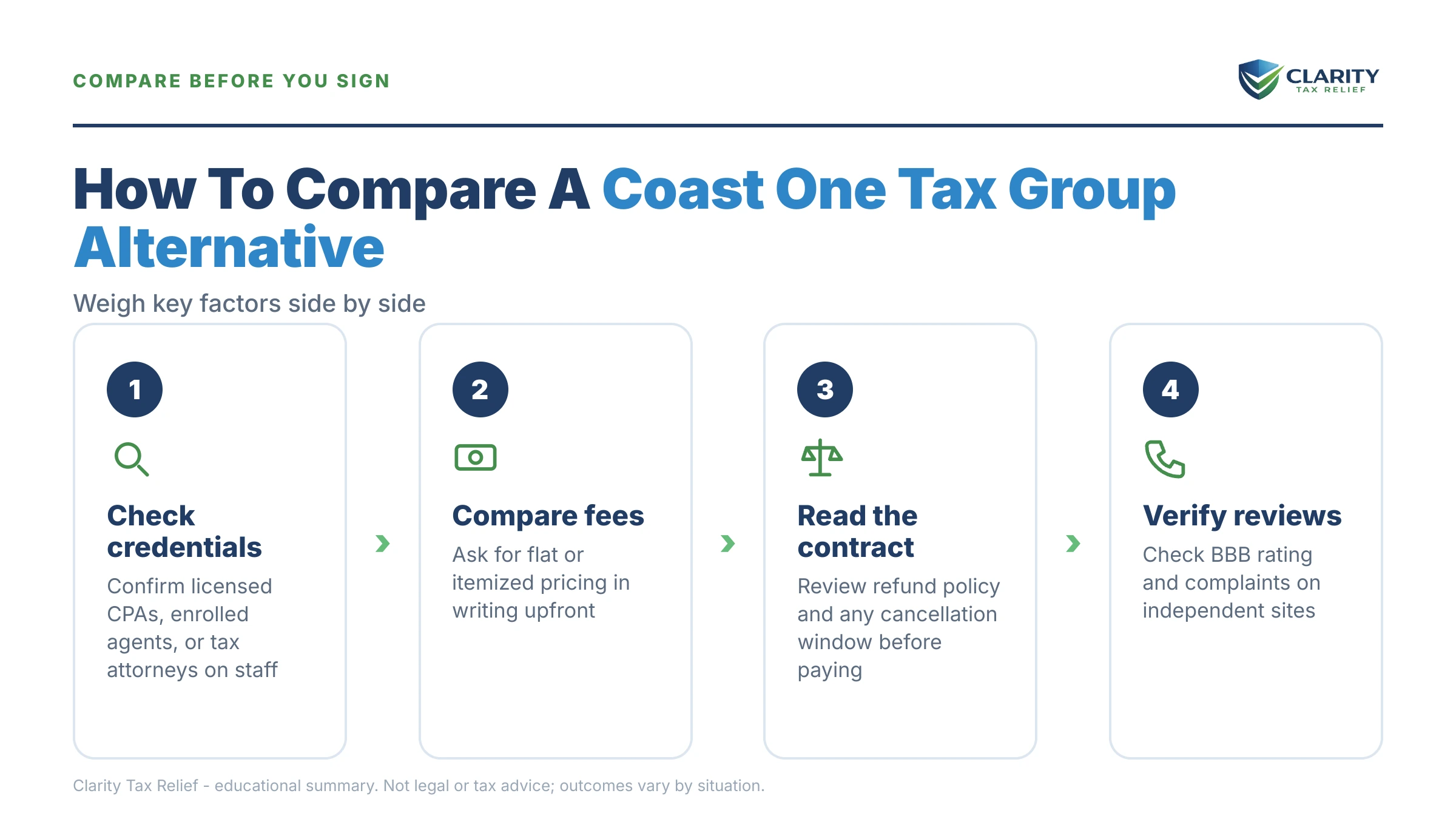
We can't speak to any other firm's internal practices, and you shouldn't take any company's word — including ours — on faith. What we can give you is the checklist experienced buyers use. When people compare tax relief firms, the differences that actually matter come down to four things:
- Pricing model: a flat fee quoted in writing versus open-ended billing, and whether an upfront "investigation" fee credits toward the resolution work.
- Diagnosis before quote: does the firm name a specific IRS program tied to your income and assets, or sell a vague promise first and figure out the plan later?
- Who does the work: whether an enrolled agent, CPA, or attorney holds your power of attorney — and whether you can reach that person directly.
- Honesty about eligibility: settlement programs are means-tested. A firm that hints at a settlement figure before seeing your finances is guessing at best.
Our full buyer's checklist for how to choose a tax relief company goes deeper, and the tax relief company red flags list covers the patterns that precede complaints industry-wide.
What happens to your tax debt while you compare firms
Comparing firms doesn't pause anything — the IRS collection machine escalates on its own schedule whether you've hired someone or not. If you already have notices arriving, they follow a fixed order, each with more enforcement power than the last:
- CP14 — the first bill, with roughly 21 days to pay before the sequence continues.
- CP501 / CP503 — reminder notices. Still just bills, but the balance grows every month they sit.
- CP504 — Notice of Intent to Levy. The IRS can now seize your state tax refund, and a federal tax lien becomes a live possibility.
- LT11 / Letter 1058 — the final notice. It starts a 30-day clock and your Collection Due Process rights; after it passes, the IRS can levy bank accounts and garnish income.
- Levy — a bank levy freezes funds for a 21-day hold before the money leaves; a wage levy is continuous until released.
Two things make 2026 unusual. The IRS workforce was cut roughly 27% in 2025, so reaching a human is harder than ever — but the notices and levies are generated by automated systems that never stopped. And on a $48,300 balance, the ongoing math is concrete: about $241 a month in failure-to-pay penalty alone, before interest. A week of comparison shopping is smart. A quarter of it is expensive.
Comparing firms with a balance hanging over you?
Get Clarity's free case review first: an experienced tax professional will name the exact IRS program your numbers support and quote one flat fee in writing — before you decide anything. Penalties and interest accrue monthly whichever firm you pick, so get the diagnosis now.
The IRS programs any legitimate alternative works with
Every tax relief firm in America — Coast One, Clarity, and everyone in between — resolves debt through the same five IRS programs. The value a firm adds is picking the right one for your numbers, sequencing the work correctly, and not overcharging for it.
| Program | Who qualifies | Cost to set up | What it does |
|---|---|---|---|
| Short-term payment plan | Can pay in full within 180 days | $0 setup | Buys time; stops escalation while interest continues |
| Long-term installment agreement | Balance ≤ $50,000 → up to 72 months, set up online; streamlined at ≤ $25,000 (or ≤ $50k with direct debit) | Setup fee (reduced for online/direct-debit setup) | Monthly payments; enforcement stops while you comply |
| Offer in Compromise | Finances must show the IRS can't collect the full debt before the statute expires | $205 fee + 20% down on lump-sum offers (both waived with low-income certification, AGI ≤ 250% of poverty) | Settles for less than owed; IRS accepted roughly 1 in 5 offers in FY2024 |
| Currently Not Collectible | Paying anything would create genuine hardship, shown on Form 433-F | $0 | Pauses collection; the debt and interest remain |
| Penalty relief (FTA / AEP) | Clean compliance the prior 3 years; from summer 2026, the Automatic Exemption from Penalty applies with no request needed | $0 | Removes penalties, not the underlying tax |
Notice what's missing: there is no program named "Fresh Start enrollment," no debt-erasure hotline, and no path any firm can access that you can't. That's not a reason to skip help — it's the reason to buy help on diagnosis and price, not on promises.
Say you owe $48,300 as a 1099 contractor: the real math
A worked example makes the comparison concrete — and it's the math any honest firm should walk you through before quoting a fee. Say you're a 1099 contractor who owes $48,300 across two tax years, mostly from missed quarterly estimated payments plus the penalties that followed. (Hypothetical numbers, but a very common shape — see first year self-employed owe taxes for how these balances get built.)
Payment plan: at $48,300 you're under the $50,000 line, so a streamlined installment agreement is available with direct debit and no full financial disclosure. Spread over 72 months, the base math is $48,300 ÷ 72 ≈ $671 a month — with interest and the 0.5% monthly failure-to-pay penalty still accruing, so the real payoff runs somewhat higher unless you pay faster.
The $50,000 cliff: this is the detail a good firm flags immediately. At $241/month of penalty plus interest, a $48,300 balance can cross $50,000 within months of inaction. Above that line, the easy online agreement disappears and the IRS wants a full financial statement. Acting before the cliff is worth real money — no salesmanship required.
Offer in Compromise: whether $48,300 can settle for less depends entirely on your Reasonable Collection Potential — asset equity plus a multiple of your monthly disposable income after IRS-allowed expenses. If your contractor income is lumpy, you rent, and the math shows $7,000 of equity plus $250/month of disposable income, roughly 12 months of that surplus for a lump-sum offer puts your RCP near $10,000 — a genuinely viable offer position. But if steady 1099 income shows $1,500/month of disposable cash, the IRS's math says you can full-pay within the 10-year collection statute, and the offer gets returned no matter which firm filed it. You can estimate your own position with our Offer in Compromise Calculator before anyone quotes you a fee to pursue one.
Penalty relief: if the first delinquent year followed three clean years, first-time penalty abatement can strip that year's penalties — and starting summer 2026, the new Automatic Exemption from Penalty applies automatically for qualifying taxpayers. On a two-year, $48,300 balance, penalty relief alone can be worth thousands, and it's the kind of step a quality firm sequences before negotiating the balance.
One more marker: $48,300 sits below the 2026 passport-certification threshold of $66,000 — but an ignored balance compounding at penalty-plus-interest rates moves toward that line. It's a real consequence, on a real schedule, not a scare tactic.
Owe more or less than $48,300? Realistic options by balance band
The right resolution — and whether you need a firm at all — shifts with the size of the debt. Here's the honest map:
| Balance | Realistic options | DIY or professional? |
|---|---|---|
| Under $10,000 | Pay within 180 days, or a guaranteed installment agreement | DIY almost always |
| $10,000–$25,000 | Streamlined installment agreement online; penalty abatement | DIY usually; help if years are unfiled |
| $25,000–$50,000 | Streamlined agreement with direct debit; OIC or CNC if finances are genuinely tight; penalty relief first | DIY possible; a professional earns their fee near the $50k cliff or with self-employment complexity |
| $50,000–$66,000+ | Non-streamlined agreement with financial disclosure; passport certification risk begins at $66,000 | Professional review usually pays for itself |
| $100,000+ | Likely revenue officer assignment, lien filing, asset review | Experienced representation strongly advised |
How to choose a Coast One Tax Group alternative, step by step
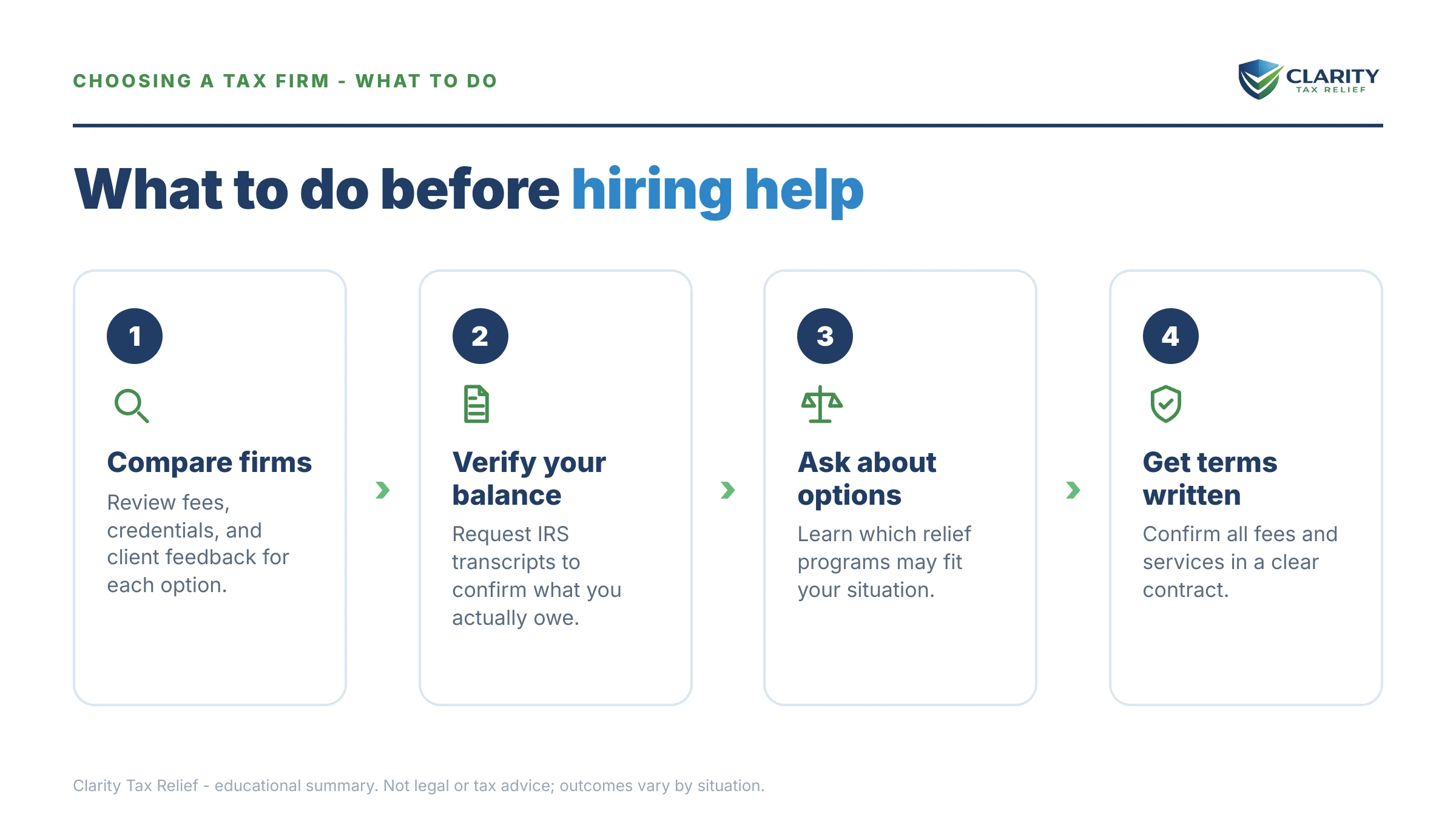
- Verify your balance directly with the IRS. Log into your IRS online account and confirm the exact balance for each tax year before any sales call. You can't judge a quote — or a pitch — without your own numbers in hand.
- Make each firm name the program — and the why. A real diagnosis names a specific IRS program (installment agreement, Offer in Compromise, Currently Not Collectible, penalty abatement) and ties it to your income and assets. "We'll get you into Fresh Start" is a slogan, not a diagnosis.
- Get the total fee flat and in writing. Ask for one all-inclusive number, exactly what it covers, and what happens to your money if you don't qualify for the program that was pitched. Open-ended monthly billing on a simple case is a warning sign.
- Ask who actually works your case. Get the name and credential — enrolled agent, CPA, or attorney — of the person who will hold your power of attorney. That is a different person from the salesperson closing you.
- Compare at least two firms before signing. Quotes are free. If two firms name the same IRS program but one charges half as much, you've just learned what the work is actually worth.
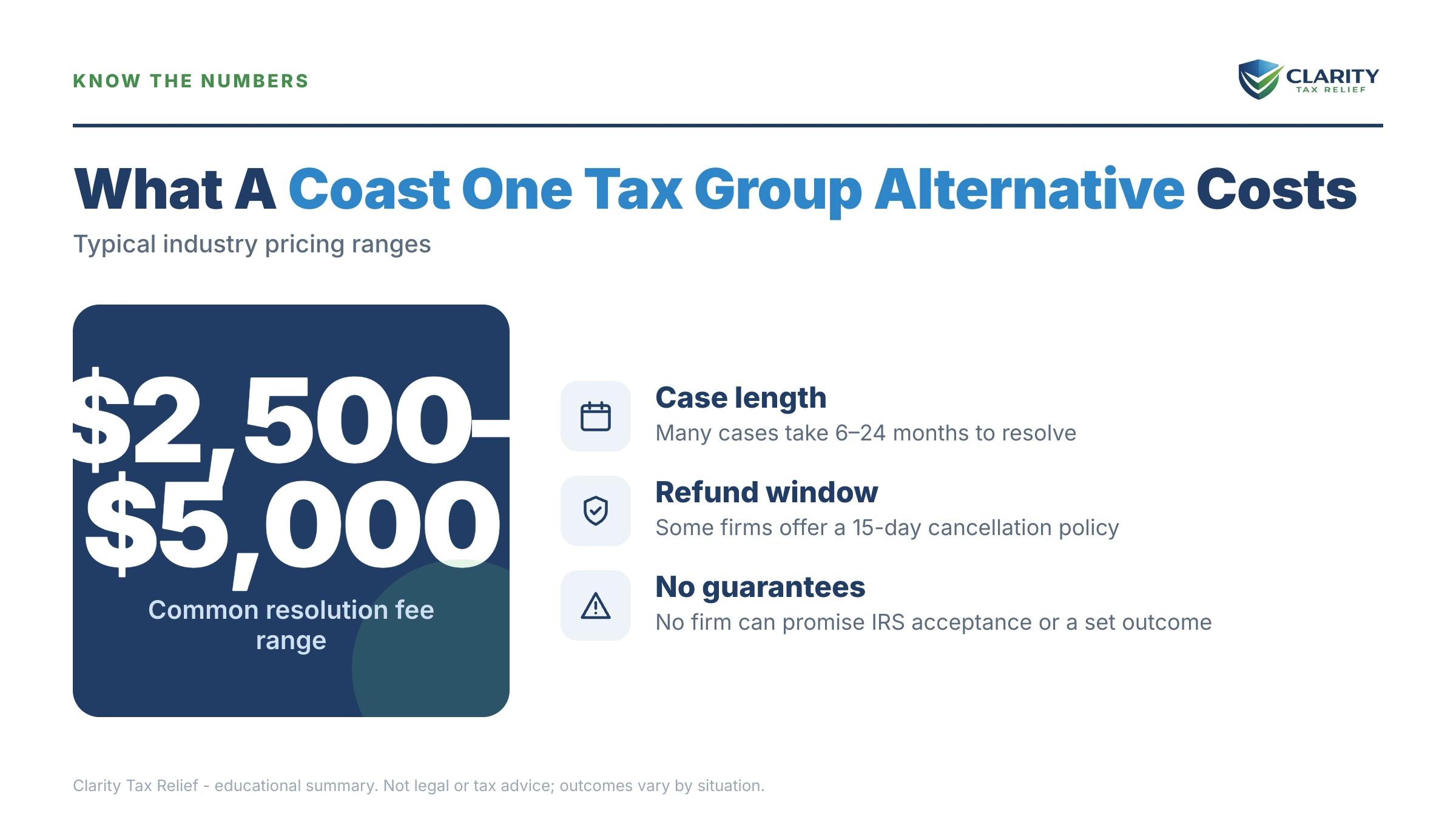
For the full interview script, see our list of questions to ask a tax relief company — and for context on what fees run across the industry and why, how much does tax relief cost breaks down the pricing models.
When you can handle this yourself — and when a firm earns its fee
Honest answer first: many people comparing tax relief firms don't need one at all. If you agree with the balance, your returns are filed, and you owe under $50,000, you can set up an IRS payment plan online yourself — no firm, no fee beyond the IRS's own setup charge. Our guide to how to settle tax debt yourself walks the entire DIY path, program by program.
Experienced help changes outcomes in specific situations: a levy or garnishment already in motion, multiple unfiled years that must be sequenced before anything else, business or payroll tax debt where personal liability is on the table, disputed balances, or an Offer in Compromise — where the Form 433 financial-disclosure math determines whether you save five figures or waste an application fee. As a self-employed contractor, you're also more likely to hit OIC valuation questions around business income and equipment equity that reward someone who has run the math hundreds of times.
The right question isn't "do I need Coast One or an alternative?" It's "does my situation have any of those complications?" If not, do it yourself and keep your money. If yes, buy the help — from whichever firm survives the five questions above.
Already signed with another firm? How switching works
You can change tax relief firms at any time — the IRS doesn't care who represents you. Representation runs through Form 2848, the power of attorney; a new representative files a fresh one (or you revoke the old one), and the change is effective. Your deadlines, program eligibility, and anything already filed with the IRS carry over — nothing restarts.
Before you cancel: read your contract's refund terms for unearned fees, request your complete case file (transcripts, filed forms, IRS correspondence), and get the timing right so no IRS deadline falls in the gap between representatives. If you paid for work that was never performed, document everything — our guide for when a tax relief company took my money covers the recovery routes, from the contract itself to state consumer-protection complaints.
Terms tax relief salespeople use, decoded
- Investigation (or discovery) phase: the firm pulls your IRS transcripts and reviews your finances before quoting resolution work. Legitimate — but ask whether that fee credits toward the resolution itself.
- Form 2848: the power of attorney that lets a professional speak to the IRS for you. Filing a new one is how you change firms.
- Reasonable Collection Potential (RCP): the IRS's formula for what it could realistically collect from you — asset equity plus future income. It decides every Offer in Compromise, regardless of who files.
- Fresh Start: a real set of IRS policy changes from years back — not an enrollable program, a hotline, or a limited-time offer.
- Currently Not Collectible: a hardship pause on collection. The balance and interest remain; it's relief, not forgiveness.
- "Pennies on the dollar": a marketing phrase, not an IRS program. Any firm quoting a settlement figure before seeing your full finances is guessing — that's the signature move of an offer in compromise mill.
Comparing more than one firm? We've written the same honest breakdown for other companies people shortlist: Anthem Tax Services alternative, Fortress tax relief alternative, and Alleviate tax relief alternative.
Coast One Tax Group alternative FAQs
Is Coast One Tax Group affiliated with the IRS?
No. Coast One Tax Group is a private tax-relief company, not a government agency, and no tax relief firm has special access to IRS programs. Don't confuse it with Coast Professional, Inc., which is one of the private collection agencies the IRS actually contracts with to collect certain overdue accounts. If a caller says they're collecting for the IRS, verify them independently before discussing payment.
Can I switch tax relief companies in the middle of my case?
Yes, at any time. Filing a new Form 2848 power of attorney — or revoking the old one — transfers representation, and your IRS deadlines and program eligibility don't reset when you change firms. Before you cancel, check your existing contract for refund terms on unearned fees, and request your case file: transcripts, anything already filed, and all IRS correspondence.
How much should a tax relief company charge on a $48,300 tax debt?
There is no standard industry price, which is exactly why you should demand a flat, all-inclusive quote in writing before paying anything. Fees legitimately vary with complexity — unfiled years, business income, and an Offer in Compromise take more work than a straightforward installment agreement. Warning signs: open-ended monthly billing on a simple case, and an upfront "investigation" fee that doesn't credit toward the resolution work.
Do I need a tax relief company at all, or can I do this myself?
If you agree with the balance and owe under $50,000, you can usually set up an IRS payment plan online yourself in under an hour, with no firm involved. Professional help earns its fee when a levy is already in motion, multiple years are unfiled, the debt involves a business, or you're pursuing an Offer in Compromise — where the financial-disclosure math decides everything.
Will hiring a tax relief firm stop IRS collections immediately?
No firm can stop all collections instantly — be wary of any that claims it can. Filing a power of attorney gets a representative on the phone with the IRS, but enforcement generally pauses only when a specific resolution is in place or formally pending, such as an approved installment agreement, Currently Not Collectible status, or a processable Offer in Compromise. Interest and penalties keep accruing throughout.
What's a realistic settlement on $48,300 in IRS debt?
Whatever your financial disclosure supports — there is no standard percentage, no matter which firm files. The IRS calculates your Reasonable Collection Potential from asset equity plus a multiple of monthly disposable income; if that math shows you can pay the $48,300 in full before the collection statute expires, an Offer in Compromise won't fly regardless of who prepares it. The IRS accepted roughly 1 in 5 offers in FY2024.
Is the IRS Fresh Start program that tax relief ads mention real?
Yes and no. Fresh Start was a real set of IRS policy changes that raised installment-agreement thresholds and eased lien rules — but it isn't an application, a hotline, or a limited-time offer. Ads that treat it as something you must enroll in before it expires are using the name as a sales hook. The underlying options are the standard IRS programs any firm — or you — can use.
What questions should I ask before hiring any Coast One Tax Group alternative?
Ask five: What exact IRS program are you recommending for my numbers, and why? Who — by name and credential — will actually work my case? What is the total flat fee, in writing? What happens to my fee if I don't qualify for the program you pitched? And what specifically will you do in the first 30 days? A firm that answers all five plainly belongs on your shortlist.
Your next 24 hours
- Pull your real numbers. Log into your IRS online account and write down the exact balance for each tax year, plus which notices (if any) have already arrived. Every comparison starts from the same facts — get them from the source, not a sales call. The IRS's own program pages are worth ten minutes too: payment plans and installment agreements and the Offer in Compromise overview.
- Gather three things: your last filed return, any IRS letters you've received, and a rough monthly picture of your 1099 income and expenses. That's everything needed for a real diagnosis — from any firm. (If you're in genuine hardship and can't afford help at all, the independent Taxpayer Advocate Service exists for exactly that.)
- Get Clarity's free case review — the 2-minute form at the top of this page or (888) 825-7779. We'll name the exact IRS program your numbers support and quote one flat fee in writing, so you can compare us against anyone with real information. Penalties and interest are accruing monthly either way; the diagnosis costs nothing.
This guide is general information, not tax or legal advice for your specific situation. Eligibility for IRS programs depends on individual facts and circumstances; no outcome is guaranteed.