
Tax Relief Companies
Alleviate Tax Relief Alternative: Every Real Option Compared (2026)
The short answer: if you're searching for an Alleviate Tax relief alternative, you have four real options — another full-service firm, an independent enrolled agent or tax attorney, free help through a Low Income Taxpayer Clinic or the Taxpayer Advocate Service, or working with the IRS directly yourself. Every legitimate option uses the same IRS programs; compare credentials, written fees, and fit.
You've sat through a sales consultation, maybe two, and the quotes don't match. One tab is open to Alleviate Tax, another to a competitor, and you still don't know who would actually work your case — or whether you need a company at all. That uncertainty is fixable in one afternoon, and this guide is the map: what genuinely differs between providers, what's identical everywhere, and how to decide.
⏱ The real clock: there's no deadline for choosing a provider — but your balance doesn't wait while you compare. The failure-to-pay penalty adds 0.5% of the unpaid tax every month, interest compounds daily, and the IRS notice cycle keeps advancing. On a $41,800 balance, the penalty alone is roughly $209 a month before interest.
Why people look for an Alleviate Tax alternative
Every tax relief provider — Alleviate Tax included — resolves debt through the same short list of IRS programs, so switching providers changes who does the work and what it costs, not what's legally possible. That single fact reframes your whole search: you're not shopping for a secret program, you're shopping for the right person at the right price.
In practice, people compare alternatives for a handful of reasons: they want the total fee in writing before committing, they want to know the name and credential of the person who will actually represent them, their situation is more complicated than a sales call captured (self-employment income, unfiled years, a state balance on top of the federal one), or they simply want a second opinion before signing a four-figure agreement. All of those are good instincts, not paranoia.
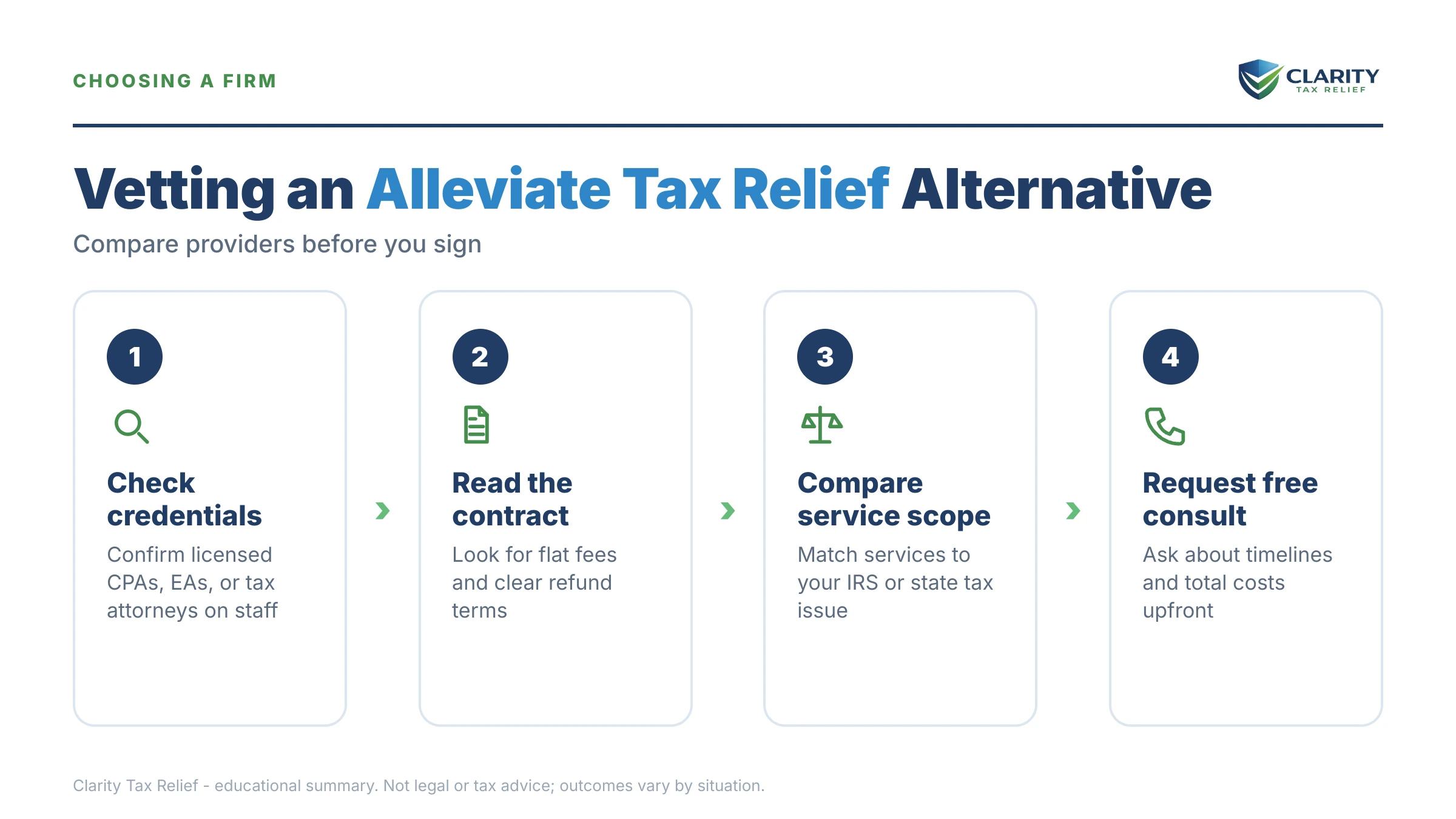
Whatever you decide, run the same screen on every candidate. Our how to choose a tax relief company checklist and the tax relief company red flags list apply equally to Alleviate Tax, to us, and to anyone else you're considering.
What happens to your tax debt while you compare providers
The IRS collection sequence is automated and keeps moving no matter how long your provider search takes. The 2025 workforce cuts — roughly 27% — made humans harder to reach, but the notices, liens, and levies come from computers that never stopped. Here's the sequence your balance is riding, wherever you currently sit on it:
- CP14 — the first bill, with roughly 21 days to pay or arrange payment before the cycle advances.
- CP501 / CP503 — reminder notices. Still just bills, but the balance grows every month they're ignored.
- CP504 — Notice of Intent to Levy under IRC §6331(d). The IRS can seize your state tax refund at this stage, and a federal tax lien becomes a live possibility.
- LT11 / Letter 1058 — the final notice. A 30-day clock starts on your Collection Due Process rights; after it runs, the IRS can levy bank accounts and, for a sole proprietor, send levies directly to your business clients for money they owe you.
- Active levy — a bank levy freezes funds for 21 days before they're sent to the IRS; a levy on payment sources continues until released.
The takeaway isn't panic — it's sequencing. A week of careful comparison is fine. Months of quote-collecting while an LT11 clock runs is how self-employed people wake up to levied receivables.
Comparing quotes on a five-figure IRS balance?
Before you sign with anyone — Alleviate Tax, an alternative, or us — get a free second read of your case. An experienced tax professional will tell you which IRS program your numbers actually fit and what it should cost, while penalties and interest are still accruing on the balance. No pressure, no obligation.
Your four alternatives to Alleviate Tax
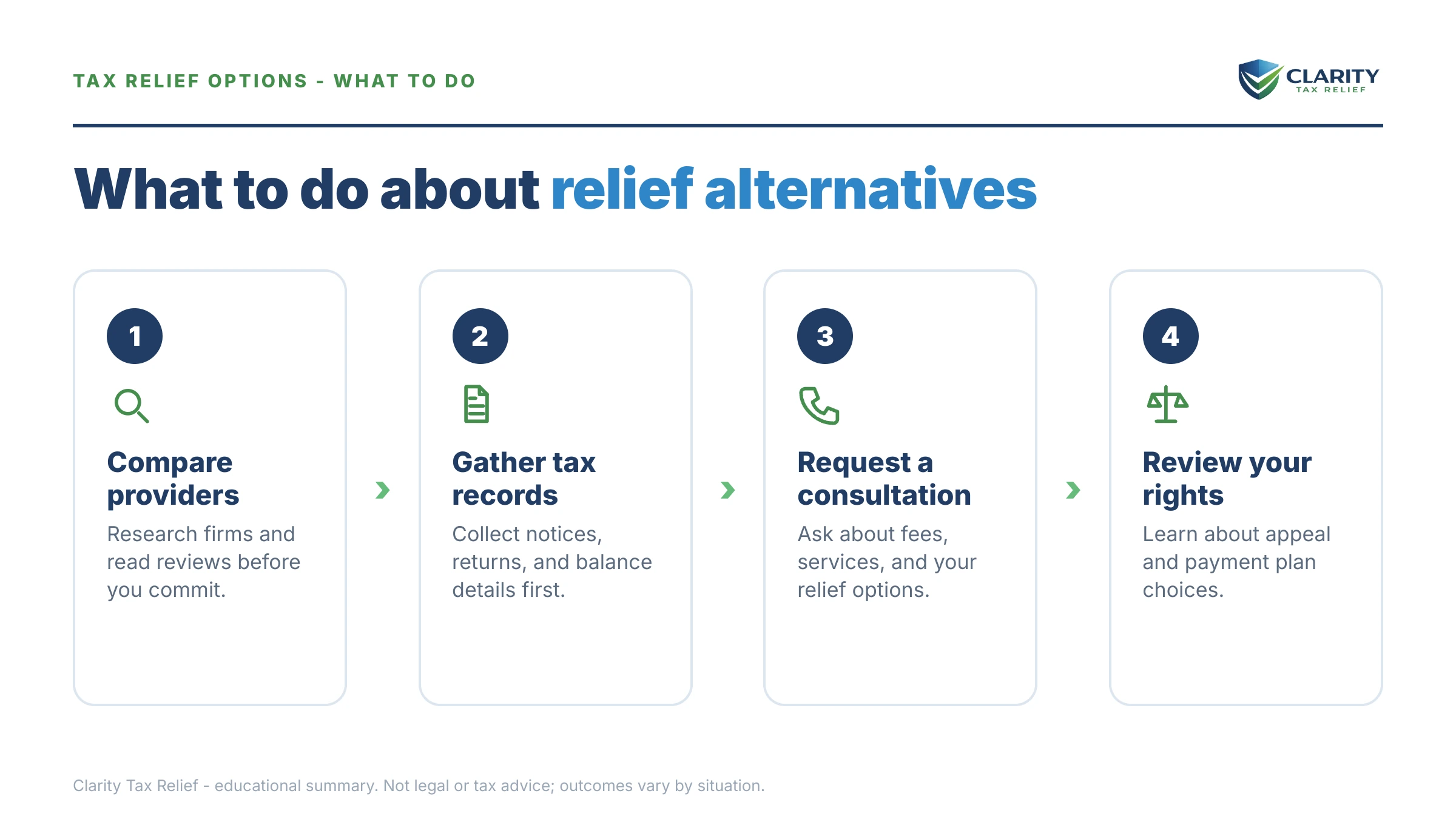
Four paths can resolve the same tax debt, and the right one depends on your balance, your complexity, and your income. The person who signs your Form 2848 power of attorney — not the brand on the invoice — is your actual representative, so evaluate every path through that lens.
1. Another full-service tax relief firm. The same model with different execution: a firm investigates your account, then negotiates a resolution under a power of attorney. What separates good firms from bad ones is transparency — a total fee in writing, a named enrolled agent, CPA, or tax attorney on your case, and a recommendation tied to a specific IRS program rather than vague "settlement" talk. We've written the same honest breakdown for people researching an Anthem Tax Services alternative, a Community Tax alternative, and a Fortress tax relief alternative — the vetting criteria never change, only the names.
2. An independent enrolled agent, CPA, or tax attorney. Instead of a company with a sales team, you hire the credential holder directly. For a self-employed reader this path has a specific advantage: one person can clean up unfiled Schedule C years, set your quarterly estimates, and negotiate the balance — and you talk to that person from day one. Fees are often comparable or lower because there's less overhead between you and the work.
3. Free help, if you qualify. A Low Income Taxpayer Clinic provides free representation in IRS disputes when your income is low enough to qualify. The Taxpayer Advocate Service — a free, independent office inside the IRS — intervenes when collection is causing hardship or your case is stuck in the machinery. Neither is a fit for every case, but both are real, and no honest firm should steer you away from them if you're eligible.
4. Do it yourself, directly with the IRS. For simpler balances this is genuinely the best answer, and our guide on how to settle tax debt yourself walks through every program in detail. The section below on when you don't need a company at all tells you honestly where the line sits.
The IRS programs every alternative uses — and their thresholds
No provider can get you a program your finances don't qualify for, because eligibility is set by IRS thresholds and formulas, not by negotiation skill. This table is the actual menu behind every sales pitch you'll hear:
| IRS program | Who typically qualifies | Cost to apply | Key limit to know |
|---|---|---|---|
| Short-term payment plan | Anyone who can pay in full within 180 days | $0 setup | Interest and penalties continue until paid |
| Guaranteed installment agreement | Balances of $10,000 or less, returns filed | Setup fee varies by method | Approval is automatic if conditions are met |
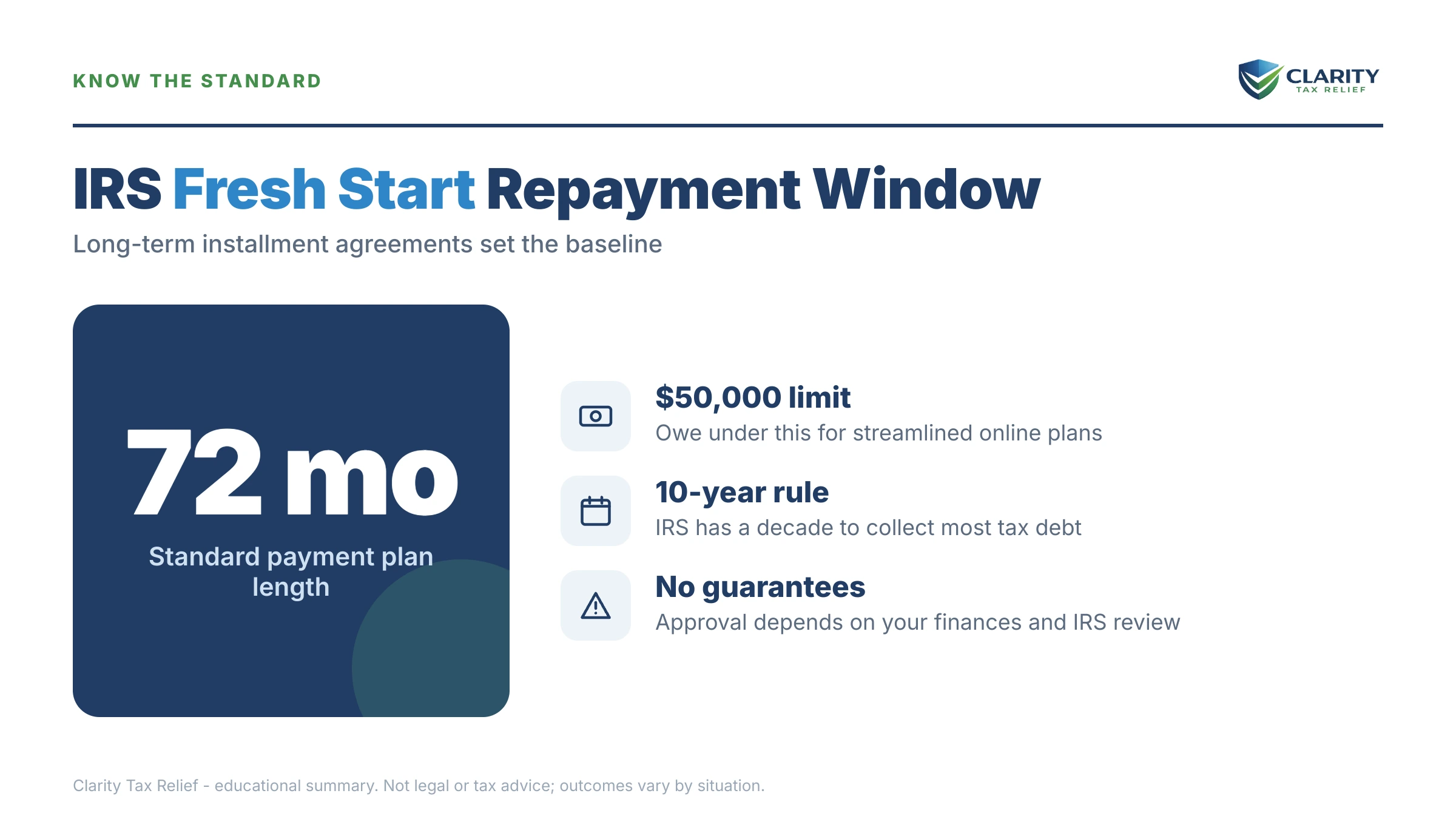
| Streamlined installment agreement | Balances up to $50,000, set up online | Setup fee varies; lower with direct debit | Up to 72 months; no financial disclosure required |
| Offer in Compromise | Assets + future income genuinely can't cover the debt | $205 fee + 20% down (lump sum); both waived at AGI ≤ 250% of poverty | Roughly 1 in 5 offers accepted in FY2024 |
| Currently Not Collectible | Paying anything would create documented hardship (Form 433-F) | $0 | Pauses collection; debt and accruals remain |
| Penalty abatement | Clean compliance the prior 3 years (First-Time Abate) or reasonable cause | $0 | Automatic Exemption from Penalty (AEP) begins replacing First-Time Abate in summer 2026 |
One threshold matters extra for the self-employed: the IRS generally won't approve — or keep — any agreement unless you're compliant on the current year, which means quarterly estimated payments are being made. Any alternative worth hiring fixes that first, because a plan that defaults in six months is worse than no plan.
Worked example: a self-employed sole proprietor owing $41,800
Say you're a sole proprietor who owes $41,800 across two tax years of self-employment income — a common shape for this search. Here's the math each alternative would actually be working with, hypothetically:
Streamlined installment agreement: because $41,800 is under the $50,000 threshold, you — or any representative — can set up a plan online for up to 72 months without submitting financial statements. $41,800 ÷ 72 ≈ $581 a month as a floor, though interest and the 0.5% monthly failure-to-pay penalty keep accruing, so the real payoff costs more and paying faster saves real money. No firm changes this arithmetic; a good one decides whether you can beat it.
Offer in Compromise: the IRS decides any offer using Reasonable Collection Potential — your asset equity plus what it projects it can collect from your future income after allowable living and business expenses. Suppose your work truck and tools net $4,500 in reachable equity after loans and exemptions, and the IRS's expense standards leave you $200 a month of disposable income. A lump-sum offer would run roughly $4,500 + ($200 × 12) = $6,900 — filed on Form 656 with Form 433-A (OIC), a $205 fee, and 20% ($1,380) down. That's a real outcome only if the IRS agrees $41,800 is genuinely uncollectible from you; if your Schedule C income supports the $581 plan, the offer gets rejected no matter who filed it. You can sanity-check your own numbers with our Offer in Compromise Calculator before believing any sales pitch, and our guide to the OIC for the self-employed covers how business income changes the formula.
If income has collapsed: a slow year that leaves nothing after essential expenses points toward Currently Not Collectible status instead — collection pauses, though the balance keeps growing and the IRS revisits your finances periodically.
Notice what just happened: three programs, three wildly different monthly realities, all driven by the same financial facts. The value of any alternative — paid or free — is getting that analysis right before money changes hands.
What you owe changes which alternative makes sense
Balance size is the fastest filter for whether professional help earns its fee. Use this as a first cut, not a verdict:
| Balance | Realistic IRS options | Does paid help add value? |
|---|---|---|
| Under $10,000 | Guaranteed installment agreement; pay-in-full within 180 days | Rarely — setup takes minutes online |
| $10,000–$25,000 | Streamlined plan online; penalty abatement to trim the total | Usually DIY, unless you have unfiled years |
| $25,000–$50,000 | Streamlined plan up to 72 months; OIC or CNC if income won't cover it | Worth a professional analysis — especially with self-employment income |
| $50,000–$100,000 | Non-streamlined plans requiring Form 433-F/433-A disclosure | Representation typically earns its fee on the disclosure and negotiation |
| Over $100,000 | Full financial review; possible revenue officer assignment | Yes — and note passport certification risk begins at $66,000 (2026) |
Fee expectations should scale the same way — a firm quoting complex-case prices for an under-$25,000 streamlined plan is the pattern to walk away from. Our breakdown of how much tax relief costs maps fair pricing to each scenario.
How to evaluate an Alleviate Tax relief alternative, step by step
- Pull your own numbers first. Log into your IRS online account and note your total balance, tax years, and penalty amounts — so every quote you collect is priced against the same facts.
- Identify the human, not the brand. Ask who will sign your Form 2848 power of attorney and confirm they are an enrolled agent, CPA, or tax attorney — by name, before you pay.
- Get the total fee in writing. Demand the all-phases price — investigation plus resolution — and ask what you're refunded if the recommended program turns out to be unavailable to you.
- Make them name the IRS program. A real plan cites a specific option — streamlined installment agreement, Offer in Compromise, Currently Not Collectible — and the eligibility facts that make you a candidate.
- Test them on your self-employment. Ask how they'll handle quarterly estimated taxes and any unfiled Schedule C years, because no agreement survives without current-year compliance.
- Compare at least two options before signing. Put one firm's quote next to an independent practitioner's or a DIY plan — ten extra minutes of comparison routinely saves four figures.
If any candidate dodges these questions, that's your answer. Our list of questions to ask a tax relief company expands each one into a script you can read off the page. And if anyone — anyone — promises to settle your debt for "pennies on the dollar" before seeing your transcripts, that's the classic offer in compromise mill pitch; the IRS formula, not the salesperson, decides every offer.
When you don't need any tax relief company
Most tax balances under $50,000 can be resolved online, by you, without paying anyone a fee. That's not a knock on the industry — it's the honest line every good firm should draw. Handle it yourself when:
- You agree with the balance, it's under $50,000, and a streamlined installment agreement payment fits your budget — set it up at the IRS payment plans page in one sitting.
- You can pay in full within 180 days — the short-term plan costs $0 to set up at IRS.gov/payments.
- Your only issue is a first-time penalty on an otherwise clean record — abatement is a phone call or letter, no representative required.
Experienced help changes outcomes in the opposite situations: a levy or garnishment already in motion, multiple unfiled years that must be reconstructed before anything can be negotiated, business or payroll tax debt, an Offer in Compromise where the Reasonable Collection Potential math is genuinely close, or a state balance being collected alongside the IRS. If collection is causing immediate hardship or your case is stuck inside the IRS, the free Taxpayer Advocate Service exists for exactly that, and the IRS's own Offer in Compromise page includes a pre-qualifier you can run before hiring anyone.
Terms tax-relief sales calls use, decoded
- Investigation phase: the first paid stage, where a firm pulls your IRS transcripts to see what you owe — data you can also get free from your IRS online account.
- Resolution fee: the second-stage fee for the actual program work; get it capped in writing before paying for phase one.
- Fresh Start: an umbrella marketing name for standard IRS options — payment plans, offers, lien thresholds — not a separate program you enroll in.
- Reasonable Collection Potential (RCP): the IRS formula (asset equity plus future disposable income) that decides every Offer in Compromise, regardless of who files it.
- Currently Not Collectible (CNC): hardship status that pauses collection while penalties and interest continue, documented with Form 433-F.
- Power of attorney (Form 2848): the form that determines who may speak to the IRS for you — the person named on it is your real representative.
Alleviate Tax alternative questions, answered
Is Alleviate Tax a scam?
No — Alleviate Tax is an operating tax relief company, and searching for an alternative doesn't suggest otherwise. Most people comparing providers are weighing fees, communication, or credentials, not fraud. The legitimacy test is the same for any firm you consider: a total fee in writing, a named enrolled agent, CPA, or tax attorney who will sign your Form 2848, and no promised outcome before anyone has reviewed your IRS transcripts.
Can I switch tax relief companies in the middle of my case?
Yes — you can change representatives at any time. Your new representative files a fresh Form 2848, which by default revokes the old power of attorney, and picks up wherever the case stands. Two cautions: IRS deadlines do not pause while you switch, so time any change around open response windows, and check your existing contract's refund terms before you cancel so you know what any unfinished phase costs you.
Do tax relief companies have special access to IRS programs?
No. Every provider — Alleviate Tax, any competitor, or an independent practitioner — uses the exact same programs you can apply for yourself: payment plans, Offer in Compromise, Currently Not Collectible status, and penalty abatement. What a good representative adds is analysis and experience — knowing which program the IRS formulas will actually approve for your numbers, and packaging the application so it isn't rejected on technicalities.
How much should an Alleviate Tax alternative cost?
Separate the IRS's costs from professional fees. The IRS itself charges little: $0 for a short-term plan, a modest setup fee for installment agreements, and a $205 Offer in Compromise application fee that's waived for low-income filers. Professional fees vary widely with complexity — a simple payment plan should cost far less than an Offer with business income. Whatever you're quoted, insist on the total, all-phases price in writing before paying anything.
Can I settle my tax debt for less without hiring anyone?
Yes — the Offer in Compromise is a form-driven program, not a negotiation that requires a middleman. You file Form 656 with Form 433-A (OIC), pay the $205 fee and 20% of a lump-sum offer up front — both waived if your income is at or below 250% of the federal poverty level. Be realistic: the IRS accepted roughly 1 in 5 offers in FY2024, and acceptance is decided by a financial formula, not persuasion.
What is the best free alternative to Alleviate Tax?
Two real ones exist. Low Income Taxpayer Clinics provide free representation in IRS disputes if your income qualifies, and the Taxpayer Advocate Service is a free, independent office inside the IRS that intervenes when collection is causing hardship or the system is stuck. For straightforward balances, the IRS's own online tools are also free — most payment plans under $50,000 can be set up without any representative at all.
What should a self-employed person check before hiring any tax relief firm?
Ask three things before signing. First, will they fix current-year compliance — the IRS generally won't approve or keep an agreement if you aren't making this year's quarterly estimated payments. Second, have they handled resolution math with Schedule C income, where allowable business expenses change what the IRS thinks you can pay. Third, who exactly will sign your Form 2848 and what is their credential — an enrolled agent, CPA, or tax attorney, by name.
Your next 24 hours
- Pull your real balance. Log into your IRS online account and write down the total owed, the tax years involved, and how much of it is penalties — this one number disciplines every quote you'll hear.
- Gather your comparison file. Your last filed return, any IRS notices you've received, a rough picture of this year's self-employment income, and every written quote you've collected so far.
- Get a free, no-pressure second opinion. Call (888) 825-7779 or use the 2-minute form — an experienced tax professional will match your numbers to a specific IRS program and tell you what it should cost, while penalties and interest are still compounding on the balance.
This guide is general information, not tax or legal advice for your specific situation. Eligibility for IRS programs depends on individual facts and circumstances; no outcome is guaranteed. Clarity Tax Relief is not affiliated with Alleviate Tax; company references are for comparison and informational purposes only.