
Tax Relief Companies
Ideal Tax Alternative: How to Choose the Right Help in 2026
The short answer: there is no single best Ideal Tax alternative — the right help depends on your balance. Under about $25,000 with returns filed, you can often set up an IRS payment plan yourself for almost nothing. Levies, unfiled years, or a possible settlement are where a flat-fee firm or local enrolled agent earns its cost.
If you're searching for an ideal tax alternative, you're probably somewhere specific: you sat through a sales call that felt more like pressure than advice, a quote landed higher than the debt seemed to justify, or a firm you already paid has gone quiet — while the IRS letters keep arriving. Here's the good news: the outcome of your case never depended on that one company. Every legitimate path is still open, and this guide maps all of them.
⏱ The real clock: there's no deadline on choosing help, but a 0.5% monthly failure-to-pay penalty plus daily-compounding interest run the entire time you compare firms. On a $19,700 balance, that's roughly $98 in new penalty alone every month — before interest — so comparison shopping should take days, not months.
Why people look for an alternative to Ideal Tax
Every tax relief company — national brand or solo practitioner — files the same forms with the same IRS under the same rules. No firm has special access to IRS programs, insider relationships, or a settlement formula the IRS doesn't publish. What actually differs between companies is who works your case, how they price it, and how honest the intake conversation is.
That's why the reasons people comparison-shop are almost always about process, not programs: a fee quoted before anyone looked at IRS records, an "investigation" charge with no clear deliverable, urgency scripts designed to get a same-day signature, or slow communication after payment. If any of that sounds familiar, our tax relief company red flags checklist names each pattern and what a clean version of the same step looks like.
One more reframe before you compare anyone: the question isn't "which company?" — it's "which type of help does my case actually need?" Get that right and the company choice becomes easy.
The IRS clock doesn't pause while you compare firms
IRS collections run on an automated notice sequence that continues whether you're represented, shopping, or frozen with indecision. Each stage adds enforcement power the previous one didn't have:
- CP14 — the first bill. You typically have about 21 days from the notice date before the sequence advances. No enforcement yet — this is the cheapest moment to act.
- CP501 / CP503 — reminder notices. Still just bills, but the failure-to-pay penalty and interest have been compounding the whole time.
- CP504 — Notice of Intent to Levy under IRC §6331(d). The IRS can now take your state tax refund. Despite the alarming name, this is not the final notice.
- LT11 / Letter 1058 — the final notice. A 30-day clock starts, along with your Collection Due Process rights (requested on Form 12153). After it runs, the IRS can levy bank accounts (funds are held 21 days before they leave) and — the part that matters most to a 1099 contractor — send levies directly to your clients, intercepting payments owed to you.
In 2026 this asymmetry is sharper than ever: the IRS workforce was cut roughly 27% in 2025, so reaching a human is harder — but the notices and levies are generated by systems that never got smaller. The machine escalates on schedule even when no employee ever reads your file. Whatever help you choose, choose it before the next notice, not after.
Comparing firms with an IRS balance hanging over you?
Get a second opinion free before you sign anywhere. An experienced tax professional at Clarity will pull your IRS transcripts, tell you honestly whether you even need a firm, and put a flat fee in writing — while penalties and interest are still small. No pressure, no same-day-signature scripts.
Ideal Tax alternatives compared: every real type of help
There are five genuine alternatives, and only one of them is another national brand. Here's the honest field:
| Type of help | Typical cost | Best fit |
|---|---|---|
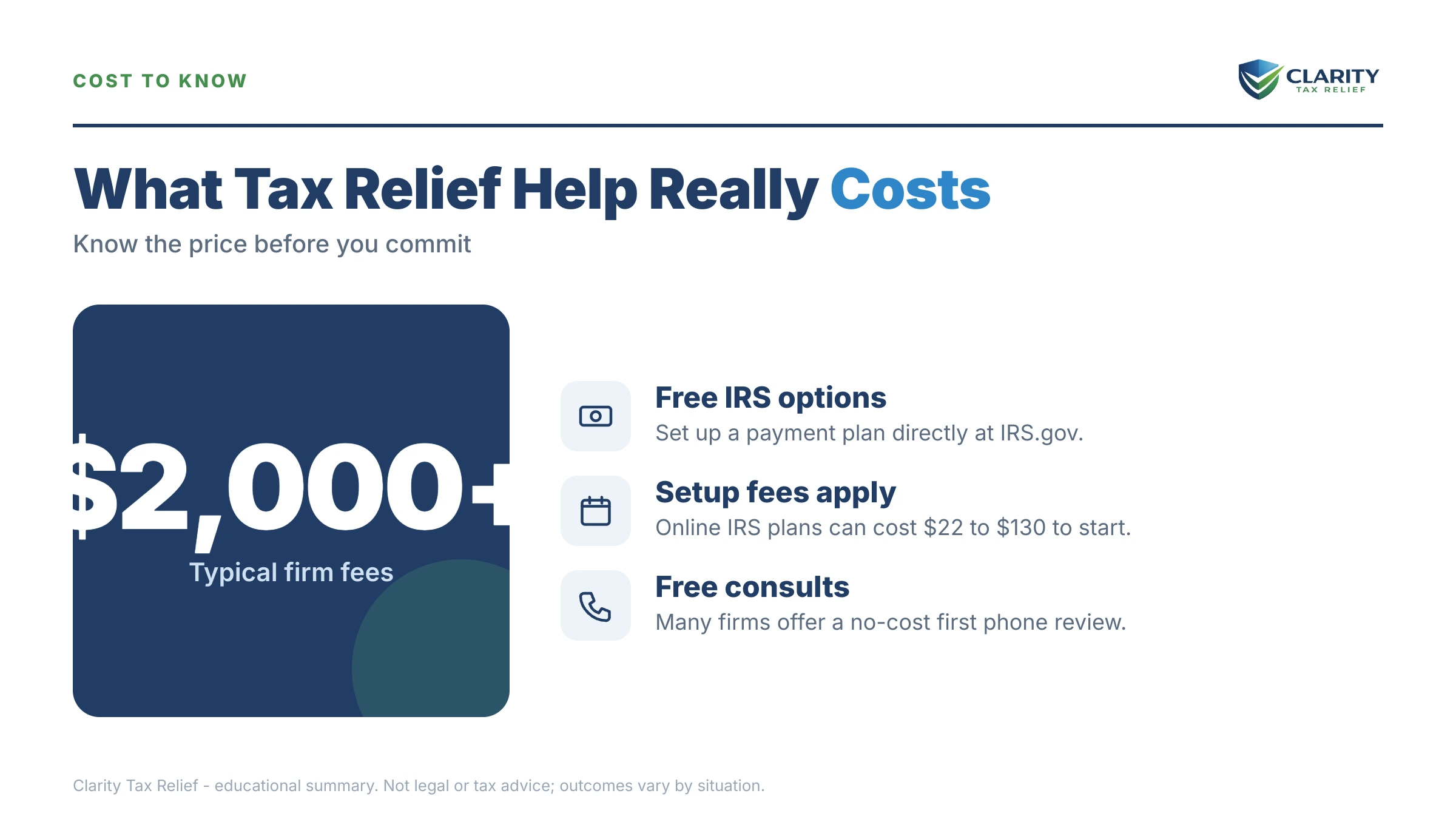
| Work with the IRS directly (DIY) | $0 for a short-term plan; a modest setup fee for a monthly plan (reduced or waived for low-income) | Balance you agree with, roughly $25,000 or less, all returns filed, no active levy |
| National flat-fee tax relief firm | Commonly quoted from several hundred dollars to a few thousand, by scope | Multiple years, IRS plus state debt, active or imminent levy, realistic Offer in Compromise cases |
| Local enrolled agent or CPA | Hourly or smaller flat fees; varies by market | Self-employed filers who want one person handling resolution and ongoing quarterly taxes |
| Tax attorney | Highest; often hourly | Disputed liabilities, Tax Court deadlines, fraud exposure, very large or business debts |
| Low Income Taxpayer Clinic (LITC) | Free if you meet income limits | Lower-income taxpayers with an active IRS dispute or collection problem |
DIY with the IRS is the alternative no sales rep will pitch, and for many readers of this page it's the correct answer. Our hub guide on how to settle tax debt yourself walks the whole process; the short version is that the IRS's own online tools handle most sub-$25,000 cases without a middleman.
A national flat-fee firm — including Clarity — earns its fee on complexity and speed: multi-year cases, stacked IRS and state balances, levy releases with real deadlines, and settlement math that has to be built correctly the first time. What separates a good one from a bad one is transparency, not marketing; our guide to how to choose a tax relief company gives you the full checklist, and how much does tax relief cost breaks down what fair pricing looks like at each scope.
A local enrolled agent or CPA is often the best long-term fit for 1099 contractors specifically, because your problem usually isn't just the old balance — it's the missing quarterly estimates that created it. One professional who fixes the debt and sets up your estimated payments prevents a repeat.
A tax attorney is the right alternative when the amount itself is disputed, a court deadline is running, or there's any criminal exposure. For a straightforward balance-due case, attorney rates buy you the same forms an EA files for less.
If you're comparing several national brands side by side, we've published the same honest framework for others — see our anthem tax services alternative, community tax alternative, and fortress tax relief alternative guides. The evaluation criteria don't change; only the company names do.
What actually resolves the debt: your IRS options at $19,700
A balance under $25,000 with returns filed qualifies for a streamlined installment agreement — up to 72 months, set up online, no detailed financial disclosure required. That single fact reframes the whole shopping decision, because whichever alternative you choose will be steering you into one of these five programs:
| Option | Who qualifies | What it costs |
|---|---|---|
| Short-term payment plan | Can pay in full within 180 days | $0 setup; interest and penalties continue until paid |
| Streamlined installment agreement | Owe $25,000 or less (up to $50,000 with direct debit), all returns filed | Setup fee (reduced or waived for low-income); up to 72 months; accruals continue |
| Currently Not Collectible (CNC) | IRS allowable living expenses meet or exceed your income (shown on Form 433-F) | $0; collection pauses, but the debt and interest remain |
| Offer in Compromise (Form 656) | Assets plus future income genuinely can't cover the balance — means-tested, roughly 1 in 5 offers accepted in FY2024 | $205 fee plus 20% down on lump-sum offers; both waived with low-income certification (AGI ≤ 250% of poverty) |
| Penalty relief (FTA / AEP) | Clean compliance the prior 3 years; the new Automatic Exemption from Penalty applies without a request starting summer 2026 | Free to request |
Most readers at this amount end up in the streamlined installment agreement, often paired with first-time penalty abatement to strip the failure-to-pay penalty if the prior three years are clean. For a fuller amount-band breakdown, our I owe the IRS $20,000 guide covers this exact neighborhood.
Two situations change the answer. If you have unfiled years, the IRS generally won't approve any agreement until the missing returns are in — so the right alternative is whoever can reconstruct and file those returns fast, not whoever pitches settlement first. And if you also owe a state, remember states run entirely separate programs with their own rules and timelines; confirm any firm you hire will handle both balances, in the right order.
One compliance point that matters specifically to 1099 contractors: every IRS agreement requires you to stay current going forward. If you set up a payment plan but keep missing quarterly estimates, the agreement defaults and you're back at the top of the notice sequence with a bigger balance. Fixing the estimates is part of the resolution, not an afterthought.
A worked example: $19,700 as a 1099 contractor
Say you owe $19,700 from a year of contract income with no withholding. The streamlined math looks like this:
- Minimum plan: $19,700 ÷ 72 months ≈ $274/month. But interest and the 0.5% monthly failure-to-pay penalty keep accruing on the unpaid balance, so the minimum payment stretches the debt — and the total cost — to its maximum.
- Faster payoff: at roughly $560/month you'd clear it in about three years, cutting years of accruals. At the start, the failure-to-pay penalty alone is about $98/month (0.5% × $19,700), so every month shaved off the plan is real money. You can estimate your own accruals with our Penalty & Interest Calculator.
- The settlement question: whether an Offer in Compromise beats the plan depends entirely on your numbers. If your net self-employment income after IRS allowable expenses leaves $650/month of disposable income and you have about $2,700 of asset equity, the IRS's collection math works out to roughly $650 × 12 + $2,700 = $10,500 — less than $19,700, so an offer is worth analyzing. But if disposable income is $1,750/month, the same formula gives $1,750 × 12 + $2,700 = $23,700 — more than you owe, and any firm selling you an offer anyway is selling paper, not a result.
This is a hypothetical, but the shape is universal: the honest firms run this math before quoting you, and the ones worth avoiding quote before running it. That's the entire test.
How to choose an Ideal Tax alternative, step by step
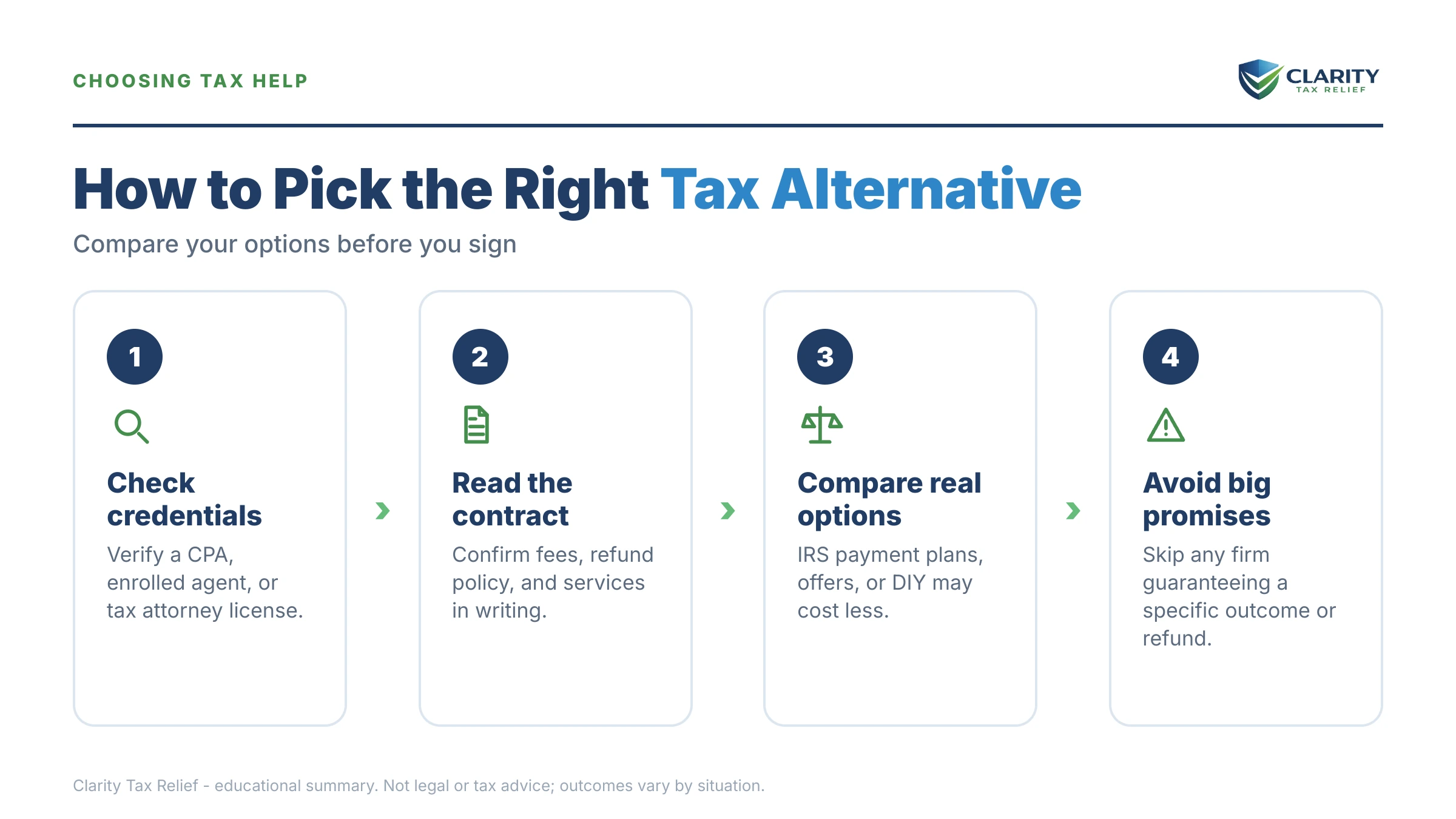
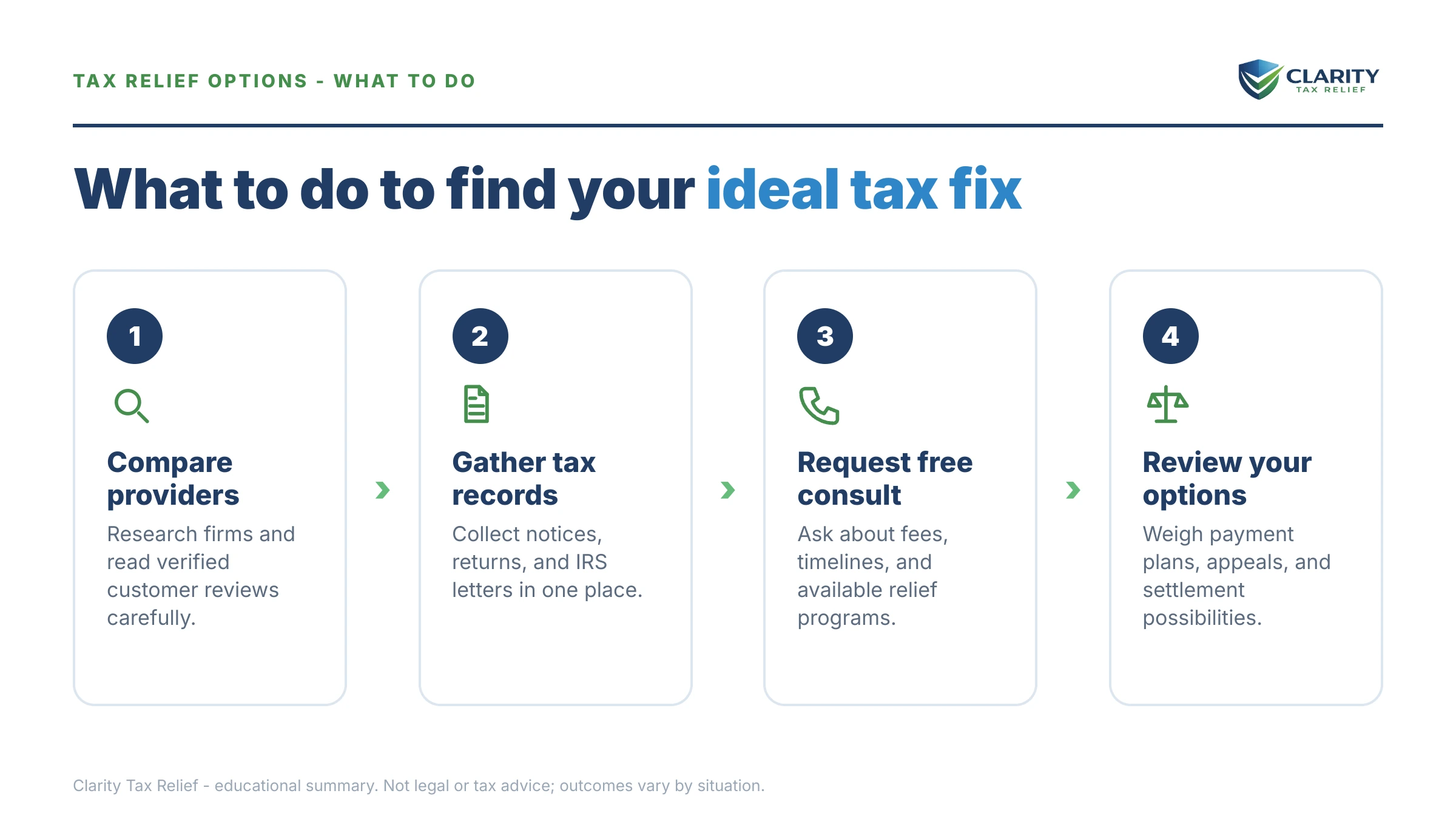
- Pull your own IRS records first. Create an IRS online account and confirm your exact balance, penalties, and which returns the IRS shows as filed — before any sales call. Ten minutes of checking makes inflated claims obvious.
- Match your situation to the right type of help. Under $25,000 with returns filed usually means DIY or a local pro; an active levy, unfiled years, or business debt justifies a full-service firm or attorney.
- Get two or three quotes in writing. Ask each firm for the flat fee, the exact deliverable, and the name and credential of the person who will work your case.
- Verify credentials and complaint history. Confirm the assigned professional is an enrolled agent, CPA, or attorney, and check the firm's complaint record with your state and the BBB before signing anything.
- Start the resolution — not just the contract. A signed engagement letter doesn't stop IRS notices; a submitted payment plan, hardship claim, or offer does. Make sure your first week with any firm produces a filing, not just paperwork.
For the intake calls themselves, bring our list of questions to ask a tax relief company — the way a firm handles direct questions about fees and staffing tells you more than any review page.
When you don't need any tax relief company
An honest alternative includes the option of hiring no one. You can likely handle this yourself if all four are true: you agree with the balance, it's roughly $25,000 or under, every return is filed, and no levy is in motion. In that case, set up the plan directly at the IRS payment plans page, request penalty abatement by phone or letter, and keep the confirmation. Total cost: a small setup fee. If your income is limited, a Low Income Taxpayer Clinic through the Taxpayer Advocate Service network may represent you for free.
Experienced help changes outcomes in specific situations, not all of them: a levy already hitting your bank or your clients' payments, several unfiled years that need reconstruction, a balance you dispute, business or payroll tax debt, and Offer in Compromise cases — where the financial packaging determines whether the IRS's formula works in your favor. If a firm can't articulate why your case needs them, it probably doesn't.
Terms you'll hear on sales calls, decoded
- Investigation fee — an upfront charge to pull your IRS transcripts and assess options; legitimate when small and defined, a red flag when it's large and the "findings" arrive with a bigger contract attached.
- Enrolled agent (EA) — a federally credentialed tax professional authorized to represent taxpayers before the IRS in all 50 states; the workhorse credential of collection cases.
- Form 2848 — the power of attorney that lets a professional speak to the IRS for you; no firm can actually work your case until it's filed.
- Reasonable Collection Potential (RCP) — the IRS formula (asset equity plus future disposable income) that decides Offer in Compromise acceptance; details at the IRS Offer in Compromise page.
- Currently Not Collectible (CNC) — hardship status that pauses collection when paying anything would leave you unable to cover basic living expenses; the debt and interest remain.
- "Pennies on the dollar" — a marketing phrase, not a program. When you hear it, you're talking to an offer in compromise mill, and it's time to hang up.
Ideal Tax alternative questions, answered
What is the best alternative to Ideal Tax?
The best alternative depends on your balance and complexity, not the brand name. Under about $25,000 with all returns filed, working directly with the IRS on a streamlined installment agreement is often the strongest option. Larger balances, unfiled years, or business and payroll debt usually justify a flat-fee firm or local enrolled agent who names the specific person handling your case.
Do I need a tax relief company if I owe less than $25,000?
Often you don't. Balances of $25,000 or less generally qualify for a streamlined installment agreement you can set up online yourself, with no financial disclosure required and up to 72 months to pay. Professional help earns its fee when a levy is already in motion, you have multiple unfiled years, the amount is disputed, or you may qualify for an Offer in Compromise.
How much should a tax relief company charge?
Most legitimate firms quote a flat fee after reviewing your IRS transcripts, and resolution work commonly runs from several hundred dollars for a simple payment plan to a few thousand for an Offer in Compromise. Be wary of any firm that quotes a price — or promises a result — before pulling your IRS records, or that charges a large upfront investigation fee with no defined deliverable.
Can a tax relief company settle my debt for less than I owe?
Only if the IRS's own math says so. An Offer in Compromise is accepted when your assets and future income genuinely can't cover the balance — the IRS accepted roughly 1 in 5 offers in FY2024. No company can change that formula; a good one tells you upfront whether you're a realistic candidate instead of selling the program to everyone.
Is a local enrolled agent or CPA better than a national tax relief firm?
Either can do excellent work — what matters is who actually touches your case. A local enrolled agent or CPA typically offers direct access to the person filing your paperwork, while a good national firm offers volume experience with specific programs. Ask any firm to name the credentialed professional assigned to you and how you reach them; refusal to answer is your answer.
What are the biggest red flags when replacing a tax relief company?
The same ones that likely sent you searching: promised outcomes before anyone reviews your transcripts, pennies-on-the-dollar pitches, pressure to sign the same day, and large upfront fees with vague scopes. Legitimate firms put the fee, the deliverable, and the assigned professional in writing before you pay anything.
Will the IRS pause collections while I choose a new firm?
No. The IRS notice sequence is automated and continues whether or not you have representation, and failure-to-pay penalties plus daily-compounding interest accrue the entire time. The only things that pause enforcement are an accepted resolution — a payment plan, hardship status, or a pending Offer in Compromise — or formal appeal rights on a final notice.
Your next 24 hours
- Log into your IRS online account and write down your exact balance, the penalty breakdown, and which tax years are involved — that's your baseline for judging any quote.
- Gather three things: your most recent tax return, every IRS letter you've received, and rough monthly income and expense numbers (the inputs any professional — or Form 433-F — will need).
- Get a free case review at the 2-minute form or (888) 825-7779. Whether or not you hire anyone, you'll know exactly which option fits your numbers — and every week of deciding adds penalty and interest to the balance you eventually resolve.
This guide is general information, not tax or legal advice for your specific situation. Eligibility for IRS programs depends on individual facts and circumstances; no outcome is guaranteed.