
Tax Debt by Profession
Travel Nurse Owes Taxes? Why It Happens and How to Fix It (2026)
The short answer: when a travel nurse owes taxes, the cause is almost always one of three things — stipends that lost their tax-free status, 1099 contract pay with nothing withheld, or state returns that never got filed. A federal balance under $10,000 fits the guaranteed installment agreement, but every missing return must be filed first.
You finished the contract, stacked your W-2s and 1099s from three different agencies, ran the return — and instead of the refund your staff-nurse friends got, the software says you owe $4,800. The pay package that looked so good at $2,100 a week suddenly makes sense in the worst way. This is fixable, and for a balance this size, more fixable than almost any other tax problem. Here is exactly why it happened and the fastest way out.
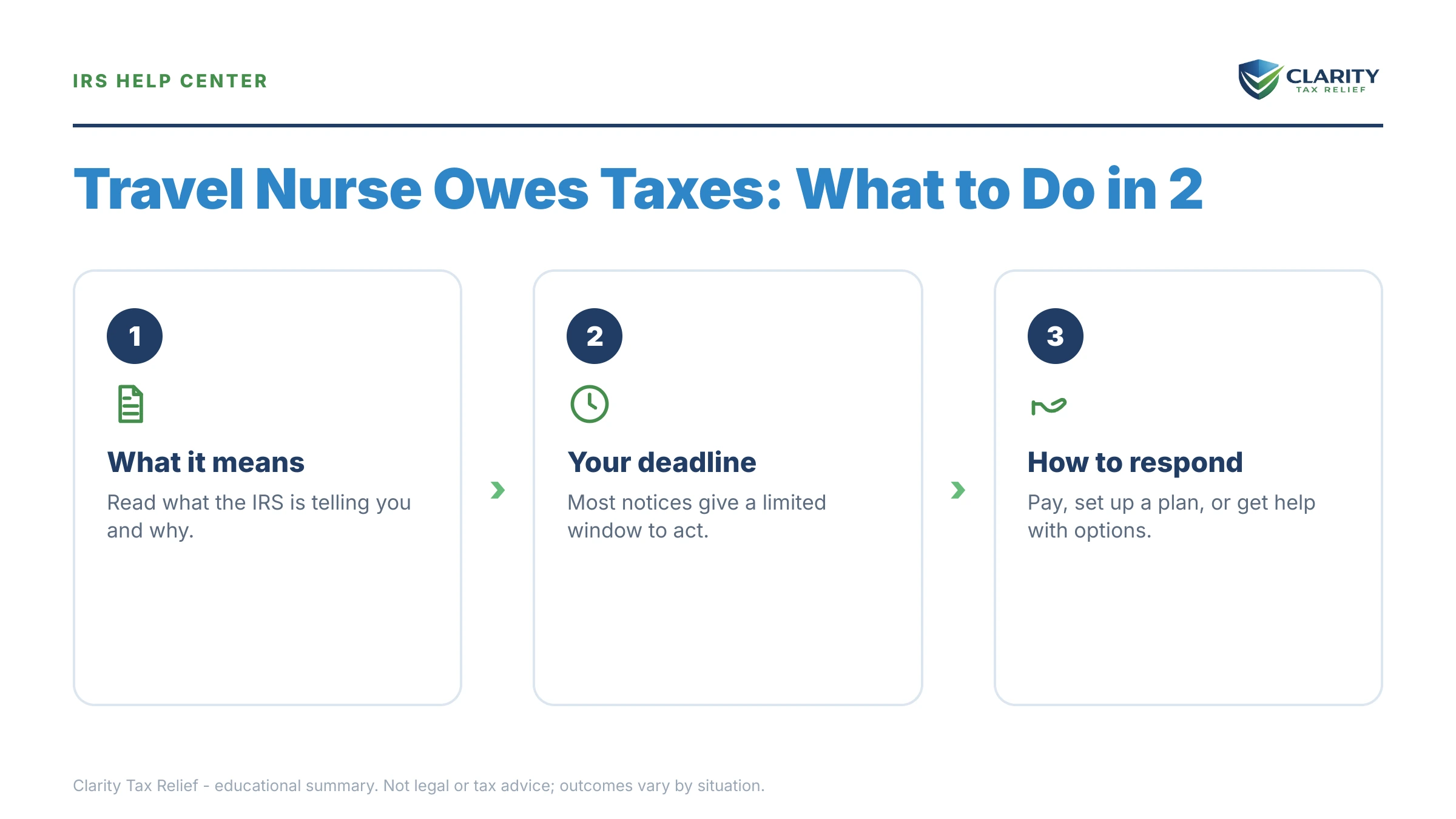
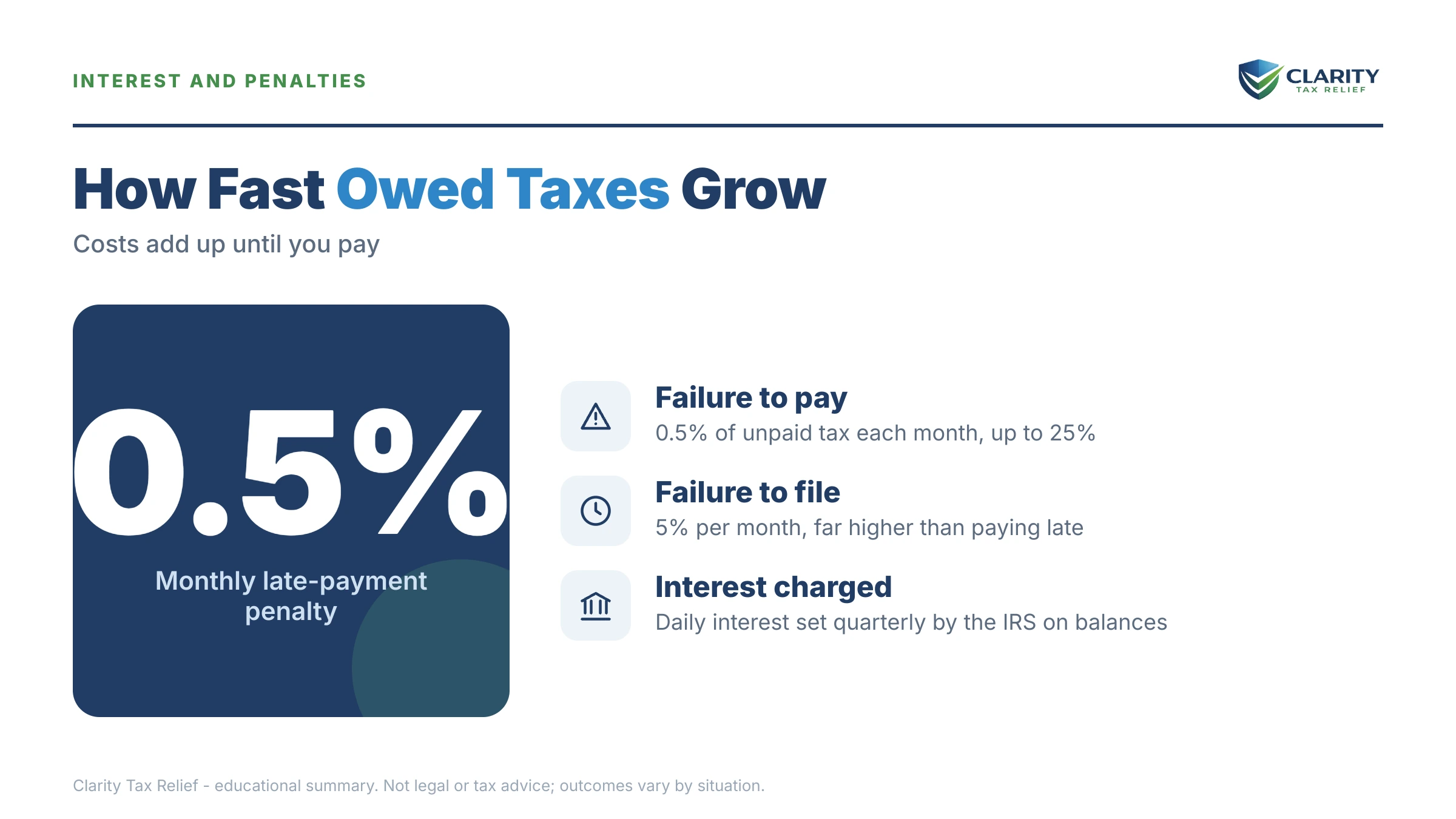
⏱ The real clock: there's no letter-printed deadline on a balance you just discovered — but the meter is running. The failure-to-pay penalty adds 0.5% of the balance every month, plus interest. And if a return is still unfiled, the failure-to-file penalty runs 5% per month — ten times faster. On $4,800, that's the difference between roughly $24 and $240 a month.
Why travel nurses owe taxes: the three structural causes
Travel nurse tax debt almost always traces to untaxed stipends, unwithheld 1099 pay, or multi-state contracts that withholding never kept up with. Your situation is probably at least one of these — many nurses hit two at once.
1. Your stipends weren't actually tax-free
Housing and meal stipends are excluded from income only while you maintain a qualifying tax home — a main home base where you duplicate living expenses (rent or mortgage there and rent at the assignment) and to which you regularly return between contracts.
Lose the tax home and every stipend dollar becomes taxable wages. The classic traps: you let your apartment go and lived assignment-to-assignment, you "crashed with family" without paying fair-market rent, or you kept extending in the same metro until it became your main place of work. Recruiters rarely explain this; the IRS computer eventually does — often through a CP2000 notice proposing tax on income the agency reported but your return treated as tax-free.
One more thing that changed the math: since the 2017 tax law, W-2 employees can no longer deduct unreimbursed work expenses like travel, licensure, or scrubs on their federal return. If a W-2 nurse's stipends get reclassified, there's no deduction cushion to soften it.
2. You took 1099 contracts with zero withholding
A growing share of travel contracts — especially crisis rates, local agency shifts, and app-based per-diem work — pay on 1099. That makes you a sole proprietor: you owe 15.3% self-employment tax on net profit via Schedule SE, on top of regular income tax, and no one withholds a cent. The mechanics are the same shock that hits every first-year contractor — the self-employment tax arrives as one lump at filing unless you sent quarterly estimated payments on Form 1040-ES during the year. Skip the quarterlies and the IRS adds an underpayment penalty to the balance too.
3. Multi-state contracts your withholding never matched
Agencies commonly withhold for the work state only — or for their own headquarters state — while your resident state expects its full share. Take contracts in three states and you can owe a nonresident return in each, plus a resident return at home claiming a credit for taxes paid elsewhere. When those pieces were never filed or never reconciled, balances quietly accumulate in systems you've never heard from. Yet.
The multi-state problem: every state collects on its own
Every state where you took a contract can bill you separately, on its own timeline, under its own rules — none of the IRS's thresholds or windows apply to them. A payment plan with the IRS does nothing for a bill from Sacramento or Albany.
Two things travel nurses should know specifically:
- California is the outlier. If you took a California contract and owe the FTB, its collection statute runs 20 years — twice the IRS's 10. See California FTB back taxes for how that agency operates.
- Non-filing doesn't mean safe. States receive your wage data from agencies and can assess tax for you — usually with no credits and no deductions — if you never file the nonresident return.
If you owe both the IRS and one or more states, the sequencing matters; our guide to state tax debt vs IRS covers which to resolve first and why the answer isn't always the biggest balance.
What happens if a travel nurse owes taxes and does nothing
An unpaid federal balance moves through an automated notice sequence before the IRS can touch a paycheck — and in 2026, that sequence runs on autopilot even though IRS staffing was cut roughly 27% in 2025. The humans are harder to reach; the notices never stopped.
- CP14 — the first bill. Shows the year, the balance, and the penalty/interest breakdown. You typically have about 21 days before the sequence advances. No enforcement yet.
- CP501 / CP503 — reminders. Still just bills, but each one arrives with a bigger number than the last as penalties and interest compound.
- CP504 — Notice of Intent to Levy. Under IRC §6331(d), the IRS can now seize your state tax refund — which stings for a multi-state filer expecting refunds from work states. It is not yet the final notice.
- LT11 / Letter 1058 — Final Notice of Intent to Levy. This starts a 30-day clock and your Collection Due Process rights (requested on Form 12153). After the 30 days, the IRS can levy bank accounts and wages.
- Levy. A bank levy freezes funds with a 21-day hold before the money leaves. A wage levy on W-2 pay is continuous until released; on 1099 contracts, the IRS takes whatever the agency owes you when the levy hits.
Meanwhile, each state you owe is running its own parallel track — refund intercepts, liens, and garnishments under state law, on state timelines.
Staring at a travel-nurse tax bill right now?
Send us the numbers — your notices, your contracts, your states. An experienced tax professional will map exactly what you owe, to whom, and the cheapest way through it before another month of penalties and interest stacks on. Free and confidential.
Your options for travel nurse tax debt in 2026
A federal balance under $10,000 sits in the easiest resolution tier the IRS offers — most travel nurses in this range never need anything more exotic than a payment plan plus penalty relief. The full menu, and who fits each door:
| Option | Who qualifies | What it does |
|---|---|---|
| Short-term payment plan | Any balance you can clear within 180 days | Buys up to 180 days to pay in full; stops the notice escalation; $0 setup fee |
| Guaranteed installment agreement | Owe $10,000 or less, all returns filed, pay within 3 years | The IRS must accept it — monthly payments, minimal questions asked |
| Streamlined installment agreement | Up to $25,000 (up to $50,000 with direct debit); online plans run up to 72 months | Monthly plan without detailed financial disclosure |
| Currently Not Collectible | Paying anything would create genuine hardship, shown on Form 433-F | Pauses IRS collection; the debt remains and interest still accrues |
| Offer in Compromise | Assets and future income genuinely can't cover the debt; means-tested | Settles for less than owed — the IRS accepted roughly 1 in 5 offers in FY2024, so it fits few $4,800 cases |
| Penalty abatement (FTA / AEP) | Clean compliance the prior 3 years; AEP applies automatically starting summer 2026 | Removes penalties, shrinking the balance itself |
Two notes for this profession specifically. First, the guaranteed installment agreement requires all returns filed — including those nonresident state-year federal returns you skipped — so filing always precedes negotiating. Second, penalty relief is unusually winnable here: a first bad year after a stipend reclassification or a first 1099 season is exactly the profile first-time penalty abatement exists for, and beginning summer 2026 the new Automatic Exemption from Penalty (AEP) applies some of that relief automatically, with no request needed.
| Option | Upfront cost | What $4,800 looks like | Speed to set up |
|---|---|---|---|
| Short-term plan (180 days) | $0 | About $800/month for 6 months, then done | Online, usually same day |
| Installment agreement | Modest online setup fee (reduced or waived for low income) | Roughly $134/month base over 36 months, while interest and penalties keep accruing on the shrinking balance | Online, usually same day under $50,000 |
| Currently Not Collectible | $0 | $0/month while it lasts; the balance keeps growing | Weeks — requires a financial review |
| Offer in Compromise | $205 fee + 20% down on lump-sum offers (both waived with low-income certification, AGI ≤ 250% of poverty) | Offer amount set by IRS math, not by what you'd like to pay | Months; auto-accepted only if the IRS fails to decide within 2 years |
| Penalty abatement (FTA / AEP) | $0 | Removes penalty dollars from the balance rather than paying them | Often one phone call or letter |
A worked example: the $4,800 1099 contract year
Say you took 1099 crisis contracts all year and cleared $31,500 in net profit after deducting mileage between assignments, licensure, CEUs, and malpractice coverage. This is hypothetical — but the math is exactly what your return does:
- Self-employment tax: $31,500 × 92.35% = $29,090 taxable base; × 15.3% ≈ $4,451.
- Add a modest slice of income tax after your deductions, and the return lands at roughly $4,800 due — with nothing withheld all year to cover it.
Now the resolution math. On the 180-day short-term plan, that's $4,800 ÷ 6 ≈ $800 a month with a $0 setup fee — painful but finished by fall. On a 36-month guaranteed installment agreement, the base payment is about $134 a month, though interest plus the monthly failure-to-pay penalty (starting around $24 a month at 0.5%) keep adding while a balance remains, so the plan costs more in total. And if that return had gone unfiled, the failure-to-file penalty would have run about $240 a month, capping near $1,200 — a quarter of the debt created by silence alone. You can estimate your own accrual with our Penalty & Interest Calculator.
How to respond when you owe taxes as a travel nurse, step by step
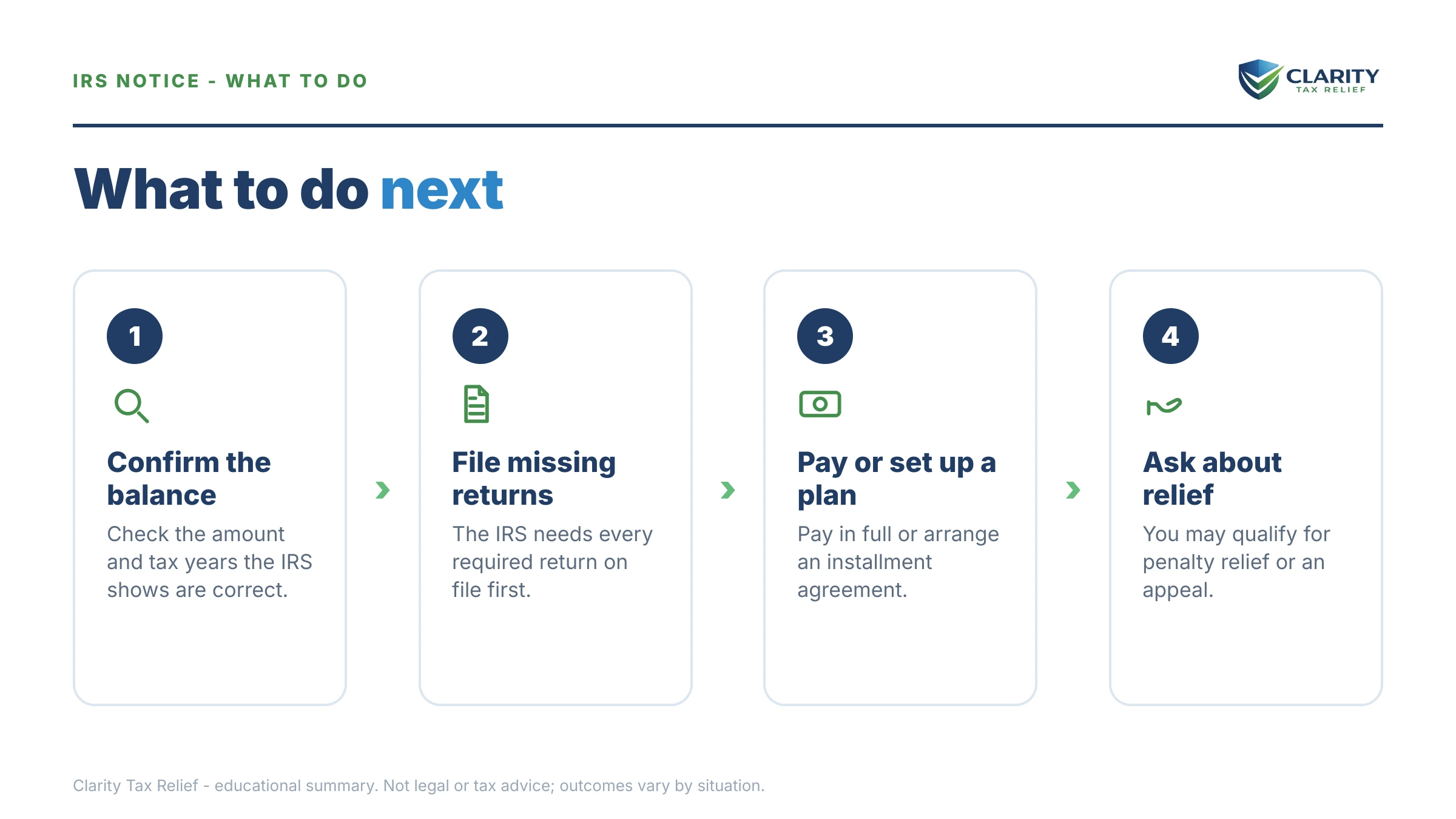
- Pull your records. Log into your IRS online account, download wage and income transcripts for every year in question, and dig out each contract's pay-package breakdown showing taxable rate versus stipends.
- File every missing return. Federal first, then a nonresident return for each work state — before negotiating anything. The failure-to-file penalty runs ten times faster than the failure-to-pay penalty.
- Verify how your stipends were reported. Confirm whether your tax home actually qualified during each contract. If the IRS reclassified stipends through a CP2000, you can dispute the numbers before agreeing to the balance.
- Set up your payment arrangement online. Choose the 180-day short-term plan or a monthly installment agreement at IRS.gov (Form 9465 works by mail) and enroll before the notice sequence escalates.
- Request penalty relief and fix the leak. Ask for first-time abatement if your prior three years are clean, then set up quarterly estimates or corrected withholding so next April does not repeat this.
If you'd rather run the whole process without hiring anyone, our DIY pillar on how to settle tax debt yourself walks through every form and phone script, and the online-plan walkthrough at how to set up an IRS payment plan online covers the enrollment screens click by click.
When you can handle this yourself — and when help changes the outcome
A single-year, sub-$10,000 balance you agree with is a do-it-yourself problem. If your returns are filed, the amount is right, and you just can't pay at once, the online payment plan takes about twenty minutes and no professional fee will beat that.
Experienced help starts paying for itself in these situations:
- The IRS reclassified your stipends and you believe your tax home qualified — the CP2000 response window is where that fight is won, with lease records, mileage, and duplicated-expense proof.
- Multiple unfiled years across multiple states. The order you file in, and which state credits offset which, changes the total you pay.
- The IRS filed a substitute return for you — it will overstate what you owe, and replacing it correctly is worth real money.
- A final levy notice already arrived or a garnishment is in motion — the 30-day CDP window is not the place to learn procedure.
- Balances stacked past $25,000 across years, where financial disclosure and option-sequencing genuinely change the outcome.
Terms on your pay package and notices, decoded
- Tax home — your main home base for tax purposes; keeping one (with real, duplicated living costs) is what makes stipends tax-free.
- Duplicated expenses — paying to maintain your home base and your assignment housing at the same time; the core evidence for a tax home.
- Stipend / per diem — untaxed allowances for housing and meals; tax-free only while the tax home rules are met.
- Self-employment (SE) tax — the 15.3% Social Security and Medicare tax a 1099 nurse pays on net profit, computed on Schedule SE.
- Nonresident return — the state return you file where you worked but didn't live; your home state usually credits the tax paid there.
- CSED — the Collection Statute Expiration Date; the IRS generally has 10 years from assessment to collect, though appeals, offers, and bankruptcy pause the clock.
Travel nurse tax debt questions, answered
Why do travel nurses owe taxes even as W-2 employees?
Because agencies typically withhold only on your taxable base rate, not your stipends — and often only for one state. If your stipends should have been taxable, or a nonresident state saw no withholding at all, the shortfall lands at filing time. Check each contract's pay breakdown: a low taxable hourly rate paired with large untaxed stipends is the setup that most often produces a surprise balance.
Are travel nurse stipends taxable?
Housing and meal stipends are tax-free only while you maintain a qualifying tax home — a main home base where you duplicate living expenses and to which you regularly return. If you gave up your home base, stopped paying rent there, or stayed in one assignment area indefinitely, those stipends become taxable wages, and the IRS can reclassify them after the fact through a CP2000 underreporter notice.
Do 1099 travel nurses have to pay quarterly estimated taxes?
Generally yes — if you expect to owe $1,000 or more for the year, the IRS expects four estimated payments on Form 1040-ES. As an independent contractor you also owe 15.3% self-employment tax on net profit, on top of income tax, and nothing is withheld from your contract pay. Missing quarterlies adds an underpayment penalty to the balance, which is why 1099 nurses are often surprised twice.
Can I get an IRS payment plan for $4,800 in tax debt?
Yes, and it is one of the easier balances to resolve. Under $10,000 with all returns filed, you generally fit the guaranteed installment agreement, and a short-term plan gives you up to 180 days to pay in full with a $0 setup fee. Both can usually be set up online in one sitting — but interest and penalties continue to accrue until the balance is paid.
What if I never filed state returns in the states where I worked?
File them — most travel nurses owe a nonresident return in each work state, and your resident state usually gives a credit for tax paid to other states, so true double taxation is rarer than feared. Each state runs its own collection system with its own deadlines and statutes; California's FTB, for example, can collect for 20 years. Unfiled state years will not fix themselves, and some states will assess tax for you if you never file.
Can the IRS garnish my nursing pay?
Not immediately, and never without warning letters first. The IRS must send a final notice of intent to levy — an LT11 or Letter 1058 — and give you 30 days to respond before it can garnish wages. A W-2 wage levy is continuous until released; for a 1099 contractor, the IRS levies whatever the agency owes you at the moment the levy lands. Acting during the notice stage prevents all of it.
Will owing taxes affect my nursing license or passport?
The IRS does not suspend professional licenses — that power belongs to states, and a few states can act against licenses over unresolved state tax debt. Your passport is a federal issue: the IRS can certify seriously delinquent tax debt of $66,000 or more (the 2026 threshold) to the State Department, which can deny or revoke a passport. A $4,800 balance is nowhere near either risk if you address it.
Your next 24 hours
- Find the exact number. Log into your IRS online account and note the balance for each year — then pull each contract's pay package so you can see taxable rate versus stipends at a glance.
- Gather your paper. Last year's return, every W-2 and 1099, a list of states you worked in, and any IRS or state letters you've received.
- Get it reviewed free. Call (888) 825-7779 or use the 2-minute form — every month you wait adds another 0.5% penalty plus interest to the balance, and an experienced tax professional can usually map your fastest exit in one conversation.
Primary sources if you want to go straight to the government: the IRS's payment plans and installment agreements page covers plan setup, IRS.gov/payments handles direct payment, and the independent Taxpayer Advocate Service can step in when normal channels stall.
This guide is general information, not tax or legal advice for your specific situation. Eligibility for IRS programs depends on individual facts and circumstances; no outcome is guaranteed.