
Gig Economy Taxes
Grubhub Driver Taxes: What to Do When You Owe the IRS in 2026
The short answer: Grubhub withholds nothing from driver pay — you owe income tax plus 15.3% self-employment tax on your net delivery profit. If a bill already exists, you can resolve it with a payment plan (up to 72 months under $50,000), hardship status, penalty relief, or — when the math truly supports it — an Offer in Compromise.
Grubhub driver taxes catch people in one specific way: the app deposited money all year, the 1099-NEC showed a gross number bigger than you expected, and the return spat out a bill you never set money aside for. Nothing was stolen and nothing was hidden — there was just no employer withholding a cent for you.
That bill is fixable, and usually cheaper to fix than the number on the screen suggests, because most drivers under-claim their single biggest deduction: miles. The image below shows exactly what a Grubhub 1099-NEC looks like and where to find the figure the IRS matches against your return — start there, because everything else keys off that number.
⏱ The real clock: there's no letter deadline on this yet — but the failure-to-pay penalty adds 0.5% of your balance every month, interest compounds daily on top, and if IRS notices have already started arriving, the date printed on your letter controls. Check that date before anything else.
Why your Grubhub driver taxes came out so high
Grubhub pays drivers as independent contractors, which means your 1099-NEC gross includes base pay, the per-mile "contribution," and every tip paid through the app — all fully taxable, with zero withheld. Three things stack up from there:
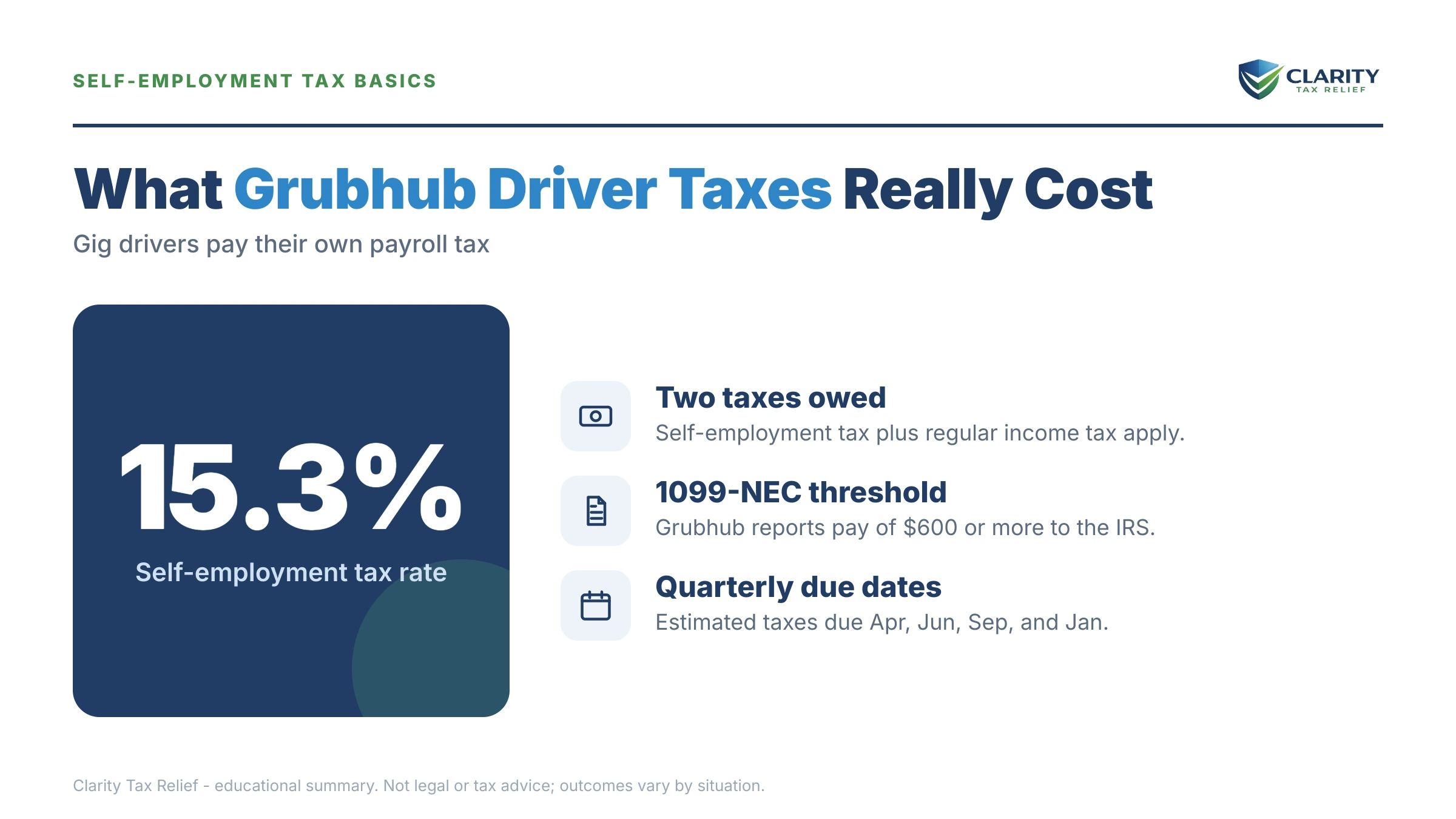
Self-employment tax comes first. As a contractor you pay both halves of Social Security and Medicare — 15.3% of net profit — before ordinary income tax even starts. That single line is why a modest-looking delivery year produces a four-figure bill; the mechanics are covered in our guide to the self employment tax owe irs shock.
Second, Grubhub's mileage contribution is income, not a reimbursement. It's baked into your 1099 gross. Your actual vehicle deduction comes separately, on Schedule C, from the miles you drove — including the miles between deliveries while you were on the clock, which the app's order history doesn't total up for you. Drivers who never tracked those miles routinely overpay; if that's you, see didn't track miles doordash taxes for how to reconstruct a log the IRS will respect.
Third, the IRS wanted this money during the year, not in April. Contractors who expect to owe $1,000 or more are supposed to send quarterly payments — the how do quarterly estimated taxes work guide covers the system, and the quarterly estimated tax deadlines 2026 page has this year's dates. Miss them and an underpayment penalty accrues from each missed due date, even if you pay everything at filing.
Worked example: what a $54,600 Grubhub year actually owes
A full-time delivery year grossing $54,600 can produce a federal bill near $7,600 with nothing withheld. Here's the arithmetic, using a clearly hypothetical driver:
Say your 1099-NEC shows $54,600 in gross pay — base, mileage contributions, and in-app tips. You drove roughly 22,000 deductible business miles, and mileage plus your phone, insulated bags, and tolls add up to about $16,600 in Schedule C expenses. Net profit: $38,000.
- Self-employment tax: $38,000 × 92.35% = $35,093 taxable base; × 15.3% ≈ $5,369.
- Federal income tax: after deducting half the SE tax and the standard deduction, roughly $2,200 for a single filer (your bracket and credits may differ).
- Total owed at filing: about $7,600 — plus an underpayment penalty for the skipped quarters.
Leave that unpaid for a year and the failure-to-pay penalty alone adds about $460 (0.5% × 12 months), with daily-compounding interest on top. You can estimate your own accrual with our Penalty & Interest Calculator. On a streamlined 72-month plan, the same $7,600 works out to a minimum of roughly $106 a month — though paying faster than the minimum saves real interest.
Notice what moved the number most: the $16,600 in deductions. Without a mileage log, that same gross produces a net of $54,600 and a bill roughly twice as large. Deductions are the lever — which is why rebuilding records comes before picking a payment plan.
What happens if you ignore a Grubhub tax debt
An unpaid gig-tax balance escalates through an automated notice sequence that ends in levies — and in 2026, with the IRS workforce down roughly 27%, the humans are harder to reach but the automated notices never stopped. The stages, in order:
- Silent accrual. Before any letter, the 0.5%/month failure-to-pay penalty and daily interest are already running.
- CP14 — the first bill. You typically have about 21 days from the notice date before the sequence advances.
- CP501 / CP503 — reminders. Still just bills, but the balance grows with each one.
- CP504 — intent to levy your state refund. The IRS can now take your state tax refund, and a federal tax lien becomes realistic.
- LT11 / Letter 1058 — final notice. This starts a 30-day clock with Collection Due Process appeal rights (requested on Form 12153). After it, the IRS can levy your bank account — funds sit under a 21-day hold before they're sent — and can serve a levy on Grubhub itself for money owed to you.
Two Grubhub-specific wrinkles. If you filed but left the 1099 off the return, the matching system sends a cp2000 notice instead — proposing tax on your full gross with zero deductions, which is why CP2000 amounts look inflated. And if several delivery years stack past $66,000 (the 2026 threshold), the IRS can certify the debt to the State Department and block your passport.
Owe the IRS from Grubhub driving?
Penalties and interest are accruing every month the balance sits. An experienced tax professional will review your 1099s, your deductions, and your options — free, confidential, no pressure.
Your options when you can't pay the IRS in full
Most Grubhub drivers who owe can resolve the debt without a levy ever landing — the full DIY playbook lives in how to settle tax debt yourself; here's how each option maps to a delivery-driver balance:
| Option | Who typically qualifies | Cost & the catch |
|---|---|---|
| Short-term payment plan | Can pay in full within 180 days | $0 setup; interest and penalties still accrue until paid |
| Guaranteed installment agreement | Balance of $10,000 or less, returns filed | The IRS must accept it — the official program name, not a promise about anything else |
| Streamlined installment agreement | Balance of $50,000 or less | Up to 72 months, set up online, no financial disclosure; interest continues |
| Currently Not Collectible | Income covers only basic living expenses | Collection pauses; the debt and interest remain, and the IRS re-checks your income |
| Offer in Compromise | Assets + future income genuinely can't cover the debt | $205 fee, 20% down on lump-sum offers (both waived with low-income certification); roughly 1 in 5 offers accepted in FY2024 |
| Penalty abatement | Clean compliance for the prior 3 years, or reasonable cause | Removes penalties, not tax; interest tied to a removed penalty comes off with it |
Two notes on that table. On penalties: first time penalty abatement is the classic route, and starting summer 2026 the IRS is rolling it into an Automatic Exemption from Penalty (AEP) that applies without a request — so check whether penalties have already dropped before paying them. On the Offer in Compromise: it's real, but means-tested. A driver with $38,000 in annual net profit and few assets usually collects too much future income to qualify on a $7,600 debt — a payment plan is faster and cheaper. It becomes worth pricing when multiple years have stacked and income has fallen.
How to respond, step by step
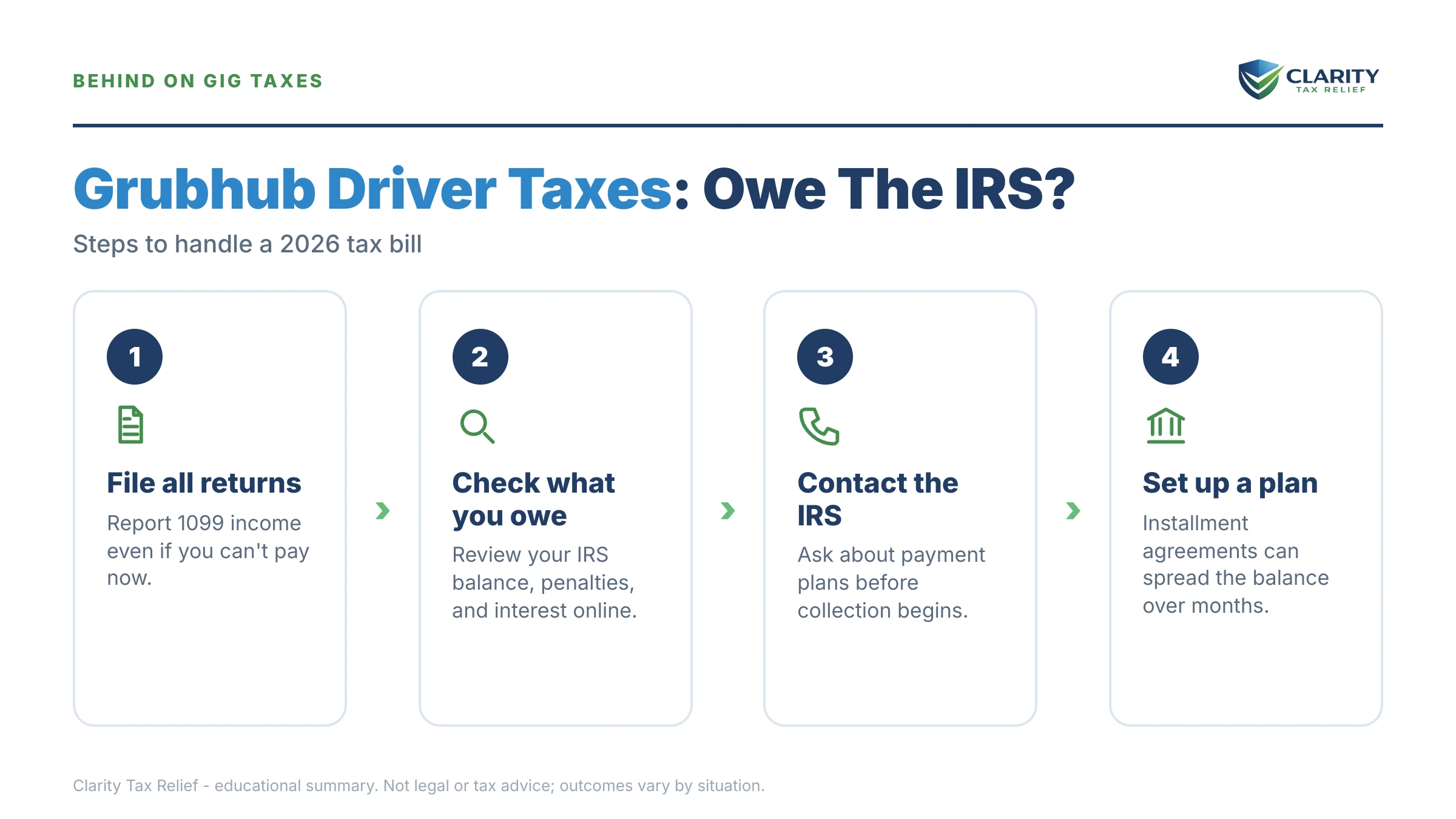
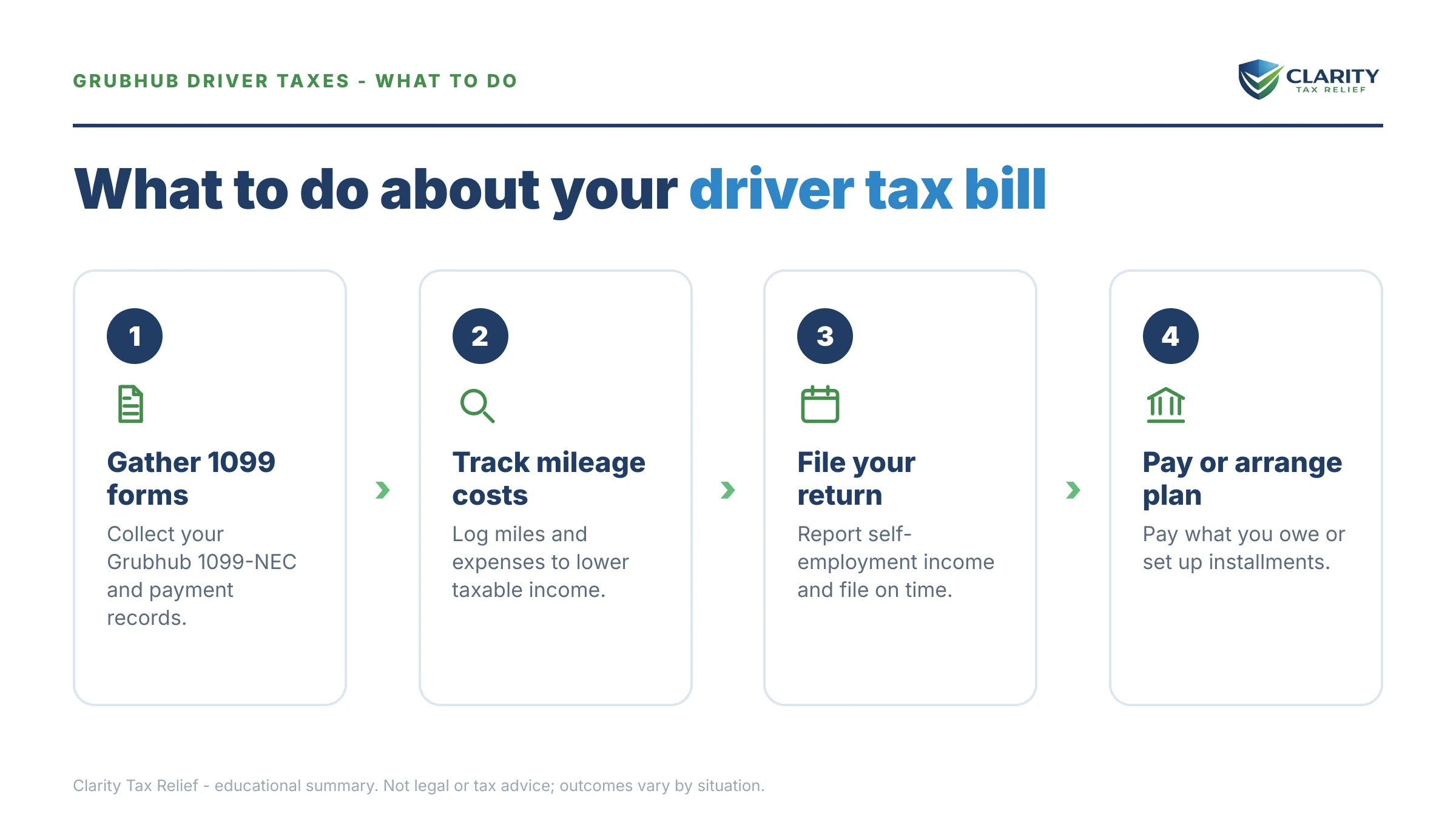
- Pull your real numbers. Download your Grubhub annual pay summary and Form 1099-NEC, then confirm the gross matches what the IRS has on file in your online account.
- File every missing return. The failure-to-file penalty runs 5% per month — ten times the 0.5% failure-to-pay rate, though in months where both penalties apply the failure-to-file portion drops to 4.5% (5% combined) — so filing stops the fastest-growing cost even if you can't send a dime with the return.
- Rebuild your deductions. Reconstruct your mileage log from delivery history and bank records before you accept any IRS-calculated balance; deductions are the biggest lever on what you owe.
- Choose a resolution and set it up. Match your balance to the options table above — most drivers owing under $50,000 can set up a payment plan online in one sitting.
- Fix the leak going forward. Start setting aside 25–30% of net earnings from every payout and make quarterly estimated payments so next April doesn't repeat this one.
Multi-app driving, unfiled years, and a W-2 day job
Three situations change the playbook for delivery drivers who owe.
You drive multiple apps. Grubhub, DoorDash, and Uber Eats each file their own 1099, and the IRS sums them all. A driver who reported the Grubhub 1099 but forgot a second app's still gets matched on the missing one. The resolution math also runs on your combined balance — if DoorDash is part of your picture, the doordash driver owes taxes guide covers that platform's specifics, and rideshare drivers should see lyft driver back taxes.
You never filed at all. If returns are missing, the IRS can file a substitute return for you — using the full 1099 gross with no mileage, no expenses, and the least favorable filing status. Filing your own return, even years late, almost always replaces that inflated number with a smaller real one. Do this before negotiating anything; the IRS won't approve most payment plans with unfiled years outstanding.
Grubhub is your side gig. If you also hold a W-2 job, your delivery profit stacks on top of your wages, often landing in a higher bracket than the 25–30% rule assumes. The cleanest fix is bumping your W-2 withholding to cover the gig income — our side hustle taxes how much to save guide walks through sizing it.
When you can handle this yourself — and when to get help
Most single-year Grubhub tax debts under $10,000 are a do-it-yourself fix. If you filed on time, agree with the balance, and it's your first slip, you can set up a guaranteed or streamlined installment agreement online in under an hour, request penalty abatement yourself, and be done. Paying a professional to do that rarely changes the outcome.
Experienced help starts earning its fee when the facts get layered: multiple unfiled years (order of operations changes what you ultimately pay), a CP2000 or substitute return computed on gross with no deductions, a levy already served on your bank or on Grubhub, combined app debts past $50,000 where financial disclosure kicks in, or an Offer in Compromise where the calculation itself decides acceptance. In those cases, the sequencing — returns first, then penalties, then the balance — is where money is won or lost.
Reading your IRS transcript as a Grubhub driver
Your IRS account transcript shows exactly where a gig-tax debt stands, line by line. These are the codes delivery drivers see most:
| Code | What it means | What to do |
|---|---|---|
| 150 | Your return posted; this is the tax you self-reported | Confirm it matches the return you actually filed |
| 806 | Withholding credited — often $0 for full-time drivers | If you also had a W-2 job, verify that withholding appears |
| 276 | Failure-to-pay penalty assessed | Check first-time abatement (or automatic AEP relief from summer 2026) |
| 196 | Interest charged to the account | Interest generally drops only when the underlying penalty is removed |
| 922 | Underreporter review — a 1099 didn't match your return | Expect a CP2000; gather your Schedule C and mileage records now |
| 971 | A notice was issued | Match the date to the letter in your mailbox and read its deadline |
Terms on your 1099 and IRS letters, decoded
- 1099-NEC: the form Grubhub files reporting your nonemployee compensation — the IRS gets its own copy and matches it against your return.
- Self-employment tax: the 15.3% you pay for Social Security and Medicare as a contractor, covering both the employee and employer halves.
- Schedule C: the form where your delivery income and expenses meet — the net profit here is what actually gets taxed.
- Underpayment penalty: the charge (figured on Form 2210) for not paying quarterly during the year, separate from any late-payment penalty.
- Failure-to-pay penalty: 0.5% of the unpaid balance per month after the filing deadline, on top of interest.
- CSED: the collection statute expiration date — the IRS generally has 10 years from assessment to collect, though appeals, offers, and bankruptcy pause the clock.
Grubhub driver tax questions, answered
Does Grubhub take taxes out of my pay?
No. Grubhub classifies drivers as independent contractors, so nothing is withheld from your weekly deposits — no income tax, no Social Security, no Medicare. You're responsible for both income tax and the full 15.3% self-employment tax on your net profit, which is why the IRS expects quarterly estimated payments during the year rather than one payment in April.
Does Grubhub send a 1099-NEC or a 1099-K?
Most drivers get a Form 1099-NEC reporting delivery pay, mileage contributions, and tips paid through the app. The 1099-K applies to third-party payment platforms and, for 2026, only kicks in at $20,000 and 200 transactions. Either way, the IRS receives its own copy — and its computers match that copy against your return, so unreported Grubhub income usually triggers a CP2000 notice.
What happens if I didn't report my Grubhub income?
The IRS's document-matching system compares the 1099-NEC Grubhub filed against your return, often more than a year after you filed. When they don't match, you get a CP2000 proposing extra tax — calculated without any of your mileage or expense deductions, so the proposed amount is almost always higher than what you truly owe. Responding with a corrected Schedule C can shrink the bill significantly.
How much should Grubhub drivers set aside for taxes?
A working rule is 25% to 30% of your net earnings after mileage — more if a second job pushes you into a higher bracket, less if your deductible miles are heavy relative to pay. Set it aside from each payout, then send it in quarterly using Form 1040-ES so the underpayment penalty never builds.
Can I deduct my miles if I didn't track them?
You can often reconstruct a defensible mileage log using your Grubhub delivery history, bank and fuel records, and odometer readings — the app's order history shows dates and delivery locations. A reconstructed log isn't as strong as one kept in real time, but it is far better than claiming zero miles and overpaying by thousands.
What if I can't pay the taxes I owe from Grubhub driving?
File anyway, then pick a payment option: balances under $50,000 qualify for an online installment agreement of up to 72 months, and a short-term plan gives you up to 180 days with no setup fee. If paying anything would leave you unable to cover rent and food, Currently Not Collectible status can pause collection. Interest and penalties keep accruing under every option except full payment.
Can the IRS garnish my Grubhub earnings?
Yes, but differently than a W-2 paycheck. Because Grubhub owes you money as a contractor, a levy served on Grubhub reaches only what's owed to you at that moment — it isn't continuous like a wage garnishment. The IRS can also levy your bank account, where funds sit under a 21-day hold before being sent. It only gets to that stage after a final notice giving you 30 days of appeal rights. More detail: can irs garnish 1099 income.
Do Grubhub drivers have to pay quarterly estimated taxes?
Generally yes, if you expect to owe $1,000 or more for the year. Payments are due in April, June, September, and January. Skipping them doesn't just delay the bill — it adds an underpayment penalty that accrues from each missed quarterly due date, even if you pay in full the following April.
Your next 24 hours
- Find your real gross. Open the Grubhub driver app (or your mailed 1099-NEC) and write down the exact nonemployee-compensation figure — that's the number the IRS is working from.
- Gather three things: your last filed return, any IRS letters you've received, and whatever mileage evidence exists — app delivery history, fuel receipts, odometer photos.
- Get the free case review. Every month the balance sits, another 0.5% penalty plus daily interest lands on top. Send us what you gathered via the 2-minute form at claritytaxrelief.com/#consult or call (888) 825-7779 and an experienced tax professional will map your cheapest way out.
Once resolved, keep it resolved: pay each quarter directly at IRS.gov/payments, and if a plan fits your balance, the official terms live on the IRS payment plans page. If IRS delays or errors are causing you financial harm, the independent Taxpayer Advocate Service can intervene at no cost.
This guide is general information, not tax or legal advice for your specific situation. Eligibility for IRS programs depends on individual facts and circumstances; no outcome is guaranteed.