
Tax Relief by City
Tax Relief in Sacramento: Your IRS and FTB Options for 2026
The short answer: tax relief in Sacramento usually means resolving two debts at once — the IRS and California's Franchise Tax Board (FTB). Both offer payment plans, hardship status, penalty relief, and offer-in-compromise programs, but each requires its own application, and the FTB can collect for 20 years versus the IRS's 10.
If you're looking for tax relief in Sacramento, odds are the letters are coming from two directions: an IRS envelope from a service center out of state, and an FTB notice postmarked right here in town — because the Franchise Tax Board is headquartered in the Sacramento area. Owing both at once feels like being surrounded. You're not. Each agency has a defined set of programs, and this guide maps every one of them, with the costs and eligibility lines that decide which fits you.
⏱ Your real clock: there is no single "tax relief" deadline — your deadline is the response date printed on your most recent notice. On the federal side, an LT11 or Letter 1058 gives you 30 days to request a Collection Due Process hearing before levies can begin. On both IRS and FTB balances, penalties and interest accrue every month you wait.
Why tax debt works differently in Sacramento
Sacramento taxpayers answer to two separate collectors: the IRS and the California Franchise Tax Board, and neither one waits for the other. If you owe federal and state income tax for the same years — which is how most balances arise — you have two independent debts, two notice streams, and two enforcement machines running on separate timetables.
All three of California's tax agencies — the FTB, the CDTFA (sales tax), and the EDD (payroll tax) — are headquartered in the Sacramento region. That doesn't make collection more personal, but it does mean California's systems are fast, automated, and unusually aggressive. Our California FTB back taxes hub covers the state side in depth; this page focuses on how a Sacramento resident resolves both sides together.
One strategic point up front: which agency you resolve first can change what you pay on both. A state payment often counts as an allowable expense in the IRS's ability-to-pay math, and the reverse is also true. If you owe both, read state tax debt vs IRS — which to resolve first before you commit money to either.
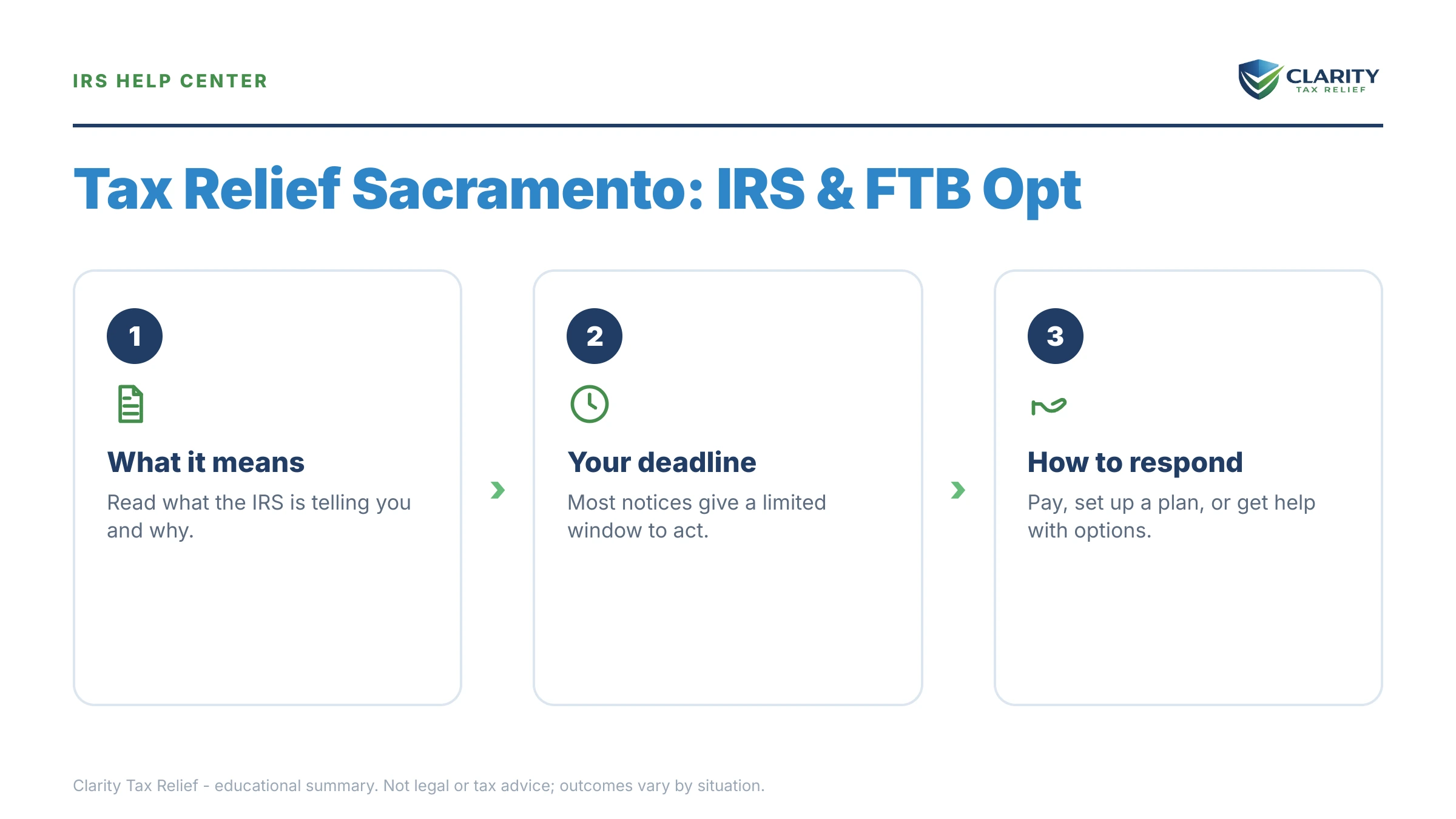
What happens if you ignore IRS and FTB collections
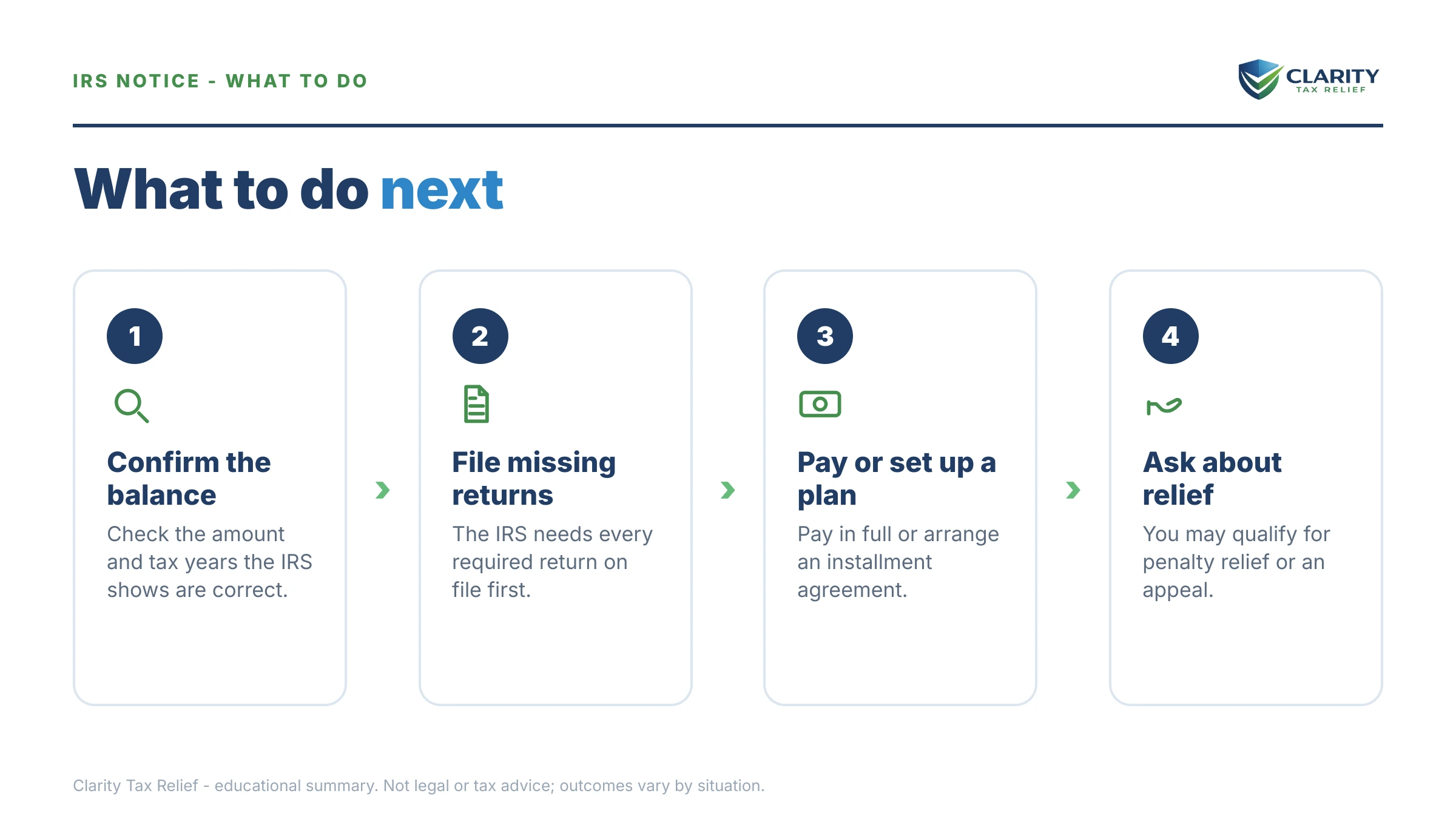
Ignoring the notices pauses nothing — both agencies escalate on autopilot, and in 2026 those automated systems run whether or not a human ever reviews your file. On the IRS side, the sequence is fixed:
- CP14 — the first bill. You typically have about 21 days from the notice date before the sequence advances. No enforcement yet; this is the cheapest moment to act.
- CP501 / CP503 — reminder notices. Still just bills, but the balance grows every month with penalties and interest.
- CP504 — Notice of Intent to Levy under IRC §6331(d). The IRS can now seize your California state refund — an irony not lost on Sacramento readers — and a federal tax lien becomes a live risk.
- LT11 / Letter 1058 — Final Notice of Intent to Levy. A 30-day clock starts, along with your right to a Collection Due Process hearing via Form 12153. After the 30 days, wage and bank levies are legal.
- Levy — a bank levy freezes funds with a 21-day hold before the money leaves; a wage levy is continuous until released.
The FTB runs its own track in parallel: a balance-due notice, then a demand for payment, then an intent-to-levy notice — and then bank levies and FTB wage garnishment through administrative earnings withholding orders that require no court judgment. For the state's largest delinquencies, the FTB also publishes a public Top 500 list that can trigger state license consequences. The exact windows are printed on each FTB notice; treat those dates as hard.
| Notice | What it means | Your window |
|---|---|---|
| CP14 | First bill for a balance due | Typically 21 days from the notice date |
| CP501 / CP503 | Reminders; balance still growing monthly | The date printed on the notice |
| CP504 | Intent to levy your state tax refund (IRC §6331(d)) | The deadline printed on the notice |
| LT11 / Letter 1058 | Final notice; wage and bank levies become legal | 30 days to request a CDP hearing (Form 12153) |
| Levy | Bank funds held 21 days before release to the IRS; wage levy runs until released | Act immediately — release is still possible |
IRS letters on one side, FTB notices on the other?
Send us photos of both. An experienced tax professional will map exactly where each agency stands, which clock is shortest, and the cheapest sequence to resolve them — free and confidential. Penalties and interest are accruing on both balances while you wait.
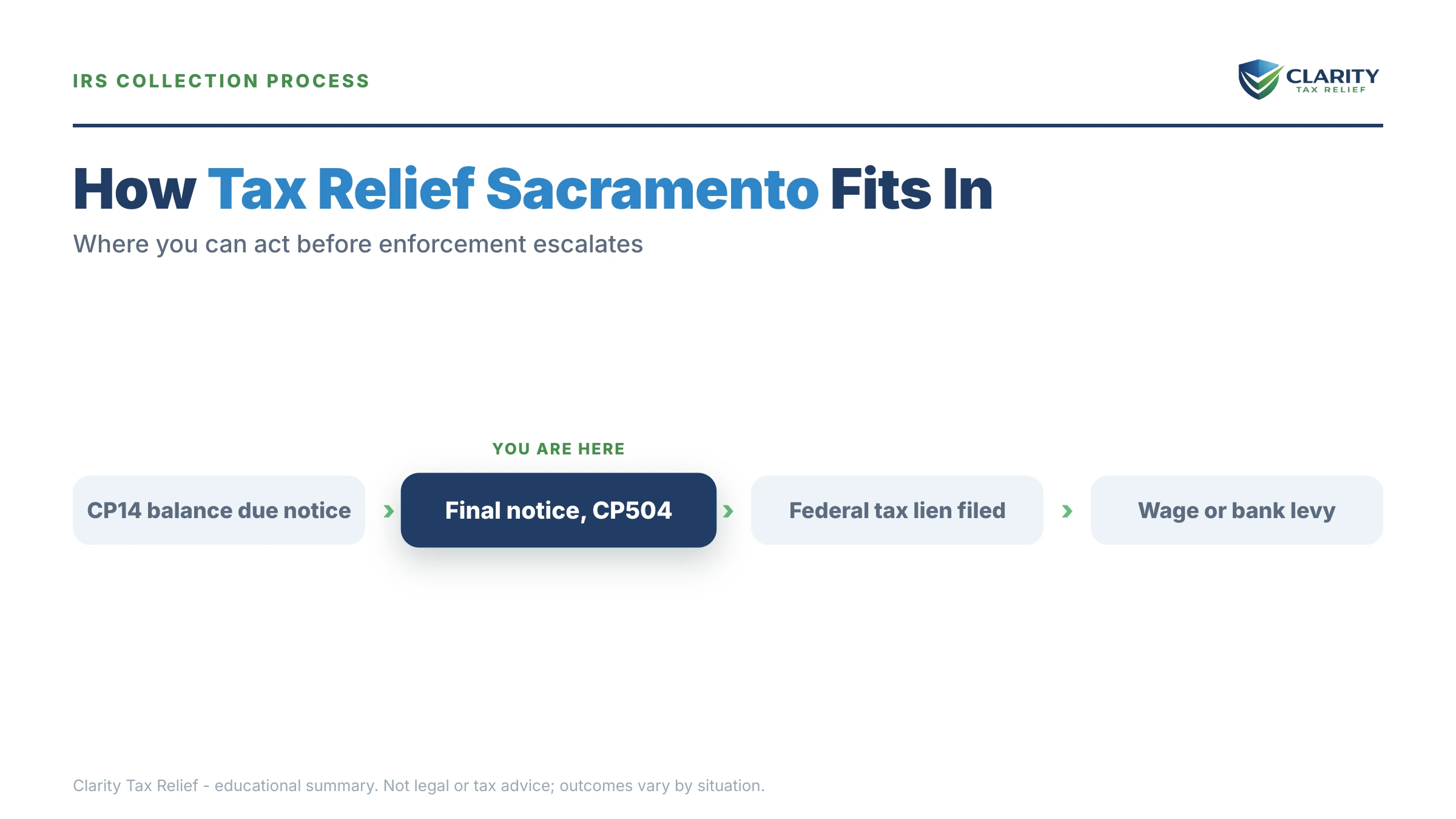
Tax relief options in Sacramento: every real program (2026)
Both the IRS and the FTB offer payment plans, hardship status, penalty relief, and offer-in-compromise programs — eight distinct programs in total, each with its own eligibility line. Here's the full menu:
| Program | Who typically qualifies | Cost & key facts |
|---|---|---|
| IRS short-term plan | Can pay in full within 180 days | $0 setup; interest and penalties still accrue |
| IRS streamlined installment agreement | Balance ≤ $50,000 | Up to 72 months, set up online; setup fee lower with direct debit |
| IRS non-streamlined agreement | Balance over $50,000 | Requires Form 433-F financial disclosure |
| Currently Not Collectible (CNC) | Income covers only allowable living expenses | $0; collection pauses but the debt and interest remain |
| IRS Offer in Compromise | Assets + future income can't cover the debt | $205 fee + 20% down on lump-sum offers (both waived with low-income certification); roughly 1 in 5 accepted in FY2024 |
| IRS penalty abatement (FTA / AEP) | Clean compliance the prior 3 years, or reasonable cause | Free; AEP becomes automatic starting summer 2026 |
| FTB installment agreement | California balance; FTB's own criteria | Apply through the FTB directly; separate from any IRS plan |
| FTB Offer in Compromise | Can't pay the state in full now or in the future | Separate application and review from the IRS program |
IRS payment plans. Under $50,000, a streamlined agreement can usually be approved online with no financial disclosure, spread over up to 72 months. Over that line, the IRS wants a Form 433-F and the rules change substantially — our guide to an IRS payment plan over $50,000 walks through what the disclosure reveals and how to prepare it.
Offer in Compromise. Real, but math-driven: the IRS accepts an offer only when your equity plus future income genuinely can't cover the balance before the collection statute runs. If your AGI is at or below 250% of the federal poverty level, low-income certification waives the fee, the 20% down payment, and payments during review. And a quirk in your favor: if the IRS doesn't decide within 2 years, the offer is accepted by default — though with narrow exceptions, a returned or rejected offer stops the clock, and time during court disputes does not count.
Penalty relief. First-Time Abatement removes penalties for taxpayers with a clean prior three years — and starting summer 2026, the new Automatic Exemption from Penalty (AEP) applies this relief automatically, no request needed. Reasonable-cause relief covers illness, disaster, and other events beyond your control, on both federal and state penalties.
The FTB side. California runs parallel versions of nearly everything: an FTB payment plan, its own hardship status, and an FTB offer in compromise. None of them cross-honor the IRS's decisions — every program needs its own application, and the FTB applies its own criteria rather than the IRS thresholds above.
IRS vs. FTB: two collectors, two rulebooks
The FTB can collect a California tax debt for 20 years under R&TC §19255 — twice as long as the IRS's 10-year collection statute. That single difference reshapes strategy for Sacramento taxpayers: an old federal balance may be nearing expiration while the matching state balance has a decade or more of life left. Our guide to California's 20-year collection statute covers the state clock; you can estimate when your federal window ends with our CSED Calculator.
| Rule | IRS | FTB |
|---|---|---|
| Collection statute | 10 years from assessment (pausable by appeals, OIC, bankruptcy) | Generally 20 years (R&TC §19255) |
| Pre-levy final warning | LT11 / Letter 1058 with 30-day CDP hearing rights | Intent-to-levy notice; deadline printed on the notice |
| Wage garnishment | Continuous levy until released | Administrative earnings withholding order — no court needed |
| Settlement program | IRS Offer in Compromise | Separate FTB Offer in Compromise |
Worked example: $54,600 in IRS debt and a refinance on the calendar
Say you own a home in Elk Grove, you owe the IRS $54,600 across two tax years, and you're planning to refinance this year. This is purely hypothetical, but the math is exactly what a Sacramento homeowner in this spot faces:
- The $50,000 line. At $54,600 you're above the streamlined threshold, so the online 72-month plan isn't available and a Form 433-F disclosure is on the table. Pay the balance down by $4,601 — to $49,999 — and the streamlined plan opens up: $49,999 ÷ 72 months ≈ $695/month minimum, no financial disclosure. Keep the full $54,600 and a non-streamlined plan at the same term runs $54,600 ÷ 72 ≈ $758/month, if the IRS accepts your financials.
- The refinance problem. Above $50,000 with no agreement in place, a Notice of Federal Tax Lien becomes far more likely — and a lien recorded with the Sacramento County Clerk-Recorder clouds title and can stall underwriting. If a lien is already filed, tax lien subordination via Form 14134 can let the new mortgage take priority so the loan closes; with enough equity, the lender may instead pay the IRS through escrow.
- The cost of waiting. The failure-to-pay penalty runs 0.5% per month — about $273/month on $54,600 — plus interest, on top of whatever the FTB is charging on any matching state balance.
- The passport check. At $54,600 you're below the 2026 passport-certification threshold of $66,000, but accruing penalties and interest can close that gap within a few years of inaction.
The sequencing lesson: for this homeowner, scraping together $4,601 before applying is worth far more than $4,601 — it buys a simpler agreement, a lower monthly payment, and a much cleaner path through underwriting.
How to get tax relief in Sacramento, step by step
- Gather every notice from both agencies. Pull together every IRS letter and every FTB notice, and write down the response date printed on each one.
- Pull your account records. Log into your IRS online account for balances and transcripts, and register for MyFTB to see your California account.
- File any missing returns. Neither agency will approve a payment plan or an offer while required returns are unfiled.
- Match each balance to a program. Use the options table above — the IRS and the FTB each need their own application.
- Set up both agreements before the next notice lands. An active arrangement stops the automated escalation on that agency's side of your case.
- Request penalty relief once you're in compliance. Ask about first-time abatement or reasonable cause after the agreements are in place — not before.
Federal applications run through the IRS payment plans page; California applications run through the Franchise Tax Board directly.
When you can handle this yourself — and when help changes the outcome
You can set up most simple payment plans yourself, for free, in under an hour. If you agree with the balances, have all returns filed, and owe amounts each agency's online tools can handle, do it yourself — our how to settle tax debt yourself guide walks through the whole DIY path, and the Taxpayer Advocate Service is a free federal resource when the IRS itself is the obstacle.
Experienced help tends to change the outcome in five Sacramento situations: an FTB earnings withholding order or IRS levy already in motion; a refinance or sale on a deadline with a lien in the way; multiple unfiled years across both agencies; business debt involving the EDD, CDTFA, or payroll taxes — see our tax relief for small business guide; and offer-in-compromise math, where a miscalculated offer wastes months and money. The honest test: if both agencies are involved and enforcement has started, coordination is the product you're buying — not access to secret programs, because there are none.
Choosing a tax relief company in Sacramento
The best tax relief company for a Sacramento case is usually the one with real FTB experience — not the one with the biggest ad budget. Because your case is almost certainly two-agency, ask any firm directly: how many FTB installment agreements and FTB offers has your team filed? Many national brands handle the IRS competently and treat California as an afterthought, which leaves half your problem unsolved.
Ignore anyone promising to settle for "pennies on the dollar" before seeing your transcripts — that phrase is the signature of the offer-mill scam, and the IRS's own data shows only about 1 in 5 offers were accepted in FY2024. Legitimate firms review first and quote after. Our how to choose a tax relief company checklist covers the questions that expose the mills, and if you're comparing the big names, start with our Optima Tax Relief alternatives breakdown.
Sacramento tax relief questions, answered
Do I need a local Sacramento tax relief company?
No — IRS and FTB cases are worked by phone, mail, fax, and online portals, not across a desk. A representative in another state can file a power of attorney and negotiate the same agreements a local firm can. What actually matters for a Sacramento case is California experience: many national firms handle the IRS side well but have never filed an FTB installment agreement or an FTB offer.
Can the IRS and the FTB both collect from me at the same time?
Yes. They are separate governments with separate debts, and neither waits for the other. You can be on an IRS payment plan and still get levied by the FTB, or the reverse. Each balance needs its own resolution — an IRS installment agreement, offer, or hardship status does nothing to a California liability, and an FTB arrangement does nothing to a federal one.
How long can the FTB collect back taxes in California?
Generally 20 years under Revenue and Taxation Code section 19255 — twice the IRS's 10-year collection statute. That is why waiting out a California balance almost never works. The federal clock can also be paused by events like a pending offer, bankruptcy, or a collection appeal, so the real end dates on both sides depend on your account history.
Does the FTB have its own Offer in Compromise?
Yes. The FTB runs its own offer program with its own application and its own review — an accepted IRS offer does not settle a California balance, and the reverse is also true. Like the IRS version, approval turns on proof that you cannot pay the full amount now or in the foreseeable future. Taxpayers who qualify for one often apply to both agencies in parallel.
Will a tax lien stop me from refinancing my Sacramento home?
Not automatically, but it usually stalls the loan until the lien is addressed. If there is enough equity, the IRS can be paid from escrow at closing. If not, Form 14134 asks the IRS to subordinate its lien — letting the new mortgage take priority so the refinance can close. Lenders see this regularly; the key is starting the subordination request before your rate lock expires.
How much does tax relief cost in Sacramento?
It depends on what your case needs, not your ZIP code. Setting up a simple IRS payment plan yourself costs only the IRS setup fee, and a short-term plan has no setup fee at all. Professional representation typically runs from several hundred dollars for a straightforward agreement to several thousand for an offer in compromise or a two-agency case with unfiled returns. Be wary of any firm quoting a large fee before reviewing your transcripts.
Can the FTB garnish my wages without going to court?
Yes. The FTB can issue an earnings withholding order to your employer administratively — no lawsuit or court judgment required — and it can levy bank accounts the same way. These orders usually follow written notices, so the letters you are receiving now are the warning phase. Setting up an FTB payment arrangement before an order reaches your employer is far easier than getting one released afterward.
Is the IRS too understaffed in 2026 to collect from Sacramento taxpayers?
No. The IRS workforce shrank roughly 27% in 2025, which makes humans harder to reach — but collection notices, lien filings, and levies are generated by automated systems that never stopped running. Understaffing mostly hurts taxpayers trying to fix problems by phone. The practical takeaway: respond in writing or online, keep proof of everything, and never assume silence means your case went away.
Your next 24 hours
- Sort your letters by agency and date. Find the most recent IRS notice and the most recent FTB notice, and circle the response date printed on each — those two dates are your real deadlines.
- Gather three things: your last filed federal and California returns, every notice from both agencies, and a rough picture of your monthly income and expenses.
- Get the two-agency review, free. Call (888) 825-7779 or use the 2-minute form — an experienced tax professional will map both balances and the cheapest order to resolve them, while penalties and interest are still small.
This guide is general information, not tax or legal advice for your specific situation. Eligibility for IRS programs depends on individual facts and circumstances; no outcome is guaranteed.