
City Tax Relief Guides
Tax Relief in New Orleans: Your 2026 Guide to IRS and Louisiana Options
The short answer: tax relief in New Orleans means resolving debt with two separate collectors — the IRS and the Louisiana Department of Revenue. Federal options include payment plans up to 72 months, Offers in Compromise, hardship status, and penalty relief. Louisiana runs its own separate programs, and the order you resolve them in matters.
Maybe it was a strong year of tips and gig income with nothing withheld, or a storm season that pushed the returns to the bottom of the pile. Either way, there's a balance now — federal, state, or both — and it's sitting between you and plans you've already made, like the refinance you've been pricing. This is the full map of tax relief New Orleans taxpayers can actually use in 2026: what each option requires, what it costs, and what none of them will do.
⏱ The real clock: tax debt has no single deadline, but the meter never stops. The IRS failure-to-pay penalty adds 0.5% per month on top of compounding interest, and every collection notice you receive starts its own response window. Whatever date is printed on your most recent notice is the one that controls right now.
Why New Orleans taxpayers end up owing
New Orleans runs on income the tax system handles badly: tips, gigs, seasonal work, and self-employment with no withholding. Servers and bartenders in the Quarter get W-2s that understate what actually hit their pockets. Musicians, festival crews, tour guides, and short-term-rental hosts get 1099s — and a 1099 means nobody set aside a dime for the IRS. Contractors doing rebuild and renovation work face the same math on a bigger scale.
Storm seasons add a second layer. When FEMA declares a disaster for Orleans Parish, the IRS grants automatic deadline extensions — but shifted deadlines are exactly how returns slip through the cracks, and a missed extended deadline still generates penalties. Our guide to disaster-relief deadline extensions covers how those windows actually work.
The result: a balance that grew quietly for a year or two before the first serious notice arrived. The good news is that every IRS resolution program is available to you regardless of where you live — the work is done by phone, mail, and IRS.gov, not at a local counter.
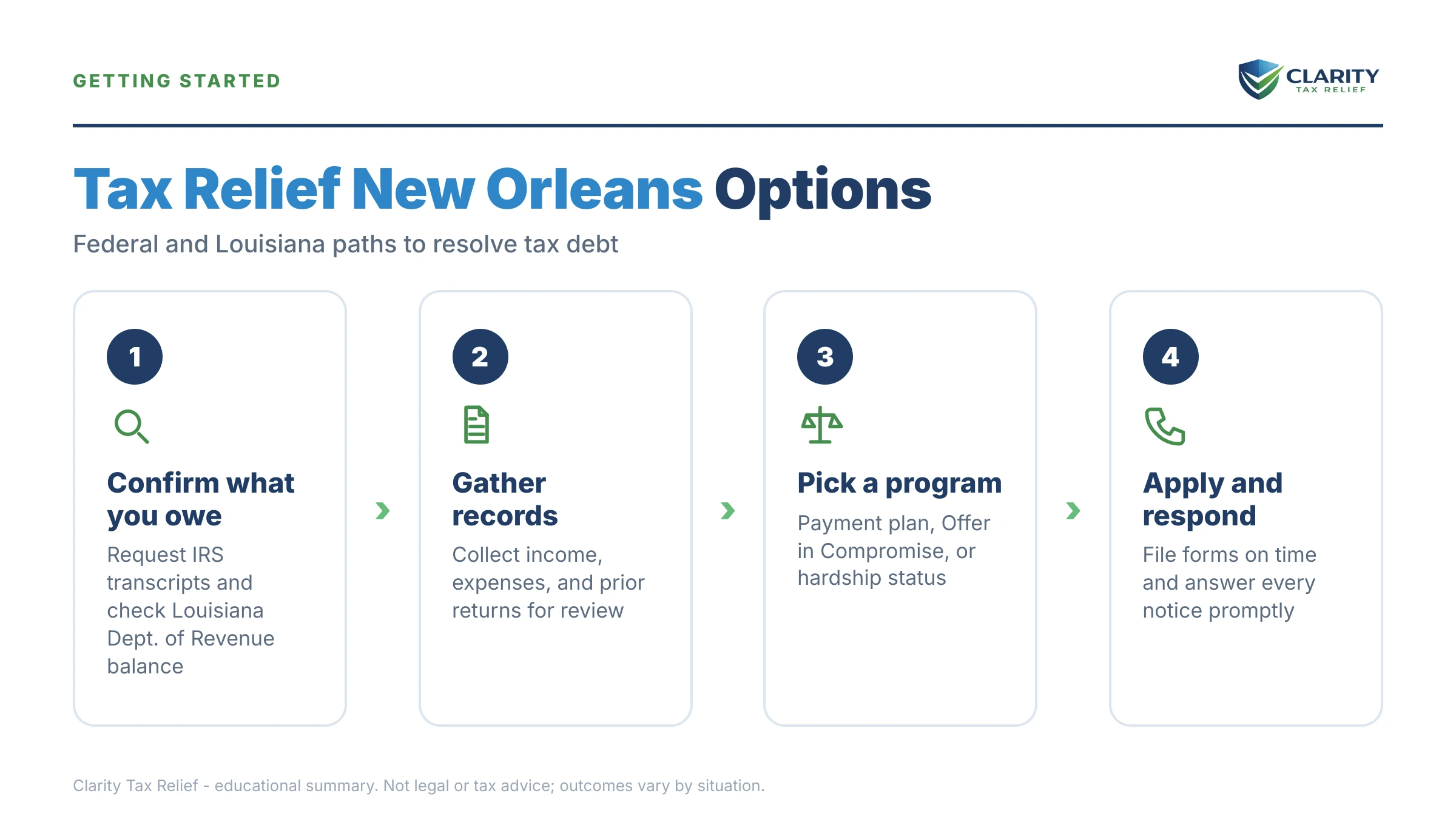
One debt, two collectors: the IRS and the Louisiana Department of Revenue
Unlike taxpayers in Texas or Florida, New Orleans residents can owe income tax to two agencies at once. The IRS collects the federal side and generally has 10 years from the date of assessment to collect (the CSED), a clock that can be paused by appeals, an Offer in Compromise, or bankruptcy. The Louisiana Department of Revenue, headquartered in Baton Rouge, collects the state side under its own rules, its own notices, and its own timelines — resolving your IRS balance does nothing to a state balance, and vice versa. Our Louisiana back taxes guide covers the state side in depth.
The two systems also talk to each other. Under the State Income Tax Levy Program, the IRS can grab your Louisiana refund to pay federal debt — that's exactly what a CP504 notice threatens. When you owe both, sequencing matters: usually you stabilize whichever agency is escalating fastest, then work the other. See state tax debt vs IRS — which to resolve first for the decision framework.
One more Louisiana wrinkle: this is a community property state. That means one spouse's tax debt can, in some situations, reach community income and assets — and it changes how innocent-spouse claims are analyzed. If your balance traces to a spouse or ex-spouse, read about community property tax relief before assuming the debt is only theirs.
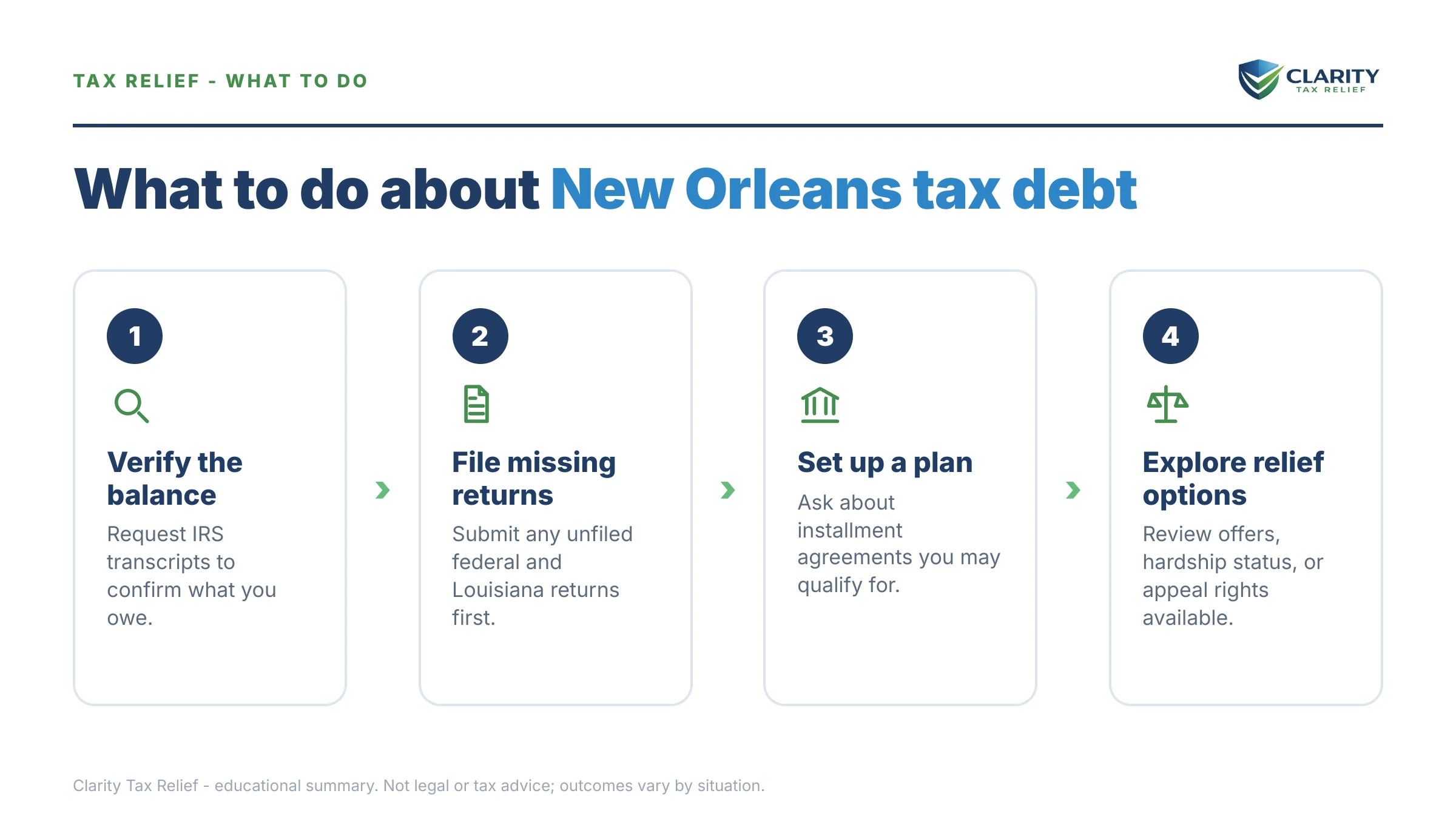
What happens if you ignore IRS tax debt in New Orleans
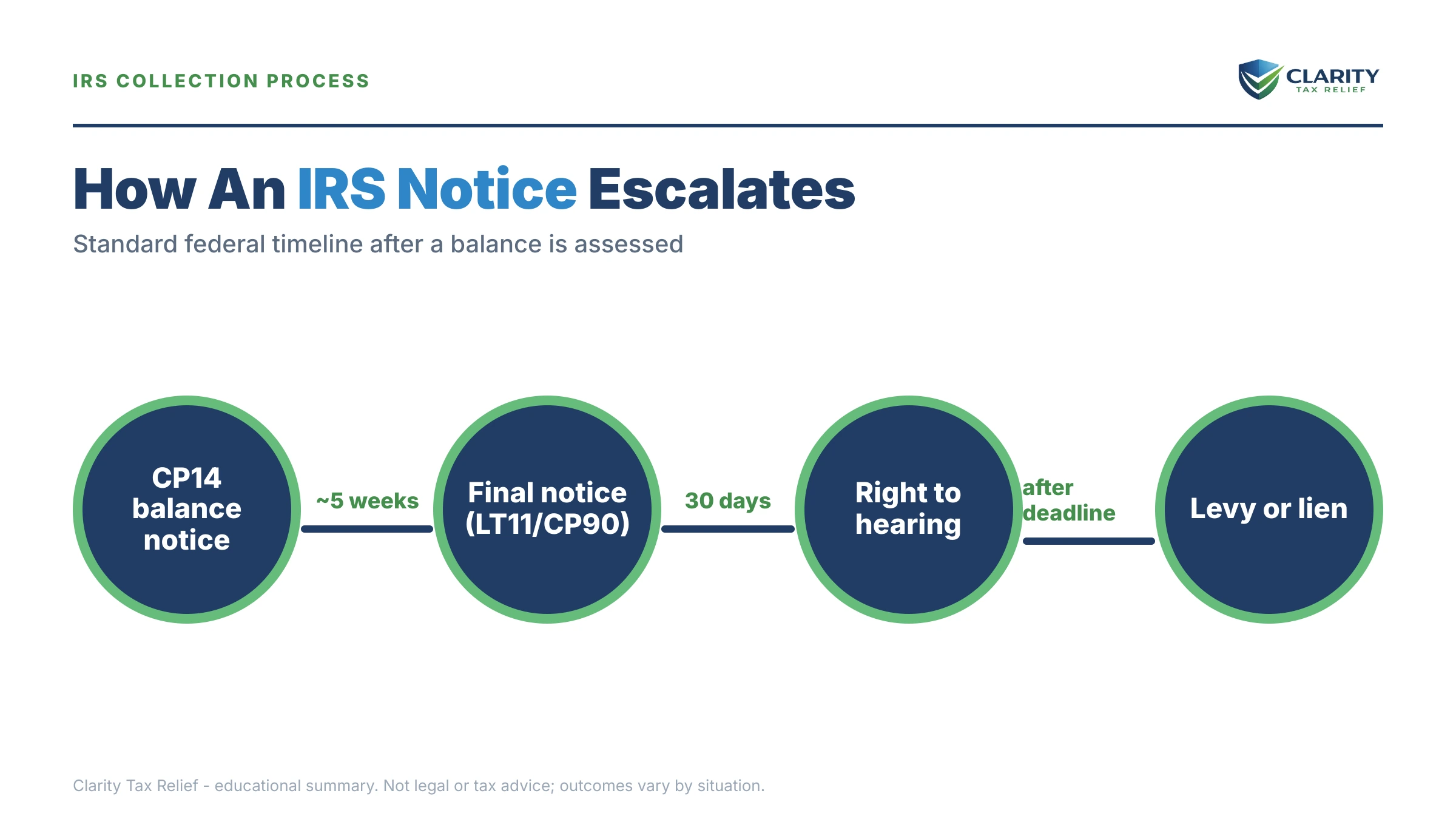
Unresolved IRS debt follows an automated escalation path that ends in wage garnishment, bank levies, and a public lien on your home. No human decides to escalate your file — the system does it on schedule, and the 2025 IRS workforce cuts of roughly 27% thinned the people who answer phones, not the computers that issue levies. Here is the sequence:
- CP14 — the first bill. Typically about 21 days to pay before the next notice queues up. No enforcement yet.
- CP501 / CP503 — reminder notices. Still just bills, but the balance grows every month they sit unanswered.
- CP504 — Notice of Intent to Levy under IRC §6331(d). The IRS can now seize your Louisiana state refund, and a Notice of Federal Tax Lien becomes a live possibility — the single worst outcome if a refinance is in your plans.
- LT11 / Letter 1058 — the Final Notice of Intent to Levy. This starts a 30-day clock and your Collection Due Process rights (requested on Form 12153). After 30 days, wages and bank accounts are fair game.
- Levy and garnishment — a bank levy freezes funds for a 21-day hold before they're sent to Treasury; a wage levy is continuous until released.
Two more consequences ride alongside the notices. A lien can be filed at almost any point once the balance is assessed and unpaid — it attaches to your home the moment it hits the parish records. And if a balance grows past $66,000 (the 2026 threshold), the IRS can certify it to the State Department, which can deny or revoke your passport. A $36,900 debt is well under that line today; three years of penalties, interest, and another unpaid year can change that.
| Notice | What it means | Your window |
|---|---|---|
| CP14 | First bill for a balance due | Typically 21 days from the notice date |
| CP501 / CP503 | Reminder bills — balance still growing | The pay-by date printed on the notice |
| CP504 | Intent to levy your Louisiana state refund; lien risk rises | The date printed on the notice (typically about 30 days) |
| LT11 / Letter 1058 | Final notice — wage and bank levies authorized after this | 30 days to request a CDP hearing (Form 12153) |
| After LT11 | Bank levy (21-day hold) or continuous wage levy | Fastest fix: get into an agreement or hardship status |
Owe the IRS or Louisiana — with a refinance or closing on the line?
Get your notices and balances reviewed free before a lien hits the parish records. Penalties and interest are accruing monthly either way — an experienced tax professional can map your fastest, cheapest path in one call.
Your tax relief options in New Orleans
The IRS offers five main resolution paths, and a typical mid-five-figure New Orleans balance qualifies for most of them. Which one fits depends on your income, assets — including home equity — and how fast you need the account stabilized. The full do-it-yourself mechanics for each live in our guide to how to settle tax debt yourself; here's the decision layer.
| Option | Who typically qualifies | Cost & key terms |
|---|---|---|
| Short-term payment plan | Can pay in full within 180 days | $0 setup fee; interest and penalties continue until paid |
| Guaranteed installment agreement | Owe $10,000 or less, returns filed | Approval is by statute; modest setup fee; up to 36 months |
| Streamlined installment agreement | Owe $50,000 or less | Up to 72 months, set up online, no financial disclosure; direct debit generally required above $25,000 |
| Offer in Compromise | Assets + future income genuinely can't cover the debt | $205 fee + 20% down on lump-sum offers (both waived with low-income certification); roughly 1 in 5 offers accepted in FY2024 |
| Currently Not Collectible | Paying anything would prevent basic living expenses | Free; requires financial disclosure (Form 433-F); pauses collection, debt and interest remain |
| Penalty abatement | Clean 3-year compliance history, or reasonable cause (illness, disaster) | Free to request; removes penalties, not tax or interest |
A note on the Offer in Compromise, because it's the option every ad oversells. The IRS decides offers by computing your Reasonable Collection Potential — your asset equity plus a multiple of your monthly disposable income. If that number covers the debt, the offer is rejected no matter how persuasive the paperwork. For a homeowner, home equity usually counts toward RCP, which is why homeowners with refinance-level equity rarely qualify. You can estimate your own numbers with our Offer in Compromise Calculator before spending anything to pursue one.
On penalties: if the years before your problem year were clean, first-time penalty abatement can strip the failure-to-pay penalty from one year — and starting summer 2026, the IRS's new Automatic Exemption from Penalty (AEP) begins applying similar relief automatically, no request needed. Hurricane-related reasonable cause is also a genuinely strong argument in Orleans Parish; document the disaster's effect on your ability to file or pay.
A worked example: resolving $36,900 before a refinance
Say you owe the IRS $36,900 across two tax years and you're a homeowner hoping to refinance within six to nine months. This is hypothetical, but the arithmetic is real:
- Streamlined installment agreement: $36,900 is under the $50,000 ceiling, so you can set up a 72-month plan online with no financial disclosure. $36,900 ÷ 72 ≈ $513 per month before accruals; because you're over $25,000, expect a direct-debit requirement. A bonus most people miss: while an installment agreement is in effect, the failure-to-pay penalty drops from 0.5% to 0.25% per month.
- For the refinance: your lender will typically count that ~$513 in your debt-to-income ratio. Many lenders will approve with an active IRS agreement and payment history — provided no lien has been filed. That's why moving before the CP504/lien stage is worth real money.
- Offer in Compromise check: if you hold, say, $80,000 in home equity, your Reasonable Collection Potential already exceeds $36,900 before the IRS even looks at your income — an OIC would be rejected. This is the honest answer most homeowners in your position need to hear before paying a firm to file one.
- Cash-out alternative: if your refinance itself can produce $36,900 at closing, paying the IRS in full from proceeds ends penalties and interest immediately — but the sequencing has to be handled with your lender and title company so the debt doesn't block the very loan meant to pay it.
Owing the IRS when you're planning to refinance in New Orleans
A filed federal tax lien — not the debt itself — is what blocks most New Orleans refinances. Until a Notice of Federal Tax Lien hits the Orleans Parish mortgage and conveyance records, your tax debt is between you and the IRS; underwriters see it only through what you disclose and your tax transcripts. Once a lien is filed, it attaches to your home, becomes public record, and jumps into the title search.
Your position determines the play:
- No lien filed yet: get into an installment agreement now. Staying current on a streamlined direct-debit agreement generally keeps you out of lien territory, and lenders can work with a documented plan. Details in can I refinance with an IRS lien.
- Lien already filed: you'll usually need a certificate of subordination — Form 14134 — where the IRS agrees to let the new mortgage take priority ahead of its lien so the loan can close. Plan on at least 45 days of IRS processing time before your closing date, and expect the IRS to want the refinance to benefit collection (for example, proceeds going toward the debt).
- Balance at or under $25,000: a different door opens — pay the balance down to $25,000 or less, get on a direct-debit agreement, and after a run of consecutive payments you may be able to request full lien withdrawal on Form 12277, which removes the lien from the record entirely rather than just repositioning it.
The theme is timing. Every one of these paths is cheaper and faster when started before the lender orders title work — and dramatically harder in the two weeks before closing.
How to start resolving your tax debt, step by step
- Pull your IRS account records. Set up an IRS online account to confirm the exact balance, which tax years it covers, and whether a Notice of Federal Tax Lien has been filed.
- Confirm your Louisiana balance. Contact the Louisiana Department of Revenue or check its online portal for any state-side balance and open notices — federal fixes do not touch state debt.
- File every missing return. The IRS will not approve a payment plan or consider an offer while required returns are unfiled, so compliance comes first.
- Match your numbers to an option. Under $50,000 with steady income usually means a streamlined installment agreement; genuine hardship points to Currently Not Collectible; a true inability to ever pay in full points to an Offer in Compromise.
- Protect your refinance before you apply. Search the parish mortgage and conveyance records for a filed lien, and if one exists, start the subordination request early — well before your lender orders title work.
When you can handle this yourself — and when help changes the outcome
Plenty of New Orleans tax problems don't need a hired professional. If you agree with the balance, it's under $50,000, your returns are filed, and no lien or levy is in motion, you can set up a streamlined plan on IRS.gov in under an hour — the online agreement is the single most underused fix in tax resolution. If money is tight, free help exists: the Taxpayer Advocate Service maintains a directory of Low Income Taxpayer Clinics that represent qualifying taxpayers at no charge, and the downtown New Orleans Taxpayer Assistance Center handles account questions by appointment (844-545-5640).
Experienced help earns its fee when the stakes or complexity jump: a lien filed with a closing date approaching, balances with both the IRS and LDR, multiple unfiled years, business or payroll tax debt, a levy already in motion, or OIC math complicated by home equity and self-employment income. In those cases the order of operations — returns, penalties, lien strategy, then the balance — changes what you ultimately pay, and mistakes are expensive to unwind. Fee ranges and pricing models are covered honestly in how much does tax relief cost.
If you do hire, vet before you sign. Our how to choose a tax relief company checklist covers credentials and fee red flags; if you're comparing the big national brands, start with our Optima Tax Relief alternatives breakdown. Business owners with payroll or sales tax exposure should read the tax relief for small business buyer's guide — business debt follows different rules entirely.
Terms you'll see, decoded
- Notice of Federal Tax Lien (NFTL): the public filing that attaches the IRS's claim to your property, including your home — the document title companies flag.
- Subordination: the IRS agreeing to let a new mortgage take priority ahead of its lien so a refinance can close (the lien itself stays).
- CSED: the Collection Statute Expiration Date — generally 10 years from assessment, after which the IRS can no longer collect, though appeals, offers, and bankruptcy pause the clock.
- Streamlined installment agreement: a payment plan for balances of $50,000 or less that can be set up online, over up to 72 months, without submitting financial statements.
- Currently Not Collectible (CNC): a hardship status that pauses IRS collection when paying would leave you unable to cover basic living expenses; the debt and interest remain.
- Community property: Louisiana's marital-property system, under which income and assets acquired during marriage generally belong to both spouses — which can expose one spouse to the other's tax debt.
Tax relief in New Orleans: your questions, answered
Is there an IRS office in New Orleans?
Yes — the IRS operates a Taxpayer Assistance Center in downtown New Orleans, but it is appointment-only; call 844-545-5640 to schedule. TACs can help with account questions, transcripts, and identity verification, but they do not negotiate settlements or evaluate offers. After the roughly 27% IRS workforce reduction in 2025, appointments book out further ahead, so for payment plans the online tools at IRS.gov are usually faster.
Does Louisiana have its own tax relief programs?
Yes. The Louisiana Department of Revenue collects state tax debt separately from the IRS, with its own notices, payment arrangements, and resolution processes. An IRS payment plan does nothing for a state balance, and vice versa. Because state program terms and windows differ from federal rules, confirm current requirements directly with LDR before assuming an IRS-style option exists on the state side.
Can I refinance my New Orleans home if I owe the IRS?
Often, yes. If no federal tax lien has been filed, many lenders will approve a refinance when you are on an IRS installment agreement, counting the monthly payment in your debt-to-income ratio. If a lien has been filed, you will typically need a certificate of subordination (Form 14134) so the new mortgage can take priority — plan on at least 45 days for the IRS to process it before closing.
How much does tax relief cost in New Orleans?
Setting up an IRS payment plan yourself costs little — short-term plans have no setup fee, and long-term plans carry a modest fee that is reduced or waived for low-income taxpayers. Professional representation on a mid-five-figure, two-agency case typically runs four figures depending on complexity. Be wary of any firm that quotes a settlement amount before reviewing your complete finances — eligibility is means-tested, not promised.
Do hurricane disaster declarations extend IRS deadlines in New Orleans?
Yes — when FEMA issues a federal disaster declaration covering Orleans Parish, the IRS automatically postpones filing and payment deadlines that fall within the relief window for affected taxpayers. That relief applies to current deadlines, though: it does not erase older balances, and interest on pre-existing debt generally keeps accruing. Check the IRS disaster relief page for whether an active declaration covers your parish before relying on an extension.
Is my spouse responsible for my tax debt in Louisiana?
Sometimes — Louisiana is a community property state, which means the IRS can in some cases reach community income and assets to collect one spouse's tax debt, and a joint refund can be applied to either spouse's balance. Innocent spouse and injured spouse rules still apply, but community property law adds extra wrinkles under IRC Section 66, so this is an area where the details of who earned what, and when, genuinely change the answer.
Do I need a local New Orleans firm or a national tax relief company?
Credentials matter far more than the office address. IRS resolution work is federal and handled almost entirely by phone, mail, and online tools, so an enrolled agent, CPA, or tax attorney anywhere in the country can represent you. Familiarity with the Louisiana Department of Revenue helps when you owe the state too. Whoever you consider, vet them on flat-fee transparency, real credentials, and whether they review your finances before promising anything.
Your next 24 hours
- Find your most recent notice. Note the notice number (CP14, CP503, CP504, LT11) and the date printed on it — that tells you exactly where you sit in the escalation sequence — then log into your IRS online account to confirm the total balance and years.
- Gather your paper. Last filed federal and Louisiana returns, every IRS and LDR notice you've received, your mortgage statement, and any refinance paperwork or lender pre-approval.
- Get a free case review. Call (888) 825-7779 or use the 2-minute form — an experienced tax professional will map your federal and state balances against your refinance timeline. There's no single deadline forcing your hand today, but penalties and interest compound monthly, and every month unresolved is a month closer to a lien on the parish records.
This guide is general information, not tax or legal advice for your specific situation. Eligibility for IRS programs depends on individual facts and circumstances; no outcome is guaranteed.