
Tax Relief by City
Tax Relief Fort Worth: Every Real IRS and Texas Option in 2026
The short answer: tax relief in Fort Worth is almost entirely federal — Texas has no state income tax, so most local tax debt is IRS debt. Your real options are an IRS payment plan, Currently Not Collectible status, penalty abatement, or an Offer in Compromise, plus the Texas Comptroller's separate process for business sales and franchise tax.
You run a business in Tarrant County, you've been robbing the tax account to make payroll, and now the IRS letters are stacking up next to the invoices you haven't sent yet. Or maybe it's simpler — a 1099 year that outran your withholding. Either way, the balance is real, it grows every month, and every option for fixing it still exists today. This guide maps all of them, in the order that actually works.
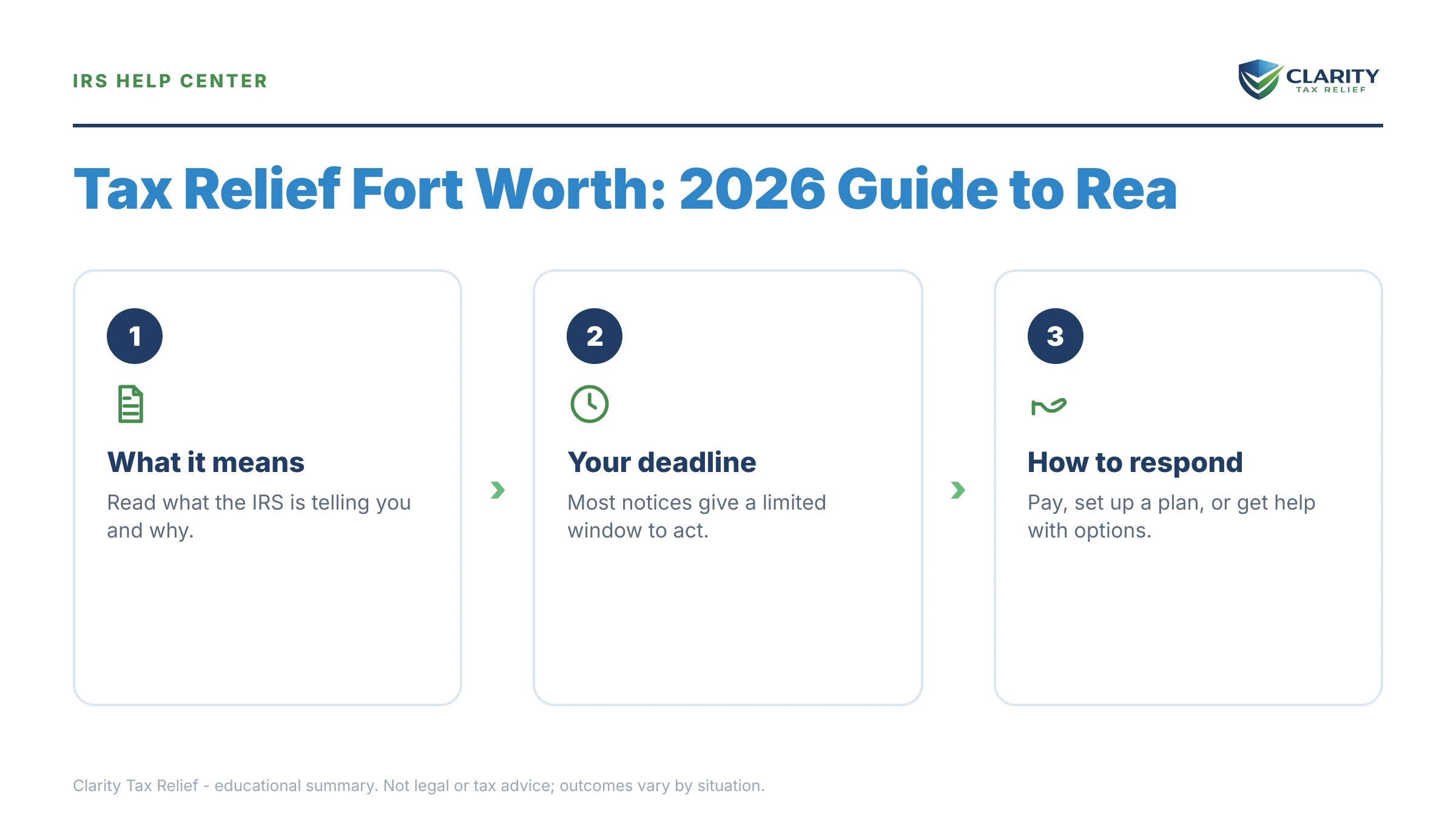
⏱ The real clock: there's no single deadline printed on a tax debt itself, but the meter never stops — the failure-to-pay penalty adds 0.5% of the balance every month and interest compounds daily until you put a resolution in place. Each IRS notice you receive also starts its own response window, printed on that notice.
Why Fort Worth taxpayers end up needing tax relief
Most IRS debt in Fort Worth traces to income that arrived without withholding attached. Contractors and trades working the DFW construction boom, owner-operators running out of Alliance, medical and dental practices, real estate agents, and every kind of 1099 side income — none of it has an employer quietly setting tax aside, and a missed year of quarterly estimates becomes a five-figure balance fast.
For business owners, the pattern is more dangerous: a slow quarter, and the payroll tax deposit becomes the loan of last resort. Withheld payroll tax is trust-fund money the IRS treats as its own, and falling behind on Form 941 deposits is the single fastest way to turn a business problem into a personal one — more on that below.
The Texas twist cuts both ways. There's no state income-tax collector chasing you alongside the IRS — a real advantage over taxpayers in California or New York. But if your business collects sales tax or owes franchise tax, the Texas Comptroller tax debt process runs on its own rules, separate from everything the IRS does.
What happens if you ignore IRS debt in Fort Worth
IRS collection is an automated sequence of notices, and each one carries more enforcement power than the last. Nobody in an IRS office is watching your file — the system escalates on its own schedule, and the 2025 workforce cuts of roughly 27% made humans harder to reach without slowing the machine at all. Here's the sequence, for individuals and for businesses:
- First bill (CP14 personal / CP161 business) — the balance, itemized. You typically have about 21 days before the next notice queues up. No enforcement yet; cheapest moment to act.
- Reminders (CP501, CP503 / CP163) — still just bills, but penalties and interest have been compounding the whole time.
- Intent to levy (CP504 / CP504B) — the IRS can now seize your state tax refund. For a Texas individual there's usually no state income-tax refund to take, which makes this notice feel toothless here — it isn't. It's the last stop before the final notice, and a federal tax lien filed in the Tarrant County records becomes a live possibility.
- Final notice (LT11 / Letter 1058) — this one has teeth. You get 30 days to request a Collection Due Process hearing on Form 12153. Let it pass and the IRS can levy bank accounts and garnish wages without further warning.
- Levy — a bank levy freezes funds for 21 days before they leave; a wage levy is continuous until released. For a business, the IRS can also levy accounts receivable — telling your customers to pay the IRS instead of you.
| Stage | Personal notice | Business (941) notice | The clock |
|---|---|---|---|
| First bill | CP14 | CP161 | Typically ~21 days before the next notice |
| Reminders | CP501 / CP503 | CP163 | Balance grows 0.5%/month plus daily interest |
| Intent to levy | CP504 | CP504B | State refund can be seized; lien risk rises |
| Final notice | LT11 / Letter 1058 | LT11 / Letter 1058 | 30 days to request a CDP hearing (Form 12153) |
| Enforcement | Bank levy (21-day hold), continuous wage levy | Business bank and accounts-receivable levies | Ongoing until released or resolved |
One more escalation worth knowing: once your assessed federal debt passes $66,000 (the 2026 threshold), the IRS can certify it to the State Department, which can deny or revoke your passport. And if payroll taxes are in the mix, a local revenue officer can pursue the trust-fund portion against you personally at any point in this sequence.
Behind with the IRS in Fort Worth?
Whether it's a personal balance or 941 payroll debt, an experienced tax professional can review your notices and transcripts free and map the resolution that fits your numbers — before penalties and interest add another month to the bill.
Tax relief in Fort Worth: every option and who qualifies
Every legitimate tax relief outcome in Fort Worth runs through one of six IRS programs — there is no secret local program, and no firm has access to options you don't. What a good firm changes is which program you land in and how the numbers are presented. Here's the full menu:
| Option | Who typically qualifies | Cost & key catch |
|---|---|---|
| Short-term payment plan | Can pay in full within 180 days | $0 setup; penalties and interest continue |
| Streamlined installment agreement | Individuals owing ≤ $50,000; up to 72 months | Online setup, no financial disclosure; interest accrues |
| Non-streamlined installment agreement | Balances over $50,000, or business debt | Form 433 financial disclosure; lien filing possible |
| Currently Not Collectible (CNC) | Paying anything would prevent covering basic living expenses | Collection pauses; debt and interest remain, refunds offset |
| Offer in Compromise (OIC) | Assets plus future income genuinely below the balance | $205 fee + 20% down on lump-sum offers (both waived with low-income certification); roughly 1 in 5 accepted in FY2024 |
| Penalty abatement (FTA / AEP / reasonable cause) | Clean prior 3 years, or documented circumstances beyond your control | Free to request; removes penalties, not tax or interest |
| Business payroll (941) resolution | Business current on this quarter's federal tax deposits | In-business trust-fund plans (smaller balances qualify for expedited terms); Trust Fund Recovery Penalty exposure remains |
Three notes that change outcomes:
Penalty relief is the most underused option on the list. If your prior three years are clean, first-time penalty abatement can strip failure-to-file and failure-to-pay penalties from one year with a phone call. Starting in summer 2026, the IRS is rolling out the Automatic Exemption from Penalty (AEP), which applies similar relief automatically — so never let anyone charge you a large fee for relief you may already be entitled to.
An OIC is math, not mercy. The IRS calculates what it could realistically collect from your equity and future income; if that figure meets or exceeds your balance, the offer fails no matter how well it's written. The full mechanics live in our guide to how does an offer in compromise work.
Business debt plays by different rules. Payment plans for an operating business are shorter and stricter than individual plans, and the trust-fund portion of payroll debt can be assessed against owners personally. If that's you, start with our guide to 941 back taxes before negotiating anything.
The Texas Comptroller side: sales and franchise tax
If your Fort Worth business owes sales tax or franchise tax, that debt belongs to the Texas Comptroller of Public Accounts — not the IRS — and none of the IRS thresholds or timelines above apply to it. Collected-but-unremitted sales tax is trust money the state pursues aggressively, and responsible individuals can face personal exposure for it. The Comptroller runs its own payment-agreement and hearing processes; start with our overview of Texas back taxes, and when a state figure matters, confirm it with the Comptroller directly rather than assuming an IRS rule carries over.
A worked example: a Fort Worth business owner who owes $83,100
Say you own a Fort Worth HVAC company with six employees and you owe $83,100 total: $52,400 in unpaid 941 payroll taxes across four quarters, plus $30,700 on your personal 1040 from two thin years. This is hypothetical, but the math is exactly what an experienced tax professional would run:
- Sequence matters more than size. The 941 debt comes first, because the withheld portion of it can be assessed against you personally through the trust fund recovery penalty — even if the company later closes. Step zero is getting this quarter's deposits current; the IRS won't negotiate a plan while the hole is still deepening.
- The business balance needs financial disclosure. At $52,400, the company is above the expedited trust-fund plan range, so expect a Form 433-B financial statement and a negotiated monthly payment sized to the business's actual cash flow — the details are in our guide to an irs payment plan over 50000.
- The personal balance is the easy part. At $30,700, you're under the $50,000 streamlined ceiling: roughly $30,700 ÷ 72 ≈ $427 per month before accruals, set up online with no financial disclosure. Interest and the 0.5% monthly penalty keep running, so paying faster than the minimum saves real money — you can estimate the accrual on your own numbers with our Penalty & Interest Calculator.
- Penalty relief could shrink both. If the first delinquent year followed three clean ones, first-time abatement on that year — plus reasonable-cause arguments on the payroll penalties if, say, a major customer default caused the shortfall — can cut thousands off the total before any payment plan is even priced.
Could this owner settle for less through an OIC? Only if the business equity, personal assets, and future income together genuinely can't cover $83,100 — and with an operating company that pays its owner, they usually can. That's why plan-plus-abatement, not settlement, is the realistic path for most Fort Worth business cases.
How to get tax relief in Fort Worth, step by step
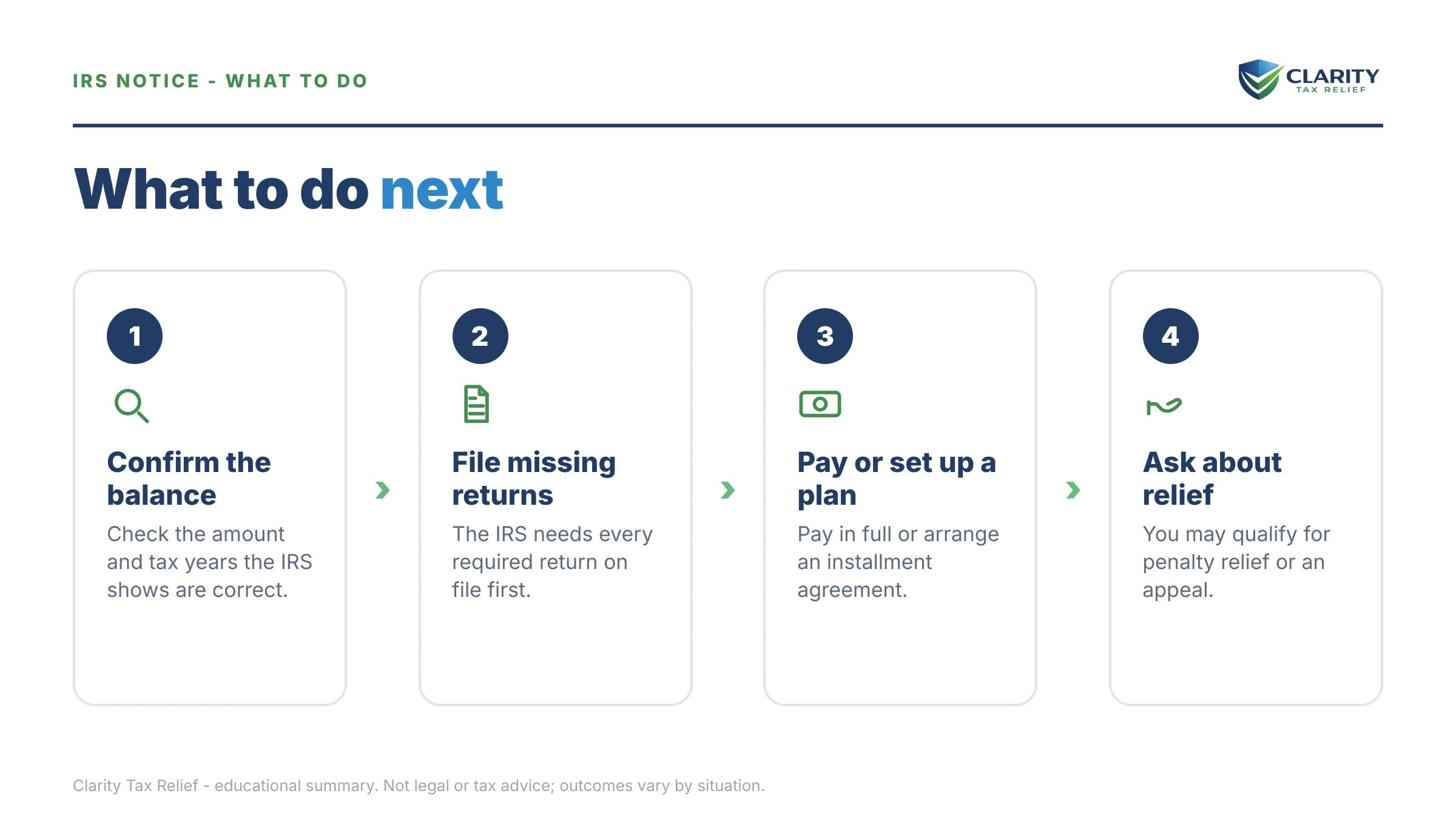
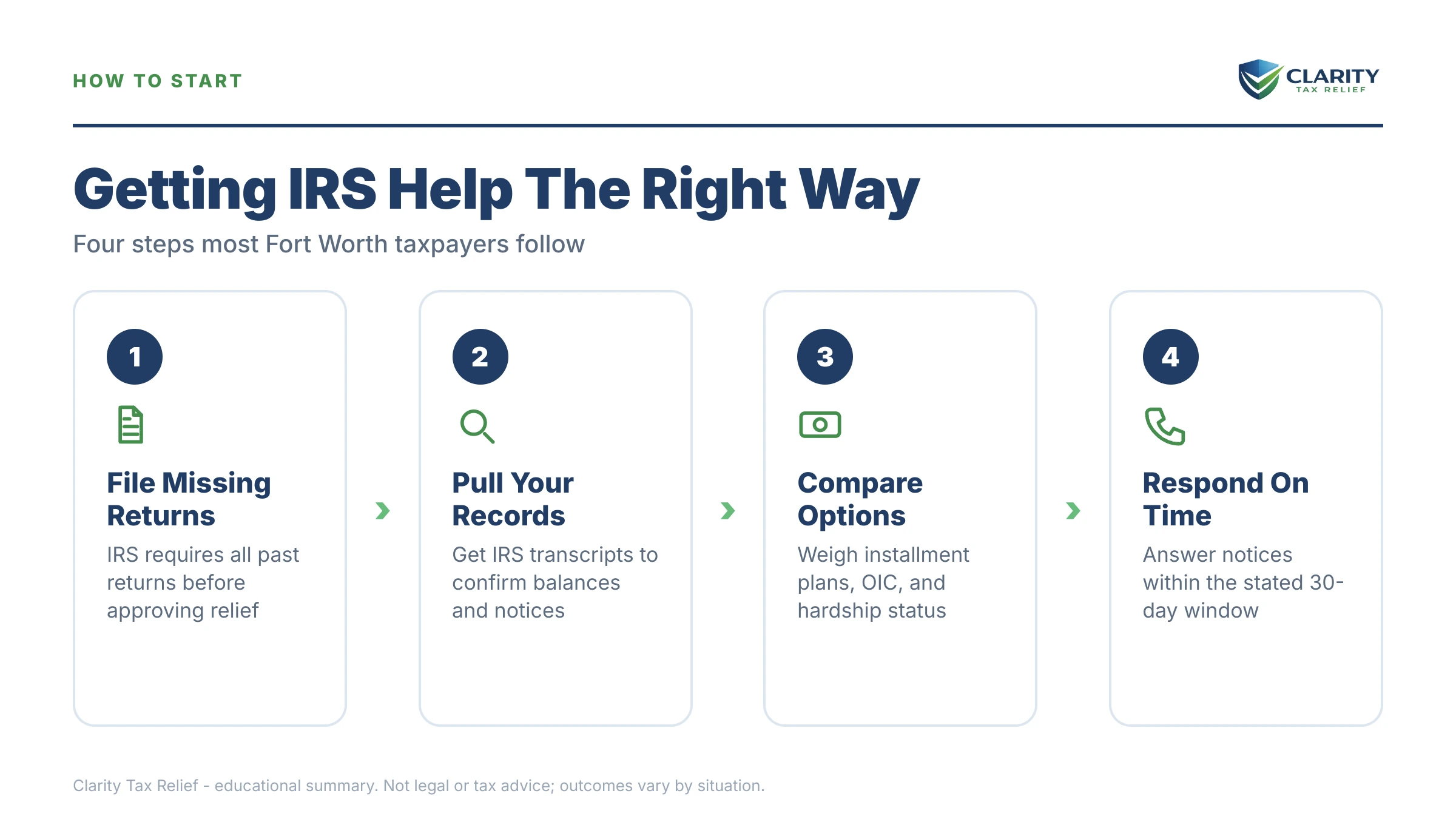
- Pull your IRS records — set up an IRS online account and download your account transcripts so you know the exact balance, years, and penalties before you negotiate anything.
- Get compliant first — file any unfiled returns and, if you run payroll, get this quarter's federal tax deposits current, because the IRS will not approve any resolution while you are still falling behind.
- Match your balance to a program — use the options table above to identify which resolution your balance and finances actually fit, then apply online at IRS.gov or by filing Form 9465.
- Request penalty relief — ask for First-Time Abatement if your prior three years are clean, or reasonable-cause relief if illness, disaster, or events beyond your control caused the debt.
- Set it up and protect it — finalize the agreement before the next notice escalates, adjust withholding or quarterly estimates so a new balance doesn't default the deal, and get a professional review first if a levy, payroll debt, or multiple unfiled years are involved.
Payments and plan applications go through IRS.gov/payments and the IRS payment plans page — never through anyone who asks for gift cards, wire transfers, or payment apps.
When you can handle this yourself — and when help changes the outcome
A large share of Fort Worth tax debts need no professional at all. If you owe under $25,000 or so on a personal return you agree with, have all your returns filed, and can afford a monthly payment, the streamlined online agreement plus a first-time abatement call is genuinely a do-it-yourself job — our hub on how to settle tax debt yourself walks through every form and phone script.
Experienced help earns its fee in specific situations: 941 payroll debt with Trust Fund Recovery Penalty exposure, a final notice or active levy where the 30-day CDP window is running, balances over $50,000 where the IRS demands financial disclosure (how you present the Form 433 changes the payment), multiple unfiled years that must be reconstructed before anything can be negotiated, and Offer in Compromise math, where a miscalculated offer wastes months and a nonrefundable down payment. Business owners should also read our tax relief for small business buyer's guide before hiring anyone.
One thing you never need to pay for: talking to the IRS's independent watchdog. If IRS delays or errors are causing you hardship, the Taxpayer Advocate Service is free. Fort Worth also has an IRS Taxpayer Assistance Center downtown for in-person account help — appointment only, so check irs.gov for current hours before going. For state business balances, the Texas Comptroller is the direct source.
Choosing tax relief help in Fort Worth without getting burned
The "tax relief Fort Worth" search results are full of national call centers whose salespeople quote settlement amounts before anyone has seen your transcripts — the opposite of how legitimate resolution works. Because federal representation isn't local, your real choice is between credentialed practitioners (enrolled agents, CPAs, tax attorneys) with transparent flat fees and volume shops that charge for an "investigation" and disappear. Our checklist on how to choose a tax relief company lists the exact questions to ask, and if you're comparing the big advertisers, start with our optima tax relief alternative breakdown. If your business straddles the metroplex, the federal playbook in our tax relief dallas guide is identical — the IRS doesn't care which side of the county line you're on.
Terms on your IRS notices, decoded
- Lien vs. levy: a lien is a public claim against your property recorded in the county records; a levy is the actual taking of money or assets.
- Trust Fund Recovery Penalty (TFRP): the IRS's power to assess the withheld portion of unpaid payroll taxes personally against owners, officers, and check-signers.
- CSED: the Collection Statute Expiration Date — the IRS generally has 10 years from assessment to collect, though offers, bankruptcy, and appeals pause the clock.
- CDP hearing: the Collection Due Process appeal you can request within 30 days of a final levy notice, using Form 12153; it freezes levy action while pending.
- Currently Not Collectible: an IRS status that pauses collection when paying would create genuine hardship — the debt and interest remain.
- Franchise tax: Texas's tax on business entities, administered by the Comptroller — a separate debt from anything the IRS collects.
Fort Worth tax relief questions, answered
Is tax relief in Fort Worth legit, or is it a scam?
Tax relief is real, but it is not a special local program — it is the set of official IRS resolution options (payment plans, penalty abatement, hardship status, and the Offer in Compromise) that any taxpayer can request. The scam version is a firm promising to settle for pennies on the dollar before anyone has reviewed your finances. Judge any firm by whether it discusses outcomes only after analyzing your actual numbers.
Does Texas have its own tax relief programs?
Texas has no state income tax, so there is no state income-tax relief program to apply for — personal tax debt in Fort Worth is federal. If your debt is business-related, such as sales tax or franchise tax, the Texas Comptroller of Public Accounts handles it under its own rules and timelines, which differ from the IRS's. When in doubt about a state balance, contact the Comptroller directly rather than assuming IRS rules apply.
Can the IRS garnish wages in Texas?
Yes. Texas law blocks wage garnishment for most private creditors, but that protection does not apply to federal tax levies — the IRS can garnish Fort Worth wages after it sends a final notice (LT11 or Letter 1058) and the 30-day window passes. An IRS wage levy is continuous until it is released, so acting inside that 30-day window matters more than anything else.
Can the IRS take my house in Fort Worth despite the Texas homestead exemption?
The Texas homestead exemption does not stop a federal tax lien from attaching to your home — federal law overrides it. That said, the IRS almost never seizes a primary residence; doing so requires federal court approval and is reserved for extreme cases. The realistic risk is the lien clouding your title when you sell or refinance, not losing the house.
How much does tax relief cost in Fort Worth?
Reputable firms serving the Fort Worth market typically charge flat fees that scale with complexity — a simple payment-plan setup costs far less than payroll-tax defense or an Offer in Compromise, which involve financial statements and negotiation. Be wary of any firm that quotes a settlement amount before reviewing your finances or demands the entire fee upfront. Always get the fee, the scope, and the deliverables in writing before you sign.
Do I need a local Fort Worth tax attorney, or can any firm help?
Federal tax representation is not local — an enrolled agent, CPA, or tax attorney can represent you before the IRS from anywhere using a Form 2848 power of attorney, and nearly all IRS collection work happens by phone, mail, and fax rather than in person. Choose based on credentials, flat-fee transparency, and payroll-tax experience if you own a business — not office location. An attorney specifically matters when there is potential criminal exposure.
What if my Fort Worth business owes payroll taxes it can't pay?
Treat payroll debt as the priority ahead of any personal balance. The withheld portion of 941 taxes is trust-fund money, and the IRS can assess it personally against owners, officers, and check-signers through the Trust Fund Recovery Penalty — meaning the debt can follow you even if the business closes. Getting current on this quarter's deposits is the required first step in every payroll resolution, because the IRS will not negotiate while the hole is still growing.
Does IRS debt eventually expire?
Generally yes — the IRS has 10 years from the date a tax is assessed to collect it (the Collection Statute Expiration Date, or CSED), after which the remaining balance expires. But the clock pauses while an Offer in Compromise, bankruptcy, or certain appeals are pending, so the real date is often later than year ten. Trying to wait out the statute while ignoring notices usually means enduring liens and levies for years along the way.
Your next 24 hours
- Find the newest IRS notice you've received and locate its notice number (top right corner) and the response date printed on it — that tells you exactly where you sit in the escalation sequence above.
- Gather three things: your last filed tax return, every IRS (and Comptroller) letter you have, and — if you run payroll — your last four quarters of 941 filings and deposit records.
- Get a free case review. An experienced tax professional will pull your transcripts, confirm the real balance, and map the resolution your numbers actually support — use the 2-minute form at claritytaxrelief.com/#consult or call (888) 825-7779. Penalties and interest accrue every month you wait; there's no upside to another billing cycle.
This guide is general information, not tax or legal advice for your specific situation. Eligibility for IRS programs depends on individual facts and circumstances; no outcome is guaranteed.