
City Guides
Tax Relief Burlington: How to Resolve IRS and Vermont Back Taxes in 2026
The short answer: tax relief in Burlington means resolving up to two separate debts — one with the IRS and one with the Vermont Department of Taxes — through payment plans, hardship status, penalty abatement, or an Offer in Compromise. Balances under $10,000 generally qualify for a guaranteed installment agreement paid over three years.
The divorce was finalized months ago, but the tax year it left behind just showed up in your mailbox — a balance built on joint income you no longer have, due from a household you no longer share. It's unnerving to owe the IRS on your own for the first time. It's also fixable, and this guide maps the tax relief Burlington taxpayers can actually use in 2026 — federal and Vermont, program by program, with the real numbers.
⏱ The real clock: IRS debt has no single due date, but the failure-to-pay penalty adds 0.5% of your balance every month, with interest compounding daily on top. On an $8,900 balance, that's roughly $44 in fresh penalty each month before interest — the cost of waiting is automatic, not a decision anyone at the IRS makes.
Why Burlington taxpayers end up owing
Most Burlington tax debt starts with a life change or an income type that withholding never covered. Four patterns account for the bulk of the balances we see from Chittenden County:
- Divorce and filing-status change. Your first year filing single (or head of household) after years of married-filing-jointly often means a smaller standard deduction, a different bracket, and a W-4 that was set for a two-income household. The result is a surprise balance in April — and any debt from a still-joint prior year follows both spouses, no matter what the decree says.
- Self-employment and 1099 income. Burlington runs on seasonal tourism, remote contract work, and small studios and shops around the Church Street core. None of that income has taxes withheld, and a first year of missed quarterlies compounds fast.
- Two jobs or a side income. Two W-2s each withhold as if they're your only job, leaving a gap the return exposes.
- A parallel Vermont balance. Vermont has its own income tax, so the same underpayment that created your IRS debt usually created a smaller state debt with the Vermont Department of Taxes at the same time.
Whatever the cause, the resolution options are the same — and they get narrower the longer the notices go unanswered.
What happens if you ignore IRS debt in Burlington
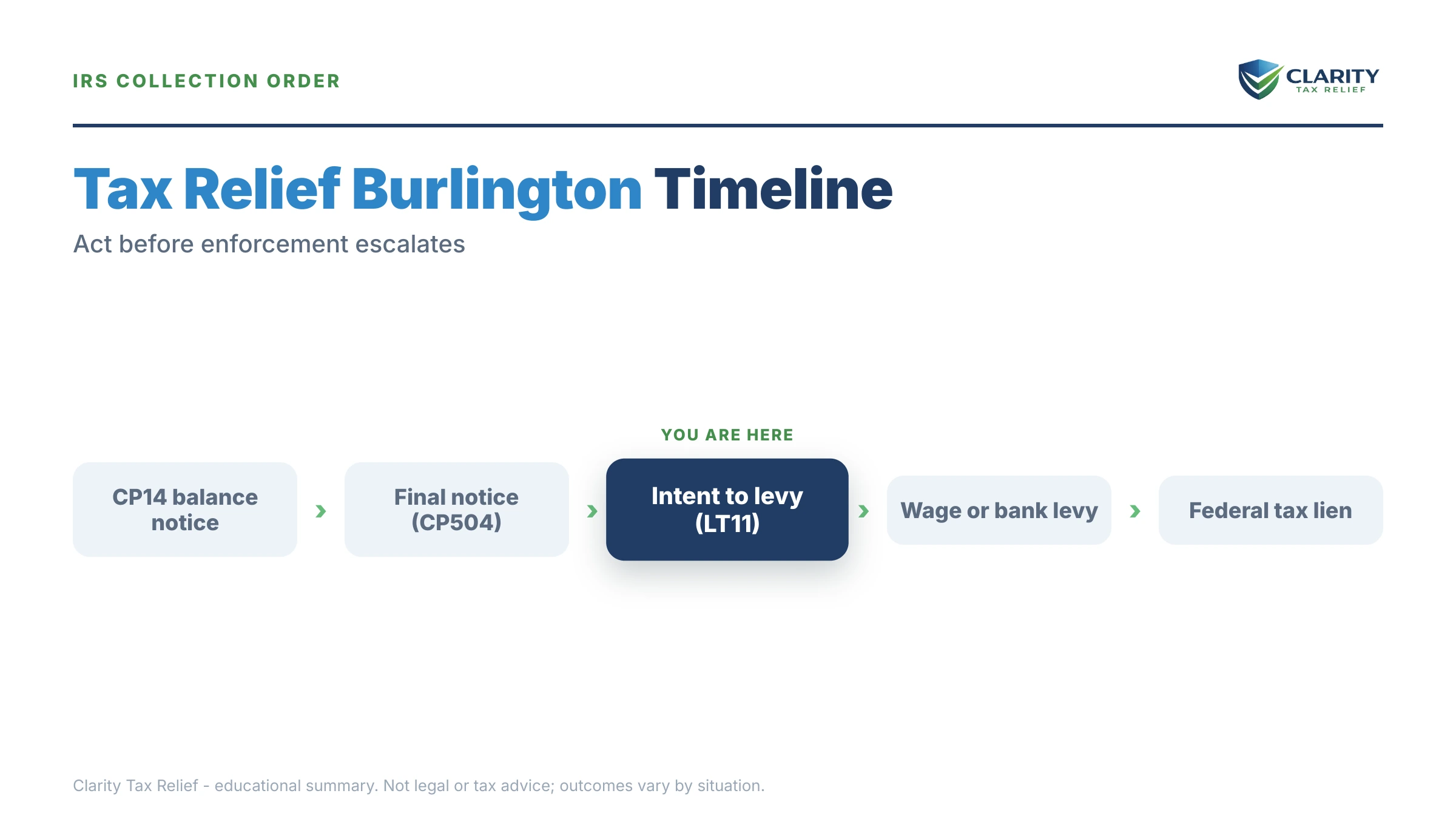
IRS collection follows an automated notice sequence that escalates on its own, whether or not a human ever reviews your file. The 2025 workforce cuts trimmed the IRS by roughly 27% — which makes the agency harder to reach by phone — but the notice and levy systems are computerized and never paused. The sequence runs like this:
- CP14 — the first bill. No enforcement yet; you typically have about 21 days from the notice date (10 business days if the balance is $100,000 or more) before the sequence advances. This is the cheapest moment to act.
- CP501 and CP503 — reminders. Still just bills, but penalties and interest are compounding the whole time.
- CP504 — intent to levy your state refund. Under IRC §6331(d), the IRS can now seize your Vermont state tax refund. Despite the alarming language, this is not yet the final notice.
- LT11 or Letter 1058 — final notice of intent to levy. This starts a 30-day clock and your Collection Due Process rights, which you invoke with Form 12153. After the 30 days, the IRS can levy bank accounts and garnish wages.
- Enforcement. A bank levy freezes funds with a 21-day hold before the money leaves; a wage levy is continuous until released. A federal tax lien can attach to your home, and once a debt passes $66,000 (the 2026 threshold), the IRS can certify it to the State Department, which can deny or revoke your passport.
At $8,900 you're a long way from passport trouble — but you're squarely in refund-offset and, eventually, levy territory. The whole point of acting at the CP14 or CP501 stage is that every option on the menu below is still available and cheap.
Holding an IRS or Vermont notice in Burlington right now?
Whether the debt came from a divorce year, a 1099 year, or a return you're not sure is right, penalties and interest are compounding monthly while you wait. Get a free, confidential transcript review from an experienced tax professional — we'll tell you exactly where your account stands and which option actually fits.
Tax relief Burlington taxpayers can realistically get in 2026
The IRS has six real resolution programs, and eligibility for each is means-tested — no company can promise you any of them before seeing your numbers. Here's the full menu, with the thresholds that decide which door is open to you:
| Option | Who may qualify | Cost to set up | What it does |
|---|---|---|---|
| Short-term payment plan | Can pay in full within 180 days | $0 | Stops enforcement while you pay; interest and penalties continue |
| Guaranteed installment agreement | Owe $10,000 or less in tax, can pay within 3 years, compliant history | Setup fee (reduced for direct debit) | The IRS must accept it — no financial disclosure required |
| Streamlined installment agreement | Owe $25,000 or less (up to $50,000 with direct debit), up to 72 months | Setup fee (reduced online / direct debit) | Monthly plan without a full financial statement |
| Currently Not Collectible | Paying anything would prevent basic living expenses | $0 (financial disclosure required) | Pauses levies and payment demands; debt and interest remain |
| Offer in Compromise (Form 656) | Assets + future income can't cover the debt before the collection statute ends | $205 fee + 20% down on lump-sum offers (both waived with low-income certification) | Settles for less than the full balance — accepted roughly 1 in 5 times in FY2024 |
| First-Time Penalty Abatement / AEP | Clean compliance record for the prior 3 years | $0 | Removes penalties (not tax or interest); becoming automatic under AEP starting summer 2026 |
For the mechanics of setting these up on your own — the forms, the phone scripts, the order of operations — our guide on how to settle tax debt yourself walks through every program in depth. This page focuses on which one fits which Burlington situation.
Worked example: an $8,900 IRS debt after a divorce
Say you're recently divorced, renting in the New North End, and your first single-filer return left you owing $8,900 you can't pay at once. This is a hypothetical, but the math is real:
- The cost of waiting: the failure-to-pay penalty runs 0.5% per month — about $44/month at the start — plus daily-compounding interest. Do nothing for a year and you've added several hundred dollars without the IRS lifting a finger. You can estimate your own accrual with our IRS Penalty & Interest Calculator.
- Short-term plan (180 days): $0 to set up. Paying it off in six months means roughly $1,485/month — steep, but the cheapest total cost because accrual stops sooner.
- Guaranteed installment agreement: because the tax owed is under $10,000, the IRS must accept a plan that pays it off within 3 years if your filing history is clean. $8,900 ÷ 36 months is about $247/month, though penalties and interest keep accruing, so budgeting closer to $270 finishes the debt on schedule.
- Penalty relief: if this is your first slip after years of clean filings, First-Time Penalty Abatement can strip the failure-to-pay penalties already assessed — and starting summer 2026, the new Automatic Exemption from Penalty (AEP) applies similar relief automatically, with no request needed.
- Offer in Compromise: usually the wrong tool at this size. The IRS measures an offer against what it could collect over the remaining ten-year statute; if you can afford even $250/month, that projects to far more than $8,900, and the offer gets rejected. An OIC becomes realistic only when income and assets genuinely can't cover the debt.
The practical answer for this profile: a guaranteed installment agreement plus a penalty abatement request — total setup cost under $100, no financial disclosure, done online in an afternoon.
What you owe changes what's realistic
Eligibility for every IRS program is driven first by the size of the balance. Here's how the options shift as the number grows:
| You owe | Realistic options | What changes at this level |
|---|---|---|
| Under $10,000 | Short-term plan, guaranteed installment agreement, penalty abatement | The IRS must accept a 3-year plan; DIY is very doable |
| $10,000 – $25,000 | Streamlined installment agreement (up to 72 months), CNC if hardship | Still no financial statement needed; lien risk grows with age of debt |
| $25,000 – $50,000 | Streamlined plan with direct debit, OIC if finances qualify | Direct debit becomes the key to avoiding disclosure and reducing lien risk |
| $50,000 – $100,000 | Non-streamlined agreement with financial disclosure, OIC, CNC | Full Form 433 financials; passport certification once past $66,000 |
| Over $100,000 | Negotiated agreement, OIC, lien/levy defense | Likely revenue officer assignment; professional representation strongly advised |
IRS debt vs. Vermont Department of Taxes debt: two separate problems
An IRS resolution does nothing for a Vermont state tax balance — the two agencies collect independently and don't coordinate your case. If you underpaid federal tax, odds are the same year produced a Vermont balance too, with its own notices, its own penalties, and its own collection process run by the Vermont Department of Taxes out of Montpelier.
Vermont's programs, deadlines, and thresholds are its own — don't assume any federal figure in this article applies to the state. The department offers payment arrangements for taxpayers who can't pay in full; contact it directly through tax.vermont.gov to confirm your balance and options before its process advances. Two cross-agency traps worth knowing: the IRS can take your Vermont refund through the State Income Tax Levy Program once your federal debt reaches the CP504 stage, and your federal refund can be offset for either debt. When money is tight, resolve the debt with the more immediate enforcement first — usually whichever agency has sent the most recent levy-stage notice.
Searching from a different Burlington? If you're in Burlington, North Carolina, your state agency is the NC Department of Revenue — start with our North Carolina back taxes guide. In Burlington, Iowa, see our Iowa back taxes guide. Everything in this article about the IRS applies no matter which Burlington you call home.
Divorced in Burlington with a joint tax debt? Read this first
The IRS can collect 100% of a joint-return debt from either ex-spouse, regardless of what your divorce decree says. The decree binds you and your ex to each other — it does not bind the federal government, which will pursue whichever of you is easier to collect from. Our guide to who pays IRS debt after divorce covers this in full, but three points matter before you agree to any payment plan:
- Innocent spouse relief (Form 8857) can remove your liability entirely when the debt comes from your ex's errors, omissions, or hidden income and it would be unfair to hold you responsible. See innocent spouse relief: how to qualify — and note that some relief types carry a two-year deadline from the first IRS collection action against you.
- Don't set up a plan on debt you might not owe. Agreeing to pay a joint balance can undercut a later argument that it wasn't yours. Sort out the liability question first.
- Your solo-year debt is separate. A balance from your first single-filer year is yours alone — that's the debt where a guaranteed or streamlined plan usually makes immediate sense.
How to respond, step by step
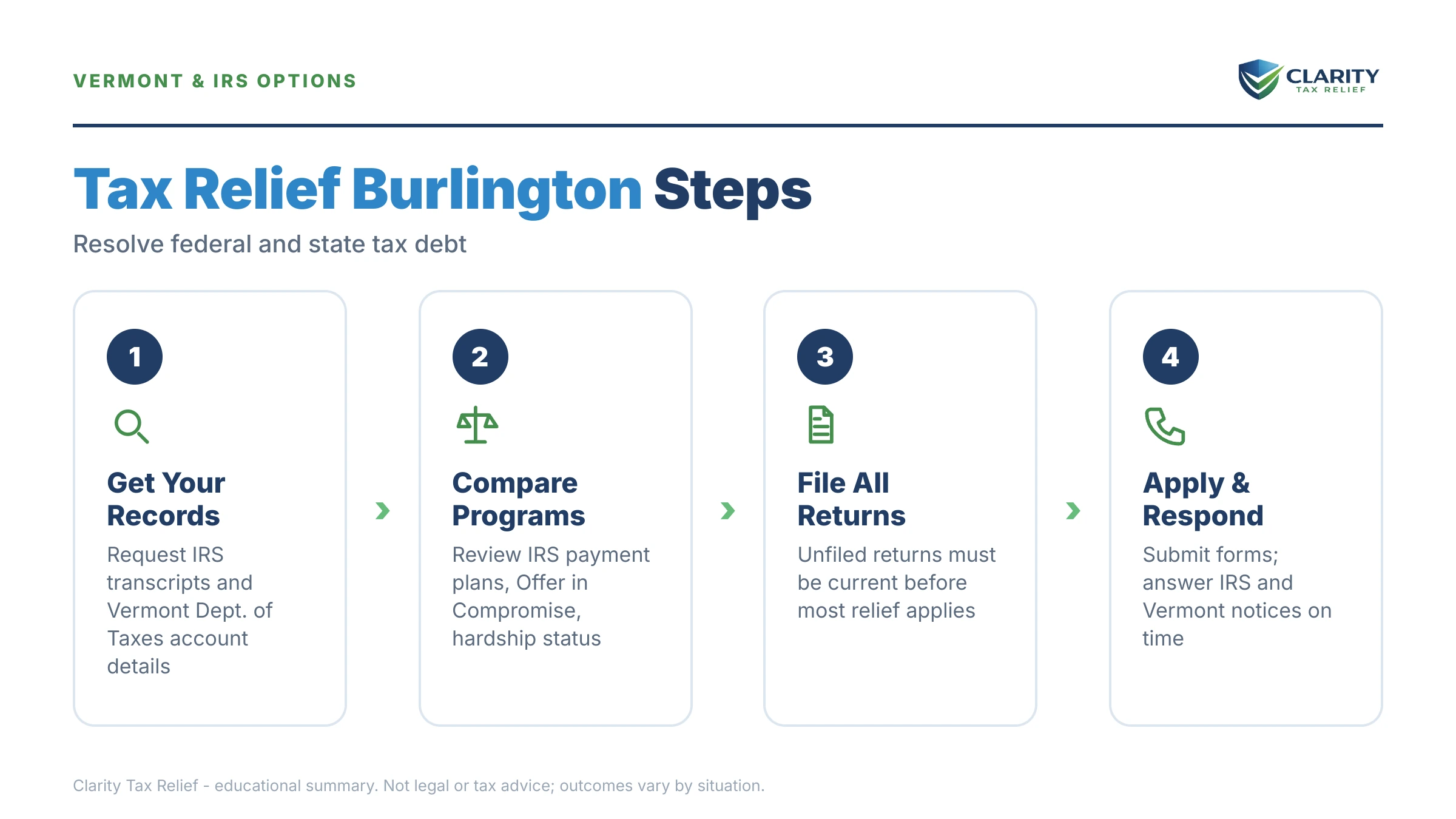
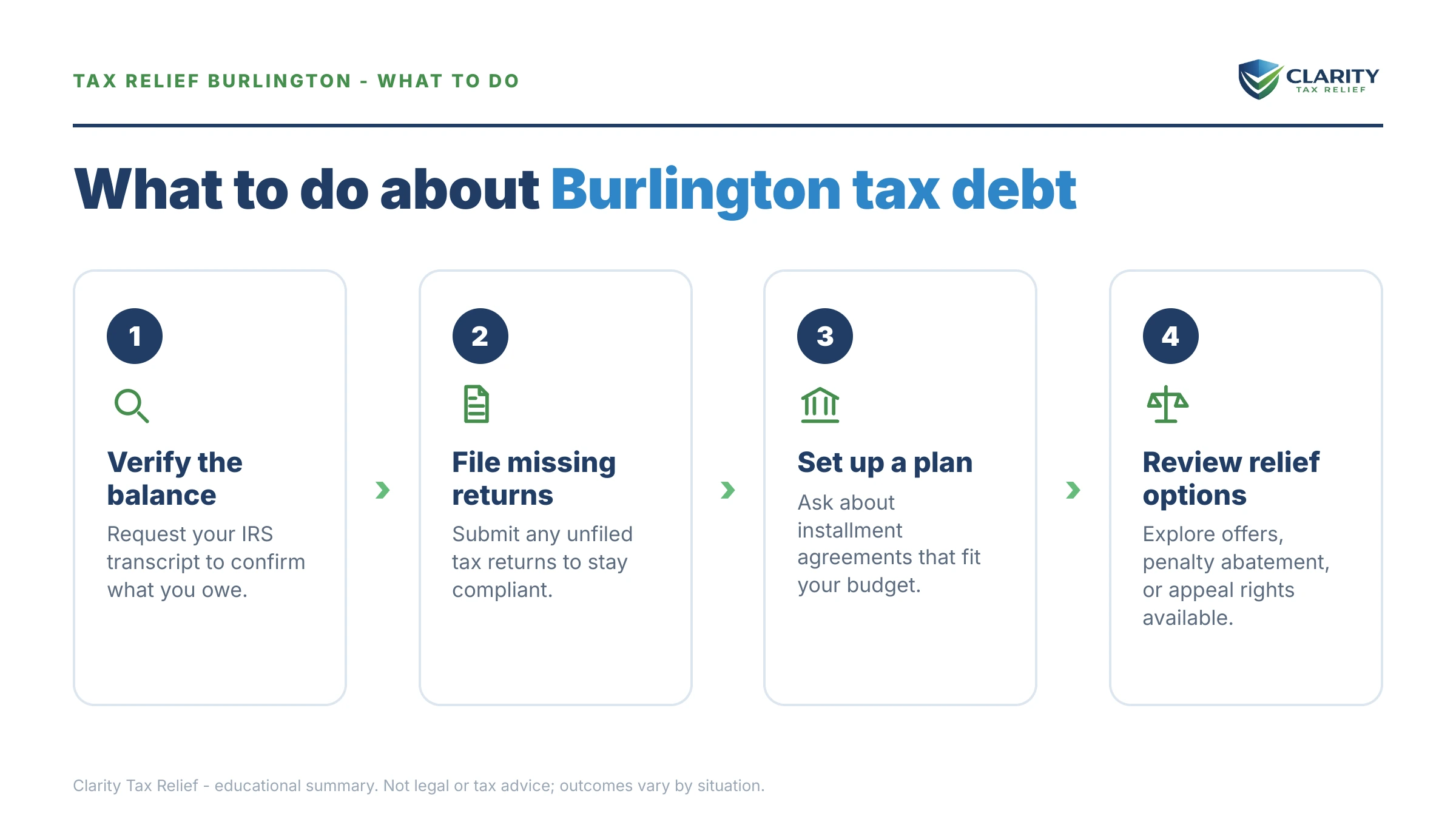
- Pull your IRS records. Log into your IRS online account to confirm each year's balance, the penalties attached, and which notices have already gone out — the notice sequence tells you how much time you have.
- Check your Vermont account. Contact the Vermont Department of Taxes through tax.vermont.gov to confirm whether you owe the state separately — an IRS fix does nothing for a Vermont balance.
- File any missing returns. Every IRS resolution program requires filing compliance first, and the failure-to-file penalty runs ten times the failure-to-pay penalty — though in months where both apply, the failure-to-file portion drops to 4.5% (5% combined) — file even when you can't pay.
- Set up your resolution. Pick the option from the table above that matches your balance and budget, then lock it in online or with Form 9465 before the next notice escalates your account.
- Get a review if the stakes are high. If a levy notice has arrived, you have unfiled years, or the debt traces to an ex-spouse, have an experienced tax professional review your transcripts before you commit to anything.
Payments and plan setup happen directly at IRS.gov/payments, and the official plan terms live on the IRS payment plans page. If the IRS system itself is causing you harm — a levy despite an approved plan, a refund held with no explanation — the Taxpayer Advocate Service is a free, independent path inside the IRS.
When you can handle this yourself — and when help changes the outcome
Most Burlington taxpayers who owe under $10,000 on a single filed year can resolve it alone in an afternoon. If you agree with the balance, your returns are filed, and a 36-month payment fits your budget, set up the plan online, request penalty abatement, and skip the professional fee entirely — that honest answer is exactly why the harder cases trust us.
Experienced help genuinely changes outcomes in a narrower set of situations: a levy or garnishment already in motion, multiple unfiled years that need reconstructing before any program will accept you, a joint-liability fight where innocent spouse relief is on the table, simultaneous IRS and Vermont collection, or Offer in Compromise math where the asset and future-income calculations decide everything. In those cases, the order you fix things in — returns, penalties, liability, then the balance — often matters more than the program you pick.
If you do hire someone, hire carefully. How much tax relief costs should be a flat, written quote given only after a transcript review, and our checklist on how to choose a tax relief company lists the questions that separate real practitioners from sales floors. Burlington has no shortage of national firms advertising here — if you're comparing the big names, our Optima Tax Relief alternatives and Larson Tax Relief alternatives breakdowns show what to look for and what to avoid. And treat any pitch promising to settle your debt for "pennies on the dollar" as the red flag it is — that phrasing is the signature of the offer-mill scam, not of how the IRS actually evaluates offers.
Tax relief in Burlington: your questions, answered
Is there a local IRS office in Burlington, Vermont?
The IRS operates Taxpayer Assistance Centers in Vermont, but they are appointment-only — you can't walk in with your notice. Check the office locator at IRS.gov and book before you go. For most balance-due problems, you'll resolve things faster through your IRS online account, by mail, or by phone than at a counter, and nothing about tax relief requires an in-person visit.
Does Vermont have its own tax relief programs?
Yes. The Vermont Department of Taxes handles state income tax debt completely separately from the IRS and offers its own payment arrangements — contact the department through tax.vermont.gov before its collection process advances. Never assume an IRS resolution covers your Vermont balance; the two agencies don't coordinate, and each can pursue collection on its own timeline.
Can I settle my IRS debt for less than I owe?
Sometimes — through an Offer in Compromise, which the IRS approves only when your income and assets genuinely can't cover the debt before the collection statute expires. The IRS accepted roughly 1 in 5 offers in FY2024, so it's real but far from routine. On a smaller balance like $8,900 with a steady paycheck, a payment plan is usually the more realistic path.
My ex caused the tax debt — am I still responsible?
If the debt is on a jointly filed return, the IRS can collect the full amount from either spouse, no matter what your divorce decree says. Innocent spouse relief, requested on Form 8857, can remove your liability when the debt comes from your ex's errors or unreported income and holding you responsible would be unfair. Deadlines apply — some relief types must be requested within two years of the first IRS collection action against you.
How much does tax relief cost in Burlington?
Doing it yourself costs at most the IRS setup fee — $0 for a short-term plan, with reduced fees for direct-debit online agreements — plus the $205 Offer in Compromise application fee if you go that route. Professional representation typically runs from a few hundred dollars for a simple installment agreement to several thousand for an offer or levy defense. Be wary of any firm that quotes a fee before reviewing your IRS transcripts.
Will the IRS take my Vermont state tax refund?
It can. Once your federal debt reaches the CP504 stage, the IRS is authorized to seize your state tax refund through the State Income Tax Levy Program, and it also offsets your federal refund every year until the balance is paid. If you count on a refund each spring, that's usually the first money the IRS takes — a payment plan doesn't stop the refund offset, only the enforced levies.
Should I hire a Burlington tax firm or a national company?
Location matters far less than credentials, because nearly all IRS collection work happens by phone, mail, and online — not across a desk. What matters is that an enrolled agent, CPA, or tax attorney personally works your case, quotes a flat and transparent fee, and does so only after reviewing your transcripts. A firm's ZIP code changes nothing about how the IRS treats your file.
Your next 24 hours
- Find your most recent notice — IRS and Vermont, if you have both — and locate the notice date and the total balance box. Those two numbers tell you exactly where you sit in the collection sequence.
- Gather three things: your last filed tax return, every notice you've received, and a rough picture of your monthly income and expenses. That's everything any resolution — DIY or professional — is built from.
- Get a free case review. Penalties and interest on your balance compound every month you wait, so have an experienced tax professional map your options now — call (888) 825-7779 or use the 2-minute form. Free, confidential, no pressure.
This guide is general information, not tax or legal advice for your specific situation. Eligibility for IRS programs depends on individual facts and circumstances; no outcome is guaranteed.