
Hiring Tax Help
Tax Attorney vs Enrolled Agent: Which One Do You Actually Need in 2026?
The short answer: in the tax attorney vs enrolled agent decision, an enrolled agent can do everything a tax attorney can before the IRS — payment plans, offers in compromise, audits, penalty relief — usually at a meaningfully lower cost. You need a tax attorney when the problem is legal: criminal exposure, Tax Court litigation, or bankruptcy.
Somewhere between the IRS letter on your kitchen counter and the second sales call quoting four figures, this question stopped being abstract: you owe real money, and everyone selling help has a different title. Here's the calm version — most tax debts are money problems, not legal problems, and the credential you need tracks that line exactly. This guide draws the line in dollars, so you can see which side your case sits on before you pay anyone.
One disclosure up front: the author of this guide is an enrolled agent. That's exactly why the sections below are blunt about the situations where you should hire the other side.
⏱ The real clock: there's no notice deadline on choosing a professional — but the failure-to-pay penalty adds 0.5% of your balance every month while you decide, and interest compounds daily on top. On an $11,300 balance, that's roughly $56 a month in penalty alone before interest.

Tax attorney vs enrolled agent: the real difference in one minute
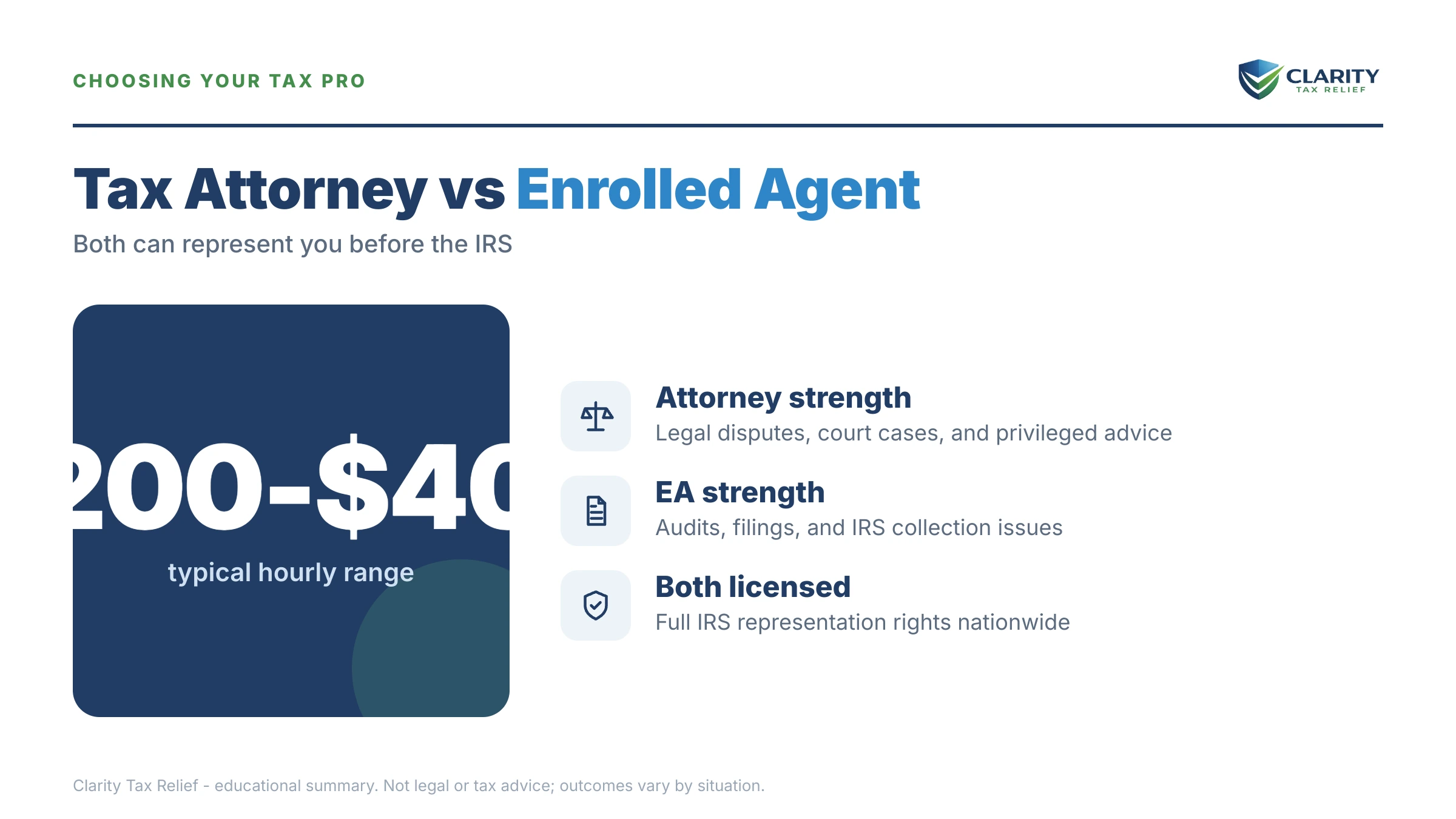
A tax attorney and an enrolled agent hold identical, unlimited representation rights before the IRS under Treasury Circular 230 — the difference is everything that surrounds those rights. An enrolled agent is a tax-only specialist credentialed directly by the U.S. Treasury Department, either by passing the three-part Special Enrollment Examination or through qualifying years working inside the IRS. A tax attorney is admitted by a state bar after law school, and the law degree adds three things the EA credential can't: full attorney-client privilege, the ability to walk into a courtroom, and criminal defense.
That's the whole decision in miniature. The IRS itself doesn't rank the two — a signed power of attorney from either one gets the same treatment from the same IRS employees. What differs is what happens if your case ever leaves the IRS's administrative process and enters a legal one. (For a deeper look at the EA credential on its own, see what is an enrolled agent; if you're weighing a third option, our tax attorney vs. CPA vs. enrolled agent comparison adds the accounting credential to this same framework.)
| Factor | Enrolled agent (EA) | Tax attorney |
|---|---|---|
| Credential comes from | U.S. Treasury Department, via the Special Enrollment Examination or qualifying IRS experience | A state bar, after law school and the bar exam |
| Scope of practice | Tax only — it's the entire credential | All areas of law; tax may be one specialty among several |
| IRS representation rights | Unlimited — any tax matter, any IRS office, nationwide | Unlimited — identical rights before the IRS |
| Confidentiality protection | Limited §7525 privilege — noncriminal IRS matters only | Full attorney-client privilege, including criminal matters |
| Tax Court / courtroom | No, unless separately admitted as a USTCP (rare) | Yes — Tax Court admission comes with bar membership |
| Criminal tax defense | Never | Yes |
| Typical hourly rate | Commonly $150–$300 | Commonly $300–$550+ |
| Strongest fit | Back taxes, payment plans, OICs, audits, penalty relief | Criminal exposure, litigation, bankruptcy, privileged advice |
What each one can do before the IRS
Once you sign Form 2848, an enrolled agent and a tax attorney have exactly the same authority in front of the IRS. Either can receive your notices, call the practitioner line on your behalf, pull your transcripts, and negotiate every administrative resolution the agency offers: installment agreements, Offers in Compromise, Currently Not Collectible status, penalty abatement, audit defense, IRS Appeals, and Collection Due Process hearings requested on Form 12153. The Form 2848 power of attorney is the document that makes any of it official — the IRS won't discuss your account with a professional who hasn't filed one.
The attorney's exclusive territory begins where the IRS's administrative process ends. Only an attorney can petition and argue in U.S. Tax Court (admission comes automatically with bar membership; non-attorneys must pass a separate, rarely attempted exam), represent you in federal district court or bankruptcy court, and defend you if IRS Criminal Investigation ever gets involved.
The privilege gap matters more than most comparison articles admit. Your conversations with an EA carry only the limited protection of IRC §7525 — it covers tax advice in noncriminal IRS matters, and it evaporates in a criminal investigation and doesn't cover return preparation at all. Your conversations with an attorney are protected everywhere, including in a criminal case. If you'd hesitate to put what you're about to tell your representative in front of a prosecutor, that hesitation is your answer: attorney first.
What happens to your tax debt while you decide
The IRS collection machine does not pause while you compare professionals — penalties and interest accrue monthly, and the notice sequence advances automatically. Whichever professional you eventually hire inherits whatever stage your case has reached, and every stage forward means fewer good options:
- CP14 — the first bill. Typically about 21 days before the sequence moves. Every resolution option is still open, and setup is cheapest here.
- CP501 / CP503 — automated reminders. Still just bills, but the balance is compounding and the file is moving toward enforcement.
- CP504 — Notice of Intent to Levy under IRC §6331(d). The IRS can now seize your state tax refund, and a federal tax lien becomes a live possibility.
- LT11 / Letter 1058 — Final Notice of Intent to Levy. A 30-day clock starts, along with your Collection Due Process rights (requested via Form 12153). After it runs, wage garnishment and bank levies are on the table.
The 2026 twist: the IRS workforce shrank roughly 27% in 2025, which means reaching a human is harder than ever — but the notices, liens, and levies come from automated systems that never took a day off. A professional with a practitioner-line relationship and a filed 2848 can often get answers you can't get on hold. What no professional can do is un-ring a levy that landed while you were still comparison shopping.
Not sure which one your case needs?
Tell us what letter you're holding and roughly what you owe. An experienced tax professional will tell you — free — whether your situation is enrolled-agent territory or genuinely needs an attorney, before another month of penalties posts to your account.
Enrolled agent vs tax attorney: which one for which problem
The dollar amount you owe and the letter you're holding decide this question far more reliably than any credential debate. Below the streamlined thresholds, the IRS resolves cases by formula and a hired negotiator adds little; above them — or once the problem turns legal — the right professional changes real outcomes. Where you're choosing between resolutions rather than between professionals, our payment plan vs. offer in compromise guide covers that separate decision.
| Your situation | Threshold or trigger | Realistic best choice |
|---|---|---|
| Can pay in full within 180 days | Short-term plan, $0 setup fee | Yourself |
| Balance of $10,000 or less | Guaranteed installment agreement territory | Yourself |
| Balance up to $50,000 | Streamlined online plan, up to 72 months | Yourself, or an EA if there are complications |
| Balance over $50,000 | Form 433-series financial disclosure required | Enrolled agent |
| Offer in Compromise | Means-tested; IRS accepted roughly 1 in 5 offers in FY2024 | Enrolled agent — the work is financial, not legal |
| Civil audit or IRS Appeals | Any amount | Enrolled agent; attorney if fraud could surface |
| Notice of Deficiency → Tax Court | 90-day petition window | Tax attorney |
| IRS Criminal Investigation contact | Any contact from a special agent | Tax attorney only — before anyone speaks |
| Bankruptcy involving tax debt | Discharge timing rules apply | Tax attorney |
Notice what's absent from the attorney column: the entire everyday collection workload. Payment plans, hardship status, penalty relief, and even most Offers in Compromise are financial negotiations run on IRS formulas — an EA who does them daily is not a downgrade from an attorney who does them occasionally. The reverse is equally true: no volume of collection experience substitutes for a bar admission when a special agent is on your porch.
What a tax attorney and an enrolled agent cost in 2026
For the same IRS task, an enrolled agent typically charges one-third to one-half of what a tax attorney charges. Rates vary widely by city, firm, and case complexity, so treat these as commonly quoted market ranges — and always ask for a flat fee in writing rather than an open-ended hourly meter. Our guides to how much tax relief costs and IRS audit representation cost break the pricing models down further.
| Service | Typical enrolled agent fee | Typical tax attorney fee |
|---|---|---|
| Hourly rate | $150–$300 | $300–$550+ |
| Installment agreement with financial disclosure | $500–$1,500 flat | $1,500–$3,500 |
| Offer in Compromise (Form 656 package) | $2,500–$5,000 | $4,000–$7,500+ |
| Audit representation | $1,500–$4,000 | $3,000–$10,000+ |
| Penalty abatement request | $250–$1,000 | $1,000–$2,500 |
| Tax Court litigation | Not available (unless USTCP) | $5,000–$15,000+ |
The premium in the right-hand column buys privilege and courtroom rights. When your case needs those, the premium is cheap. When it doesn't, you're paying litigation rates for paperwork — and the IRS employee reading your file can't tell the difference and wouldn't care if they could.
Say you owe $11,300: the hiring math, worked out
Say you're a W-2 employee filing single, and underwithholding left you owing $11,300 for last year — a completely hypothetical but very common shape of case. Here's what each path actually costs:
- Do it yourself. At $11,300 you're just over the $10,000 guaranteed-agreement line but comfortably inside the streamlined installment agreement threshold, so you can set up a plan online with no financial statement. Stretched over the maximum 72 months, that's about $157 a month before interest and the 0.5% monthly failure-to-pay penalty (which drops while a plan is active). Professional cost: $0. Our how to settle tax debt yourself guide walks the entire DIY route.
- Hire an enrolled agent. A flat fee commonly in the $500–$1,500 range buys a transcript review of every open year, a check for cheaper resolutions, and a penalty-relief request. If your prior three years are clean, first-time penalty abatement can strip the failure-to-pay penalties from the account — and starting summer 2026, the IRS's new Automatic Exemption from Penalty (AEP) applies similar relief automatically. On a balance carrying several hundred dollars of penalties, the abatement alone can cover much of the fee.
- Hire a tax attorney. At $350 an hour, the same streamlined agreement takes perhaps five to six hours of attorney time — roughly $1,750–$2,100, or close to 19% of the debt itself — and produces an agreement identical to the letter to the one above. Nothing about a clean W-2 underwithholding case uses anything a law degree adds.
Now change one fact: the $11,300 traces to cash income you never reported across several years. The balance is the same, but the problem is no longer arithmetic — it's whether the IRS could read your file as willful. That version of the case starts with an attorney, full stop, because everything you tell them stays privileged while you find out how bad it is.
When you can handle this yourself
Honest answer: a large share of the people searching this comparison don't need either professional. You can confidently go it alone when:
- You agree with the balance on a first notice and can pay in full or within 180 days — pay directly at IRS.gov/payments and the matter ends there;
- You owe $50,000 or less, all your returns are filed, and a streamlined online payment plan solves it;
- Your only issue is a first-time penalty with three clean prior years — abatement is a phone call, not an engagement.
Experienced help starts changing outcomes — not just saving you time — when a levy or garnishment is already in motion, when multiple years are unfiled and the filing order affects what you'll owe, when the debt involves a business or payroll taxes, when you dispute the amount itself, or when Offer in Compromise math (income, assets, allowable expenses) determines whether you save five figures or get rejected. In those cases the fee buys a different result, not just a signature on the same form.
When a tax attorney is the only right answer
Four situations make the attorney premium non-negotiable, and every one of them is legal rather than financial. First, criminal exposure: unreported income, badges of fraud on a return, or any contact from an IRS special agent — our guide to when the IRS goes criminal explains where that line actually sits, and it's further away than most people fear but unforgiving once crossed. Second, litigation: if you're holding a Notice of Deficiency, the 90-day letter and Tax Court petition process runs on a rigid clock, and only an attorney can argue the case. Third, bankruptcy: whether old tax debt can be discharged turns on timing rules a bankruptcy attorney lives in — see chapter 7 vs 13 tax debt. Fourth, any situation where you need advice that stays confidential no matter what: only attorney-client privilege survives a criminal referral.
There's a subtler version of the question too: attorney versus a big tax-relief brand's sales floor. Those are different decisions with different traps — our tax relief attorney vs company comparison covers it, and do I need a tax attorney for back taxes pressure-tests the attorney question specifically for collection cases.
If your mailbox already holds a CP504 or LT11, skip the extended credential research — have an experienced tax professional review the notice free at (888) 825-7779 or through the 2-minute form, and sort the attorney question after the clock is handled.
Terms you'll hear while shopping, decoded
- Circular 230 — the Treasury rulebook governing everyone who practices before the IRS; attorneys, CPAs, and EAs are all bound by it equally. The IRS's own overview of the EA credential is at IRS.gov: Enrolled Agents.
- Unlimited representation rights — the authority to represent any taxpayer, on any matter, before any IRS office; EAs, CPAs, and attorneys all hold it.
- Form 2848 — the power of attorney that lets your representative speak to the IRS for you; nothing happens until it's filed.
- §7525 privilege — the limited confidentiality protection for EAs and CPAs; it covers noncriminal tax advice before the IRS and nothing more.
- Kovel arrangement — a setup where a tax attorney hires the EA or accountant, extending attorney-client privilege over the accountant's work; the standard structure for sensitive cases that still need heavy number-crunching.
- USTCP — United States Tax Court Practitioner, a non-attorney who passed the Tax Court's own exam; they exist, but they're rare enough that "can you go to Tax Court?" remains a fair screening question.
How to choose the right professional, step by step
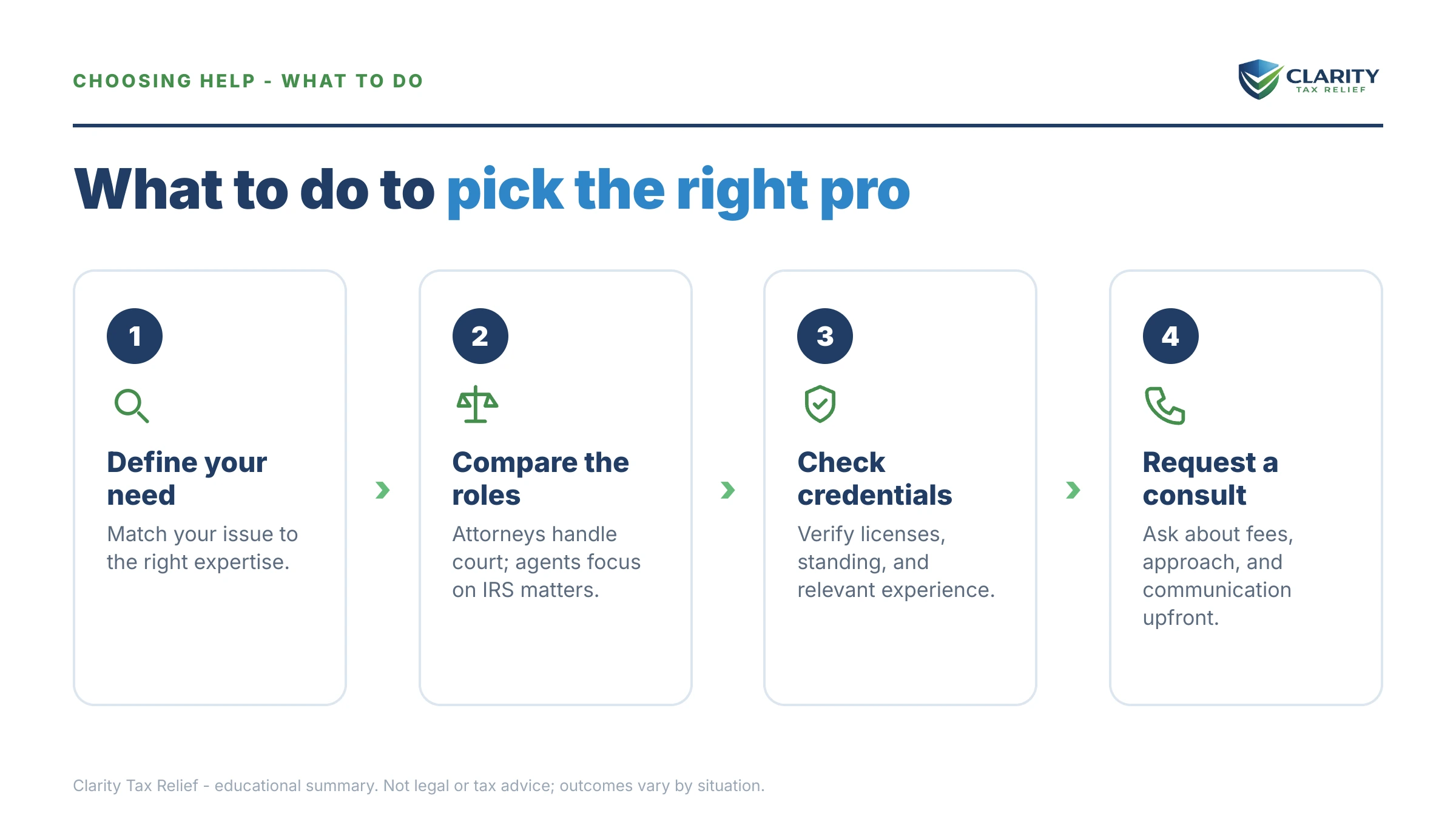
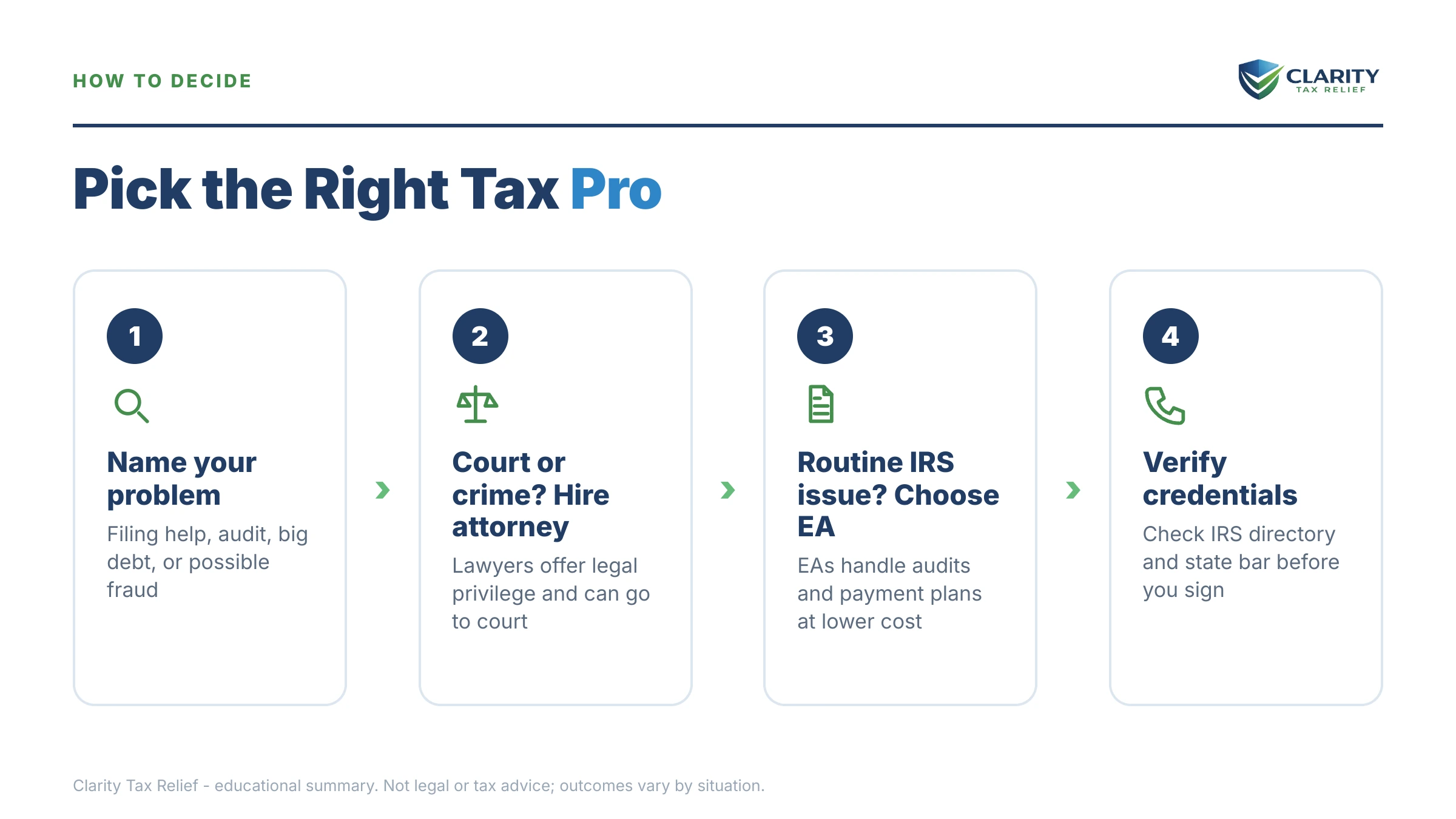
- Write your problem in one sentence. "I owe $11,300 for 2024 and can't pay it all at once" is a money problem; "the IRS may find income I never reported" is a legal one. That sentence alone points to your column in the tables above.
- Screen for the four attorney triggers. Criminal exposure, a case headed to Tax Court, bankruptcy involving tax debt, or advice you need fully privileged. Any yes means interview tax attorneys; all no means an enrolled agent covers it.
- Verify the credential before the first phone call. Confirm an EA in the IRS Directory of Federal Tax Return Preparers; confirm an attorney through the state bar's public lookup.
- Get flat-fee quotes from at least two professionals. Ask exactly what the fee covers, what triggers additional charges, and who will personally sign your Form 2848.
- Sign Form 2848 and get the plan in writing. The power of attorney routes IRS contact to your representative; the engagement letter should name the target resolution and a realistic timeline.
Tax attorney vs enrolled agent: your questions, answered
Is an enrolled agent as good as a tax attorney?
For IRS collection and audit work, yes. Enrolled agents and tax attorneys hold the same unlimited representation rights before the IRS under Circular 230, so both can negotiate payment plans, offers in compromise, and audit outcomes. An attorney becomes the stronger choice only when the matter turns legal — criminal exposure, Tax Court litigation, or bankruptcy — where a bar admission and full privilege actually change the outcome.
Can an enrolled agent negotiate with the IRS on my behalf?
Yes. Once you sign Form 2848, an enrolled agent can speak to the IRS for you, receive your notices, and negotiate installment agreements, offers in compromise, hardship status, penalty abatement, and audit or appeals outcomes. The two things an EA cannot do are represent you in court and defend you in a criminal tax case.
Do enrolled agents have attorney-client privilege?
No — they have a narrower protection. IRC Section 7525 extends a limited privilege to enrolled agents and CPAs, but it covers only noncriminal tax advice in IRS matters. It does not apply to criminal investigations, most court proceedings, or tax return preparation. If there is any chance your facts could be read as willful, that gap is the single strongest reason to start with a tax attorney.
Is a tax attorney or an enrolled agent cheaper?
An enrolled agent is almost always cheaper for the same IRS task. EA hourly rates commonly run $150 to $300 versus $300 to $550 or more for tax attorneys, and flat fees for collection cases follow the same pattern. Since the IRS treats a signed Form 2848 from either one identically, paying attorney rates for routine collection work buys a costlier path to the same result.
When do I actually need a tax attorney instead of an enrolled agent?
Four situations: possible criminal exposure (unreported income, fraud indicators, or contact from IRS Criminal Investigation), a case headed to Tax Court or another courtroom, a bankruptcy filing that involves tax debt, and any matter where you need advice fully protected by attorney-client privilege. Outside those four, an enrolled agent handles the full IRS collection and audit playbook.
Can an enrolled agent represent me in an IRS audit?
Yes, at every administrative level — correspondence audits, office audits, field audits, and IRS Appeals. Many EAs handle audits full time. The exception is what practitioners call an eggshell audit, where the return hides a problem that could be viewed as willful; there, an attorney should assess the criminal risk before anyone speaks to the examiner.
Can an enrolled agent take my case to Tax Court?
Generally no. Tax Court admission is automatic for attorneys in good standing with a state bar, while non-attorneys must pass a separate, rarely attempted Tax Court examination. If you receive a Notice of Deficiency, the 90-day window to petition Tax Court is rigid — so a case likely headed there should involve an attorney early, even if an EA handles the groundwork.
What about a CPA — how does that compare?
A CPA has the same unlimited IRS representation rights as an EA and an attorney, but the CPA credential centers on accounting, not IRS procedure. For a pure back-tax or collections problem, the EA-versus-attorney logic in this guide applies unchanged; a CPA makes the most sense when your problem is tangled up with business books, financial statements, or complex return preparation.
How do I verify that someone is really an enrolled agent or tax attorney?
Look them up before you pay anything. Enrolled agents appear in the IRS Directory of Federal Tax Return Preparers with Credentials, and every state bar runs a free public attorney lookup showing standing and discipline history. Be wary of firms that advertise attorneys but route your case to uncredentialed salespeople — ask who will personally sign your Form 2848.
Your next 24 hours
- Pull your most recent IRS letter and find two things: the notice name in the top corner (CP14, CP504, LT11) and the total balance due. Those two facts decide most of the attorney-versus-EA question before anyone quotes you a fee.
- Gather three items: your last filed return, every IRS letter you've received, and a rough picture of monthly income and expenses. Whichever professional you hire will ask for exactly these — having them ready shortens every consultation.
- Get a free case review — call (888) 825-7779 or use the 2-minute form — and ask one question: "Is anything in my file a legal problem?" Penalties and interest post to your account monthly either way; finding out which professional you need costs nothing.
This guide is general information, not tax or legal advice for your specific situation. Eligibility for IRS programs depends on individual facts and circumstances; no outcome is guaranteed.