
Marriage & Tax Debt
Prenup IRS Debt Protection: What a Prenup Can and Can't Shield in 2026
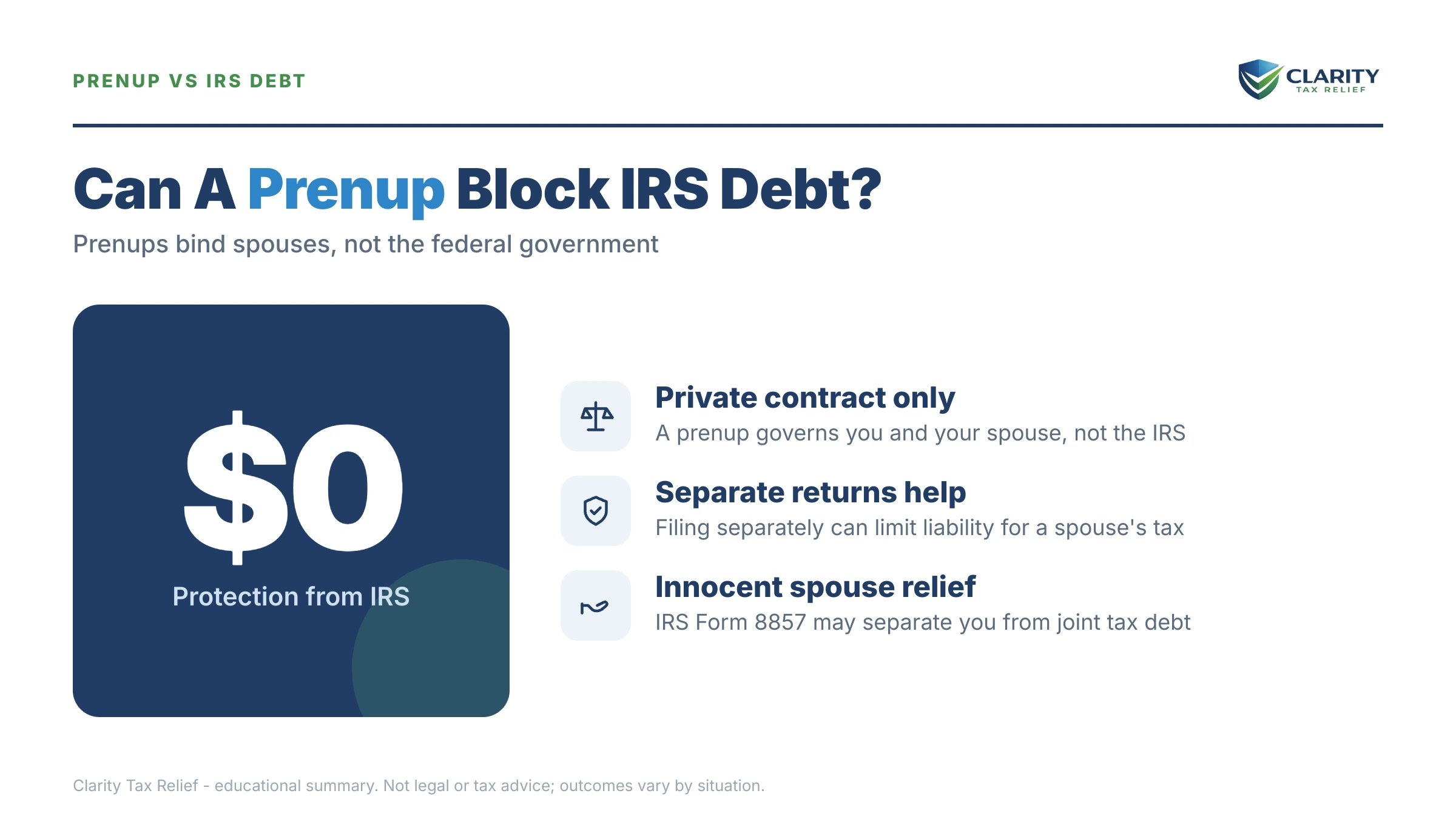
The short answer: a prenup cannot stop the IRS from collecting a tax debt your spouse legally owes — the IRS isn't a party to the contract. What it can do is keep your separate property and income off the collection table, especially in community property states. You never become liable for premarital IRS debt just by marrying.
You're planning a wedding, and somewhere between the venue deposit and the guest list, your partner told you the number: years of self-employment left them owing the IRS. Now you're searching "prenup IRS debt" at midnight, wondering whether one document can wall that balance off from the life you're building. It mostly can — just not the way most people assume, and the contract alone won't do it.
This guide walks through exactly what a prenup controls, where your real exposure comes from, and — using a hypothetical $92,700 sole-proprietor debt — what it takes to neutralize the balance itself before it follows you both down the aisle.
⏱ The real clock: there's no response deadline on a prenup, but the debt has its own. A $92,700 balance is already above the $66,000 passport-certification threshold for 2026, interest compounds daily, the failure-to-pay penalty adds 0.5% every month until it caps at 25% of the unpaid tax, and every joint refund you'd ever file can be seized until it's resolved.
Prenup IRS debt protection: what the contract actually controls
A prenuptial agreement binds two spouses — it does not bind the IRS, which collects under federal law from any property the debtor spouse legally owns. That single fact sorts every claim you'll read about prenups and tax debt into two piles: what the contract genuinely does, and what it only appears to do.
What a well-drafted prenup can do:
- Define separate property before the wedding. The federal tax lien attaches to "all property and rights to property" of the person who owes. If your house, savings, and future earnings are contractually and factually yours alone, the lien has nothing of yours to attach to.
- Opt out of community property rules. In the nine community property states, this is where a prenup has real collection consequences — more on that below.
- Document who owns what. When you later file Form 8379 injured spouse to recover your share of a seized joint refund, or when your spouse's Offer in Compromise requires allocating household income, a prenup with separate accounts behind it makes the split defensible instead of arguable.
- Give you an indemnification right. A clause requiring your spouse to reimburse you for anything the IRS takes from you is enforceable — but only between the two of you, in state court. It works exactly like a divorce decree and IRS debt: binding on the spouses, invisible to the IRS.
What no prenup can do: erase or reassign the liability, stop a lien or levy against the spouse who owes, undo joint-and-several liability on a return you both sign, or prevent the offset of a joint refund by itself. The IRS collects from whoever the tax law says owes — the contract only decides what counts as yours.
| Protection layer | Protects against | Does NOT protect against |
|---|---|---|
| Prenup (separate-property agreement) | Lien attaching to your separate assets; community-income reach (with a valid opt-out) | Collection against anything your spouse owns; joint-refund offsets |
| Filing married filing separately | Your refund being offset; liability on your spouse's new balances | Usually a higher combined tax bill; lost credits |
| Form 8379 (injured spouse) | Losing your share of a joint refund permanently | The offset happening in the first place — it recovers, it doesn't prevent |
| Separate accounts & titling | Bank levies reaching your deposits; the lien encumbering your home | Levies on anything titled jointly or in your spouse's name |
| Resolving the debt itself | Everything above — a resolved balance stops liens, levies, and offsets at the source | Nothing; this is the only complete fix |
Where the real exposure comes from when your spouse owes the IRS
Marriage never makes you liable for a spouse's premarital IRS debt — your exposure is indirect, and it flows through four specific channels. Every one of them can be closed, but each closes a different way, and the prenup only closes some of them.
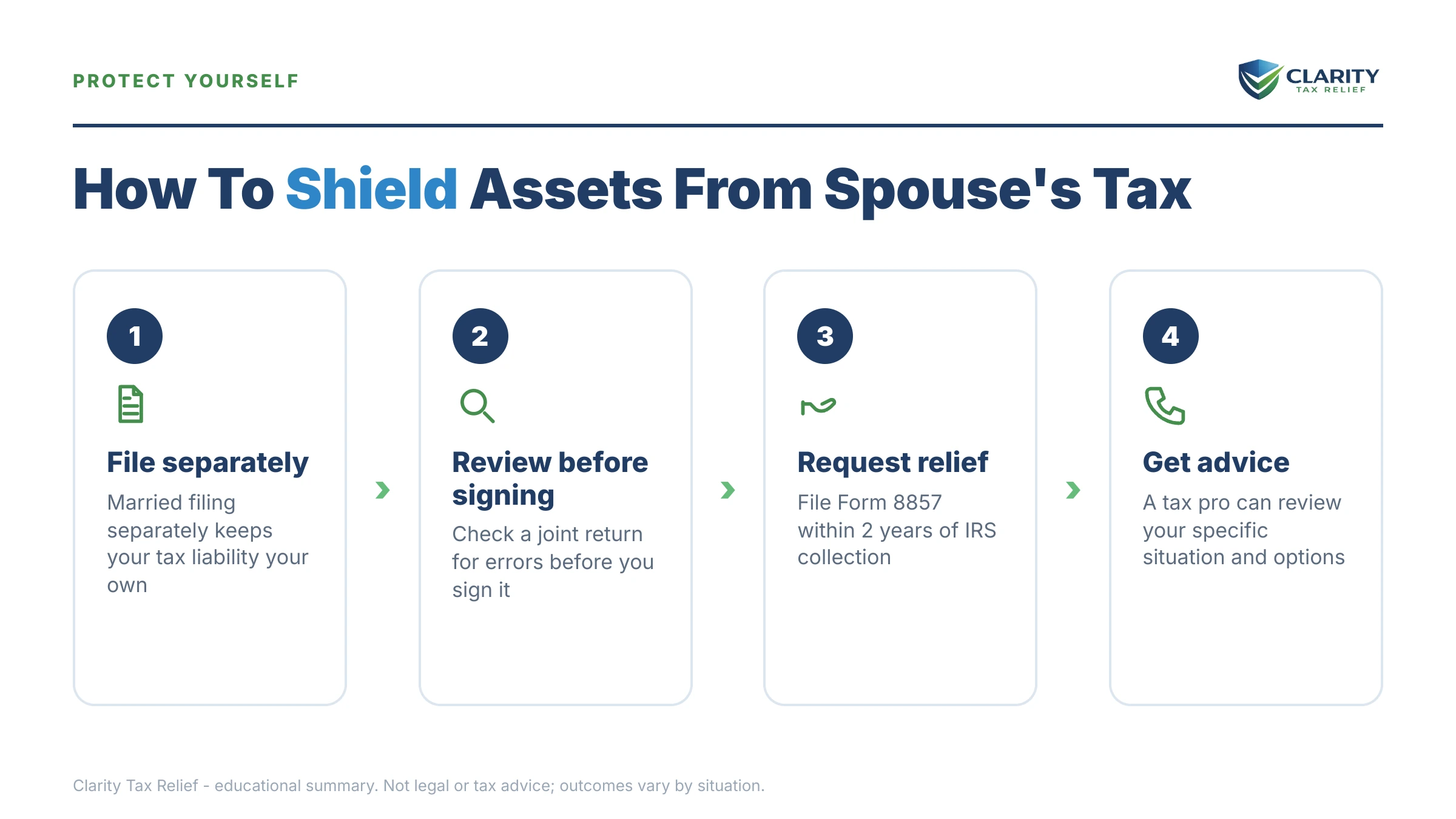
- Joint tax refunds. File jointly and the IRS applies the entire refund — including the part generated by your withholding — to your spouse's old balance, every year until it's paid. You can recover your share with Form 8379, or avoid the offset entirely by married filing separately when your spouse owes the IRS. Couples blindsided by this usually learn it the way described in our guide to a new spouse refund taken for old debt.
- Joint bank accounts. The IRS can levy any account your spouse can freely draw from — even if 90% of the money is yours. See can the IRS take my spouse's bank account for how levies treat joint funds.
- Jointly titled property. A federal tax lien attaches to your spouse's interest in anything you buy together, including after-acquired property like the home you purchase next year. It doesn't take your half, but it clouds every sale and refinance — the mechanics are in our guide to an IRS lien on jointly owned property.
- Community property income. In community property states, your own wages can become partially reachable for your spouse's separate debt. This is the one channel a prenup can shut directly.
For the broader picture of what changes the day you say "I do" to someone with a balance, see marrying someone who owes the IRS.
Community property states: where a prenup has real teeth
Nine states — Arizona, California, Idaho, Louisiana, Nevada, New Mexico, Texas, Washington, and Wisconsin — treat most income earned during marriage as community property, and IRS collection rights follow state property law. In those states, once you're married, some or all of the community estate — which can include your paycheck — may be reachable for your spouse's separate, premarital tax debt. How much varies significantly by state.
This is where the prenup stops being symbolic. A valid agreement that opts out of the community property regime (sometimes paired with a transmutation agreement after the wedding) keeps your earnings your separate property — property the IRS generally cannot reach for a debt that isn't yours. In a common-law state, the prenup mostly confirms protections you'd largely have anyway; in a community property state, it can be the difference between your income being on or off the table.
Two cautions. First, the opt-out must be valid under your state's law — independent counsel, full disclosure, and proper timing matter, so this is drafting for a family-law attorney, not a template. Second, community property cuts both ways at filing time: even filing separately, community property rules can require you to report half of community income, with relief available under IRC §66 — covered in our guide to community property tax relief. And if the debt includes California state tax, plan for a longer horizon: the FTB has 20 years to collect under R&TC §19255, double the IRS's window.
What happens if you marry $92,700 of IRS debt and do nothing
An unresolved IRS balance doesn't sit still while you plan a wedding — it moves through an automated collection sequence that follows your spouse into the marriage. Here is the order of escalation for a balance that size, stage by stage:
- Growing balance. Interest compounds daily and the failure-to-pay penalty adds 0.5% per month until it caps at 25% of the unpaid tax. The number on the engagement-week confession is smaller than the number at the first anniversary.
- Refund offsets, every year. Any refund on any return your spouse files — including your first joint return — is seized and applied to the balance until it's gone.
- Federal tax lien. A recorded Notice of Federal Tax Lien becomes public record and attaches to everything your spouse owns and later acquires — including their interest in the house you buy together.
- CP504. The IRS announces intent to levy your spouse's state tax refund and positions the account for enforced collection.
- LT11 / Letter 1058. The final notice of intent to levy starts a 30-day clock to request a Collection Due Process hearing. After it lapses, the IRS can levy wages (continuously, until released) and bank accounts (with a 21-day hold before funds leave) — including joint accounts.
- Passport certification. At $66,000+ of seriously delinquent debt in 2026, the IRS can certify the debt to the State Department, which can deny or revoke your spouse's passport. A $92,700 balance is already over the line — hard news if the honeymoon involves a flight. Details in passport revoked for tax debt.
One 2026 reality worth knowing: the IRS workforce shrank roughly 27% in 2025, so reaching a human is harder than ever — but liens, levies, and offsets are issued by automated systems that never stopped running. Silence from the IRS is not the same as safety.
Marrying into a $90,000+ IRS balance?
Get the debt reviewed free before the wedding — an experienced tax professional will map exactly what's reachable, what isn't, and the fastest way to put the balance on a resolution track while interest and penalties are still accruing. Call (888) 825-7779 or use the 2-minute form.
Your options: shrink or resolve the debt before it touches the marriage
The strongest prenup protection isn't in the prenup — it's making the debt smaller, managed, or gone before the wedding. Every resolution program below is available to your spouse as an individual, and putting the account on one of these tracks stops the escalation sequence above. (The full DIY playbook for each program lives in our guide to how to settle tax debt yourself; here's how each one fits a $92,700 balance.)
| Option | Eligibility at $92,700 | Cost & notes |
|---|---|---|
| Short-term plan (up to 180 days) | Available, but requires full payment within 180 days — unrealistic at this size for most | $0 setup; interest and penalties continue |
| Streamlined installment agreement (≤$50,000) | Not eligible unless the balance is paid down below $50,000 first | Online setup, up to 72 months, no financial statement |
| Non-streamlined installment agreement | Eligible — requires Form 433-F financial disclosure above the streamlined line | Payment set by ability to pay; lien filing likely at this balance |
| Offer in Compromise | Only if income and assets genuinely can't cover the debt — means-tested, not automatic | $205 fee + 20% down on lump-sum offers (both waived with low-income certification); ~1 in 5 accepted in FY2024 |
| Currently Not Collectible | Only with documented hardship — paying anything would leave basic living expenses unmet | $0; pauses collection but debt and interest continue; lien still possible |
| Penalty abatement / AEP | First-Time Abate needs a clean prior 3 years; the new Automatic Exemption from Penalty (AEP) begins applying automatically in summer 2026 | $0; removes penalties, not tax or interest — can shave thousands off this balance |
The math on a hypothetical $92,700
Say your fiancé ran a sole proprietorship for three years, underpaid self-employment tax, and now owes $92,700 across those years. Straight-line over 72 months, that's roughly $1,288 a month before accrued interest and the 0.5% monthly failure-to-pay penalty until it caps at 25% of the unpaid tax — the real payment lands higher. And because $92,700 sits above the $50,000 streamlined ceiling, the choice is stark: either pay roughly $42,700 down to get under $50,000 and set up a 72-month plan online with no financial disclosure, or hand the IRS a Form 433-F showing income, expenses, and assets.
Two moves specific to a self-employed debtor can shrink the number before any plan is signed. First, check the returns themselves: sole-proprietor assessments are frequently overstated because mileage, home office, or equipment deductions were never claimed — amending a return to lower a tax debt attacks the principal, not just the terms. Second, if the debt is old enough and the finances are bleak enough, run the bankruptcy analysis: income taxes can be dischargeable when they pass the age tests, and our comparison of Chapter 7 vs 13 for tax debt walks through which chapter fits which facts.
If an Offer in Compromise is on the table, understand what the IRS actually measures: reasonable collection potential — the equity in your spouse's assets plus a multiple of their monthly ability to pay. Here's where the prenup quietly earns its keep: with a marital agreement and genuinely separate finances, the non-liable spouse's income and assets can be allocated out of the calculation instead of inflating it. You can estimate an offer amount with our Offer in Compromise Calculator before deciding whether the program is even worth pursuing — acceptance is means-tested, and the IRS runs the math, not the marketing.
How to protect yourself before the wedding, step by step
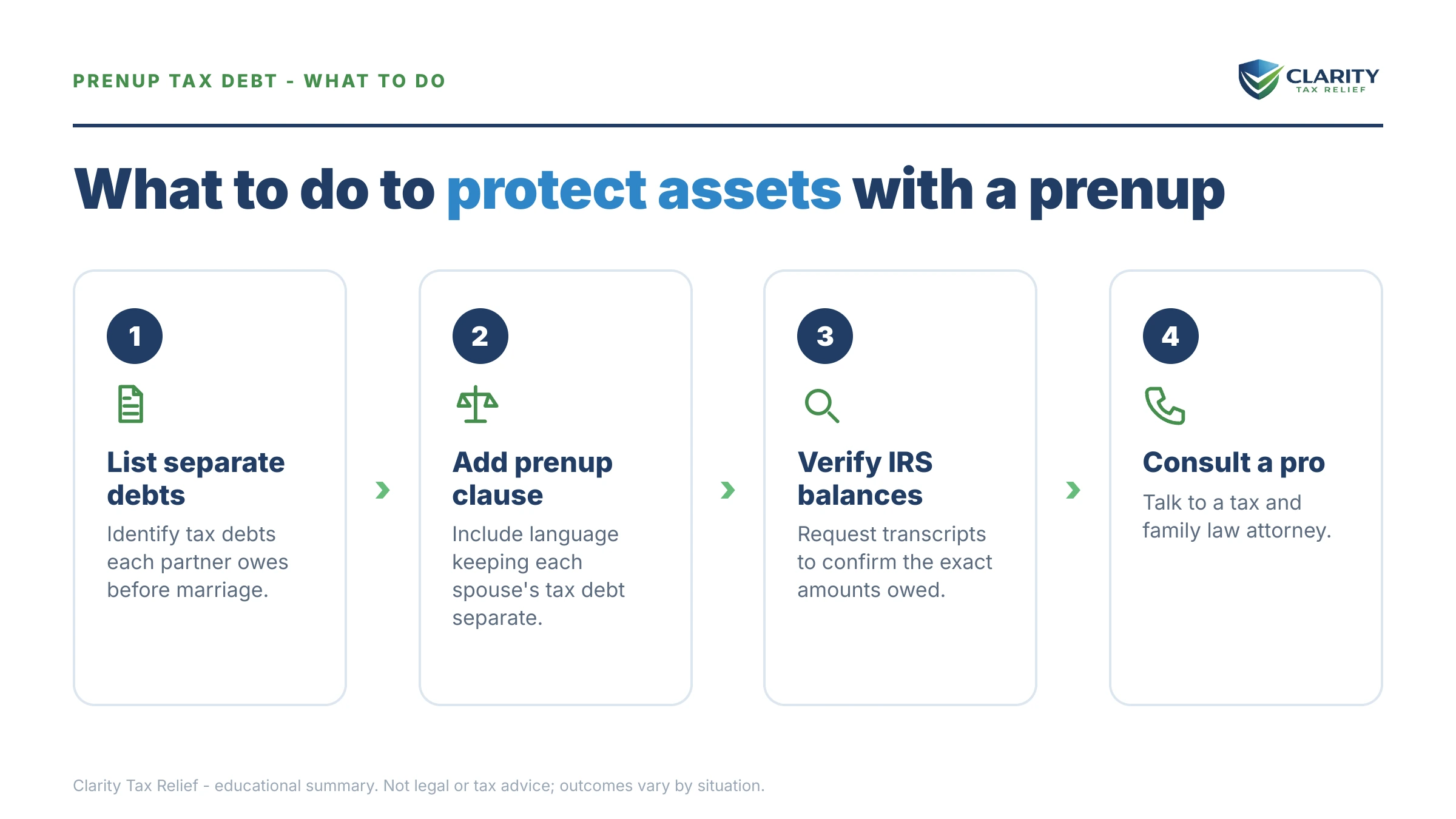
- Get the real number. Have your partner pull their IRS online account balance and account transcripts for every year with a balance — the assessment dates and penalty breakdown drive every decision that follows.
- Verify the balance is right. Self-employed assessments are often overstated; if deductions were missed, amending the returns can shrink the debt before anyone negotiates on it.
- Keep everything separate. Maintain separate bank accounts, title new property carefully, and attach a complete separate-property schedule to the prenup before the wedding date.
- Decide your filing-status plan. Choose between married filing separately and filing jointly with Form 8379 before your first joint return is due — not after a refund disappears.
- Put the debt on a resolution track. Set up a payment plan, submit an offer, or document hardship now, so the balance stops escalating into liens and levies during your marriage.
When you can handle this yourself — and when help changes the outcome
Plenty of prenup-and-tax-debt situations need a family-law attorney and nothing more. If your partner's balance is under $10,000, a guaranteed installment agreement (the official IRS program name) makes the payment plan nearly automatic; under $50,000, they can set up a streamlined plan online in an afternoon at IRS.gov's payment plans page. If your only issue is a seized joint refund, Form 8379 is a form most people can file themselves. In those cases: sign the prenup, keep accounts separate, and move on with the wedding.
Experienced help changes outcomes in the harder fact patterns: a balance above $50,000 (where financial disclosure sets the payment and a lien filing is likely), unfiled years hiding behind the known balance, OIC math that has to allocate a non-liable spouse's income, a levy or passport certification already in motion, or a community property state where the opt-out drafting and the tax strategy have to line up. Those are the cases where the order of operations — returns first, penalties second, balance last — determines what a couple actually ends up paying.
Terms on prenups and tax debt, decoded
- Joint and several liability: when spouses sign a joint return, the IRS can collect 100% of that return's balance from either spouse — no prenup can split it.
- Separate vs. community property: separate property belongs to one spouse alone; community property belongs to the marriage — and can be reachable for one spouse's debt in the nine community property states.
- Federal tax lien: the government's automatic legal claim to all property, and future property, of the person who owes — it follows the debtor, not the marriage.
- Injured spouse allocation: the Form 8379 process for recovering your share of a joint refund the IRS applied to your spouse's separate debt.
- Transmutation: a state-law agreement that changes property's character between separate and community — the mechanism behind a community-property opt-out.
- CSED: the Collection Statute Expiration Date — 10 years from assessment, after which the IRS can no longer collect, though offers, bankruptcy, and appeals pause the clock.
Prenup and IRS debt questions, answered
Does a prenup protect me from my spouse's IRS debt?
It protects your property, not your spouse from the IRS. A prenup keeps your separate assets and, in community property states, your income off the collection table — but the IRS can still lien, levy, and offset anything your spouse owns. Real protection is the prenup plus separate accounts, careful titling, and a filing-status plan.
Am I responsible for my spouse's tax debt from before we got married?
No — marriage never transfers liability for premarital IRS debt to you. Your exposure is indirect: a joint refund can be offset, a joint account can be levied, and in the nine community property states the IRS may reach community income for one spouse's separate debt. A valid prenup opting out of community property closes that last channel in most of those states.
Can the IRS take our house if only my spouse owes back taxes?
The federal tax lien attaches only to your spouse's interest in property, not yours. If the home is titled solely in your name and bought with your separate funds, it is generally beyond the lien's reach; if you buy jointly, the lien encumbers their share and complicates any sale or refinance. Community property states follow different rules, so get state-specific advice before titling.
Should we file jointly or separately if my spouse owes the IRS?
Filing jointly usually produces a lower tax bill, but the IRS will take the entire joint refund by offset unless you file Form 8379 to claim your share back. Filing separately protects your refund automatically but often costs more tax and disqualifies some credits. Signing a joint return never makes you liable for the old premarital balance itself — only new balances on returns you sign.
Does a prenup help with an Offer in Compromise?
Indirectly, yes. When one spouse applies to settle a separate debt, the IRS calculates reasonable collection potential and generally wants to see household finances; a prenup plus genuinely separate accounts documents which income and assets belong to the non-liable spouse. It doesn't change the odds by itself — the IRS accepted roughly one in five offers in FY2024 — but it makes the allocation defensible.
Can the IRS levy a joint bank account for one spouse's tax debt?
Yes. The IRS can levy any account the debtor spouse can freely withdraw from, including a joint account holding mostly your money. Banks must hold levied funds for 21 days before sending them, which gives you a short window to prove which deposits were yours and request a release. The clean fix is keeping accounts fully separate before the debt is resolved.
Does my spouse's tax debt affect my credit score or passport?
No — the debt, any lien, and any passport action attach only to the spouse who owes. Tax liens no longer appear on consumer credit reports at all, and the State Department passport certification (triggered at $66,000 of seriously delinquent debt in 2026) applies solely to the debtor. You'll still feel it indirectly: a recorded lien is public record and shows up when you apply for a joint mortgage.
Does my spouse's IRS debt eventually expire?
Generally yes — the IRS has 10 years from the date each balance was assessed to collect, after which the remaining debt expires. But the clock pauses during an Offer in Compromise, bankruptcy, and certain appeals, so the real date is often later than year ten. State debt runs on its own rules; California's FTB, for example, has 20 years to collect.
Your next 24 hours
- Get the assessment dates. Have your partner log into their IRS online account and note the exact balance, the tax years involved, and when each year was assessed — that's the raw material for every protection and resolution decision.
- Gather the paper. Pull the prenup draft (or attorney's contact), both of your most recent tax returns, and a list of every account and property title you'd share after the wedding.
- Get the debt reviewed free. Interest and penalties are accruing on that balance every month you wait — call (888) 825-7779 or use the form at claritytaxrelief.com/#consult and an experienced tax professional will map what's reachable, what's protected, and the cheapest path to resolving the balance before it becomes a marriage problem.
If the IRS side of the plan feels stuck at any point, the Taxpayer Advocate Service is an independent office within the IRS that helps when normal channels fail.
This guide is general information, not tax or legal advice for your specific situation. Eligibility for IRS programs depends on individual facts and circumstances; no outcome is guaranteed. Prenuptial agreements are governed by state law — consult a family-law attorney in your state for drafting and enforceability questions.