
Refund Offsets
New Spouse Refund Taken for Their Old Debt? How to Get Your Share Back (2026)
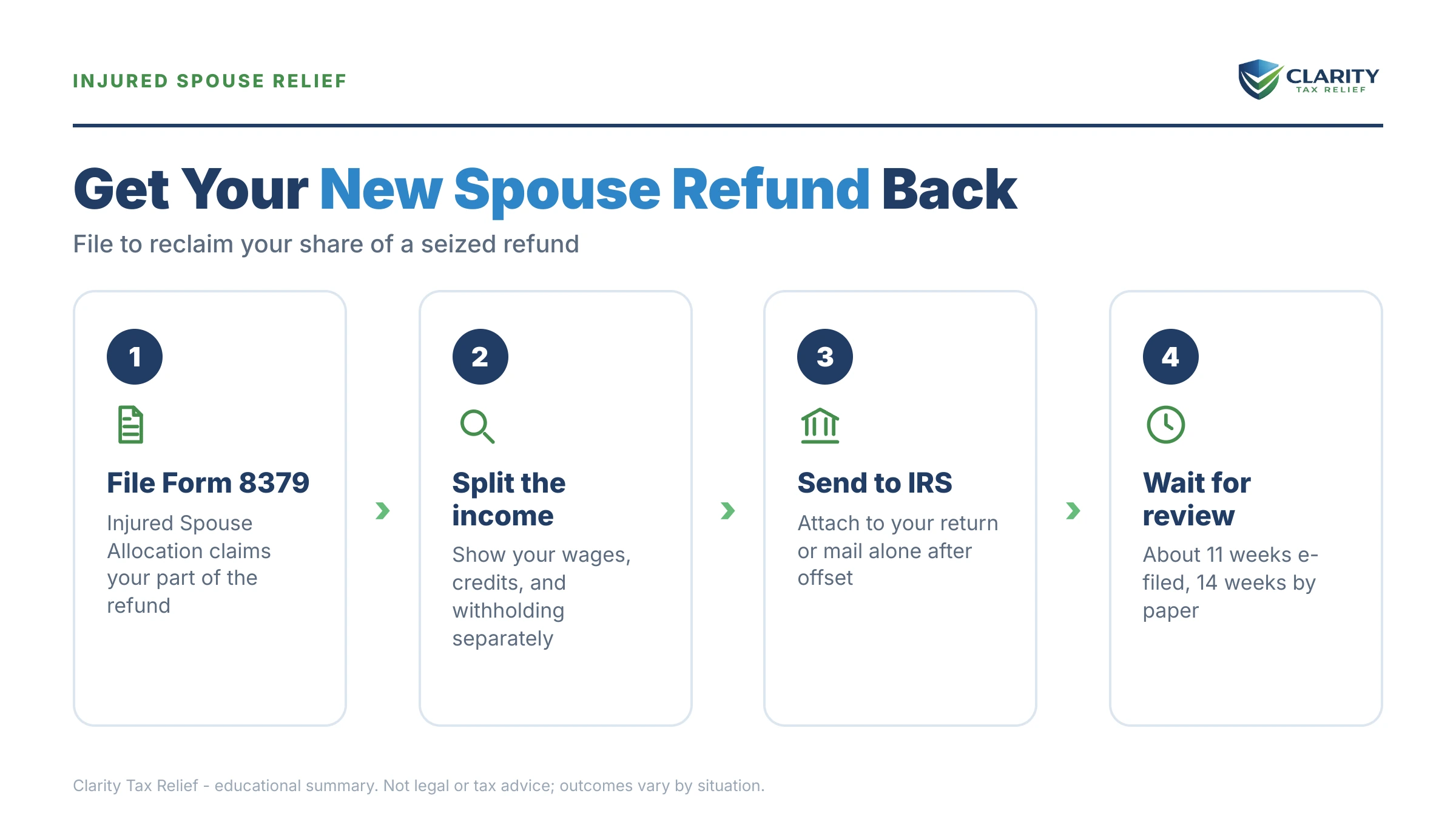
The short answer: a new spouse refund taken for their old, pre-marriage debt is usually partly recoverable. File Form 8379, Injured Spouse Allocation — it tells the IRS how much of the joint refund came from your income and payments, and the IRS sends that share back to you. You generally have 3 years to claim it.
You got married, filed your first joint return together, and the refund never arrived — instead there's a letter saying all of it went to a debt your spouse ran up years before you met. That's not a mistake, and it's not the end of the money. The offset was automatic; getting your share back is a paperwork fight you can win.
Two documents matter here: the notice that took the money, and Form 8379, which gets your part of it back. The image below shows you exactly what the injured spouse form looks like and where your numbers go — keep reading, because the allocation is where most people leave money on the table.
⏱ Your window: to recover a refund that's already been offset, you generally have 3 years from the joint return's due date (or 2 years from the date the tax was paid, whichever is later) to file Form 8379. Miss that window and your share stays permanently applied to a debt that was never yours.
Why your refund was taken for your spouse's old debt
A joint tax refund is legally one refund, and the government can apply all of it to either spouse's debts — even debts from before the marriage. When you signed a joint return, both names went on the overpayment, and the Treasury Offset Program matched your spouse's Social Security number against a database of unpaid federal tax, state tax, child support, and defaulted student loans. The match fired automatically; no human decided to take your money.
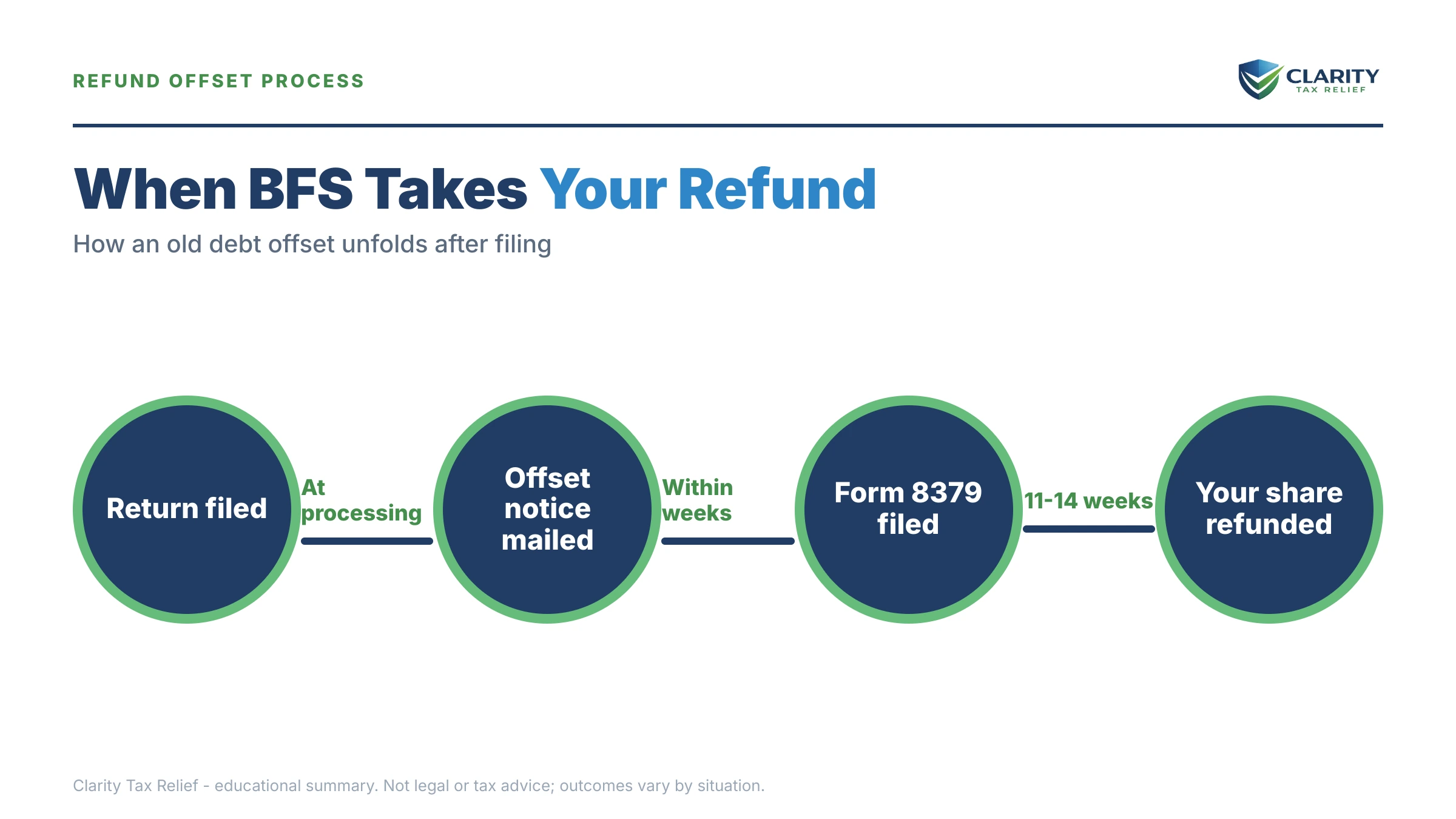
What matters is which letter you got. If the IRS took the refund for your spouse's old federal tax balance, you'll see a CP42 notice saying your refund was applied to your spouse's debt. If a non-IRS debt took it — child support, student loans, state tax — the letter comes from the Bureau of the Fiscal Service and names the agency that got the money. The Treasury Offset Program handles those non-IRS grabs, and Form 8379 works against both kinds.
One thing this is not: your debt. Marriage does not transfer tax liability — the IRS cannot bill you personally for returns your spouse filed before you married. Your money got caught in the net; your name did not go on the debt. (If the debt is from a joint return you both signed, that's a different problem — see injured spouse vs innocent spouse.)
| Debt that took the refund | Who notifies you | Does Form 8379 recover your share? |
|---|---|---|
| Spouse's pre-marriage IRS income tax | IRS — CP42 notice | Yes |
| Past-due child support | Bureau of the Fiscal Service letter | Yes — but community property states can shrink your share |
| Defaulted federal student loans | Fiscal Service letter naming the Dept. of Education | Yes |
| Spouse's state income tax debt | Fiscal Service letter naming the state agency | Yes |
| Tax from a joint return you both signed | IRS balance-due notices | No — that's innocent spouse territory (Form 8857) |
What happens if you do nothing
An unchallenged offset repeats every filing season until the debt is gone — and eventually your right to claim the money back expires. The sequence is entirely automated:
- This year: your full joint refund stays applied to your spouse's debt. No one at the IRS reviews whether part of it was yours — that only happens if you file Form 8379.
- Next filing season: the same match runs again. If you file jointly and overpay, the next refund is offset too — the Treasury Offset Program doesn't remember that last year's money included yours.
- Every year after: the cycle repeats until the debt is paid, resolved through an IRS program, or expires under the 10-year collection statute. You can estimate how much longer the IRS can collect your spouse's old debt with our CSED Calculator — though appeals, offers, and bankruptcy pause that clock.
- Year three: the refund-claim window closes on the earliest offset. Your share of that first taken refund becomes permanently unrecoverable, even though the debt was never yours.
Notice what's not on that list: no levy, no lien, no garnishment against you. A refund offset for your spouse's separate debt doesn't put your paycheck or accounts at risk — the exposure is your refund, every year, until you act.
Your refund went to a debt that isn't yours?
Send us the CP42 or offset letter. An experienced tax professional will confirm which debt took the money, estimate the share you can recover with Form 8379, and map how to stop next year's offset — free and confidential.
Injured spouse allocation and your other options
Form 8379 is the main recovery tool, but it's not the only move — and the right combination depends on whether you're fixing last year, protecting next year, or attacking the debt itself. Our injured spouse Form 8379 walkthrough covers the form line by line; here's how the options compare:
| Option | Who it fits | What it does | Key limit |
|---|---|---|---|
| Form 8379 filed after the offset | Refund already taken for spouse's separate debt | Returns your allocated share of that year's refund | Generally 3 years from the return due date (or 2 years from payment) |
| Form 8379 attached to future joint returns | The debt will outlast this filing season | Protects your share before the offset happens | Adds several weeks to refund processing every year |
| Married filing separately | You want zero offset exposure | Your separate refund can't be taken for their debt | Kills joint-only credits; usually raises total tax |
| Resolve the underlying debt | Spouse wants the debt handled for good | Stops offsets at the source (plan, offer, hardship status) | Eligibility is means-tested; interest accrues meanwhile |
| Innocent spouse relief (Form 8857) | Debt is from a joint return you signed | Removes your liability for the joint debt itself | Doesn't apply to pre-marriage debt — different program |
If the debt belongs to an ex rather than a current spouse — say a lingering joint-year balance from a prior marriage — the analysis changes; see ex-spouse's tax debt took my refund. And if your state refund vanished instead of the federal one, that's a different intercept system covered in state refund taken for IRS debt.
The allocation math: a worked example
Your recoverable share is roughly your payments in, minus your share of the joint tax — not a 50/50 split. Say you run a small business with payroll, your new spouse has a $19,000 IRS balance from before you met, and your $11,300 joint refund was just seized. Here's how the hypothetical allocation works:
- Your side: you paid $16,400 in quarterly estimates plus $14,200 withheld through your own company's payroll — $30,600 in payments. Your share of the joint tax, computed as if you'd filed separately, comes to $20,400.
- Their side: your spouse's W-2 job withheld $4,700, against a separate-tax share of $3,600.
- The split: your share of the refund = $30,600 − $20,400 = $10,200 recoverable. Your spouse's share = $4,700 − $3,600 = $1,100, which stays applied to their old debt. Together: the full $11,300.
In other words, roughly 90% of this refund was your money — and none of it comes back unless Form 8379 is filed. The IRS runs the official computation, and refundable credits like the EITC get allocated under their own rules, so your real number can differ. But the principle holds: the spouse who paid in the money gets that money back.
How to respond, step by step
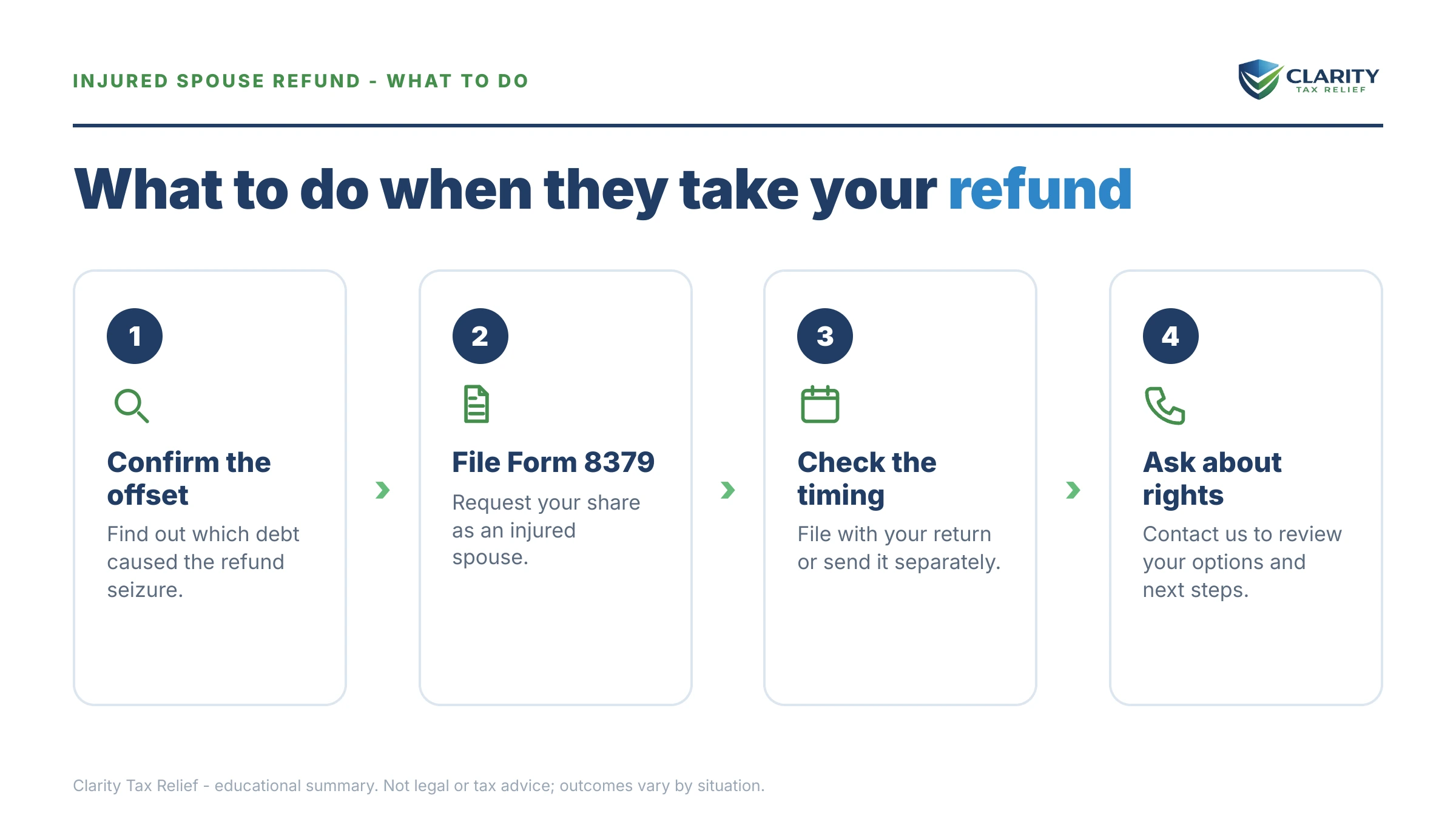
- Identify which debt took the refund — read your CP42 or Fiscal Service offset letter, or call the Treasury Offset Program call center at 800-304-3107 to hear which agency received the money.
- Confirm the debt is solely your spouse's — it must come from before your marriage or from a return you did not sign jointly. If it's from a joint return you signed, Form 8379 is the wrong tool.
- Gather your income and payment records — your W-2s or 1099s, estimated-payment confirmations, business records, and a copy of the joint return, so you can show which dollars were yours.
- Complete Form 8379 — allocate income, tax payments, and credits between the two of you, column by column. The IRS runs the final math, but your allocation drives it.
- File it and track it — send Form 8379 by itself to the service center where you filed the joint return, allow roughly 8 weeks, and watch your account transcript for code 846.
- Protect next year's refund — attach Form 8379 to every joint return you file while the debt exists, or work on resolving the underlying debt so the offsets stop at the source.
When your claim is approved, the release shows on your transcript as code 846 — refund issued for your allocated amount. If nothing posts after the processing window, the offset hotline and your online account are the fastest ways to check status; our guide to the offset hotline walks through what to ask.
If you live in a community property state
In the nine community property states — including California, Texas, and Arizona — half of each spouse's income legally belongs to the other, and the IRS allocates injured spouse claims under state law instead of the payments-in math above. That usually means you recover less than the worked example suggests, and for child support offsets some states let the agency keep more of the joint refund. The rules overlap with community property tax relief — this is one of the situations where a professional review before filing genuinely changes the number.
New spouse refund taken every year? How to stop the cycle
The offset repeats automatically each spring until the debt is gone — so the durable fix is either shrinking your refund or shrinking the debt. Three moves, in order of impact:
First, stop overpaying. A big refund is an interest-free loan the government can intercept. As a business owner you control your own estimates and payroll withholding — dial them closer to your actual liability and there's less on the table to take. Aim to owe a little or break even.
Second, attach Form 8379 proactively. Filing it with each joint return protects your share before the offset instead of clawing it back after. It slows your refund by several weeks, but the money arrives — to you.
Third, deal with the debt itself. Your spouse's old balance may qualify for a payment plan, hardship status, penalty relief, or — if their finances genuinely can't cover it — an offer in compromise. The full menu, with costs and eligibility, is in our guide to how to settle tax debt yourself. Any resolution that closes the balance ends the offsets for good. And if you're reading this before the wedding rather than after, marrying someone who owes the IRS covers the planning moves that prevent this article entirely.
When you can handle this yourself
A straightforward injured spouse claim is genuinely DIY-friendly. If you're both W-2 employees, the debt is clearly your spouse's alone, and you're not in a community property state, Form 8379 is a two-page allocation you can complete in an evening — no representative needed, no fee to the IRS.
Experienced help changes the outcome in four situations. Business income complicates the allocation — self-employment tax, payroll you run through your own company, and quarterly estimates all have to be attributed correctly, and a sloppy allocation costs you real dollars. Community property rules can cut your recovery in ways worth modeling before you file. If refunds from multiple years were taken, each year needs its own correctly-built claim before the 3-year windows close. And if the smarter play is resolving your spouse's underlying debt — because it's large, old, or growing — sequencing that resolution against your refund claims is exactly what a professional plans in one pass. Comparing filing statuses first? Married filing separately when your spouse owes the IRS lays out that trade in detail. Or skip the research and have your specific numbers reviewed free.
Terms on your notice, decoded
- Injured spouse: the spouse whose share of a joint refund was taken for the other spouse's separate debt — "injured" financially, not physically.
- Innocent spouse: a different program (Form 8857) that removes your liability for tax owed on a joint return you signed.
- Treasury Offset Program (TOP): the federal database system that intercepts tax refunds to pay child support, student loans, and state and federal tax debts.
- Refund offset: the application of your refund to a debt before it's ever paid to you — it's not a levy and doesn't require advance notice.
- Allocation: the split of joint income, payments, and credits between spouses that determines how much of the refund was legally yours.
- Community property state: one of nine states where income earned during marriage belongs to both spouses — which changes the allocation math against you.
New spouse refund questions, answered
Can the IRS take my refund for my spouse's debt from before we were married?
Yes — when you file a joint return, the entire refund is legally available to offset either spouse's debts, including debts from years before you met. Marriage does not make you liable for the debt itself; it's only the joint refund that's exposed. Form 8379 lets you recover the portion of that refund that came from your own income and payments.
How long does Form 8379 take to process?
Plan on roughly 8 weeks when Form 8379 is filed by itself after an offset, and longer — often 11 to 14 weeks — when it's attached to a joint return. With the IRS workforce cut about 27% in 2025, some claims run past those windows. Watch your account transcript for code 846, which posts when your allocated share is released.
Is injured spouse the same as innocent spouse relief?
No — they solve opposite problems. Injured spouse relief (Form 8379) recovers your share of a joint refund that was taken for your spouse's separate debt. Innocent spouse relief (Form 8857) asks the IRS to remove your liability for tax owed on a joint return you actually signed. For a new spouse's pre-marriage debt, Form 8379 is almost always the right form.
Should we just file separately so my refund is safe?
Sometimes, but run both numbers first. Married filing separately shields your refund completely, but it disqualifies you from the Earned Income Tax Credit and education credits and usually produces a higher total tax than filing jointly. For most couples, filing jointly with Form 8379 attached nets more money — the exception is when the credits don't apply to you anyway and you want zero processing delay.
Will the IRS take our refund every year until the debt is paid?
Yes — the offset is automated and repeats every filing season for as long as the debt exists and you keep filing jointly with a refund. You can attach Form 8379 to each joint return to protect your share in advance. The longer-term fixes are resolving the underlying debt or adjusting withholding and estimated payments so you stop building large refunds.
Does Form 8379 work for student loans and child support, or only IRS debt?
It works for any debt collected through the Treasury Offset Program — defaulted federal student loans, past-due child support, and state income tax debt, as well as your spouse's old IRS balances. One caveat: in community property states, state law can entitle the other agency to a larger slice of the joint refund, especially for child support, so your recovered share may be smaller.
Am I now responsible for my spouse's old tax debt because we got married?
No — marriage does not transfer tax liability. Debt from returns your spouse filed before you married stays theirs alone, and the IRS cannot assess it against you personally. Your exposure points are shared assets: joint refunds, jointly titled accounts in some situations, and community income in the nine community property states. Protecting those is a planning problem, not a liability problem.
The offset happened months ago — can I still get my share back?
Usually, yes. You generally have 3 years from the joint return's due date (or 2 years from the date the tax was paid, whichever is later) to file Form 8379 and claim your allocated share. File one Form 8379 for each year a refund was offset — if two years were taken, you need two separate forms.
Your next 24 hours
- Find the letter. Pull out the CP42 or Fiscal Service notice and locate two things: the offset amount and the description of whose debt received it. If you can't find the letter, call 800-304-3107 and the automated system will tell you which agency took the money.
- Gather your side of the return. Your W-2s or 1099s, estimated-payment confirmations, business payroll records, and a copy of the joint return — everything that proves which dollars in the refund were yours.
- Get the allocation reviewed free. Business income and community property rules change what Form 8379 recovers, and each offset year has its own 3-year claim window. Use the 2-minute form or call (888) 825-7779 and an experienced tax professional will run your numbers before you file.
Official references: the IRS's About Form 8379, Injured Spouse Allocation page has the current form and instructions; the Bureau of the Fiscal Service explains offsets at its Treasury Offset Program page; and if your claim stalls past the processing window with no answer, the Taxpayer Advocate Service can intervene.
This guide is general information, not tax or legal advice for your specific situation. Eligibility for IRS programs depends on individual facts and circumstances; no outcome is guaranteed.